In this post I wanted to share the list of books I read along the year (1) with a small comment for each one. I have also included a small rating from one to three “+” depending on how much I do recommend its reading.
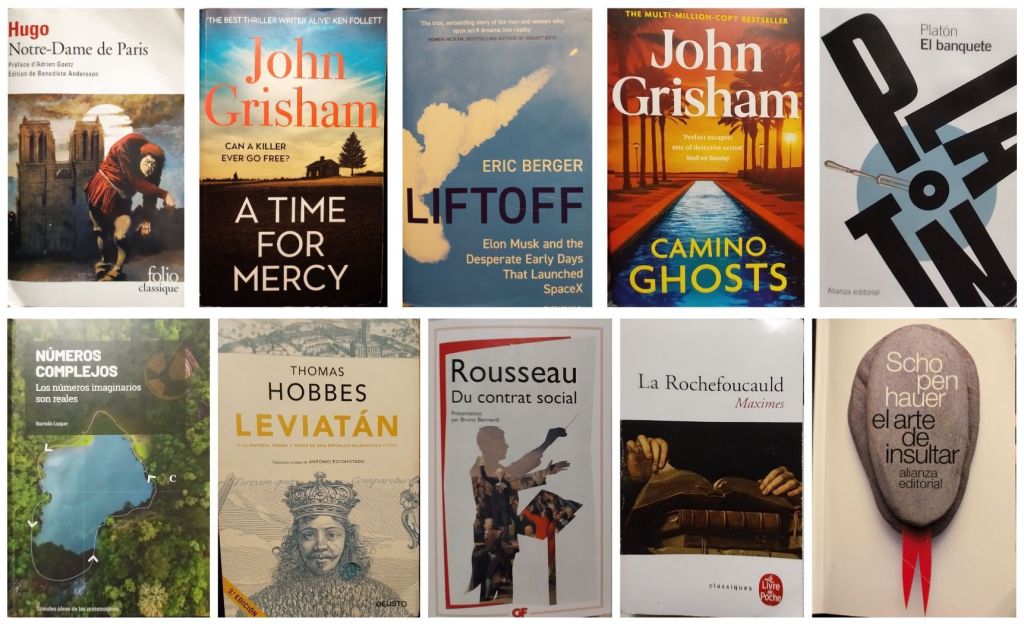
- “Notre-Dame de Paris” (The Hunchback of Notre-Dame) by Victor Hugo (++): this is the second book of the author I have read after Les Misérables. The key theme and word of the book is the fatality, Quasimodo’s fate in his attraction for the street artist Esmeralda. The book is set in the Paris of the XV century with very detailed descriptions and maps of its streets, buildings, atmosphere and especially of the cathedral (which I guess can be delicious for the history of art lover, though sometimes it is quite dense). The plot narrates the interconnected lives of Quasimodo, his caretaker the priest Frollo, Esmeralda, Gringoire and the captain Phœbus de Châteaupers, the love some have for others and its impossibility. The plot also denounces the injustice suffered by those in the lower classes with some undue legal processes (a recurrent theme for Hugo). What I liked the most was the unbending commitment of Quasimodo in the last part of the book, to the very end of his life.
- “A time for mercy” by John Grisham (++): this is another legal thriller around the courtroom in Clanton, with the lawyer Jake Brigance defending a minor convicted of capital murder (of his mother’s partner after months of abuses and threats). As in some of his books of 20+ years ago, he takes time to guide the reader through the jury selection process and later laying up the strategy for the ambushes that will happen during the trial.
- “Liftoff” by Eric Berger (+++): I received the book as a gift from my friend Asier and quickly started reading it. The book tells the story of SpaceX in its early years. It takes time to dwell in the details of some of its first engineers, the technical challenges they faced and what they went through (administrative burdens, financing troubles, changes of location, first failures…) up to the first successful launch of the Falcon 1 in its 4th flight and some insights into SpaceX’s transition towards the Falcon 9 program. The book is energising, and exudes passion for engineering and the extreme dedication of those individuals. [Twitter thread]
- “Camino ghosts” by John Grisham (+): this is a legal thriller linked to Grisham’s character Bruce Cable (a bookshop owner and old books collector in South Florida) with an old lady author descendant of African slaves as the centre of the plot (Lovely Jackson) and an enchanted little island off the coast where her ancestors lived. At the time of the novel a real estate development company wants to work on the island to build some housing and a resort. Lovely wants to preserve the island off the hands of the developers and claims the property of the island which triggers the legal action. This is one of the books I have liked the least by the author (after having read over 25 of his) mixing beliefs in black magic, enchantments on the island, misticsm and the praise of the oppressed political agenda of the past decade.
- “El banquete” (Symposium) by Plato (+): this book is a short dialogue after a banquet in which several attendees to the meal are asked to give a speech praising love and Eros, the Greek god. These praises include the controversial relationship at that time between minor pupils and their adult instructors. One of the last passages of the book includes the praise by the young and ambitious Alcibiades of his instructor Socrates, as the latter didn’t attend to the approaches of the former as Socrates was focused on his search for truth.
- “Leviatán” (Leviathan) by Thomas Hobbes (++): published in 1651 (during the English civil war), the book portrays the republic as a mortal God (Leviathan) needed for the defence of the individual. The book discusses different types of government (with monarchy as the preferred one for the author) and the relationship between the civil power and the Church (to which christians have an allegiance and commandments to follow), for which the author discusses in depth different passages of the Bible.
- “Números complejos” by Bartolo Luque (++): this is a short book from a collection of Mathematics books I started reading some years ago. This particular one was written by an Applied Math teacher I had at the engineering school. It explains the appearance of complex numbers from Heron of Alexandria up to the the first labeling of imaginary by Descartes. The book explains some of their applications such as the Zhukovsky transformation (very much used in aerodynamics), the art of Escher and goes into the Riemann hypothesis. The book doesn’t spare mathematical expressions thus it is not recommended to the untrained reader. [Twitter thread]
- “Du contrat social” by Jean-Jacques Rousseau (+++): written in 1762, the book describes how the people in a community (the Sovereign) come to be organized (Social pact) in order to be defended and have their natural rights as individuals upheld. The book discusses different forms of government (monarchy, aristocracy and democracy), which of those forms suit best to different countries based on their size and wealth, who is the legislator, different types of laws. [Twitter thread]
- “Maximes” by La Rochefoucauld (++): La Rochefoucauld was a duke in XVII century France (also known as Prince de Marcillac). In 1665 he published the first edition of the reflections known today as his “Maximes”, out if which some originated from his acquaintances at the time. Once drafted he shared the volume with friends and continued to edit them with additions and removals. The present edition includes all those and some of the exchanges and critiques of the volume made at the time. The topics of the reflections are virtues and vices of humans, with the particularity that the author takes a rather sceptical view on human nature pointing at the weaknesses, the pride being at the centre of many of our actions… and even portraying sloth as our main virtue (!) as it subdues our passions preventing us from taking action and falling prey of our vices more often. [Twitter thread]
- “El Arte de insultar” by Schopenhauer (+): the book wasn’t really written as such by Schopenhauer but it is a compilation of rants he wrote throughout his different publications. In the book the insults and rants are classified per topic in alphabetical order. Which are the most recurrent subjects? Other philosophers (in particular Hegel), the French language, women (several times, placing women as a secondary sex), university professors / deans, journalists, writers… [Twitter thread]
This year I read a bit more than in 2023 but not as much as I would have liked, as I found myself not finding time sometimes during the year and other times I was stuck with a couple of books.
A resolution for 2025 will be to keep the habit and read a bit more, for which I will be following these two tips that I share every year:
– a blog post from Farnam Street blog “Just Twenty-Five Pages a Day“, which was published well after I had adopted such an approach to reading but captures it very well,
– the Wikipedia article about the Pomodoro Technique, which enables you to efficiently use the last hours of the day.
I wish you all very interesting reads in 2025!
(1) You can find here: my 2012 reading list, 2013, 2014, 2015, 2016, 2017, 2018, 2019, 2020, 2021, 2022 and 2023 ones.

 The Blog by Javier