In this post I wanted to share the list of books I read along the year (1) with a small comment for each one. I have also included a small rating from one to three “+” depending on how much I do recommend its reading.
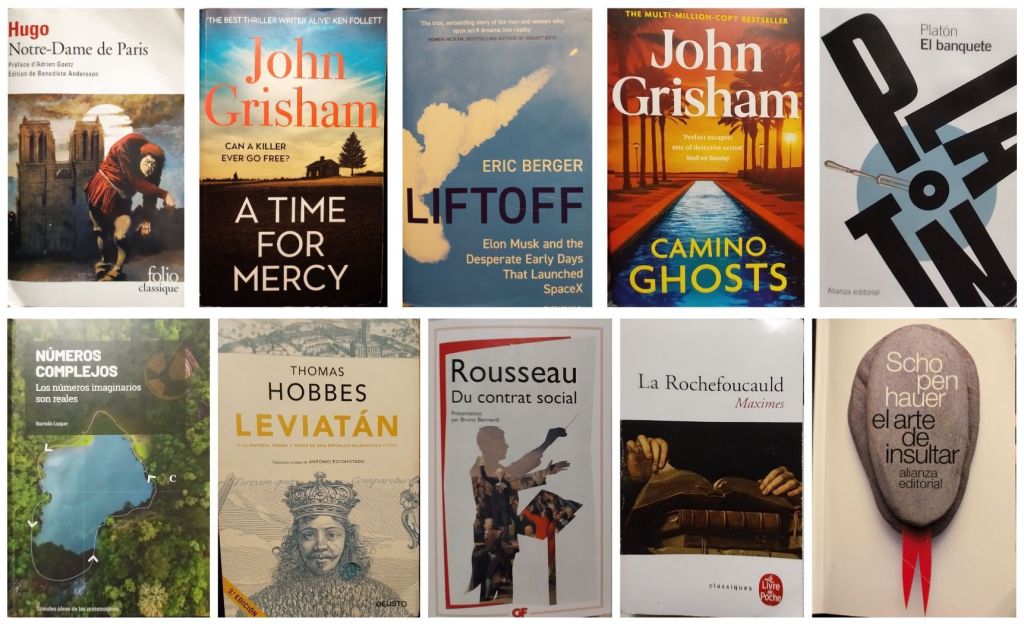
“Notre-Dame de Paris” (The Hunchback of Notre-Dame) by Victor Hugo (++): this is the second book of the author I have read after Les Misérables. The key theme and word of the book is the fatality, Quasimodo’s fate in his attraction for the street artist Esmeralda. The book is set in the Paris of the XV century with very detailed descriptions and maps of its streets, buildings, atmosphere and especially of the cathedral (which I guess can be delicious for the history of art lover, though sometimes it is quite dense). The plot narrates the interconnected lives of Quasimodo, his caretaker the priest Frollo, Esmeralda, Gringoire and the captain Phœbus de Châteaupers, the love some have for others and its impossibility. The plot also denounces the injustice suffered by those in the lower classes with some undue legal processes (a recurrent theme for Hugo). What I liked the most was the unbending commitment of Quasimodo in the last part of the book, to the very end of his life.
“A time for mercy” by John Grisham (++): this is another legal thriller around the courtroom in Clanton, with the lawyer Jake Brigance defending a minor convicted of capital murder (of his mother’s partner after months of abuses and threats). As in some of his books of 20+ years ago, he takes time to guide the reader through the jury selection process and later laying up the strategy for the ambushes that will happen during the trial.
“Liftoff” by Eric Berger (+++): I received the book as a gift from my friend Asier and quickly started reading it. The book tells the story of SpaceX in its early years. It takes time to dwell in the details of some of its first engineers, the technical challenges they faced and what they went through (administrative burdens, financing troubles, changes of location, first failures…) up to the first successful launch of the Falcon 1 in its 4th flight and some insights into SpaceX’s transition towards the Falcon 9 program. The book is energising, and exudes passion for engineering and the extreme dedication of those individuals. [Twitter thread]
“Camino ghosts” by John Grisham (+): this is a legal thriller linked to Grisham’s character Bruce Cable (a bookshop owner and old books collector in South Florida) with an old lady author descendant of African slaves as the centre of the plot (Lovely Jackson) and an enchanted little island off the coast where her ancestors lived. At the time of the novel a real estate development company wants to work on the island to build some housing and a resort. Lovely wants to preserve the island off the hands of the developers and claims the property of the island which triggers the legal action. This is one of the books I have liked the least by the author (after having read over 25 of his) mixing beliefs in black magic, enchantments on the island, misticsm and the praise of the oppressed political agenda of the past decade.
“El banquete” (Symposium) by Plato (+): this book is a short dialogue after a banquet in which several attendees to the meal are asked to give a speech praising love and Eros, the Greek god. These praises include the controversial relationship at that time between minor pupils and their adult instructors. One of the last passages of the book includes the praise by the young and ambitious Alcibiades of his instructor Socrates, as the latter didn’t attend to the approaches of the former as Socrates was focused on his search for truth.
“Leviatán” (Leviathan) by Thomas Hobbes (++): published in 1651 (during the English civil war), the book portrays the republic as a mortal God (Leviathan) needed for the defence of the individual. The book discusses different types of government (with monarchy as the preferred one for the author) and the relationship between the civil power and the Church (to which christians have an allegiance and commandments to follow), for which the author discusses in depth different passages of the Bible.
“Números complejos” by Bartolo Luque (++): this is a short book from a collection of Mathematics books I started reading some years ago. This particular one was written by an Applied Math teacher I had at the engineering school. It explains the appearance of complex numbers from Heron of Alexandria up to the the first labeling of imaginary by Descartes. The book explains some of their applications such as the Zhukovsky transformation (very much used in aerodynamics), the art of Escher and goes into the Riemann hypothesis. The book doesn’t spare mathematical expressions thus it is not recommended to the untrained reader. [Twitter thread]
“Du contrat social” by Jean-JacquesRousseau (+++): written in 1762, the book describes how the people in a community (the Sovereign) come to be organized (Social pact) in order to be defended and have their natural rights as individuals upheld. The book discusses different forms of government (monarchy, aristocracy and democracy), which of those forms suit best to different countries based on their size and wealth, who is the legislator, different types of laws. [Twitter thread]
“Maximes” by La Rochefoucauld (++): La Rochefoucauld was a duke in XVII century France (also known as Prince de Marcillac). In 1665 he published the first edition of the reflections known today as his “Maximes”, out if which some originated from his acquaintances at the time. Once drafted he shared the volume with friends and continued to edit them with additions and removals. The present edition includes all those and some of the exchanges and critiques of the volume made at the time. The topics of the reflections are virtues and vices of humans, with the particularity that the author takes a rather sceptical view on human nature pointing at the weaknesses, the pride being at the centre of many of our actions… and even portraying sloth as our main virtue (!) as it subdues our passions preventing us from taking action and falling prey of our vices more often. [Twitter thread]
“El Arte de insultar” by Schopenhauer (+): the book wasn’t really written as such by Schopenhauer but it is a compilation of rants he wrote throughout his different publications. In the book the insults and rants are classified per topic in alphabetical order. Which are the most recurrent subjects? Other philosophers (in particular Hegel), the French language, women (several times, placing women as a secondary sex), university professors / deans, journalists, writers… [Twitter thread]
This year I read a bit more than in 2023 but not as much as I would have liked, as I found myself not finding time sometimes during the year and other times I was stuck with a couple of books.
A resolution for 2025 will be to keep the habit and read a bit more, for which I will be following these two tips that I share every year:
– a blog post from Farnam Street blog “Just Twenty-Five Pages a Day“, which was published well after I had adopted such an approach to reading but captures it very well, – the Wikipedia article about the Pomodoro Technique, which enables you to efficiently use the last hours of the day.
In this post I wanted to share the list of books I read along the year (1) with a small comment for each one and links to some Twitter threads where I shared some passages that caught my attention while reading the book. I have also included a small rating from one to three “+” depending on how much do I recommend its reading:
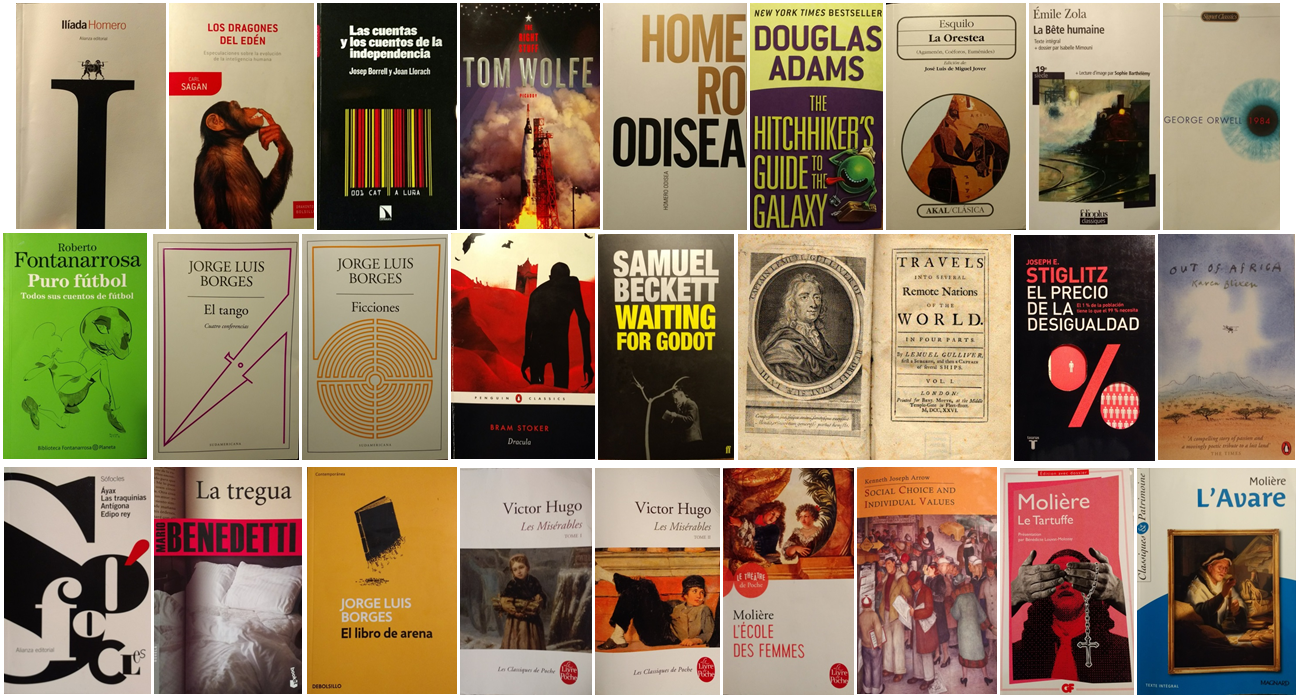
“Iliad” (by Homer) (+++): arguably the first book of Western civilization, I took on reading after having discussed about it and the Odyssey with a friend during 2016 summer holidays. The Iliad is widely seen as the more epic of the book of the two. I would say it is harsher. It is centered in the battle of Troy, fought around the XII century BC between a coalition of Greek armies led by Agamemnon king of Mycenae and Troy, led by Hector. The war features warriors the size of Achilles, Odysseus, Ajax, Menelaus… the origin of the war is the kidnapping of Helen, wife of Menelaus, by Paris, who takes her to Troy, against which the Greek armies fight in order to bring her back. The description of the fights does not spare any bloody detail, reaches at times the point of recreation in the violence and brutality of the characters. Another interesting point to note are the Homeric epithets; every single time the name of character is referred to a series of epithets will be quoted to describe him, such as “swift-footed” Achilles.
“The dragons of Eden” (by Carl Sagan) (++): I was not yet born when the series Cosmos was released and became so popular in 1980, but I had read often about the character and the importance of Sagan as a outreach scientist. I bought this book, on the evolution of human intelligence, about a decade ago and took on it this year after having read “Exploradores: La historia del yacimiento de Atapuerca” by one of the lead researchers of Atapuerca (José María Bermúdez de Castro) last year. The book is read very easily and draws from different disciplines in order to provide examples, outcomes from scientific studies and his vision on evolution. [I leave here a Twitter thread with some passages that caught my attention while reading the book]
“Las cuentas y los cuentos de la independencia” (by J. Borrell and J. Llorach) (+++): this short book by the economists Joan Llorach and Josep Borrell (who among other posts was the Spanish minister of Public Works and Transport in the 1990s) originated from an article they wrote for a news paper refuting some of the populist arguments often used by separatist leaders in Catalonia (note: both writers are Catalan themselves). The main point of the book goes around the different calculations methods for what is called the fiscal balance, pointing to the distortions played by separatists. Before that point is tackled many other mantras are dismantled, such as the purported calculations of fiscal balances in Germany and the limits to them often cited by separatists, for which the authors of the book made a thorough research including cross checking with German economics professors and the German embassy just to find out that the whole story is based on nothing, pure invention, hence the title of the book (“las cuentas y los cuentos“, as in the “the calculations and the stories”). [Twitter thread]
“The Right Stuff” (by Tom Wolfe) (+++): released in 1979 and awarded the US National Book Award for Nonfiction, this book portrays the lives, the selection process, the training and mission of the Mercury Seven. The book was later adapted to the cinema in a movie by the same title. The movie and the book are classic of aerospace literature and cinema. The images of the mercury seven in their silver space suits or their orange fighter pilot suits are part of popular culture. The book goes into the struggles and ego disputes among the different astronauts and between them and Air Force test pilots, including Chuck Yeager whose auto biography I had read in 2016, thus letting me see that episode from both sides. A definite must read. [Twitter thread]
“Odyssey” (by Homer) (+++): this book is partly the continuation of the Iliad, as in it Homer describes the return trip of Odysseus from Troy to Ithaca, his kingdom, where is wife Penelope and son Telemachus suffer for years the absence of the king. This book is more of an adventure book than the Iliad, and some of the passages are quite known such as those of the cyclops or the sirens. [Twitter thread]
“The Hitchhiker’s Guide to the Galaxy” (by Douglas Adams) (+): the novel is part of a comedy science fiction series released in 1979, originated from radio broadcasts and later taken to TV. I read it as had seen it recommended by Elon Musk a couple of times. The book has some hilarious points and fine criticisms, but other than that I thought it was quite overrated. [Twitter thread]
“Oresteia (Agamemnon, The Libation Bearers (Choephoroi), The Eumenides)” (by Aeschylus) (+): Aeschylus is seen as the father of tragedy. The Oresteia is a trilogy first represented at a festival in 458 BC. The play plots several tragic events: the murder of Agamemnon by Clytaemnestra, the murder of Clytaemnestra by Orestes, the trial of Orestes, the end of the curse on the House of Atreus and pacification of the Erinyes. [Twitter thread]
“La Bete humaine” (by Emile Zola) (++): published in 1890, this novel by Zola caused a great impact in the French society by its brutality: murder, suicides, abuses… the novel is centered around the rail company and the line Paris – Le Havre, and the plot relates the lives of the president, some workers and their relatives. [Twitter thread]
“1984” (by George Orwell) (++): published in 1949, the influence of this novel cannot be overstated. It coined terms and introduced figures widely used today such as Big Brother, Newspeak, Thought Police, thoughtcrime… even if I found some passages of the book rather tedious, it is a must read, a wake up call, a reminder of always having to be alert in the defence of individual rights. [Twitter thread]
“Puro Fútbol” (by Roberto Fontanarrosa) (++): In the 90s I used to read some newspaper articles of former football player and coach Jorge Valdano, in some of them he would refer to stories from the writer Fontanarrosa. Since then, I had heard about those stories some other times. In April we visited Argentina and we went to a bookshop to enjoy going through book stands, when I found his name in bookshelf I picked one of his books to read a few of his stories. The book is a compilation short stories of Argentinean football. They are fictional stories which feature amateur players and aficionados, either playing football, remembering memorable matches or attending events. I especially liked its fresh and down to earth language, which very easy transmit that for some people football is much more than sport. [Twitter thread]
“El Tango” (by Jorge Luis Borges) (+++): during a trip to Argentina I bought 3 books of Borges to approach the author. This was the first one I read. Rather than a book written by him, it is the transcription written in 2016 of a series of lectures Borges gave in 1965 around Tango, its origins, meaning, etc. I loved the book, as it gave me some insight into Argentinean life at the beginning of the XX century, the dance itself, its evolution from a dance of locals of dubious reputation to a dance more than socially accepted. Living in Toulouse, I loved to learn that in fact Carlos Gardel might have been a Frenchman by the name Charles Gardés born in the same neighborhood of Saint Cyprien (Toulouse) where I used to live when I came to France. [Twitter thread]
“Ficciones” (by Jorge Luis Borges) (+): published in 1944, the book is a compilation of about 20 short stories. With them Borges plays with different concepts, styles and themes. I saw that it has a great reception by critics, I do not share it.
“Dracula” (by Bram Stoker) (++): the count of Dracula and vampires are part of our popular culture. There are countless films, books, comics, plays, that include such characters. This book, published in 1897, set a framework for that popular culture: the prominent teeth, the biting and sucking of blood, the coming out at night, the counter measures, etc. The story is made of a series of letters, entries into the diaries of some of the characters and press articles. I liked the originality of such approach, although in my view it lacked some rhythm at some points. [Twitter thread]
“Waiting for Godot” (by Samuel Beckett) (+): I got some books from 1969 Literature Nobel prize winner, the Irish Samuel Beckett, as part of my Irish literature immersion following my 2016 trip to the island. Waiting for Godot is theater play that portrays two characters, Vladimir and Estragon, who wait for a third one, Godot, who never arrives. Meanwhile they engage in a series of discussions, absurd at times, comical at others, or even tedious. I have read reviews of the play stating that it is one the most significant play in English language of the XX century. I found it rather absurd and wouldn’t recommend it, other than for the humorous note of reading once and again the gag “We can’t / Why not? / We’re waiting for Godot”. [Twitter thread]
“The travels of Gulliver…” (by Jonathan Swift) (+++): during a trip to Ireland in 2016, I found out that Jonathan Swift had been about everything in Ireland, I thus decided to take on this classic book, out of which some stories we all have heard of at some point or another, such as the trip to Lilliput. Written in 1726, the book covers several trips of Gulliver, to nations previously unknown to him, where he discovers different civilizations (Lilliputians, giants, a civilization on a flying island) with their own ways of thinking. These travels offer the author situations to explain different points of view from menial subjects to more profound ones, such as fraud, the importance of rewarding good behavior, the importance of attitude over skills, astronomy, the influence of lawyers, taxes… up to a rather harsh criticism on human kind in comparison to the honesty of horses. A classic definitely worth reading. [Twitter thread]
“The Price of Inequality” (by Joseph E. Stiglitz) (+++): I had bought this book from the 2001 Nobel prize in economics to my father a couple of years ago. Once he finished it, I grabbed this boomerang gift so I could read it too. The book is a review of income inequality in the USA, the policies that have been taken in the last decades and that have contributed to the increasing of that inequality and its consequences. Criticism of austerity, defence of higher taxes, denouncing the double standards, the fine print of trade agreements, the need of labor unions, globalization and rent seeking are some of the topics discussed in the book. [Twitter thread]
“Out of Africa” (Karen Blixen) (++): I visited my sister in Denmark in the summer of 2016 and it was in that trip that I got acquainted with Karen Blixen (not having yet seen the movie based on the book). I bought the book and put it on the reading list. Written in 1937, the book is a passionate story of a farm life in Africa, lovely at times, with some descriptions of landscapes, relationships, the sounds of nature, the animals in the safaris, the flights in the Moth of her friend Denys…, that brings you back to a time and a world that most probably, for good and bad, we will never see again. A melancholic read at times, especially at the end, when the author describes when she was already closing her experience in Kenya. [Twitter thread]
“Ajax“, “The Trachiniae“, “Antigone“, “Oedipus Rex” (by Sophocles) (++): Sophocles was one of the great tragedians in ancient Greece, following Aeschylus, he lived in the 5th century BC. The book I read is a compilation of the four plays mentioned above. The plays treat the death of Ajax, of Heracles, of Antigone and the self-blinding of Oedipus, this last one considered to be the masterpiece of Greek tragedy. [Twitter thread]
“La tregua” (by Mario Benedetti) (++): written in 1959, this novel by the Uruguayan writer, long time based in Buenos Aires, tells the story of the widower Martín Santomé who falls in love with a much younger female work colleague just prior to his retirement. The book is written in the form of entries into the diary of Martin. [Twitter thread]
“El libro de arena” (by Jorge Luis Borges) (+): this book, published in 1975, is a compilation of 13 short stories. Together with “Ficciones“, which I had read a few months before (above), it is considered one of the masterpieces of Borges. Other than some pills of sharp criticism on fairmindedness, self described liberal free thinkers, disdain for science, culture and history, I did not like much this book either. [Twitter thread]
“Les Misérables” (by Victor Hugo) (+++): it took over 15 years to Victor Hugo to write Les Misérables, a 1,900-page (in the French version) historical novel considered one of the greatest novels of the 19th century if not of all time. Hugo centers the story around Jean Valjean, who was initially convicted for stealing bread but after a series of escape attempts he ends up serving 19 years. Valjean will be transformed into a benefactor who is always chased by his past and who follows an internal struggle between justice and doing good. Valjean will take as personal mission to save Cosette, a young orphan girl. The book includes some other central characters such as Fantine, Eponine, Marius, Gavroche or Javert, and Hugo will use them and the historical events hapenning at the time around which the novel is staged (1820s and 30s) to discuss about several subjects such as monarchy, social justice, criminal justice, romance, family, French politics… It took me about 10 weeks and around 70 hours to read it, the longest book I have read so far, but definitely worth it, especially the last about 300 pages. [Twitter thread]
“L’Écoles des femmes” (by Molière) (+++): this play, published in 1662, portrays a comedy around Arnolphe, Horace and Agnès, where the first has been isolating and “educating” Agnès to marry her and Horace is her lover. Through candid and innocent dialogues between Horace and Arnolphe and Agnès and Arnolphe, the latter will become aware of the affair going on and the failure of his strategy. A great comedy and criticism of the society of his time in its view of women rights. [Twitter thread]
“Social Choice and Individual Values” (by Kenneth J. Arrow) (+): one of the 1972 Economics Nobel prize winner, Kenneth Arrow passed away in February 2017. At that point I thought of reading this book, a 100-page essay in which he derives his “General Possibility Theorem”, known as Arrow’s impossibility theorem or voting paradox: “If there are at least three alternatives which the members of the society are free to order in any way, then every social welfare function (…) must be either imposed or dictatorial”. The exposition of his social choice theory, the implications of the theorem and the particular cases when some conditions are quite interesting. However, the book is a plagued with demonstrations with which he arrives to his theorem; a tough read if not on student mode. [Twitter thread]
“Le Tartuffe ou L’imposteur” (by Molière) (+++): the first version of this play appeared in 1664, and after some struggles with censorship it reappeared in its final version in 1669. In this comedy, Molière criticizes the hypocrisy and trickery often hidden behind a pious appearance. In the plot, Tartuffe is an impostor that passes by a fervor devotee who uses religion to trick Orgon, to the point of getting his state and at the brink of getting his wife. A great pointed comedy. [Twitter thread]
“L’Avare” (by Molière) (+++): written in 1668, in this great comedy the author takes on greed and its influence on love between parents and children, jealousy, marriage arrangements based on dowries… [Twitter thread]
During this year again, I have been able to read at a higher pace than years ago, before I adopted a more rigorous approach following these two tips:
a blog post from Farnam Street blog “Just Twenty-Five Pages a Day“, which was published well after I had adopted such an approach to reading but captures it very well,
the Wikipedia article about the Pomodoro Technique, which enables you to efficiently use the last hours of the day.

 The Blog by Javier