Tag Archives: Wilson Kipsang

Marathon world record evolution (2025)

Last time I checked all-time men’s best marathon times and the world record evolution was in 2014 ahead of running Rotterdam marathon (post back then). In this blog post I’m going to make an update, share some charts and review some statistics. For that purpose, I use the website “Track and Field all-time Performances” (maintained since years ago by Peter Larsson).

With the data of all-time best men’s marathon I plotted the chart below with the best 1,903 times, i.e., all those below 2h08′ and their dates, highlighting marathon times by Haile Gebrselassie, Wilson Kipsang, Eliud Kipchoge, Kenenisa Bekele and Kelvin Kiptum.
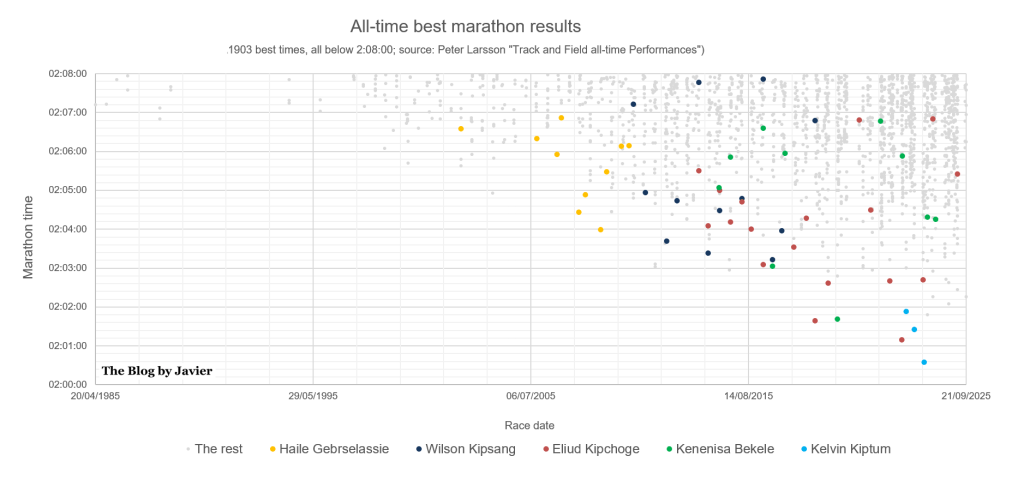
Some stats in relation to those 1,903 times under 2h08′:

  • Countries of which athletes achieved most such times: Kenya 853 times or 44.8%, Ethiopia 570 times or 30.0%, Japan 114 (6.0%), Morocco 44 (2.3%), Eritrea 41 (2.2%), Israel 20 (1.1%), France 20 (1.1%), Uganda 19 (1.0%). Those are the top 9 countries, there are another 34 from which athletes have run below 2h08′ (for a total of 43 countries).
  • There are 742 athletes that have run below 2h08′. The individuals who have done so more often: Eliud Kipchoge 18 times, Sisay Lemma 17, Tsegay Kebede 15, Tamirat Tola 13, Abel Kirui 13, Wilson Kipsang 12, Bernard Kiprop 12, Evans Chebet 12, Benson Kipruto 12, Laban Korir 11, Emmanuel Mutai 11, Amos Kipruto 11, Birhanu Legese 11, Kenenisa Bekele 10, Haile Gebrselassie 10, Leul Gebrselassie 10, Deso Gelmisa 10…

Now, if we raise the bar to see the times at or below 2h05′, we find 231 times:

  • Countries of which athletes achieved most such times: Kenya 108 times or 46.8%, Ethiopia 98 times or 42.4% (both combined 89.2%!), Tanzania 4 (1.7%), Belgium 4 (1.7%), Netherlands 3 (1.3%). Those are the top 5 countries, there are another 11 from which athletes have run at or below 2h05′ (for a total of 16 countries).
  • There are 124 athletes that have run at or below 2h05′. The individuals who have done so more often: Eliud Kipchoge 14 times, Tamirat Tola 8, Wilson Kipsang 8, Sisay Lemma 7, Amos Kipruto 6, Birhanu Legese 6, Leul Gebrselassie 5, three athletes with 4 times including Kenenisa Bekele, 14 athletes with 3 times including Kelvin Kiptum, Dennis Kimetto, Geoffrey Mutai and Haile Gebrselassie, 23 athletes with 2 times including Patrick Makau…
  • Which are the fastest marathons? The cities where most of those 231 times at or below 2h05′ have been achieved are: Berlin and Valencia with 35 each, London and Dubai with 27 each, Rotterdam 18, Amsterdam and Chicago with 15 each, Tokyo 14. Those are the top 8 cities (accounting for 81% of those 231 times), there are other 16 cities where such fast times have been achieved.

Now let’s look at the evolution of the World Record since 1985 in this other chart:
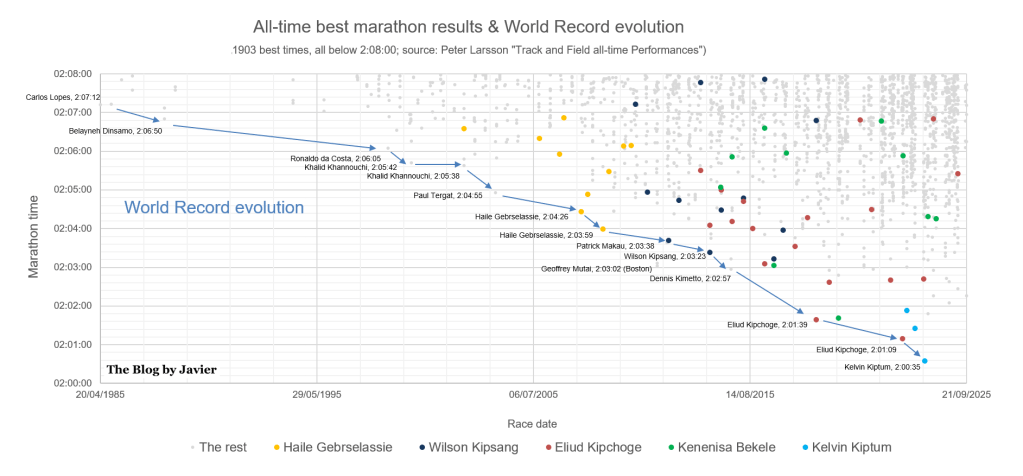
Some comments to the chart:

  • In the last 40 years, the record has been beaten 13 times.
  • The current world record was set by Kelvin Kiptum in Chicago in 2023 with 2h00’35” at the age of 23.9. He sadly passed away in a car crash a few months later. His career was very promising, having run only 3 marathons, all three in less than 12 months, all 3 below 2h02′. 3 of the best 7 times, 1 of the only 4 men having run below that mark.
  • The record that lasted the most was Dinsamo’s 2:06:50 in 1988, which took just over 10 years to be beaten by Ronaldo da Costa in 1998.
  • 3 athletes have set the world record twice: Khalid Khannouchi, Haile Gebrselassie and Eliud Kipchoge.
  • The biggest improvement of the record was made by Eliud Kipchoge who took 1’18” off Dennis Kimetto’s previous record.
  • Geoffrey Mutai ran in 2h03’02” before 3 world records set the bar below his time, however, as he achieved that in Boston 2011 (downhill and point to point race) it didn’t count for the record.

What is the best age to run marathons?

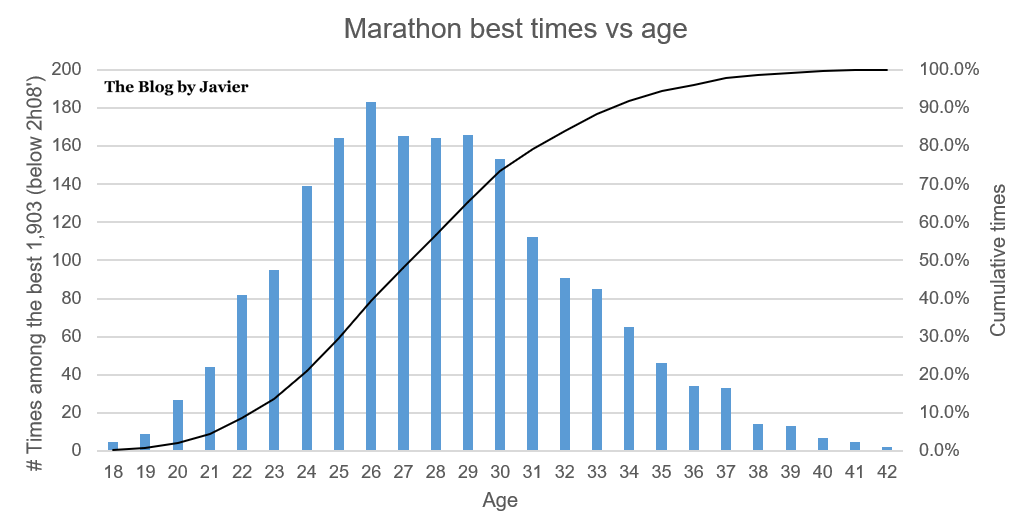
I plotted this other chart looking at the best 1,903 marathon times vs the age the runners had at the time of completing each of those races.
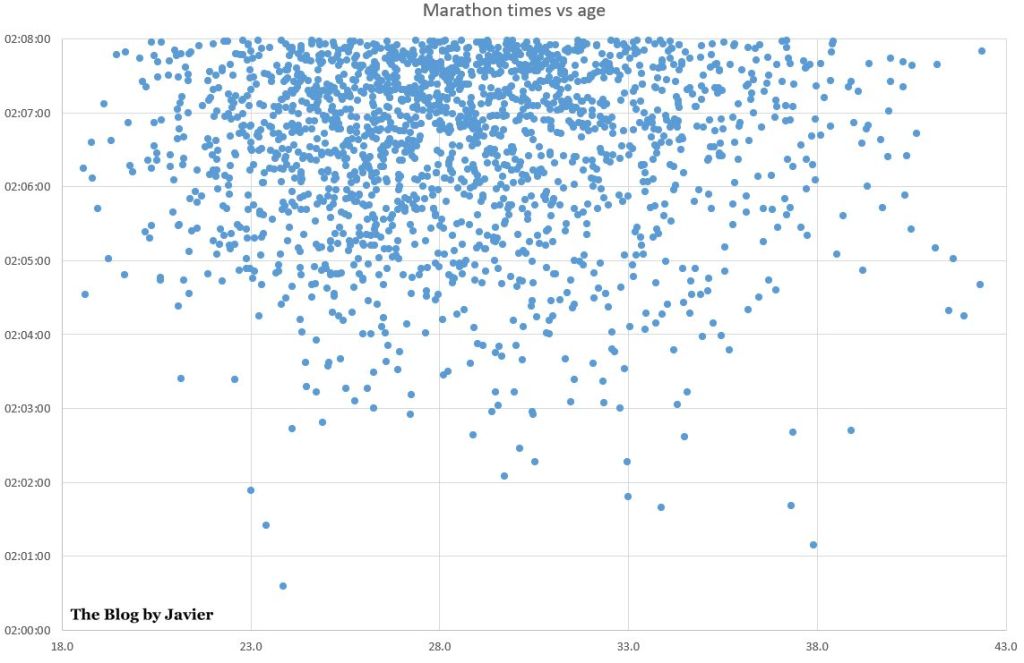
Most of the times below 2h08′ are achieved between 23 and 33 years old, but indeed most of the best ones are achieved between 28 and 39 years old, with the exception of the 3 marathons ran by Kelvin Kiptum, including his current world record.

Another interesting chart to relate best times and age is the histogram below. In that one we can see that effectively most of the times below 2h08′ are achieved between 24 and 30 years old, and between 23 and 33 (both included) 80% of those times are achieved.
Leave a comment

Filed under Sports

Rotterdam Marathon preview

Next Sunday, April 13th, I will take part in the Rotterdam Marathon together with the usual suspects (Jaime, Serna and Manuel). I am arriving to this marathon a bit short of training as I already reflected at the time of running Blagnac’s half marathon about a month ago. I may have completed just about 2/3 of the training plan I followed, having run just about 500km in the 16 weeks preceding the marathon. Thus, in this preview instead of talking about how I arrive to it I wanted to focus on the front of the race.

Rotterdam marathon is one of the fastest marathons in the world nowadays. On top of that, I learnt a few weeks ago that Kenyan athlete Eliud Kipchoge will take part in it. Kipchoge has today the 7th best time (1) in the distance (2h4’5″), achieved in only his second attempt at a marathon, in Berlin on the 29th of September 2013, when Wilson Kipsang beat the World Record (2h3’23”). I then wondered whether on Sunday a new world record could be set.

To be clear, setting up an athletics record is not an easy feat. Especially not in a marathon. But taking that question as a departure point I deep dived a bit into the data in order to learn more about the race.

The last time the marathon WR record was set in Rotterdam was in 1988 (26 years ago), when Belayneh Densamo left it at 2:06:50. Since then the WR has been beaten 8 times; once in Chicago, once in London and 6 times in Berlin, among them the last 5 times (see here the progression). Thus, we could confidently say that Berlin is the fastest marathon nowadays.

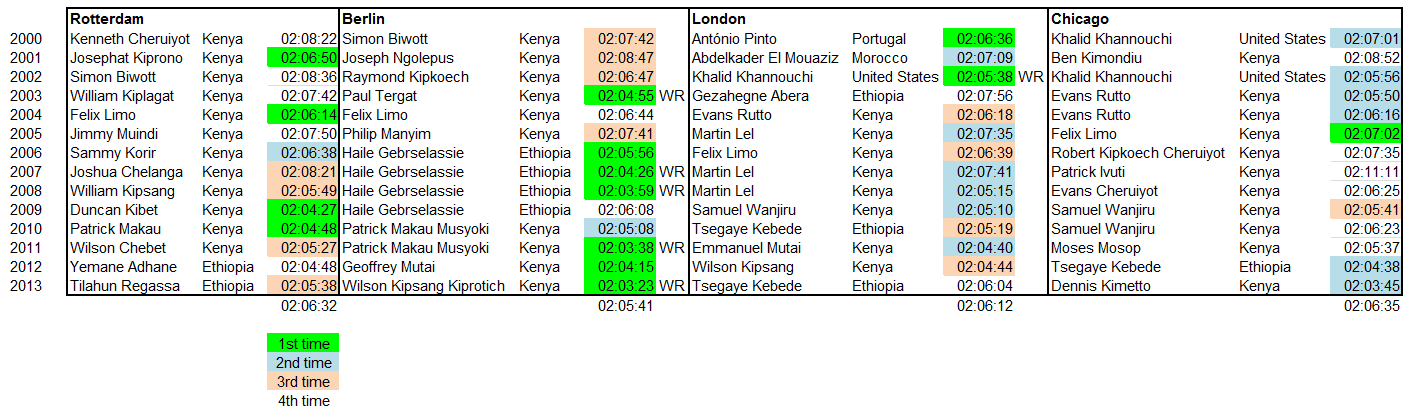
I then made a comparison of those 4 fast marathons over the last 14 years (since 2000), to see which one was the fastest race each of those years. See the results in the table below:

World fastest marathons (2000-2014).

World fastest marathons (2000-2014).

In the table you may see that out of the 14 years Berlin was the fastest of the 4 marathons in 7 (50%), however Rotterdam was the fastest marathon in 4 of those years (with a best time of 2h4’27”). By average winning times it would came 3rd (with a 2h6’32”) just after Berlin and London.

A curiosity, only twice in the past 14 years has the same runner won both Rotterdam and Berlin marathons in the same natural year: Felix Limo (2004) and Patrick Makau (2010) (2), both times each runner made a faster time in Rotterdam.

My train of thought then suggested: you are only paying attention to the winners’ times, you should compare more times to sense the profile of the race. I then found the following terrific website with all time best performances in track and field (maintained by Peter Larsson). With that database the analysis was rather simple.

I focused on the top 100 all-time marathon best times, of those:

  1. Berlin: 15 of the 100 all-time best times were achieved in Berlin, with a top 5 average time of 2h3’53” and a top 10 average of 2h4’18”.
  2. Chicago: 13/100; 2h4’29” (top 5); 2h5’4″ (top 10).
  3. Dubai: 18/100; 2h4’39” (top 5); 2h4’46” (top 10).
  4. Rotterdam: 14/100; 2h4’40” (top 5); 2h5’54” (top 10).
  5. London: 14/100; 2h5’02” (top 5); 2h5’15” (top 10).

Taking into account the top 100 times, Rotterdam marathon falls to the 4th place, seeing the irruption of Dubai as one of the top marathons, with all those times achieved in the last 6 years (run since 2000).

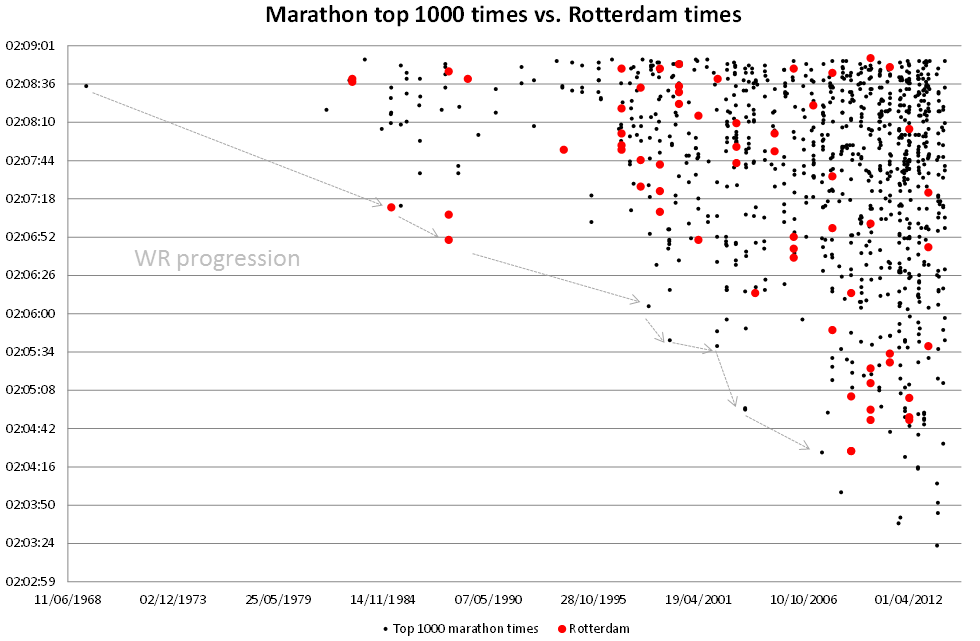
I then went a further step and made the following graph taking into account the top 1,000 times achieved in the last 45 years and highlighted in red those achieved in Rotterdam:

Marathon top 1000 times vs. those achieved in Rotterdam.

Marathon top 1000 times vs. those achieved in Rotterdam.

With those top 1,000 times, I then went back to compare the head to head of Rotterdam vs. Berlin, this time not only comparing winners times as above (Limo and Makau) but all those runners who run consecutively Rotterdam and Berlin, and checked in which race did they achieve the fastest of the 2 (or 3) times. See the results:

Runners among top 1,000 marathon times having run consecutively in Rotterdam and Berlin.

Runners among top 1,000 marathon times having run consecutively in Rotterdam and Berlin.

Of the top 1,000 marathon times, 16 runners achieved some of then running consecutively in Rotterdam and Berlin (or viceversa) (3). I made this comparison assuming that they must have been in a similar fitness (though not necessary). Of the 16, 9 of them achieved the better time in Rotterdam, 7 in Berlin. Among those times, the best 4 were achieved in Rotterdam (James Kipsang Kwambai, Patrick Makau, Geoffrey Mutai, Abel Kirui).

Then, having seen all these times, tables and graphics:

  • In the last 16 years the marathon WR has been beaten once every second year (8 times).
  • Rotterdam is arguably between the 2nd and the 4th fastest marathon.
  • However, the best time in Rotterdam (2h4’27”, Duncan Kipkemboi in 2009) is only the 14th best time overall.
  • Kipchoge PB is among the top 7 times after only his 2nd attempt at the distance.
  • Kipchoge ran in Berlin in September 2013 (2h4’5″), chances are that he beats that time running consecutively in Rotterdam in 2014.

Given the size of the feat I would not bet much on it, but I would not discard it either. Either way, I will only discover what happened about 2 hours after the race, at the front, has finished.

In case you feel like cheering me up and feel sorry for being thousands of kilometers away, don’t worry: click on this link and you will arrive at a website provided by the organization in which you can leave either one or two support messages that will be shown to me when I run by the kilometer 37 or I am just 500m from the finish line (my bib number for this race will be 1599).

Finally, find a classic picture from my brother (and marathon pal) Jaime symbolizing this marathon:

(1) Excluding times from Boston and other races not qualifying for IAAF world records.

(2) A year later, in 2011, Patrick Makau set a new WR in Berlin, 2h3’38”.

(3) Felix Limo, Geoffrey Kipsang and Jackson Koech run 3 consecutive races in a row each.

5 Comments

Filed under Sports