
Author Archives: Javier Irastorza

Elegies and eulogies

In the previous post I mentioned Toastmasters. This is a public speaking non-profit association I joined in December 2007. Its mission is mainly to provide a mutually supportive environment in which members can grow their communication and leadership skills. It sounds great, and it is indeed.

I say it is great because of the comprehensive program it follows, the amount of manuals it has to polish different skills, the variety of the assignments you have to complete, the details within a meeting that help you polish your public speaking… and also because of the amount of things you learn.

My club, Toastmasters Madrid, meets twice a month, but yesterday I was attending other club’s meeting, Excelencia Toastmasters. I especially liked one of the speeches. It was about elegies (a mournful poem, a lament for the dead). You may think it’s a sad topic to talk about. I saw it as a very useful one. We may not have to give elegies many times in our lives, we certainly wouldn’t like so. However, the times we will be faced with it, we better be well equipped.

Some quick tips the speaker gave:

  • Intro: Tell some story that happened to both the deceased and you together, or how you met each other. Even something moderately funny might be good (explanation behind was the possitive biological stimulus that some smile, small laugh can give to a crowd under stress or even crying).
  • The body: Anything could work, try to avoid generalizations.
  • Conclusion: Talk directly to the deceased. Tell her something you wanted to have told her in live but failed to do so.  You may also read a poem.
  • Plan B: under the stress of that day, anything can happen. Plan ahead. Practice it more than ever: by practising it you will have lived it beforehand and probably will have released those emotional moments in the safe of your place instead of in front of the audience.  Have your script in written at hand, in case you cannot continue by heart you may still read it. Have some water nearby. Have a back up person with instructions of what to do in case you become blocked.

To finish his speech, the speaker recommended the eulogy B. Obama gave in Ted Kennedy’s funeral.  His evaluator read out:

Recuerde el alma dormida,
avive el seso y despierte
contemplando
cómo se pasa la vida,
cómo se viene la muerte
tan callando;
cuán presto se va el placer,
cómo después de acordado
da dolor,
cómo a nuestro parescer,
cualquiera tiempo pasado
fué mejor.
              
Y pues cemos lo presente
cómo en un punto es ido
y acabado
si juzgamos sabiamente,
daremos lo no venido
por pasado.
No se engañe nadie, no,
pensando que ha de durar
lo que espera
má que duró lo que vió,
porque todo ha de pasar
por tal manera.
              
Nuestras vidas son los ríos
que van a dar en la mar,
que es el morir;
allí van los señoríos
derechos á se acabar
y consumir;
allí los ríos caudales,
allí los otros medianos
y más chicos;
allegados, son iguales
los que viven por sus manos
y los ricos.

                                                 Jorge Manrique
3 Comments

Filed under Toastmasters

Intro

I wanted to start the blog with some introduction of myself… but I did not feel like preparing a piece for this purpose. Then I thought: “I could use the icebreaker speech I gave in Toastmasters when I joined”… this was a better idea. Since this not only introduced myself but started creating topics for next posts, e.g. what is Toastmasters? Speeches?…

The only objection: I went through that speech and I don’t like it much anymore, nevertheless I came to see again another speech, which even though hasn’t been the best one ever since, it talks about some of the things I like the most: a bit of aircraft, another bit of travelling and some numbers here and there. Since that is what this blog will mostly talk about in the future… here it goes that speech (given on May 7th 2008):

“May 2nd is a very important day for Madrid. It is the day of the uprising. The day, in which the people of Madrid rebelled against the occupation of the French troops. A day that changed our history.

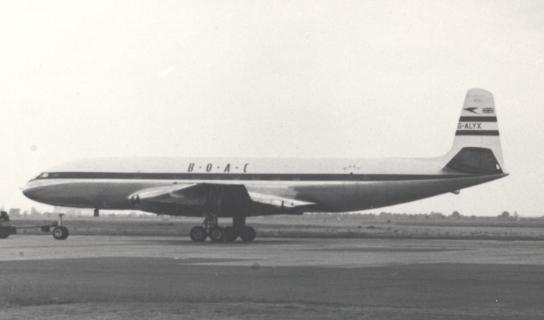
I will talk about another 2nd of May that changed our history as well. The 2nd of May of year 1952. That day took place the first commercial flight of a jet plane, the De Havilland Comet.

In this speech I will talk about that flight, about how it changed the history and I will finish explaining one of the Comet’s biggest contributions to engineering which at the same time caused the very end of the aircraft.

BOAC’s De Havilland Comet

That first flight departed from London to Johannesburg and was operated by BOAC, British Overseas Airways Corporation, one of the companies that later merged in today’s British Airways.

BOAC used a configuration of 36 seats (a luxurious configuration for the size of the aircraft). The galley could serve hot and cold food and there was even a bar. There were separate men’s and women’s washrooms. The passenger cabin was quieter than those of propeller-driven planes.

Many people thought jet engines wouldn’t be economically viable on a commercial plane since jets had higher fuel consumption. However the Comet was able to fly at an altitude of 35,000 feet where the air is less turbulent. The Comet was smoother and faster. Hours were cut off in flights. New York was only twelve hours flying time away from London instead of the eighteen hours it took piston-engine planes.

Now let’s see how it changed the history by comparing some differences from that first flight to commercial aviation today!

  • It took only 3 years from the first design work till the first flight of the Comet; it took about 14 years for the A380.
  • The Comet could take 36 persons to a distance of 2,700 kilometres, compared to the more than 800 passengers in a 3-class configuration to 15,000 km of the A380.
  •  If we take a look at that first flight, London – Johannesburg, it took more than 23 hours!! With 5 stops in between (Rome, Beirut, Khartoum…) like a frog jumping from one water lily to the other. Now, the same company, British Airways, operates the flight with a B-747 and takes less than 12 hours (half the time) in a non-stop flight!!
  • A ticket in that first flight cost 175 pounds, while a ticket for tomorrow’s flight in the afternoon would cost you 240 pounds taxes included! That could seem just a bit more expensive, but in fact if we discount the effect of the inflation throughout the 50 years now it is about 4 times cheaper!
  • The Comet needed a crew of four men: including two pilots, a flight engineer, and a navigator. Nowadays planes need only 2 pilots… if any.
  • 114 aircraft of the different models of Comet were produced compared to the more than 5,200 Boeing 737 built to date plus the 1,500 in waiting list.
  • The estimated price of a Comet 1 was a quarter million pounds, while the B-747 costs 120 million pounds (hundred times more expensive after discounting the effect of inflation).

Only a year after it began commercial service, Comets started to fall out of the sky. Thirteen aircraft were lost in fatal accidents with hundreds of victims. Extensive investigation revealed a devastating design flaw – metal fatigue. This problem had never been encountered in aviation.

The constant stress of pressurization weakened an area of the fuselage in the corner of the windows. All Comets were grounded until the jets could be redesigned. This was a tragic but great contribution of the Comet to aeronautical engineering.

The Comet re-entered commercial service in 1958, but its reputation was forever damaged. The Comet 1 disasters contributed to archrival Boeing’s domination of the jetliner market.

2nd of May. A special day both in the History of Madrid and in the History of commercial aviation. A day that changed the lives of madrileños in a good way. The uprising in Madrid and the Comet’s first commercial flight.”

May this serve as introduction.

4 Comments

Filed under Aerospace & Defence