Category Archives: Investing

I am an angel

Last 23rd March the three Toastmasters clubs in Madrid organized a gathering at Hard Rock Cafe. The event was a great success with over 40 people attending it. John organized it including 3 prepared speeches, a book review, some table topics and an improvised theatre!

I gave a speech which I had created over a year before. That was my 9th speech in the way to obtaining the Competent Communicator award of Toastmasters. The objective: “Persuade with Power”.

I first gave this speech titled “Angels” on the 4th of February in 2009. Then I used it again for the Area spring contest and again in the Division conference in Lisbon that same year.

With some slight modifications I gave it again in the gathering. This is its script and more or less what I said…

“Do you believe in angels? I do. I do believe in angels. What if I tell you that I am an angel? Wouldn’t you be curious? Wouldn’t you like to hear about it? You will.

I believe in what are called “business angels”.

I guess that most of you have heard the term “business angel” at some point. For those of you who haven’t: business angels are investors who invest part of their money in small and medium start-up companies, helping entrepreneurs to set up their businesses.

In this speech I want to persuade you to become business angels. You may tell me “Javier, I don’t have a spare million to invest in companies”; neither do I.

Do you think that to be an angel… to help someone to start-up with their business, a lot of money is needed?

Microcredits are small loans given to the poor, to those entrepreneurs who lack collaterals and a credit history; this makes them not eligible for the traditional credit given by banks. We are talking about someone in Vietnam who runs a grocery shop or about Mariano Choque who makes handicraft in Peru and whom I met last summer in a trip to Peru.

Microcredits are generally considered to have originated with the Grameen Bank created by Muhammad Yunus in Bangladesh more than 30 years ago. It all started as a research project to examine the possibility of designing a credit delivery system to provide banking services targeted to the rural poor. For this contribution, Muhammad Yunus was awarded the Nobel Peace Prize in 2006.

Ok, this is the theory. Now, I told you I was an angel; do you think I am part of that Grameen Bank in Bangladesh? No, I’m not.

Today the internet has facilitated very much the process. Kiva.org is a US non-profit organization which links those poor entrepreneurs, in developing countries, with us, here in Europe.

Kiva presents us with a list of individuals who are requesting an amount to start or improve their business. There you choose in which project you want to invest and how much do you want to invest. Kiva was started in 2005, and now counts with over 600,000 users who have given credits worth over 120M$ to over 320.000 entrepreneurs.

What it’s more… think of this for a moment: we are talking about credits and not donations; this means that you will get the money back! Say you invested 100$; when you get them back what would you do with them? You can lend them again! Imagine how many people you can help with those same 100$. Isn’t it wonderful?

Let’s see possible concerns you may have:

  • Is Kiva profiting from it? No, as I said is a non-profit organization. Like Toastmasters. Of course, Kiva has operating costs, but these are covered with different donations than the money you lend to entrepreneurs.
  • How do we know the money reached the entrepreneur? Kiva works with several field partners who are the ones scouting the entrepreneurs, uploading the information about them and their projects and finally handing them the money.
  • What if the loan is not repaid? Indeed some loans are not repaid. Around 2% of them. To avoid this Kiva is classifying the field partners. They classify them according to the level of risk of the credits already given to entrepreneurs presented by the field partners. But then again… with investment in the stock market, what would you do to avoid losing your investment: you just diversify!
  • If you have more concerns or questions about the topic you may ask me after the other speeches.

As I said at the beginning, I believe in angels. I am an angel. And what is more important: each of one you here can give a loan that can change a life… each of you can become an angel.”
3 Comments

Filed under Helping others, Investing, Toastmasters

A Kiva success story

Kiva’s mission is to connect people, through lending, for the sake of alleviating poverty.

A friend recently wrote in his blog a post about Kiva, therefore I will refer you to it for a deeper explanation of what Kiva is (in Spanish), or to Kiva’s website to know about it in English.

For those of you who like statistics and facts, these are the ones shown in the latest newsletter:

  • 53 months old
  • $124,156,585 raised
  • 98% repayment rate
  • 312,345 entrepreneurs funded
  • 681,527 Kiva users
  • 193 countries represented

Kiva’s slogan is: “Loans that change lives”. I wanted to write about how it changes both borrowers and lenders lives.

I believe that the two main “selling points” that Kiva has are:

  • The fact that you are lending money instead of donating it.
  • Being able to chose one specific project to which you want to loan money.

The fact that you are lending money instead of donating it. This aspect is positive again in a twofold way: you incentivize the borrower to use the money in building a sustainable business and when you get the money back, you can lend it again, and again, etc… therefore with the same amount of money you may help many different people.

The minimum amount you can lend in Kiva is 25$. It’s obvious that if you lend only 25$ you will have to wait until this loan is fully repaid before lending these 25$ to someone else. But, if you are lending to several people the picture changes.

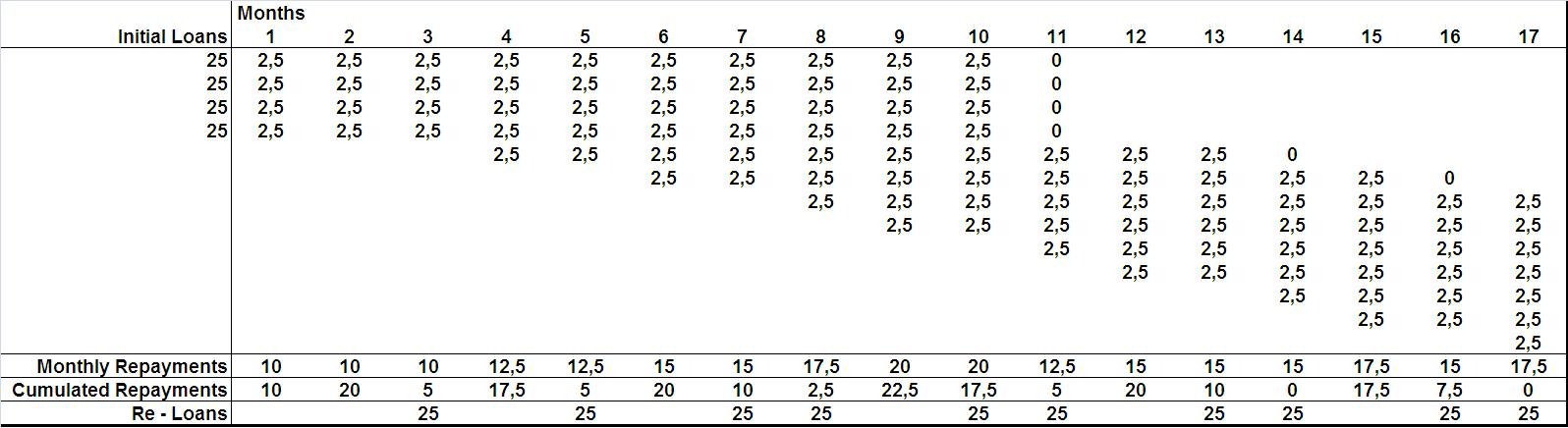
Let’s see an example in which you start lending 25$ to 4 different projects (e.g. handicraft in Peru, a food market in Tanzania, a grocery store in Viet Nam and a small restaurant in Nicaragua).

Let’s imagine that all four projects will repay their loans in 10 months, starting from the next month of the loan disbursal.

You can see in the graphic that since you are collecting 10$ in the first 3 months, in that third month you can already re-loan 25$; in the fifth month you will be able to re-loan other 25$… Before the end of the 10 months you’re already helping 8 different projects. From that moment on you will be always be supporting between 6 and 7 different projects at every time.

Loans repayment "money creation".

And believe me: it’s both entertaining and rewarding to read the stories of these people, trying to grasp how they’re trying to improve their business.

Being able to chose one specific project to which you want to loan money. We are attracted by this for whatever reason: we identify ourselves with the person, we find the business especially interesting, we think it’ll have a larger impact in the community… we “put a face” to the act of lending money.

Last year I went on holidays to Peru. Since I had funded some projects in Peru I thought it would be a good idea to learn from one of those business first hand and see how Kiva is making an impact.

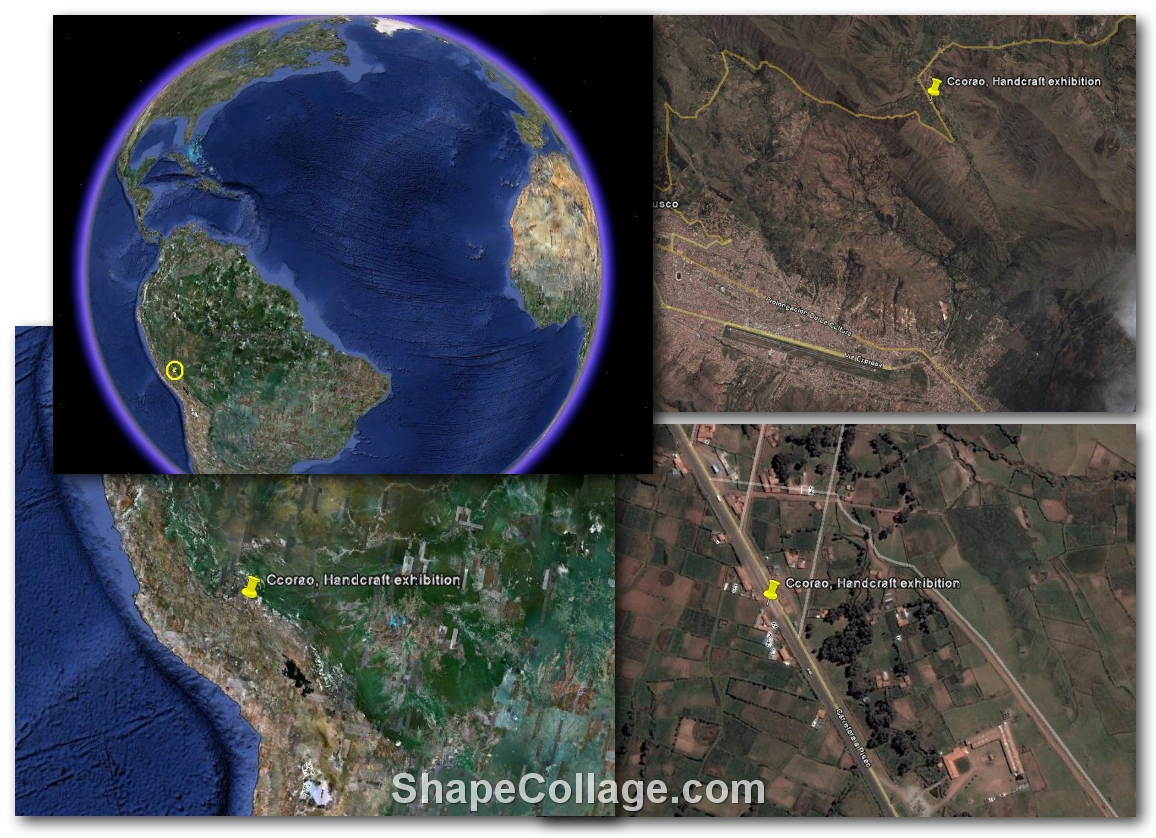
Reynita de Belen de Ccorao is a community founded 7 years ago in the village of Ccorao, near Cusco. It is formed by more than ten people, each of them dedicated to a different business. Together they requested through Kiva 3,950$ to “purchase more supplies for their handiwork and to buy seeds and dry grains”. They would repay in the following 8 months.

Once I was in Peru I was quite flexible about the plan of whether to visit or not this community, since I didn’t know where Ccorao was and also in the Kiva description another name was given  for the name of the village, “Corroa”, which didn’t appear in any map (it seems that Ccorao is a Quechua name, being Quechua mainly used in the Altiplano region).

Ccorao in the World.

Luca and I were going to spend some days in Cusco and surroundings, with an intermediate escape to the Amazon Basin. During those days we wanted to visit the city of Cusco with a guided tour including the ruins of Sacsayhuaman, we would go to Machu Picchu, and make an excursion to the Sacred Valley ending in the fortress of Ollantaytambo, all these under continuous threats of transport strikes.

The day of the Sacred Valley excursion, on the way to Pisac we passed through a village with a sign post that read “Ccorao”; that immediately rang a bell and I told Luca: “This is the place”. That day in the afternoon I went to an internet cafe to check the names of the people that we would look for the next day.

The plan was simple: we had 3 hours in the morning before taking the flight back to Lima, we would use them. The following morning we took a taxi and went back to Ccorao, and with the help of the taxi driver we tried to find that group. Of course, the taxi driver had never heard of it.

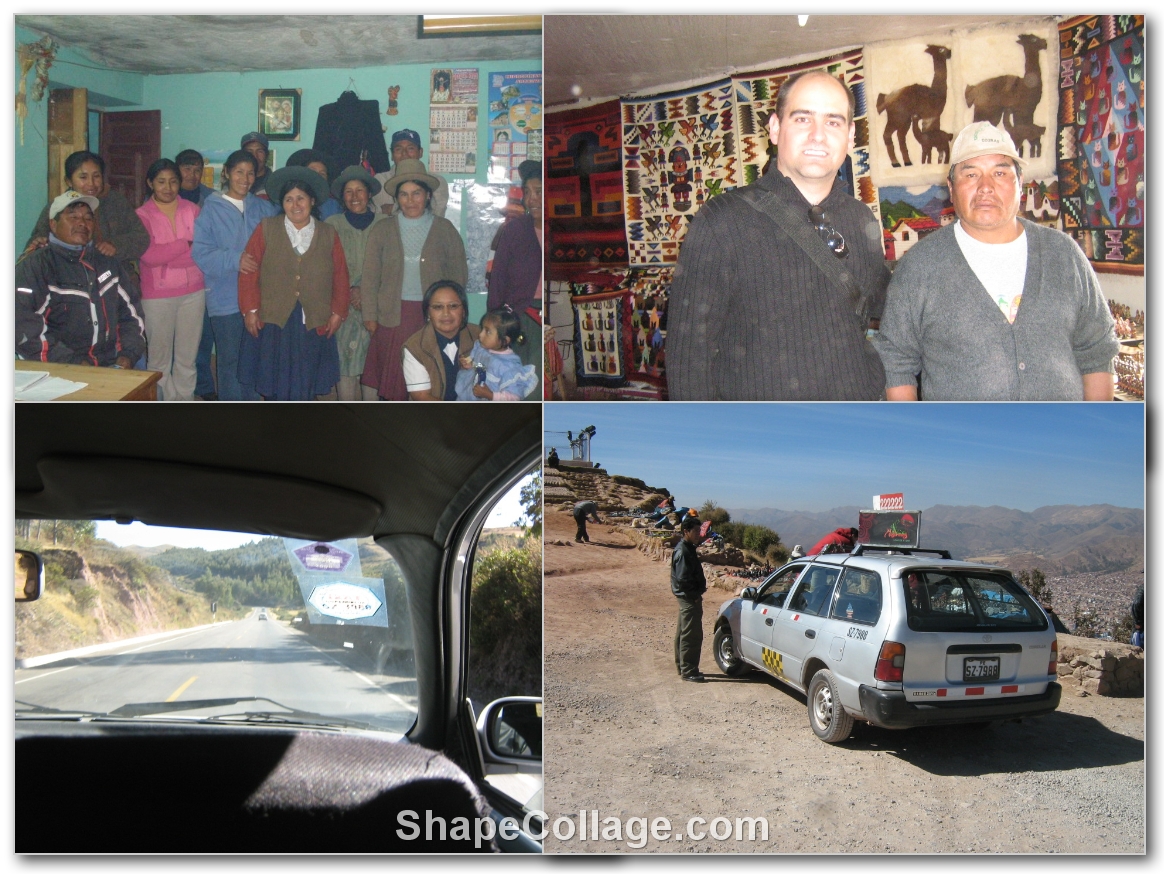
I tend to be lucky: although the first stop we made wasn’t successful, in the second one we completely hit the target. We reached Mariano Choque Raya, “Mariano”. We introduced ourselves as what we were: a couple of tourists that had lended money to a group through Kiva. Mariano had never heard of Kiva, or if he had he didn’t recall the name, but he knew very well Arariwa, the field partner Kiva works with in that region. He not only had taken loans from Arariwa but had received certain financial education from it.

Reynita de Belen, Mariano and our way to Ccorao.

The group had taken several loans from Arariwa and from other lending institutions. This particular loan was fully repaid in November 2009.

He showed us their handicraft exhibition and went on explaining how they had grown their business. The first loans he used were employed in buying grain and feeding cuys (guinea pigs) that he would grow to later sell them to restaurants in Cusco. Then, as tourism grew, they focused on the handicraft business and he advanced in the value chain of the cuy business: he continued to grow them but instead of selling them he started running an eatery post that opened only during the weekends and there he would cook and serve his cuys, retaining more margin for himself.

With time, more and more buses filled with tourists were stopping in Ccorao in their way to Pisac. Other groups started their handicraft exhibitions along the road, so competition became fiercer (though be sure that the items we purchased came from his shop).

Thanks to Mariano’s entrepreneurship and skills, and partially to the loans offered to him, as he said: now, his children are attending to school, something his generation couldn’t afford to, and he is able to save some money for his retirement as he won’t have any pension when that moment comes.

Kiva: loans that change lives.

13 Comments

Filed under Helping others, Investing, Travelling

Not just another letter

Last Saturday Warren Buffet’s letter to the shareholders of Berkshire Hathaway was released.

I encourage you to read it. In the best case it will raise some interest for this guy within you, and that may be translated in further readings and wiser investments decisions. If it doesn’t go that far, it’ll provide some fun reading. Let me give you some hints of this year’s letter:

“An old Wall Street joke gets close to our experience:

  • Customer: Thanks for putting me in XYZ stock at 5. I hear it’s up to 18.
  • Broker: Yes, and that’s just the beginning. In fact, the company is doing so well now, that it’s an even better buy at 18 than it was when you made your purchase.
  • Customer: Damn, I knew I should have waited.”

“If Charlie, I and Ajit are ever in a sinking boat – and you can only save one of us – swim to Ajit.”

“GEICO’s managers, it should be emphasized, were never enthusiastic about my idea. They warned me that instead of getting the cream of GEICO’s customers we would get the – – – – – well, let’s call it the non-cream. I subtly indicated that I was older and wiser.

I was just older.”

“It’s clear that I failed you in letting NetJets descend into this condition. But, luckily, I have been bailed out.”

“Big opportunities come infrequently. When it’s raining gold, reach for a bucket, not a thimble.”

“Charlie and I enjoy issuing Berkshire stock about as much as we relish prepping for a colonoscopy.”

“If you decide to leave during the day’s question periods, please do so while Charlie is talking. (Act fast; he can be terse.)”

“If pushed, we would gladly pay substantial sums to have our jobs (but don’t tell the Comp Committee).”

It’s only 19 pages…

5 Comments

Filed under Investing

Three centuries of confusion

Last Monday I was reading an article in FT by Tony Jackson: “Is China an investment sweet spot or a sour lesson?”.

Not that I am thinking about investing there, but in this article I started reading sentences which rang bells… “the long-run correlation between real growth in gross domestic product and real equity returns is in fact slightly negative”, “reminder of the futility of long-range forecasting”, “how to explain the underwhelming performance of emerging equities, besides a simple propensity to overpay for growth?”…

Nevertheless, the best I got from this articles it wasn’t those reflections but that it referred me to the Credit Suisse annual study from the academics Dimson, Marsh and Staunton. 

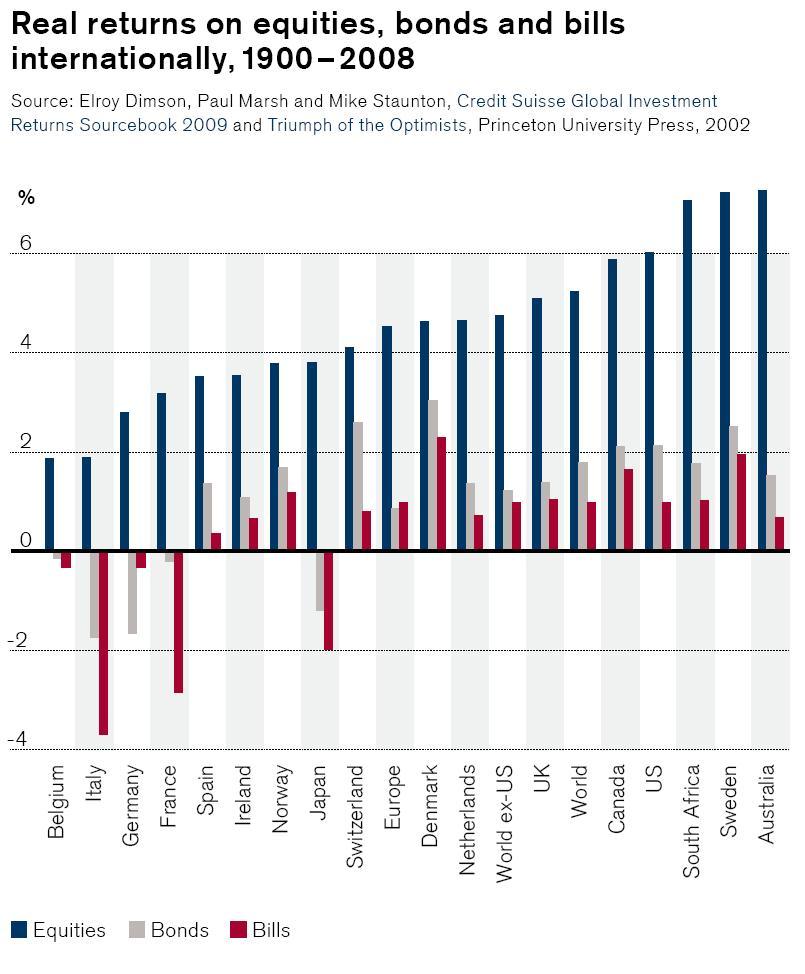
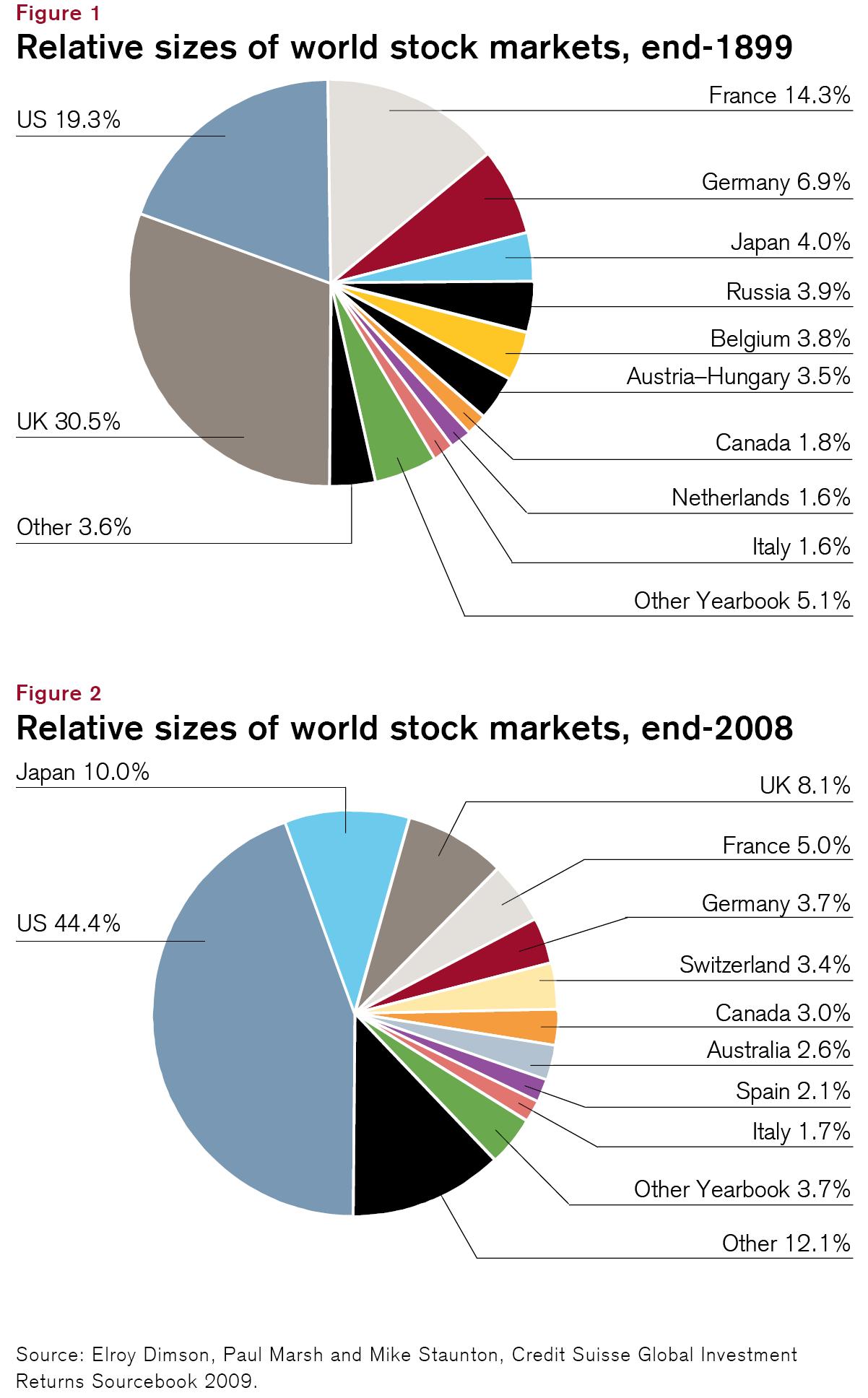
This annual study contains wonderful data and graphics. Let me share some of them.

Later on the report very well summarises what we have read and heard so many times from Graham and/or Buffet:

“Value stocks sell for relatively low multiples of earnings, book value or dividends. They may be mature businesses with an unexciting future, or they may have a depressed share price that anticipates setbacks. Growth stocks sell for relatively high valuation ratios, reflecting favorable prospects for the business, and their stock price anticipates cash flows that are expected to get larger in the future.

For larger US companies, over the longest available period (end-1926 to end-2008), the difference between the annualized returns on the Fama-French value and growth indexes is 2.5%. In other words, the premium for US value stocks, relative to large companies as a whole, is approximately +1.2%, while the «premium» for growth stocks is of the same magnitude but negative.”

Finally the report reviews the case for different countries and regions. Among them The Netherlands, where the stock exchange originated with Dutch East India Company. Here we find a reference to the book “Confusión de confusiones” by Jose de la Vega (1688), an Spaniard who wrote the first book ever on the stock exchange business. 

I will end this post with one quotation from the book: “What really matters is an awareness of how greed and fear can drive rational people to behave in strange ways when they gather in the marketplace.” (We have heard this lately from someone else as well).

2 Comments

Filed under Books, Investing