Category Archives: Sports

Athens Classic Marathon

I heard about the modern Athens Classic Marathon from Antonio, a colleague at the office. Ever since, I had wanted to take part in it. Last week, two friends (Jose and Juan), my brother and I completed it.

In a previous post I wrote about the legend of Pheidippides and the origin of the modern marathon. In this post I will focus on my experience and will share some of the pictures that we took during this trip.

Training

Volume of kilometres run per week.

Volume of kilometres run per week.

To prepare for this marathon I followed a 16-week training plan provided by Garmin (Level II). Each week it included between 4 and 5 days of running and often 1 day of cross-training. I fulfilled most of the plan, missing not more than two or three days of running and some more of cross-training. I did not skip any series session or long run. In all, I ran over 780km in those weeks, excluding the 42km of the race (an average of just over 50km per week).

During this training season I beat my 10k and half marathon personal records. I had not experienced any serious injury that prevented me from training during whole weeks or months as it had been the case in previous years. According to a running calculator that I use sometimes, had the race been in similar conditions as those 10k and half, I should have been around 3h30′. The profile and conditions were not the same, and despite of that I started with a pace towards 3h30′ just to see how far would I reach maintaining it and if I could be under 3h45′, thus achieving a new PR.

The day before the race we went to the marathon expo which was held at the Taekwondo pavillion of the 2004 Olympic Games held in Athens. This way we also visited the beautiful small port at Piraeus close to Faros (just past the Stadio Eirinis & Filias, where Olympiakos bastketball team plays).

At the marathon expo.

At the marathon expo.

Before the race

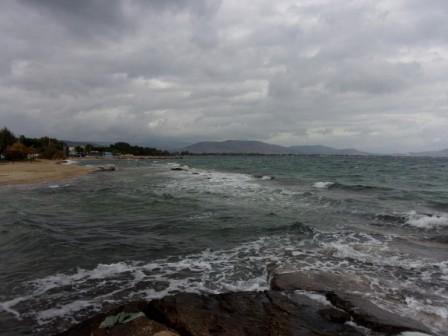
Marathon beach.

Marathon beach.

As I mentioned in the previous post, the race goes from the village of Marathon to Athens, replicating the route followed by Pheidippides to announce the victory of Athens in the Battle of Marathon. The Persians landed at the bay of Marathon in their attempt of invading Attica, thus Marathon is almost at sea level.

From Marathon, the race goes South more or less parallel to the sea-line for about 17 kilometres and then heads to the West to climb up the hills before the valley where the city of Athens is located.
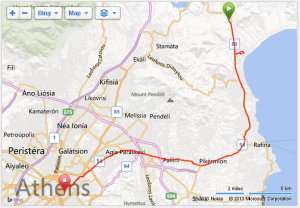
Route of the Athens Classic Marathon.

Route of the Athens Classic Marathon.

The last part of the race is a descent from the hills to the centre of Athens where the Panathinaiko stadium is located. But by then, the damage is already done to the legs after a long climb.

Profile of the Athens Classic Marathon.

Profile of the Athens Classic Marathon.

The morning of the race, we were transported from Syntagma square to Marathon by dozens of buses early in the morning to be able to start at 9:00. Everything ran smoothly (in that and many other aspects the organization of the race was superb).

We changed clothes in Marathon, where we could take some pictures, go to the toilet, warm up and slowly get into the racing mindset.

Urinaries panoramic view.

WC panoramic view (at Marathon, picture by Jose).

We took one group picture and set for the departing line.
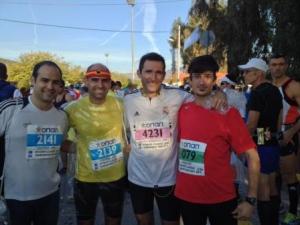
Pre-race group picture.

Pre-race group picture.

The week following to the race I went back to Marathon to visit the place with time and see the different spots (some of the pictures in the post are from those other days).

In the village of Marathon there is a small athletics stadium at the end of the national road from Athens to Marathon.

The 1896 Olympic marathon race started at “… the brigde at Marathon Plain”, or “… at the bridge near the entrance of the sacred city”, according to “Olympic Games 776 B.C. – 1896” by A. K. Bech, or “… The starting point will be at the 40th stadion on the Marathon – Athens national road”, according to the Athens daily “Olympia” on March 9, 1896 (as can be read in the milestone below). That point, the “40th stadion” of that national road, is marked by the milestone below.

Today, the Athens Classic Marathon starts a bit ahead at the mid-point of what is now a kind of majestic avenue at the beginning of which one can find a marble stone indicating the starting point of the olympic race, a milestone indicating that 40th stadion, and the tower where the Marathon Flame is lit after being brought from the Marathon Tomb (just 5km away).

1896 Athens marathon start

1896 Athens marathon start

40th stadion milestone

40th stadion milestone

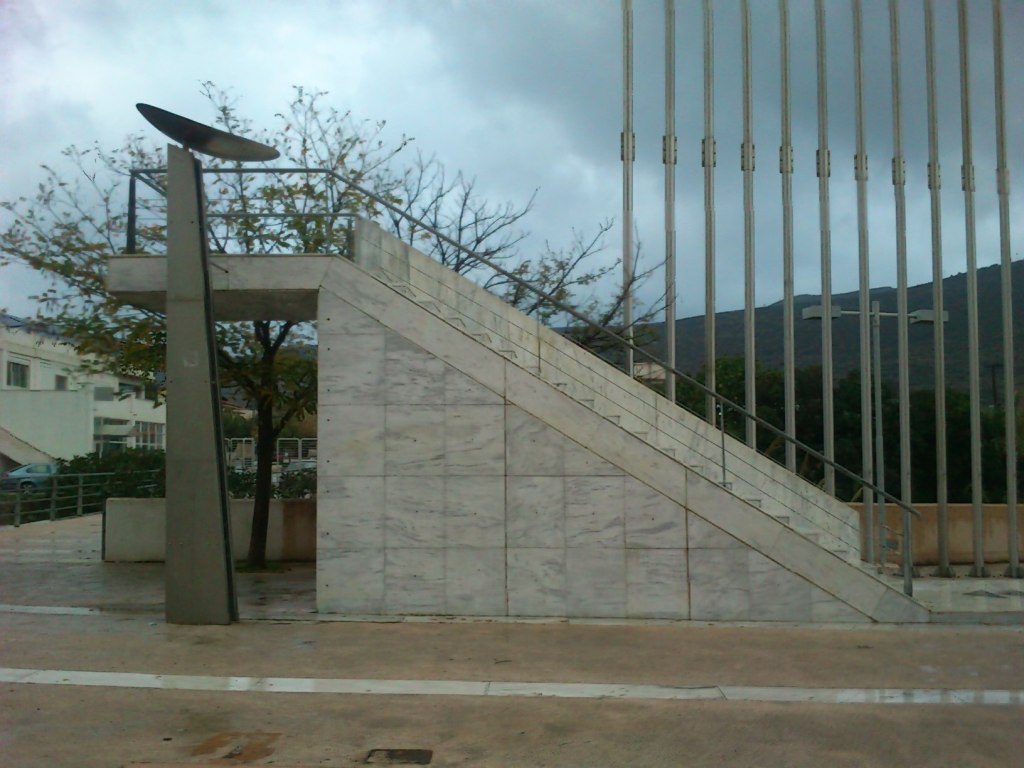
Marathon flame tower.
Marathon flame tower.

Boston 2013 marathon memorial bracelet.

2013 Boston marathon memorial bracelet.

Just before the race start we observed 1 minute of silence for the victims of the attack at the Boston marathon earlier this year. This minute counted with the presence of president of the Boston Athletics Association. That was the 3rd such minute I had observed as during my honeymoon trip I had taken part in two races in the USA, in San Francisco and San Diego, from which I got the memorial bracelet that I wear often lately.

The race

At 9:03 our group departed and there we went my brother and I trying to pace ourselves at a bit less than 5′ per km. That was comfortable for the flat part at the beginning. Another positive point of that beginning: with less than 10,000 runners taking part the running was possible from the start.

Milestone of the km 1 of the Athens Classic Marathon Course.

Milestone of the km 1 of the Athens Classic Marathon Course.

The course of the marathon race is marked, not only by ad-hoc signals for the race, but by permanent posts along the road, such as the one of the picture for the first kilometre.

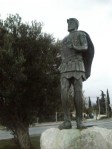
At about the km. 5 the course takes a small detour from the national road to round the commonly known as Marathon Tomb, or Marathon Tumulus, a park with a small hill where each year the Marathon flame is lit. Close to the park entrance, there is a small statue of Miltiades, credited as the one devising the tactics to defeat the Persians at the Battle of Marathon.

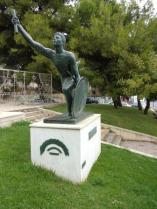
Statue of Pheidippides km. 18.

Statue of Pheidippides km. 18.

At the return from the tomb, already 6km had been passed. The road continued to be flat until about the 11th km, where the road started to pick up until km. 16, where there is a short and steep descent up until km. 17.

At the km. 18, there is a small statue of the legendary Pheidippides. From then on the road continues to climb more or less continuously until km. 31.

Up until the 20th km I was still at the pace of 3h30′, but in the beginning of the climb I was already feeling that it was going to be very tough to run kms at below 5’50”.

I have checked the Garmin records afterwards and I had already surpassed 167bpm at some points by the km 20th, which experience tells me that is the barrier that makes me feel fatigued.
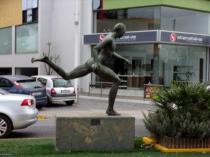
Statue of a runner at km. 21.

Statue of a runner at km. 21.

During the race, not having read about heart rate, just by the feelings I had I decided to forget about the time and continue the climb at a more comfortable pace. With that, the 3h30 and the sub 3h45′ were gone. In the end I completed the race in 3h53’18”, but the profile nor the day (temperatures from 14ºC to 21ºC, on the hot end) were the best to attempt a PR.

At the km. 21 there is another statue of an anonymous runner.

I crossed the half marathon at slightly over 1h47′, but knowing that the following 10km would take about a full hour and not knowing how I would be for the remainder 11km.

The heat of the day called for lots of hydration, and at that point the organization was again terrific, with water posts every 2.5km and with isotonic drinks in most of the posts, plus energetic gels in some of them.

One hour later, and having reached the top of the hill I remembered the sentence one of us had read describing the race “from km. 31 you can fly down to the end”. Well, I was not fit for flying. When I tried to speed up I felt muscles starting to cramp, thus I couldn’t run any faster than 5’45”, which I tried to keep, drinking and eating well at each supply post.
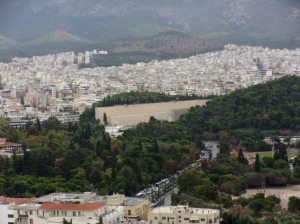
Panathinaiko stadium from Acropolis.

Panathinaiko stadium from Acropolis.

Once in the centre of Athens, there were still some 3-4 kilometres to cover. I kept myself just for the last kilometre where the atmosphere close to the stadium was great, starting with the descent by Irodou Attikou street.

The last turn to the left, climbing up the ramps to enter the Panathinaiko and covering the last meters inside the stadium was overwhelming. One of the best marathon endings I can recall.

See in the panoramic below a view of how the stadium looked that day.
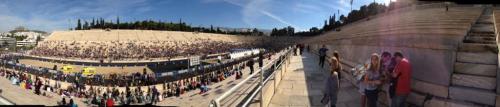
Panathinaiko stadium panoramic view.

Panathinaiko stadium panoramic view (picture by Jose).

I remembered then when I first visited Athens back in 2002. That time, we visited the stadium and took some pictures as if running in those tracks. Now, 11 years later, there was I, sprinting to complete the Athens Classic Marathon (my 10th), where it all began, no less.
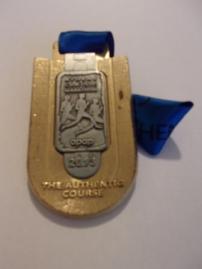
2013 Athens marathon medal

2013 Athens marathon medal

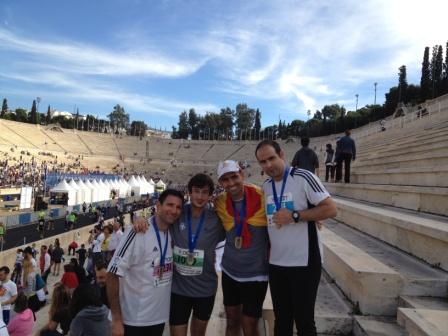
Post-race groupe picture.

Post-race group picture with a great marathon team! Juan, Jose, me and Jaime.
6 Comments

Filed under Sports, Travelling

Καλημέρα, Marathon!

Καλημέρα, Marathon!

(Good morning, Marathon!)

At the time this post is being published, two friends (Jose and Juan), my brother and I are starting the Athens Classic Marathon; the marathon starting in the town of Marathon, in the East of Attica region, and finishing in Athens.

Today, there are hundreds of marathon-distance (and longer) races organized around the globe all along the year. The trend is growing. The numbers of people running such races is increasing year by year. But it all started here, in Attica.

Pheidippides, the legend

The basic traces of the legend are widely known: a courier named Pheidippides ran from Marathon to Athens to announce the result of the battle and perished after the arrival. However, there are some confusions in relation to the legend, as it is well explained in the respective Wikipedia article.

The first record from the legend comes in a text from Lucian:

… The modern use of the word dates back to Philippides the dispatch-runner. Bringing the news of Marathon, he found the archons seated, in suspense regarding the issue of the battle. ‘Joy, we win!’ he said, and died upon his message, breathing his last in the word Joy … – Lucian Pro lapsu inter salutandum (translated by F.G. and H.W. Fowler, 1905) 

Statue of Pheidippides along the Marathon Road (picture by Hammer of the Gods27).

What is less known is that according to the story Pheidippides (530 BC–490 BC) was first sent to Sparta to request help from the Spartans when the Persians landed at Marathon. Thus, he already had run 240km to Sparta (and back). Right afterwards, he was sent from Marathon to Athens (another 40km) to announce the victory in the battle.

To the ones having completed a marathon race this makes sense, as: how it can be that it all started with the one supposed gifted runner collapsing after completing the 40km if thousands (about half a million) people each year complete a marathon? The catch is that Pheidippides had come from twice running what today is known as the Spartathlon, a 246km ultramarathon race which is also organized yearly in Greece, between Athens and Sparta.

Thus, the feats of Pheidippides have yielded two modern running race distances and hundreds of events.

The Olympic Games

Spyridon Louis entering the Panathinaiko stadium at the end of the marathon (public domain image, author Albert Meyer).

More than two thousand years passed until the sport of marathon was established on the occasion of the first modern Olympic Games held in 1896 in Athens.

The idea of including such a race in the programme of sport events was from Michel Bréal, a friend of Pierre de Coubertin. The proposal was accepted by the Olympic committee and that first marathon race had a distance of 40,000m (the current 42,195 distance for marathons was established years later, in 1924 , based on the distance of the 1908 London Games).

That first marathon was run on April 10th of 1986.  Only 17 runners took part in that race; of which only 9 of them finished, one being disqualified after his arrival (as he had completed part of the race on a carriage) and the other 8 retired at different points of the route. The race was won by the Greek Spyridon Louis with a time of  2:58:50.

Athens Classic Marathon

From 1972, the Athens Classic Marathon is organized yearly following the route of that first marathon race in 1896 and the legend of Pheidippides (490 BC).

Today in 2013, 117 years after those first 17 runners and 2503 years after Pheidippides, the 4 of us will try to cover the distance between Marathon and Athens, to say ‘Joy, we win!’ at our arrival and this time, not to collapse.

3 Comments

Filed under Sports, Travelling

Born to run

Born to Run cover.

Born to Run cover.

I recently finished the book “Born to Run“, by Christopher McDougall a runner and author who has collaborated with several magazines including Men’s Health. The book, published in 2009, has recently become a classic reading for runners.

The main thesis of the book is the support of what is called the Endurance running hypothesis, which explains some human evolution traits as being adaptations for long distance running, suggesting that early humans hunted down animals by running after the prey till it died of exhaustion.

Prior to reading the book I had watched some years ago the following TED talk [15’52”] from the author in which he explains the same thesis.

I have to admit that after listening to the talk I was quite sceptic and became somewhat reluctant to the reading of the book. It has been only years after that I was curious enough to give it a try. Now, having completed it, I have to say that the book is quite entertaining and the writing style of McDougall makes it enjoyable.

The other main theme of the book is the approach to the Tarahumara people, native American indians living in the North West of Mexico, which are known for their endurance running.

The book ends with the first Copper Canyon Ultra Marathon, run in 2003 over 51 miles, organized by Micah True (Caballo Blanco) and gathering several Tarahumara natives and some elite American ultramarathon runners. In previous chapters, the author introduces all of the characters that ultimately will take part in the race along some other thesis such as the vegan diet and barefoot running, which I continue to be sceptic of.

What I appreciated most about the book was the vivid description of epic races that took place in the past like some editions of Leadville Trail 100 or the already mentioned Copper Canyon Ultra Marathon, the getting to know those races or the Western States, the Badwater Ultramarathon (through the Death Valley), being introduced to both some legendary Tarahumara runners (Manuel Luna, Arnulfo…) or Western ones such as Scott Jurek, Ann Trason, Matt Carpenter, etc.

Thus, I would recommend the book as an entertaining read and motivating one for someone who is into running even if I remain sceptic of some of the thesis if defends.

Leave a comment

Filed under Books, Sports

The mind in long distance running

Some weeks ago I came across the following article in the site Runner’s World Running Times, How Much Does Mental Toughness Affect Race Times?. The article discusses a study by John Hall, a performance psychologist at Staffordshire University (U.K.) in which he tried to find quantifiable evidence supporting the notion that mental toughness has a direct effect on race times (1).

Some excerpts from the article:

[…] Hall noted that there was little quantifiable evidence supporting the notion that mental toughness has a direct effect on race times, so he set out to see if he could put a number to it. 

Hall surveyed 706 ultramarathoners at six international events, including the Marathon des Sables in Morocco and the Comrades Marathon in South Africa. The sample included 539 men and 167 women from multiple countries ranging in age from 22 to 69.

For the study, Hall used a previously established tool to measure three components of mental toughness: confidence (self-belief), the sense of being in control, and constancy (concentration, determination, acceptance of responsibility, and stability of attitudes). Perceived effort, discomfort levels, use of mental skills and hardiness were also measured. Mental skills are actions like goal setting and refocusing. Hardiness is a personality trait tested in previous research.

Hall found that mental toughness greatly influenced subjects’ finishing times, and that among the variables influencing performance (fitness, weather, and nutrition), mental toughness accounted for 14%.

I read reactions to the article in Twitter from several runners criticizing the numbers, having reactions like “in long distance running the mind is everything”. I am also of the opinion that the mind has a great deal of importance in running, however I believe that the catch is in the what the study is trying to measure.

The study is already taking a group of 706 ultramarathoners and sees how much mental toughness is influencing the differences in their finishing times as compared to other elements. To that respect it finds out that the mind’s influence in the difference in times is 14%, other elements like heat and strong wind had more relevance in the final times.

What the study is not telling is that to complete the Marathon des Sables in a certain time having the correct mental toughness will contribute only a 14%… and I think this is what runners have in mind when hearing the outcome of the study and reacting to it.

When training for a marathon or an ultramarathon for months prior to the race, only the runner knows how many times he has to rely on that mental toughness to go out in a rainy day and do his series training, or wake up really early on a Sunday morning to squeeze a long run before some other family event, or to bring running shoes to every business or leisure travel he has during months, or to keep the pace up in all the repeats of a series training session… in all those situations, mental toughness plays a role and that is what runners have in mind.

Those 706 ultrarunners who took part in the study already had a great mental toughness (much higher than a sedentary person). The study looked at the slight differences between the toughness of some runners compared to others.

To end this post, I leave you with a few quotes on the different roles that the mind plays in running:

Yiannis Kouros (Greek ultramarathon legend holding every men’s road world record from 100 to 1,000 miles and every road and track record from 12 hours to 6 days):

“When other people get tired they stop, I don’t. I take over my body with my mind I tell it that it’s not tired and it listens.”

Emil Zatopek (Czech runner, winner of four Olympic gold medals):

“We are different, in essence, from other men. If you want to win something, run 100 meters. If you want to experience something, run a marathon.”

Jacqueline Gareau (Canadian runner, 1980 Boston Marathon champion):

The body does not want you to do this. As you run, it tells you to stop but the mind must be strong. You always go too far for your body. You must handle the pain with strategy…It is not age; it is not diet. It is the will to succeed.

Frank Shorter (American runner, 1972 Olympic champion in the marathon):

“You can actually suffer a little bit more going slowly than when you’re going really fast. A faster marathon might even be easier than a slow one, in terms of what it takes out of you mentally.

John Bingham (American runner, No Need for Speed column in Runner’s World):

Marathons are about tenacity as much as talent.”

Hal Higdon (American runner and author of 34 books):

“Motivation remains key to the marathon: the motivation to begin; the motivation to continue; the motivation never to quit.

(1) The paper related to the study has not yet been published, as the author explained in the comments thread of the article in the Running Times online magazine.

Leave a comment

Filed under Sports

Ballesteros (the movie)

I have never been a big fan of golf and in fact I have only played a few times starting in 2012 during a trip to Scotland. Thus, the phenomenon of Severiano Ballesteros if not unnoticed never fully touched me.

Earlier this month I spent some days resting in the village of Comillas (Cantabria, Spain). There we witnessed the preparation of the set and the filming of a movie. We heard that the crew had a British accent and then lunching in a terrace we learnt that the movie was about the life of Ballesteros.

I then, searched in the web about the movie project. I found several articles and read a couple from The Independent and Today’s Golfer.

The movie is produced by BAFTA award-winning Stephen Evans. The £5m movie project is running late as it was initially supposed to be already released, and now is expected for 2014, after over  5,000 hours of footage. It will tell the life of the golfer from its youth in Cantabria. While reading about the movie I found some sentences that catched my attention:

“He had one of the most fascinating childhoods I have ever come across. It is almost straight out of Charles Dickens.”

“If you don’t understand Seve’s formative years then you can’t possibly grasp why he became the man he did.”

“Like (Ayrton) Senna, Seve transcends his sport and like Senna, Seve was incredibly handsome and charismatic, but unlike Senna, Seve was not handed everything on a plate.”

“Jack Nicklaus, Arnold Palmer, Tom Watson, Lee Westwood and Luke Donald are all wonderful players, but that is all they are. There is no real story, so if you tried to make a movie about them people would fall asleep. Seve is different.

I have never seen such a display of triumph and joy in my life. It was incredible, amazing and electric.”

Seve Ballesteros, Spanish golfer (by Peter from Liverpool, UK).

Spanish media tends to elevate sportsmen to the highest quite rapidly after some victories, thus I still wanted to check just a few figures of majors won. Ballesteros won 5: 2 Masters (1980, 1983) and 3 times The Open Championship (1979, 1984, 1988). In the last 50 years, only eight (8) players have won 5 or more majors: Gary Player (9), Jack Nicklaus (18), Arnold Palmer (7), Lee Trevino (6), Tom Watson (8), Nick Faldo (6), Tiger Woods (14) and Phil Mickelson (5).

I obviously missed something. I am now looking forward to see that movie.

1 Comment

Filed under Movies, Sports

Toulouse half marathon 2013

Today I took part in the Semi Marathon de Toulouse. I had run this race already in 2011, where I achieved my personal best time in the distance (1h42’30”). The race is quite flat and runs two laps at a circuit of almost 10 kilometres, with some variations at the beginning and the end to reach the 21.1km.

I am now in the middle of the training period following a plan towards Athens Classic Marathon in November. Despite of not focusing the training on this race, and due to the PB in 10k obtained two weeks ago I was looking forward to beat my half marathon PB, aiming at clocking a time at least below 1h40′.

I went to Sept Derniers, the neighbourhood where the race is starting together with Luca and Andrea. There we met my colleague Manuel and together we did some warming up.

The race started about 15 minutes late. Manuel is lately in great shape so he wanted to start at the front of the pack, thus, I accompanied him there. This made me run the first kilometre much faster than I wanted to. From then on I slowed a bit until I just came to be running just a few seconds under 4’40” per km, that would ensure me to finish below 1h39′.

I could pace myself well until the km 14, from that moment I found it hard to keep a pace under 4’40”. I guess I paid the extra effort of the first 2-3 kilometres. Nevertheless, I made the numbers in my head and saw that even clocking times around 4’44”-4’48” I would be well under 1h39′ if I didn’t have any further problem (which almost had at the km 17, when I almost fell after bending the left ankle).

Just before entering the athletics track in the Airbus’ sports facilities, TOAC, I checked the watch and knew that I would be under 1h38′, as I would accomplish that final 400m lap in under 2 minutes.

I finally beat my best time in half marathon by 5 minutes! For which I am quite happy. I ended in 1h37’29” as per my Garmin (a couple of seconds more as per the official timing – no net time provided by the organization). I came in the 241th out of 1080, not being that especially important I made it to the top 23% percentile for the second race in a row (in Colomiers I came in 226th out of 990).

Thus, in 2 weeks I have beaten 2 PBs (10k & 21k)! Let’s hope that the health keeps going well with the training besides the small inflammation I have now in the right knee.

Enjoy some pictures of me running today (most of them taken by Luca):

This slideshow requires JavaScript.

3 Comments

Filed under Sports

Boulevards de Colomiers 2013

Colomiers is a village close to Toulouse. Today, I went there to take part in the race “Boulevards de Colomiers”, over 10km. Last year, I had already taken part in it, where I achieved my personal best over that distance with 46’14” (despite of the problems I had at the time with the Achilles tendon).

Posing with Andre prior to the start.

Posing with Andre prior to the start.

This year, I had in mind to follow the 45′-pacer as far as I could to break a new personal best. So from the start I followed the pacer, together with my co-worker Manuel. The weather was a bit hot and sunny, I would have preferred it colder and cloudy, thus I tried to take a bit of water in each of the water supply points, to ensure I was well hydrated.

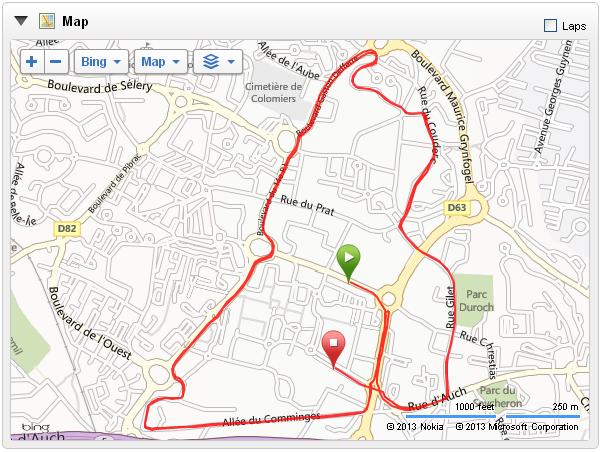
Boulevards de Colomiers 10k circuit.

Boulevards de Colomiers 10k circuit.

The race had 2 laps around a 5k circuit in the centre of the village. I tend to like this kind of races as then in the second half one can know what to expect (where the water stations are, sharp turns, small hills…). I was following more or less comfortably the pacer up until the 7th kilometre.

Running at about 5k.

Running at about 5k (see the pacer with the blue balloons, I am in the centre with the yellow t-shirt, picture taken by Luca).

I found it not so easy to keep up the pace from the 8th to almost the end. I think it is mostly a psychological issue: the knowing that there is only 1 kilometre to go, that you are already going to beat the PB, etc., make the brain to send signals to the muscle in the way of “it’s ok, you can relax a bit, it’s done”

Then I saw the shop where we used to rent skies, knew that there were less than 400m to go and kept the effort up, at that point the pacer slowed to look and cheer up at the pack of runners that were following him (thanks!) and there we went for a last sprint.

I finished in 44’28” as recorded by my Garmin, setting a new Personal Best with a margin of 1’46” under the previous one. I’m very happy for that, thus I celebrated it taking this other picture:

Posing with Andrea after having finished.

Posing with Andrea after having finished.

5 Comments

Filed under France, Sports

Bay to Breakers

While reading the tourist guide about California in preparation of our honeymoon, Luca discovered the race “Bay to Breakers” in San Francisco. We checked the website, the dates, we saw it was going to take place during our stay and so I subscribed to it.

For those who haven’t heard about it, Bay to Breakers is more than just a race. It is a city event. A party that has been going in San Francisco since it was first celebrated in the year 1912, partly to boost the city’s morale after 1906 earthquake. This year they celebrated 102nd edition. Bay to Breakers obtained the Guinness World Record as the largest footrace in 1986 with over 110,000 runners, while today they count with between 60 to 80 thousands. Another fun fact: it is the longest consecutively race in the world (not having changed length nor course along these 100 years).

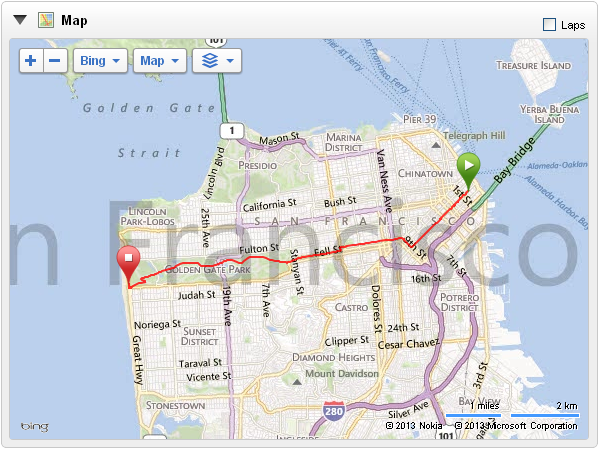
The race is a kind of carnival, very much like the San Silvestre Vallecana in Madrid in New Year’s Eve. It goes from one side of San Francisco, Embarcadero (in Howard street), to the other by the Pacific Ocean, after 12 kilometres (see the map here, PDF).

The atmosphere was great, despite of the bombing in the Boston marathon having taken place just a month beforehand, for which we observed a minute of silence prior to the race in memory of the victims.

Most of the participants were wearing some costumes, perhaps more than in the San Silvestre in Madrid, as the weather is milder at this time of the year.

Not knowing the circuit nor the streets, my intention was just to run the 12 kilometres in less than 1 hour, that was the time I had indicated in order to start from one of the front corrals. In the end, I felt quite good running, even during the climb up in Hayes Street Hill I kept up running (I only needed to make a quick stop by some urinary at the 4 km :-)).

Bay to Breakers circuit.

Bay to Breakers circuit.

The views of the race were especially good at the beginning while running along the civic center area, where most of the cheering crowd was, and then at the Golden Gate Park, which was also the longest part of the race. However, in the final kilometres there weren’t many people cheering, which is the only weak point that I see of this race in the comparison to the San Silvestre Vallecana in Madrid.

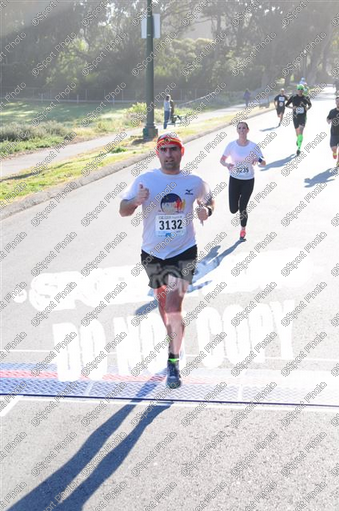
Having pushed hard in the last 4 kilometres where the profile was descending to the sea-shore, finishing with a sprint after a turn by the Dutch mills of the park, I finished in 58 minutes, two minutes below my initial target. A very good experience for my first race in the USA.

Finishing.

Finishing. 

One final fun fact: at some points in the race I encountered groups of runners that were somehow chained to one another. I found it strange but not so much, as I have seen runners pulling a chariot, dressing in all kinds of costumes in coordination with other runners, etc. Only after having finished, I learnt that these were centipedes!

There is a special classification for centipedes, which are teams of 13 runners attached to one another. In fact the record of the Centipedes category (LinkedIn 2012) is 36’44”, which is over 1 minute faster than the best ever women time and way faster than I would ever dream to accomplish!

P.S.: For the San Silvestre team: shall we go for centipede team next time?

3 Comments

Filed under Sports, Travelling

Santa Monica Track Club

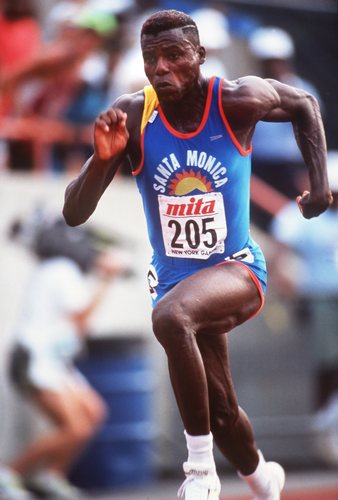
To some of you the initials SMTC or the name Santa Monica Track Club won’t ring any bell. Some others will immediately recognize the name of the athletics or “track and field” club in which some of the all time best athletes ran, such as Carl Lewis, Leroy Burrell, Michael Marsh, and many others.

When preparing the planning of our honeymoon, and since I was going to be running some days throughout it due to the preparation for San Diego marathon, I thought it would be nice to go and check SMTC and see where did they train and do a training session there myself.

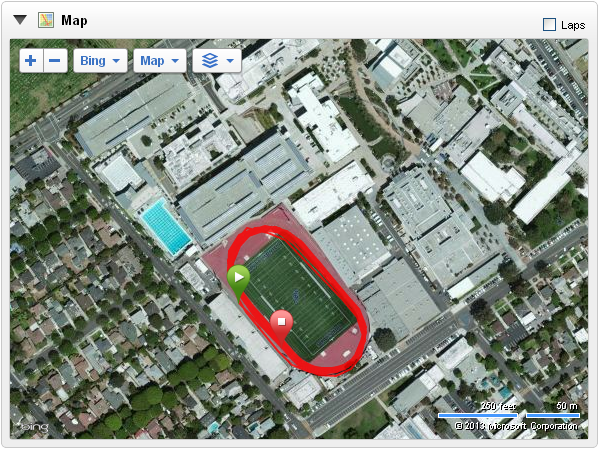
I checked the website of the club but it did not help much. However, searching in different forums in the web, I found out that the club is not going through the best of the times struggling to find sponsors. The coach, Joe Douglas, is still the same one who prepared Carl Lewis. They normally trained in either in the Santa Monica College track (in the “Corsair Stadium”) and in Ocean Avenue, at a park by the beach, and they seemed to keep training in those places.

Then, I contacted the Santa Monica College faculty members in charge of the sports installations to see if I could use the track for training. Given the hours in which I planned to train (between 6 and 8 am) I obtained permission.

On May 15, Luca and I set out early in the morning for the track, where I did a 10 kilometre training surrounded by several other people running, walking or warming up to practice other sports.

Training session at SMC.

Training session at SMC.

It was a good experience and I am happy to have checked it out. However, it was a bit disappointing to see no memory, no sign, no trace of what glory that place lived not so long ago (ok, between 25 to 30 years ago). When I think of the legend that Carl Lewis is in athletics, I am puzzled that they do not show any pride of him.

This slideshow requires JavaScript.

Another thing that I missed was finding a t-shirt of the SMTC. I searched in various local shops but I didn’t find any. I learnt in some of them that Nike is selling a cotton replica (not a technical t-shirt) to commemorate it, however I didn’t find it in the stores, only in the online shop. I may buy it at some point as my personal and private homage to the SMTC of the ’80s.

Carl Lewis with SMTC t'shirt.

Carl Lewis with SMTC t-shirt.

3 Comments

Filed under Sports, Travelling

Sequoia National Park

When planning our honeymoon, with main destination California, it early became clear that other national parks were optional but the must visit would be the Sequoia National Park.

The schedule of the trip was tight and we were not up to long walks or hiking routes, however, with a good map and a car we could reach many of the sights in the west part of the park (be aware that within the park there are no gas stations, so you better fill up the tank beforehand).

We slept over at Montecito Sequoia Lodge and before breakfast I took the opportunity to run in the forest. It wasn’t a long run, just 8km, but it was wonderful though the climbing part was tough as I went up until Big Baldy (2,503m) where the 360º sights of snow-covered mountains and valleys were superb (it’s a pity that I did not take the photo camera for that morning run).

Run from Montecito Lodge to Big Baldy.

Run from Montecito Lodge to Big Baldy.

After breakfast, we spent the day driving through the park seeing most of the highlights of the park and dozens if not hundreds of sequoia trees. The biggest one is the General Sherman Tree, if not the oldest nor the tallest nor the widest (as there are other trees claiming those records).

General Sherman Tree.

General Sherman Tree.

It is the biggest by volume, with 1,487 cubic metres, with an estimated age between 2,300-2,700 years and about 1,900 metric tones of estimated mass (that is 10 times the weight of a blue whale or almost 200 times that of an elephant). You can see some explanation about the tree in the sign post from the park pictured below:

Sherman tree explanation.

General Sherman tree explanation.

There are many other stunning sequoia trees living or fallen, that make the visit to the park special, even if at the end of the day you end up not deviating the sight from the road to see one more sequoia.

Apart from the trees, there are many other worthy things to do or to see, including the stunning views from Moro Rock, or the different meadows you could walk by.

Enjoy some other pictures we took at the park:

This slideshow requires JavaScript.


P.S.: By the way, Luca had just learn before this trip that you need not to go to California to see sequoia trees, but that in the region of Cantabria (Spain) you can see them as well! At the Monte Cabezón.

Leave a comment

Filed under Sports, Travelling