In this post I wanted to share the list of books I read along the year (1) with a small comment for each one. I have also included a small rating from one to three “+” depending on how much I do recommend its reading.
“Gobierno omnipotente” (Omnipotent Government: The Rise of the Total State and Total War) by Ludwig von Mises (++): Written in 1944, the book shares a critique of state interventionism and central planning on their diverse varieties (socialism, Marxism, nationalism, Nazism), analyzing similarities and differences among them, and the economic and social disasters generated by them in the first half of the XX century, including disastrous wars. [Twitter thread]
“El origen de las especies” (On the origin of species) by Charles Darwin (++): In this famous book written in 1859, Darwin shares his theory of natural selection and survival of the fittest. The book includes numerous examples of evolutionary changes, variations, mutations in different species across the world, counter points and many references to previous studies on the topic (the theory didn’t occur to him out of the blue, but this book is more a compendium of different elements supporting it). The laws that in general terms define evolution are: growth with reproduction, heritage, variation (due to changes of life conditions, use or lack of use), a rate of growth so great that leads to the fight for survival and as a consequence of this natural selection determined by a divergence of characters and the extinction of the less perfect forms. The 6th edition that I read includes as well a review of previous criticisms made to his first editions. The book also includes a discussion of how evolution can still work with the divine creation of a short number of different forms that later evolve. [Twitter thread]
“La mayor ocasión que verá el siglo XXI” by Rafael Acedo (+++): Rafael Acedo is one of my former bosses at Airbus Military and most importantly a senior executive of the company that held different positions, in particular in Programme management and Engineering. This book tells with a unique point of view the fascinating story of the genesis of the A330 MRTT (multi role tanker transport) aircraft. The book offers a blend of technical aspects of the design and development, insight into the sales campaigns with their various requirements that shaped the products, the personnel selection searching for the right engineers to lead those developments, the leadership struggles and styles at CASA and with the integration into EADS… It is an excellent book.
“A room of one’s own“, by Virginia Woolf (+): This short book is based on 2 lectures given in 1928 about women and writing. It emphasizes the need for financial independence, a room without interruptions, access to education and time (“give her hundred years“) for women to shine in literature. [Twitter thread]
“Tractatus logico-philosophicus” by Ludwig Wittgenstein (-): Essay written in 1918 about language, logic, mathematics and their limits, and how the meaning of the world, ethics, mysticism are outside of what can be expressed. The language used and writing style make for a very difficult read even if it is a very short book. [Twitter thread]
“La cuestión P vs. NP” by Jordi Delgado Pin (-): This is a short book from a collection of Mathematics books I started reading some years ago. This particular one is an introduction to computational complexity, and the analysis of the time it takes to solve problems. Too technical for a reader that it’s not into programming like myself. [Twitter thread]
“Elements” by Euclid (++): The book I read is Simson’s translation of 1774, and includes the books I to VI, XI and XII of the geometry manual of the 3rd century BC by Euclid, a classic of Western civilization. Throughout the different books Euclid departs from few definitions, postulates and axioms and goes into graphically calculating different distances, angles, surfaces, etc., with the help of what has been proven before. Some of those exercises are studied in a high school technical drawing course (e.g., how to circumscribe a circle about a triangle) many others are technical drawing on steroids. [Twitter thread]
“Faust” by Goethe (+): Written in 1832, the book is a dramatic poem (in rhyme in the original German) where Faust makes a pact with the devil Mephistopheles to grow in knowledge and live all kinds of experiences; including the love of Grechten and Helen, various parties and military conquests. [Twitter thread]
“Politics” by Aristotle (++): The book, written in the IV century BC, offers a critique of Plato’s Republic, and it’s essay on constitutions for different states, forms of government (monarchy, aristocracy, democracy, oligarchy, tyranny), on virtues, citizens, the separation of powers, the different magistracies, about private property, slaves, women, the natural inequalities among individuals… [Twitter thread]
“Peter Pan” by James M. Barrie (++): Narrated form (1911) of the play (1904) about the adventures of Peter Pan, Wendy, Hook, Tinker Bell… Peter Pan is today a character of world fame, a boy who refuses to grow up and goes to live in Neverland. An aviation angle: his passion for flying and the fact that to fly the only thing which is required are happy thoughts. [Twitter thread]
“Dinero, crédito bancario y ciclos económicos” (Money, bank credit and economic cycles) by Jesús Huerta de Soto (+++): Huerta de Soto is a Spanish economist of the Austrian School of economics. The book, written in 1998, calls for a system of free banking with 100% reserve requirement for deposits, the elimination of central banks and a return to the gold standard. To arrive at those proposals the book analyzes the business cycles and how fractional reserve banking distorts investments decisions, capital allocation, creates inflation and crises. The book offers a comprehensive historical overview of several authors and schools of thought (back to the Middle Age), with numerous citations and an extensive bibliography. [Twitter thread]
“Historiones de la Geografía” by Diego González (+++): The book is a collection of short stories and curiosities about islands, remote territories, unique borders, time zones… Very much like the blog Fronteras (in Spanish) but now compiled in a book, with the fresh style of its author Diego.[Twitter thread]
“La energía nuclear salvará el mundo” (Nuclear energy will save the world) by Alfredo García (+++): A brilliant exercise in popularizing nuclear energy, the science and technology behind it, its unique safety levels (contrary to popular beliefs and the defamation campaigns against it; in particular I loved the detailed analysis of how there’s no risk with eating fish from Fukushima! Much less than with eating bananas), the most well-known accidents (their origin, an account of what happened and what not! i.e., it turns out that most of those accidents are success stories despite how they have stayed in the collective memory), waste management, the need for nuclear energy in the energy decarbonization path, new technologies… The author, Alfredo , works at a nuclear plant and is very active in Twitter / X, follow him (in Spanish) for more information.[Twitter thread]
“Annals” by Tacitus (+): Written around 102 AD, it describes year by year (consulship by consulship), from the death of Augustus in the year 14 to the fall of Nero in 68, with large gaps not preserved. The book mainly deals with the reigns of Tiberius and Nero. Every year it gives an account of the relevant events of the empire: about wars and their development, conquests and appointments in the provinces; discussion of some laws being passed, trials, betrayals, notable executions and suicides in Rome. [Twitter thread]
“Cyrano de Bergerac” by Edmond Rostand (+++): Written in 1897, the book is a theatre play entirely in verse, which is based on some true characters of the XVII century and which has as themes the choice (that Roxane has to make) between beauty (Christian) and the talents, the words and the pen of Cyrano. Along the play the characters exhibit honor, humor, the Gascon spirit, freedom (“panache“). Only by the end, when it might be too late, Roxane discovers what had been going on and how wrong she was. A very amusing and dynamic opening. [Twitter thread]
“Human Action, a treatise on economics“, by Ludwig von Mises (+++): Written in 1949, Human Action is the main work of Von Mises (4 volumes), an economist from the Austrian school. In the book he defends that human action is directed to reduce current uneasiness, that there’s a time preference, that humans are beings that show social cooperation that allows division of labor, which enables individuals to save and accumulate capital. This will lead to an increase of productivity, increasing added value, offering better products at lower prices, the beauty of capitalism, the market economy, prices, consumer satisfaction as the ultimate goal and profits only accrued when that has happened… as opposed to government intervention, socialism and lack of economic calculation, leading to miss allocation of capital, increase in poverty, etc.
“Réconciliation. Mémoires” by King Juan Carlos I & Laurence Debray (+++): In this rare autobiography by a king, Juan Carlos talks about childhood in exile (Italy, Switzerland, Portugal) and in Madrid during the Franco regime (where he was raised away from his family). The formation of his family in the 1960s and his relationship with other royal houses. He shares some of his exchanges with Franco and the dictator left to the future king some of the reforms to be made. He talks about coronation, how he shaped the government that would launch the transition to democracy and the following modernization of Spain. He also discussed his abdication, his current retirement in Abu Dhabi and he explains the sadly limited relationship he has now with his son, king Felipe VI. An overarching theme in the book is the importance of the Crown for the unity of the country and its long term vision. Finally, he explains that he is publishing this book to counter the attacks on the Crown by the current socialist government and its revisionism of History.
This year I read more than in 2024, with a good habit in the first half of the year and the last 3 months, but struggling to find continuity in the summer months, when I was stuck with Annals. In the end I read 17 books and nearly 7,300 pages (~20 pages a day on average), most of them in Spanish with a couple of books in English and another couple in French. Among them I read 5 books out of the Great Books list.
A resolution for 2026 will be to keep the habit, for which I will be following these two tips that I share every year:
a blog post from Farnam Street blog “Just Twenty-Five Pages a Day“, which was published well after I had adopted such an approach to reading but captures it very well,
the Wikipedia article about the Pomodoro Technique, which enables you to efficiently use the last hours of the day.
Another question that I have got a few times is about the source of the list of some of the classics that I read. That one comes from yet another blog post from Farnam Street blog. That post mentioned the Great Books curriculum for the bachelor in arts of Saint John’s College in Annapolis. You can get the list from the Wikipedia or directly from the college website. As I am not reading exclusively those books I advance at a pace of 5 to 8 books out of that curriculum per year, thus it will take me other 20 years to finish the program.
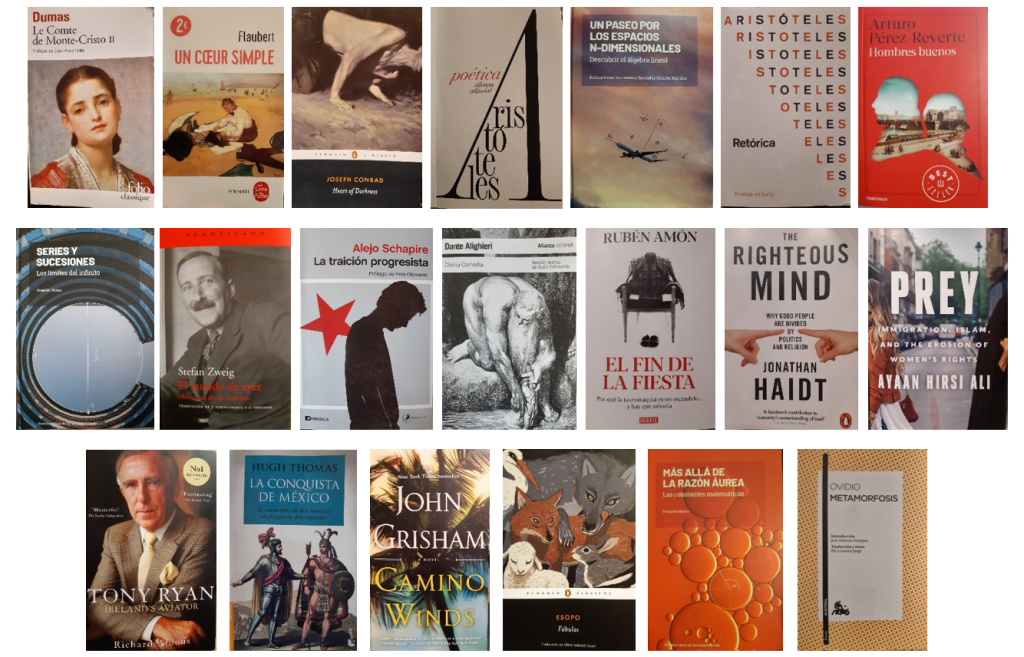
In this post I wanted to share the list of books I read along the year (1) with a small comment for each one and links to some Twitter threads where I shared some passages that caught my attention while reading the books. I have also included a small rating from one to three “+” depending on how much I do recommend its reading.
“Le Comte de Monte-Cristo“, tome II (by Alexandre Dumas) (+++): Great book, a must read. In this second part we see how justice and vengeance are meticulously delivered by the almighty count of Monte-Cristo. “Wait and hope”. [Twitter thread].
“Un coeur simple“, (by Gustave Flaubert) (+): Short and sad story about Félicité, a poor and simple servant who sees how her circle gets narrowed down to the point of idolizing a dead parrot. [Twitter thread].
“Heart of Darkness“, (by Joseph Conrad) (+): Marlow’s search for Kurtz, the most successful ivory trader of the company at an station by the river Congo. Danger, savages, darkness, “horror!”. [Twitter thread].
“Poetics“, (by Aristotle) (+): A treatise on tragedy: argumentation, characters, plotting and sufferings, music, scenery, metric… Unfortunately, the second part of the treatise covering comedy hasn’t been conserved till our time. [Twitter thread].
“Un paseo por los espacios n-dimensionales“, (by Esteban Ferrer and Soledad Le Clainche) (++): This is a book from a collection of 40 short books on mathematics that my mother gifted me with in 2019. My idea is to read a few of those books per year. This book was written by two professors from my alma mater and it’s a brief review of Algebra with notes on its evolution and some of its applications. [Twitter thread].
“Rhetoric“, (by Aristotle) (++): Being rhetoric the art of persuasion, in this book Aristotle discusses the different types of speeches, emotional states, rhythms, structures, choices of words… to better achieve the purpose of the speech. [Twitter thread].
“Hombres buenos“, (by Arturo Pérez-Reverte) (+++): A great novel based on a real trip to Paris made in 1785 by two members of the Spanish (language) Academy to get hold of a copy of the Encyclopédie by D’Alembert and Didérot, which was at that time censored in Spain. The book offers many details on the research for the novel, discusses many other relevant books of that time and depicts the struggles that the protagonists suffered in that quest to bring some enlightenment to Spain. [Twitter thread].
“Series y sucesiones“, (by Ángel M. Núñez) (+): A book written by a couple of teachers from my alma mater on series, successions and limits and the evolution of them, describing the contributions by mathematicians such as Nicolas d’ Oresme, D’Alembert, Cauchy or von Neumann. [Twitter thread].
“The world of yesterday“, (by Stefan Zweig) (+++): This book makes for a great read, very well written and with a good taste. The description of Vienna before 1914, the cultural activities of that society, the acquaintances of the author, the freedom they enjoyed, etc., makes for a beautiful picture of the world of yesterday. Then history turns for the worse: first world war, the poision of nationalism, hyperinflation destroying German society, the rise of Hitler, persecution of Jews, living in exile… both a historical recount and warning. [Twitter thread].
“La traición progresista“, (by Alejo Schapire) (+++): A brief and straightforward book lamenting the path followed by the political left and liberals in many Western countries with the focus given to identities. The book is rich on examples and references. [Twitter thread].
“Divine Comedy“, (by Dante Alighieri) (+++): This is an impressive landmark of literature. The book describes Dante’s passage through the inferno, purgatorio and paradiso, with the guidance of the poet Virgil. The structure of the book with the description of the different levels is remarkable. The amount of detailed information of historic or mythical characters from Tuscany, Rome, Greece, etc., is overwhelming, with the only downside of having to interrupt the reading of poetry to frequently consult footnotes. [Twitter thread].
“El fin de la fiesta“, (by Rubén Amón) (++): The book discusses the current situation of bullfighting, the challenges it faces with lack of appreciation from part of the society, the attacks it receives, and also some clues for its defence, its strengths and virtues. I liked the book and the message, but the style and narrative were repetitive at times. [Twitter thread].
“The righteous mind“, (by Jonathan Haidt) (+++): This book offers a review of the evolution of moral psychology and what the author calls Moral foundations theory, showing as well moral differences between liberals and conservatives, helping to understand people with different intuitions and morals. A very valuable book. [Twitter thread].
“Prey. Immigration, Islam and the erosion of women’s rights“, (by Ayaan Hirsi Ali) (++): Necessary book on an uncomfortable subject. The thesis is that women’s rights are receding and society cannot turn a blind eye on that fact. The reading of the book is at times tough and disgusting due to the nature of the cases, the cover ups by different institutions in several European countries… [Twitter thread].
“Tony Ryan. Ireland’s aviator“, (by Richard Aldous) (++): A biography of the man behind Guinness Peat Aviation (a major leasing company in the 70s and 80s, and arguably one of the creators of the aircraft leasing business as such) and Ryanair. A remarkable life with continuous ups and downs. [Twitter thread].
“La conquista de México“, (by Hugh Thomas) (+++): Historical relation of the different Spanish expeditions to what now is Mexico, including that of Hernán Cortés (and other ones such as those of Grijalva or Narváez) until the conquest of Tenochtitlan, of which 500th anniversary took place this year. The book is very exhaustive covering different aspects of the times and events: the greatness and beauty of the city of Tenochtitlan, the traditions of the Aztec or Mexica empire (including human sacrifices and heavy taxation onto other cities, which contributed to their demise), the tension between different Mexican peoples but also the intrigues between different Spanish conquerors (Cortés, Narváez, Velázquez, the son of Columbus…) and the legal charges and proceedings they faced back in Spain, the navigation details of their trips, the different settlements, commercial exchanges, the relationships and alliances built with some peoples (varying with time), the infighting in various places across several years especially including the “sad night” when the Spanish had to flee the city and were on the brink of a total defeat to the recovery period at Tlaxcala and the final assault and devastation of Tenochtitlan. Very good read even if a long one in which I was stuck for some weeks at some points of the narrative. [Twitter thread].
“Camino Winds“, (by John Grisham) (++): In this novel the author goes back to Camino Island and its community of writers that were presented in a previous novel. This time one of the authors is murdered the night a hurricane hits the village. The plot includes professional killers and big corporations. Very entertaining. [Twitter thread].
“Fables“, (by Aesop) (++): Compilation of fables from the VII-VI century b.C, most of them between animals (wolves, foxes, rabits, oxen, ants…) which form the basis of a big part of European popular culture. The fables are short, one or two paragraphs, and the edition I read included a line with the moral of the fable explicitly. [Twitter thread].
“Metamorphoses“, (by Ovid) (++): Written in the first century, the book is an epic poem that covers from the creation to the time of Caesar, describing up to 250 myths and legends of Greek and Roman mythology, with the transformation of many characters into different beings, animals, trees, rocks or rivers. At times the story is difficult to follow as the organization within the different chapters is a bit unclear even if the author worked on the transitions. [Twitter thread].
“Más allá de la razón áurea“, (by Fernando Blasco) (++): Another book of the maths collection. This one discusses the golden ratio and its use in different fields as well as some other mathematical constants including pi and e. The book includes some hard math but as well a few tricks that can be used as magic. [Twitter thread].
I started 2021 reading at a good pace until summer holidays, then a couple of trips interrupted my rhythm and it took me months to recover it, as always, thanks to the rigorous approach following these two tips:
a blog post from Farnam Street blog “Just Twenty-Five Pages a Day“, which was published well after I had adopted such an approach to reading but captures it very well,
the Wikipedia article about the Pomodoro Technique, which enables you to efficiently use the last hours of the day.
Another question that I have got a couple of times is about the source of the list of some of the classics that I read. That one comes from yet another blog post from Farnam Street blog. That post mentioned theGreat Books curriculum for the bachelor in arts of Saint John’s College in Annapolis. You can get the list from the Wikipedia or directly from the college website. As I am not reading exclusively those books I advance at a pace of 5 to 8 books out of that curriculum per year, thus it will take me other 20 years to finish the program.
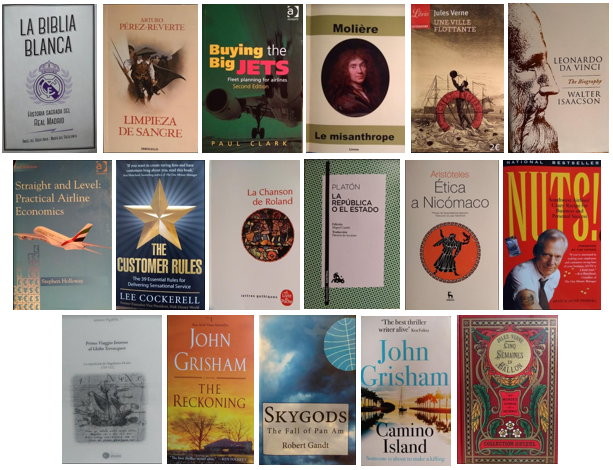
In this post I wanted to share the list of books I read along the year (1) with a small comment for each one and links to some Twitter threads where I shared some passages that caught my attention while reading the books. I have also included a small rating from one to three “+” depending on how much I do recommend its reading.
“La Biblia blanca” (by Ángel del Riego Anta and Marta del Riego Anta) (+++): this is a great book mainly for Real Madrid supporters. It provides a good overview of the history of the club with plenty of stories and anecdotes, adopting a curious structure: that of the Christian Bible with its old and new testaments, and drawing parallels between many of the chapters of the Bible and that of Real Madrid’s history, and between the main characters in both. I enjoyed it and learnt quite a few things from the football club.
“Limpieza de sangre” (by Arturo Perez-Reverte) (++): This book is part of the series of books about the character Captain Alatriste. In this one the plot takes place in Madrid and includes some real historical characters such as the writer Quevedo, an acquaintance of Alatriste. The plot of the book starts with the murder of woman and Alatriste is involved in its investigation which involves the Inquisition. [I leave here a link to the Twitter thread with some quotes or passages that captured from the book while reading it]
“Buying the big jets” (by Paul Clark) (+++): This is a great book about the processes and methods involved in the decision-making of buying large commercial airplanes. The book is a great tool to understand some key concepts of fleet planning, network planning, aircraft performance and economics, etc., and how they influence the investment decision of acquiring airplanes. This was a great recommendation from my colleague Peter. [Twitter thread].
“Le Misanthrope” (by Moliere) (+): I read this play after having read three others from Moliere (École de femmes, Tartuffe, Don Juan) and this is the only one I didn’t really like, while the three others were very engaging and entertaining. In this one, Moliere criticizes society’s hypocrisy by portraying the different personalities of Alceste and Célimène along other of her lovers. [Twitter thread]
“Une ville flottante” (by Jules Verne) (+): Published in 1871, this book covers the trip from Liverpool to New York of the Great Eastern, a large ship transporting thousands of travelers. The book mixes some technical descriptions and explanations about the boat, the navigation or other engineering works, with the day to day life of the passengers, very much in Verne’s style. However, I must say that I found it quite dull at some times. [Twitter thread]
“Leonardo Da Vinci” (by Walter Isaacson) (+++): This book was a present from my mother in law and I read it in this 2019 to celebrate the 500th anniversary of the death of Leonardo, well ahead of our summer trip to Italy where we saw some of his greatest paintings and where we visited is birthplace in Anchiano, close to Vinci. The biography is great. It takes you through the life of the artist, showing and explaining his personal struggles at the same time that it offers an insight into the techniques he developed (smufato, sketching, use of light…), an analysis of his works and possible interpretations. A great painter, even if not constant with completing the works he was commissioned, a frustrated military engineer, a complex character and without a doubt a very talented and innovative individual. [Twitter thread]
“Straight & Level, Practical Airline Economics” (by Stephen Holloway) (+++): This is a detailed review (over 600 pages in the edition I read) of the airline industry economics, operating revenue and cost (traffic, price and yield, output and unit cost), capacity management (network management, fleet management and revenue management) and the relationships between all those concepts. The book is extremely thorough in the presentation and discussions of the different concepts and the variables influencing them. Not for the faint reader. [Twitter thread]
“The Customer Rules” (by Lee Cockerell) (+++): I had this book at home after having received it from the magazine The Economist following a response to one of their surveys. I decided to read it thinking it would be good fit with the new job I was about to get, closer to the customers. Written by Lee Cockerel, a former Disney executive VP, the book is structured along 39 tips to improve customer service. With plenty of anecdotes, experiences, very short chapters with no nonsense, the book is an enjoyable fast read. [Twitter thread]
“La Chanson de Roland” (possibly by Turold) (++): This is a French epic poem written in the XI century describing the battle in Roncesvalles (Roncevaux) in 778 between Spanish Muslims of the king Marsile, based in Zazragoza, and the army of Charlemagne. The main character, Roland, Charlemagne’s nephew, antagonizes with his stepfather who sets him up to cover the rear of the Franks’ army and is then fatally attacked by the Muslims. His call for help, sounding his horn, comes too late to be helped by Charlemagne and he dies in Roncesvalles along with his companion Oliver. I found it especially interesting 1) the outcome that the book gives to his sword in comparison with the many legends about it that have reached our days (Rocamadour, Gavarnie, church in Roncesvalles…), and 2) the many references to Spain and the kingdom of Spain. [Twitter thread]
“La Republica o El Estado” (by Plato) (+++): In this book of dialogues, Plato portrays Socrates discussing about justice (giving what’s due and appropriate), education, virtues, the arts… but what I liked the most was the book (chapter) in which he discusses the different forms of government, what defines them and how the abuse of some aspect in them leads to the adoption of another subsequent form of government. I loved to discover that among the different models he presented, the one presented as the ideal one was aristocracy and not democracy. So much for… [Twitter thread]
“Etica a Nicomaco” (by Aristotle) (++): Aristotle’s text book on ethics, possibly compiled from the notes he used in the Lyceum. Where he defines and discusses virtues, distinguishing from virtues of character and moral virtues. Then he discusses happiness to end with the need for education.
“Nuts! Southwest airlines…” (by Kevin & Jackie Freiberg) (+++): Great book about the airline Southwest. The authors had been consulting for Southwest before they decided to write the book and they are a couple of cheerleaders of the airline (they even include such a disclaimer at the beginning), and despite of that the book is very enjoyable with an extremely positive note. There is no criticism to the airline in the book but plenty of details and anecdotes compiled from dozens of interviews with employees. It is written as a kind of business management book which can also be applied for personal development, with a sort of reference check list at the end of each chapter. If I had to highlight a single takeaway from the book it would the going the extra mile by the individual employees to provide what they call positively outrageous service, and only afterwards thinking about who will pay, what the procedure says, what their boss would say… [Twitter thread]
“Primo Viaggio intorno al Globo” (by Antonio Pigafetta) (++): I decided to read this book on the first circumnavigation of the Earth to celebrate the 500th anniversary of their departure from Sevilla and Sanlúcar de Barrameda. The author, the Venetian Antonio Pigafetta, was one of the few survivors that completed the round the world trip that lasted three years. He started as a secretary to the expedition commander, the Portuguese Magellan. He describes with detail the adventures they went through, the navigation, what they ate, the illnesses they suffered, the landscapes, how they procured food, gold, silver and other materials. He described the exchanges with the different local rulers, which surprisingly were mostly delighted to enter into commercial terms with the king of Spain. It is interesting to note that even though after the death of Magellan in Mactan (which is described in the book) the Spanish Elcano became the commander of what was left from the original expedition, Pigafetta does not mention him not even once in the book; plausibly due to differences with him, as he described tensions and rivalries between the captains of different nationalities taking part in the expedition.
“The Reckoning” (by John Grisham) (+): In this book Grisham shows very early the facts: the victim, the killer, the sentence. What is left unknown is the motive. Most of the book then is dedicated to backtrack the life of the killer, from rural Mississippi to West Point, his marriage and family building, life as a farmer, his participation world war II and the sequels that it brought… However, I must say that I found it too long, though I confess that I loved the final twist.
“Skygods. The Fall of Pan Am” (by Robert Gandt) (+): This book about the rise and fall of the airline Pan Am is very easy to read, a bit repetitive with some expressions, not very elaborate, but entertaining. I found interesting in it the explanations about the many things that didn’t work and didn’t make sense in the operation of Pan Am: from not having a domestic network to feed their international destinations, to being politically denied one time after the other the possibility to develop or acquire such network, the madness surrounding it (seeking super sonic trips, trips to the moon, the NY headquarters, keeping the 747 flying empty to the most exotic locations…). At the same time, Pan Am was a pillar of the American landscape of the time: flying the Berlin service, its standards of service (including its lounges around the world, more like embassies), its support to the military by flying troops as part of the civil reserve fleet, etc. [Twitter thread]
“Camino Island” (by John Grisham) (++): Interesting novel in which Grisham deviates from the legal world and dives into characters of the book industry: writers, editors, sellers, dealers, collectors. The story runs along the robbery and placement in the black market of some manuscripts of Scott Fitzgerald novels, in parallel with the investigation to find the manuscripts and the people involved in the crime. A nice read.
“Cinq semaines en ballon” (by Jules Verne) (+): This book describes the journey of doctor Ferguson and his two companions from Zanzibar to Senegal in a balloon, in their quest to find the sources of the river Nile and confirming many of the discoveries in Africa of previous explorers of their time while avoiding many of the dangers of traveling in Africa by doing so through the air instead of on the ground. On the positive side of the book are the technical descriptions of the physics behind the balloon, the devices they use and may the operations and maneuvers they perform. That is a mark of Jules Verne. A negative note is the language used to describe Africans in general, black people or Arabs, clearly a language that may have passed in 1863 when the book was published but not today. [Twitter thread]
During this year, I have been able to read at a good pace during the first and last quarters (not so during the middle months while switching jobs and going through training) thanks to the rigorous approach following these two tips:
a blog post from Farnam Street blog “Just Twenty-Five Pages a Day“, which was published well after I had adopted such an approach to reading but captures it very well,
the Wikipedia article about the Pomodoro Technique, which enables you to efficiently use the last hours of the day.


 The Blog by Javier