Tag Archives: Peter Larsson

Marathon world record evolution (2025)

Last time I checked all-time men’s best marathon times and the world record evolution was in 2014 ahead of running Rotterdam marathon (post back then). In this blog post I’m going to make an update, share some charts and review some statistics. For that purpose, I use the website “Track and Field all-time Performances” (maintained since years ago by Peter Larsson).

With the data of all-time best men’s marathon I plotted the chart below with the best 1,903 times, i.e., all those below 2h08′ and their dates, highlighting marathon times by Haile Gebrselassie, Wilson Kipsang, Eliud Kipchoge, Kenenisa Bekele and Kelvin Kiptum.
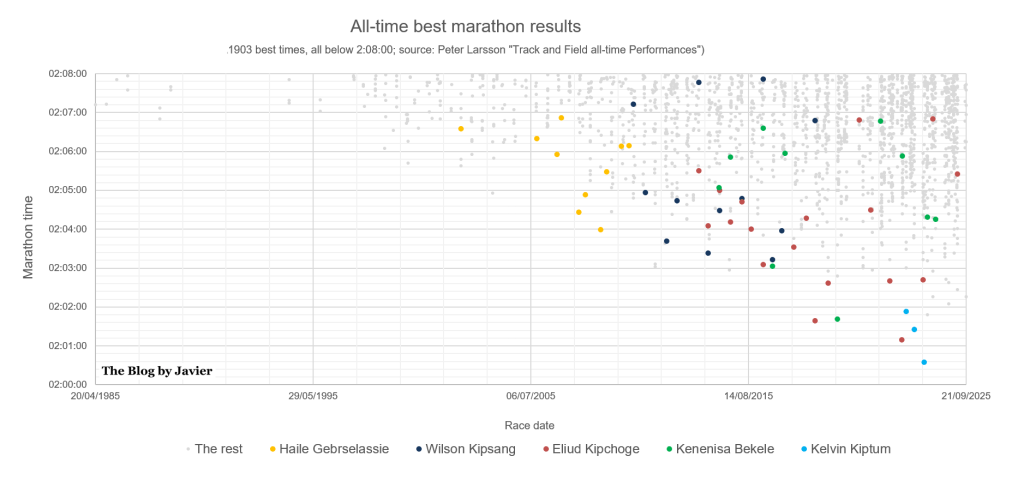
Some stats in relation to those 1,903 times under 2h08′:

  • Countries of which athletes achieved most such times: Kenya 853 times or 44.8%, Ethiopia 570 times or 30.0%, Japan 114 (6.0%), Morocco 44 (2.3%), Eritrea 41 (2.2%), Israel 20 (1.1%), France 20 (1.1%), Uganda 19 (1.0%). Those are the top 9 countries, there are another 34 from which athletes have run below 2h08′ (for a total of 43 countries).
  • There are 742 athletes that have run below 2h08′. The individuals who have done so more often: Eliud Kipchoge 18 times, Sisay Lemma 17, Tsegay Kebede 15, Tamirat Tola 13, Abel Kirui 13, Wilson Kipsang 12, Bernard Kiprop 12, Evans Chebet 12, Benson Kipruto 12, Laban Korir 11, Emmanuel Mutai 11, Amos Kipruto 11, Birhanu Legese 11, Kenenisa Bekele 10, Haile Gebrselassie 10, Leul Gebrselassie 10, Deso Gelmisa 10…

Now, if we raise the bar to see the times at or below 2h05′, we find 231 times:

  • Countries of which athletes achieved most such times: Kenya 108 times or 46.8%, Ethiopia 98 times or 42.4% (both combined 89.2%!), Tanzania 4 (1.7%), Belgium 4 (1.7%), Netherlands 3 (1.3%). Those are the top 5 countries, there are another 11 from which athletes have run at or below 2h05′ (for a total of 16 countries).
  • There are 124 athletes that have run at or below 2h05′. The individuals who have done so more often: Eliud Kipchoge 14 times, Tamirat Tola 8, Wilson Kipsang 8, Sisay Lemma 7, Amos Kipruto 6, Birhanu Legese 6, Leul Gebrselassie 5, three athletes with 4 times including Kenenisa Bekele, 14 athletes with 3 times including Kelvin Kiptum, Dennis Kimetto, Geoffrey Mutai and Haile Gebrselassie, 23 athletes with 2 times including Patrick Makau…
  • Which are the fastest marathons? The cities where most of those 231 times at or below 2h05′ have been achieved are: Berlin and Valencia with 35 each, London and Dubai with 27 each, Rotterdam 18, Amsterdam and Chicago with 15 each, Tokyo 14. Those are the top 8 cities (accounting for 81% of those 231 times), there are other 16 cities where such fast times have been achieved.

Now let’s look at the evolution of the World Record since 1985 in this other chart:
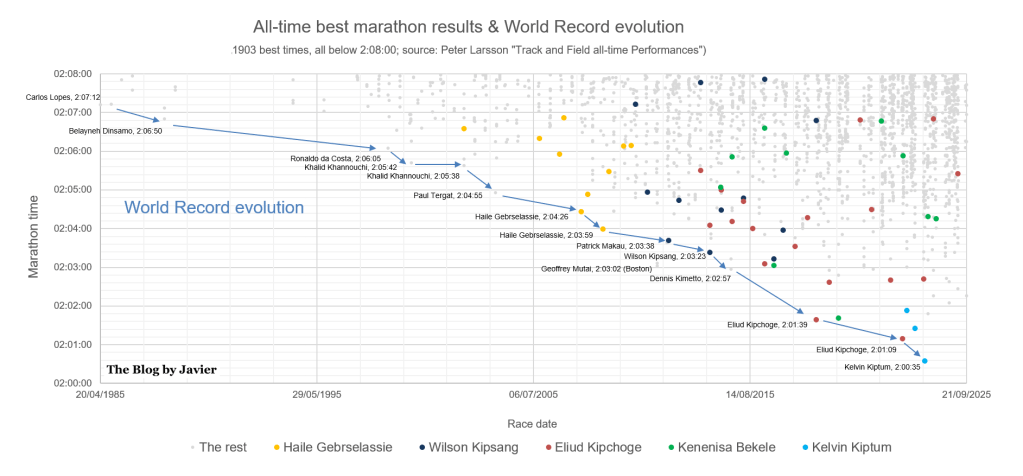
Some comments to the chart:

  • In the last 40 years, the record has been beaten 13 times.
  • The current world record was set by Kelvin Kiptum in Chicago in 2023 with 2h00’35” at the age of 23.9. He sadly passed away in a car crash a few months later. His career was very promising, having run only 3 marathons, all three in less than 12 months, all 3 below 2h02′. 3 of the best 7 times, 1 of the only 4 men having run below that mark.
  • The record that lasted the most was Dinsamo’s 2:06:50 in 1988, which took just over 10 years to be beaten by Ronaldo da Costa in 1998.
  • 3 athletes have set the world record twice: Khalid Khannouchi, Haile Gebrselassie and Eliud Kipchoge.
  • The biggest improvement of the record was made by Eliud Kipchoge who took 1’18” off Dennis Kimetto’s previous record.
  • Geoffrey Mutai ran in 2h03’02” before 3 world records set the bar below his time, however, as he achieved that in Boston 2011 (downhill and point to point race) it didn’t count for the record.

What is the best age to run marathons?

I plotted this other chart looking at the best 1,903 marathon times vs the age the runners had at the time of completing each of those races.
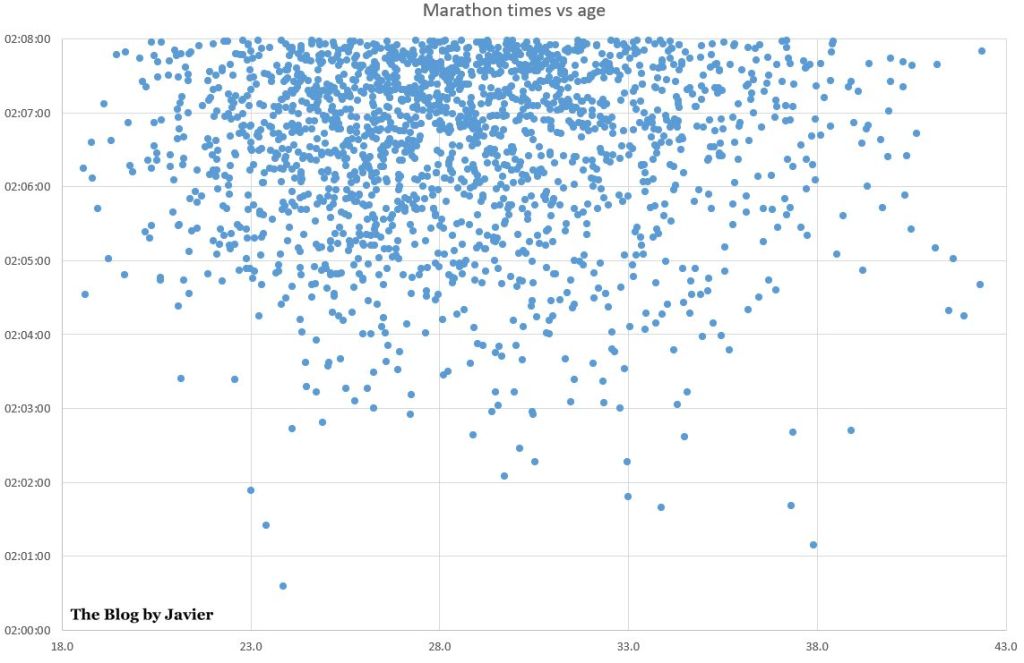
Most of the times below 2h08′ are achieved between 23 and 33 years old, but indeed most of the best ones are achieved between 28 and 39 years old, with the exception of the 3 marathons ran by Kelvin Kiptum, including his current world record.

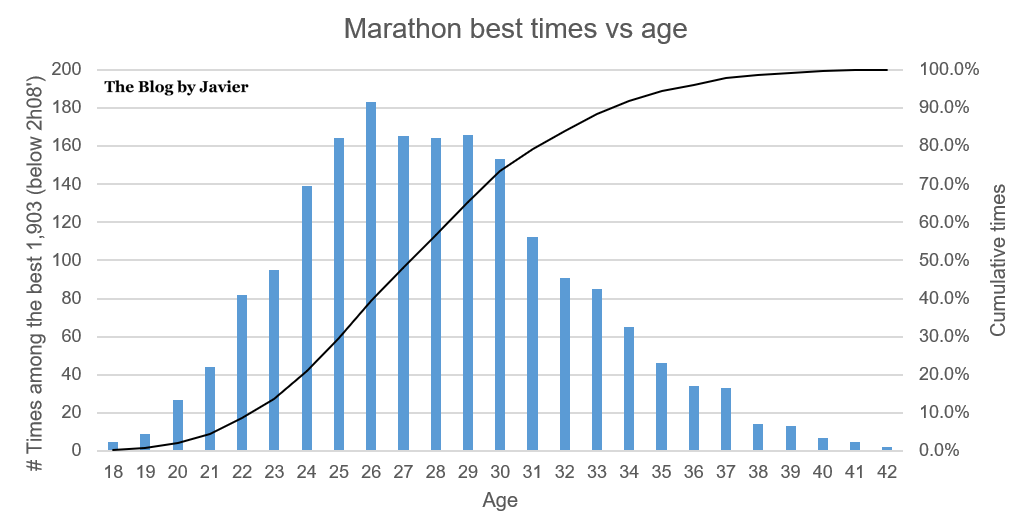
Another interesting chart to relate best times and age is the histogram below. In that one we can see that effectively most of the times below 2h08′ are achieved between 24 and 30 years old, and between 23 and 33 (both included) 80% of those times are achieved.
Leave a comment

Filed under Sports

All-time men’s best pole vault – Olympic Games Paris 2024 – Armand Duplantis

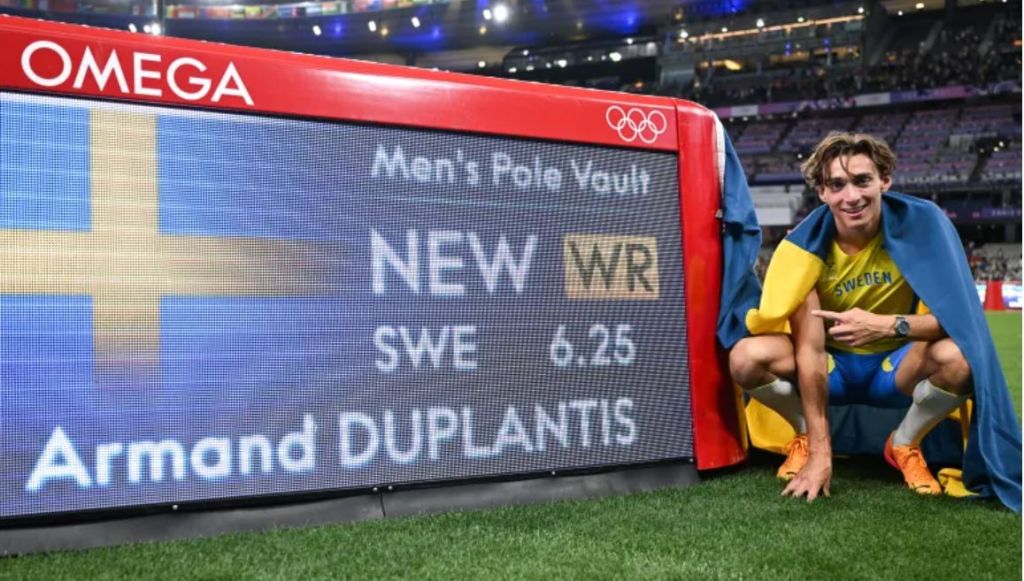
Following the closure of the Olympic Games Paris 2024 a few days ago, I wanted to take a look at the track record of Armand “Mondo” Duplantis, one of the dominant athletes of our times that set a new world record in the pole vault competition with 6.25m. For that purpose I used the website “Track and Field all-time Performances” (maintained since years ago by Peter Larsson).

With the data of all-time men’s best pole vault I plotted the chart below with the best 3,754 jumps (jumps from 5.80m and above) and their dates, highlighting the jumps by Sergey Bubka, Renaud Lavillenie and Duplantis (dark colour for outdoor vaulting, light colour for indoor).

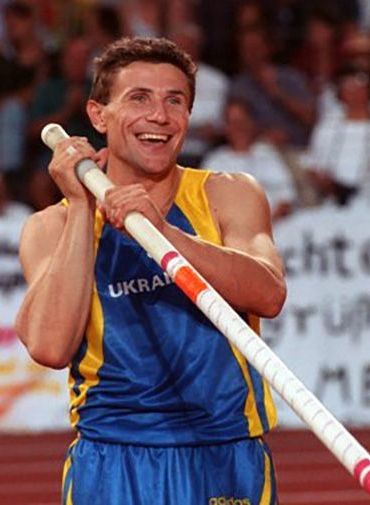
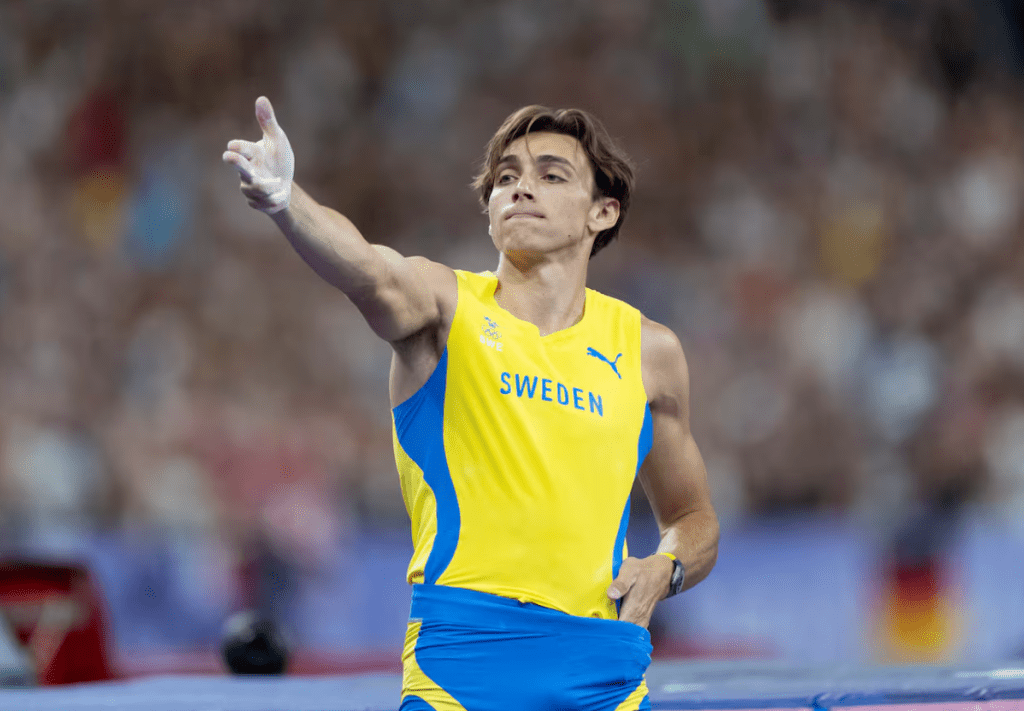
Bubka dominated the sport in the 1980’s and 90’s (first competing for the Soviet Union and later for Ukraine) when he set up to 35 world records (17 outdoor and 18 indoor), won 6 gold medals at the World Championships and 1 at the Olympic Games. Lavillenie also won a gold medal at the Olympics in London and won several World Indoor Championships (among other medals) and set an indoor world record (which was the absolute record for 6 years). Duplantis, competing for Sweden, at the young age of 24 has already won 2 gold medals at the Olympics (Tokyo and Paris) and 2 World Championships (among other medals) and has already set 9 world records (6 outdoors and 3 indoors).

Some comments after looking at the chart:

  • Bubka holds 249 of the 3,754 jumps (6.6%) at 5.80m and above
  • Lavillenie holds 271 of the 3,754 jumps (7.2%) at 5.80m and above
  • Duplantis holds 259 of the 3,754 jumps (6.9%) at 5.80m and above
  • Of those jumps of 6.00m and above (222 jumps):
    • Bubka holds 46 of the 222 jumps (20.7%) at 6.00m and above
    • Lavillenie holds 21 of the 222 jumps (9.5%) at 6.00m and above
    • Duplantis holds 86 of the 222 jumps (38.7%) at 6.00m and above
  • If we focus at outdoor jumps of 6.00m and above (134 jumps):
    • Bubka holds 28 of the 134 jumps (20.9%) at 6.00m and above
    • Lavillenie holds 4 of the 134 jumps (3.0%) at 6.00m and above
    • Duplantis holds 57 of the 134 jumps (42.5%) at 6.00m and above
    • 24 men have vaulted outdoors at 6.00m or above, only Bubka and Duplantis jumped 6.08m or above (7 and 14 times, respectively)
Sergey Bubka

Bubka achieved his best jumps when he was between 27 and 30 years old. Duplantis at his 24 years has already twice as many high jumps as Bubka in his entire career. If Duplantis continues his progression up to 27-30 years of age the best is still to come, something that might have been deemed unbelievable for those of us who witnessed Bubka in his prime, but we are now going through the same dominance yet with higher heights and more pronounced (Sam Kendricks, silver at the Olympics in Paris, achieved 5.95m… 30cm less than Duplantis!).

Leave a comment

Filed under Sports

All-time men’s best 400m hurdles – Olympic Games Tokyo 2020

Following the 400m hurdles final race of the Olympic Games Tokyo 2020, four days ago, a race that has been qualified by some as the best Olympic race in history, I had the curiosity to take a close look at how both the winner and world record holder, Karsten Warholm, and the runner up, Rai Benjamin, had arrived to the competition and what was their track record in the past. For that purpose I used the website “Track and Field all-time Performances” (maintained since years ago by Peter Larsson).

With the data of all-time men’s best 400m hurdles times I plotted the chart below with the best 3,720 times (times below 49 seconds) and their dates, highlighting the times by Edwin Moses (the legend champion from the 1970s and 1980s, when he won the gold medal in two Olympics and two World championships, set the world record twice, and went unbeaten for a whole decade between 1977 and 1987 winning 107 competitions and 122 races in a row), Kevin Young (who won the event in the Olympic Games of 1992 establishing a new world record and being the first person to run the distance below 47 seconds, a record that held until a month ago), Rai Benjamin and Karsten Warholm.

Comments:

  • Of the fastest 102 times, those below 47.6″:
    • Edwin Moses achieved 20
    • Kevin Young achieved 5
    • Rai Benjamin achieved 10
    • Karsten Warholm achieved 14
    • Alison dos Santos (bronze in the Tokyo final) achieved 6
    • Kyron McMaster (4th in Tokyo) achieved 3
    • Abderrahmane Samba (5th in Tokyo) achieved 10
  • 43 of those 102 were achieved by 5 of the 8 runners in the starting line in Tokyo.
  • It took nearly 9 years for Kevin Young to beat Edwin Moses’ record by 0.24″.
  • It took nearly 29 years for Karsten Warholm to beat Kevin Young’s record, which he did on July 1st 2021, about a month ago, by 0.08″ at a Diamond League event in Oslo.
  • It took just a month for Karsten Warholm to beat again his own world record by 0.76″.

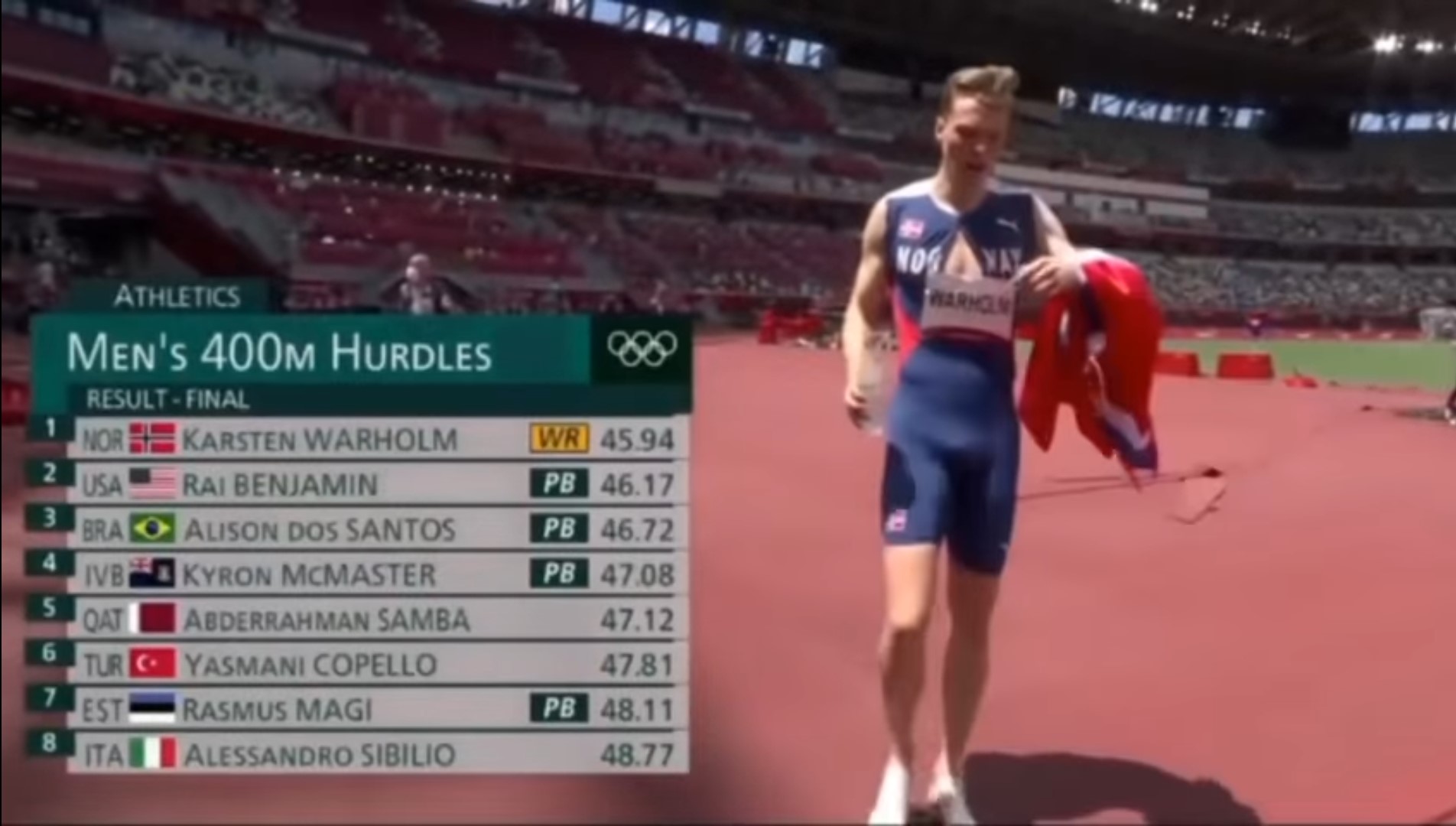
Since 1992 nobody had run below 47″ until the summer of 2018. Between 2018 and 2020, Benjamin, Warholm and Samba did a combined four times between 46.87 and 46.98″. In the last month and a half Benjamin, Warholm and dos Santos have also run below 47″. The first in doing so was Benjamin at the US Olympic Trials on June 26th, when he ran in 46.83″, short of setting a world record. But just five days later at the Diamond League in Olso, Warholm beat the world record with 46.70″ (see that race here). With those times the expectation for the final last Tuesday was quite high, with the roster as in the picture below.

Instead of commenting the race I suggest to review it in Youtube. You can find many videos, for example the one below:

The result of the race: a new world record, 45.94″, first time below 46″ (remember that nobody had run below 47″ between 1992 and 2018). Rai Benjamin, silver medal, also ran below the previous world record. Alison dos Santos, bronze medal, ran in 46.72″ which would have been a world record just 5 weeks before. Both Benjamin and dos Santos set continental records. Other 3 runners in the final set their respective national records: McMaster, Copello (matching his previous best and national record) and Magi.

In other words, six of the eight runners run their best times and set either a national, continental or world record. That is why some have called this race the best Olympic race in history.

Leave a comment

Filed under Sports

All-time men’s best high jump – Olympic Games Tokyo 2020

Following the unusual ending of the men’s high jump event in the Olympic Games Tokyo 2020 a few days ago, with images of an official explaining to Mutaz Essa Barshim and Gianmarco Tamberi the options they had to end the final, I was curious as to how both of them had arrived to the competition and what was their track record in the past. For that purpose I used the website “Track and Field all-time Performances” (maintained since years ago by Peter Larsson).

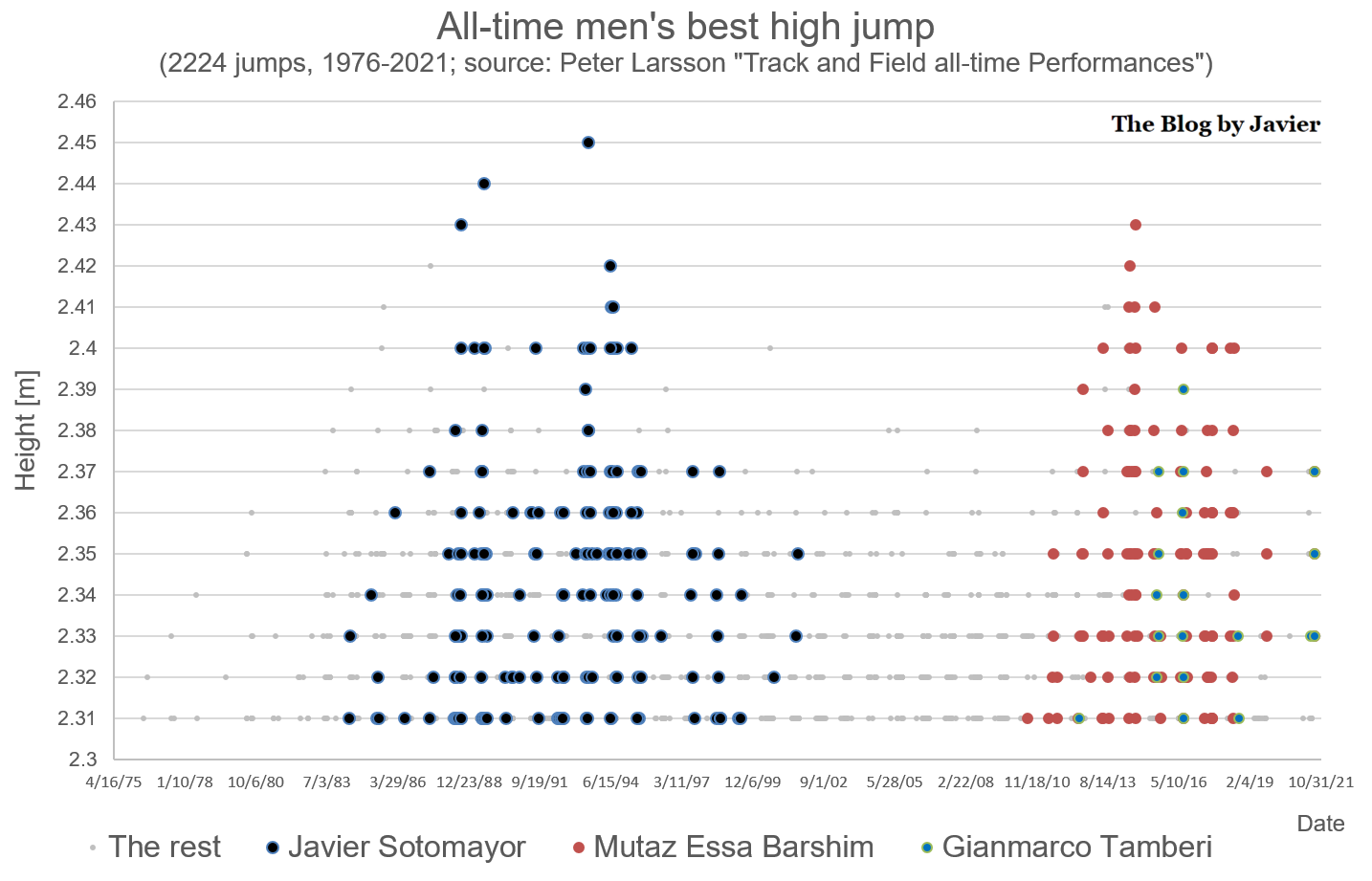
With the data of all-time men’s best high jumps I plotted the chart below with the best 2,224 jumps (jumps from 2.31m and above) and their dates, highlighting the jumps by Javier Sotomayor (who still holds the record), Barshim and Tamberi.

Comments:

  • Sotomayor holds 189 of the 2224 jumps (8.5%) at 2.31m and above.
  • Barshim holds 128 of the 2224 jumps (5.8%) at 2.31m and above.
  • Tamberi holds 19 of the 2224 jumps (0.9%) at 2.31m and above.
  • Of those jumps of 2.38m and above:
    • Sotomayor holds 25 of the 105 jumps (23.8%) at 2.38m and above.
    • Barshim holds 24 of the 105 jumps (22.9%) at 2.38m and above.
    • Tamberi holds 1 of the 105 jumps (1.0%) at 2.38m and above.
  • At higher heights the dominance of Sotomayor and Barshim is more relevant.

Tamberi had previously won some Europan championships medals and a World Indoor Championship medal in 2016 which is also the year he jumped is best jump of 2.39 in Monaco. Ever since, he had jumped at or below 2.33m until last Sunday.

Barshim had previously won 3 medals in the World Outdoor Championships, including the gold medal in the last two, and had also won two Olympics Games medals, bronze and silver, at the previous two Games in London and Rio de Janeiro. He has the best ever jumps after Sotomayor. While in 2019 he had also jumped 2.37m the last time he had jumped above that height was in 2018, when he jumped 2.40 twice and 2.38m.

Looking at that background, I can imagine that, when asked by the official about what they intended to do, Barshim wanted to secure the gold medal that had escaped him in the previous two Olympic Games (the gold was won in London with 2.33m and in Rio de Janeiro with 2.38m; heights that Barshim in theory dominated). On the other hand, Tamberi must have thought that he had little chance against Barshim, even if they had both already missed three times attempts over 2.39m, looking at how each one had been jumping in the past years.

Leave a comment

Filed under Sports

Usain Bolt and Justin Gatlin; 100m and 200m

In the previous two posts I compared Usain Bolt and Carl Lewis as 100m and 200m sprinters. For that comparison I used as a source a website with all time best performances in track and field (maintained by Peter Larsson). I will use the same source to make a more relevant comparison nowadays: Usain Bolt and Justlin Gatlin, both in 100m and 200m.

Best ever ~800 100m times, focus on Usain Bolt and Justin Gatlin.

Best ever ~800 100m times, focus on Usain Bolt and Justin Gatlin.

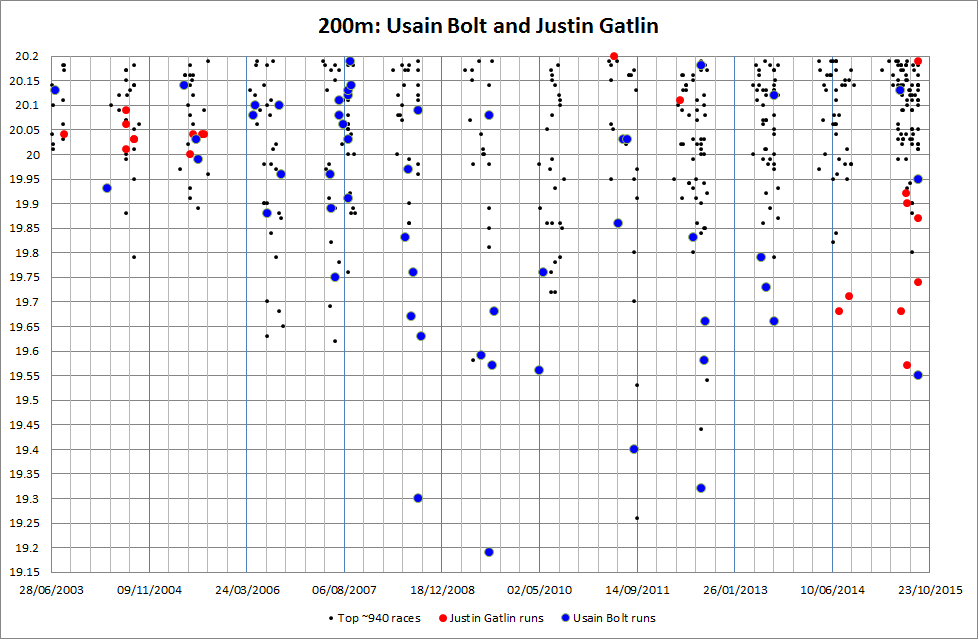
Best ever ~950 200m times, focus on Usain Bolt and Justin Gatlin.

Best ever ~950 200m times, focus on Usain Bolt and Justin Gatlin.

You can see in both graphics why there was so much attention in the races of this summer Beijing World Championship and expectation with the possibility of Bolt being defeated by Gatlin. 2014 wasn’t a good year for Bolt due to injuries. Gatlin ran more often and faster that year. The year of 2015 had started in the same way, with Gatlin running more often and faster, to the point of beating his personal bests in both 100m and 200m (twice).

  • The best 5 times in 100m of the year belong to Gatlin, yet the 6th best time made Bolt the World Champion.
  • Of the best 4 times in 200m of the year, 3 belong to Gatlin, yet the Bolt managed the best time (better than Gatlin’s personal best) on the final and that made Bolt the World Champion.

Note: the times included here exclude wind-aided races and times excluded due to doping.

Leave a comment

Filed under Sports

200m: Usain Bolt and Carl Lewis

Usain Bolt has recently won the gold medal in the 200m of Beijing Athletics World Championships, with a time of 19.55″, that is the 10th best ever time.

In the previous two posts, I wanted to highlight the size of the figure of Carl Lewis as a long jump athlete (here) and to compare both Usain Bolt and Carl Lewis as 100m sprinters (here). I want to recap here the following two graphics:

Best ever ~180 long jumps, focus on Carl Lewis.

Best ever ~180 long jumps, focus on Carl Lewis.

Best ever ~800 100m times, focus on Carl Lewis and Usain Bolt.

Best ever ~800 100m times, focus on Carl Lewis and Usain Bolt.

Recall the following lines from those two posts, on the long jump:

Now, in 2015, 18 years later, of the best 184 long jumps ever (all those at or above 8.50m), 55 of those jumps (a 30%) correspond to Carl Lewis. I let you to qualify the feat.

The runs (100m and 200m) Carl Lewis did in the 80s would probably not win him any gold medal today; his jumps would still win him almost everygold medal today.

On the dash 100m:

[…] on all the times a runner has *ever* finished the 100m below 9″90, 187 times. Of those,

  • 32 times correspond to Usain Bolt (17%), and
  • just 1 to Carl Lewis.

In this post, I want to compare Usain Bolt and Carl Lewis as 200m sprinters. I will use as a source again the website with all time best performances in track and field (maintained by Peter Larsson).

Best ever ~950 200m times, focus on Carl Lewis and Usain Bolt.

Best ever ~950 200m times, focus on Carl Lewis and Usain Bolt.

In the previous graph you can notice that times in the 200m have significantly improved since the 80s and 90s. Usain Bolt is today way faster than Carl Lewis was in the 80s.

If we want to focus not on the best ~950 times, but in a similar amount of marks as in the long jump and the 100m above, we can just focus on all the times a runner has *ever* finished the 200m below 19.95, 190 times. Of those,

  • 26 times correspond to Usain Bolt (14%), and
  • just 7 to Carl Lewis (4%).

Compare that 14% of best times of Usain Bolt in the 200m with the 17% in the 100m. Despite his telling that the 200m is his preferred distance, his dominance of the 100m has been even greater. Anyway, compare that to the 30% of long jumps today (while he retired 18 years ago) of best long jumps of Carl Lewis.

In relation to Lewis, he retains 7 of the best 190 200m times (4%) while only 1 of the best 184 100m times… who would have suspected that? We tend to remember Lewis as more of a 100m sprinter and Bolt more of a 200m…

… and it seems that Lewis was first a jumper, then a 200m sprinter (despite of never holding the world record of any of those) and then a 100m sprinter. Whereas it seems that Bolt is a more distinguished 100m sprinter despite of what he likes best.

2 Comments

Filed under Sports

100m: Usain Bolt and Carl Lewis

Usain Bolt has recently won the gold medal in the 100m of Beijing Athletics World Championships, with a time of 9″79, that is the 34th best ever time.

In the previous post, I wanted to highlight the size of the figure of Carl Lewis as an athlete, but a long jump athlete. I want to recap here the following graphic:

Best ever ~180 long jumps, focus on Carl Lewis.

Best ever ~180 long jumps, focus on Carl Lewis.

Recall the following lines from that post:

Now, in 2015, 18 years later, of the best 184 long jumps ever (all those at or above 8.50m), 55 of those jumps (a 30%) correspond to Carl Lewis. I let you to qualify the feat.

The runs (100m and 200m) Carl Lewis did in the 80s would probably not win him any gold medal today; his jumps would still win him almost every gold medal today.

In this post, I want to compare Usain Bolt and Carl Lewis as 100m sprinters. I will use as a source again the website with all time best performances in track and field (maintained by Peter Larsson).

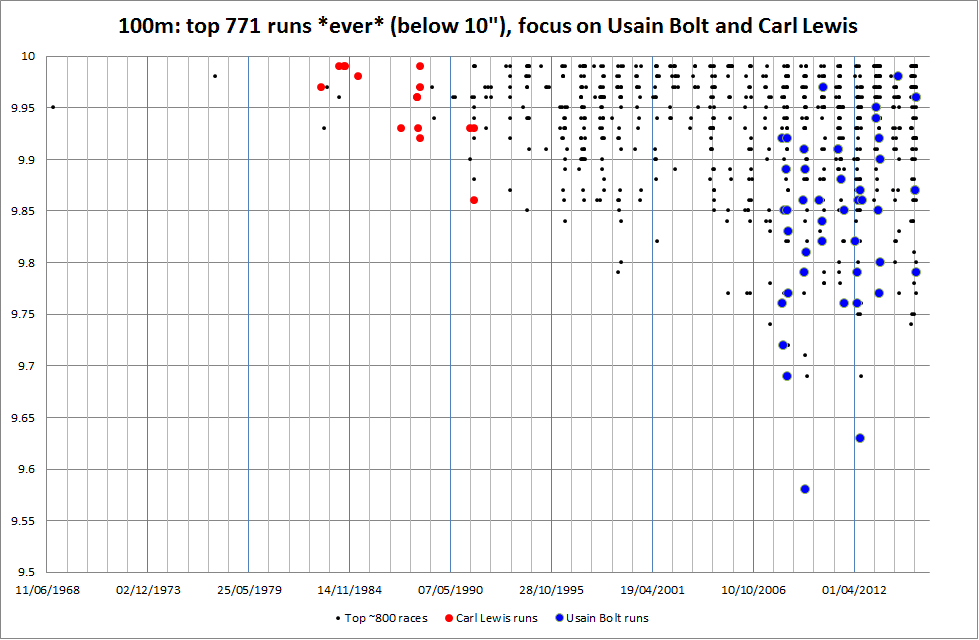
Best ever ~800 100m times, focus on Carl Lewis and Usain Bolt.

Best ever ~800 100m times, focus on Carl Lewis and Usain Bolt.

In the previous graph you can notice that times in the 100m have significantly improved since the 80s. Usain Bolt is today way faster than Carl Lewis was in the 80s.

If we want to focus not on the best ~800 times, but in a similar amount of marks as in the long jump above, we can just focus on all the times a runner has *ever* finished the 100m below 9″90, 187 times. Of those,

  • 32 times correspond to Usain Bolt (17%), and
  • just 1 to Carl Lewis.

Compare that 17% of best times of Usain Bolt today (while he is running) with the 30% today (while he retired 18 years ago) of best long jumps of Carl Lewis. That speaks about the size of the figure of Bolt as a sprinter but, again, speaks a great deal about the figure of Lewis as a jumper and also about the different evolution of both events.

3 Comments

Filed under Sports

Carl Lewis, the jumper

I read earlier today an article claiming that Usain Bolt might be the best athlete ever (here, in Spanish). I do not want to dispute that with this post; by the number of olympic and world championship medals he has won and the records he has set, he might be so. However, in that article the author compared Usain Bolt (the runner) with Carl Lewis the runner. However, it happens that Carl Lewis was much more than a runner, he was a long jumper. In this blog post I just want to put into perspective the size of Carl Lewis as a jumper.

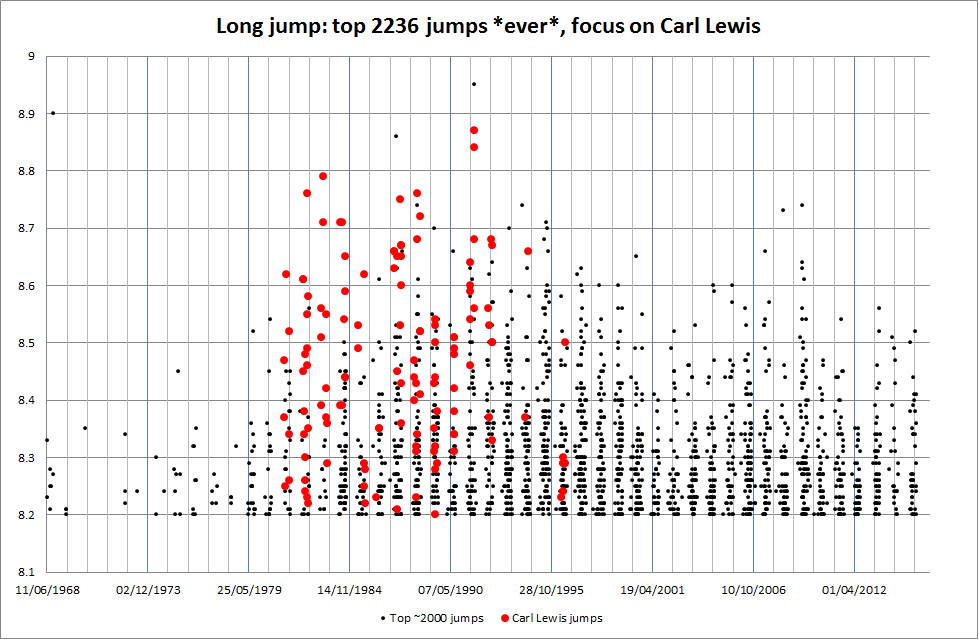
I will again base the analysis on the following terrific website with all time best performances in track and field (maintained by Peter Larsson (1)). In the following two graphics you can see the best ~2200 and the best ~180 long jumps *ever*. The red dots correspond to Carl Lewis’ jumps.

Best ever ~2200 long jumps, focus on Carl Lewis.

Best ever ~2200 long jumps, focus on Carl Lewis.

Best ever ~180 long jumps, focus on Carl Lewis.

Best ever ~180 long jumps, focus on Carl Lewis.

Carl Lewis retired in 1997. His last great competition was the Olympic Games of Atlanta in 1996 (where, by the way, he collected a gold medal with a 8.50m jump at age 35).

Now, in 2015, 18 years later, of the best 184 long jumps ever (all those at or above 8.50m), 55 of those jumps (a 30%) correspond to Carl Lewis. I let you to qualify the feat.

The runs (100m and 200m) Carl Lewis did in the 80s would probably not win him any gold medal today; his jumps would still win him almost every gold medal today.

That was Carl Lewis the jumper.

Finally, after having highlighted the talent of Carl Lewis as a jumper, I wanted to recall that several times along the past years we have read news indicating that Usain Bolt was going to venture into either long jump (here) or 400m (here), he hasn’t done so far (not in big events, at least). This is not a criticism. Without a doubt, he is the best sprinter ever. However, athletics is much more than sprinting… (2)

(1) I already used this magnificent source when I analyzed Rotterdam marathon times, here.

(2) Personally, I would always pick a marathoner ;-).

Edit [28/08/2015]

(3) I believe it would be interesting to share the World Championship long jump competition of 1991, when Mike Powell managed to set a new long jump world record (8.95m), 22 years after Bob Beamon had set the previous one in Mexico DF (8.90). Find the explanation from the Wikipedia here. Despite of losing it, Carl Lewis managed the following four jumps in that competition: 8.91 (wind aided, therefore it doesn’t count for world record and best ever jumps), 8.87, 8.84, 8.68 and 8.56. The first 3 jumps would have won *any* competition in history except 3, including the two world records referred. Unluckily for Lewis, these jumps got him only a silver medal.

(4) Better still, see it here:


2 Comments

Filed under Sports