Tag Archives: Recopa

How does UEFA weigh club honours? (football clubs’ coefficients, 2024 update)

This is an update of a post I wrote 6 years ago (here, in Spanish) explanining how UEFA weighs club honours and now sharing the current (end of 2023/24 season) ranking.

UEFA publishes various rankings of football clubs, football federations and national teams. For that purpose UEFA assigns a series of points according to results achieved in the competitions organized by UEFA itself. From those, one can see at the end of each season the club which reached the highest scoring.

With the scoring of different years, UEFA publishes two different club rankings: the 5-year club ranking and the 10-year club ranking.

The 5-year club ranking is the one that UEFA generally employs to rank the teams (when UEFA publishes the team leading the ranking at any given point, it refers to the team leading that 5-year ranking, not the one with the highest score on that particular year). UEFA also uses the 5-year club ranking at the time of seeding the draw of the different groups of the Champions League.
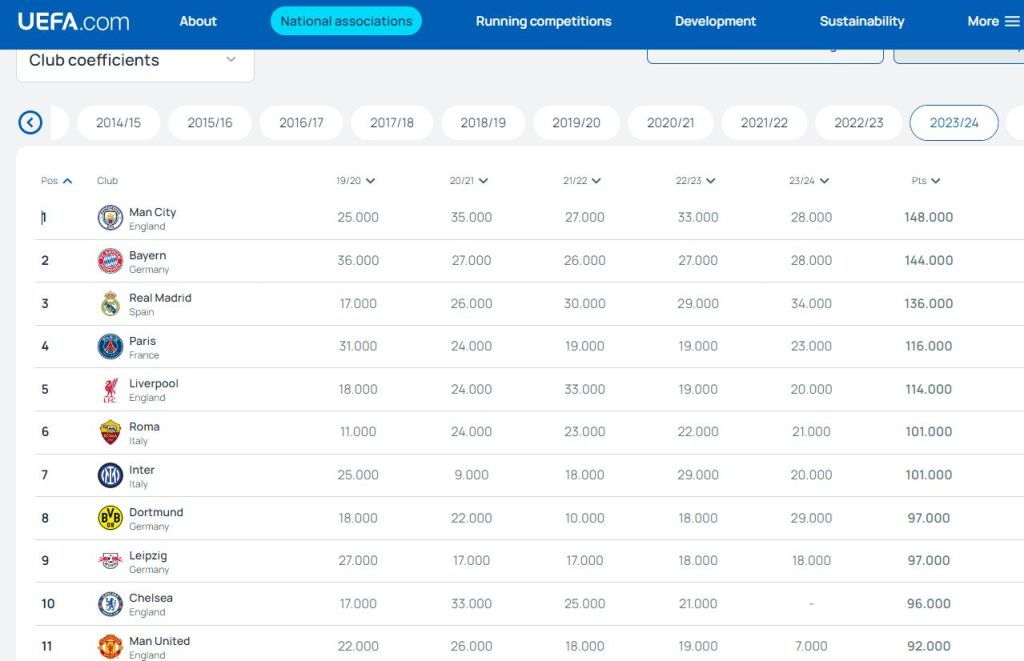
5-year club coefficients (2023/24)

On the other hand, UEFA uses a slightly different 10-year club ranking as one of the criteria in order to distribute the money prizes among the different clubs. To compute that 10-year club ranking UEFA collects the yearly scoring of clubs in the last 10 years, and to that sum it adds another coefficient that UEFA calls “Title“, which is the coefficient I wanted to write about, and that shows the weighing that UEFA does of clubs’ honours.
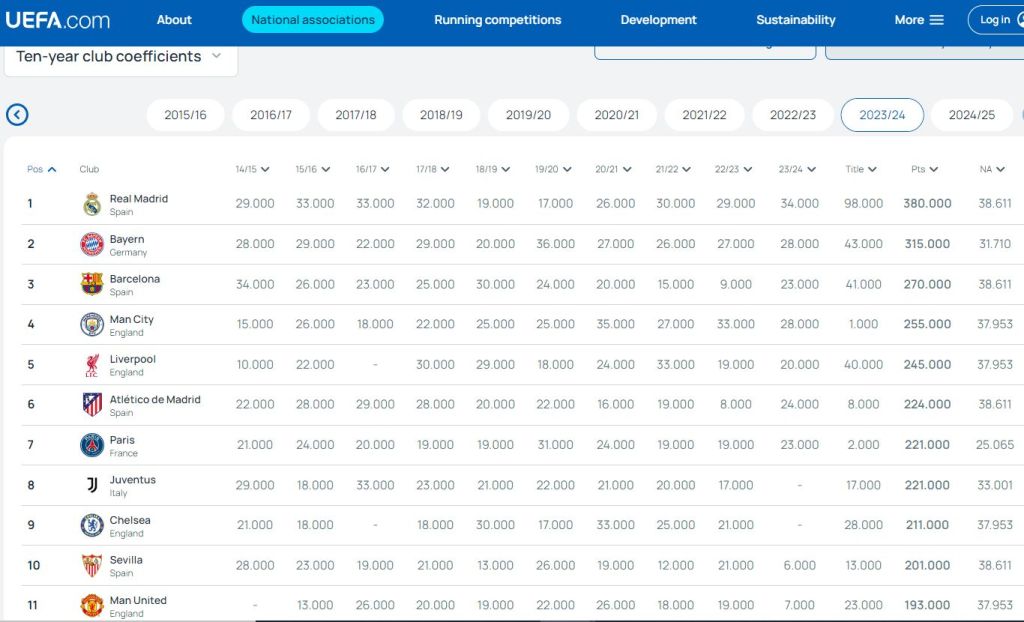
10-year club coefficients (2023/24*)

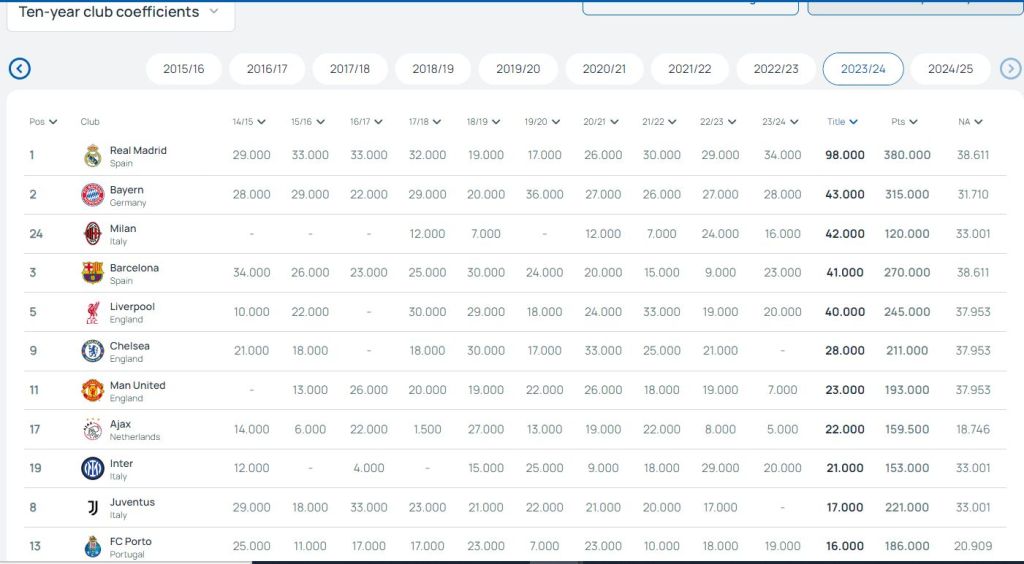
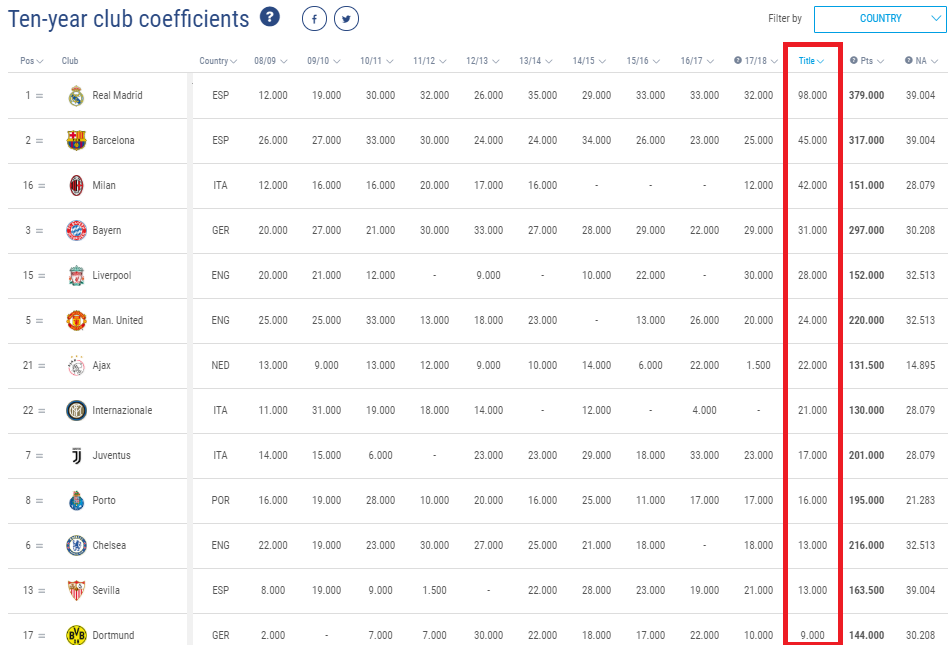
I leave below the the 10-year club ranking sorted by the column “Title:

10-year club coefficients (2023/24*) sorted by the column Title

The table shows that Real Madrid leads the “Title” ranking with 98 points, followed by Bayern Munich with 43, AC Milan with 42 and Barcelona with 41…

How does UEFA compute that “Title” coefficient?

  • UEFA Champions League / European Cup:
    • 12 points for those won in the last 5 seasons, i.e., 2019/20 to 2023/24
    • 8 points for those won since the creation of the Champions League up to 6 seasons ago, i.e., 1992/93 to 2018/19
    • 4 points for the European Cups won from 1955/56 to 1991/92
  • European Cup Winners’ Cup / UEFA Cup / UEFA Europa League:
    • 3 points for those won in the last 5 seasons, i.e., 2019/20 to 2023/24
    • 2 points for those won since the creation of the Champions League up to 6 seasons ago, i.e., 1992/93 to 2018/19
    • 1 point for the Cup Winners’ Cup / UEFA Cup won from 1960/61 or 1971/72 to 1991/92
  • UEFA Super Cup does not compute for UEFA Title coefficient (if it did, Real Madrid leads that ranking as well with 6 titles)
  • Intercontinental Cup / FIFA Club World Cup do not compute for UEFA Title coefficient (if they did, Real Madrid leads that ranking as well in both of them with 3 and 5 titles, respectively)
  • National competitions do not compute for UEFA Title coefficient

After having gone through the explanation, some comments to it:

  • UEFA has not updated this Title since the end of 2021/22 season; you can see that Manchester City’s Title coefficient shows 1 point only, which is related to the European Cup Winners’ Cup they won in 1969/70 and does not include the 12 points for the Champions League won in 2022/23. Similarly, Real Madrid updated figure should be 106 points, as you can see in the table below
  • Among the competitions that UEFA organizes it weighs the Champions League as 4 times more important than either the UEFA League, or the extint UEFA Cup and European Cup Winners’ Cup
  • UEFA applies a time weighing as described above: titles in the last 5 seasons get a given amount of points, titles since 1992/93 to 6 years ago get 2/3 of those points and everything older than 1992 get 1/3 of those points
    • That time weighing makes teams having won titles more recently (Chelsea, 6 major titles) be better placed than others with older titles (Juventus, 6 major titles)
  • The extint Inter-Cities Fairs Cup (played between 1955 and 1971) does not compute for UEFA Title coefficient as it was not organized by UEFA and there were not qualifying criteria to take part in it. Interestingly enough, this competition is much talked about in Spain to make up for the lack of sufficient honours on the part of Barcelona when compared to Real Madrid

Which European club has the largest honours sheet?

The answer is clear, Real Madrid. So clear that the Title coefficient it has (either the outdated 98 or the updated 106, see below) is as high as the sum of the coefficients of all the other clubs that played the Champions League finals in the last 4 seasons (2020/21 to 2023/24) combined: Chelsea (27), Manchester City (13), Liverpool (36), Internazionale Milan (21) and Borussia Dortmund (9).

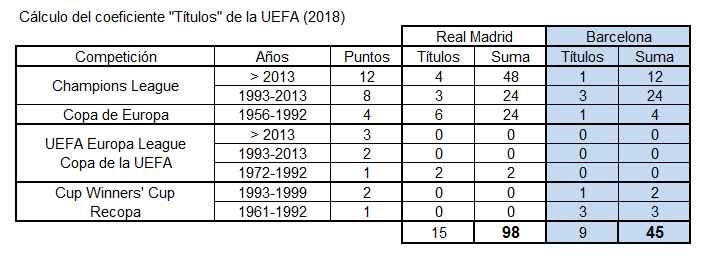
To conclude, I leave below a table where I show the computation to get the coefficients for the top 4 clubs (Real Madrid, Bayern, Milan and Barcelona) with the results up to the end of the 2023/24 season. I invite the reader to compute the updated figures for City, Chelsea or Liverpool that I referred to above.
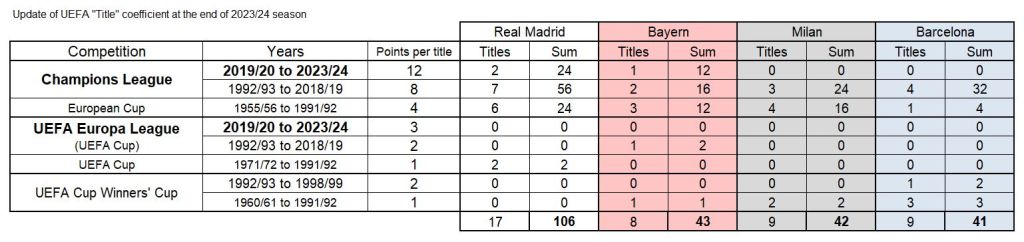
Title coefficient computation, updated to the end of 2023/24 season for the top 4 clubs

Leave a comment

Filed under Sports

Cómo pondera la UEFA el palmarés de los clubes

Ésta es una pequeña entrada futbolera para compartir una curiosidad sobre cómo pondera la UEFA el palmarés de los clubes dentro de los rankings de clubes que realiza la UEFA.

La UEFA publica varios rankings de clubes y asociaciones de futbol (federaciones de cada país). Para realizar los ranking de clubes, la UEFA asigna una serie de puntos según los resultados conseguidos en los partidos de las competiciones que organiza la propia UEFA. A partir de ellos, cada año se puede ver cuál es el club europeo que ha obtenido una mayor puntuación.

A partir de esas puntuaciones, la UEFA publica un ranking a 5 años y un ranking a 10 años. El ranking a 5 años es el que la UEFA utiliza, por ejemplo, para distribuir a los clubes en los diferentes bombos en los sorteos. También es el que utiliza para publicar cada año cual es el club que lidera el ranking UEFA (que no es necesariamente el que haya obtenido más puntos en ese año de competición, sino en los últimos 5 años).

Por otro lado, la UEFA aclara en su web que el ranking a 10 años sólo lo usa para la distribución de los premios en metálico a todos los clubes participantes en sus competiciones. Para realizar ese ranking a 10 años la UEFA utiliza la puntuación que los clubes han obtenido en cada uno de los últimos 10 años y a esa cifra le añade un coeficiente al que llama “títulos”. Y es sobre este coeficiente sobre el que quería escribir.

Primero dejo debajo el ranking a 10 años ordenado por la columna “títulos”:

Ten-year_UEFA_club_coefficient_2018.06.19_filtered by Title

En la tabla se puede ver que lo lidera el Real Madrid con un coeficiente de 98, al que le sigue el Barcelona con 45, el AC Milan con 42, Bayern con 31…

¿Cómo calcula ese coeficiente la UEFA?

  • Copa de Europa / UEFA Champions League:
    • Ganadas en los ultimos 5 años (2014-2018): 12 puntos.
    • Ganadas desde la creación de la Champions League hasta hace 6 años (1993-2013): 8 puntos.
    • Ganadas antes de la creación de la Champions League (1956-1992): 4 puntos.
  • Recopa (Cup Winners’ Cup) / Copa de la UEFA / UEFA Europa League :
    • Ganadas en los ultimos 5 años (2014-2018): 3 puntos.
    • Ganadas desde la creación de la Champions League hasta hace 6 años (1993-2013): 2 puntos.
    • Ganadas antes de la creación de la Champions League (1961-1992): 1 punto.
  • UEFA Super Cup: no suman para el cómputo del ranking de títulos UEFA.
  • Intercontinental Cup / FIFA Club World Cup: no suman para el cómputo del ranking de títulos UEFA.
  • Competiciones nacionales: no suman para el cómputo del ranking de títulos UEFA.

Comentarios:

  • La UEFA, entre las competiciones que ella organiza, da un valor a la Champions League 4 veces superior que a la antigua Recopa o a la UEFA Europa League.
  • La UEFA aplica una ponderación temporal:
    • Los títulos conseguidos entre 1956 y 1992 tienen un valor hoy de un 33% de los conseguidos en los últimos 5 años (4 vs 12 para la Copa de Europa; 1 vs 3 para la UEFA).
      • Por tanto, la Copa de Europa del “Dream Team” (Barcelona FC en 1992, en “color”) para la UEFA tiene el mismo valor temporal que uno de los “botijos” que ganó el Real Madrid de Di Stefano en los años 1950 (“en blanco y negro”).
    • Los títulos conseguidos entre 1993 y 2013 (para el ranking de 2018) tienen un valor hoy de un 67% de las conseguidas en los últimos 5 años (8 vs 12).
  • La extinta Copa de Ferias (Inter-Cities Fairs Cup), a la que en España se le da mucha relevancia, no computa para la UEFA. No era organizada por la UEFA, no había criterios de clasificación para la misma…
  • La Supercopa de Europa: no suma. Un torneo veraniego, que es mejor ganarlo que perderlo, pero que para la UEFA no tiene mayor relevancia que la fiesta de ese día.
  • La Intercontinental Cup / FIFA Club World Cup : no suma. Para la UEFA es un torneo pre-navideño, que es mejor ganarlo que perderlo, pero que para la UEFA no tiene mayor relevancia que la fiesta de ese día.
  • El palmarés europeo del Sevilla (13) es, para la UEFA, superior al del Atlético de Madrid (8). No obstante, el Atlético de Madrid en 2018 tiene una posición en el ranking (4º con 230 puntos) bastante superior al Sevilla (13º con 163.5 puntos), dado que a pesar de no haber ganado ninguna Champions League (palmarés), sí ha sumado puntos para el ranking por sus buenos resultados obtenidos entre 2014-17.

¿Qué club europeo tiene un mayor palmares de títulos europeos?

La respuesta es clara, el Real Madrid. Tan clara que tiene un coeficiente por títulos (98), aplicando las ponderaciones de UEFA, igual que la suma de los coeficientes de Liverpool (28), Juventus (17), Atlético de Madrid (8) y Barcelona juntos (45), es decir igual que todos los otros cuatro finalistas de la Copa de Europa en los últimos 5 años (2014-2018).

Por último, debajo dejo una tabla clara donde muestro el cálculo de los coeficientes de Real Madrid y Barcelona.

Calculo_coeficiente_titulos_2018


1 Comment

Filed under Sports