I recently finished the book “Born to Run“, by Christopher McDougall a runner and author who has collaborated with several magazines including Men’s Health. The book, published in 2009, has recently become a classic reading for runners.
The main thesis of the book is the support of what is called the Endurance running hypothesis, which explains some human evolution traits as being adaptations for long distance running, suggesting that early humans hunted down animals by running after the prey till it died of exhaustion.
Prior to reading the book I had watched some years ago the following TED talk [15’52”] from the author in which he explains the same thesis.
I have to admit that after listening to the talk I was quite sceptic and became somewhat reluctant to the reading of the book. It has been only years after that I was curious enough to give it a try. Now, having completed it, I have to say that the book is quite entertaining and the writing style of McDougall makes it enjoyable.
The other main theme of the book is the approach to the Tarahumara people, native American indians living in the North West of Mexico, which are known for their endurance running.
The book ends with the first Copper Canyon Ultra Marathon, run in 2003 over 51 miles, organized by Micah True (Caballo Blanco) and gathering several Tarahumara natives and some elite American ultramarathon runners. In previous chapters, the author introduces all of the characters that ultimately will take part in the race along some other thesis such as the vegan diet and barefoot running, which I continue to be sceptic of.
What I appreciated most about the book was the vivid description of epic races that took place in the past like some editions of Leadville Trail 100 or the already mentioned Copper Canyon Ultra Marathon, the getting to know those races or the Western States, the Badwater Ultramarathon (through the Death Valley), being introduced to both some legendary Tarahumara runners (Manuel Luna, Arnulfo…) or Western ones such as Scott Jurek, Ann Trason, Matt Carpenter, etc.
Thus, I would recommend the book as an entertaining read and motivating one for someone who is into running even if I remain sceptic of some of the thesis if defends.
While reading the tourist guide about California in preparation of our honeymoon, Luca discovered the race “Bay to Breakers” in San Francisco. We checked the website, the dates, we saw it was going to take place during our stay and so I subscribed to it.
For those who haven’t heard about it, Bay to Breakers is more than just a race. It is a city event. A party that has been going in San Francisco since it was first celebrated in the year 1912, partly to boost the city’s morale after 1906 earthquake. This year they celebrated 102nd edition. Bay to Breakers obtained the Guinness World Record as the largest footrace in 1986 with over 110,000 runners, while today they count with between 60 to 80 thousands. Another fun fact: it is the longest consecutively race in the world (not having changed length nor course along these 100 years).
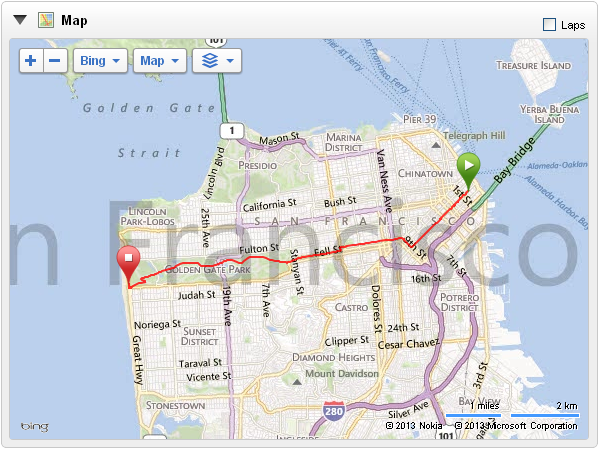
The race is a kind of carnival, very much like the San Silvestre Vallecana in Madrid in New Year’s Eve. It goes from one side of San Francisco, Embarcadero (in Howard street), to the other by the Pacific Ocean, after 12 kilometres (see the map here, PDF).
The atmosphere was great, despite of the bombing in the Boston marathon having taken place just a month beforehand, for which we observed a minute of silence prior to the race in memory of the victims.
Most of the participants were wearing some costumes, perhaps more than in the San Silvestre in Madrid, as the weather is milder at this time of the year.
Not knowing the circuit nor the streets, my intention was just to run the 12 kilometres in less than 1 hour, that was the time I had indicated in order to start from one of the front corrals. In the end, I felt quite good running, even during the climb up in Hayes Street Hill I kept up running (I only needed to make a quick stop by some urinary at the 4 km :-)).
Bay to Breakers circuit.
The views of the race were especially good at the beginning while running along the civic center area, where most of the cheering crowd was, and then at the Golden Gate Park, which was also the longest part of the race. However, in the final kilometres there weren’t many people cheering, which is the only weak point that I see of this race in the comparison to the San Silvestre Vallecana in Madrid.
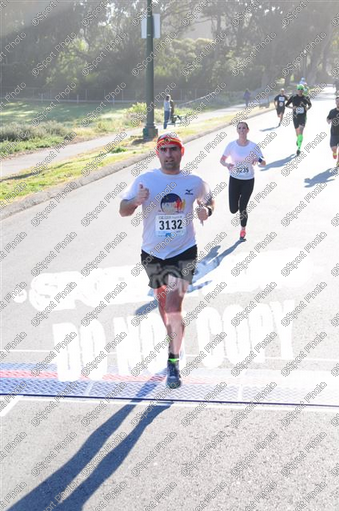
Having pushed hard in the last 4 kilometres where the profile was descending to the sea-shore, finishing with a sprint after a turn by the Dutch mills of the park, I finished in 58 minutes, two minutes below my initial target. A very good experience for my first race in the USA.
Finishing.
One final fun fact: at some points in the race I encountered groups of runners that were somehow chained to one another. I found it strange but not so much, as I have seen runners pulling a chariot, dressing in all kinds of costumes in coordination with other runners, etc. Only after having finished, I learnt that these were centipedes!
There is a special classification for centipedes, which are teams of 13 runners attached to one another. In fact the record of the Centipedes category (LinkedIn 2012) is 36’44”, which is over 1 minute faster than the best ever women time and way faster than I would ever dream to accomplish!
—
P.S.: For the San Silvestre team: shall we go for centipede team next time?
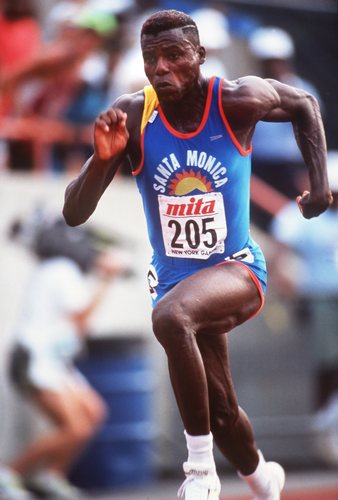
To some of you the initials SMTC or the name Santa Monica Track Club won’t ring any bell. Some others will immediately recognize the name of the athletics or “track and field” club in which some of the all time best athletes ran, such as Carl Lewis, Leroy Burrell, Michael Marsh, and many others.
When preparing the planning of our honeymoon, and since I was going to be running some days throughout it due to the preparation for San Diego marathon, I thought it would be nice to go and check SMTC and see where did they train and do a training session there myself.
I checked the website of the club but it did not help much. However, searching in different forums in the web, I found out that the club is not going through the best of the times struggling to find sponsors. The coach, Joe Douglas, is still the same one who prepared Carl Lewis. They normally trained in either in the Santa Monica College track (in the “Corsair Stadium”) and in Ocean Avenue, at a park by the beach, and they seemed to keep training in those places.
Then, I contacted the Santa Monica College faculty members in charge of the sports installations to see if I could use the track for training. Given the hours in which I planned to train (between 6 and 8 am) I obtained permission.
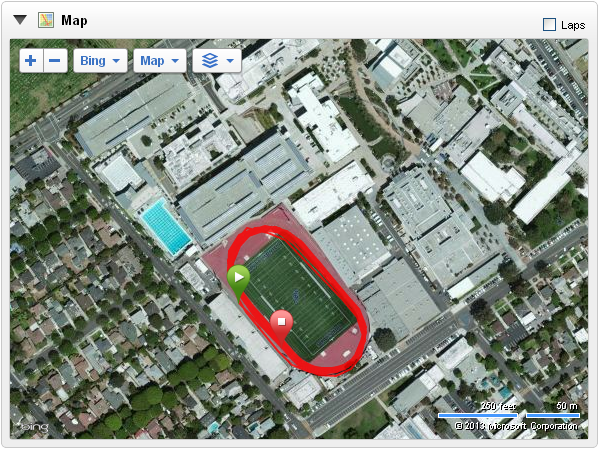
On May 15, Luca and I set out early in the morning for the track, where I did a 10 kilometre training surrounded by several other people running, walking or warming up to practice other sports.
Training session at SMC.
It was a good experience and I am happy to have checked it out. However, it was a bit disappointing to see no memory, no sign, no trace of what glory that place lived not so long ago (ok, between 25 to 30 years ago). When I think of the legend that Carl Lewis is in athletics, I am puzzled that they do not show any pride of him.
This slideshow requires JavaScript.
Another thing that I missed was finding a t-shirt of the SMTC. I searched in various local shops but I didn’t find any. I learnt in some of them that Nike is selling a cotton replica (not a technical t-shirt) to commemorate it, however I didn’t find it in the stores, only in the online shop. I may buy it at some point as my personal and private homage to the SMTC of the ’80s.
When planning our honeymoon, with main destination California, it early became clear that other national parks were optional but the must visit would be the Sequoia National Park.
The schedule of the trip was tight and we were not up to long walks or hiking routes, however, with a good map and a car we could reach many of the sights in the west part of the park (be aware that within the park there are no gas stations, so you better fill up the tank beforehand).
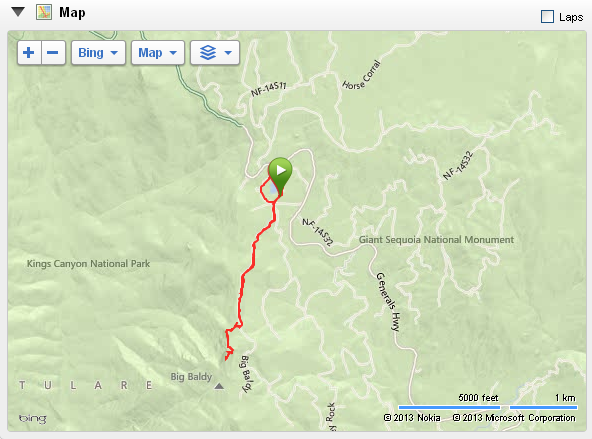
We slept over at Montecito Sequoia Lodge and before breakfast I took the opportunity to run in the forest. It wasn’t a long run, just 8km, but it was wonderful though the climbing part was tough as I went up until Big Baldy (2,503m) where the 360º sights of snow-covered mountains and valleys were superb (it’s a pity that I did not take the photo camera for that morning run).
Run from Montecito Lodge to Big Baldy.
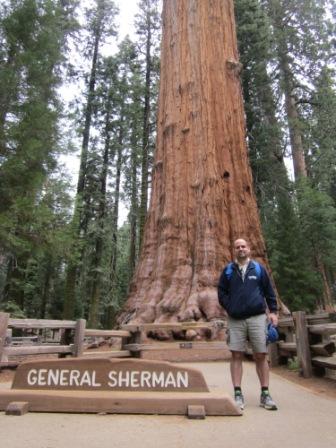
After breakfast, we spent the day driving through the park seeing most of the highlights of the park and dozens if not hundreds of sequoia trees. The biggest one is theGeneral Sherman Tree, if not the oldest nor the tallest nor the widest (as there are other trees claiming those records).
General Sherman Tree.
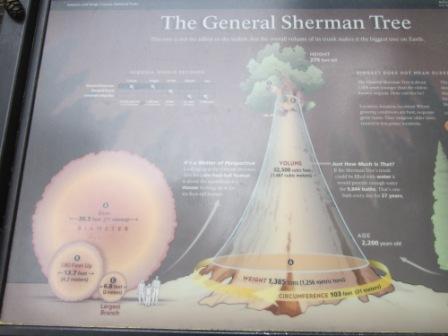
It is the biggest by volume, with 1,487 cubic metres, with an estimated age between 2,300-2,700 years and about 1,900 metric tones of estimated mass (that is 10 times the weight of a blue whale or almost 200 times that of an elephant). You can see some explanation about the tree in the sign post from the park pictured below:
General Sherman tree explanation.
There are many other stunning sequoia trees living or fallen, that make the visit to the park special, even if at the end of the day you end up not deviating the sight from the road to see one more sequoia.
Apart from the trees, there are many other worthy things to do or to see, including the stunning views from Moro Rock, or the different meadows you could walk by.
Enjoy some other pictures we took at the park:
This slideshow requires JavaScript.
—
P.S.: By the way, Luca had just learn before this trip that you need not to go to California to see sequoia trees, but that in the region of Cantabria (Spain) you can see them as well! At the Monte Cabezón.
At the beginning of the year I had just a few objectives in relation to running:
Reach 2,000km run along the year.
Reach personal best times in 10k, half marathon and marathon.
Run 2 marathons.
Now, just one week after mid-year it’s a good moment to take a look at how these months have gone regarding the running part:
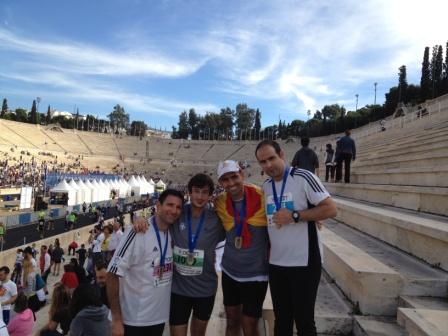
I have already run 2 marathons (Rome and San Diego) though in none of them I was under 3 hours 45 minutes. In Rome I was close to it (a minute slower) but didn’t reach it. I will even run a 3rd marathon this year in Athens next November (health permitting).
So far, even if I have run more races in 6 months than ever (10 races), I only attempted one half-marathon, in La Latina district (Madrid) which is not the best circuit to attempt a PB; I didn’t achieve it. I clocked 1:44:49 vs. the 1:42:30 I did in Toulouse in 2011.
I have run 3 races of 10 kilometres. In the first one of the year I was short of only 6 seconds to beat my PB (46:14) clocking 46:20. One of the other two was a cross and the third one was the Corrida Pedestre de Toulouse, where the distance is not even 10k but 9.64km and despite of that I was not in the rhythm to do any PB.
In relation to the mileage: in the first 6 months I ran 920 km, a bit less than 1,000km, but not a difference that I can’t make up for in the second half of the year.
Some stats to close the post:
920 km run from January 1st to June 30th.
206 km run in races in this time (22.4% of the distance).
86 hours and 58 minutes running in this 6 months.
19 hours and 46 minutes running in races in this time (22.7% of the time –> long trails).
Some weeks ago Luca and I spent a weekend in the Central Massif in France, a plateau the size of Castile and Leon, with an average height of around 600m.
On Friday we went to Chaudes-Aigues where we wanted to spend the saturday in a spa. The village, in the region of Auvergne, has less than 1,000 inhabitants, a couple of hotels and restaurants and its famous for its hot springs. With over 30 different springs starting from 45ºC to 82ºC, the latter is supposed to be one of the hottest ones in Europe (if not the hottest as proudly announced in the signpost close to it).
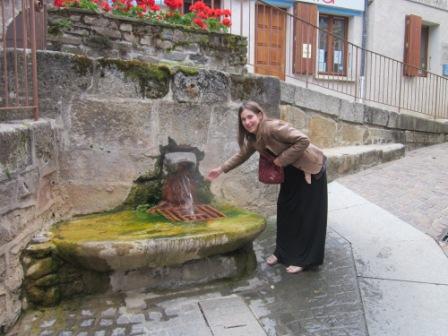
Luca by the 82ºC hot spring in Chaudes-Aigues (arguably the hottest in Europe… the spring as well).
Another curious thing of Chaudes-Aigues is a network of hot water going through private houses built back in the year 1,332, which is still working today though only in those original houses.
On Sunday morning, we woke quite early to cover the distance to Nasbinals, another little commune in the region of Aubrac where I wanted to run a ~18km trail.
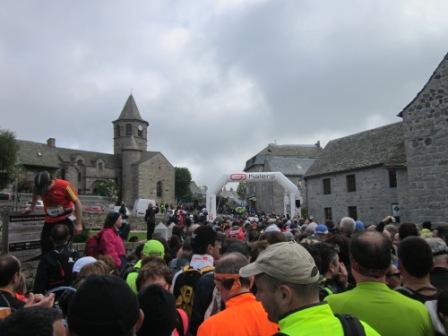
Start line of the trail.
I started the trail in the back of the pack so I took the first kilometres without stress trying to run with the crowd and only overtaking other runners where possible and moderately easy. In that way I could enjoy at some points the views offered by the circuit of the trail, which at points was through closed forests but at some others was through open countryside.
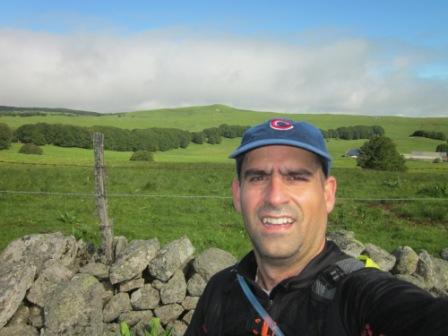
Fields of Aubrac.
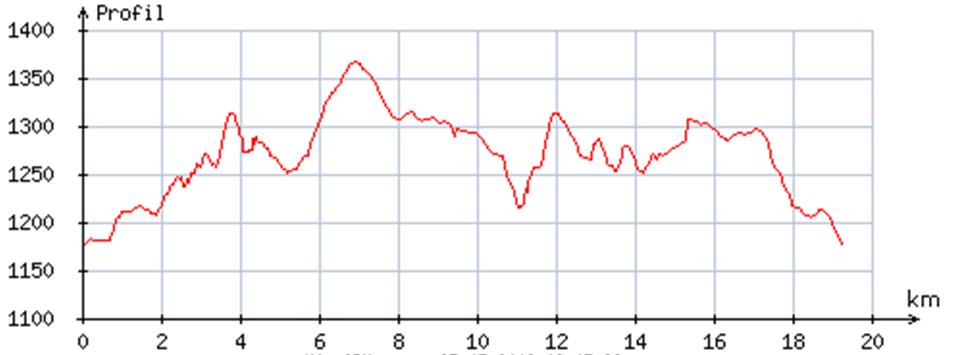
I was running with the water bag and carried some vanilla-flavoured energetic gels, so I did not have any problems with supplies, I didn’t need to use those provided by the organization. One good point of the trail is that the route was very well marked, however, the measuring of the distance wasn’t. The trail was supposed to be 18 kilometres long, and when my GPS-watch indicated 17.75km I saw a signpost saying “Arrivée 2 km”. In the end I measured 19.60 km, but I guess the organization knows this, as in their own web, when showing the altitude profile, the distance they have measured is clearly over 19km.
Profile of the race “Trail des Capucins” (over 19km instead of the announced 18km).
It is not such a big issue, though you may have been managing your strength resources to have a last good kilometre and instead you find out that there are still 2 more to go! It would be as easy as to announce the trail as a 19km or 19.6km instead of 18km.
In the end it took me over 2 hours and 12 minutes, and ended the 255th out of 810 runners. A good run for a Sunday morning.
Even if not of very good quality, you can find below a short video I recorded around the 8th kilometre to give a glimpse of how these trails are:
“The next time you’re in the USA, run a marathon there”. Those were the words from by brother Jaime after he took part in Chicago marathon in 2011.
It has taken me 2 years to go back there. This time for my honeymoon. This did not stop me to follow the advice. I went through a website with all the marathons in California and found that San Diego Rock’n’Roll marathon was taking place on the very last day of the trip. Perfect! That way the muscle soreness of the following days would not interrupt the tourism activities.
June 2nd, the day of the race was only one month and a half after March 17th, when we ran Rome marathon, thus I did not follow any special training plan for this marathon. I just tried to keep the form with which I arrived to Rome by running often, though I didn’t do any series session and only one long run… I paid for that.
The atmosphere was very good but only in some neighbourhoods, in others not so many people cheering the runners. Along the road 163, during the steepest (up to 6% along 1km) and longest (about 4km) climb there was almost nobody. Even if the overall profile is a descent I found the course quite tough. The times of the first 3 runners seem to say the same (2h15 for the winner, 20 minutes more for the second…). The other thing that I didn’t like much was the solid or the lack of abundant and varied solid supplies along the course. I thus only relied on my 3 energetic gels and drinks.
Course of San Diego marathon as recorded by my Garmin.
San Diego marathon profile.
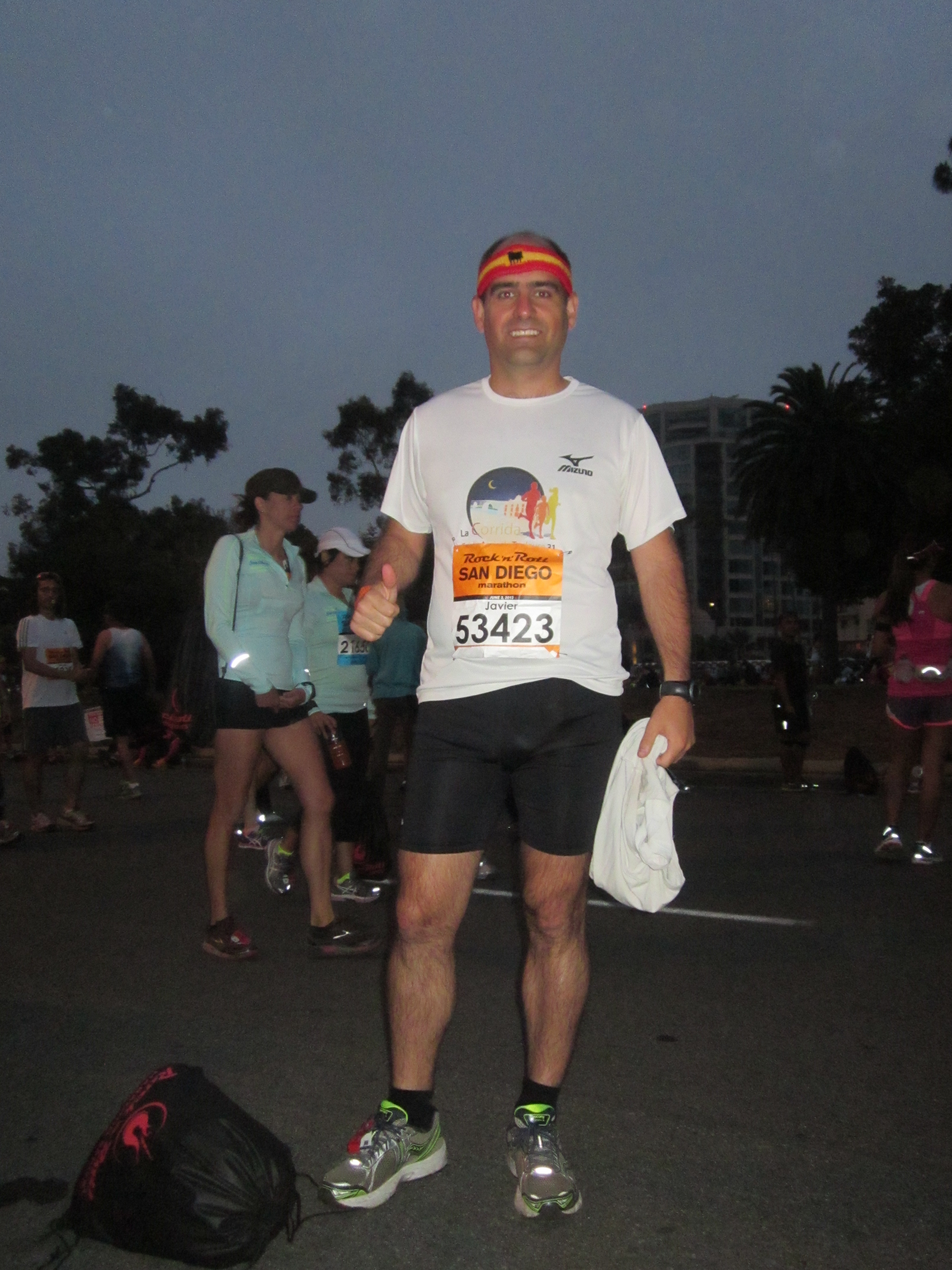
At 5:30am, before departing.
I went quite well at the expected pace (below 5’20” / km) for the first 28 kilometres, then I started to miss endurance and right afterwards the long climb “killed” me. I, however, did not stop and kept running up, if very slow (most of the runners in my time -between 3h45 and 4h- where walking during those kms). I’ve gone through much tougher situations in the last years, thus I only thought “well, slow the rhythm and the climb will finish at some point, keep up”.
Running at some point of San Diego marathon.
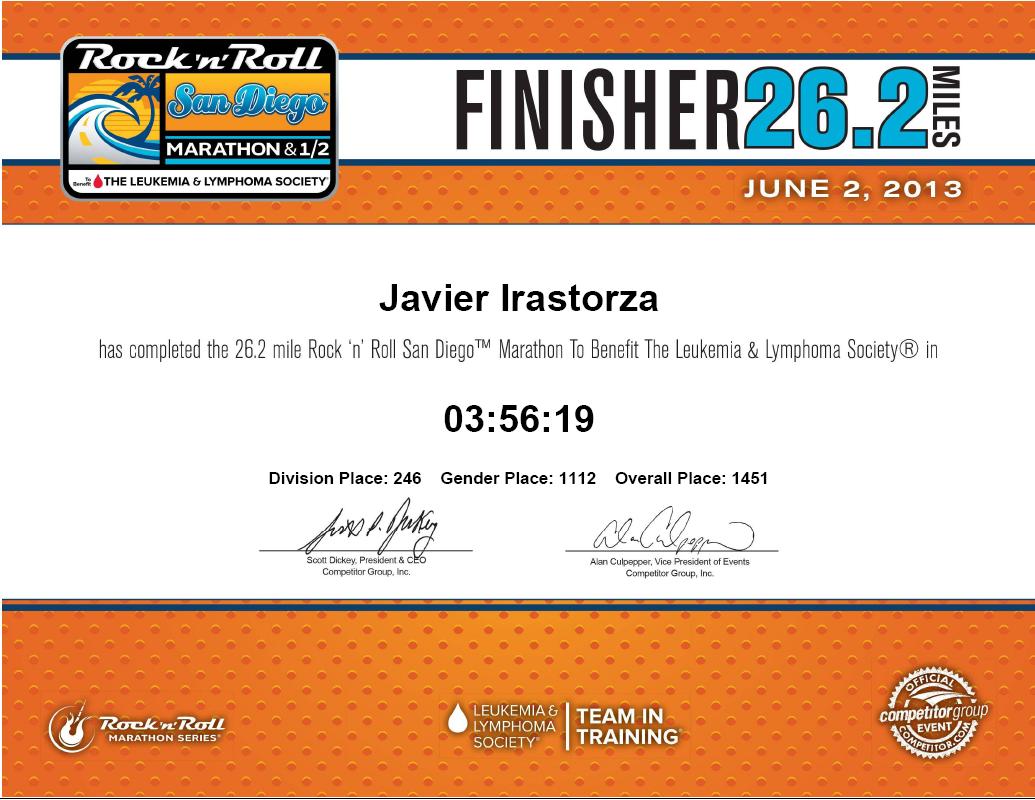
In the end I finished in some 3h56’19” as clocked by the official chip (see the report of the race as recorded by my Garmin here). I was happy enough with the result and with having finished the second marathon in the year, another sub-4-hour marathon (the 4th in a row under 4h) and the 9th overall.
San Diego marathon finisher diploma.
San Diego marathon medal.
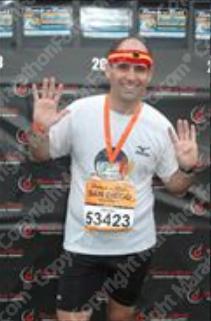
9 marathons!
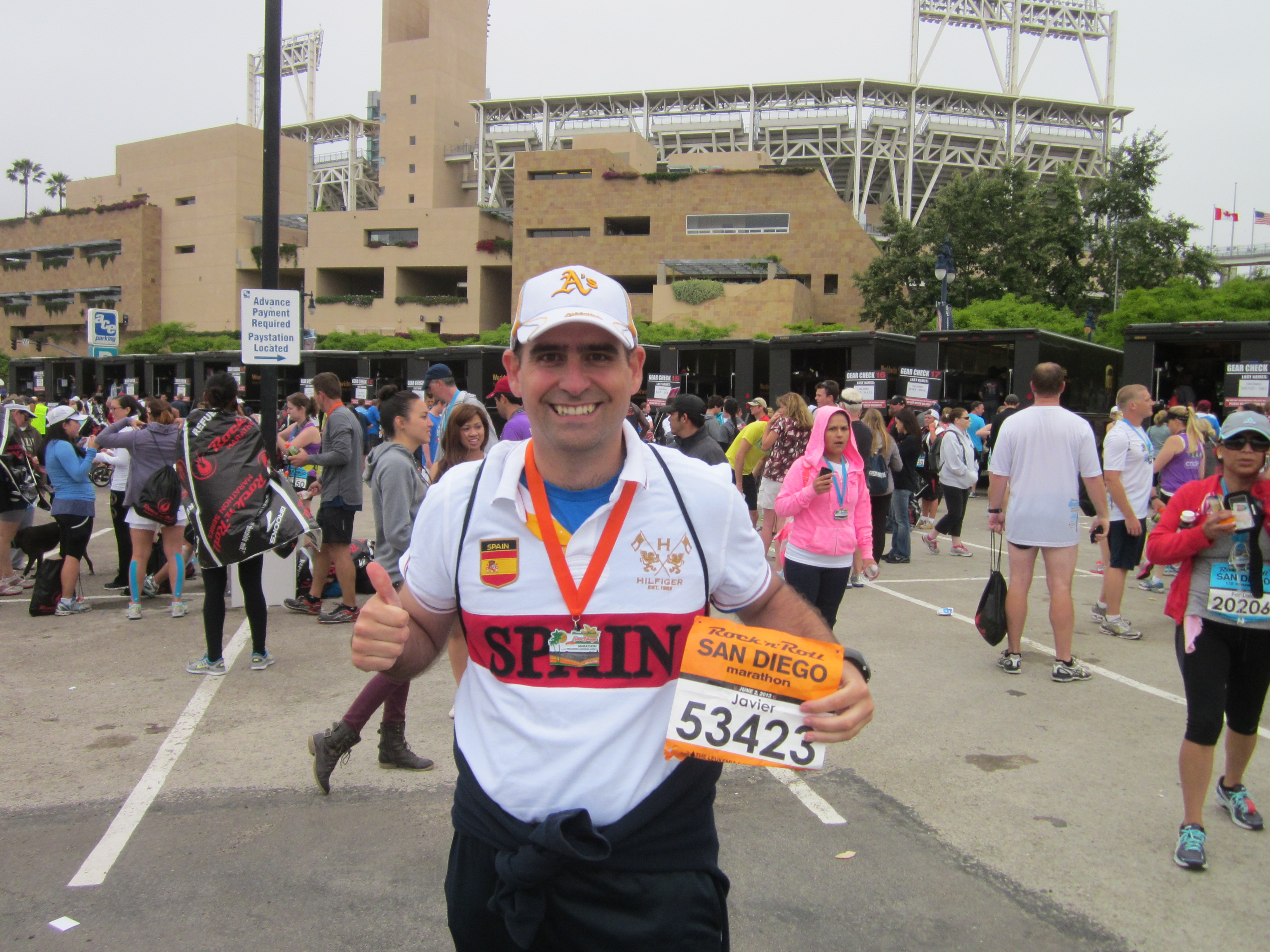
Enjoying the feat (behind me: San Diego Padres baseball stadium).
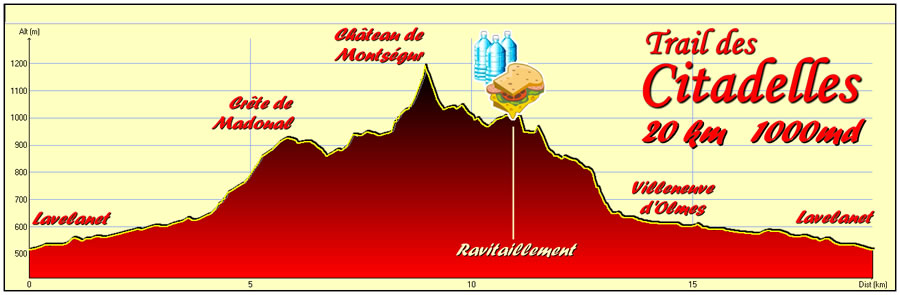
The Château de Montségur used to be a Cathar castle dating from late XII / early XIII century. For some time it was the centre of the Cathar church, though today only some ruins remain. The castle is at the top of a 1,200m-high rocky mountain, some kilometres away from the small village of Lavelanet out of which the Trail des Citadelles started.
This was my first long run and first race just 2 weeks after completing Rome marathon. I had only run 2 days between then and today, thus I took it more as a run in the nature than as a race, no stress from the departure. I even took the photo camera as I suspected I could take some nice pics.
The race consisted of 20km from Lavelanet to the castle and back, going as much as possible through the forest and as little as possible through paved roads (basically the first and last kilometres and little else). The rain of the previous days, of that precise morning and the passing of hundreds of runners left many of the paths impracticable, completely muddy and enabling the funniest situations.
Trail des Citadelles (20km) profile.
Before having completed the 2nd kilometre my running shoes and socks were already completely soaked. Before the 3rd kilometre we had been running through some stretches in which the feet were covered up to the ankles with mud (chop, chop, splash!).
I love trails for they put you in close contact with nature, the variety of their landscapes, the absence of time pressure; even if I acknowledge that I am not particularly good with difficult descents which require some technique and equipment that I lack of.
Today I missed some mountain sticks. At the starting line I saw many people with them. I wasn’t sure if it was because they would walk instead of run. Indeed. The thing is that I would also have to walk a lot, uphill, through rocks covered with very slippery mud. Only during the race I understood why they brought them. Between the 4th and 5th kilometre we started to walk uphill more than run, and it lasted like that for almost the next 7 kilometres.
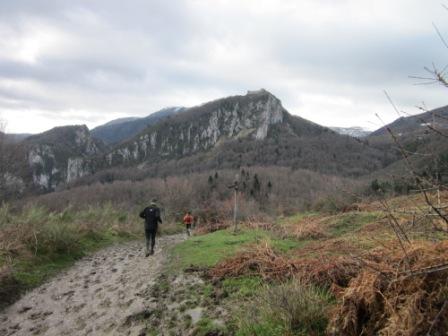
Montségur castle from afar at the top of the mountain (notice the footprints in the mud). Picture taken at about km. 5
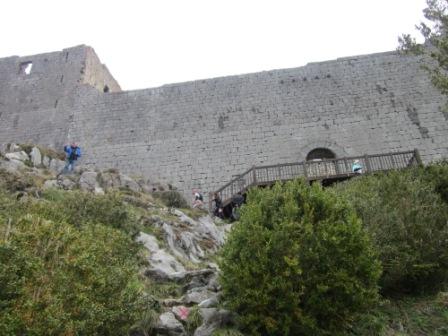
The mostly walking uphill took a full hour to cover about 5 kilometres to the bottom of the castle stairs.
Montségur castle from below.
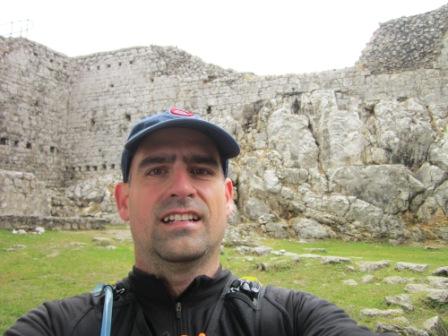
Inside the castle.
The views from the castle are stunning. The picture below does not make enough justice so I took a panoramic video.
Views from the castle.
From the castle to the end of the race most of the time we would be descending. In theory, this should have made it easier. But that was only the theory. That is when the fun began (to call it that way).
The way down started with the same stairs of the castle, which we descended with much care. Then some hundreds of metres of going up and down over more or less dry surface and finally the same kind of very steep descent, sometimes along and others crossed by water flows, fully covered with slippery mud.
I lost count of how many times I slid without any control on the verge of falling down. I do keep count of the 5 times that these detours ended with me, my face, arms, whatever it was… in the mud. They were not especially painful, but left you with hands and face covered of mud, having to wash yourself in the next current of brownish water. Other times the sliding left you looking uphill to the wrong side of the race hands in the ground to prevent a full-blown fall. As I was not the only one going through this, you can get an idea of the image…
Eating at ~ km. 12.
Around the kilometre 11-12 there was the only point of supply so I did a little stop to drink some Coke, eat some chocolate, etc.
After this stop, the mix of sliding / running continued for about another kilometre until we entered a forest of pine trees where the ground was a bit drier. There I was happy as I started running faster, less worried about falling and more focused on keeping the pace… until I bent my ankle… the same ankle I strained 3 times during winter. That one was painful. I had to stop and walk for some 2-3 minutes to recover from it.
It was then that I took the camera to film another short video as an update of the race so far at 13.4 km (in Spanish):
The making of the video, the self-deprecating humour of the situation lifted my morale. I tried the ankle, which responded positively, so I started running again.
During the last 5 kilometres, more or less flat, even if still going at times through water flows or mud, I tried to enjoy running a little. I think it was only at this point that I was overtaking others instead of being overtaken :-). I discovered then that instead of avoiding water flows and poodles, it was indeed better going through them as their bottom used to be firmer. The guys of the organization took it seriously and somehow made us literally run along the river for about 200m! That was another high moment of the trail, which I recorded here (excuse my French):
When arriving at the village, one final sprint and done. I mean, done.
Finish line.
My performance: 2h49’16”, 201 out of 366 finishing within the time given of 3h30′ (see Garmin records).
—
PD: All this happened in the 20 km race; bear in mind that at the same time 2 other races were taking place one of 40 km and one of 73 km (the runners having departed at 6am to run… 9 hours? 12?). My admiration to all those heroes.
This morning, as this post is being published I’ll be starting the 19th Rome marathon, together with my friends Serna, Manuel and brother Jaime.
I am very satisfied with the way I could train towards this marathon, no injuries this time.
Since running Berlin marathon last September 30th, I only stopped for a couple of weeks and swiftly started running again. Even if I started a bit late to pick up with the number of miles run per week (from mid December instead of mid November) I have amounted almost 800km in these last months, including:
5 days of tough series training: 12x400m, 14x400m, 8x800m, 9x800m and 10x800m.
7 long runs of over 16km each, 4 of them over 20km.
5 races: San Silvestre Vallecana (10km), Course des Rois (10km), Le Deca d’Escalquens (10km), Trailhounet (18km) and Media Maratón de La Latina (21km).
You can see below the mileage run per week:
Maratona di Roma 2013 training season. Kilometres run per week.
A lesson learned from previous training sessions: when I noticed that some muscle or tendon was getting sore from too much training I did not hesitate in slowing down that week, instead of keeping up with the training until getting seriously injured. Let’s see today how it goes, anyway, as Jaime says, it’ll sure be a day for the epic :-).
After 6 months running together, it has come the time to retire the old Saucony Triumph 8 running shoes and start using the new Saucony Triumph 9.
Saucony’s: old Triumph 8 and new Triumph 9.
Let this short post be a tribute to the Triumph 8s, which have run to date over 770km, in several cities and countries, and including 6 races, among them a marathon and a half-marathon. A similar curriculum awaits the Triumph 9 pair: several races including 2 marathons and no less than 700 km in a few months.
Triumph 8s will live side by side with the 9s, as casual sport shoes from now on, instead of running shoes.