Tag Archives: stock

Boeing vs. Airbus: CEO compensation (2024)

For some years of the past decade (2013 to 2017), I wrote a small series of yearly posts comparing the compensation of Airbus and Boeing CEOs (1). This series started out of conversation with colleagues and I kept it updated to have a record of the evolution and for quick reference in other conversations. I then stopped the series. This post is just an update with the information for the 2024 fiscal year.

Many things happened in the industry in those 7 years (2017 to 2024), but if we focus just on the CEOs from both companies: Tom Enders was replaced by Guillaume Faury at the helm of Airbus; at Boeing, Dennis Muilenburg was replaced by David Calhoun who then left the place for Robert Kelly Ortberg.

As both Boeing and Airbus are public companies, the information about their CEOs compensation is public and can be found in the annual report and proxy statement from each one. I just share the information and sources below for comparison and future reference.

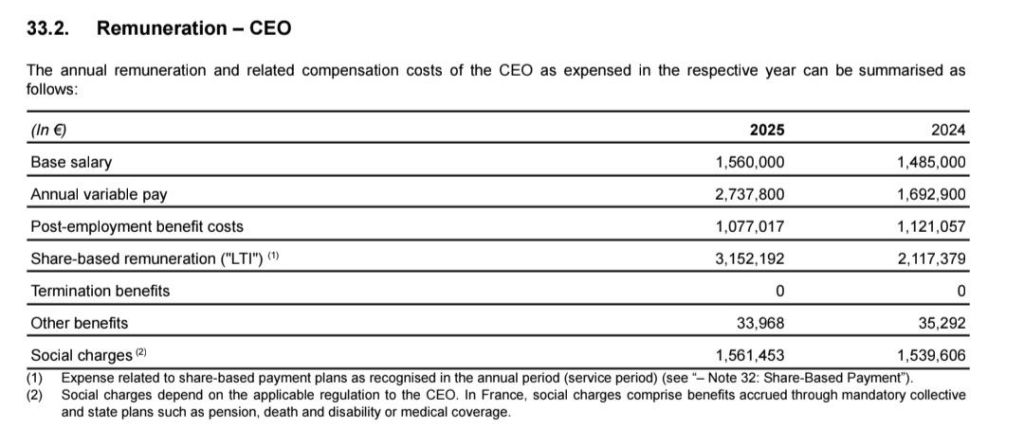
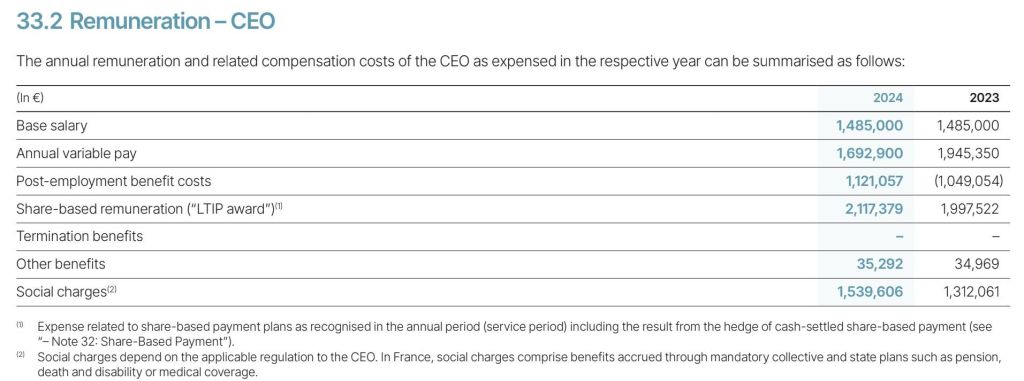
Airbus CEO, Guillaume Faury’s 2024 compensation (financial statements here, PDF, 2.7 MB, page 59):

Airbus CEO Guillaume Faury 2024 compensation.

Faury had his base salary frozen in relation to 2024 at 1.485M€  (which is lower than Enders’ one at 1.5 M€ in 2017). Variable pay decreased in 13% to 1.69M€, post-employment benefit costs increased, as did share-based remuneration and social charges. In comparison to 2017, the main changes are that there are no “Termination benefits” in 2024 while in 2017 Enders had announced his departure in 2019, thus the concept included 2.9M€ and the exponential increase of social charges: 1.5M€ in 2024 vs 12k€ in 2017. Thus, the overall compensation at 7.99M€ increased vs 2023 but is below 2017 level (9.1 M€).

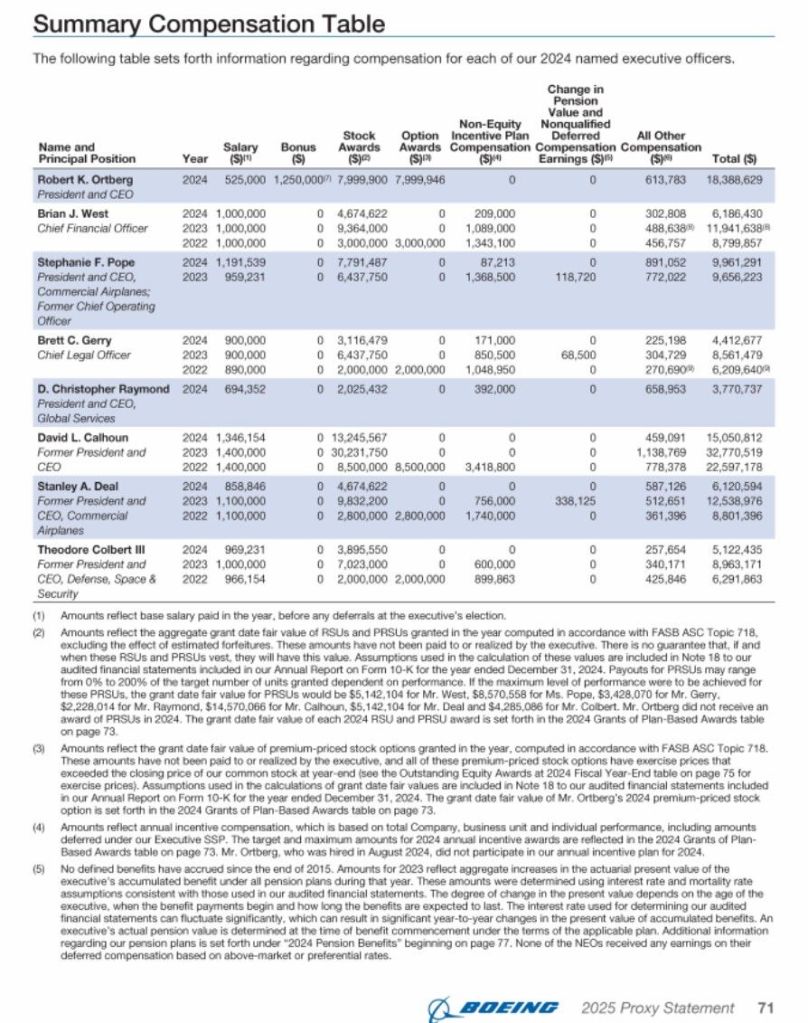
Boeing CEO, Robert Kelly Ortberg’s 2024 compensation (2025 proxy statement here, page 71):

Boeing’s CEO Robert Kelly Ortberg 2024 compensation.

Robert Kelly Ortberg had a base salary of 0.5M$, one bonus of 1.25M$ and 16M$ in stock based awards. The 2024 total compensation was 18.39M$, very similar to 2017 levels, but…

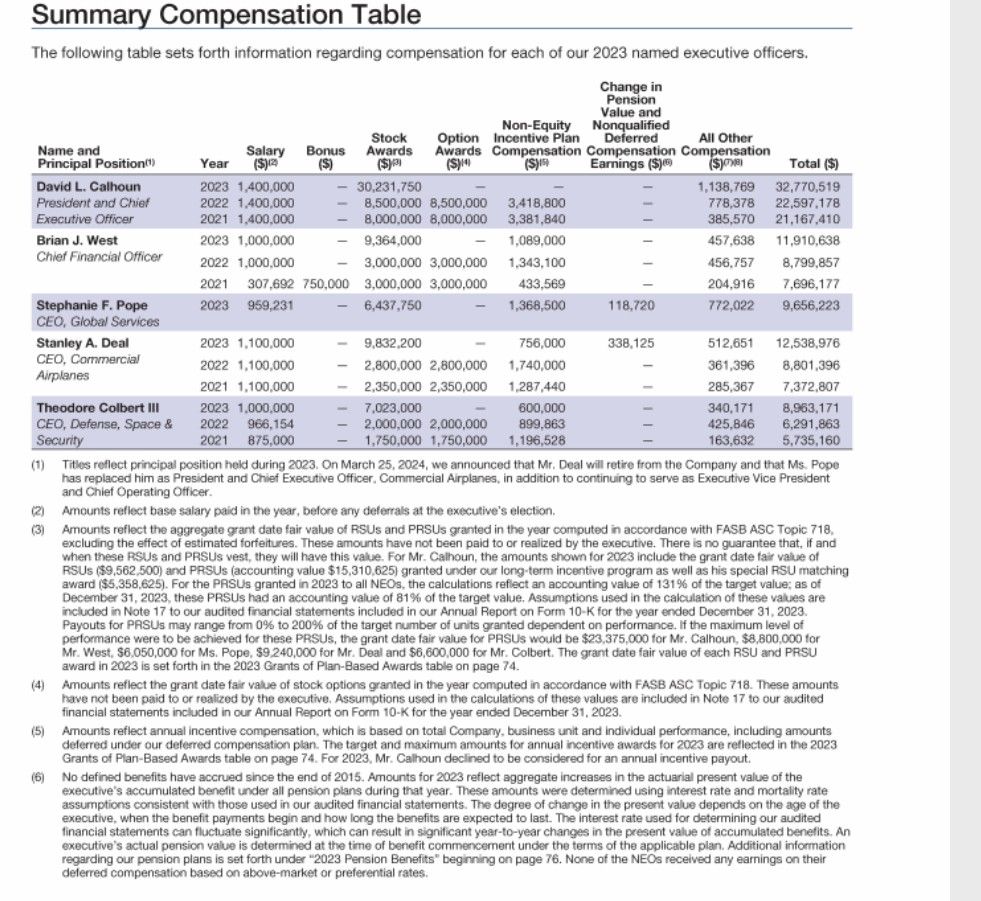
In the table you can also find the compensation for David Calhoun, and this is because Ortberg took over as CEO only in August of 2024. I will therefore add for comparison purposes the same table for Boeing 2023 fiscal year (2024 proxy here, page 72) when only Calhoun served as CEO.

Boeing’s CEO David Calhoun 2023 compensation.

David Calhoun had a base salary of 1.4M$, 30M$ in stock based awards and another 1.1M$ component. The 2023 total compensation was 32.77M$, 77% higher than 2017 levels, or +14M$.

Comparison. It is interesting to note that while the base salary is nearly the same in both companies, ~ 1.5 m€, the much higher stock based incentive schemes at Boeing push up the total remuneration for the CEO to about four times (x4.1) the one in Airbus.


(1) See the previous comparisons for the years 2013, 2014, 2015, 2016 and 2017.

Leave a comment

Filed under Aerospace & Defence

Société des moulins de Bazacle

The Vereenigde Oost-Indische Compagnie (VOC) or the (United) Dutch East India Company is widely regarded as the first company to have issued stock. It was at least the only company traded at the time in Amsterdam stock market at the Dam, what is regarded as the first ever stock market. I wrote about it in the review of the bookConfusión de Confusiones” by José de la Vega (Confusion of Confusions in English).

However, I had read some time ago about the Bazacle in Toulouse, and a disputing argument behind it. I went to visit it this weekend, in order to learn more from it.

The word bazacle in French means ford, or a shallow place in a river where one can easily cross it. The Bazacle in Toulouse is located at a place where the river Garonne makes a turn to the left, becoming quite wide and shallow. Apparently in ancient times, it bifurcated in several branches and people did use to cross the river there. Some time later a bridge crossed the river at that location.

View of The Bazacle, Toulouse.

View of The Bazacle, Toulouse.

At the end of the XII century, permission was granted to build a sort of dam and some mills. Those mills, according to the sign post outside of the Bazacle (see the picture above) were widely admired up to the French Revolution, being regarded as the largest of the type in Europe and appearing in the encyclopedia of Diderot and D’Alembert.

The argument in dispute comes next: the Société des moulins de Bazacle was financed by an association of noblemen who shared the profits of the company. Thus, this company is also regarded as the most ancient joint-stock company. The shares from the company could be traded at the market Toulouse, their value fluctuating and depending on the yields of the mills. Shouldn’t then be Toulouse regarded as the first stock market ever?

The Bazacle Milling Company ceased to exist in 1946, when it was acquired by EDF, French national electricity company. The Bazacle today has a museum on the use of water, energy, origin of electricity, etc., hosts temporary art exhibitions and has as a main attraction a fish ladder, permitting migratory movements of some species.

View of the Bazacle, its fish ladder and the river Garonne.

View of the Bazacle, its fish ladder and the river Garonne.

Leave a comment

Filed under France, Investing

Studios are more profitable than flats

Two weeks ago I was having some drinks with a good friend of mine. Talking about books we were reading we ended up talking about investments.

He had the idea of buying a small studio in order to rent it, because the margin you could get in a small studio compared to its price was larger than if you did the same with a larger apartment.

I wanted to test the argument with idealista.com, the leading real state website in Spain. Apart from the many ways in which you can screen and sort out houses, the site has a very handy piece of information which is the average price per square meter of your selection either for rental or sale.

I restricted my searches to the district “Centro” in Madrid. I then looked for average prices of “studios” of “less than 60m2” and “flats” of “more than 80m2”, both for rental and for sale. The minimum sample of houses was 175 and the maximum over 700, so I believe they can be considered a good sample for this little study. I then looked for the averages:

  • Studio of less than 60m2:
    • Rental: ~17 €/m2 per month.
    • Sale:  ~4,287 €/m2.
  • Flat of more than 80m2:
    • Rental: ~13 €/m2 per month.
    • Sale:  ~4,295 €/m2.

As you can already see, the price per square meter is very slightly higher in the case of flats (~0.2%) while the price of rental is much higher in small studios (~31%).

What is the profitability of the case?

We can make the calculation with these per square prices. If you buy the small studio and put it for rent, you would earn from it 12 times 17€ per year (204€), this is 4.8% return on the asset, which in this case is a square meter valued at 4,287€. For the larger flat the earnings would be 3.6%. Thus, as my friend said renting small studios is a whole 31% more profitable than renting larger flats.

Paid by itself? My friend also mentioned that you could even get a mortgage that it was cheaper than the monthly rent and thus really not needing to dedicate ~100k€ to the purchase of the prize, but paying the flat simply with the monthly rent incomes.

That case also holds true with current low interest rates. I checked the case for a small studio of 25m2 and you could charge about 425 euros while the mortgage would be around 322 (25 years). This case would not be true anymore if you want to pay the studio in a shorter time, or interest rates rise.

This  case also excludes the extra costs that house ownership has (repairs, improvements in the building, idle time between renters…). So we should see the figure 4.8% as a ceiling.

I still would prefer investing in stocks, where returns have been higher throughout history and avoids you the hassle of dealing with the problems involved with real state…

1 Comment

Filed under Investing