Category Archives: Aerospace & Defence

Most desired company to work for in Spain…

Today Spanish financial press gave some coverage to a study performed by Randstad, “Employer Branding: cuando la percepción puede convertirse en realidad”. To compile this study Randstad interviewed 10.000 workers between 18 and 65 years old in Spain.

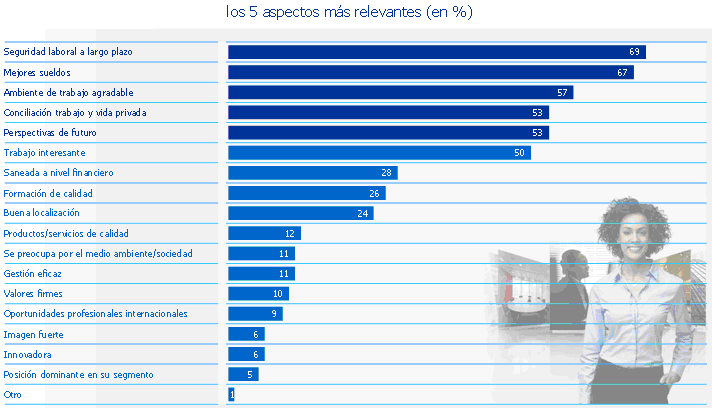
Workers were asked what issues they considered most important at the time of choosing a company to work for, the highest rated ones were:

  1. Long-term stability, 69% of respondents.
  2. Better salaries, 67%.
  3. Good atmosphere in the workplace, 57%…

Most important factors when selecting a company to work for

Randstad found a high variability between men and women respondents and between different age groups.

…

After this introduction… what I wanted to say: EADS CASA (Airbus Military) was rated by respondents as the most desirable company to work for. (period)

Other remarkable companies: GlaxoSmithKline, Nokia Spain, Pfizer, Correos, Coca-Cola and Iberdrola.

1 Comment

Filed under Aerospace & Defence

Augustine’s Laws

Last summer I read a book, a classic: “Augustine’s Laws” by Norman Augustine. Norman served in many positions both in the Administration (Under Secretary of the Army) and in the Aerospace & Defence industry (CEO of Lockheed Martin). Lately he lead the Committee that was reviewing the US Human Space Flight Plans.

I first learnt about this book from a teacher in Seville in 2006. He used a couple of his graphics in the course. One was plotting the trend of fighter aircraft acquisition costs per unit. I remember that the extrapolation of the trend pointed that somewhere in 2054 the whole DoD budget would allow to procure one single aircraft, that would have to be shared by US Air Force and Navy, with the 29th February of the leap years availabe for the US Marines.

Since that moment I wanted to read it, and it was only 3 years later that I had the opportunity to do so. The book reviews A&D programs, especially their mismanagement and failures from the Wright brothers times till the early 80’s, when the book was written. The book is hilarious. Really. Let me show you this by concatenating some of its “findings”:

  • The first one was commented above: aircraft are more and more costly with time.
  • At the same time aircraft developments turn in aircraft always becoming heavier than initially designed, producing more capable and heavier aircraft.
  • Another trend points out that avionics and electronic components are of greater importance in the aircraft of today. Wright brothers didn’t make use of avionics or electronics, however in the 80’s the percentage of OEW dedicated to them was around 20%, and increasing.
  • We also find that electronic components themselves become smaller and cheaper with time (just think of room-size computers of decades ago compared to today’s smart phones).

Thus we find ourselves in front of a paradox: Aircraft that will be heavier and more expensive, but that a certain point will be entirely made of avionics and electronic components which are lighter and cheaper with time! How can this be? As Augustine points out: engineers came to the rescue, they came up with “something” that it’s very expensive, doesn’t add weight and helps to solve the paradox without violating 2nd law of Thermodynamics. They came up with software. Neverending of lines of software… which also contribute to delay developments.

Here you may read the different laws, I’ll just copy the ones I like the most:

  • Law Number V: One-tenth of the participants produce over one-third of the output. Increasing the number of participants merely reduces the average output.
  • Law Number VII: Decreased business base increases overhead. So does increased business base.
  • Law Number XIII: There are many highly successful businesses in the United States. There are also many highly paid executives. The policy is not to intermingle the two.
  • Law Number XXVI: If a sufficient number of management layers are superimposed on each other, it can be assured that disaster is not left to chance.
  • Law Number XXXII: Hiring consultants to conduct studies can be an excellent means of turning problems into gold, your problems into their gold.
  • Law Number XXXVII: Ninety percent of the time things will turn out worse than you expect. The other 10 percent of the time you had no right to expect so much.
  • Law Number XLIV: Aircraft flight in the 21st century will always be in a westerly direction, preferably supersonic, crossing time zones to provide the additional hours needed to fix the broken electronics.
  • Law Number LI: By the time of the United States Tricentennial, there will be more government workers than there are workers.

Clearly this is not something I learnt today, but then, last summer I didn’t have a blog to comment on this. Enjoy the book.

4 Comments

Filed under Aerospace & Defence, Books

Intro

I wanted to start the blog with some introduction of myself… but I did not feel like preparing a piece for this purpose. Then I thought: “I could use the icebreaker speech I gave in Toastmasters when I joined”… this was a better idea. Since this not only introduced myself but started creating topics for next posts, e.g. what is Toastmasters? Speeches?…

The only objection: I went through that speech and I don’t like it much anymore, nevertheless I came to see again another speech, which even though hasn’t been the best one ever since, it talks about some of the things I like the most: a bit of aircraft, another bit of travelling and some numbers here and there. Since that is what this blog will mostly talk about in the future… here it goes that speech (given on May 7th 2008):

“May 2nd is a very important day for Madrid. It is the day of the uprising. The day, in which the people of Madrid rebelled against the occupation of the French troops. A day that changed our history.

I will talk about another 2nd of May that changed our history as well. The 2nd of May of year 1952. That day took place the first commercial flight of a jet plane, the De Havilland Comet.

In this speech I will talk about that flight, about how it changed the history and I will finish explaining one of the Comet’s biggest contributions to engineering which at the same time caused the very end of the aircraft.

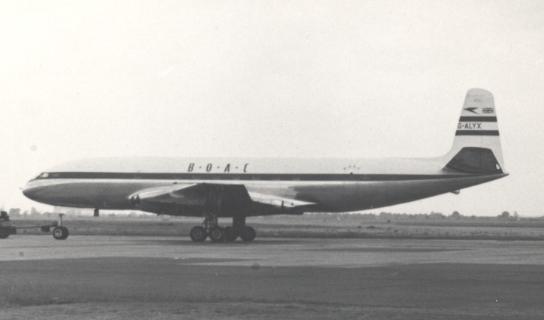
BOAC’s De Havilland Comet

That first flight departed from London to Johannesburg and was operated by BOAC, British Overseas Airways Corporation, one of the companies that later merged in today’s British Airways.

BOAC used a configuration of 36 seats (a luxurious configuration for the size of the aircraft). The galley could serve hot and cold food and there was even a bar. There were separate men’s and women’s washrooms. The passenger cabin was quieter than those of propeller-driven planes.

Many people thought jet engines wouldn’t be economically viable on a commercial plane since jets had higher fuel consumption. However the Comet was able to fly at an altitude of 35,000 feet where the air is less turbulent. The Comet was smoother and faster. Hours were cut off in flights. New York was only twelve hours flying time away from London instead of the eighteen hours it took piston-engine planes.

Now let’s see how it changed the history by comparing some differences from that first flight to commercial aviation today!

  • It took only 3 years from the first design work till the first flight of the Comet; it took about 14 years for the A380.
  • The Comet could take 36 persons to a distance of 2,700 kilometres, compared to the more than 800 passengers in a 3-class configuration to 15,000 km of the A380.
  •  If we take a look at that first flight, London – Johannesburg, it took more than 23 hours!! With 5 stops in between (Rome, Beirut, Khartoum…) like a frog jumping from one water lily to the other. Now, the same company, British Airways, operates the flight with a B-747 and takes less than 12 hours (half the time) in a non-stop flight!!
  • A ticket in that first flight cost 175 pounds, while a ticket for tomorrow’s flight in the afternoon would cost you 240 pounds taxes included! That could seem just a bit more expensive, but in fact if we discount the effect of the inflation throughout the 50 years now it is about 4 times cheaper!
  • The Comet needed a crew of four men: including two pilots, a flight engineer, and a navigator. Nowadays planes need only 2 pilots… if any.
  • 114 aircraft of the different models of Comet were produced compared to the more than 5,200 Boeing 737 built to date plus the 1,500 in waiting list.
  • The estimated price of a Comet 1 was a quarter million pounds, while the B-747 costs 120 million pounds (hundred times more expensive after discounting the effect of inflation).

Only a year after it began commercial service, Comets started to fall out of the sky. Thirteen aircraft were lost in fatal accidents with hundreds of victims. Extensive investigation revealed a devastating design flaw – metal fatigue. This problem had never been encountered in aviation.

The constant stress of pressurization weakened an area of the fuselage in the corner of the windows. All Comets were grounded until the jets could be redesigned. This was a tragic but great contribution of the Comet to aeronautical engineering.

The Comet re-entered commercial service in 1958, but its reputation was forever damaged. The Comet 1 disasters contributed to archrival Boeing’s domination of the jetliner market.

2nd of May. A special day both in the History of Madrid and in the History of commercial aviation. A day that changed the lives of madrileños in a good way. The uprising in Madrid and the Comet’s first commercial flight.”

May this serve as introduction.

4 Comments

Filed under Aerospace & Defence