Viendo el revuelo producido por las declaraciones donde Cristiano Ronaldo decía que se encontraba triste, no pude más que recordar un par de anécdotas de Alfredo Di Stefano.
Una que recordaba haber leído en internet (“Corazón Blanco“) sobre un telegrama que Di Stéfano envió a Bernabeu que recupero:
Alfredo Di Stéfano regresaba a Argentina, sin fecha de vuelta. La Saeta Rubia envía un telegrama a Santiago Bernabéu, a modo de despedida. La misiva, cuyo original está bastante deteriorado y es casi ilegible, dice: “Don Santiago me voy a mi tierra, no sé si volveré pronto. Nunca en estos años se habló mucho de nosotros. Yo llevé la peor parte. Fue un fenómeno o un gamberro. Si no me acerqué a usted fue porque no quería que creyera que busque un puesto regalado. Por lo menos eso no me lo puede quitar nadie. Lo que gané siempre fue con esfuerzo. Observé que para estar bien con usted había que ser falso. Tuve muchas desilusiones y nadie me dio moral. Usted como padre me falló. Ahí se ve que nunca tuvo hijos porque los padres siempre perdonan. Si no vuelvo más le llegue a usted mi felicitación y mi recuerdo cariñoso. Un abrazo, Alfredo”.
Y la otra sobre su despedida del Madrid, anécdota que leí hace años en su biografía “Gracias, vieja” (libro que aprovecho a recomendar), y que se puede leer en el la web del diario As:
“Muñoz se aferraba a que había que vigilar a Facchetti y nosotros decíamos: ‘¿Y quién agarra a Amancio?’. Amancio era como la luz de rápido y estaba jugando fenomenal. Al final, ¿qué pasó? Que Facchetti no se fue arriba casi nunca en el transcurso del partido… Jugamos el encuentro con uno menos, pero Muñoz me mandó a la mierda y me echaron a mí del club porque lo mandé a la mierda yo también”.
Aquel encuentro fue histórico, puesto que fue la última ocasión oficial en la que Di Stéfano vistió la camiseta blanca. Días después, el Madrid disputó la semifinal de Copa ante el Atlético, pero Muñoz no incluyó a La Saeta en la convocatoria.
I started reading the book “Thinking, Fast and Slow“, by the Nobel laureate Daniel Kahneman some months ago, and, even if I am slow progressing with it, I find it extremely interesting.
A recurring topic when reading about how our psychology deceives us is when thinking about probabilities. In this post I wanted to write about a paper he refers to in the book: “The Hot Hand in Basketball: On the Misperception of Random Sequences” [PDF, 1MB], by Thomas Gilovich of Cornell University (1985).
If you have actually made the exercise of coin-tossing several dozens times or have gone several to a casino and watched roulette results, you will believe without effort that seeing long streaks of a certain event (several heads for the coin, over a dozen reds or three 32 in a row for the roulette) is part of the randomness of those games. Basketball players and fans get it consistently wrong when believing in hot hands, and that is precisely what the paper from Gilovich is about and it is a wonderful reading.
It starts with a survey among basketball fans, who no doubt believe in hot hands being behind streaks: 91% believed a player has a better chance of hitting after having converted 2 or 3 throws. They even ventured into assigning probabilities. For a player with 50% in field throws they said the chances of :
hitting after a converted throw were 61%,
missing after a missed a shot, 42%.
Then he studied the performance of Philadelphia 76ers players (Julius Erving among them) during the season, carefully analyzing the chances of a each player hitting or missing a throw after having missed or hit the previous one, two or three consecutive throws. The results are clear, they do not support the existence of such “hot hands”, they are random. In fact, on average, the chances of hitting after a hit were always lower than the field score % of the team while chances of hitting after a miss were higher and higher than the ones of the supposedly hot hands.
He analyzed the numbers of runs (streaks, like the several heads or tails in a row for the case of a coin) and were not different that what could be expected randomly.
He went on to analyze whether the different players had more cold or hot nights than what can be expected by statistics… also discarded.
Of course, in field throws the author understood that there were many variables at play: for instance, if a player had hit 2 consecutive throws the defense might be harder on him… to eliminate those possible factors influencing results, he went to study free throws, in this case taking the figures from Boston Celtics (Larry Bird among them) and NY Knicks. Guess what? No hot hand in free throws either: there were even more players scoring after a miss than the other way around (but again, nothing statistically significant).
He went even further: he made a controlled experiment with college players in which they threw 100 shots from a distance in which their scoring success was 50% (different distance for each one). Throws were made without opposition but from different position each time. Players got paid according to the hits and could bet higher or lower money each time depending on whether they believed that they were having a hot hand… this, again, proved that there were no hot hands and what’s more: players did believe in those hot hands and were completely unreliable in predicting their next throw chance of success.
The paper has only 21 pages: I encourage anyone who likes psychology, statistics or basketball to read it, its wonderful.
I thought that to conclude this post with a funny note, I could link the following short video of Shane Battier’s “clear” hot hand in the first game of this year’s NBA finals:
Impressive, 3 consecutive 3pt-throws converted in the first quarter!
A difference between now and 1985, when the professor wrote his paper, is that now we don’t need to ask the team statistician about the figures, but NBA site records all of them. I went to check what happened to Shane and his hot hand in that match. After those 3 throws converted, he attempted other 3 in that match: he missed 2.
Still, he had a 66% on 3pt throws that night… what could be a hot night. I went to check his percentages during the season and career. During the finals he made a 0.577%, remarkable; during the whole of the play offs, 0.382% in 3pt. And guess what is his average career (13-years) percentage score for 3pt throws: the same 0.382% he showed in the play-offs. That streak you saw was nothing but the random streak expected from Shane.
I am sure that you have lived awkward situations in a flight. Miscommunications between the crew and passengers or funny messages received from the cockpit. That is precisely the topic of a book I read some months ago.
Sorry, we missed the runway
The book originated after a collection of anecdotes posted by readers of the online version of Der Spiegel. Seeing the success of the initiative, the authors, Stephan Orth and Antje Blinda, decided to launch the book with the original German title “Sorry, wir haben die Landebahn verfehlt” (in French “Désolé, nous avons raté la piste”, which is the version I read).
To be honest, what I was looking for it was more a book about serious incidents or accidents, in order to learn about things not to do as a learning activity towards my private pilot licence. Once I started and saw what it was really about I went on for the fun of it (plus the French learning component).
Among the anecdotes, curiosities and messages accounted:
the 747 City of Edinburgh which temporarily lost all 4 engines over Indonesia due to volcano smoke (“We have a small problem. The 4 engines of our aircraft have stopped. We’ll do everything possible to regain control. We hope you’re not very nervous” – they recovered control of 3 engines),
“if you forget anything aboard the airplane you’ll be able to find it tomorrow on eBay” (on a flight Orlando-Sacramento),
despite intuition: chances of surviving an aircraft accident are 70% (in fact, my economy and business administration teacher at the aerospace engineering school had survived 2 accidents!),
(after a heavy landing) “dear Sirs and Madams, please be seated until the captain finishes bringing what is left from the airplane to parking position”,
the following near crash of a A320 in Hamburg due to heavy cross wind and a sudden gust,
I guess that you can get a grasp of the book, though you can read the same stories in the link of Der Spiegel above. Finally, the book includes several sources and proposal further readings, among them: 1001crash.com, which I guess it is more the kind of reading I was originally looking for.
The Peter Principle says: “In a hierarchy, every employee tends to rise to his level of incompetence“.
The Peter Principle.
The book, by Laurence J. Peter, is a hilarious account of situations that arise in companies and institutions of why and how people are promoted, cornered, etc., or in his words is a treatise on hierarchology.
You probably have heard about the principle at some time. The author exposes a lot of other related concepts with invented jargon, including plenty of examples that we may have seen in our companies. The account of those seemingly contradicting, irrational, incomprehensible situations but which are so familiar to us is what makes the book hilarious.
Some of those other concepts and ideas introduced by the book:
The percussive sublimation: when someone is kicked upstairs to get him out of the road and unblock other promotions.
The lateral arabesque: when an incompetent employee is given a new and longer title and is moved to an office in a remote part of the building (easier in larger hierarchies).
Peter’s inversion: when internal consistency is valued more highly than efficient service (“xxx is methodical, consistent, he co-operates, is steady…”).
Pretty pass: getting out from under an incompetent to go up the ladder in a parallel circumvallation.
Flying T formation: organizations with plenty of VPs with few workers at the bottom… (I’m sure you can picture the T in your mind… and your organization).
Occupational incompetence is everywhere (a universal phenomenon).
In time, every post tends to be occupied by an employee who is incompetent to carry out its duties.
Work is accomplished by those employees who have not yet reached their level of incompetence.
You be the judge. Look at the mirror and ask whether… (there are no exceptions to the principle).
…
Years later, professor Edward P. Lazear, from Stanford Graduate School of Business, published the paper “The Peter Principle: A Theory of Decline“, where he analyzed the principle and substantiated it with mathematical formulae. As he describes in the abstract of the paper:
Some have observed that individuals perform worse after being promoted. […] Being promoted is evidence that a standard has been met. Regression to the mean implies that future ability will be lower, on average. Firms optimally account for the regression bias in making promotion decisions, but the effect is never eliminated. Rather than evidence of a mistake, the Peter Principle is a necessary consequence of any promotion rule. […] Usually, firms inflate the promotion criterion to offset the Peter Principle effect, and the more important is the transitory component relative to total variation in ability, the larger the amount that the standard is inflated.
If your promotion has been reject, you find yourself overwhelmed with your current job, you have consciously decided to go along in the office with minimum effort trying to be unnoticed, are happy with your current job and do not wish to be promoted by any standard… go and read the book 🙂
***
I have already mentioned sometimes in the blog that every time that I pass by an airport (and that is often) I try to go to the book shop to see if I can grab something interesting. I was after this book since I read about it in another book “Management gurus” in 2010 (of which I already wrote a review – in that post I remarked 4 punching books I wanted to read, one was this) and found it two years later at Dubai International airport, this only reinforces that habit :-).
Benjamin Franklin, by Joseph Siffred Duplessis (public domain image).
Benjamin Franklin was one of the Founding Fathers of the United States. The Wikipedia describes Franklin as a leading author, printer, political theorist, politician, postmaster, scientist, musician, inventor, satirist, civic activist, statesman, and diplomat; what is called a polymath.
Following Luca’s recommendation, I read some months ago Franklin’s autobiography. It was terrific. For the most part it describes his early life and how he was rising in the society and the origin and the work behind some of his great contributions to society: “Poor Richard’s Almanack” (which includes a collection of sayings that mark not only American culture but Western culture in general), “The Pennsylvania Gazette”, the first public lending library in America, the first fire department in Pennsylvania, etc.
One initiative that I especially liked was the creation of the Junto club; a club for mutual improvement where its members debated all kinds of questions from morals and politics, to sciences and business. This reminded me to the joy I have attending a particular Toastmasters meeting when you feel you have learnt something from the speeches you have heard. I will have to check whether there are such broad mutual improvement clubs in Toulouse (… note that he just went and created it! When he was 21!).
Other remarkable aspect was his setting of 13 virtues by which he was going to live (he did that at age 20) and apparently managed to practice for the rest of his life.
“Temperance. Eat not to dullness; drink not to elevation.”
“Silence. Speak not but what may benefit others or yourself; avoid trifling conversation.”
“Order. Let all your things have their places; let each part of your business have its time.”
“Resolution. Resolve to perform what you ought; perform without fail what you resolve.”
“Frugality. Make no expense but to do good to others or yourself; i.e., waste nothing.”
“Industry. Lose no time; be always employ’d in something useful; cut off all unnecessary actions.”
“Sincerity. Use no hurtful deceit; think innocently and justly, and, if you speak, speak accordingly.”
“Justice. Wrong none by doing injuries, or omitting the benefits that are your duty.”
“Moderation. Avoid extremes; forbear resenting injuries so much as you think they deserve.”
“Cleanliness. Tolerate no uncleanliness in body, cloaths, or habitation.”
“Tranquility. Be not disturbed at trifles, or at accidents common or unavoidable.”
“Chastity. Rarely use venery but for health or offspring, never to dullness, weakness, or the injury of your own or another’s peace or reputation.”
“Humility. Imitate Jesus and Socrates.”
Finally, last November, Luca and I visited the only remaining house where Benjamin Franklin once lived, for nearly sixteen years between 1757 and 1775, in one of his periods in London. I definitely recommend the visit to the house, at 36 Craven Street (2 blocks from Trafalgar Square), as it doesn’t take more than an hour and the animation that goes with it makes it highly entertaining (it goes without saying it that I highly encourage the reading of his autobiography).
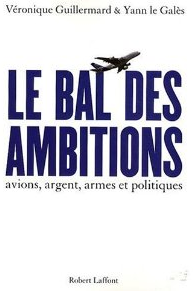
I learnt about the book “Le Bal des Ambitions” in 2009, when a former colleague mentioned it and asked me to buy it in one of my trips to Paris. By then, I did not know French so as to read it, but some months ago I found it again in the aerospace boutique in Blagnac and grabbed it.
The book is written by two journalists, Véronique Guillermard and Yann le Galès, that in my opinion give an image history of EADS and the main characters who shaped it a bit too much thriller-like. Nevertheless, I found it interesting as I could recall many of the names and chapters, even though most of the stories happened either when I was still a student or had recently joined the company.
Some of the topics covered in the book:
Who are the so-called Lagardère boys, the relationships among them and with J.L. Lagardère. (I got to know who from some of top managers came from Matra and who from Aérospatiale.
It describes the merger discussions between Aérospatiale–Matra, BAE and DASA.
You get a glimpse of the role played by the grandes écoles in French networks.
The case of insider trading affecting top management of EADS in 2006.
Some of the issues behind the delays of A380 in 2006.
I guess that for a French native the text hasn’t got much quality, but for me, being my second book in French language, it was just perfect.
Last summer I visited an exhibition on occasion of the celebration of “2011 Year of Antoine de Saint-Exupéry”. Elsewhere he is mainly known as the author of “The Little Prince” (Le Petit Prince), however I learnt in that exhibition that in Toulouse he is mainly known as an aviation pioneer, flying airmail routes (for the emblematic Aéropostale based in Toulouse) and then for the French Air Force.
I guess that some of you had read Le Petit Prince early in your lives, I didn’t. I received the book as a present from former colleagues when moving to France and only finished it some weeks ago, being the first book I’ve read in French. Not bad for a start, as according to the Wikipedia it is the most read book in French language and was voted as the best book of the 20th century in France.
It has some idealistic messages or fine criticisms, to name a few:
“One sees clearly only with the heart. What is essential is invisible to the eye.”
A businessman who goes on “owning” stars and counting them not having time for anything else, not knowing what to do with them and having a very serious thought of him.
The geographer, proud of his profession, but who lacks any practical knowledge as “that” is the responsibility of someone else, the explorer in this case.
The concept of domestication being two-ways. I loved when the prince goes “Il y a une fleur… je crois qu’elle m’a apprivoisé…” (“There is a flower … I think she domesticated me …”) I believe this could be applicable to many pet owners.
I felt especially caught when the book first said “Les grandes personnes aiment les chiffres” (adults love numbers) and later when it went:
“Si les deux milliards d’habitants qui peuplent la terre se tenaient debout et un peu serrés, comme pour un meeting, ils logeraient aisément sur une place publique de vingt milles de long sur vingt milles de large. On pourrait entasser l’humanité sur le moindre petit îlot du Pacifique.
Les grandes personnes, bien sûr, ne vous croiront pas. Elles s’imaginent tenir beaucoup de place. Elles se voient importantes comme des baobabs. Vous leur conseillerez donc de faire le calcul. Elles adorent les chiffres: ça leur plaira.”
(“If the two billion inhabitants who people its surface were all to stand upright and somewhat crowded together, as they do for some big public assembly, they could easily be put into one public square twenty miles long and twenty miles wide. All humanity could be piled up on a small Pacific islet.
The grown-ups, to be sure, will not believe you when you tell them that. They imagine that they fill a great deal of space. They fancy themselves as important as the baobabs. You should advise them, then, to make their own calculations. They adore figures, and that will please them.”)
When I read the first paragraph and before reading the second, I was already writing a remainder note to make the calculation…
In demonstrations, the range of people per square meter is between 2 and 3.5 (4 being “like a rock concert”). A square of 20 miles by 20 miles covers an area of 1,035 millions of square meters. Therefore, in such a square we could pack between 2 and 4 billion people, the population of the Earth at the time, yes.
The authors try to offer some hindsight and plausible explanations behind the fact of Israel being such an enterprising nation, which can be measured by the number of technological companies it has, the proportion of Israeli companies listed in NASDAQ as compared to other larger countries, its tremendous GDP growth since its creation, the VC investment per capita (above 250$, x2 times than second country in the list, USA) or the civilian R&D expenditure (4.5% of GDP).
They analyze different issues throughout the chapters of the book: questioning of hierarchical orders, assertiveness (what they call chutzpah), responsibilities handled while in military service, technical training at the military, creation of clusters, etc. Some of these aspects could be learnt and applied to other countries and that it’s why I would recommend the book. Some others may lie behind Israel’s special situation and politics, and thus not easily transferable.
What struck me the most is the large influence awarded in the book to the role of the military. Let me summarize some of the ideas:
There are several elite corps in the Isreal Defense force. Not only military service is compulsory (except for the haredim or the ultra-orthodox), but apparently the military does a long-term forward screening of next waves of recruits. They have interviews with them, they have access to their academic merits in high school, so they get to select the best qualified for certain corps, this in turn is also a recognition for the “candidates”.
These elite corps offer a highly valued training and experience (see the Talpiot program). Training in a broad variety of subjects from technology to logistics, very valuable for a future career. The Israeli Defense Force also counts with a very low ratio of high officers, thus delegating much of the responsibility for decisions (sometimes life or death ones) to young officers.
Once finished with the military service and university studies (45% of Israelis attended university), companies recruiting future candidates give not so much weight to academic merits in the university but to the military unit of precedence and the experience the candidate obtained during those years of service.
Democratization offered by military: since the service is compulsory it continuous to offer Israelis exposure to people from different backgrounds.
Life-long reserve service: once they have finished the service and go to pursue a civilian life they are still part of the reserve. In Israel, this means gathering every year for up to a month to train or perform active duty if the country is at war. This creates strong bonds between people from the same units (imagine having not a diner of ’81 class every second year, but 4 weeks every year). As they grow older, they do have a close contact with people in every rank of society. They’re truly no more than 2 or 3 degrees of separation to one another in the whole of Israel.
It is definitely an interesting book to reflect on many issues and take some ideas that can be transferable to other situations than that of Israel.
The official “C.I.A. Manual of Trickery and Deception“, by H. Keith Melton and Robert Wallace (248 pages), is a book based on a manual prepared by the former magician John Mulholland (1898-1970) and commissioned by the C.I.A. during the Cold War to equip its agents with undercover communication and deception techniques they might need in operations against the Soviet adversaries.
I received this manual as a gift from a close friend about two years ago. The first thing that one learns in it is the common and incorrect belief that “the hand is quicker than the eye“. As the magician explains:
“In fact, the hand is much slower than the eye, and for deceptive purposes, neither should move quickly. An illusion is primarily mental, not visual; when magicians and spies fool the minds of the audiences, eyes observe only what the performer intends.”
We should replace quick and clumsy movements that would attract attention by employing psychology, misdirection, and a natural sequence of steps to create an illusion.
A thing about the book that struck me was that, after some chapters explaining several tricks, the manual dedicates two chapters for special aspects of deception for women. That isn’t intended because women cannot perform certain tricks, but because performing some tricks in the same way a man would perform them might be suspicious and attract attention in some cases. I’ll share one example.
One of the tricks to pour some powder into another cup is by emptying the back of wooden pencil (where usually there is the small rubber) and fill it with powder. The pencil is kept in some pocket and brought into the scene with the excuse of scribbling anything or making some sketch in order to help yourself with an explanation. I found this very natural in me. Anytime I want to explain something I take a paper and a pen and draw something.
The book included a provision for women employing this trick. A woman would need to carry two pencils. One with the little hole with powder and another one untouched, apart from that the pencils shall be identical. Why is that? Not because the woman cannot draw a sketch or because she would need two pencils, but because if the woman was to be facing a man and she would use a pencil to sketch something as part of her explanation, it is very likely that the man would ask for that pencil in order to amend the woman’s sketch!! So the woman would need to have a second pencil to replace the first one before the man takes on the pencil with the little hole in order to avoid that he notices the trick.
Allow me not to explain more tricks in this post, otherwise I’ll lose the edge I currently have over you in our encounters, an edge that clearly you’ve failed to notice :-).
Finally, you may wonder why this friend chose this book as a gift. Me too.
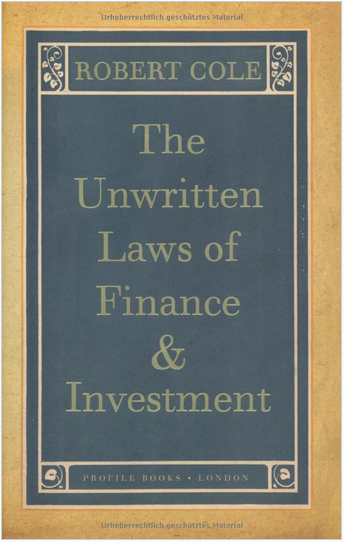
The Unwritten Laws of Finance and Investment, by Robert Cole.
I believe I have already mentioned at some point in the blog the ritual I have almost every time I get into an airport of going to one of the book shops to check whether I can find something to take with me.
The book is a collection of investment and finance maxims, advice, quotations, etc. It can be read in one shot (159 light pages).
If you are to read this book probably nothing of what you may find in it will be completely new to you, but the compilation and the witty style in which the “laws” are written make it an entertaining read and serve as repository where to find well established ideas.
Let me finish by quoting some passages from the laws that I enjoyed the most:
“I don’t want a lot of good investments; I want a few outstanding ones”, Philip Fisher.
It is impossible for investors to get their timing precisely right always. [I will come back to this in the future].
“In this business, if you’re good, you’re right six times out of ten. You’re never going to be right nine times out of ten”, Peter Lynch.
Before you go in, look for the way out. – This one is beautifully explained with a story from Winnie-the-Pooh. [I will come back to this in the future].
“Bull markets are born on pessimism, grow on scepticism, mature on optimism and die one euphoria”, Sir John Templeton. – This one reminds us to that of Warren Buffett “Be fearful when others are greedy and greedy when others are fearful”.
“There are huge mathematical advantages to doing nothing”, Warren Buffett (on compounding interest).
“The practice of contracting debt will almost infallibly be abused in every government. It would scarcely be more imprudent to give a prodigal son a credit in every banker’s shop in London, than to empower a statesman to draw bills, in this manner, upon posterity”, David Hume.
“The four most expensive words in English language are ‘This time is different'”, Sir John Templeton. [I will come to this in the future].
“Investment is most intelligent when it is most businesslike”, Warren Buffett.








 The Blog by Javier