Category Archives: Travelling

Flight destination: Corsica

I often use a version of Eleanor Rooselvet‘s famous quote “do one thing that scares you everyday“. It’s not that I try to do something that scares me, but something which either brings me out of the comfort zone or that I simply would tend to procrastinate.

Today’s scary thing is flying together with my friend Asier and his flight instructor, Jean-Louis, to Corsica. Prior to taking the decision of joining this “adventure” about 2 months ago, I had barely made 10 flights amounting to less than 8 flight hours… in the last week I was learning with my instructor, Thierry, the basics of flight navigation, the use of charts in flight, the use of VOR, etc., in order to profit the most from this experience. It definitely feels less scary now. And then, I’ll always have Jean-Louis by my side at the time of piloting the airplane. I’m happy to be stretching the comfort zone.

In the previous days I also learnt a lot with Asier on how to plan the route, noting headings, altitudes, radio frequencies, air spaces, aerodromes, etc.

Planning the flight to Corsica.

The head of the MBA I studied in Seville used to describe it as a “experiences accelerator”; in the context of flying this trip to Corsica (a group activity of the Airbus Aviation Society I belong to) really feels like such an experience accelerator.

If everything goes well, we’ll be in Propriano (LFKO) before 15:00. Then we could have one or two days of visiting the island, either by car… or by plane. Ajaccio, where Napoleon was born; Bonifacio; the dolmens close to Ajaccio… I’ll keep you updated when we’re back :-).

1 Comment

Filed under Aerospace & Defence, Travelling

In search of paradise

After visiting Seychelles with Luca (or part of them; 3 islands out of 155), I had two discussions with my sister and a friend about which islands would be more paradisiacal…

Seychelles, Maldives, French Polynesia, Galapagos, Hawaii… feedback is welcome in order to target more efficiently future holiday destinations (always bearing in mind that Torrelodones is in another league).

This slideshow requires JavaScript.

1 Comment

Filed under Travelling

Helicopter ride from Nice to Monaco (video)

About 2 months ago, Luca and I went to Monaco for the weekend. On the way there we first took a flight from Toulouse to Nice, and then a helicopter from Nice to Monaco heliport. This was our second ride in a helicopter after the first one in Brazil 2 years ago. In this post I just wanted to share the videos I filmed of the ride (find them below).

This time the helicopter was an Eurocopter EC 135 (Eurocopter is an EADS company, same as Airbus, where I work). As we took a picture before getting on it, we didn’t have the best seats to shoot a nice movie. There is another shortcoming: since the heliport in Monaco Western than Monaco Ville and in the ride from Nice you are coming from the West as well, you don’t get to see all the sea-line of Monaco in the helicopter ride (the main port, Monte Carlo and the beach).

EC-135 at Nice airport.

2 Comments

Filed under Movies, Travelling

Patek Philippe Caliber 89

I confess that I am not much into fashion, complements and luxury items, not even watches. I guess all the watches I have had in the last 20 years have been presents from my mother and I don’t remember specifically having asked for any of them.

“You never really own a Patek Philippe, you merely take care of it for the next generation”, this all I knew about Patek Philippe, because of seeing its advertisements in The Economist magazine.

When I visited Geneva some weeks ago, a friend living there suggested that we could visit the Patek Philippe Museum (10 CHF) as one of the activities for the weekend, and so we did.

In the museum you almost get exhausted with the so many luxurious watches and pieces of jewellery that you see, but some of them make it definitely worth the visit.

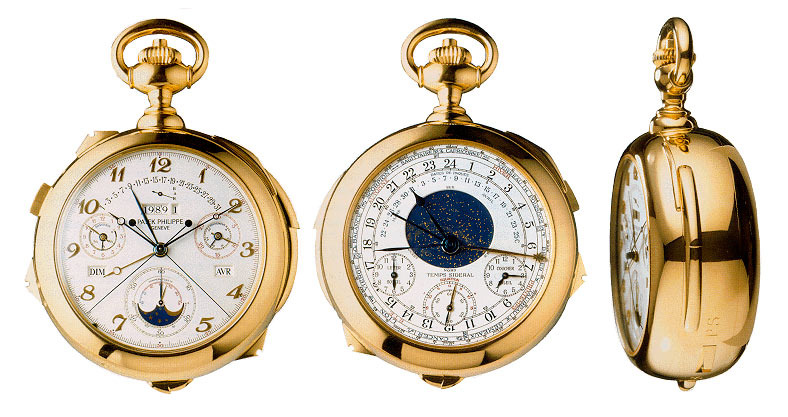
The Caliber 89 is a commemorative watch built to celebrate the 150 years of existence of the company. The small shrine displaying the watch and its features is breathtaking. It is said to be the most complicated watch ever built. You may see below the data about the watch provided by the museum.

Patek Philippe Caliber 89

Total development time 9 years: 5 years for research and development, and 4 years in manufacture.

  • Total diameter 89 mm.
  • Total thickness 41 mm
  • Total weight 1100 grams
  • Case 18 ct. Gold

Number of components 1728, including:

  • 184 wheels
  • 61 bridges
  • 332 screws
  • 415 pins
  • 68 springs
  • 429 mechanical parts
  • 126 jewels
  • 2 main dials
  • 24 hands
  • 8 display dials

Functions:

  • Hours, minutes and seconds of sidereal time
  • Time in a second time zone
  • Time of sunset and sunrise
  • Equation of time
  • Tourbillon regulator
  • Perpetual calendar
  • Century leap year correction
  • Date of the month
  • Century, decade and year
  • Day of the week
  • Months
  • Four-year cycle
  • Sun hand (season, equinox, solstice, zodiac)
  • Stars chart
  • Age and phases of the moon
  • Date of Easter
  • Chronograph
  • Split-seconds
  • 30 minute recorder
  • 12 hour recorder
  • Grande Sonnerie with carillon
  • Petite Sonnerie with carillon
  • Minute-repeater
  • Alarm
  • Going train up-and-down indication
  • Striking train up-and-down indication
  • Striking train stop work
  • Twin barrel differential winding
  • Four-way setting system
  • Winding-crown position indication

You may see below two videos explaining the watch and the process of building watches by Patek Philippe.

Finally, you may find this interesting post (in Spanish) about the Caliber 89, there I found the videos.

10 Comments

Filed under Travelling

Benjamin Franklin

Benjamin Franklin, by Joseph Siffred Duplessis (public domain image).

Benjamin Franklin was one of the Founding Fathers of the United States. The Wikipedia describes Franklin as a leading author, printer, political theorist, politician, postmaster, scientist, musician, inventor, satirist, civic activist, statesman, and diplomat; what is called a polymath.

Following Luca’s recommendation, I read some months ago Franklin’s autobiography. It was terrific. For the most part it describes his early life and how he was rising in the society and the origin and the work behind some of his great contributions to society: “Poor Richard’s Almanack” (which includes a collection of sayings that mark not only American culture but Western culture in general), “The Pennsylvania Gazette”, the first public lending library in America, the first fire department in Pennsylvania, etc.

One initiative that I especially liked was the creation of the Junto club; a club for mutual improvement where its members debated all kinds of questions from morals and politics, to sciences and business. This reminded me to the joy I have attending a particular Toastmasters meeting when you feel you have learnt something from the speeches you have heard. I will have to check whether there are such broad mutual improvement clubs in Toulouse (… note that he just went and created it! When he was 21!).

Other remarkable aspect was his setting of 13 virtues by which he was going to live (he did that at age 20) and apparently managed to practice for the rest of his life.

  • “Temperance. Eat not to dullness; drink not to elevation.”
  • “Silence. Speak not but what may benefit others or yourself; avoid trifling conversation.”
  • “Order. Let all your things have their places; let each part of your business have its time.”
  • “Resolution. Resolve to perform what you ought; perform without fail what you resolve.”
  • “Frugality. Make no expense but to do good to others or yourself; i.e., waste nothing.”
  • “Industry. Lose no time; be always employ’d in something useful; cut off all unnecessary actions.”
  • “Sincerity. Use no hurtful deceit; think innocently and justly, and, if you speak, speak accordingly.”
  • “Justice. Wrong none by doing injuries, or omitting the benefits that are your duty.”
  • “Moderation. Avoid extremes; forbear resenting injuries so much as you think they deserve.”
  • “Cleanliness. Tolerate no uncleanliness in body, cloaths, or habitation.”
  • “Tranquility. Be not disturbed at trifles, or at accidents common or unavoidable.”
  • “Chastity. Rarely use venery but for health or offspring, never to dullness, weakness, or the injury of your own or another’s peace or reputation.”
  • “Humility. Imitate Jesus and Socrates.”

Finally, last November, Luca and I visited the only remaining house where Benjamin Franklin once lived, for nearly sixteen years between 1757 and 1775, in one of his periods in London. I definitely recommend the visit to the house, at 36 Craven Street (2 blocks from Trafalgar Square), as it doesn’t take more than an hour and the animation that goes with it makes it highly entertaining (it goes without saying it that I highly encourage the reading of his autobiography).

2 Comments

Filed under Books, Travelling

Hazard and probabilities

Two weeks ago I visited Geneva for the first time. Among other things we visited a museum out of “our programme”, the History of Science Museum.

The ground floor of the museum had some tools that were in use in the past century in science research (microscopes, telescope, Earth globes…). In the upper floor there was a temporary exhibition about hazard, probability and games (“Les jeux sont faits! hasard et probabilités“). That one was great. Few times I had a better time in a museum than there. To name but a few of the games and tricks it had: rigged dice for the visitor to throw (and contribute to the experiment by noting down results), the game of the three-door game with a prize behind one of them (always change of choice when given the chance!), a small casino roulette (not only I didn’t lose any cash this time but finally I could throw the ball and say “rien ne va plus!”), a russian roulette, etc.

The interactive experiment that I enjoyed the most was one that challenged the visitor to guess the weight of a die. As a reference there were given three weights of 1, 3 and 5 kg to compare the die with (there was no scale). You had to enter your guess in a screen (my guess was 2.5 kg). Right afterwards you got information of previous visitors’ guesses: from 1 to 9.5kg (!), average weight guess of about 2.83kg… no one would tell you the solution. I don’t know how, but I hope I’ll get to know the solution to the quiz, even if it won’t be published until the exhibition finishes (January 2013).

Another feature that I loved of the museum was that in many of its rooms it had small brochures to be taken by the visitor as a complement of the visit. I took many of them to read them afterwards. It happens to me many times that after a couple of hours of slowly walking and reading lots of different interesting things in a museum I simply can’t take anymore of it. With these brochures you can make a lighter visit, knowing that the details you skip while at the museum can be read later on.

This slideshow requires JavaScript.

I highly recommend the visit to the museum. The visit will not take much longer than an hour (unless you engage yourself in every single game), it only requires a small diversion from the walk by the lake and by the way the admission is free.

6 Comments

Filed under Travelling

Monaco GP Walking Tour

This post is about something I missed in Monaco.

There are many cities where walking tours are offered. We have taken some of those and are quite enjoyable. Not only they guide you through the city, but you get to look at the right spots in the right places, you listen to some of the stories that make up the history of the city, etc. We generally regard those walking tours as good value for money.

I missed such a tour in Monaco (and if it exists, we didn’t see it announced in the guide).

Let me share with you how easy it would be to organise it.

I would pick the circuit of the Formula 1 GP of Monaco as a reference. By the way, I found no explicit reference to it in the guide or in the city, you need to make it up yourself from memories of having watched it or check it in the internet (where normally it is not displayed street by street).

"Monaco GP Walking Tour" following the Formula 1 GP circuit.

As I said, I would give the tourist a map of the circuit and off we would go:

  • Departure at the starting line of the GP at Boulevard Albert I: from there you could easily venture to the left to see the centre of La Condamine, Rue Princesse Caroline, maybe walking up to the Place d’Armes to see the market.
  • Back to the circuit you would just go ahead till the first curve and visit the church Sainte Dévote, which gives the name to the curve in the race.
  • Taking the avenue d’Ostende up, you could venture to the Carré d’Or gallery, which is actually recommended in the guides. There you can see all kinds of luxury items’ shops (most of those brands don’t even ring a bell to me).
  • Leaving Av. d’Ostende you would continue to the Av. Monte-Carlo where you could visit the Casino, take some pictures in the gardens, admire the cars at the front (that spot is one that apparently every Porsche, Ferrari, Jaguar, Maserati or the like has to pass by no matter where they go :-)) and take a drink at the Cafe Paris (all activities that are recommended in the guides).
  • Leaving Av. Monte-Carlo you would take the Av. des Spélugues where you would admire its curves, steep slope down and F1-like road borders.
  • Down at the Boulevard Louis II and prior to entering the tunnel, you could have a walk by the beach and see The Champions Promenade.
  • You would then go through the tunnel to appear again at the harbour, where you could admire the yachts.
  • Turn left at the Route de la Piscine (which last weekend was used for ice-skating) and end by having a final drink at the bar of the last curve, La Rascasse.

With this simple walk, of no much more than the 3.3km of the official Formula 1 circuit, you would have visited most of the highlights except for the Rocher, where the cathedral, the aquarium and the Palace are located.

If the walking tour was guided, someone knowledgeable of the city could tell you about the prices of houses, VIP residences, sums played at the casino, owners of biggest yachts, firms selling at the Carré d’Or, famous stunts and overtakes at F1 races history, etc, etc.

As far as I know, there is no such guided tour, above you have my two cents.

This slideshow requires JavaScript.

6 Comments

Filed under Travelling

The Champions Promenade

While walking around in Monaco last weekend we discovered by chance “The Champions Promenade”, a walk by the seaside in Monaco with the footprints of some of the best football players in the History of the sport.

There, I discovered the “Golden Foot” award, different from the Ballon d’Or and the Golden Shoe. While the last two are awarded to the best player and top scorer of the year, the former is awarded only to active players older than 29 years old and can only be won once. Each new winner adds his footprint to The Champions Promenade, being the last one to do so Ryan Giggs.

I was happy to see nine former Real Madrid players in the promenade: Luis Figo, Hugo Sánchez, Roberto Carlos, Zidane, Ronaldo, Kopa, Puskás, Gento and Di Stefano.

This slideshow requires JavaScript.

1 Comment

Filed under Sports, Travelling

A reflection on Stonehenge & Machu Picchu

I remember that during our trip to Peru in 2009, we used to hear a great many positive things from tourist guides about the Incas, or better the people of the Tawantinsuyu Empire (the Inca being just the king of the empire).

The guides used to praise their mastery in agriculture, astronomy, architecture, engineering and many other disciplines. While that civilization reached certain degree of advancement and the wonder in Machu Picchu site gives account of that, I had the parallel thought while being there that at the same time in Europe big cathedrals were being built full of arcs, domes, Leonardo da Vinci was diving into all kind of sciences, etc. The roofs in buildings at Machu Picchu were made of wood, there were not stone arcs or domes, and that is why today you cannot see trace of them.

During our last trip to England, I had a similar experience while visiting Stonehenge. The guides praised this site as being the most important prehistoric construction in Europe, which may be true, but then again I couldn’t avoid thinking of the pyramids at Giza, which we visited about a year ago.

I am no historian, thus take my next reflection as what it is: a reflection of a tourist :-).

I guess this can be seen as positive outcome of globalization understood as “global relationships of culture, people and economic activity”. I guess that by the year 2,500 B.C. the trade between different regions was much smaller than today and less exchanges of cultural and architecture best practices took place: thus you could have about at the same time the pyramids being built in Egypt while the stones at Stonehenge being put up, both being the state of the art in each place.

About 4,000 years later, the state of the art in construction building we can say that was harmonized between Middle East, Northern Africa and the whole of Europe, including the islands, and you had for example the Cathedral of Salisbury just few miles from Stonehenge being built around 1,250 A.D. , two centuries before Machu Picchu was built in a continent not yet affected by such globalization.

This reflection just related to architecture. Think of all other types of exchanges that take place from agriculture to medicine, sciences and arts… so much for the goodness of globalization.

Some pictures taken in those four sites:

This slideshow requires JavaScript.

2 Comments

Filed under Travelling

The British Museum

During the last trip to the United Kingdom I visited for the first time The British Museum (free). The museum itself is without any doubt amazing.

However I had conflicting ideas of whether the breadth of pieces mostly coming from other countries should have been better displayed at a museum in the country of origin or there in London.

I found it curious that the museum has a dedicated brochure explaining why the collection of Elgin Marbles from the Parthenon is hosted in London instead of Athens as the Greek Ministry of Culture claims they should be. The British Museum claims that the pieces were taken with permission of the then authority of those territories: the Ottoman Empire. It also gives account of an internal investigation carried by the Parliament. And even points at other 6 museums around the world hosting sculptures from the Parthenon as if trying to divert the attention.

The museum’s brochure concludes that the taking of the pieces was legal and its location in London is good as it believes the museum is a unique resource for the world, but offers the reader to check the counter opinion at the Greek ministry’s site.

I still haven’t made my mind yet: is it the World’s looting museum or most of the pieces are better off being conserved there that they would be in Greece, Egypt, Syria or elsewhere?

To end the discussion I found it comical that in order to introduce Stonehenge to the museum’s visitors a poster of it was deemed enough. In this case it wasn’t necessary to bring one or two stones from the site, as has been the case with pieces from many other places.

Besides that discussion I enjoyed seeing some items missing in previous trips. Find some pictures of some of the museum highlights below:

This slideshow requires JavaScript.

5 Comments

Filed under Travelling