Category Archives: Travelling

East Side Gallery (Berlin)

A whole decade has passed since the first time that I visited Berlin with my brother. This time again, we dedicated some time to visit some touristic highlights. I will write some posts in relation to that visit.

This first one will be dedicated to the East Side Gallery. From the Wikipedia:


The East Side Gallery is an international memorial for freedom. It is a 1.3 km long section of the Berlin Wall located near the centre of Berlin on Mühlenstraße in Friedrichshain-Kreuzberg. […]
The Gallery consists of 105 paintings by artists from all over the world, painted in 1990 on the east side of the Berlin Wall. […]
It is possibly the largest and longest-lasting open air gallery in the world. […]
The paintings at the East Side Gallery document the time of change and express the euphoria and great hopes for a better and free future for all people of the world. […]

The wall has been damaged by several reasons and gone through subsequent series of restorations.

See below some pictures from the East Side Gallery (status from September 2012):

This slideshow requires JavaScript.

1 Comment

Filed under Travelling

Berlin marathon breakfast run

One of the events that include some big marathons is a morning run the previous day, the so-called “breakfast run”.

When we ran the marathon in Paris, only our friend Serna attended that run. This time we went together and Luca and my brother Jaime waited for us at the end.

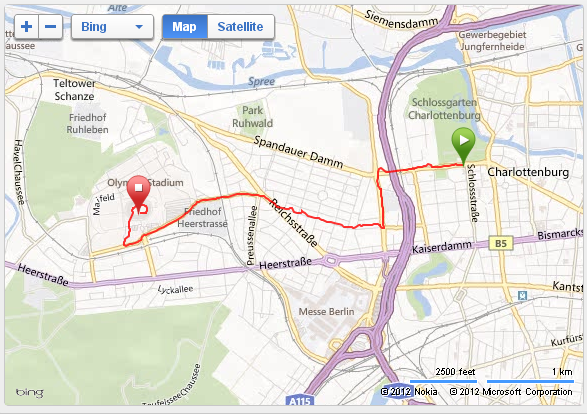
The run, a very easy run of almost 6 km, departed in front of the beautiful Palace of Charlottenburg and ended at the Olympia Stadion.

This stadium today hosts Hertha Berlin football matches, but it is better known as the stadium where the summer olympic games of 1936 were celebrated: the first ones televised, inaugurated by Adolf Hitler and the ones in which the athlete Jesse Owens won 4 gold medals.

See below some of the pictures we took during that morning run:

This slideshow requires JavaScript.

Hopefully the next time we’ll remember to bring either flags or a festive costume as many of the other runners typically do.

See the route we followed from the palace in Charlottenburg to the stadium as recorded by my Germin GPS:

Breakfast run route.

Finally, I found two interesting documents in relation to the stadium and the games:

  • The stadium plan [PDF, 1.7 MB] from today’s stadium website. In it you can see the location of the Maifeld (used for Hitler’s government celebrations and during the olympics for the equestrian events), the Bell Tower, the stadium and the Olympischer Platz.
  • The official report [PDF, 42.4 MB, 640 pages] of the games. It contains all kind of info about the International Olympic Committee at the time, hundreds of pictures of the Games and all of results of the different events.

1 Comment

Filed under Sports, Travelling

Berlin marathon

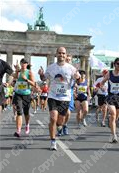
Last September 30th I completed the Berlin marathon together with my friend Serna and brother Jaime. This was the second marathon we ran together (the previous one being Paris 2012). The sixth one I ran.

Jose, Jaime and I in the runners’ fair.

The morning of the marathon I published a post in which I explained how I arrived at it in terms of training: I suffered an injury about 1.5 months prior to the race which didn’t allow me to practically train during the last month. Previously I had been training well and accumulating many kilometres.

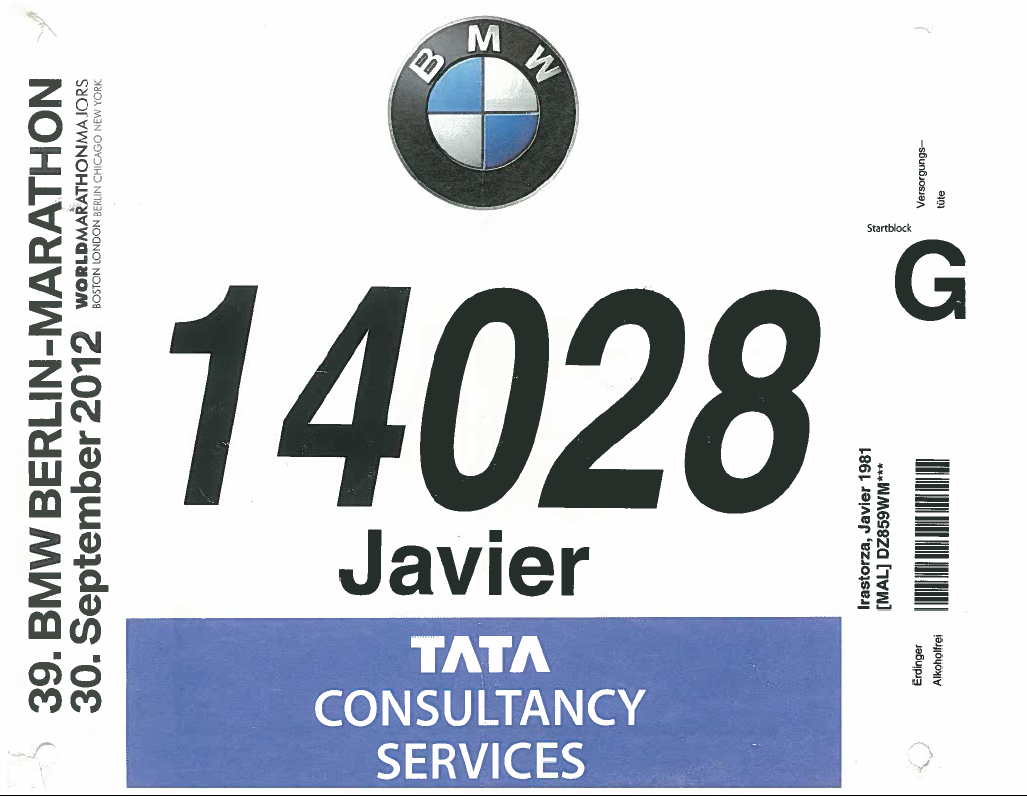
My bib number for the race:

My Berlin Marathon bib number: 14028.

You may see the route of the marathon and my performance as recorded by my Garmin GPS here:

My Berlin Marathon Garmin records.

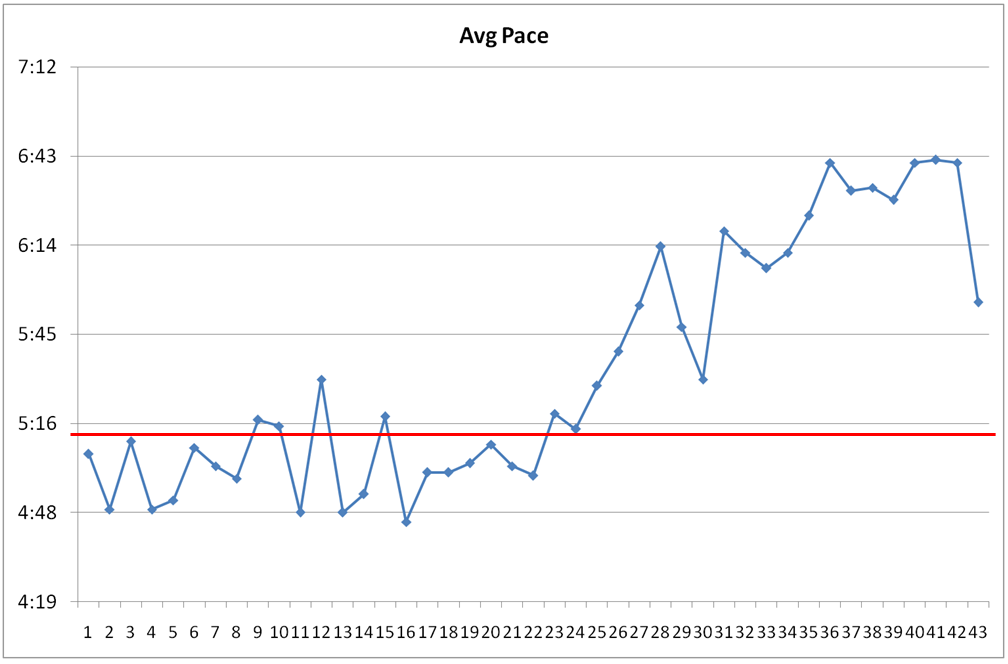
I started with a bracelet with references for a 3h40′ marathon, 5 minutes lower than in Paris. My plan was to start at that pace (5’13” per km) and keep it until I could. I was expecting that I would not be able to run the whole of it and that I would have to walk in case the Achilles tendon was hurting again. If that happened the later it occurred the better. Thus the faster I could go at the beginning the better for having to walk less distance at the end.

I did the half marathon in slightly above 1h47′, better than in Paris and was still feeling OK. Though at km 23 I started feeling hard to make kilometres under 5’20” (lack of speed endurance work and series in the last month)… I started to think of managing the margin I had built.

Finishing the marathon (km. 42).

However, 5 kilometres later I started to feel the ankle getting harder and some cramps in the quadriceps of the right leg (lack of kilometres and long runs in the last month). I then decided to slow down, otherwise I would have to start walking soon (when you get these cramps, the following step is feeling the muscle like a rock and not being able to run… experience from marathons 1 and 3).

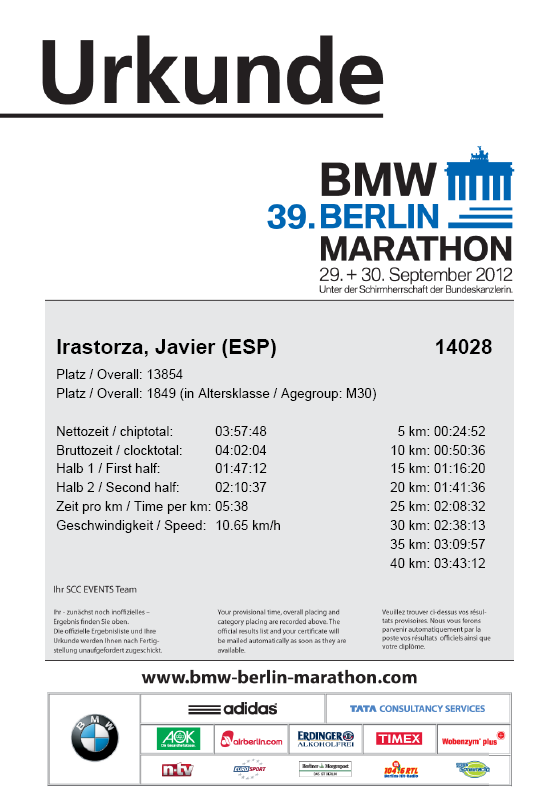
From then on I clocked 6′ per km, then 6’20”, 6’35”, 6’40″… but I was still quite happy as at every kilometre I was making the numbers in my head: “if I keep this pace, I can finish in 3h53′ “, then “3h55′ “… I finally clocked: 3h57’48”, but at all times I knew I could complete it and that I was going to be under 4 hours, thus I just kept on running and smiling.

See the analysis of Garmin records by kilometre below. You can see how the pace was at each stage as I explained it above.

My Berlin Marathon running pace per km (mm:ss).

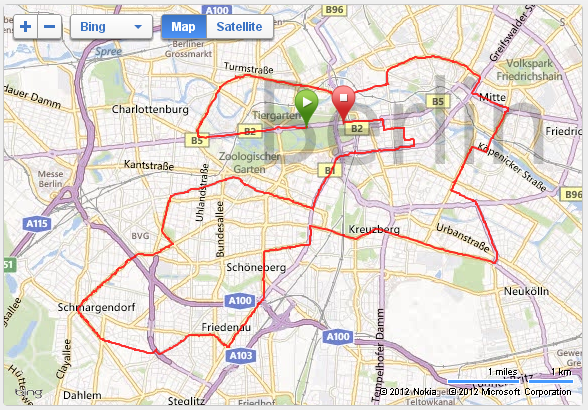
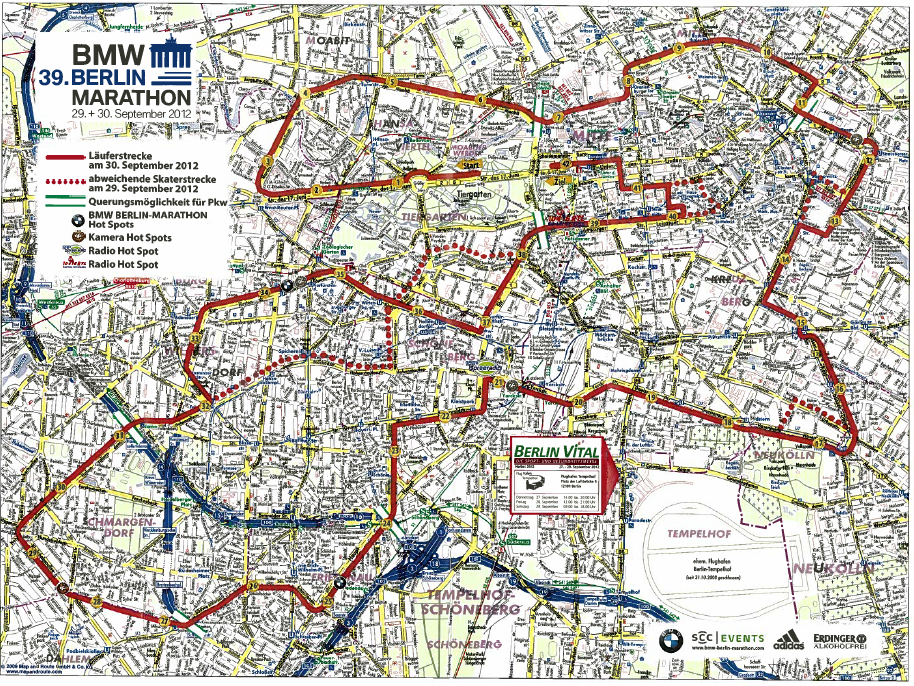
Two more pictures to complete this post: my finisher diploma and the detailed street map of the route.

Berlin Marathon detailed street map.

Next stop: Maratona di Roma, 17th March 2013.

5 Comments

Filed under Sports, Travelling

Golf & running in Papendal

Luca wanted to enjoy a weekend out in The Netherlands, I only asked some time during both Saturday and Sunday to run some 8 to 10km each day. We ended up in Papendal: a hotel and sports centre in the country side close to Arnhem. 

Papendal centre entrance

At first I didn’t know about it, just what Luca told me “there is forest around where you can run”. Once we arrived she explained to me more about the place and we could read in some posters that the hotel is used by Dutch national sports teams of several disciplines to prepare big competitions such as the Olympics.

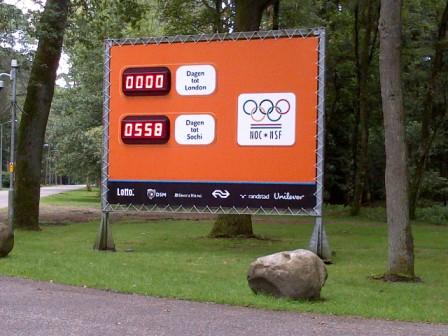
Time to the next Olympics games.


Then, I recalled “I believe that FC Barcelona might have come here as well for summer stages prior to starting the season”. I googled it, and voi là! FC Barcelona has been staged here several times starting as far back as the 70s. I saw an interesting article describing the centre [in Spanish, 237KB] from 1981, when it was already the 4th time the club visited the centre, in 1982 they repeated the experience and many times afterwards (including one in 1988 when the team captain got himself arrested by Dutch police!). Other Spanish teams have been there as well, e.g. Athletic Bilbao in 2003 & 2007.

Luca & I enjoyed a quiet weekend in which we played again golf, this time in the “Pitch & Putt” installation (close to the Edese golf club), just about 7 weeks after having played in Scotland. The game was entertaining, with some pond and trees in between the holes. We’re already looking forward to play the game in Toulouse.

Playing golf.

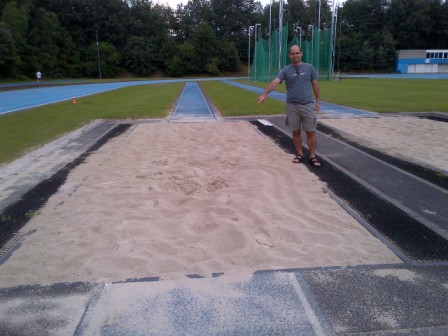
Then I could run both days around the installations and in the athletics track. I couldn’t resist the temptation of trying out 400m (1’16”), 100m (15”) and long jump (…m)… though I have to say that after having run 9km each day, the legs are not in the best situation to handle those activities. I’ll have to try again being rested in a track in Toulouse… ideally after Berlin marathon training season is finished.

Athletics track where I did some training sessions.

Not that I jumped long, huh?

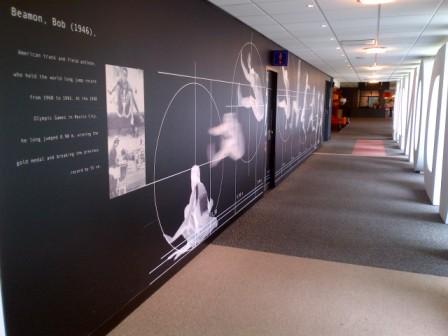
We also enjoyed the sports decoration motives that you can find in several spots in the hotel. They already make you feel in the sportive mood.

Javier Sotomayor’s 2.45m high jump.

Bob Beamon’s 8.90m long jump.

2 Comments

Filed under Sports, Travelling

Flying to Corsica (3/3)

This post is the third one of a series describing our flight from Toulouse-Lasbordes to Corsica and back. I recommend to read beforehand the first and second posts of the series.

I dedicated a single post to cover each of the 2 flights that took us to Propriano airfield. I will include in this single post some comments and pictures corresponding to the 3 flights that we needed on the way back to Toulouse.

Flight 3 (Asier at the controls): Propriano – Bonifacio – Porto Vecchio – Figari

This first flight had 2 purposes: to go to another airport in Corsica where we could refuel the aircraft (Propriano did not have gas station) and to perform a sight-seeing flight around the island. If the weather had permitted it, Jean Louis would have taken us over the mountains. The weather did not permit so, thus we flew over the coast.

Leaving Propriano.

“Torra di Campomoru” at Calanova.

Quiet beach south of Tralicetu.

Far sight of the commercial airport of Figari.

Approaching Bonifacio.

I have many other beautiful pictures of Bonifacio, but I believe I will soon write a post entirely dedicated to it. So I can give you a view of the city from the land, air and sea.

Southernmost point of Corsica.

Villas at Sperono.

Flight 4 (Asier at the controls): Figari – Propriano – Ajaccio – Saint Tropez – Avignon – Alès

Having refueled the aircraft at Figari, we commenced our return flight to mainland France, by first bordering again Corsican coast.

Propriano airfield.

Ajaccio port.

Some hours later…

Pope’s palace in Avignon.

Rhone river at Avignon.

Alès.

Flight 5 (Javier at the controls): Alès –  Millau – Montpellier – Béziers – Carcassone – Toulouse Lasbordes

Our original plan was to fly over Millau to see its viaduct (you may see a picture of it in this post about the 100km of Millau). However the weather was quite bad in the mountains between Alès and Millau and we had to change on the spot our plans. Luckily I was flying with Jean Louis who helped me in the preparation of the new route and in buying some time while he was taking the controls.

Change of plans due to the bad weather in the mountains, heading south to the coastline, re-calculating the route.

Avoiding further problems ahead (close to Sète).

Mission accomplished :-).

I guess that after seeing these 3 posts you may appreciate the beauty of learning to fly.

Leave a comment

Filed under Aerospace & Defence, Travelling

Flying to Corsica (2/3)

This post is a continuation to a previous post in which I described the first leg of our flight from Toulouse-Lasbordes to Corsica. If you haven’t yet taken a look at that one, I would recommend you to do so, as you would miss basic information and dozens of beautiful pictures of the French Mediterranean coast.

In the previous post I included images up until Cuers. There we refueled the aircraft and I took the controls of the aircraft, with Jean Louis (Asier‘s flight instructor) always by our side. This time Asier took the pictures.

Flight 2 (Javier at the controls): Cuers – Saint Tropez – Corsica – Sanguinary islands – Ajaccio – Propriano

Some curiosities about flying over the sea:

  • the distinction in the horizon between “land” and sky wasn’t very clear thus it was very important to pay attention to the instruments in order not to lose references and keep a horizontal straight trajectory;
  • as we progressed we always tried to spot ships down in the sea so in case of accident we would try to reach as close as possible to them, Jean Louis would do a water landing and we could be easily rescued;
  • we needed to increase altitude up to flight level FL55 (5,500 feet -~1,700m- vs. about 700ft that we held at some times of the first flight along the coast) so we could keep receiving the signals from VOR on ground at the coasts.

First sight of Corsica: Piana.

Flying around the Corsican coastline: Cargèse.

Notice Jean Louis (the instructor) with the life vest on.

Cemetery of Ajaccio, looking like a village.

Jean Louis & me, at Propriano airfield.

The aircraft, a DR-44, put to rest for the weekend at the airfield.

Since we are normally flying within continental France we are not required to produce a flight plan for the air traffic control. This time as we wanted to cross over the sea to Corsica it was required to do so. Thus, this was the first time we prepared one (another learning point!).

“Olivia”, French site where to file a flight plan.

One remark: it is incredible how much eases the communication with air traffic controllers having sent the flight plan beforehand, as they expect you and they know beforehand more or less the information you are going to provide.

And so we made it! We flew from Toulouse to Corsica 🙂

It took us about 4h30′ of flying time (both flights combined). You may check the Garmin records of the first and second flights by clicking on the links, and the route we followed in this second flight in the picture below:

Even though I have mentioned above that we had planned for the contingency of having to water-land in the sea, the fact that the trajectory in the Garmin records stops at half way through Corsica in the middle of the sea does not mean that we indeed carried out such maneuver. Explanation: since we flew so many kilometers as compared to running (the normal use I give to the device), the memory of the GPS reached its maximum as it recorded one “lap” for every kilometer…

(to be continued…)

3 Comments

Filed under Aerospace & Defence, Travelling

Flying to Corsica (1/3)

About 3 months ago, my colleague Asier and I went together with his instructor, Jean Louis, to Corsica for a weekend fly out, an activity of our club the Airbus’ Aviation Society.

The experience was terrific in several ways. I learnt a lot about flying and navigation the days prior to the fly out and during the trip. The views along the way by southern coastal France were superb. We enjoyed good weather despite of what had been announced and even found time to do some tourism and trekking in the island. But let’s go back to the flight.

On the way to Corsica, we made one stop at Cuers to refuel the aircraft and change pilot. Asier would start from Toulouse and I would continue to Corsica. On the way back, Asier would fly over the sea all the way to Alès and I would fly over Millau on the way to Toulouse.

I’ll try to be brief with the explanations and generous with the pictures to give you a flavour of how the French Mediterranean coast looks like. Because of the number of pitures I want to share, I will distribute them in 3 different blog posts, starting with this one dedicated to the first flight.

Flight 1 (Asier at the controls): Toulouse Lasbordes – Carcassone – Narbonne – Sète – Montpellier – Saintes Maries de la Mer – Fos-sur-Mer – Marseille – Cassis – Le Castellet – Toulon – Cuers

I encourage you to take a look at a map of France coast at the same time you are watching the pictures and try to identify the places (you may see the route at the bottom of the post as recorded by my Garmin).

See the life vests (yellow bags) at hand in case of emergency ready at hand. Jean Louis would have his vest always on. In case of emergency he would take the control buying us time to get ours on.

Carcassone from the North.

Narbonne from the North.

Coastline at Cape de Adge.

Peninsula at Étand de Thau.

Seafood plantation at Étand de Thau.

Ville de Sète.

Frontignan.

The touristic village “La grande Motte” built in the ‘60s and ‘70s with its characteristic architecture with forms resembling pyramids.

The intricate Port-Camargue, one of the first “pleasure ports” in Europe, also from the ‘60s.

Closed ponds at the mouth of the Rhone.

Bull fighting arena at Saintes Maries de la Mer.

Sands at Lagunes de Beauduc (with its non-paved driveway).

Lighthouse at Lagunes de Beauduc.

Colourful salt flats at Salins du Giraud.

Ships departing from the industrial hub Fos-sur-Mer.

Marseille and “Les Îles”.

Les Goudes and “Les Îles” (past Marseille).

Natural reservation of the “Île de Riou“.

Ideal and quiet spot at Calanque de Sormiu.

Former F1 “Paul Ricard” racing circuit and aerodrome at Le Castellet.

Military port at Toulon (an aircraft carrier can be seen).

Asier after having flown 2h30′ hours posing side by side our Robin DR-44.

You may check the Garmin records of this first flight by clicking on the link and the route we followed in the picture below:

(to be continued…)

6 Comments

Filed under Aerospace & Defence, Travelling

Visiting the CERN & Higgs boson

I visited the CERN (European Organization for Nuclear Research), in Geneva, some months ago (I already wrote some posts about two of its museums: Patek Philippe & Science). The CERN and the Large Hadron Collider (LHC) have been widely in the media lately due to the detection of the Higgs boson.

The visit was very interesting despite of the fact of not being able to descend into the under ground to see the tunnels that appear in the media so often. In fact, as we were informed by the researcher who guided our visit, all those images are from archives as at the moment radiation down there is high due to the experiments and no one can get down, everything is controlled from above the ground, being this monitoring room the closest you can get (including researchers from ATLAS, pictured in the photos).

ATLAS monitoring room

ATLAS monitoring room

As I said, tours and explanations were given by researchers contributing some of their time to science outreach: I found that fantastic, even if to some eyes the discourse might seem dull. To complement the visit some videos were displayed and I collected some brochures, that I have scanned and can now share in the blog (you see how timely the visit was!). If you are interested in the brochures, click on the links and you can retrieve them from Google docs:

Guided visits are free of charge but limited in number and group size, thus you need to make a reservation prior to going there. Needless to say that I strongly recommend the visit.

By the way, I’ve seen in many places people criticizing the Higgs boson nick as “God Particle”. The explanation is simple and funny and can be found here.

The book in which this nick first appeared, “The God Particle: If the Universe Is the Answer, What Is the Question?” is a tremendous piece of divulgative physics by the physicist Leon Lederman. I loved it because of the anecdotes he explains of his experiments, the humour he uses and the passion he transmits. I recommended this book once five years ago in Toastmasters, got it borrowed by a member and returned it after a week: “Javier, it’s not *that* easy, funny and entertaining” (obviously the person didn’t read more than 5% of it). Nevertheless, I continue to recommend it, especially if you know some teenager thinking about studying Physics.

1 Comment

Filed under Education, Travelling

Scotland

On the 2nd of June I flew in the morning from Toulouse to London Gatwick. At more or less the same time Luca flew from Amsterdam, our friend Elena from Madrid and Maicol drove from Bournemouth, in the South of England. From then on, we embarked into the adventure of seeing as much as possible of Scotland in a week. There we go!

Day 1: Gatwick, York, Riding Mill.

Day 1

At first we encountered heavy traffic in the road, thus we arrived to York later than we wished. We could have a walk around the city. We then followed to Riding Mill where we would sleep at the Low Fotherley Farm, the first of the many Bed & Breakfasts that we would be hosted at. This is a feature which I loved of the trip: those breakfasts! I also enjoyed much the suppers at pubs.

Day 2.

Day 2: Scottish Borders, Markinch, St. Andrews, Edinburgh

We continued our way to the North, making our first stop at the Scottish Borders, listening for the first time to the pipes and starting to see Scottish flags (St. Andrew’s cross). We then reached Edinburgh and passed it as we wanted to reach Markinch to witness the Highland Games, of which I already wrote one post.

Scottish Borders.

We then went to St. Andrews to visit the Old Course, which I explained in a post about golf in Scotland, and back to Edinburgh where we arrived just in time for dinner.

Day 3.

Day 3: Edinburgh, Stirling, Glamis, Cairngorms, Balmoral, Aberdeen

In Edinburgh we slept near Arthur’s Seat, but we decided to skip the trekking to the hill and head to the city centre. We then visited the Castle, where they were getting prepared for the Military Tattoo (where this year an official name for A400M may be given!).

In the castle we saw Mons Meg cannon, St. Margaret’s chapel, the Great Hall, the Scottish War Memorial, the One O’Clock Gun firing at 13:00, the Stone of Scone… We then went down to walk along the Royal Mile to see some more highlights of the city, such as the Cathedral or the statue to Adam Smith.

Edinburgh Castle.

We then went to visit the Stirling Castle, but was already closed (as were Glamis Castle and Balmoral, which we also passed by later on in the day). We took a look of the views of the fields around the castle, where many battles central to Scotland’s history were fought, among them those involving William Wallace and Robert the Bruce, who has a statue just at the entrance of the castle.

Fields at Stirling.

Instead of taking the fastest way by the coast to Aberdeen, we decided to take the route through the national park of the Cairngorms, where the highest mountains of Scotland are. There we saw plenty of deers (we almost bumped onto some of them suddenly crossing the road!), cows, rabbits, etc.

Cairngorms.

Day 4: Aberdeen, King’s College, Loch Ness, Badbea, Dunnet Head, Thurso.

In the morning we took a walk around Aberdeen, the silver or granite city. It was a pity that the cathedral and other places were closed. We could visit the Maritime Museum. We then headed for the beach. We did not take a bath yet, as we were not enough in the North. Close to the beach we saw the football stadium of Aberdeen football club, one of the two which defeated Real Madrid in a Cup winners’ Cup (Recopa) final in one of the four times it took part in the competition. We then went to see King’s College, founded in 1495, with its idyllic campus. Close to the university we visited St. Marchar’s Cathedral where we enjoyed its heraldic ceiling with the coat of arms of many European kingdoms of the time (including Castile, Leon, Navarra…), and where a quarter of William Wallace is supposed to be buried in the walls.

St. Marchar’s Cathedral heraldic ceiling.

Nessie, at Loch Ness.

Once we left Aberdeen we went to Inverness and crossed it to see the Loch Ness, and we did found Nessie!

On the way to the north coast we stopped at Badbea, a former village by the cliffs of the east coast established during the Highland Clearances, a dark episode in Scottish history.

Badbea (what it’s left of it).

We finally reached Thurso, on the north coast, but that was not enough, we needed to reach Dunnet Head, the northernmost point of the island (being this the one and not John o’Groats). There we could see the lighthouse and some fortifications built during WWII.

Day 5.

Day 5: Thurso, Bettyhill, Durness, Ullapoll.

We departed from Thurso and started our tour along the north coast of Scotland, one of the requirements for the trip. We made some stops along the way, to see some sight spots, to have a swim at the North Sea (close to Bettyhill), to visit the Smoo Cave at Durness, to see Durness’ beach and unexpectedly to play golf at Durness Golf Club, as I already explained in an earlier post.

Having a bath at the North Sea.

Luca “flying” at Durness beach.

Day 6.

Day 6: Ullapoll, Isle of Skye, Glencoe, Goban.

We had been recommended the visit of the Isle of Skye, as the most beautiful of the islands. After almost rounding it completely we do not recommend the visit. We had some lunch at Portree, which we didn’t either find particularly beautiful. Sincerely, we found dozens of more beautiful spots driving down the west coast of Scotland.

Continuing with our tour we made two short stops: at Glencoe, to visit the memorial of the massacre, where most of the MacDonald clan was killed, and at Goban, a nice port city.

Day 7.

Day 7: Islay

In Islay the main attraction was to visit Bowmore distillery, which I described in an earlier post. We had a walk around the village and then went on to visit the other villages of the island, Port Ellen and Porthaven, where we had some coffee.

Day 8.

Day 8: Islay, Glasgow, Lockerbie, Liverpool.

On the way to Liverpool we stopped to have a walk in Glasgow, where we had lunch at the restaurant “The Willow Tea Room“, designed by Charles Mackintosh in 1904. Later on, as we saw in the road the signpost of Lockerbie we drove by to see if there was any memorial of the tragedy with the Pan Am Flight 103 which exploded on air; we didn’t find it.

In Liverpool we went by Anfield, though we were late for taking on any guided tour. This is something for which I’ll have to come back. We then moved to the centre to visit The Cavern Club (where The Beatles made their first performance) and have some dinner.

Anfield, “You Will Never Walk Alone”

Luca at The Cavern Club.

Day 9.

Day 9: Liverpool, Gatwick.

This was the last day of the tour, with the only goal to get to Gatwick in time for our flights. The only remarkable thing we saw were some paratroopers being dropped from a C-130J-30 from the UK Royal Air Force, some miles to the East of Brize Norton air base.

1 Comment

Filed under Travelling

Bowmore distillery

On our last trip to Scotland, a visit to a Scotch whisky distillery was a must. But, which distillery should we visit? Location was not a problem, we would travel throughout the whole of Scotland, thus, we decided to cross some inputs to make our decision.

Making a good use of the Wikipedia we found out that only a few distilleries in the whole of Scotland were producing their own malt:  Balvenie, Kilchoman, Highland Park, Glen Ord, Glenfiddich, Bowmore, Laphroaig, Springbank, and Tamdhu. Fewer of them opened their doors to visits. Three of those were located in Islay island, which Luca had already suggested. We then decided to target the oldest one of them: Bowmore, founded in 1779.

The visit was superb, even if due to lack of rain in the previous weeks they had stopped malting (for which they need tons of water coming from the local river). We had the chance of visiting all corners of their facilities: malting barns, we entered into the kiln (like an oven where they burned the peat which smoke provides the characteristic peatty flavour of Islay whisky),  the mash tun, the tun room where the wash back is made (so far the process is practically the same as for producing beer!), the stillhouse and the warehouse, where there were cask from up to 1957!

One curiosity which I enjoyed: whisky casks normally have been used beforehand either for producing bourbon in the USA (where in some states the law allows only to use them once for bourbon production – the cask selling for ~100$ each) or for producing sherry in the South of Spain (these were in higher demand as they may have been used more times and give more flavours and aroma to the whisky – the cask selling for 500-1,000$ each). You can also take a short visit to the distillery in their website.

We immediately became fans of Bowmore, buying some small bottles of 12, 15 and 18 years old single malts, some glasses, coasters, a flask, beer made out of malt and casks from Bowmore, “peatty” honey…

This slideshow requires JavaScript.

Note: I must admit that in our becoming fans of Bowmore, or in general Islay whisky, we may have been biased as Luca’s surname, “Veen”, means in Dutch “peat”.

4 Comments

Filed under Travelling