Tag Archives: Boeing

Starting up an airline?

Some days ago I came across a post in the blog of Randy Tinseth, VP Marketing  for Boeing Commercial Airplanes, where he explains the concept of StartupBoeing and invites entrepreneurs to take up the opportunity. StartupBoeing is a website which offers information to entrepreneurs in order to help them build their business plan or run their operations. As it is stated in the web itself:

“The StartupBoeing team assists entrepreneurs in launching new airlines. From concept through launch, StartupBoeing offers guidance, review, analysis, data, resources, contacts, and referrals to qualified startup airlines.”

The first thing I thought was “yes, there is the opportunity to lose your investment”. To be fair, Tinseth points at different moments the difficulty of the business and that it is tough to start-up an airline. Airbus does also have the same concept available to entrepreneurs, in this case is called: Start Me Up.

I looked for the last industry outlook from the International Air Transport Association (IATA), the industry association. The figures are appalling (see the table below):

IATA Financial results of the last decade.

Airlines around the world have lost during the last decade 50 billion dollars, with only 2 out of ten years with profits. On average the net profit, loss in this case, was -1.4% of the revenues (over 4 trillion dollars in the decade). Of course, there are airlines making profits, but the industry is not doing well (just remember the last achievements of G. Díaz Ferrán).

I then remembered this other comment from Warren Buffet about the airline industry since its inception:

“I made the comment that if a capitalist had been present at Kittyhawk back in the early 1900s, he should have shot Orville Wright. He would have saved his progeny money.

But seriously, the airline business has been extraordinary. It has eaten up capital over the past century like almost no other business because people seem to keep coming back to it and putting fresh money in.

You’ve got huge fixed costs, you’ve got strong labour unions and you’ve got commodity pricing. That is not a great recipe for success.

I have an 800 (free call) number now that I call if I get the urge to buy an airline stock. I call at two in the morning and I say: “My name is Warren and I’m an aeroholic.” And then they talk me down.”

So, yes, if you are considering whether to start-up an airline, do yourself a favour: call that 800 number, and put your cash somewhere else where it returns more than -1.4%…

The one thing we should definitely praise from these initiatives is the information resources available to the general public, something commented by readers of Randy’s blog and a purpose expressed in the Startup website as well:

“StartupBoeing.com also has a wider purpose as a resource to pass on information to our customers – and also as a resource for existing airlines, financial institutions, consultants and the leasing community. It’s a place for neutral industry data. We want to help make the industry healthy and make airlines safe, reliable and profitable.”
1 Comment

Filed under Aerospace & Defence, Investing, Marketing

An aircraft worth its weight in gold?

Airbus announced last January that it had raised the list prices of its commercial aircraft by an average of 5.8%. It had not updated its prices since 2008. You may see the current prices here: Airbus list prices

Boeing also discloses in its website the range of list prices of its aircraft. Those prices haven’t been increased in the last two years.  

Few years ago, I saw for the first time a comparison of prices of aircraft per kilogram. It was prepared by a teacher I had at EOI Business School in Seville, Felipe Moran, who later has become a co-worker. With this post I will start a series of comparisons, the first one being precisely that one: an update on price per kilogram of aircraft. 

We already saw where to get the prices from. The other input we are going to use is the weight of the aircraft, what is called: Operating Empty Weight (OEW). You may find this information in various places, I recommend you to pay a visit to Boeing’s “Airplane Characteristics for Airport Planning”, where you will find very detailed data of all its commercial aircraft.  (While gathering this info I also came across the following section dedicated to fun facts of the legendary Jumbo 747).  

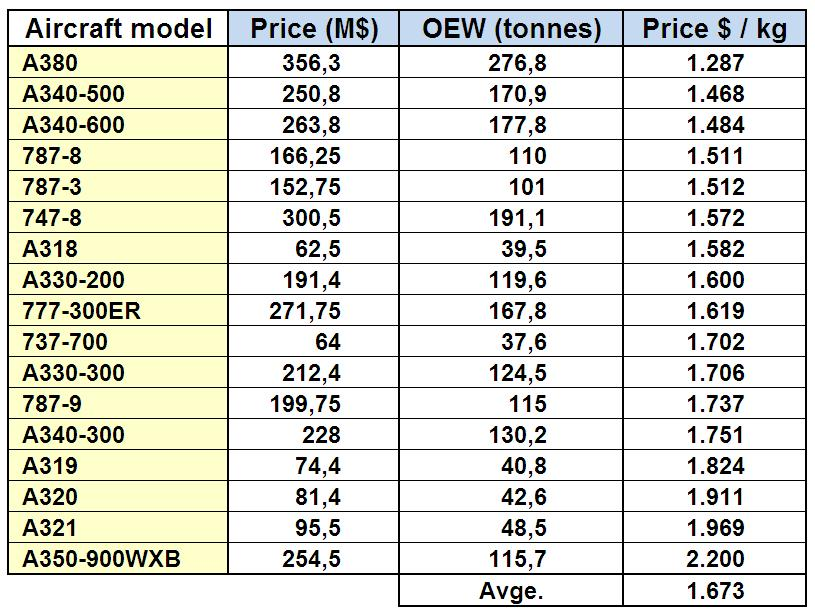
Combining these inputs we can build the following table. 

Price per kg of commercial aircraft.

Some facts may counter intuition: 

  • There doesn’t seem to be a clear discrimination between older and newer aircraft (A380 and some 787 models rank among cheapest, while A350-900 and 787-9 are among the most expensive).
  • Smaller Airbuses rank among the most expensive aircraft in a per kg basis despite the suggested price war that was reported by the specialized press in the recent years.

With the exceptions of A350-900 and 787-9 there seems to be a very slight trend in bigger aircraft being cheaper in this per kg basis. One may argue that once the frame of a certain size is built, building a bigger one might not cost that much

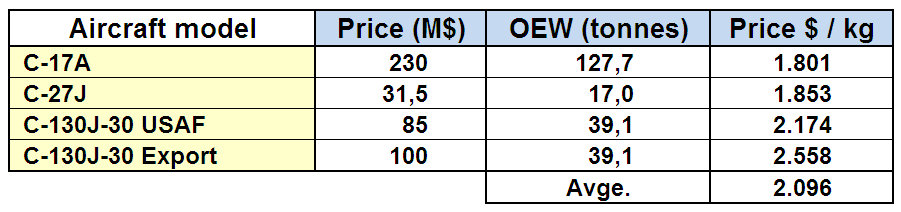
Now, let’s talk about the Military Transport business. Do we think those aircraft are more or less expensive? On one hand, those aircraft are not carrying systems such as the in-flight entertainment and, on the other, the scale of the market is smaller (with few exceptions such as the C-130) and they do carry diverse military systems, protections, etc. What is the trend weighting more in the balance? 

Military transport aircraft price per kg.

As you can see, military transport aircraft are on average 25% more expensive on a per kg basis. There is much more technology in them than people tends to think… they are clearly not just flying trucks. 

As you may have noted I have not included any sources for the prices of these aircraft, since they are rarely disclosed. I have used prices reported by the press and US budgets. 

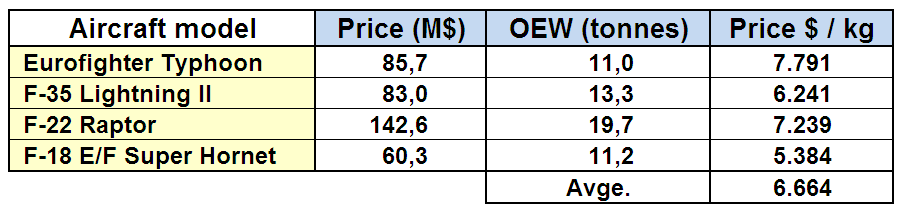
Let’s stretch the argument a bit more… What is the trend for fighter aircraft? This time scales are bigger than in military transport. Does this make them cheaper? See the table. 

Fighter aircraft price per kg.

Not even close. Fighters are around 3.2 and 4 times more expensive than military transport and commercial aircraft, respectively, on a per kg basis.  

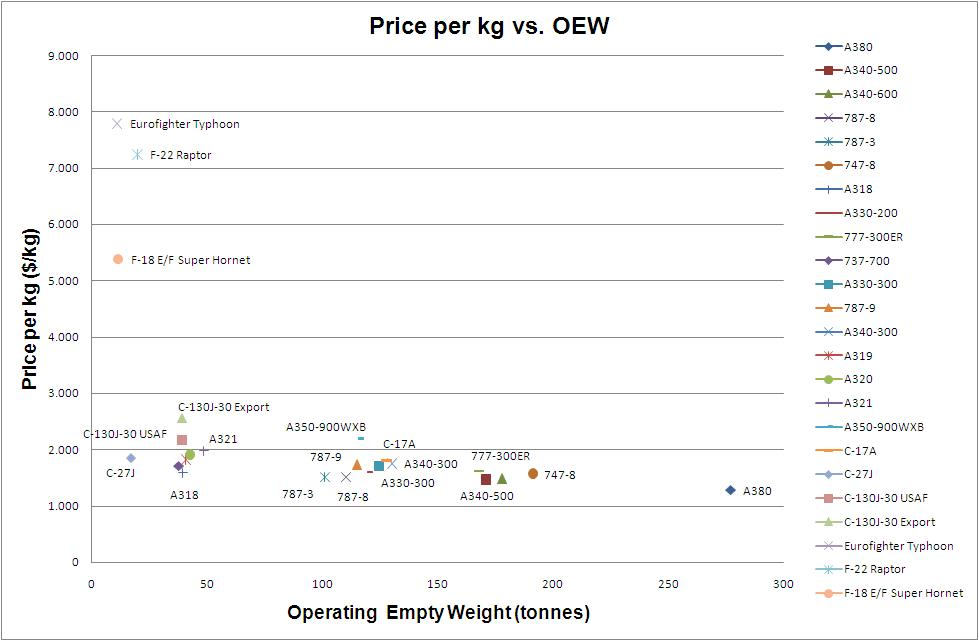
We can see in the following graphic all these aircraft together and maybe spot those trends. 

Aircraft prices per kg.

Now that we have an idea of how much aircraft cost per kg (1,700$ commercial aircraft, 2,100$ military transport aircraft and 6,700$ fighter aircraft)… is this expensive? Expensive compare to what? 

Let’s relate these prices to something closer to us. 

Cars: 

  • The best-selling car in Spain in 2009, was the Renault Megane (with 52,156 cars sold). It costs about 17,700 € (or 24 k$) and weighs 1,150 kg, this yields: 21 $/kg, clearly cheaper, about 80 times cheaper than commercial aircraft on a per kg basis. 
  • More up-scale cars such as the Mercedes Class E 350 CDI (56,000€ and 1,825 kg) or the Audi Q7 4.2 TDI (85,000€ and 2,605 kg) are more expensive per kg, 41$/kg and 44 $/kg, respectively. This is 40 times cheaper than commercial aircraft.

It may be worthy to note that in the cars we see the completely opposite trend than that we saw in airplanes: the bigger the car the more expensive on a per kg basis. 

Let’s compare this yet again with some other unrelated luxury item: Jamón Ibérico Puro de Bellota de Jabugo 5J. Today it was on offer in El Corte Ingles website for only 449€, a piece of about 7 kg, yielding: 87 $/kg. This is twice more expensive than buying a Mercedes (this may be the reason why it was an offer from Sanchez Romero supermarkets) but still 20 times cheaper than a commercial airliner. 

To end this post, let’s answer the question posed in the title of the post: 

The kilogram of gold is in the order of 35,400$, clearly more expensive than any aircraft. 

After all, nowadays, we may find no aircraft worth its weight in gold.

9 Comments

Filed under Aerospace & Defence