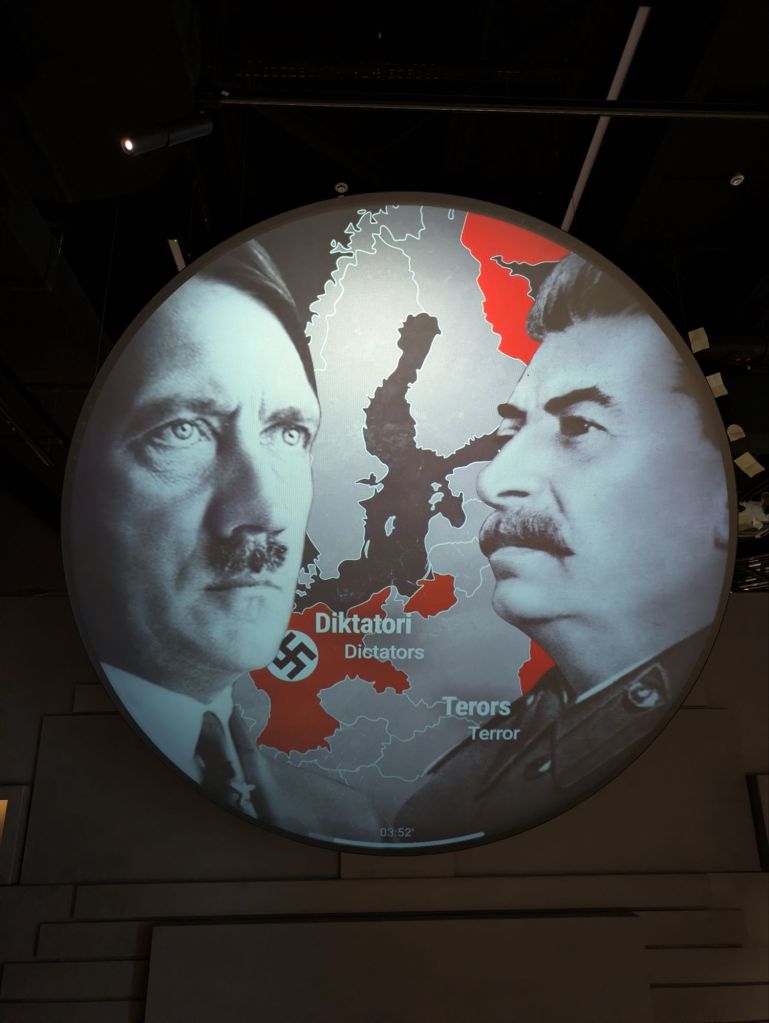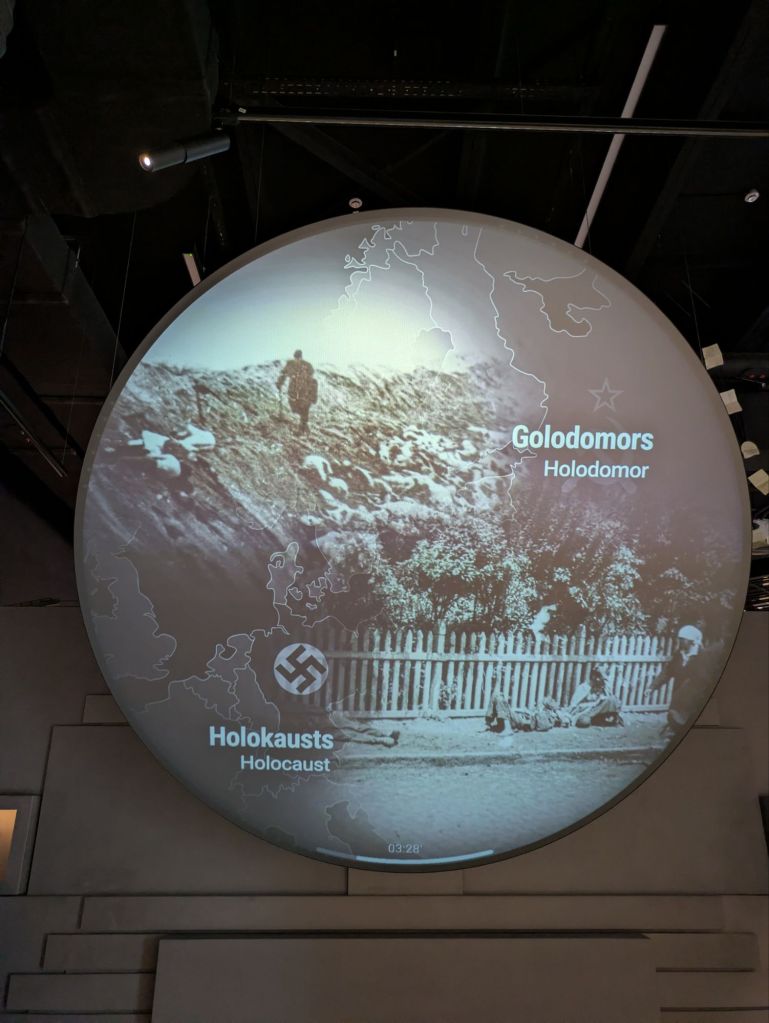
Last month I visited Riga and took the opportunity to visit The Museum of the Occupation of Latvia. The museum tells the story of the Latvian nation and Latvian state that it founded, as the German and Russian empires collapsed at the end of the First World War. A key message of the museum is to raise awareness of the conspiracy between Communist Soviet Union and Nazi Germany:
On 23 August 1939, the Soviet Union and Nazi Germany conclude a mutual non-aggression treaty. It is signed by the People’s Commissioner for Foreign Affairs of the Soviet Union Vyacheslav Molotov and German Minister for Foreign Affairs Joachim von Ribbentrop. Its secret protocols divide the eastern part of Europe into German and Soviet spheres of influence and pave the way for the Second World War.
The Soviet Union and Germany collaboration lasts for almost two years. In September of 1939, they occupy and divide Poland. The Soviet Union demands the Baltic States and Finland to sign “mutual assistance” treaties that establish Red Army bases on their territories. Finland refuses to comply; on 30 November, it is attacked by the Soviet Union. The Baltic States sign the imposed treaties.
Thus from October 1939 to September 1998 foreign troops – alternately Soviet Union, German, Russian forces – are stationed in Latvia. For 50 years, the Soviet Union denies the existence of the secret protocols. Modern day Russia continues to justify them as a necessity dictated by the historical situation.
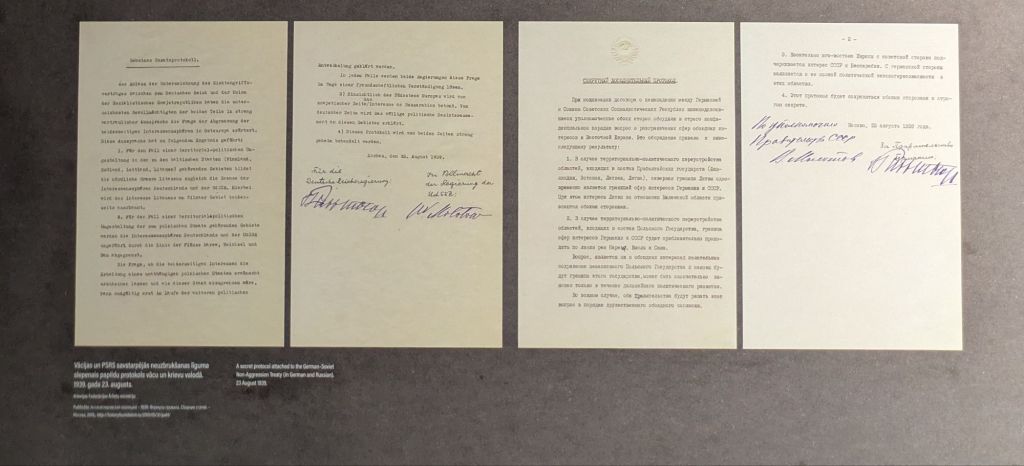
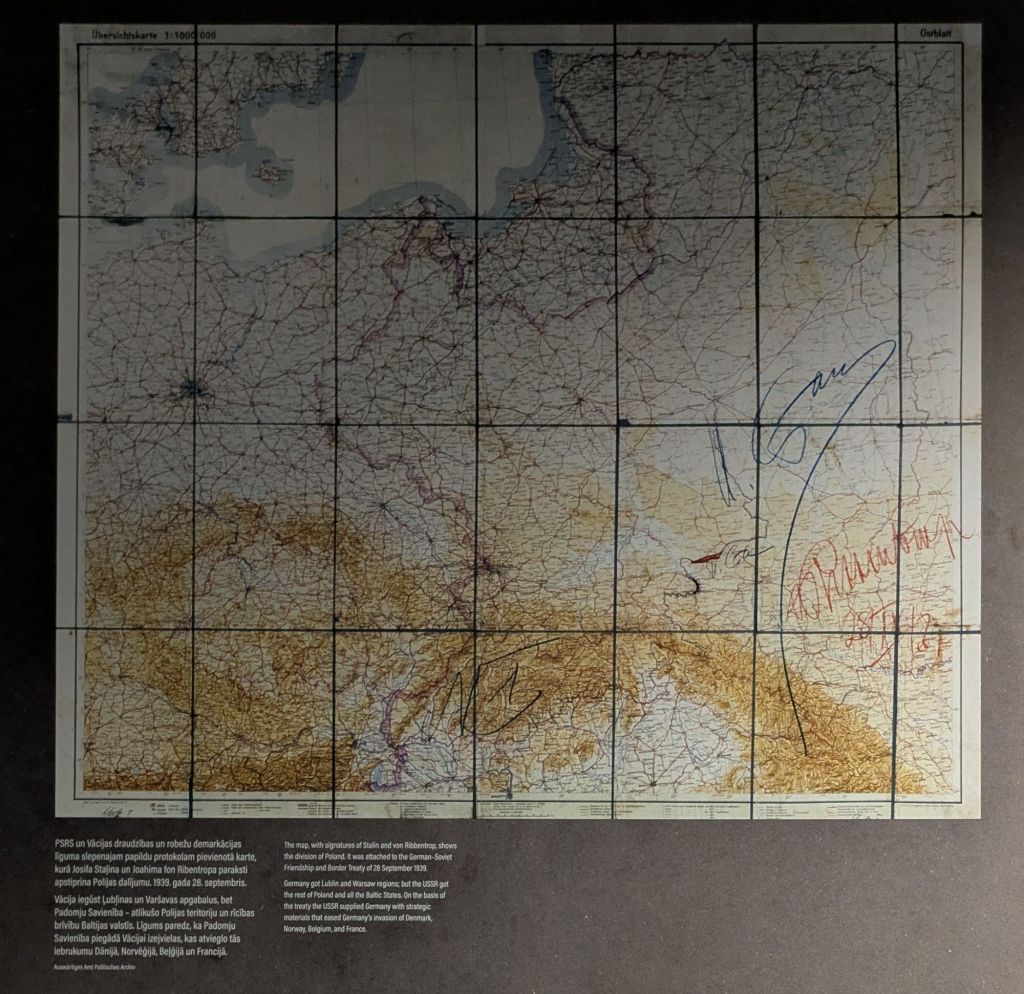
The museum is arranged chronologically and even though it’s not very big, there’s plenty of material to read and watch. I could spend only about two hours in it, as I had a flight to catch.
Organization of the museum:
- Creation of an independent Latvia (1918–1940)
- Conspiracy. The Hitler-Stalin Pact (1939)
- First Soviet Occupation (1940–1941)
- Soviet Mass Deportations of 1941 and 1949
- Nazi German Occupation, Holocaust
(1941–1944/1945) - Resistance against the Soviet Totalitarian Rule (1944/1945–1991)
- Gulag – Descent Into Hell. Incarceration and Forced Resettlement (1940–1988)
- A Renewed State. Rebuilding Latvia
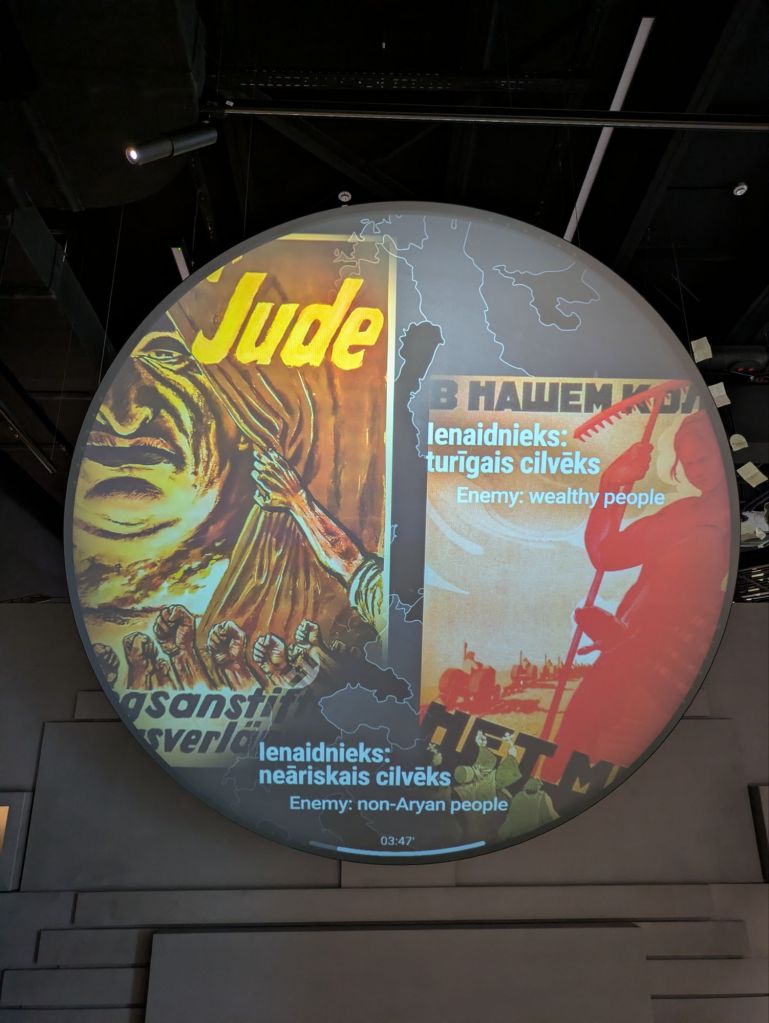
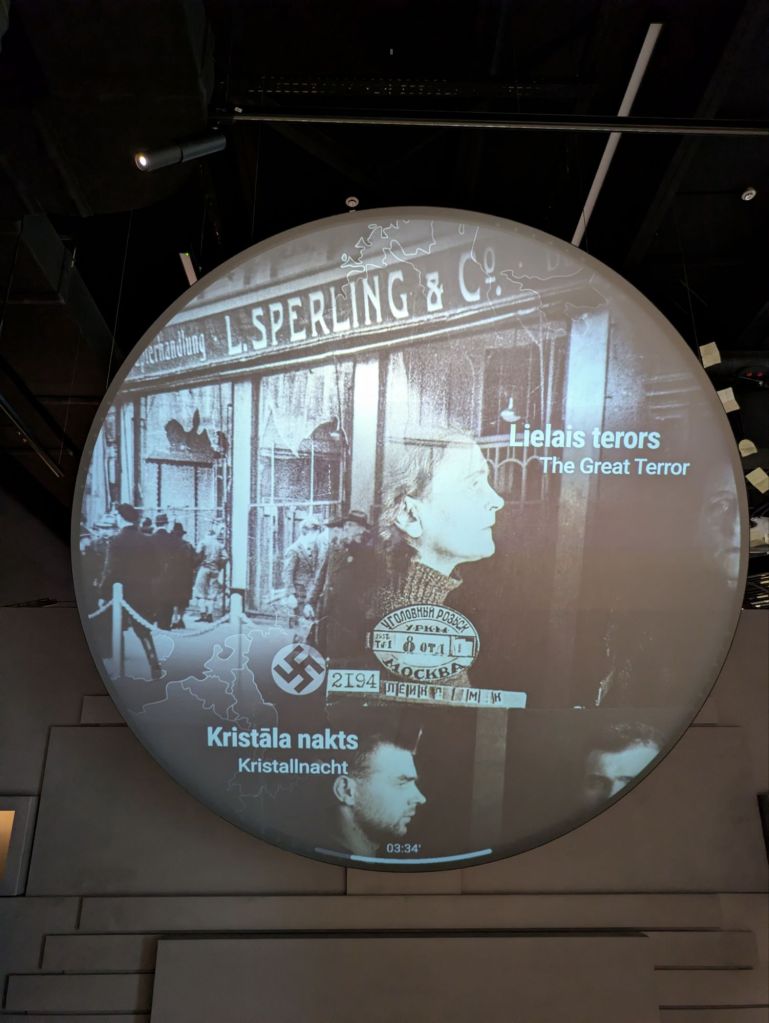
In Western Europe we have many museums and war memorials to remind ourselves of the totalitarianism from the Nazis, not so many from the totalitarianism from Communism which still enjoys sympathy in some circles, that’s why it’s interesting to visit this kind of museum in countries that suffered from it. I will include some pictures and transcriptions of different panels from the museum to illustrate it.
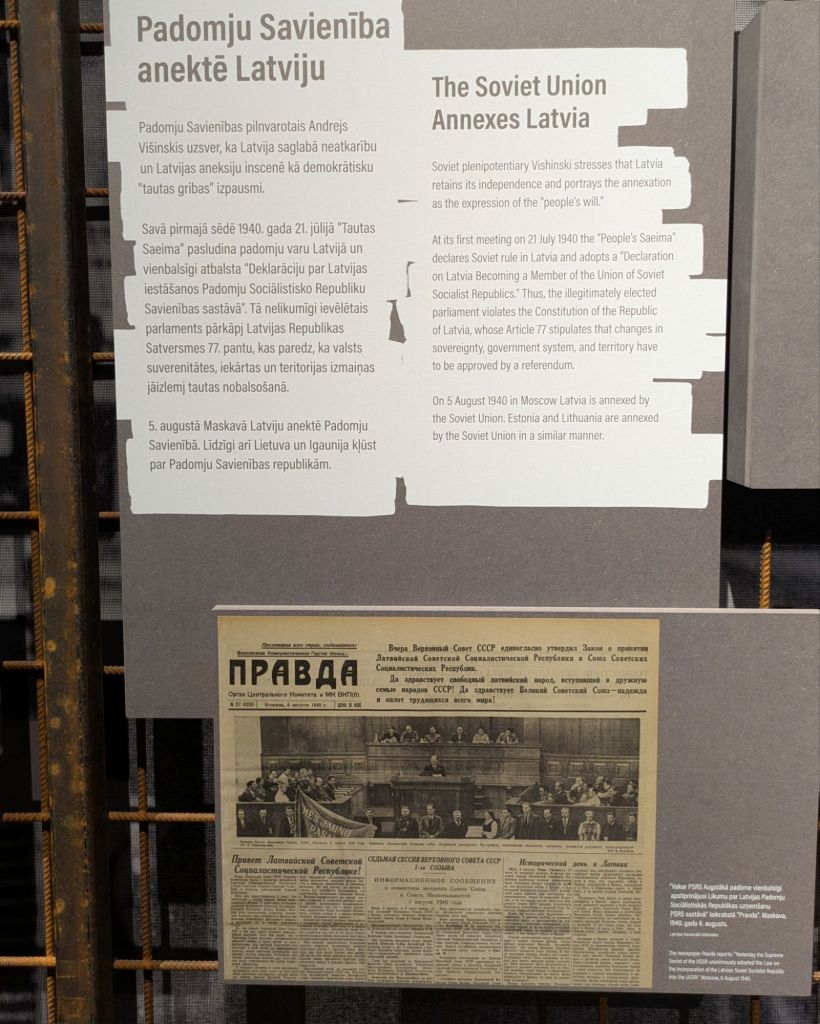
Soviet security operatives arrive from Moscow in June as Soviet rule is instituted in Latvia. They are charged with the liquidation of real and imagined opposition, intimidation of society, and enforcement of compliance.
The Soviet security service is known in Latvia after its first acronym Cheka, in most of the world, after the last – KGB. In 1940, it is the People’s Commissariat of the Interior – NKVD, whose State Security Administration establishes offices in the largest towns of Latvia with headquarters in Riga. The NKVD was the perpetrator of Stalin’s Great Terror with extreme brutality.
Latvian citizens, who have been able to trust a fair trial for the past 20 years are suddenly losing real legal protection, basic human rights and many disappear without a trace.
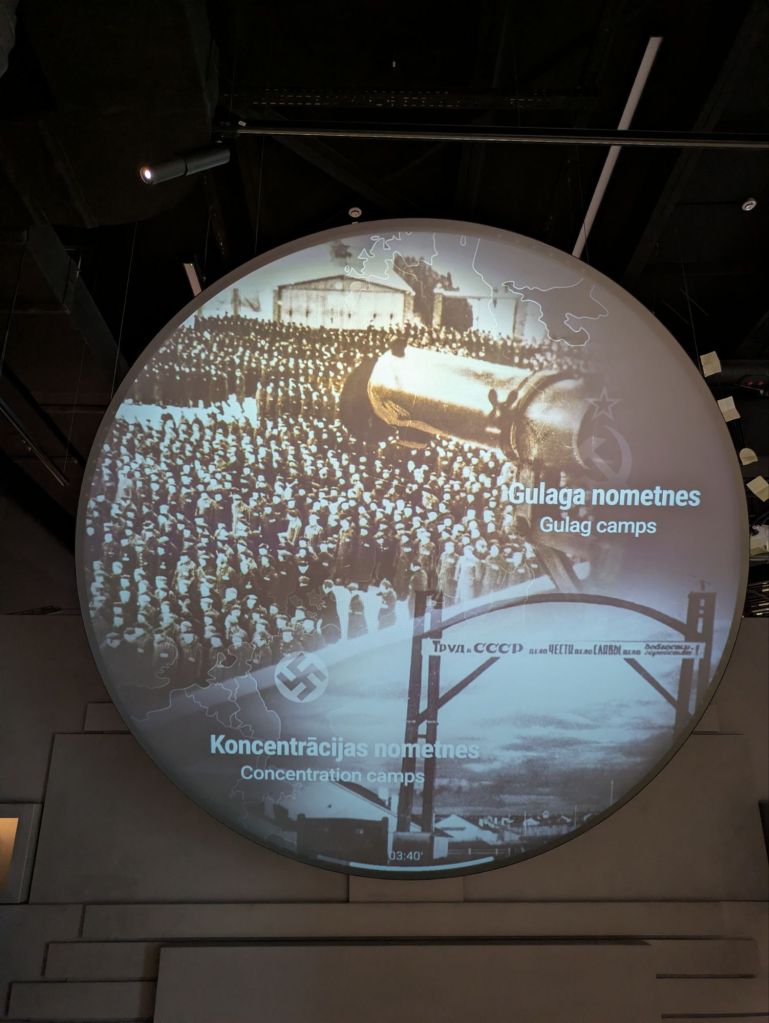
The museum included the map below with the Gulag camps:
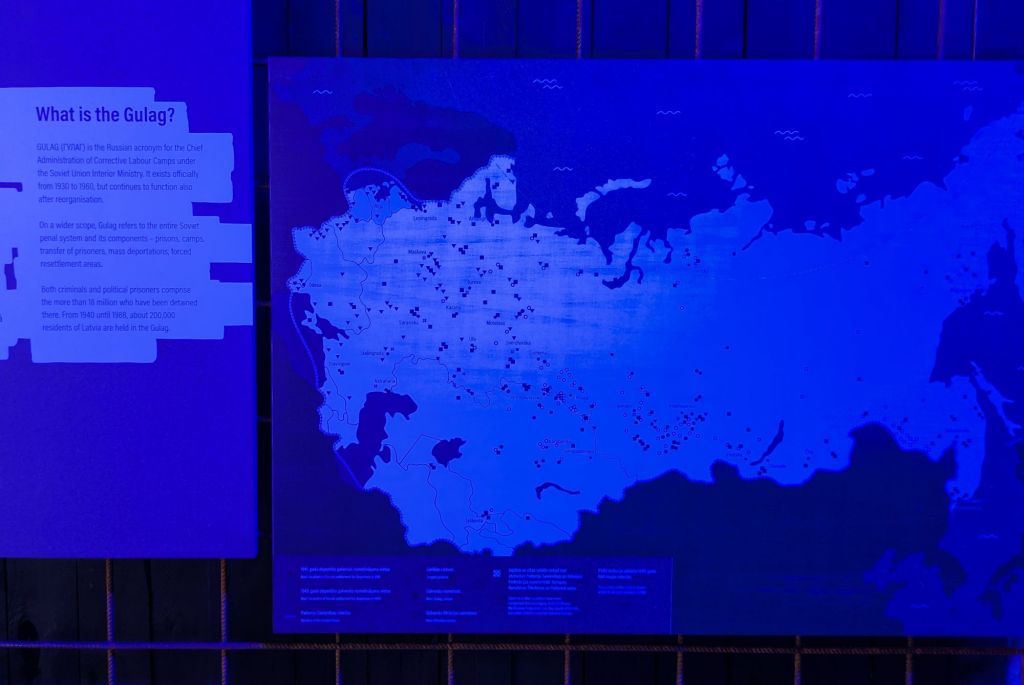
What is the Gulag? GULAG (ГУЛАГ) is the Russian acronym for the Chief Administration of Corrective Labour Camps under the Soviet Union Interior Ministry. It exists officially from 1930 to 1960, but continues to function also after reorganisation.
On a wider scope, Gulag refers to the entire Soviet penal system and its components – prisons, camps, transfer of prisoners, mass deportations, forced resettlement areas.
Both criminals and political prisoners comprise the more than 18 million who have been detained there. From 1940 until 1988, about 200,000 residents of Latvia are held in the Gulag.
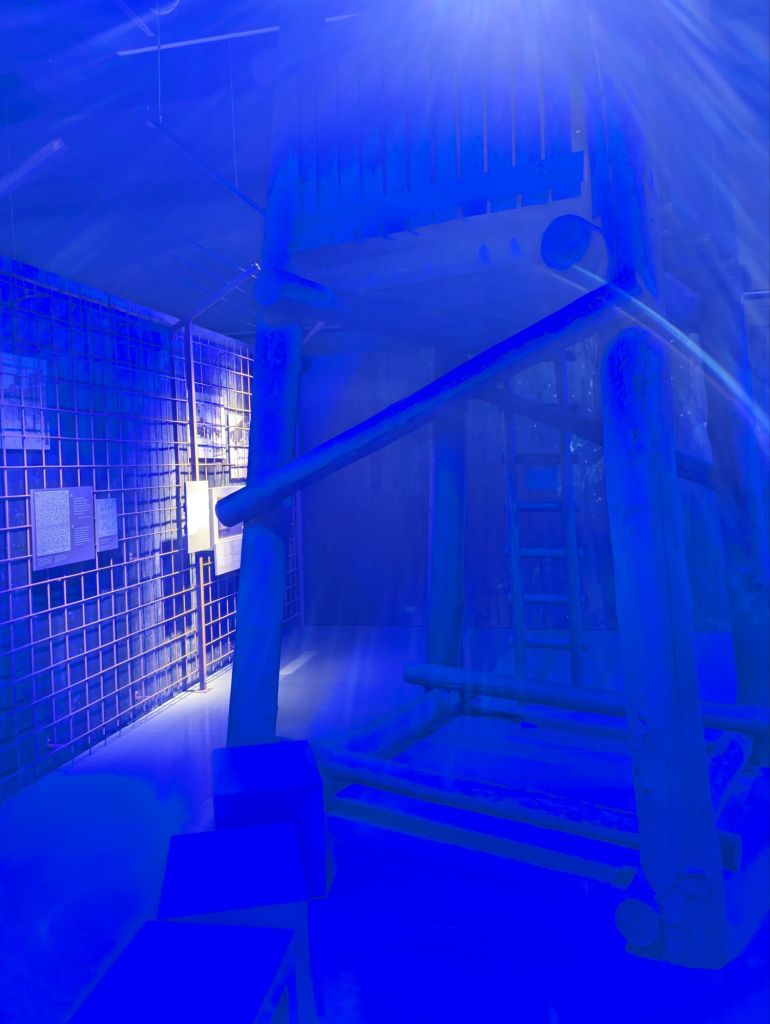
The light of the map above is not very good, because it was located in an area recreating a Gulag concentration camp, including a watchtower, sketches with the organization of the camps, stories from victims, clothes, etc.
Stalin’s death in 1953 marks a decrease of mass terror, but it does not change the totalitarian nature of the Communist Party. Psychological terror replaces physical terror. The goal remains: subjugate the Latvian people.
The Cheka and the army buttress the Communist Party. The Soviet Union’s government implements the Party’s orders. The Soviet citizen carries them out. In line with communist ideology, the economy, culture and social life are centrally planned in Moscow.
The Communist Party of Latvia and the government are Latvian in name only. They obey Moscow’s aims to colonise Latvia and blend the Latvian people into a Russian-speaking mass – homo sovieticus.
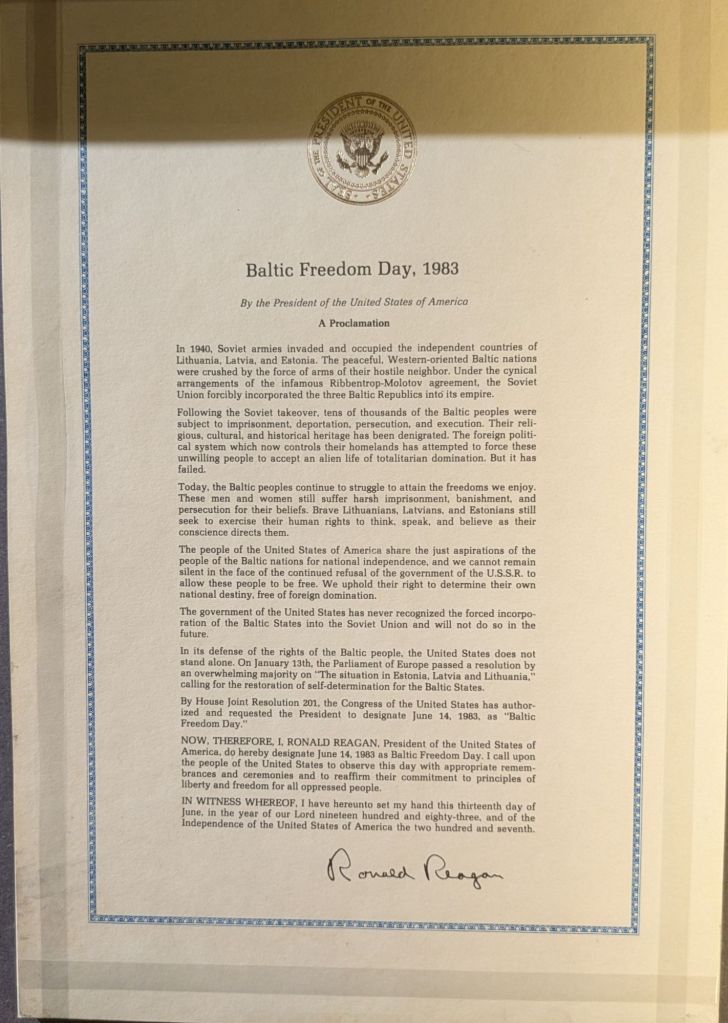
At least 30 countries didn’t recognize the occupation and annexation of Lavia. The Latvian legation in Washington DC continued to operate during the entire period of occupation. For a number of years there were also legations in London, Paris, Buenos Aires, Geneva and Rio de Janeiro, and a diplomatic mission in Madrid.
In 1983, Ronald Reagan proclaimed June 14th as the Baltic Freedom Day.
The Baltic Way
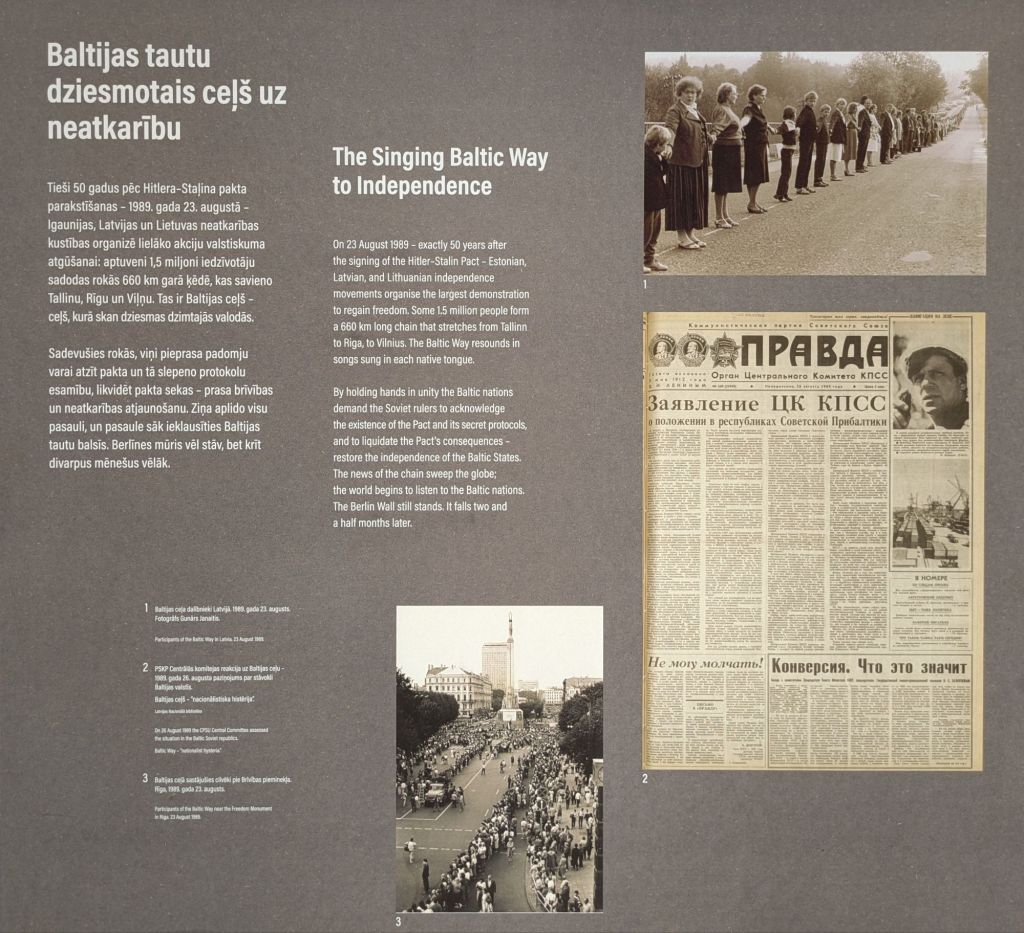
On 23 August 1989 – exactly 50 years after the signing of the Hitler-Stalin Pact – Estonian, Latvian, and Lithuanian independence movements organise the largest demonstration to regain freedom. Some 1.5 million people form a 660 km long chain that stretches from Tallinn to Riga, to Vilnius. The Baltic Way resounds in songs sung in each native tongue.
By holding hands in unity the Baltic nations demand the Soviet rulers to acknowledge the existence of the Pact and its secret protocols, and to liquidate the Pact’s consequences – restore the independence of the Baltic States.
The news of the chain sweep the globe; the world begins to listen to the Baltic nations. The Berlin Wall still stands. It falls two and a half months later.
In 1991 joins United Nations. In 1993 the Parliament reactivates the original Constitution. The Soviet (later Russian) Army doesn’t leave the country until 1994. Latvia joins NATO in 2004, as well as the European Union. During the 50 years of occupation ethnic Latvians went from 75% of the population in 1935 down to 52% in 1989.
The museum celebrates Three Heroes of Conscience: the poet Vizma Belsevica, Lidija Doronina-Lasmane (convicted three times for anti Soviet activities) and Gunars Astra (an activist convicted for reading 1984 and Archipelago Gulag).
On September 19th 2019, after the 80th anniversary of the Molotov-Ribbentrop pact, thd European Parliament passed a resolution on the Importance of European remembrance for the future of Europe, which among other points included the following:
– whereas although the crimes of the Nazi regime were evaluated and punished by means of the Nuremberg trials, there is still an urgent need to raise awareness, carry out moral assessments and conduct legal inquiries into the crimes of Stalinism and other dictatorships;
– whereas in some Member States, communist and Nazi ideologies are prohibited by law;
– whereas remembering the victims of totalitarian regimes and recognising and raising awareness of the shared European legacy of crimes committed by communist, Nazi and other dictatorships is of vital importance for the unity of Europe and its people and for building European resilience to modern external threats;
– Condemns all manifestations and propagation of totalitarian ideologies, such as Nazism and Stalinism, in the EU
Black Ribbon Day: The 23rd of August, since 2009, is officially known in the European Union, as the European Day of Remembrance for Victims of Stalinism and Nazism and also referred to as the Europe-wide Day of Remembrance for the victims of all totalitarian and authoritarian regimes
I leave some more pictures from the museum below.