Monthly Archives: January 2026

La educación concertada ahorra a la administración más de 7.300m€ al año

Esta es una breve entrada para compartir unos cálculos rápidos a partir de los anuarios “Datos y cifras” publicados por el Ministerio de Educación de España (aquí) y mostrar cómo la educación en colegios concertados no sólo no es una carga para la administración (por mucha demagogia que se haga al respecto) sino que supone un ahorro de más de 7.300 millones de euros al año (con los datos de 2023).

En el año 2023 se destinó a conciertos un 11,4% de un gasto en educación de 67.938m€; es decir, ~7.745m€ en conciertos.
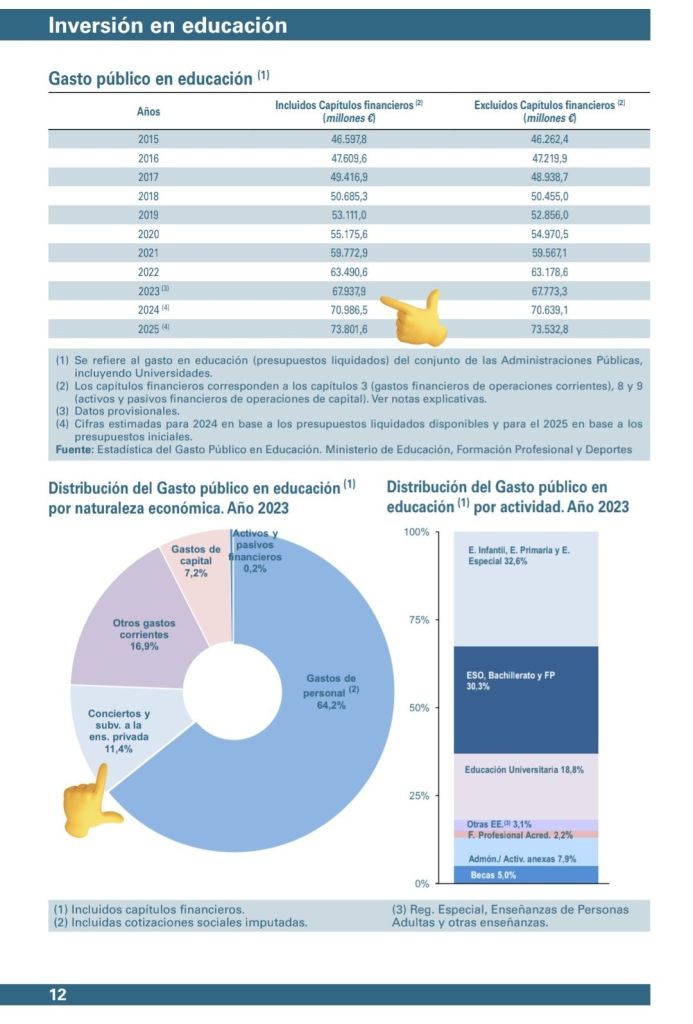
Gasto en educación y en conciertos.

En el curso 2023-24 hubo 2,033 millones de estudiantes en escuelas concertadas, un 24,4% de un total de 8,338 millones de estudiantes en enseñanzas de Régimen General. Los estudiantes en escuelas concertadas se encuentran sobre todo en primaria (0,776 millones), en ESO (0,61 millones) e infantil (0,4 millones).
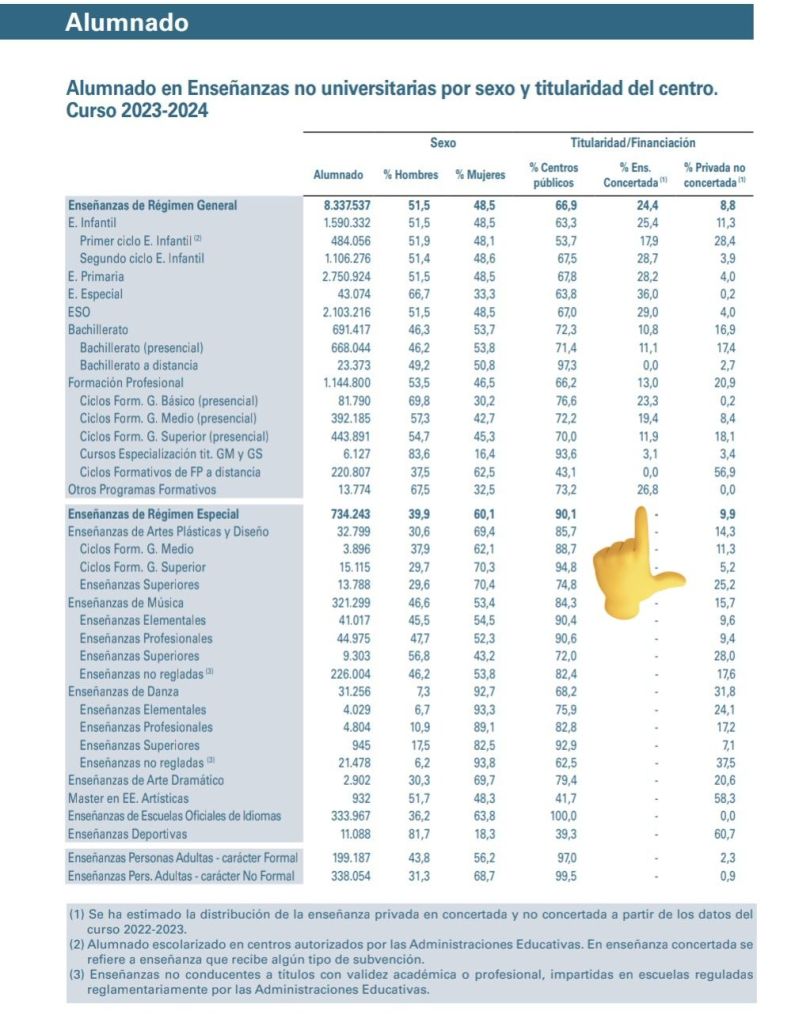
Alumnos en colegios concertados

Es decir la administración gasta ~3.800€ por alumno en educación concertada (resultado de dividir los ~7.745m€ en conciertos entre los 2,033 millones de estudiantes en colegios concertados).

Por otro lado, la administración gasta una media de ~7.400€ por alumno en colegios públicos de entre los que estudian en infantil, primaria y ESO (donde la proporción de alumnos en escuela concertada es mayor; el gasto medio por alumno en escuela pública en general es superior, pero es mayor sobre todo en formación profesional, donde el volumen de concertada es menor, así que es menos representativo).
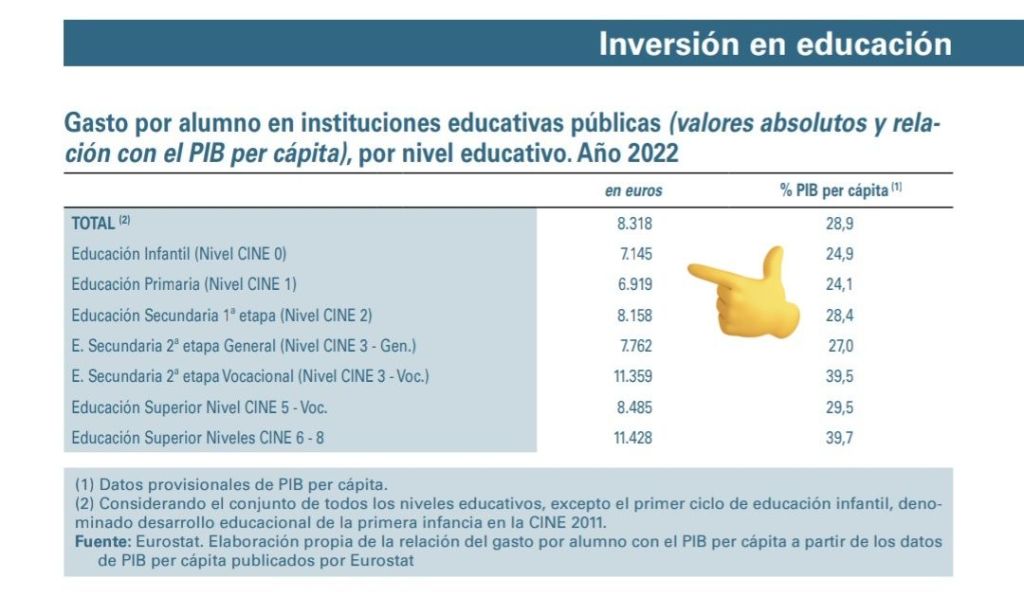
Gasto por alumno en colegios públicos.

Por tanto, la administración se ahorra por cada alumno en colegios concertados ~3.600€, es decir, la diferencia entre lo que gastaría en ellos si fueran a colegios públicos (7.400€/alumno) y la cifra que dedica a los conciertos (3.800€/alumno).

Si ahora hacemos el cálculo global, obtenemos que 3.600€/alumno * 2,033m alumnos son los 7.300m€ de ahorro anual, con las cifras de 2023.

Colegios privados

Ahora voy a repetir el cálculo para la educación privada usando las mismas fuentes, dejando ya el resultado final: la educación privada ahorra a la administración más de 6.000 millones de euros al año.

En el curso 2023-24 hubo 734 mil estudiantes en colegios privados, un 8,8% del total 8,334 millones de estudiantes. El uso de colegios privados se dio sobre todo en Formación Profesional (0,239m), infantil (0,18m), bachillerato (0,117) y primaria (0,11m).
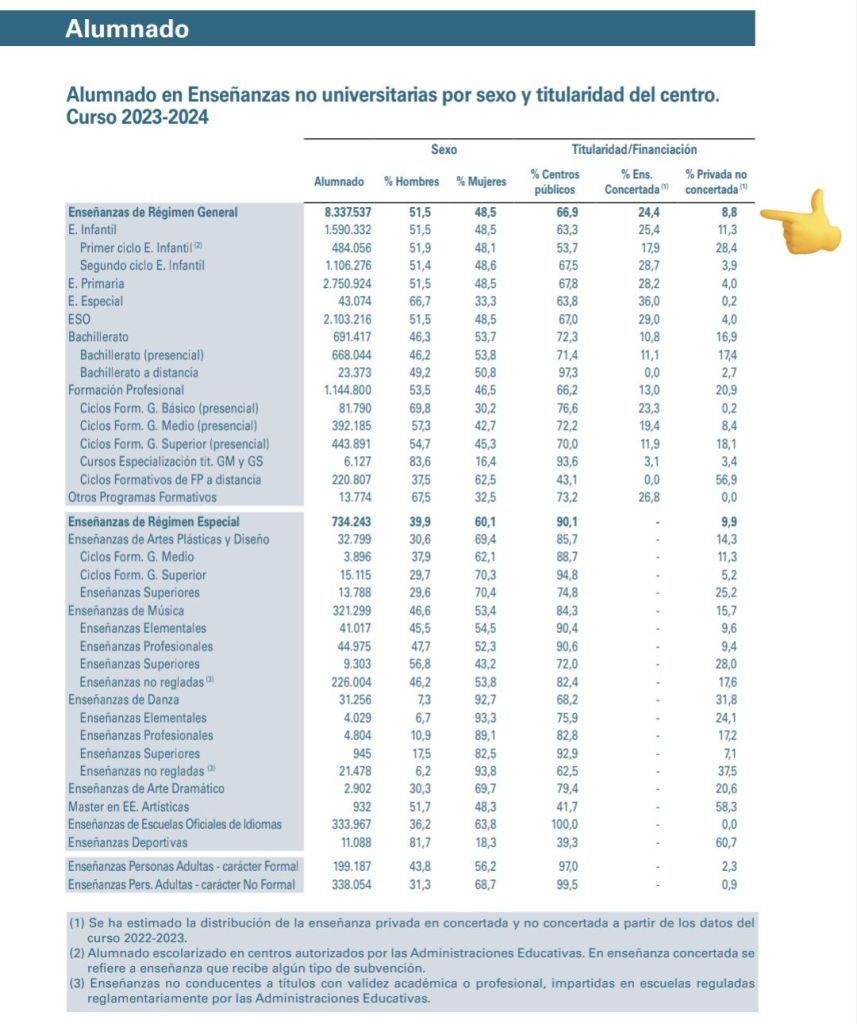
Alumnos en colegios privados

En el año 2023 el gasto medio por alumno entre todas las etapas en colegios públicos fue de 8.314€ (esta vez sí cojo la media total, dado que la proporción de alumnos en FP en colegios privados es más representativa).
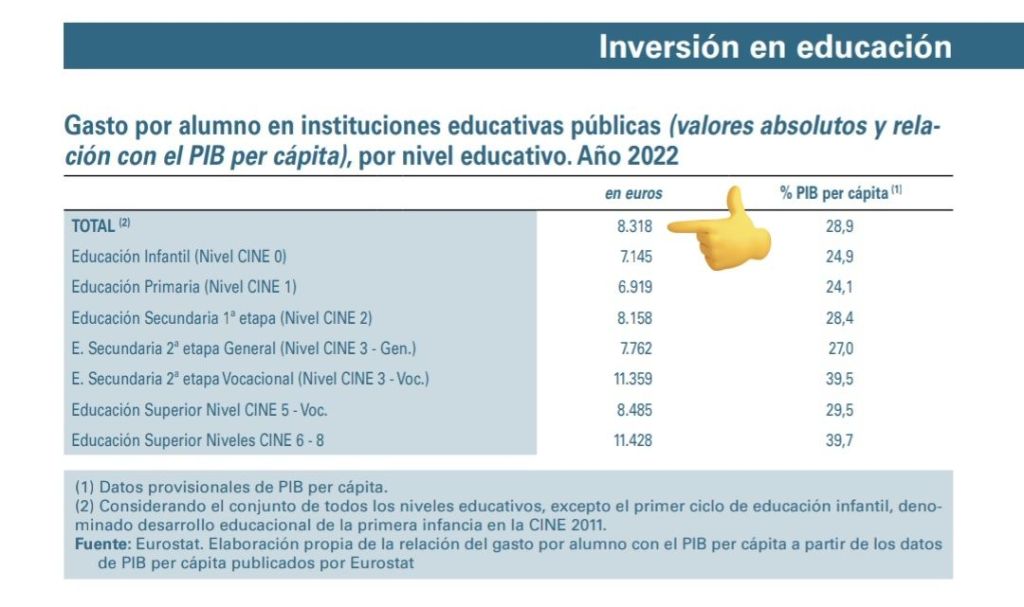
Gasto por alumno en colegios públicos

Por tanto, la administración se ahorra 6.090 millones de euros gracias a la educación privada. Es decir  el resultado de multiplicar 8.300€/alumno * 734.000 alumnos en colegios privados.

Es decir, gracias a la educación concertada (~7.300m€) y la educación privada (~6.090m€) la administración se ahorra ~13.400m€ al año.

Esto es un ~19,7% del gasto en educación del año 2023.

Además hay que tener en cuenta que las familias que envían a sus hijos a colegios concertados y privados siguen financiando con sus impuestos los colegios públicos, a pesar de no hacer uso de ellos, dado que en España no hay “cheque escolar”.

Por último, ¿a qué otra partida de gasto público se puede equiparar este ahorro de más de 13.400m€? Si miramos los presupuestos de 2023, es algo superior al presupuesto de Defensa (12.317m€), o algo inferior a la suma de Agricultura, pesca y alimentación (8.414m€) e Industria y energía (5.681m€) juntos.
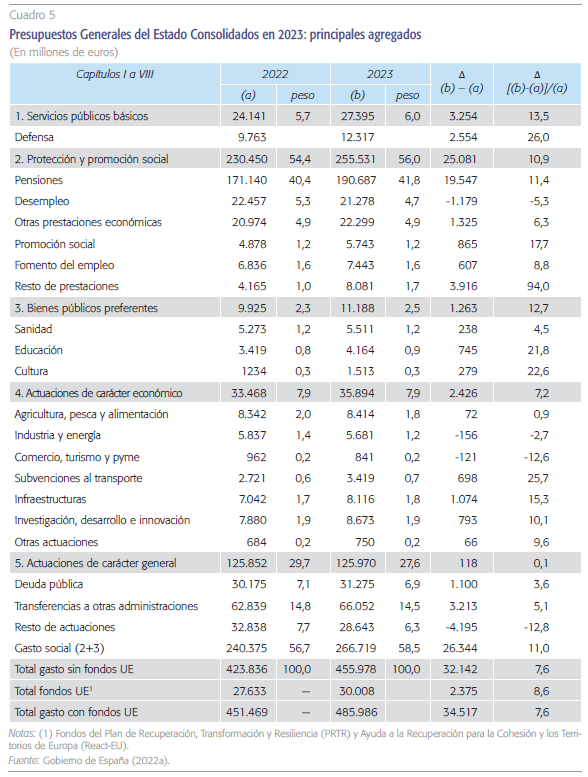
Presupuestos Generales del Estado en 2023

Leave a comment

Filed under Education

Dutch Ice Sculpture (IJsbeelden) Festival

A few weeks ago we visited with my parents in law the IJsbeelden Festival, the Dutch Ice Sculpture Festival, located in Flevoland. The festival consists of an indoor hall where ice sculptures carved by different international artists are displayed.

The festival opens just for three months in winter (this winter from December 13th, 2025 to Match 8th, 2026). The hall is cooled at -10ºC to keep the sculptures frozen during the festival. Once it’s finished the ice melts down and the water goes back to the lake.

Each year the theme of the festival is different. This winter’s theme is: “Let’s go to the movies: Ice Sculptures from the Silver Screen“. Hence, one of the highlights of the visit was to discover the movie, the scene and characters before reading them, bringing us memories of those cinema classics.

I share some of the pictures we took.

Mary Poppins
Indiana Jones
Home alone
Ghostbusters
Harry Potter
Back to the Future
Jurassic World
Barbie

Final comment, if you plan to visit it bring very warm clothes (hats, scarf, (skiing) gloves) as after a few minutes walking in those low temperatures you’ll start to freeze.

Leave a comment

Filed under Travelling

Boeing vs. Airbus: CEO compensation (2024)

For some years of the past decade (2013 to 2017), I wrote a small series of yearly posts comparing the compensation of Airbus and Boeing CEOs (1). This series started out of conversation with colleagues and I kept it updated to have a record of the evolution and for quick reference in other conversations. I then stopped the series. This post is just an update with the information for the 2024 fiscal year.

Many things happened in the industry in those 7 years (2017 to 2024), but if we focus just on the CEOs from both companies: Tom Enders was replaced by Guillaume Faury at the helm of Airbus; at Boeing, Dennis Muilenburg was replaced by David Calhoun who then left the place for Robert Kelly Ortberg.

As both Boeing and Airbus are public companies, the information about their CEOs compensation is public and can be found in the annual report and proxy statement from each one. I just share the information and sources below for comparison and future reference.

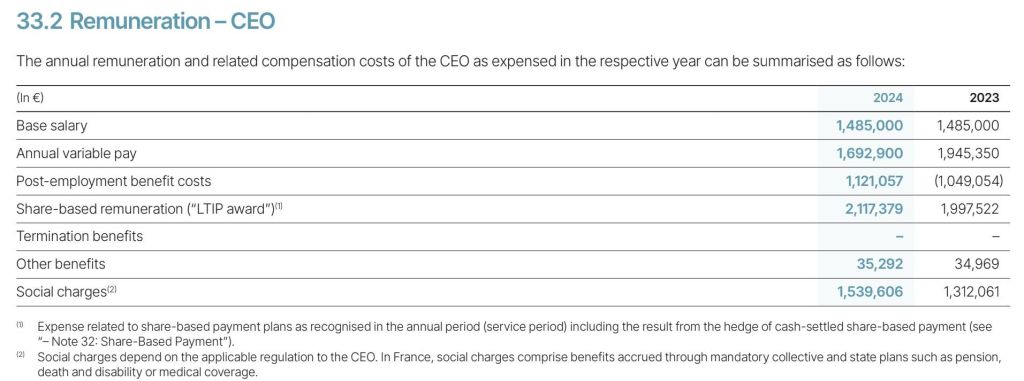
Airbus CEO, Guillaume Faury’s 2024 compensation (financial statements here, PDF, 2.7 MB, page 59):

Airbus CEO Guillaume Faury 2024 compensation.

Faury had his base salary frozen in relation to 2024 at 1.485M€  (which is lower than Enders’ one at 1.5 M€ in 2017). Variable pay decreased in 13% to 1.69M€, post-employment benefit costs increased, as did share-based remuneration and social charges. In comparison to 2017, the main changes are the following two: 1) that there are no “Termination benefits” in 2024 while in 2017 Enders had announced his departure in 2019, thus the concept included 2.9M€, and 2) the exponential increase of social charges, 1.5M€ in 2024 vs 12k€ in 2017. Thus, the overall compensation at 7.99M€ increased vs 2023 but is below 2017 level (9.1 M€).

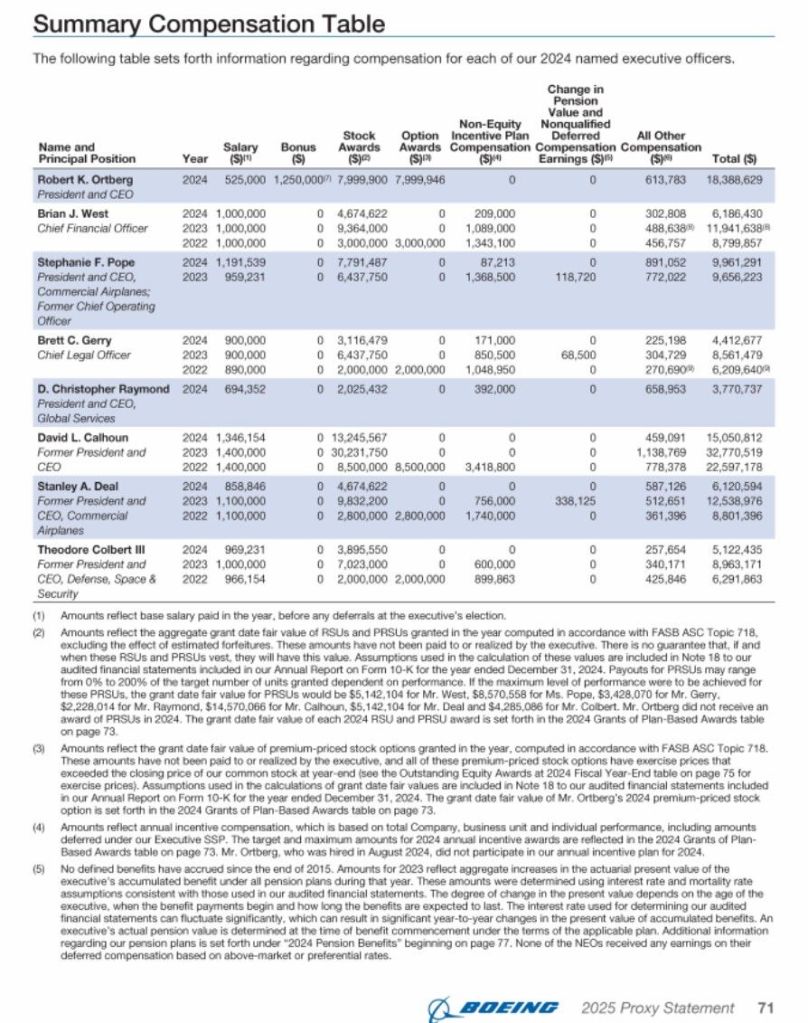
Boeing CEO, Robert Kelly Ortberg’s 2024 compensation (2025 proxy statement here, page 71):

Boeing’s CEO Robert Kelly Ortberg 2024 compensation.

Robert Kelly Ortberg had a base salary of 0.5M$, one bonus of 1.25M$ and 16M$ in stock based awards. The 2024 total compensation was 18.39M$, very similar to 2017 levels, but…

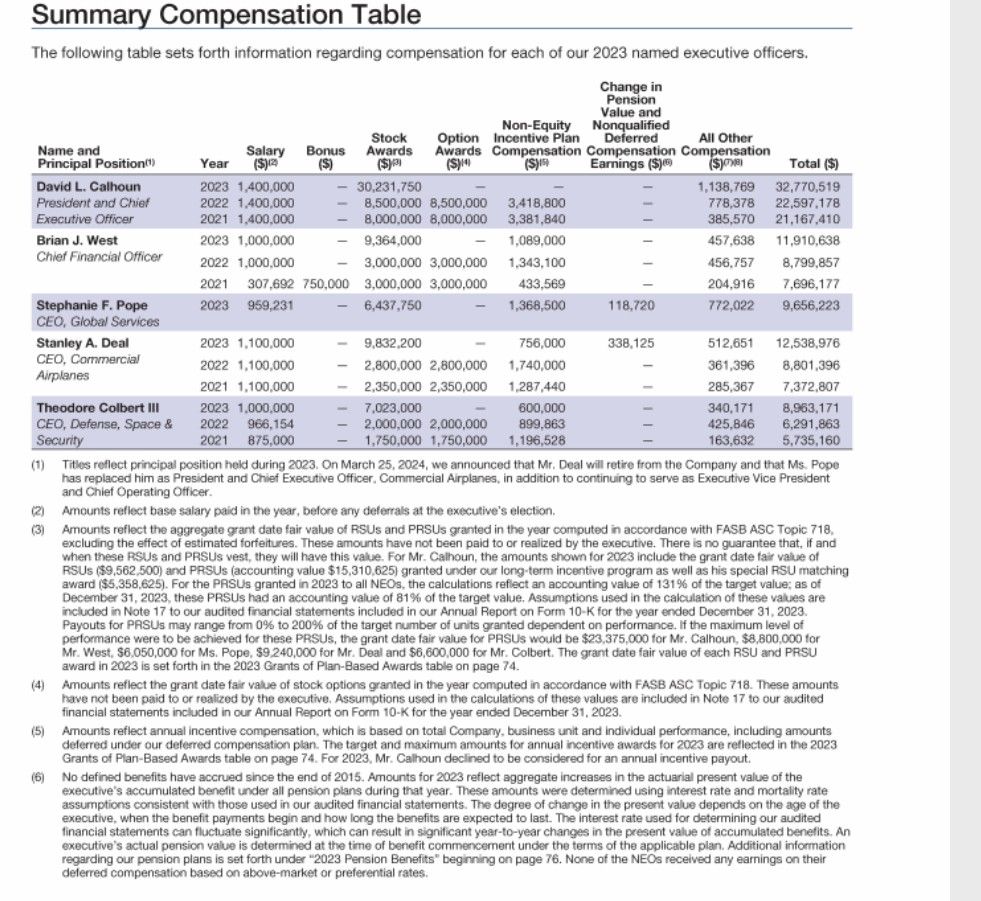
In the table you can also find the compensation for David Calhoun, and this is because Ortberg took over as CEO only in August of 2024. I will therefore add for comparison purposes the same table for Boeing 2023 fiscal year (2024 proxy here, page 72) when only Calhoun served as CEO.

Boeing’s CEO David Calhoun 2023 compensation.

David Calhoun had a base salary of 1.4M$, 30M$ in stock based awards and another 1.1M$ component. The 2023 total compensation was 32.77M$, 77% higher than 2017 levels, or +14M$.

Comparison. It is interesting to note that while the base salary is nearly the same in both companies, ~ 1.5 m€, the much higher stock based incentive schemes at Boeing push up the total remuneration for the CEO to about four times (x4.1) the one in Airbus.


(1) See the previous comparisons for the years 2013, 2014, 2015, 2016 and 2017.

Leave a comment

Filed under Aerospace & Defence