
Monthly Archives: September 2026

World oil full picture (2025)

This is a quick post to share this infographic summarizing some data of the oil industry.
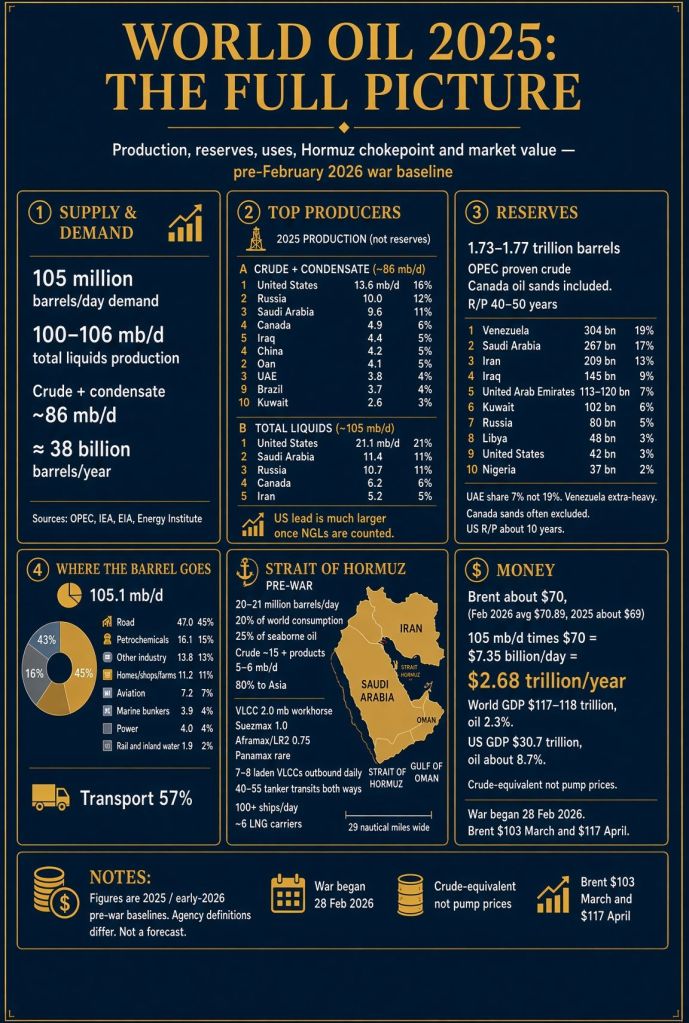
A bit of context. A few months ago I listened to a podcast on the Hormuz strait and the oil crisis by the Spanish journalist Fernando Díaz Villanueva in which he shared some figures of the industry that I found interesting. However, weeks later I could only remember some of those figures. I used Grok (Twitter/X artificial intelligence assistance) to refresh my memory through a series of questions and then asked Grok to prepare an infographic summarizing some data of the oil industry so I could have it as a reference for the future.

Global oil supply and demand in 2025 sat near 103–106 million barrels per day (mb/d), depending on definition. Agencies differ on whether they count only crude plus condensate, or a broader “total liquids” basket that includes natural gas liquids (NGLs), some other petroleum liquids, and sometimes biofuels and refinery processing gains. (source)
Top producers in 2025. Two common rankings are used. Crude + condensate is the narrow “oil well” measure. Total liquids adds NGLs (especially large in the U.S. shale system) and is closer to what many “oil production” headlines use.

  • Crude oil + lease condensate (global total ≈ 85.8 mb/d).
  • Total liquids (global total ≈ 100.4–100.6 mb/d in Energy Institute / Eni-style series; higher in IEA/EIA “petroleum and other liquids”).

The U.S. lead is much larger on total liquids because of NGL output from gas and shale. In that definition the U.S. produced nearly twice as much as Saudi Arabia.

Proven oil reserves are about 1.57–1.77 trillion barrels, depending on whether Canadian oil sands and some NGLs/condensate are counted. That is roughly 40–50 years of current production, or about 45–47 years of current consumption — but those “years left” numbers are only a simple reserve-to-production (R/P) ratio, not a forecast.

OPEC members hold about 1,243 billion barrels, or ~79% of OPEC’s world crude-reserve total. The Middle East alone is about 55–56% of that OPEC world total. (source)
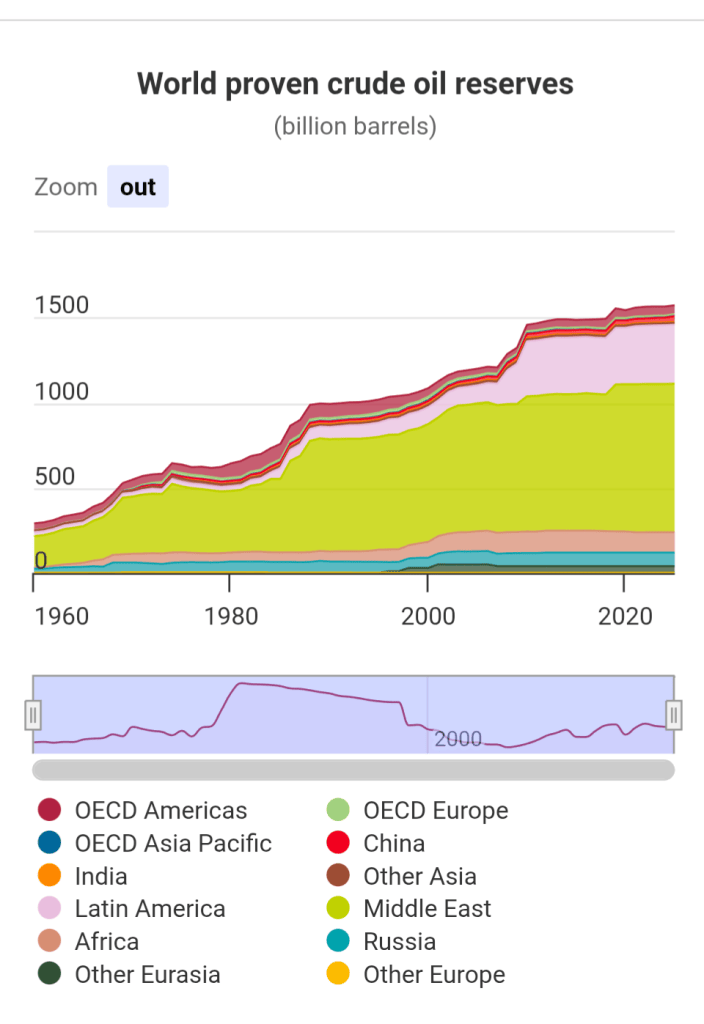
“Proven” means commercially recoverable under today’s prices and technology, not all oil in the ground.

Venezuela + Saudi Arabia + Iran already hold about half of OPEC’s booked world crude reserves. (source)

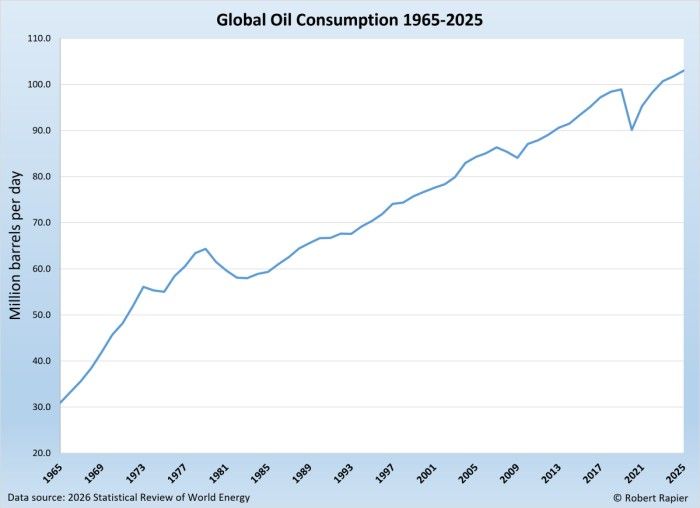
Looking at the consumption road transportation takes a clear lead with 45%, followed by the petro chemical industry, other industries, homes. Aviation consumes about 7% of the annual output. (source)

Before the February 2026 war, about 20–21 million barrels per day of oil moved through the Strait of Hormuzroughly 20% of world oil consumption and about a quarter of all seaborne oil trade. (source)

How was that transported? Long-haul Gulf crude to Asia is a VLCC (Very Large Crude Carrier) trade. Suezmax and especially Panamax are secondary.

How many ships went through the strait per day?

Pre-war snapshots:

  • S&P Global: ~135 vessels/day through the strait in February 2026, of which ~54 oil, chemical and LPG tankers and ~6 LNG carriers.
  • Oxford Institute / Kpler: ~50 liquid-cargo crossings a day (both ways) just before 28 February 2026.

A simple cargo check matches the VLCC-heavy picture:

  • 15 mb/d of crude ÷ ~2 mb per VLCC ≈ 7–8 laden VLCCs leaving the Gulf each day
  • Roughly the same number coming back empty → ~15 VLCC transits/day
  • 5–6 mb/d of products on Suezmax / Aframax / LR / MR ships (0.3–1.0 mb each) → on the order of 8–15 product-tanker sailings outbound, plus ballast returns
  • Plus a handful of Suezmax crude cargoes that are not VLCC-sized

Daily and annual dollar value of the oil barrel. Using 105 million barrels/day of consumption (OPEC 2025) and a $70 pre-war Brent marker — close to February 2026 and a fair “eve of war” price, gives about $7.0–7.5 billion a day, ~$2.7 trillion per year or ~2.3% of world GDP (that is the value of the commodity flow, not oil’s share of value added).
Leave a comment

Filed under Economy, Uncategorized

All-time men’s best pole vault – 2026

This post is a quick update to follow up on two previous posts I wrote in 2024 and 2025 following Armand Mondo Duplantis record breaking pole vault seasons. I make this update now as the season is finished after the Diamond League and the World Athletics Ultimate Championships.

For that purpose I used the website “Track and Field all-time Performances” (maintained since years ago by Peter Larsson).

In this 2026 Duplantis broke a new world record, back in March in Uppsala indoor, that continued a series of new records that he set in 2025. During the rest of 2026 he continued to jump high (including twice 6.25m, 6.21 and twice 6.20) however he missed subsequent attempts to break his own record.

This year we also saw Emmanouil Karalis stepping up with his performance. Until 2024 his best was 6.00m, in 2025 he managed to jump above 6m four times with a personal record of 6.08, and in this 2026 he jumped four times above that height reaching 6.15, 6.16 and 6.20, making him the the second man to jump that high; higher than previous holders of the record such as Sergey Bubka and Renaud Lavillenie. Note that Lavillenie continues to jump and is setting records in seniors’ categories, with 10 jumps over 5.80m in the last two years (he will be 40 years in a few days).

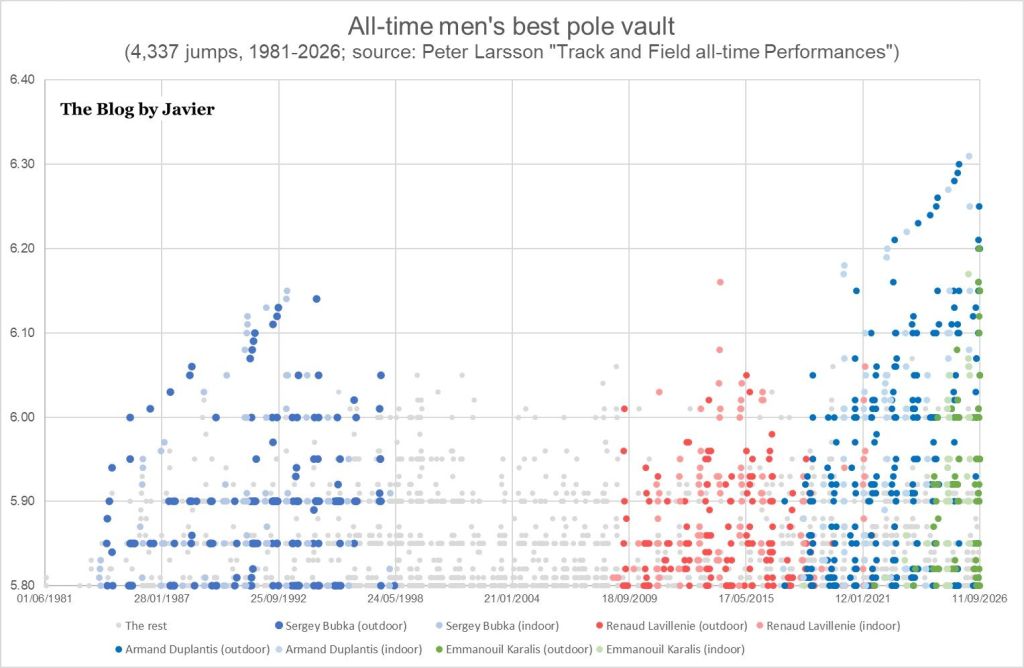
With the data of all-time men’s best pole vault I plotted the chart below with the best 4,337 jumps (jumps from 5.80m and above) and their dates, highlighting the jumps by Sergey Bubka, Renaud Lavillenie,  Duplantis and Karalis (dark colour for outdoor vaulting, light colour for indoor).

Bubka dominated the sport in the 1980’s and 90’s (first competing for the Soviet Union and later for Ukraine) when he set up to 35 world records (17 outdoor and 18 indoor), won 6 gold medals at the World Championships and 1 at the Olympic Games. Lavillenie also won a gold medal at the Olympics in London and won several World Indoor Championships (among other medals) and set an indoor world record (which was the absolute record for 6 years). Duplantis, competing for Sweden, at the young age of 25 has already won 2 gold medals at the Olympics (Tokyo and Paris) and 3 World Championships outdoors (among other medals) and has already set 14 world records (10 outdoors and 4 indoors).

Some comments after looking at the chart:

  • Bubka holds 249 of the 4,337 jumps (5.7%) at 5.80m and above
  • Lavillenie holds 281 of the 4,337 jumps (6.5%) at 5.80m and above
  • Duplantis holds 366 of the 4,337 jumps (8.4%) at 5.80m and above… he’s already the athlete with the highest proportion in that segment
  • Karalis holds 124 of the 4,337 jumps (2.9%) at 5.80m and above
  • Of those jumps of 6.00m and above (331 jumps… 57 such jumps in just the last year):
    • Bubka holds 46 of the 331 jumps (13.9%) at 6.00m and above
    • Lavillenie holds 21 of the 331 jumps (6.3%) at 6.00m and above
    • Duplantis holds 150 of the 331 jumps (45.3%) at 6.00m and above
    • Karalis holds 31 of the 331 jumps (9.4%) at 6.00m and above
  • If we focus on outdoor jumps of 6.00m and above (208 jumps):
    • Bubka holds 28 of the 208 jumps (13.5%) at 6.00m and above
    • Lavillenie holds 4 of the 208 jumps (1.9%) at 6.00m and above
    • Duplantis holds 104 of the 208 jumps (50%) at 6.00m and above
    • Karalis holds 21 of the 208 jumps (10.1%) at 6.00m and above
    • 27 men have vaulted outdoors at 6.00m or above, only Bubka, Duplantis and Karalis jumped 6.09m or above: 6, 41 and 5 times, respectively. Duplantis performed 13 such jumps just last year.
  • Until Duplantis came to the scene the World record was at 6.16m held by Lavillenie, established indoors in 2014 (Donetsk). Since 2020 Duplantis has jumped at or above that world record 22 times and Karalis 3; 10 of those in this year.

Bubka achieved his best jumps when he was between 27 and 30 years old. Duplantis at his 26 years has already three times as many high jumps as Bubka in his entire career. If Duplantis continues his progression up to 27-30 years of age we can only imagine what is to come, something that might have been deemed unbelievable for those of us who witnessed Bubka in his prime, but we are now going through the same dominance yet with higher heights and more pronounced, even more now that Emmanouil Karális has been able to partially close the gap between them.

Leave a comment

Filed under Sports