Viendo el revuelo producido por las declaraciones donde Cristiano Ronaldo decía que se encontraba triste, no pude más que recordar un par de anécdotas de Alfredo Di Stefano.
Una que recordaba haber leído en internet (“Corazón Blanco“) sobre un telegrama que Di Stéfano envió a Bernabeu que recupero:
Alfredo Di Stéfano regresaba a Argentina, sin fecha de vuelta. La Saeta Rubia envía un telegrama a Santiago Bernabéu, a modo de despedida. La misiva, cuyo original está bastante deteriorado y es casi ilegible, dice: “Don Santiago me voy a mi tierra, no sé si volveré pronto. Nunca en estos años se habló mucho de nosotros. Yo llevé la peor parte. Fue un fenómeno o un gamberro. Si no me acerqué a usted fue porque no quería que creyera que busque un puesto regalado. Por lo menos eso no me lo puede quitar nadie. Lo que gané siempre fue con esfuerzo. Observé que para estar bien con usted había que ser falso. Tuve muchas desilusiones y nadie me dio moral. Usted como padre me falló. Ahí se ve que nunca tuvo hijos porque los padres siempre perdonan. Si no vuelvo más le llegue a usted mi felicitación y mi recuerdo cariñoso. Un abrazo, Alfredo”.
Y la otra sobre su despedida del Madrid, anécdota que leí hace años en su biografía “Gracias, vieja” (libro que aprovecho a recomendar), y que se puede leer en el la web del diario As:
“Muñoz se aferraba a que había que vigilar a Facchetti y nosotros decíamos: ‘¿Y quién agarra a Amancio?’. Amancio era como la luz de rápido y estaba jugando fenomenal. Al final, ¿qué pasó? Que Facchetti no se fue arriba casi nunca en el transcurso del partido… Jugamos el encuentro con uno menos, pero Muñoz me mandó a la mierda y me echaron a mí del club porque lo mandé a la mierda yo también”.
Aquel encuentro fue histórico, puesto que fue la última ocasión oficial en la que Di Stéfano vistió la camiseta blanca. Días después, el Madrid disputó la semifinal de Copa ante el Atlético, pero Muñoz no incluyó a La Saeta en la convocatoria.
Luca wanted to enjoy a weekend out in The Netherlands, I only asked some time during both Saturday and Sunday to run some 8 to 10km each day. We ended up in Papendal: a hotel and sports centre in the country side close to Arnhem.
Papendal centre entrance
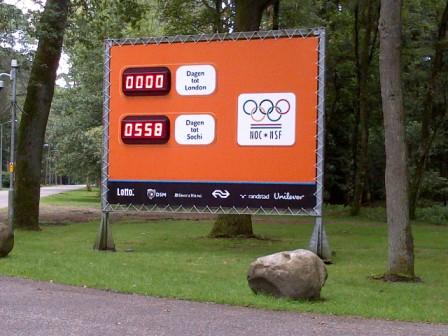
At first I didn’t know about it, just what Luca told me “there is forest around where you can run”. Once we arrived she explained to me more about the place and we could read in some posters that the hotel is used by Dutch national sports teams of several disciplines to prepare big competitions such as the Olympics.
Time to the next Olympics games.
Then, I recalled “I believe that FC Barcelona might have come here as well for summer stages prior to starting the season”. I googled it, and voi là! FC Barcelona has been staged here several times starting as far back as the 70s. I saw an interesting article describing the centre [in Spanish, 237KB] from 1981, when it was already the 4thtime the club visited the centre, in 1982 they repeated the experience and many times afterwards (including one in 1988 when the team captain got himself arrested by Dutch police!). Other Spanish teams have been there as well, e.g. Athletic Bilbao in 2003 & 2007.
Luca & I enjoyed a quiet weekend in which we played again golf, this time in the “Pitch & Putt” installation (close to the Edese golf club), just about 7 weeks after having played in Scotland. The game was entertaining, with some pond and trees in between the holes. We’re already looking forward to play the game in Toulouse.
Playing golf.
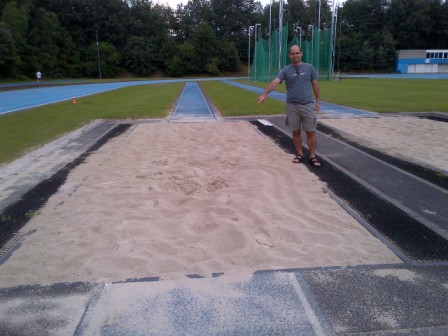
Then I could run both days around the installations and in the athletics track. I couldn’t resist the temptation of trying out 400m (1’16”), 100m (15”) and long jump (…m)… though I have to say that after having run 9km each day, the legs are not in the best situation to handle those activities. I’ll have to try again being rested in a track in Toulouse… ideally after Berlin marathon training season is finished.
Athletics track where I did some training sessions.
Not that I jumped long, huh?
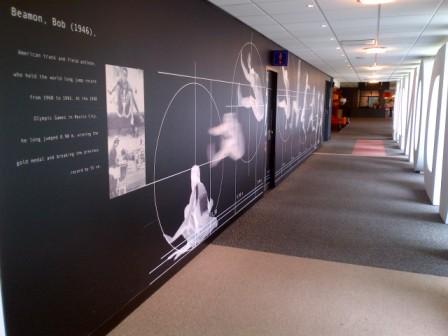
We also enjoyed the sports decoration motives that you can find in several spots in the hotel. They already make you feel in the sportive mood.
About a month ago I was struggling to get back into the habit of frequently running. What is more, I had to be starting with the specific training plan for the Berlin marathon (30 September, which I will run together with my friend Serna and my brother Jaime).
At the beginning of July I checked the stats from Garmin connect from the previous year. In July 2011 I had run 283km. I wrote the following tweet to commit myself:
Slowly getting back the habit… in July 2011 I ran 283km… will try to beat that in July 2012… #running
— Javier Irastorza (@javierirastorza) July 5, 2012
In the end, in July I ran 25 days and rested 6. I ran in Toulouse, Sevilla, El Rompido (Huelva, Spain), Madrid and Papendal (The Netherlands). I ran one race in Toulouse, I ran in the beach, did 3 days of treadmill, 4 days of series and one half marathon training. I ran in two different athletics tracks: in Toulouse and Papendal.
And in the end… I completed over 297km, 14km more than in July 2011, fulfilling the objective, setting a new personal record (previous one being 287km from September 2011 – ultramarathon of 100km included) and heading right into the marathon training mode.
Injures permitting: Berlin, see you in less than 2 months.
I started reading the book “Thinking, Fast and Slow“, by the Nobel laureate Daniel Kahneman some months ago, and, even if I am slow progressing with it, I find it extremely interesting.
A recurring topic when reading about how our psychology deceives us is when thinking about probabilities. In this post I wanted to write about a paper he refers to in the book: “The Hot Hand in Basketball: On the Misperception of Random Sequences” [PDF, 1MB], by Thomas Gilovich of Cornell University (1985).
If you have actually made the exercise of coin-tossing several dozens times or have gone several to a casino and watched roulette results, you will believe without effort that seeing long streaks of a certain event (several heads for the coin, over a dozen reds or three 32 in a row for the roulette) is part of the randomness of those games. Basketball players and fans get it consistently wrong when believing in hot hands, and that is precisely what the paper from Gilovich is about and it is a wonderful reading.
It starts with a survey among basketball fans, who no doubt believe in hot hands being behind streaks: 91% believed a player has a better chance of hitting after having converted 2 or 3 throws. They even ventured into assigning probabilities. For a player with 50% in field throws they said the chances of :
hitting after a converted throw were 61%,
missing after a missed a shot, 42%.
Then he studied the performance of Philadelphia 76ers players (Julius Erving among them) during the season, carefully analyzing the chances of a each player hitting or missing a throw after having missed or hit the previous one, two or three consecutive throws. The results are clear, they do not support the existence of such “hot hands”, they are random. In fact, on average, the chances of hitting after a hit were always lower than the field score % of the team while chances of hitting after a miss were higher and higher than the ones of the supposedly hot hands.
He analyzed the numbers of runs (streaks, like the several heads or tails in a row for the case of a coin) and were not different that what could be expected randomly.
He went on to analyze whether the different players had more cold or hot nights than what can be expected by statistics… also discarded.
Of course, in field throws the author understood that there were many variables at play: for instance, if a player had hit 2 consecutive throws the defense might be harder on him… to eliminate those possible factors influencing results, he went to study free throws, in this case taking the figures from Boston Celtics (Larry Bird among them) and NY Knicks. Guess what? No hot hand in free throws either: there were even more players scoring after a miss than the other way around (but again, nothing statistically significant).
He went even further: he made a controlled experiment with college players in which they threw 100 shots from a distance in which their scoring success was 50% (different distance for each one). Throws were made without opposition but from different position each time. Players got paid according to the hits and could bet higher or lower money each time depending on whether they believed that they were having a hot hand… this, again, proved that there were no hot hands and what’s more: players did believe in those hot hands and were completely unreliable in predicting their next throw chance of success.
The paper has only 21 pages: I encourage anyone who likes psychology, statistics or basketball to read it, its wonderful.
I thought that to conclude this post with a funny note, I could link the following short video of Shane Battier’s “clear” hot hand in the first game of this year’s NBA finals:
Impressive, 3 consecutive 3pt-throws converted in the first quarter!
A difference between now and 1985, when the professor wrote his paper, is that now we don’t need to ask the team statistician about the figures, but NBA site records all of them. I went to check what happened to Shane and his hot hand in that match. After those 3 throws converted, he attempted other 3 in that match: he missed 2.
Still, he had a 66% on 3pt throws that night… what could be a hot night. I went to check his percentages during the season and career. During the finals he made a 0.577%, remarkable; during the whole of the play offs, 0.382% in 3pt. And guess what is his average career (13-years) percentage score for 3pt throws: the same 0.382% he showed in the play-offs. That streak you saw was nothing but the random streak expected from Shane.
El pasado 10 de junio se emitió el reportaje “Reiniciando España: La Política” en “Salvados”. Aparte de los mensajes que transmiten, me llamó la atención y gustó porque en él se hablaba de Torrelodones.
En primer lugar entrevistan a Manuel Milián Mestre, ex-diputado y uno de los fundadores del PP, que admite que por su rebeldía y posiciones morales por encima de los intereses del partido tuvo que dejarlo.
Hace una radiografía de la política en los grandes partidos demoledora. Deja una serie de frases escuchadas en un partido y otro que dan una buena imagen de lo que se prima en ellos: “el que se mueve no está en la foto”, “el que me desafía la paga”, “el que se vuelve una mosca cojonera acaba perdiendo la batalla”. Define la situación actual como “darwinismo político”, “en el partido triunfan los oportunistas en este momento, se imponen los mediocres”, “áurea mediocritas”, de la meritocracia a “el codazo y el amiguete”…
A continuación se entrevista a la alcaldesa, Elena Biurrun, de una asociación de vecinos que se hizo con la alcaldía. Este hecho ya mereció un artículo en el New York Times hace algo más de un año. Durante la entrevista se mencionan una serie de hechos que muestran la desvergüenza a la que llegan los políticos con el dinero público: comidas y desayunos protocolarios, coche blindado con chófer, clientelismo. Revisando la política de gastos en su primer año consiguieron un superávit de 5,4 M€. Menciona la alcaldesa que se redujo el sueldo en un 20% hasta 49.500€ brutos anuales, pero es que en el mismo pueblo en 2007 el alcalde en aquel momento en el primer pleno se subió el sueldo un 30% hasta 91.445€, solo por detrás del entonces alcalde de Barcelona, y muy por encima del de Madrid o la presidenta de la Comunidad de Madrid y también por encima del presidente del gobierno.
La alcaldesa anima a ciudadanos de otros municipios a emprender iniciativas similares, asociarse y defender lo público. En este sentido siempre me ha llamado la atención la poca predisposición que hay en España al asociacionismo, a participar en distintas iniciativas, a dedicar un tiempo voluntariamente para trabajar desinteresadamente en algo por el beneficio común. En el caso de Holanda, sin embargo, esto sí se hace y es muy valorado por la población y las empresas. Es casi una obligación social el pertenecer a alguna o varias asociaciones, es normal que los estudiantes dediquen casi un año en medio de sus estudios universitarios a volcarse trabajando para alguna asociación. No nos vendría mal tomar ejemplo.
La historia del Mini se puede leer con detalle en su página web, pero básicamente se puede resumir en que nació en 1971 cuando una serie de amigos de la infancia comenzaron a organizar una competición en la finca de uno de ellos para poder reunirse en las tardes de verano. Con algunos periodos de interrupción, el Mini continúa hoy organizando un serie de campeonatos de fútbol para todas las edades, ambos sexos, en verano y en invierno.
Hay algo que distingue al Mini de cualquier otra competición futbolística, y es su carácter social, que se traduce en su decálogo. En este post quiero destacar algunos de los puntos que marcan el Minifútbol:
Lo importante son los compañeros, los de tu equipo y el rival, por ello en cada competición cada jugador se inscribe individualmente y con un sorteo se determina la composición de cada equipo. Cada año jugarás con 7 u 8 personas distintas, permitiéndote conocer a más gente del pueblo y jugar contra antiguos compañeros.
Todo jugador debe participar un mínimo de tiempo en cada partido.
No hay lugar a comportamientos antideportivos ni duras entradas, para lo cual se han introducido una serie de modificaciones en el reglamento.
La asistencia a los partidos como signo de compromiso con el grupo.
El voluntariado de la organización.
Y para acabar este post, tras alabar estas 2 iniciativas vecinales de Torrelodones, os dejo un extracto de un chotis sobre Torrelodones, interpretado por los vecinos Camilo Sesto y Rocío Dúrcal dentro de otra iniciativa que surgió hace unos 14 años cuando se editó un CD con canciones sobre el pueblo.
According to the Wikipedia “The Old Course at St. Andrews is considered by many to be the “home of golf” because the sport was first played on the Links at St. Andrews in the early 1400s”. Thus, we could not skip a visit to St. Andrews when we visited Scotland last week.
Even though none of us plays golf, the place breathes a special air of tradition that anyone can feel. We loved the visit. The views of the course are wonderful. Its placement close to the beach and the village make it all the more enjoyable. The possibility of crossing through was also inviting (even if hazardous).
Close the St. Andrews Links there is a small field where putts and balls can be rented for just one pound in order to play 18 holes in a green and make small tournament with friends. So we did. We had lots of fun “playing golf”, though I am afraid I came in last, with 76 strokes. See in the tweet below the complete results of our competition:
— Javier Irastorza (@javierirastorza) June 3, 2012
As a complement to visiting the Old Course, there is the British Golf Museum just 50 metres from it. The museum is wonderful. I will have to come back to it one day, as we had to visit it in a rush (it closes at 17:00 – free of charge).
Durness
A couple of days later, completing our tour by the Northern coast of Scotland we arrived at Durness. Walking by the beach we discovered a golf course. My friend Maicol mentioned that it would be a good plan to play.
At the beginning we were doubtful as in Spain you need a licence to play in a golf course, but we gave it a try and went to ask. What a positive reply! “Visitors are always welcome at Durness Golf Club”, “you don’t need any licence to play here”, “you need to pay just 10 pounds to play”, “a set of clubs can be hired for just 5 pounds”… we had a plan! 2 hours of playing golf for just 30 pounds altogether.
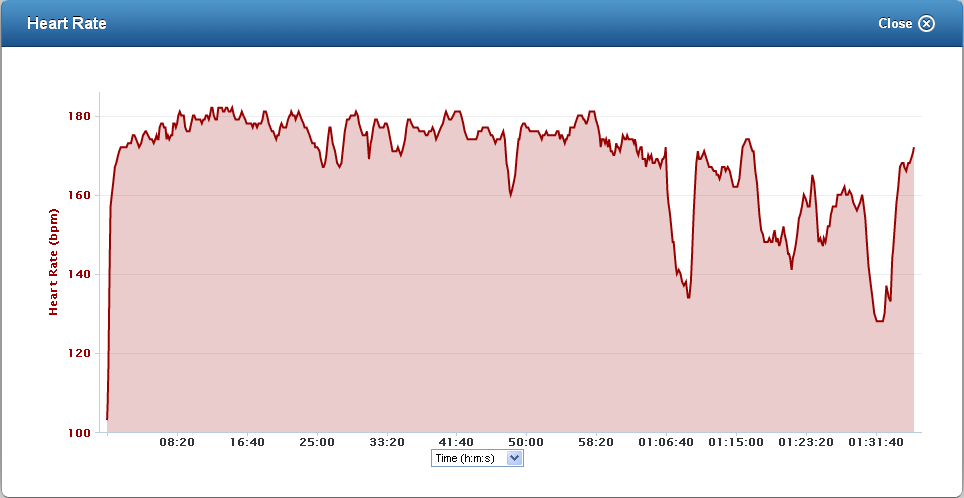
Yesterday I ran the “Trail du Confluent” (13km), a lovely countryside race in Pinsaguel which I had already run last year. I had one of the worst experiences ever while doing sport, if not the worst. I suffered what in Spanish we call “pájara“ and in English would be collapse.
From the km 4-5, I started feeling weaker and at the end I was almost incapable of running. I had only had one such previous experience cycling about 13 years ago, when after biking for 60km we made a pause and my cousin Unai had to literally push me on my bike from his for over 10km back to home as I could not cycle anymore.
These collapses happen from time to time to runners or bikers, and to avoid them it is recommended to eat and drink well before and during the race. I ate and drunk but I guess it was not enough. Other possible causes could be:
I was not well-trained, having only ran since the last marathon few days this past week.
The weather was extremely hot making us lose lots of liquid.
Heart rate during the race.
In fact, during the race and feeling already weak and underperforming I noticed that I was not the only one in such low condition. Last year with 1h22′ I came in 103th in the end (among 237 finishers), this year the 103th needed 1h32′ (the winner also need 1h compared to 56′ last year). With my disastrous time, 1h36′, I came in 141th of 254 finishers.
Nevertheless, it is not worth it to worry much about it. This is sport: there are days for glory and days of wandering around like an underdog. Continue training, sleeping, drinking and eating well and the next race will be a different story.
We all have heard the concept of handicapapplied to golf. That is a way of levelling off the game by adjusting net score to each player skill.
Markinch Highland Games programme
During our last holidays in Scotland, we attended to the Markinch Highland Games. Apart from weight throw games, pipe demonstrations and traditional dancing contests, one thing especially caught our attention: the application of handicapping to athletics races.
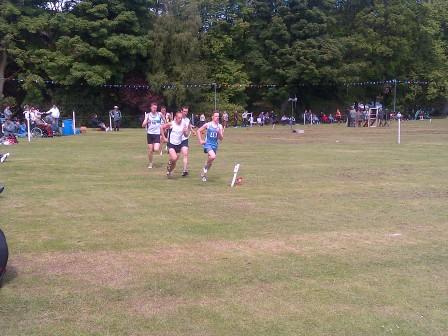
Runners of different ages (or simply speed) were competing together starting at different points to compensate for their different skill. Let me show you an example. Take a look at the roster of participants in a 800 metres race below.
The number at the left of the names is the bib number, while the number at the right side of each name indicates the handicap. Even though this was a nominally 800 m race, no runner completed 800 m. The fittest runners started 35m ahead of the 800 m starting line, while the least fit started 190 m ahead. That is, some ran 765 m while others completed 610 m.
800 m Open Handicap roster
This clearly makes the race more attractive to spectators, what I am not so sure is the opinion of the fastest in case he or she cannot recover the 155 m lead of the slowest during the race…
During 2000 and 2001 I ran 3 marathons in Madrid. The best time I achieved then was just slightly above 4 hours, 4:00:41. Then I didn’t train much for them and I paid for that during the races.
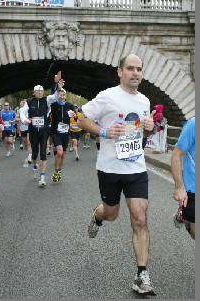
Running in Paris (@ km ~26)
Last Sunday, in Paris, I ran together with my friend Serna and my brother Jaime my 5th marathon. For this one I had a training plan to go through for 17 weeks. That training plan amounted to over 1,100 km running, and a series session per week. I started a bit late with it, then I had trouble in the adapation to the new soles, injures… in the end, during the last 4 months I ran almost 500 km, or about 45% of the plan and did only 5 days of series.
Even if I was under trained, I managed to recover from the injure about 2 months before the race. I run as much as I could during the weeks following the recovery: 330km in 7 weeks, including 4 consecutive Sundays with a run over 20km in each of them.
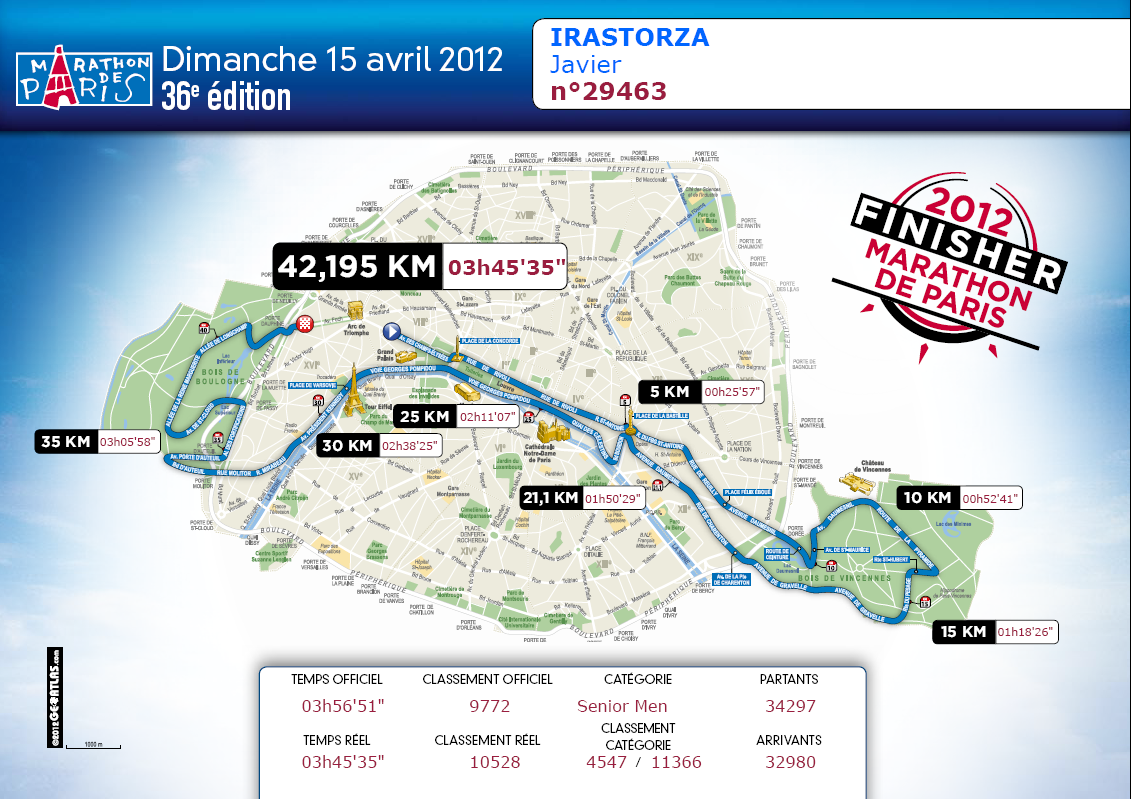
The result: I completed Paris marathon in 3h45’35”, just at my target time before starting. My first sub-4-hour marathon. You can’t imagine how happy I am for that.
Some curiosities related to the race. You may find the route we followed in the diploma below. Some of the views while running were superb (Eiffel Tower, Place de la Concorde, Les Champs-Élysées, Place de la Bastille…), even if when running a marathon you don’t get to enjoy much the views. In the diploma you will see as well two times and positions. This is due to the fact that it took me 11 minutes to reach the starting line. Positions are calculated taking into consideration net times (deducting time to starting line, “real”) and arrival order (“official”).
Paris 2012 diploma.
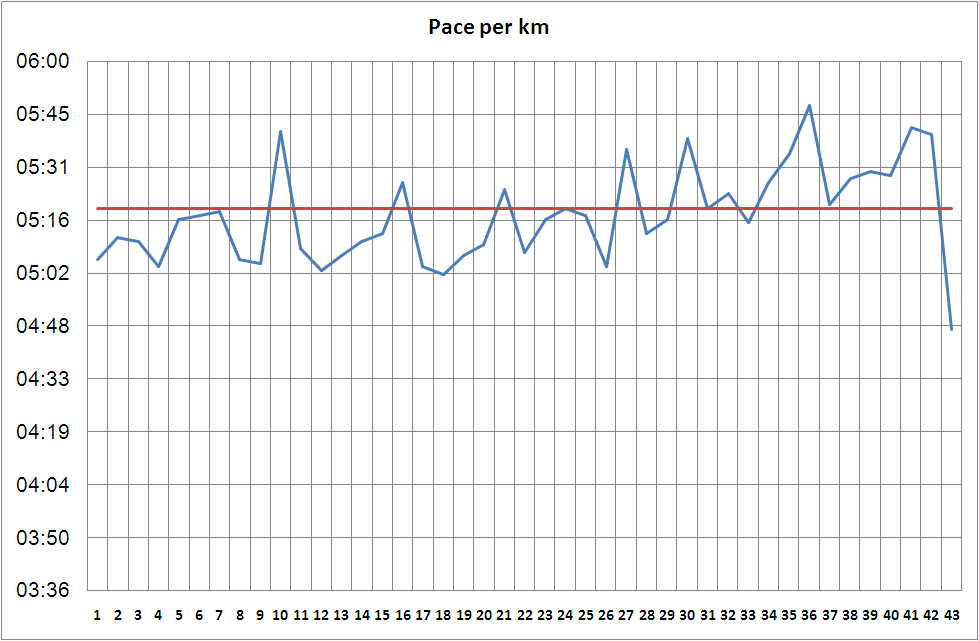
You can also see below a small graphic prepared from the info recorded by my Garmin. There you’ll see how until km. ~29, I managed to run below my target pace to achieve 3h45′ (that was 5’20” per km). There are some kilometers before km. 29 in which it took longer, that is due to stops (“WC”) or slowing down to take drinks at every 5km. From km. 30 it was hard to maintain paces even below 5’30”. In the last 12km I burnt the 2-minute buffer I built in the first 25km.
In order to keep the rhythm in the last kilometres, it is extremely important not only the long runs (I got the one and only “muscle warning” at km. 39) and the series training, the famous Yasso’s to keep “speed” and endurance.
While walking around in Monaco last weekend we discovered by chance “The Champions Promenade”, a walk by the seaside in Monaco with the footprints of some of the best football players in the History of the sport.
There, I discovered the “Golden Foot” award, different from the Ballon d’Or and the Golden Shoe. While the last two are awarded to the best player and top scorer of the year, the former is awarded only to active players older than 29 years old and can only be won once. Each new winner adds his footprint to The Champions Promenade, being the last one to do so Ryan Giggs.







 The Blog by Javier