At the beginning of the year I had just a few objectives in relation to running:
Reach 2,000km run along the year.
Reach personal best times in 10k, half marathon and marathon.
Run 2 marathons.
Now, just one week after mid-year it’s a good moment to take a look at how these months have gone regarding the running part:
I have already run 2 marathons (Rome and San Diego) though in none of them I was under 3 hours 45 minutes. In Rome I was close to it (a minute slower) but didn’t reach it. I will even run a 3rd marathon this year in Athens next November (health permitting).
So far, even if I have run more races in 6 months than ever (10 races), I only attempted one half-marathon, in La Latina district (Madrid) which is not the best circuit to attempt a PB; I didn’t achieve it. I clocked 1:44:49 vs. the 1:42:30 I did in Toulouse in 2011.
I have run 3 races of 10 kilometres. In the first one of the year I was short of only 6 seconds to beat my PB (46:14) clocking 46:20. One of the other two was a cross and the third one was the Corrida Pedestre de Toulouse, where the distance is not even 10k but 9.64km and despite of that I was not in the rhythm to do any PB.
In relation to the mileage: in the first 6 months I ran 920 km, a bit less than 1,000km, but not a difference that I can’t make up for in the second half of the year.
Some stats to close the post:
920 km run from January 1st to June 30th.
206 km run in races in this time (22.4% of the distance).
86 hours and 58 minutes running in this 6 months.
19 hours and 46 minutes running in races in this time (22.7% of the time –> long trails).
Some weeks ago Luca and I spent a weekend in the Central Massif in France, a plateau the size of Castile and Leon, with an average height of around 600m.
On Friday we went to Chaudes-Aigues where we wanted to spend the saturday in a spa. The village, in the region of Auvergne, has less than 1,000 inhabitants, a couple of hotels and restaurants and its famous for its hot springs. With over 30 different springs starting from 45ºC to 82ºC, the latter is supposed to be one of the hottest ones in Europe (if not the hottest as proudly announced in the signpost close to it).
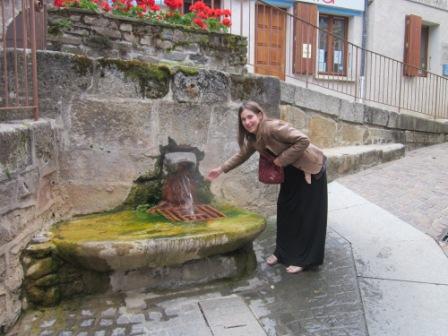
Luca by the 82ºC hot spring in Chaudes-Aigues (arguably the hottest in Europe… the spring as well).
Another curious thing of Chaudes-Aigues is a network of hot water going through private houses built back in the year 1,332, which is still working today though only in those original houses.
On Sunday morning, we woke quite early to cover the distance to Nasbinals, another little commune in the region of Aubrac where I wanted to run a ~18km trail.
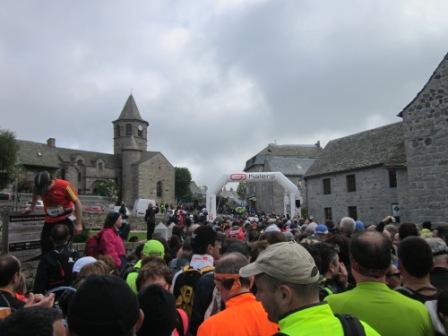
Start line of the trail.
I started the trail in the back of the pack so I took the first kilometres without stress trying to run with the crowd and only overtaking other runners where possible and moderately easy. In that way I could enjoy at some points the views offered by the circuit of the trail, which at points was through closed forests but at some others was through open countryside.
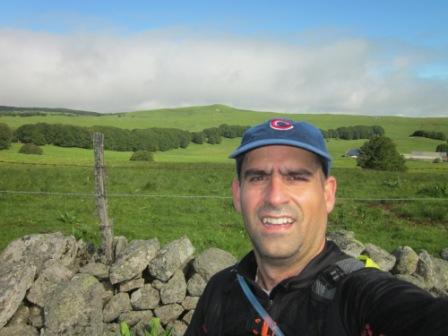
Fields of Aubrac.
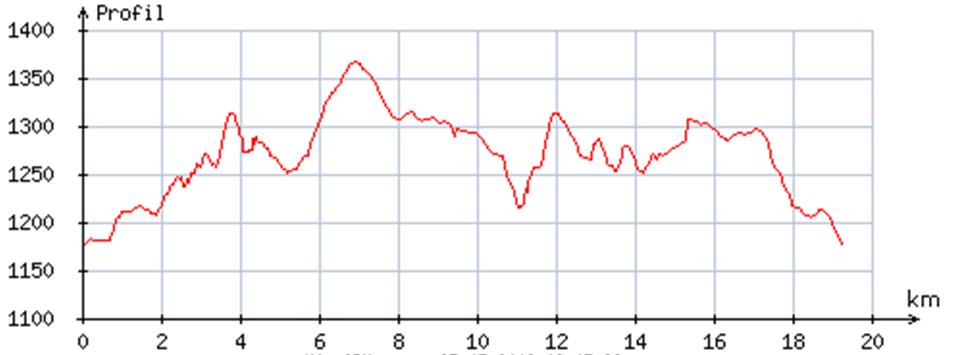
I was running with the water bag and carried some vanilla-flavoured energetic gels, so I did not have any problems with supplies, I didn’t need to use those provided by the organization. One good point of the trail is that the route was very well marked, however, the measuring of the distance wasn’t. The trail was supposed to be 18 kilometres long, and when my GPS-watch indicated 17.75km I saw a signpost saying “Arrivée 2 km”. In the end I measured 19.60 km, but I guess the organization knows this, as in their own web, when showing the altitude profile, the distance they have measured is clearly over 19km.
Profile of the race “Trail des Capucins” (over 19km instead of the announced 18km).
It is not such a big issue, though you may have been managing your strength resources to have a last good kilometre and instead you find out that there are still 2 more to go! It would be as easy as to announce the trail as a 19km or 19.6km instead of 18km.
In the end it took me over 2 hours and 12 minutes, and ended the 255th out of 810 runners. A good run for a Sunday morning.
Even if not of very good quality, you can find below a short video I recorded around the 8th kilometre to give a glimpse of how these trails are:
“The next time you’re in the USA, run a marathon there”. Those were the words from by brother Jaime after he took part in Chicago marathon in 2011.
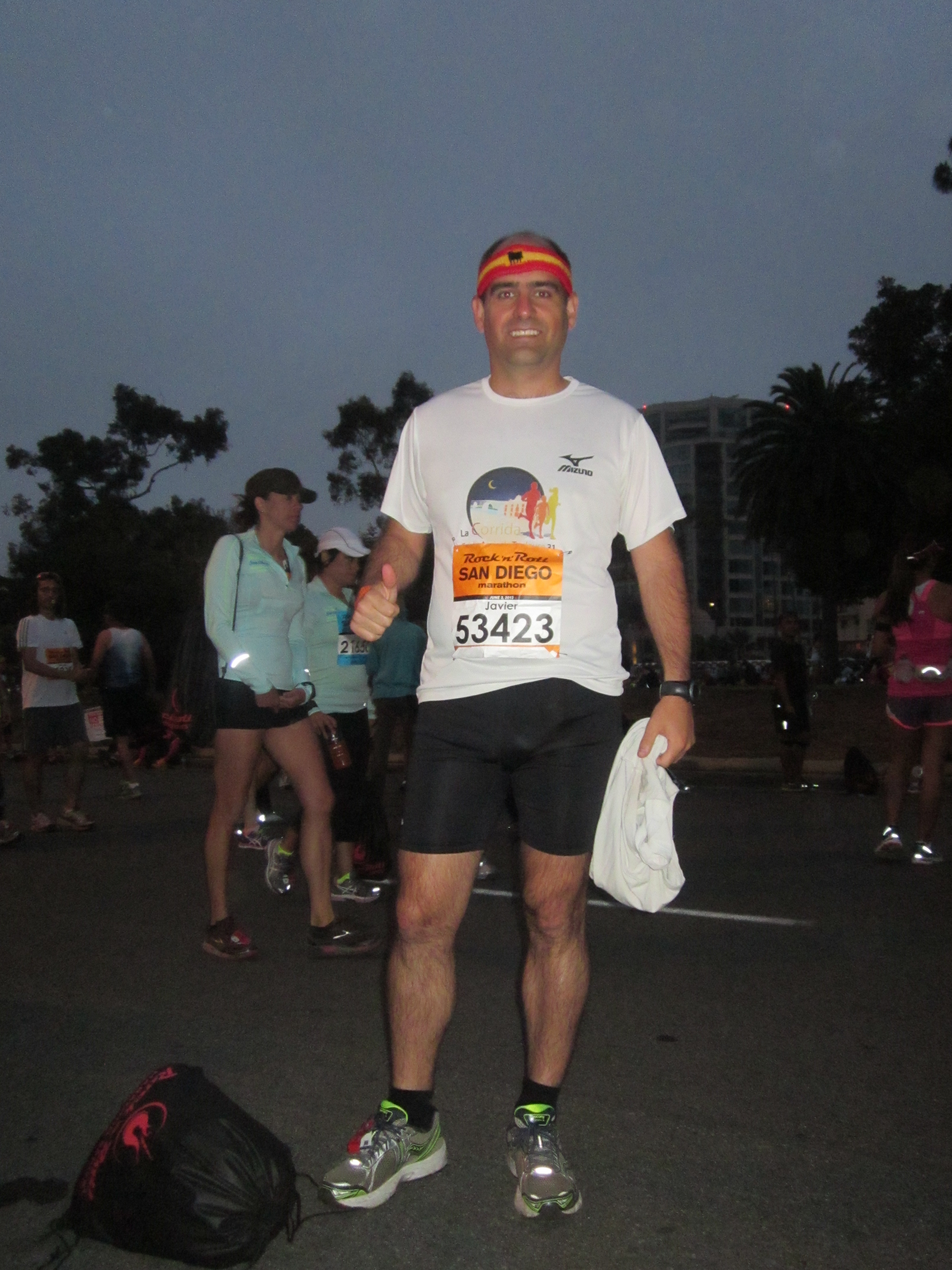
It has taken me 2 years to go back there. This time for my honeymoon. This did not stop me to follow the advice. I went through a website with all the marathons in California and found that San Diego Rock’n’Roll marathon was taking place on the very last day of the trip. Perfect! That way the muscle soreness of the following days would not interrupt the tourism activities.
June 2nd, the day of the race was only one month and a half after March 17th, when we ran Rome marathon, thus I did not follow any special training plan for this marathon. I just tried to keep the form with which I arrived to Rome by running often, though I didn’t do any series session and only one long run… I paid for that.
The atmosphere was very good but only in some neighbourhoods, in others not so many people cheering the runners. Along the road 163, during the steepest (up to 6% along 1km) and longest (about 4km) climb there was almost nobody. Even if the overall profile is a descent I found the course quite tough. The times of the first 3 runners seem to say the same (2h15 for the winner, 20 minutes more for the second…). The other thing that I didn’t like much was the solid or the lack of abundant and varied solid supplies along the course. I thus only relied on my 3 energetic gels and drinks.
Course of San Diego marathon as recorded by my Garmin.
San Diego marathon profile.
At 5:30am, before departing.
I went quite well at the expected pace (below 5’20” / km) for the first 28 kilometres, then I started to miss endurance and right afterwards the long climb “killed” me. I, however, did not stop and kept running up, if very slow (most of the runners in my time -between 3h45 and 4h- where walking during those kms). I’ve gone through much tougher situations in the last years, thus I only thought “well, slow the rhythm and the climb will finish at some point, keep up”.
Running at some point of San Diego marathon.
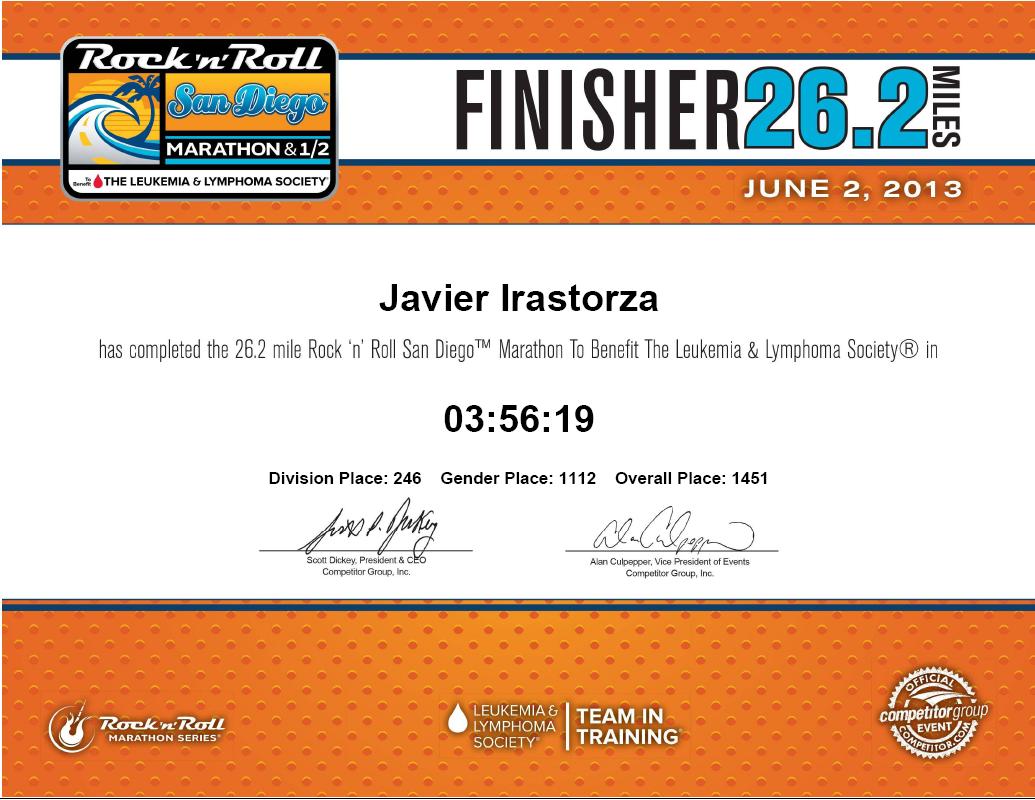
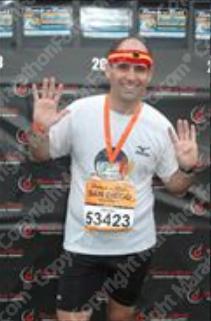
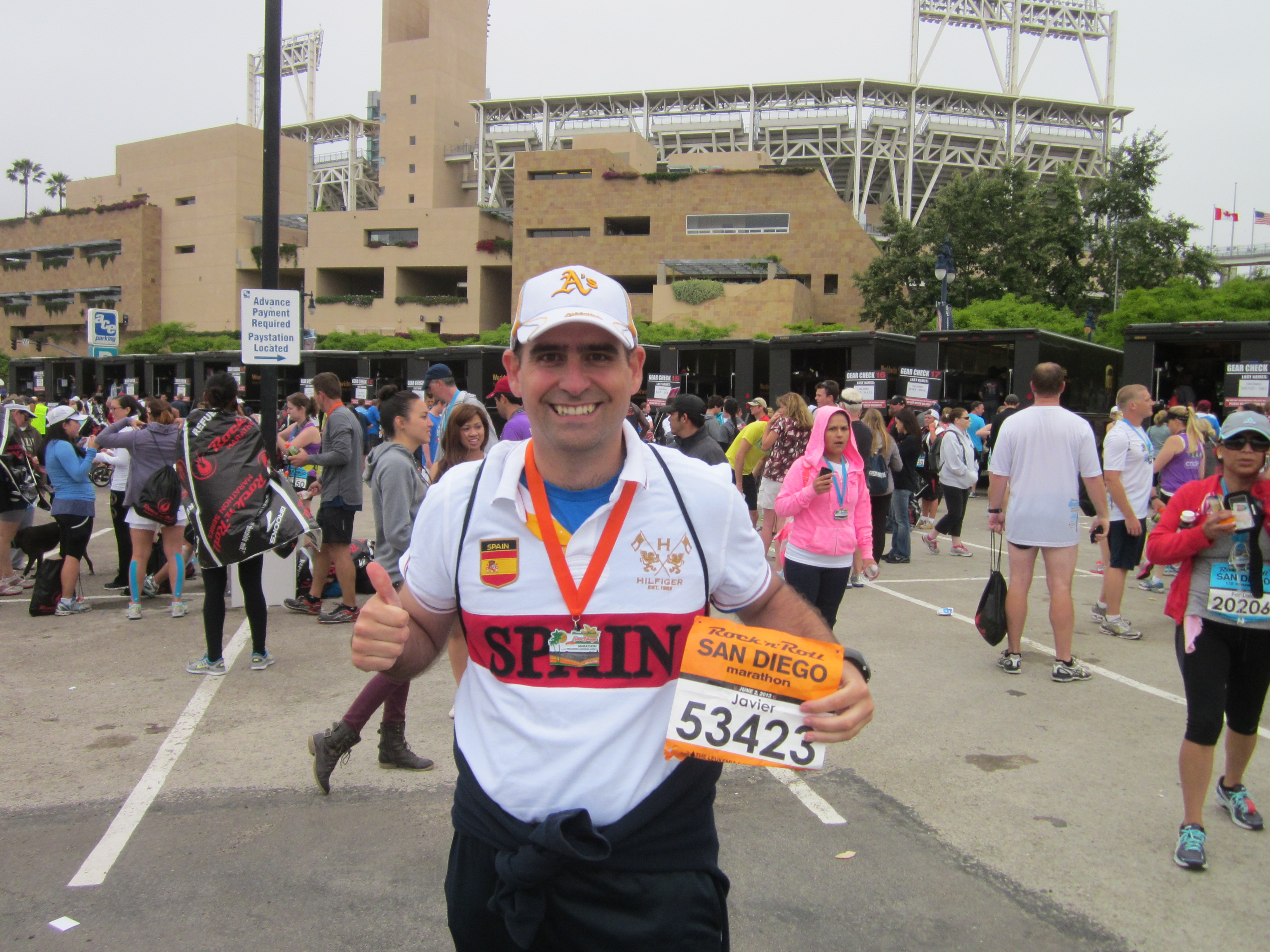
In the end I finished in some 3h56’19” as clocked by the official chip (see the report of the race as recorded by my Garmin here). I was happy enough with the result and with having finished the second marathon in the year, another sub-4-hour marathon (the 4th in a row under 4h) and the 9th overall.
San Diego marathon finisher diploma.
San Diego marathon medal.
9 marathons!
Enjoying the feat (behind me: San Diego Padres baseball stadium).
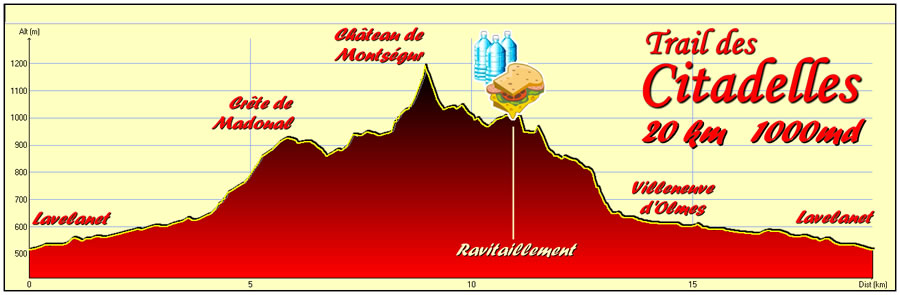
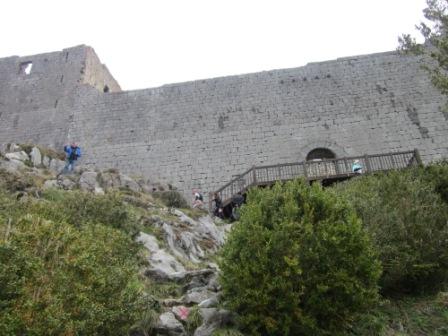
The Château de Montségur used to be a Cathar castle dating from late XII / early XIII century. For some time it was the centre of the Cathar church, though today only some ruins remain. The castle is at the top of a 1,200m-high rocky mountain, some kilometres away from the small village of Lavelanet out of which the Trail des Citadelles started.
This was my first long run and first race just 2 weeks after completing Rome marathon. I had only run 2 days between then and today, thus I took it more as a run in the nature than as a race, no stress from the departure. I even took the photo camera as I suspected I could take some nice pics.
The race consisted of 20km from Lavelanet to the castle and back, going as much as possible through the forest and as little as possible through paved roads (basically the first and last kilometres and little else). The rain of the previous days, of that precise morning and the passing of hundreds of runners left many of the paths impracticable, completely muddy and enabling the funniest situations.
Trail des Citadelles (20km) profile.
Before having completed the 2nd kilometre my running shoes and socks were already completely soaked. Before the 3rd kilometre we had been running through some stretches in which the feet were covered up to the ankles with mud (chop, chop, splash!).
I love trails for they put you in close contact with nature, the variety of their landscapes, the absence of time pressure; even if I acknowledge that I am not particularly good with difficult descents which require some technique and equipment that I lack of.
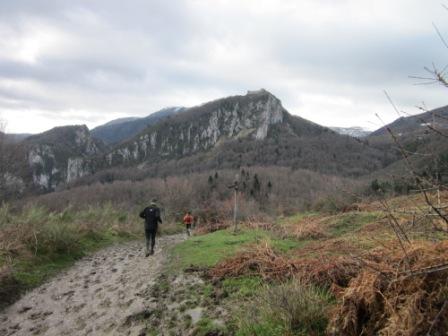
Today I missed some mountain sticks. At the starting line I saw many people with them. I wasn’t sure if it was because they would walk instead of run. Indeed. The thing is that I would also have to walk a lot, uphill, through rocks covered with very slippery mud. Only during the race I understood why they brought them. Between the 4th and 5th kilometre we started to walk uphill more than run, and it lasted like that for almost the next 7 kilometres.
Montségur castle from afar at the top of the mountain (notice the footprints in the mud). Picture taken at about km. 5
The mostly walking uphill took a full hour to cover about 5 kilometres to the bottom of the castle stairs.
Montségur castle from below.
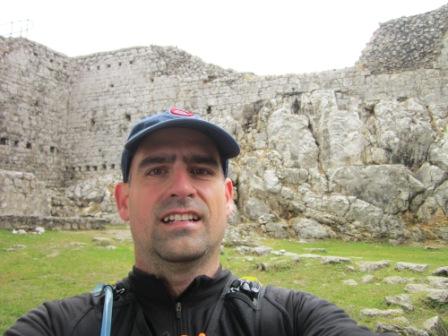
Inside the castle.
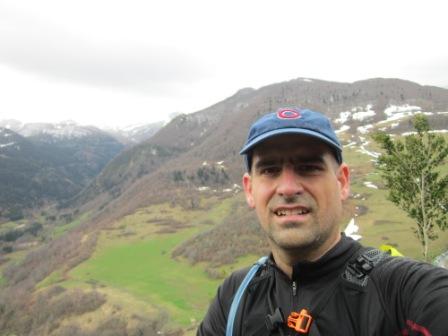
The views from the castle are stunning. The picture below does not make enough justice so I took a panoramic video.
Views from the castle.
From the castle to the end of the race most of the time we would be descending. In theory, this should have made it easier. But that was only the theory. That is when the fun began (to call it that way).
The way down started with the same stairs of the castle, which we descended with much care. Then some hundreds of metres of going up and down over more or less dry surface and finally the same kind of very steep descent, sometimes along and others crossed by water flows, fully covered with slippery mud.
I lost count of how many times I slid without any control on the verge of falling down. I do keep count of the 5 times that these detours ended with me, my face, arms, whatever it was… in the mud. They were not especially painful, but left you with hands and face covered of mud, having to wash yourself in the next current of brownish water. Other times the sliding left you looking uphill to the wrong side of the race hands in the ground to prevent a full-blown fall. As I was not the only one going through this, you can get an idea of the image…
Eating at ~ km. 12.
Around the kilometre 11-12 there was the only point of supply so I did a little stop to drink some Coke, eat some chocolate, etc.
After this stop, the mix of sliding / running continued for about another kilometre until we entered a forest of pine trees where the ground was a bit drier. There I was happy as I started running faster, less worried about falling and more focused on keeping the pace… until I bent my ankle… the same ankle I strained 3 times during winter. That one was painful. I had to stop and walk for some 2-3 minutes to recover from it.
It was then that I took the camera to film another short video as an update of the race so far at 13.4 km (in Spanish):
The making of the video, the self-deprecating humour of the situation lifted my morale. I tried the ankle, which responded positively, so I started running again.
During the last 5 kilometres, more or less flat, even if still going at times through water flows or mud, I tried to enjoy running a little. I think it was only at this point that I was overtaking others instead of being overtaken :-). I discovered then that instead of avoiding water flows and poodles, it was indeed better going through them as their bottom used to be firmer. The guys of the organization took it seriously and somehow made us literally run along the river for about 200m! That was another high moment of the trail, which I recorded here (excuse my French):
When arriving at the village, one final sprint and done. I mean, done.
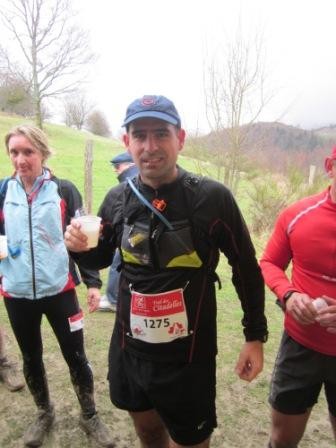
Finish line.
My performance: 2h49’16”, 201 out of 366 finishing within the time given of 3h30′ (see Garmin records).
—
PD: All this happened in the 20 km race; bear in mind that at the same time 2 other races were taking place one of 40 km and one of 73 km (the runners having departed at 6am to run… 9 hours? 12?). My admiration to all those heroes.
This morning, as this post is being published I’ll be starting the 19th Rome marathon, together with my friends Serna, Manuel and brother Jaime.
I am very satisfied with the way I could train towards this marathon, no injuries this time.
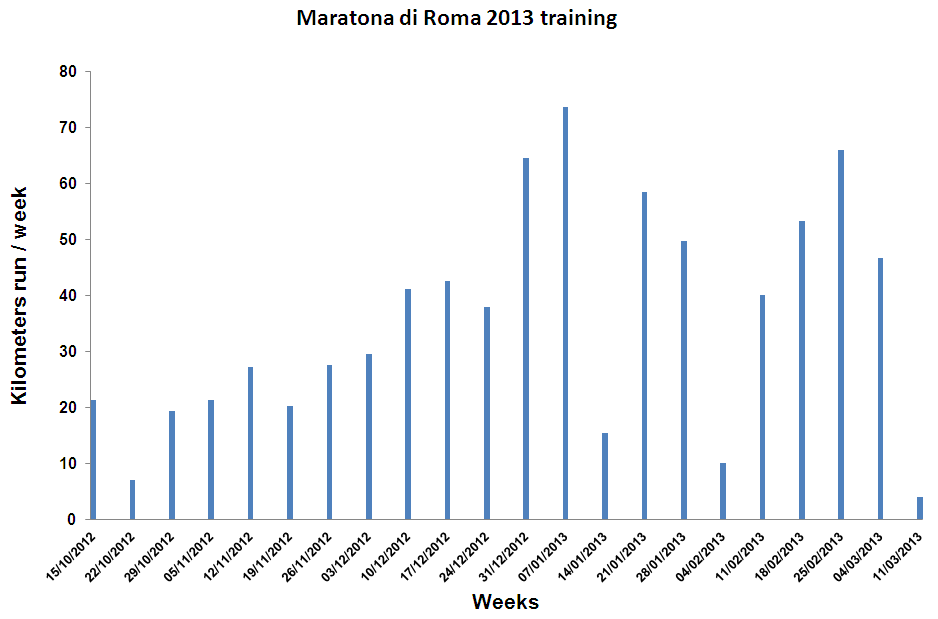
Since running Berlin marathon last September 30th, I only stopped for a couple of weeks and swiftly started running again. Even if I started a bit late to pick up with the number of miles run per week (from mid December instead of mid November) I have amounted almost 800km in these last months, including:
5 days of tough series training: 12x400m, 14x400m, 8x800m, 9x800m and 10x800m.
7 long runs of over 16km each, 4 of them over 20km.
5 races: San Silvestre Vallecana (10km), Course des Rois (10km), Le Deca d’Escalquens (10km), Trailhounet (18km) and Media Maratón de La Latina (21km).
You can see below the mileage run per week:
Maratona di Roma 2013 training season. Kilometres run per week.
A lesson learned from previous training sessions: when I noticed that some muscle or tendon was getting sore from too much training I did not hesitate in slowing down that week, instead of keeping up with the training until getting seriously injured. Let’s see today how it goes, anyway, as Jaime says, it’ll sure be a day for the epic :-).
After 6 months running together, it has come the time to retire the old Saucony Triumph 8 running shoes and start using the new Saucony Triumph 9.
Saucony’s: old Triumph 8 and new Triumph 9.
Let this short post be a tribute to the Triumph 8s, which have run to date over 770km, in several cities and countries, and including 6 races, among them a marathon and a half-marathon. A similar curriculum awaits the Triumph 9 pair: several races including 2 marathons and no less than 700 km in a few months.
Triumph 8s will live side by side with the 9s, as casual sport shoes from now on, instead of running shoes.
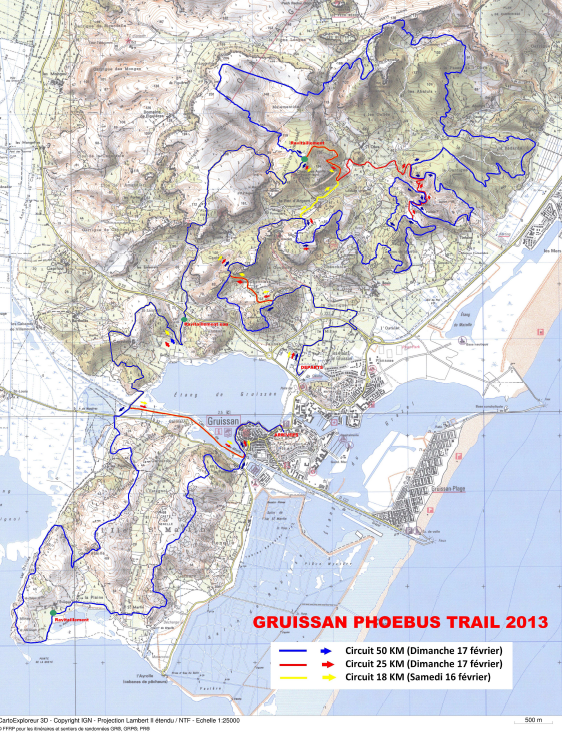
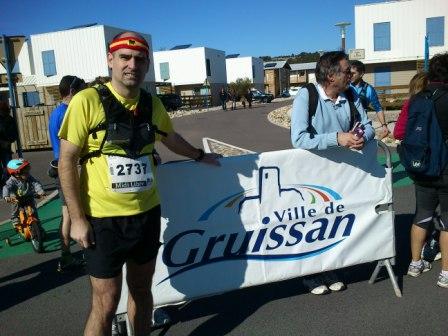
Last weekend Luca and I went to Gruissan, a small village by the Mediterranean sea. I must say that in winter time it is not very lively (not by a night at least). One of the reasons for coming to Gruissan was to take part in the trail “Trailhounet” (18km), one of three races that would take during the weekend (the others covering distance of 25km and an ultra of 50km!).
Trailhounet circuit around Gruissan.
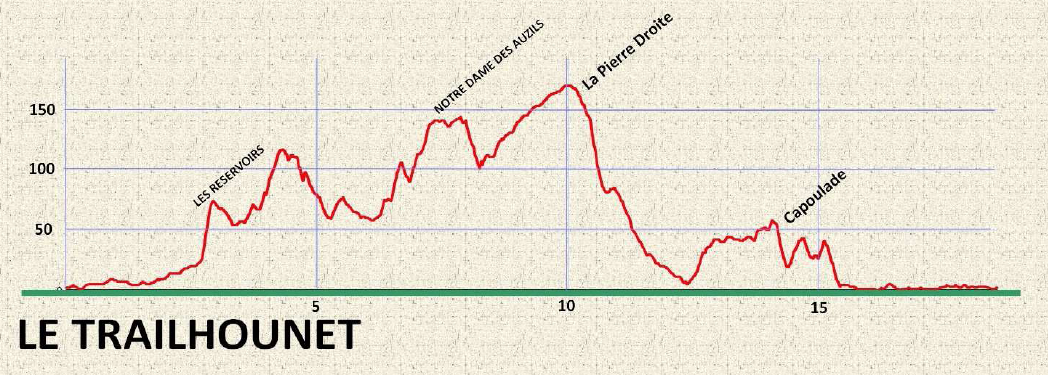
I have often mentioned that running trails through the country side feels different from running on the asphalt of city streets. However, at some points the slopes in trails get too steep to run up, or too dangerous to go as fast as possible on the way down. This time, the circuit was covered to a great extent by small stones and rocks, this made it even more challenging and painful.
Profile of the race.
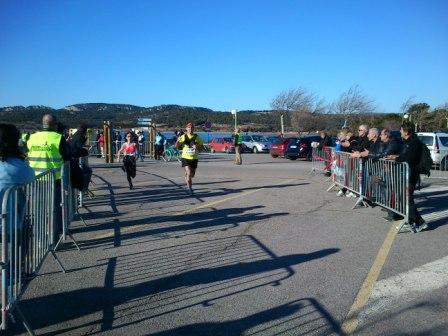
Let me share a couple of pictures from the start and the arrival:
Start line, using for the 1st time the new sweat band with the flag.
Before I took on skiing this year again, it had been already about 16 years without doing so! In the past weeks, Luca and I first went to Sain-Lary and then to Baqueira-Beret ski resorts. The experience was great, even if the weather was not the best.
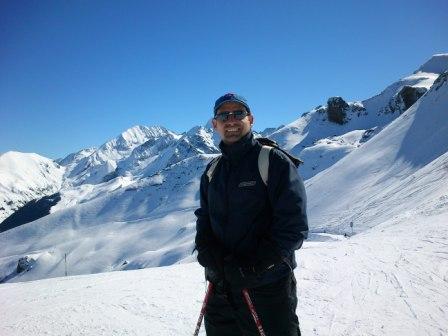
This past weekend, we went to Val Louron with a group of co-workers. Val Louron is a small resort enclosed in the valley of the same name (which connects with Spain via Viella and where the Garonne river has its source). This time the weather was perfect, the views were impressive, the day was superb. This weekend I was reminded why I loved this sport so much years ago.
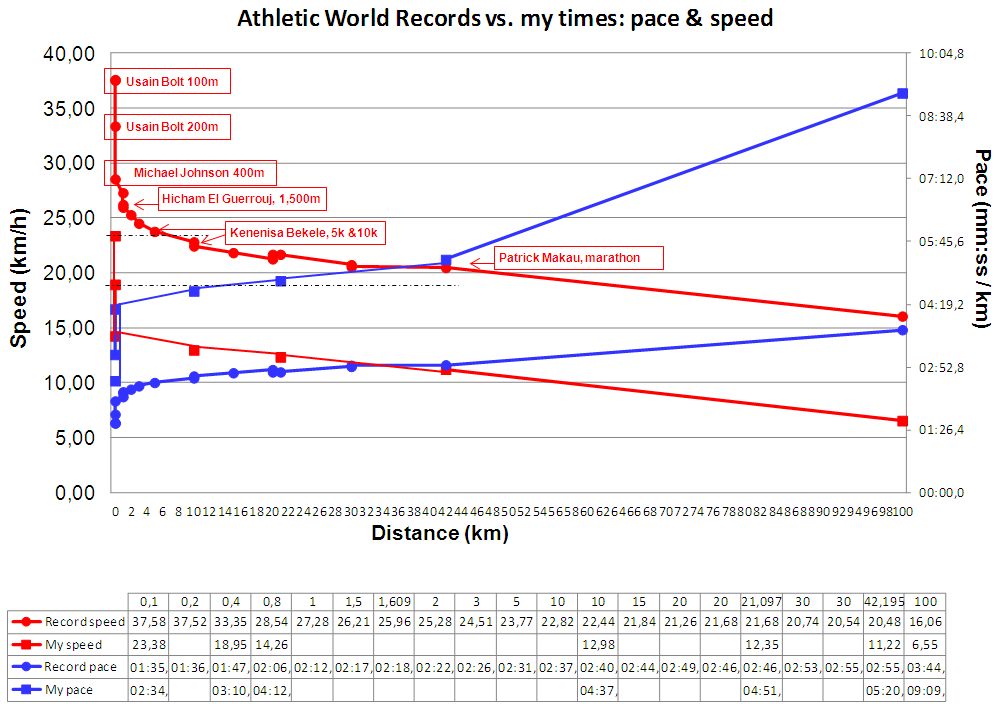
I received a comment from Uwe, a reader of the blog, suggesting to plot it using a logarithmic scale. At first, I wanted to show how the long distance runners could almost keep a speed (between 20.5 and 23.8 km/h) for distances from 5 kilometres to 42, a marathon. However, Uwe convinced me to make the plot and here it is:
Athletics World Records vs. my times (speed) – logarithmic scale for the distances.
In this view, what it is interesting is to appreciate the different slops of the lines connecting the different records. There you can see how:
100m and 200m races are fully anaerobic where Usain Bolt is capable of maintaining an average speed of above 37.5 km/h. You can see in the explanation in the Wikipedia how these two races (both lasting below ~30 seconds) use as energy source high energy phosphates.
races from 400m to 1 km are still a high intensity activity, with some anaerobic component, though another energy source enters into play: anaerobic glycolisis. And as we have heard often in descriptions about 400m races, the consequence of rapid glucose breakdown is the formation of lactic acid.
from then (1.5 or 2km) on (up to 42km) professional runners are able to keep a high speed out of aerobic metabolism (using adenosine triphosphate, ATP). Of course, speed decreases with distance, but from the 26.2 km/h of a 1,500m to the 20.5 km/h of a marathon the speed decrease is of -22% for a race 28 times longer!
for ultramarathons (over 42k) speed starts decreasing at a higher pace, though Wikipedia only offered the 100k time. Probably more data can be found in the web to try to find with more accuracy up to which distance the long distance stable pace could be maintained.
Uwe, you were certainly right. This view offers another very interesting perspective to the game :-).
I have many times commented with friends and acquaintances how impressive professional athletes are, what does it mean running a marathon in barely over 2 hours…
Many amateurs (not to mention sedentary people) would not keep up pace much longer than 100 metres. Each time I have made this comment to someone I had to verbally make some numbers for my interlocutor. I am sure these verbal calculations were not always well understood and digested. Following the adage “an image is worth more than a thousand words”:
Athletics World Records vs. my times
Red lines show speed (in km/h; decreasing as race distances get longer). Blue lines show pace (in mm:ss / km; increasing as race distances get longer). I have included a table so you can compare the numbers.
I took athletics world records from the Wikipedia. You can find my times in the page “Races” of this blog. I only added a tag to the records that most of you will recognise, as they were achieved by well-known super stars.
There are many catches in the graphic. Two impress me the most:
I could have kept up the pace of Patrick Makau in his marathon world-record-beating performance for 100 metres… but not for 400m! (see black dotted lines).
How once we enter into aerobic exercise, we’re able to almost keep up speed despite distance increases. The difference in speeds between Bekele’s 5k (23.77 km/h) and Makau’s marathon (20.48 km/h) is only 3.25 km/h!
***
NOTE: I am not a particularly fast runner, thus don’t take the times and paces and interpret them as if no amateur runner could keep up pace for more than 100m… some will keep it up somewhat longer. I just wanted to share the idea.







 The Blog by Javier