Category Archives: Travelling

Meet my avatar

Time ago I already introduced you to my Lego. Some weeks ago during a Gol flight in Brazil I was reading through the in-flight magazine when I found an article that talked about Meez among other things.

I was just playing with it little bit. Please, meet my avatar, “Javier in casual Friday” (just if I wore casual on Fridays…).

Meez 3D avatar avatars games

5 Comments

Filed under Marketing, Travelling

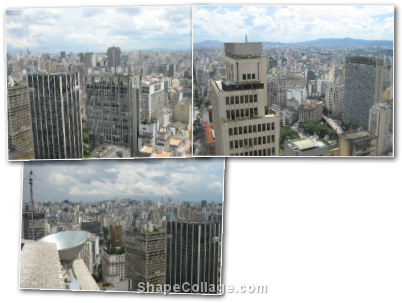
Sao Paulo from the top of Banespa building

Banespa building is an important skyscraper in the financial center of Sao Paulo. Banespa stands for Banco do Estado de Sao Paulo, which now is owned by Banco Santander. The building was designed by a Brazilian architect, Plínio Botelho do Amaral, who was inspired by the Empire State Building. It was for 20 years the highest building in Sao Paulo, until surpassed by Edificio Itália.

Banespa Building (photo by Felipe Mostarda) and Empire State Building (photo by David Shankbone).

At the top of the building there is an observation deck from which you can see stunning views of Sao Paulo, with hundreds of skyscrapers in whichever direction you look at for kilometers and kilometers. Then you realize that you are in Sao Paulo, the 6th or 7th most populated city in the world (depending whether you look at the city limits or metropolitan area).

Sao Paulo skyline from Banespa observation deck.

Other famous observation decks that I visited recently were the one in the ESB and the Top of the Rock at the GE Building Rockefeller Center, there are some differences though:

  • Height: Banespa, 161 m; Rockefeller, 259 m; ESB, 443 m.
  • Number of floors: Banespa, 35; Rockefeller, 70; ESB, 102.
  • Construction finished in the year: Banespa, 1947; Rockefeller, 1939; ESB, 1931.
  • Observation deck ticket price: Banespa, free; Rockefeller, 20$; ESB, 20$ + 20$.

Race in New York. Let me share here with you a story about a race to build the tallest building that took place in the late 1920’s. I found this story in the book, “Tales of New York”, which I commented in a previous post.

Three buildings were being built at the same time, the 40 Wall Street, the Chrysler Building and the Empire State Building. Competition among them was fierce at the time, with names of big industrialists behind them. Plans were revised once and again. The first one in being finished was the 40 Wall Street in April 1930 which claimed the title of world’s tallest building at the time. Originally it was to be 840 ft but along the race the plan was revised to make it just 2 feet taller than the Chrysler building plan at the time 925 ft, at completion the 40 Wall Street height was increased to 927 ft.

During the last weeks of its construction loads of iron and steel were brought to the interior of the Chrysler building. People thought that it was part of the interior decoration, filled with metallic details and motives of the automotive industry. But once its rival building was finished, on a clear day in the morning a needle-like metallic structure was raised from the center of the top of the Chrysler building to the surprise of the population of New York. On May 27th 1927, the Chrysler building was finished, in the end measuring 1,046 ft, taking the title of tallest building from 40 Wall Street merely a month after.

Walter Chrysler had worked in the past together with the man behind the Empire State Building, John J. Raskob, then CFO of General Motors, one of the main competitors in the automotive industry. He wanted him to either fail in the pursuit of building the tallest skyscraper or becoming bankrupt if he made it. With 1,046 ft height the Chrysler was to be tallest than the Empire State Building when it would be finished, however in the year that took the ESB to be finished the design was subsequently changed measuring 1,454 ft when it was finally finished in 1931, taking the title of tallest building from the Chrysler just a year later.

Just to close the post…

  • nowadays the tallest building is the Burj Khalifa in Dubai with 828m (160 floors),
  • the tallest building in Europe is Commerzbank Tower in Frankfurt with 259m (65 floors) and very close to it is the Main Tower (200m) that hosts a very nice restaurant which is the only observation deck in the skyscrapers of the city,
  • the tallest in Spain is the Caja Madrid Tower with 250m (45 floors) which holds the 148th position in the list of highest skyscrapers.
  • another interesting point is to see the evolution of the title of “tallest skyscraper in the world”.

Leave a comment

Filed under Books, Travelling

Lapa stairs in Rio de Janeiro… impressive.

I had already visited Rio de Janeiro in 2000. That time something went completely unnoticed to me: the stairs made by Selarón in Lapa neighbourhood. This piece of art started with the Chilean artist renovating the stairs in the street that run in front of his house 20 years ago. First he used tiles with the colours of the flag of Brazil. The stairs are still unfinished and according to the artist they will only be finished the day of his death.

The colours and forms created reminded me of creations by Gaudí in Barcelona, e.g. Parc Güell. It’s really a pleasure, it brings you the same warmth and the same smile of admiration to your face.

The stairs have something that I really found special and addictive: the artist is currently using tiles from different parts of the world, depicting:

  • countries (Croatia, Portugal, Costa Rica…),
  • cities (Toulouse, Berlin, DC…),
  • famous monuments of cities (Puerta de Alcalá – Madrid, tramway in Alfama – Lisbon, Torre del Oro – Seville, Mecca),
  • famous art crafts in the most prominent museums in the world (Van Gogh self-portrait, Nachtwacht – Rembrandt, Girl with a Pearl Earring – Vermeer, Guernica – Picasso…),
  • celebrities (Lady Di, The Beatles, Obama…),
  • stereotypes from countries (bullfighter, windmills, marijuana, cows),
  • commercial brands (Coca-Cola, Michelin…),
  • football clubs (Real Madrid, Betis…)

Trust me: once you start you can’t stop searching for the next tile, trying to frame it with the ones around, wondering whether the artist placed it there intentionally for some reason or not (is it casual that “Don’t mess with Texas” is close to “Afghanistan” or that “Lyon” is above “Real Madrid”…?), checking whether you have seen those places, monuments, cities… as I said above: it’s addictive!

Moreover, YOU can take part in the making of the craft. As explained in some tiles, you may send him by post an old tile from your city and he may place it in the stairs… your contribution may be immortalized in Rio de Janeiro! The artist promises to send you a picture of the tile once it’s placed in the stairs.

See the pictures of the artist coming to work and with Luca and me… doesn’t he remind you to another genius, Salvador Dalí?

Next time you happen to be in Rio, don’t miss it.

Enjoy the pictures:

This slideshow requires JavaScript.

Leave a comment

Filed under Travelling

3 wishes to Nosso Senhor do Bonfim

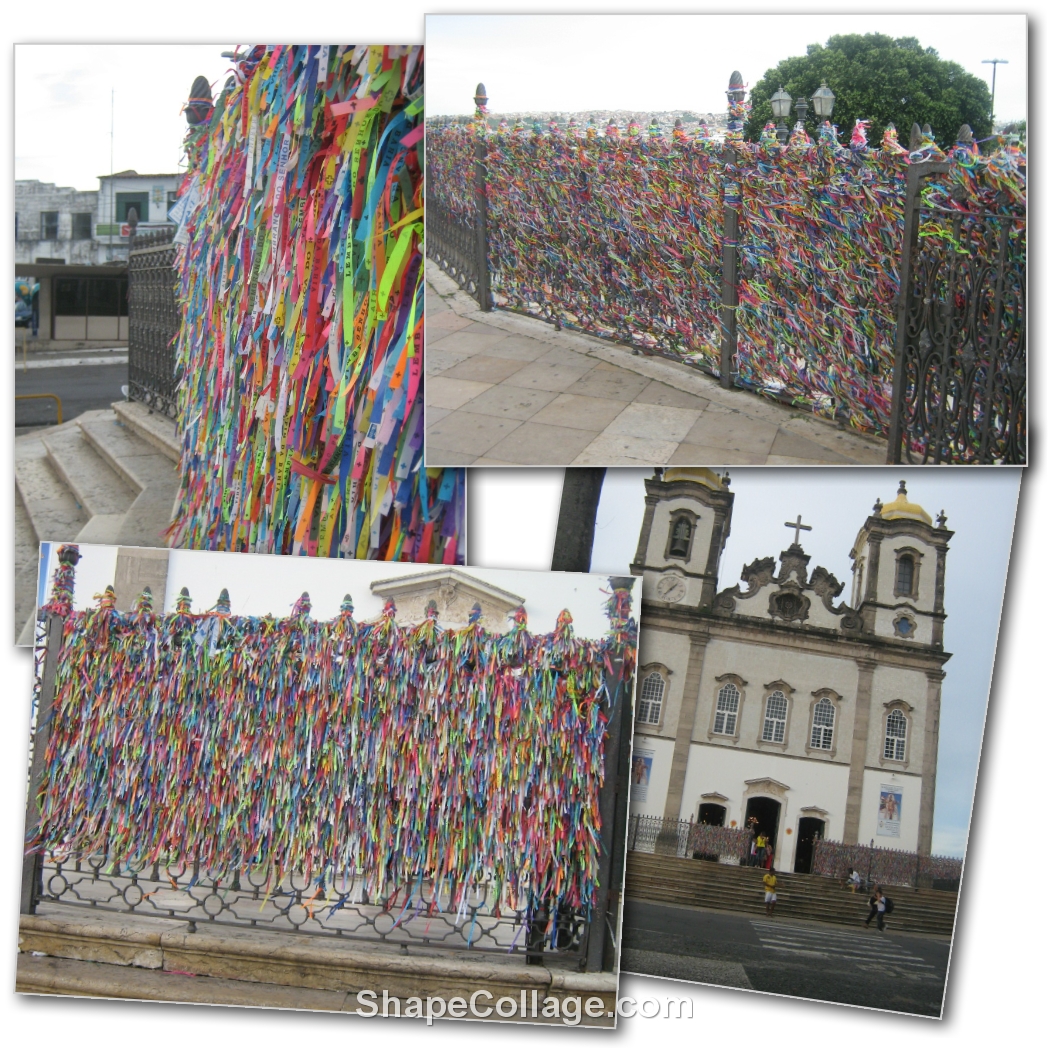
Just back from a two-week trip to Brazil, I’ll start with the first one of a series of posts. This one is about the last church we visited in Brazil: Igreja de Nosso Senhor do Bonfim (Our Lord of the Good End). This is the most famous church in Salvador de Bahia, therefore if you are interested in getting to know about its architecture, etc., you may check it on the Wikipedia.

When you approach the church the first thing that catches your attention are the thousands of little ribbons (fitas) of multitude colours attached to the entrance. Beforehand you have been offered those ribbons everywhere around the city. Prayers come to Bonfim and together with their prayer they take one of the little ribbons, and attach it to themselves (or the entrance, the benches or the candles in the church…) making three knots. Supposedly they are granted one wish for each of the knots, and they shall not remove the ribbon until the wishes come true.

Igreja de Nosso Senhor do Bonfim.

We all have seen youngsters wearing this kind of ribbons with the same wish-that-comes-true bond. Nevertheless, I find it curious that it is connected to the church. But on the other hand, two other examples that I found years ago come to my mind.

The first one is from a visit to Estonia in 2003. In the Alexander Nevsky Cathedral, in Tallinn, the church also provided people with a piece of paper where to write their wishes to later deposit the paper in a box (after due payment, of course). I may still have somewhere at home one of those papers… obviously having taken the paper with me nothing was wished so nothing could be proved about the effectiveness Alexander Nevsky. I accept a scientific reprimand.

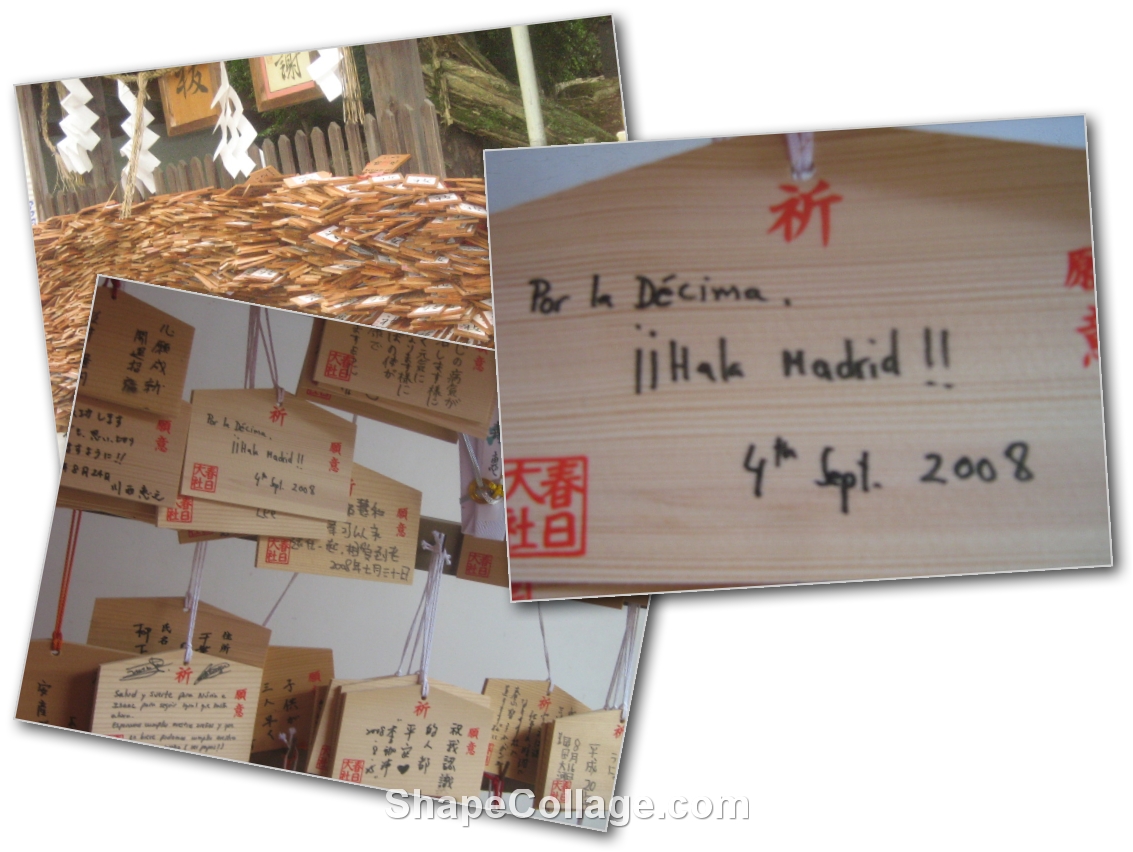
The other example is from Japan. There, close to Shinto shrines we can find Ema, or small wooden plaques where wishes are written upon and which are left hanging from special places destined to them. Again, you see thousands of them sometimes. I felt more scientifically obliged in 2008, so I used my chance to ask for only one wish; nothing personal, nothing related to love or richness (something that the genius of the lamp surely would have approved): I wished for Real Madrid to win the 2008/2009 Champion’s League… did I succeed? Well, that season Barcelona won the League, the Spanish Cup, Champion’s League, Spanish Super Cup, European Super Cup, and Club’s World Cup… not very effective.

Shinto wooden plaques, Japan.

The idea of asking for that wish started out as an exercise to prove the existence of God and at the same time checking to which confession He felt closer… but that is to be explained in another post.

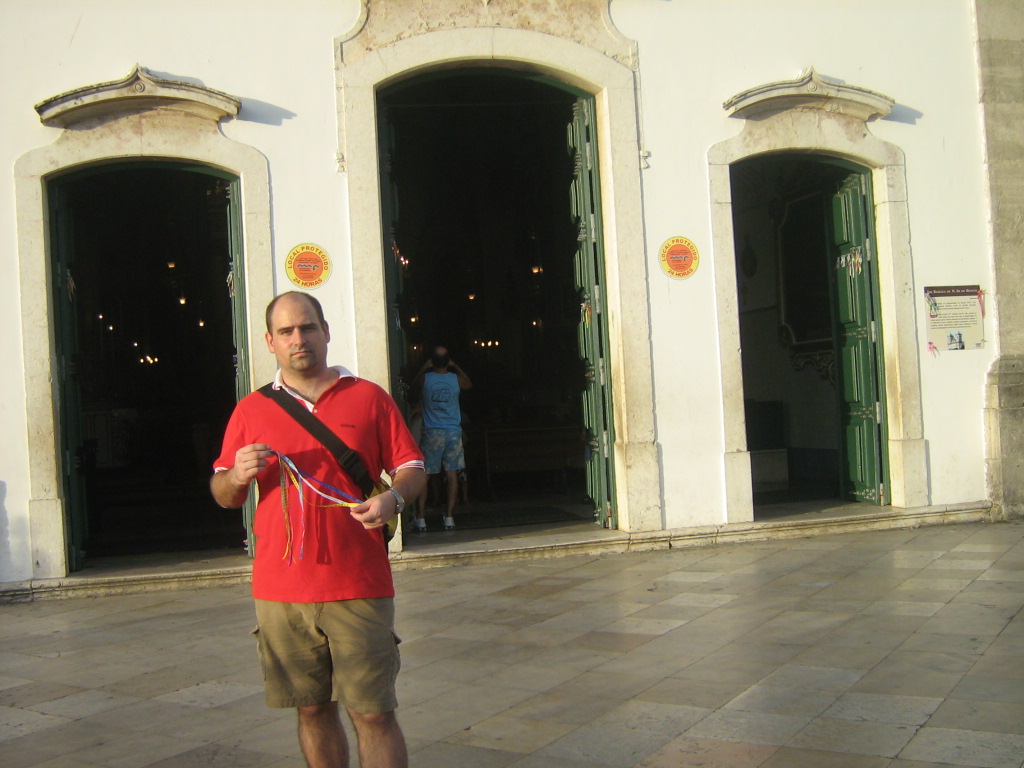
Going back to our business of today: Every superstitious person will argue that my wish in Japan didn’t come true solely because of making it public before it happened, but that is what all Japanese do! Once bitten, twice shy: this time I have been more cautious. I took my fita do Bonfim and attached it to the entrance iron wall and will keep silence about those wishes until they come true. Will they?

Me and fitas do Bonfim.

Well, I have a basis to think they will. Take a look at the pictures of the Room of the Miracles below. This is a room within the church where people who have seen their prayers’ effect leave a picture of themselves with a thank you note, a poem, an explanation of the miracle that occurred to them… and even wax or wooden replicas of different parts of the human body that were healed by Senhor do Bonfim… (this view is bizarre to say the least).

The Room of the Miracles.

Leave a comment

Filed under Travelling

“Caimaneando”

Last year Luca and I went to Peru on holidays. One of the places we visited was the Amazon basin, where we stayed some days in the rainforest in a ecotourism lodge (Posada Amazonas) close to the river Tambopata.  

There we spent two days walking around the jungle, watching different species of animals and plants, going out in the middle of the storm, sleeping in the open air… everything in a place without electricity, hot water, internet and some other Western amenities, 3 hours by boat away from Puerto Maldonado the nearest city.  

Boat trip through Amazon basin.


We really liked that experience and we look forward to repeat it.  

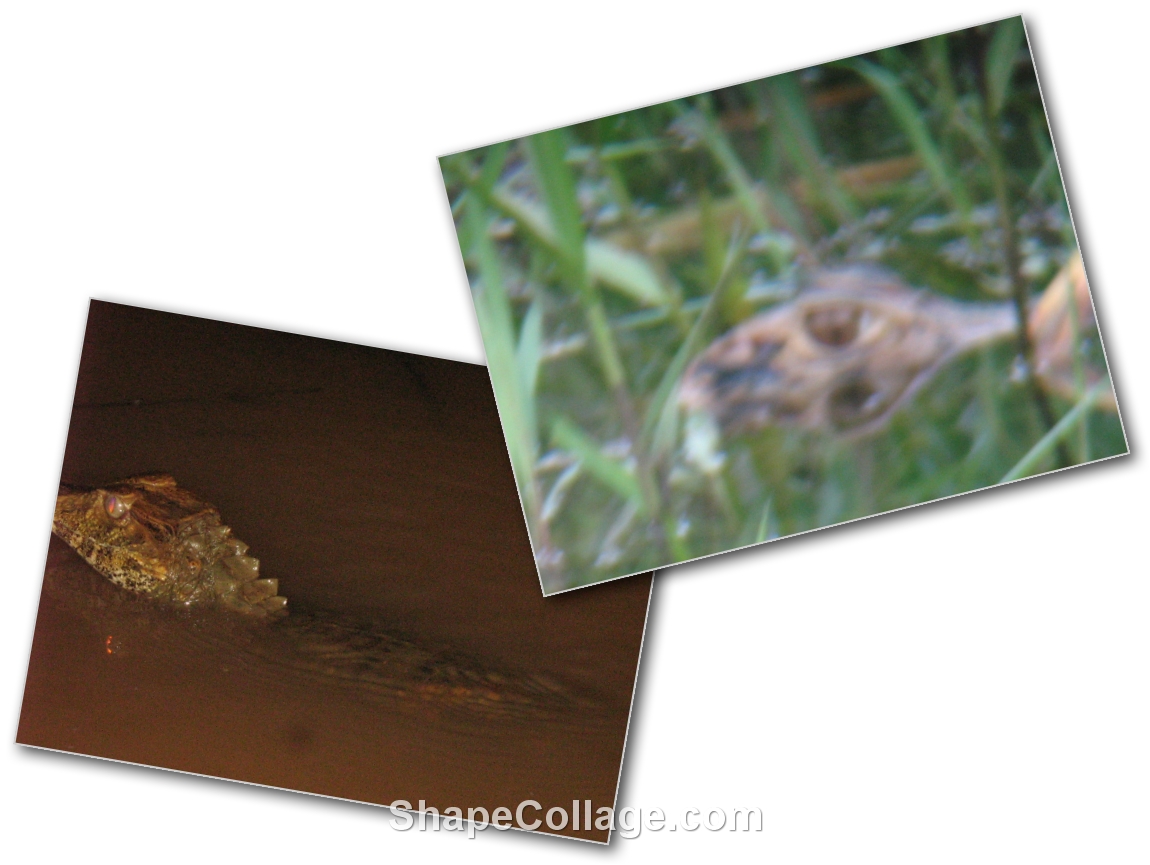
In this post I mainly wanted to share some pictures of two quite different activities we did there. Fishing for piranhas and navigating down the river “caimaneando” or silently looking for caimans…  

Fishing piranhas.


Caimaneando in Tambopata river.

3 Comments

Filed under Travelling

“Playas” in Lima

At the time this post is published, Luca and I will probably be in one the following praias (beaches in English, playas in Spanish) in Rio de Janeiro: Leblon, Ipanema or Copacabana…

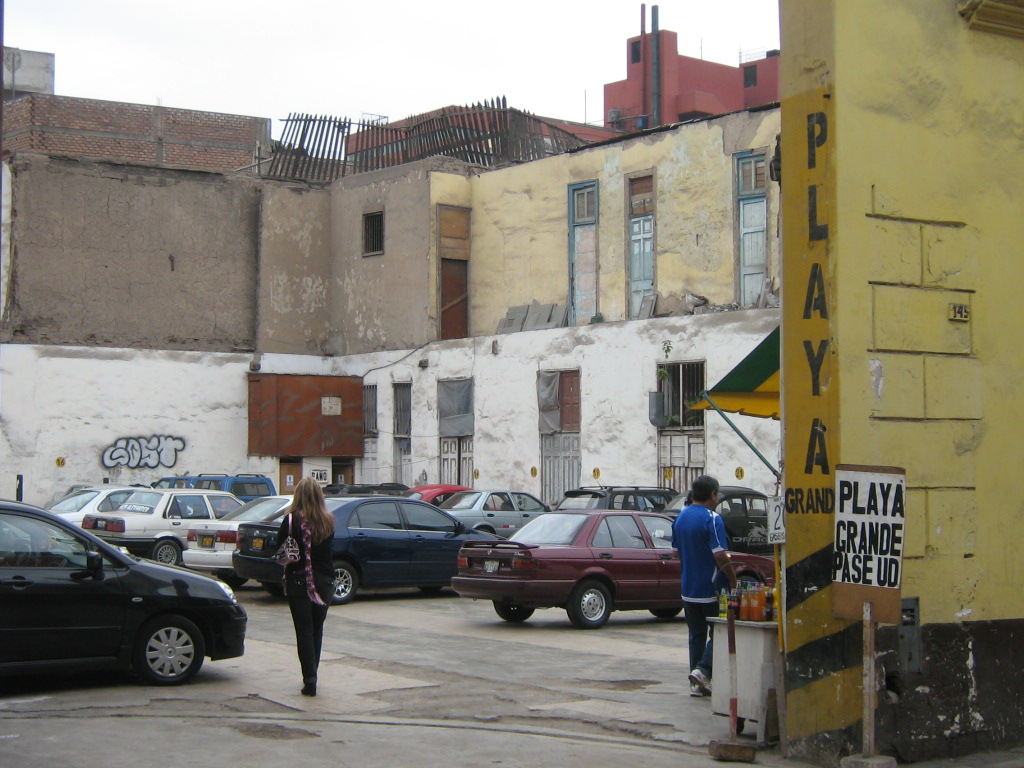
… let me share with you a picture of how playas looked like in Lima, Peru.

Playa grande, Lima.

3 Comments

Filed under Travelling

Paper birds in NY

I guess all of us have many vivid images from the terrorist attacks on 9-11 in New York and of the days after. I guess some of them are of the hundreds of candles and pictures of the missing ones. Images such as the ones below:      

Images from Ground Zero.


That fence in the picture is at Saint Paul’s Chapel, just across from where the World Trade Center once stood. That chapel was as well the place where many of the people working in the site in those days found relief.     

Last December, Luca and I went to New York, and this chapel was among the places we wanted to visit. It was a very moving experience. Let me focus on one thing I found inside. In the following picture you see strings of colourful folded paper birds inside the chapel…     

Paper birds in Saint Paul's Chapel.


I didn’t know I would find this, so it immediately rang a bell, as it was something I had learnt not so long before.     

Japanese call to the tradition of folding papers origami. There, the most famous design is that of the Japanese crane, a long-necked bird.     

The first time I saw such paper birds was in the Hiroshima Peace Memorial park, in the summer of 2008.    

Hiroshima Peace Memorial park paper cranes.


Let me paste here the explanation given by Wikipedia on the legend of these paper crane birds:    

Legend says that anyone who folds one thousand paper cranes will have their heart’s desire come true. The origami crane has become a symbol of peace because of this legend, and because of a young Japanese girl named Sadako Sasaki. Sadako was exposed to the radiation of the atomic bombing of Hiroshima as an infant, and it took its inevitable toll on her health. She was then a hibakusha — an atom bomb survivor. By the time she was twelve in 1955, she was dying of leukemia. Hearing the legend, she decided to fold one thousand origami cranes so that she could live. However, when she saw that the other children in her ward were dying, she realized that she would not survive and wished instead for world peace and an end to suffering.     

A popular version of the tale is that Sadako folded 644 cranes before she died; her classmates then continued folding cranes in honor of their friend. She was buried with a wreath of 1,000 cranes to honor her dream. While her effort could not extend her life, it moved her friends to make a granite statue of Sadako in the Hiroshima Peace Park: a young girl standing with her hand outstretched, a paper crane flying from her fingertips. Every year the statue is adorned with thousands of wreaths of a thousand origami cranes.     

The tale of Sadako has been dramatized in many books and movies. In one version, Sadako wrote a haiku that translates into English as:     

I shall write peace upon your wings, and you shall fly around the world so that children will no longer have to die this way.  

This is how the cranes flew from Hiroshima to New York; unfortunately peace hasn’t reached that far.

1 Comment

Filed under Travelling

A Kiva success story

Kiva’s mission is to connect people, through lending, for the sake of alleviating poverty.

A friend recently wrote in his blog a post about Kiva, therefore I will refer you to it for a deeper explanation of what Kiva is (in Spanish), or to Kiva’s website to know about it in English.

For those of you who like statistics and facts, these are the ones shown in the latest newsletter:

  • 53 months old
  • $124,156,585 raised
  • 98% repayment rate
  • 312,345 entrepreneurs funded
  • 681,527 Kiva users
  • 193 countries represented

Kiva’s slogan is: “Loans that change lives”. I wanted to write about how it changes both borrowers and lenders lives.

I believe that the two main “selling points” that Kiva has are:

  • The fact that you are lending money instead of donating it.
  • Being able to chose one specific project to which you want to loan money.

The fact that you are lending money instead of donating it. This aspect is positive again in a twofold way: you incentivize the borrower to use the money in building a sustainable business and when you get the money back, you can lend it again, and again, etc… therefore with the same amount of money you may help many different people.

The minimum amount you can lend in Kiva is 25$. It’s obvious that if you lend only 25$ you will have to wait until this loan is fully repaid before lending these 25$ to someone else. But, if you are lending to several people the picture changes.

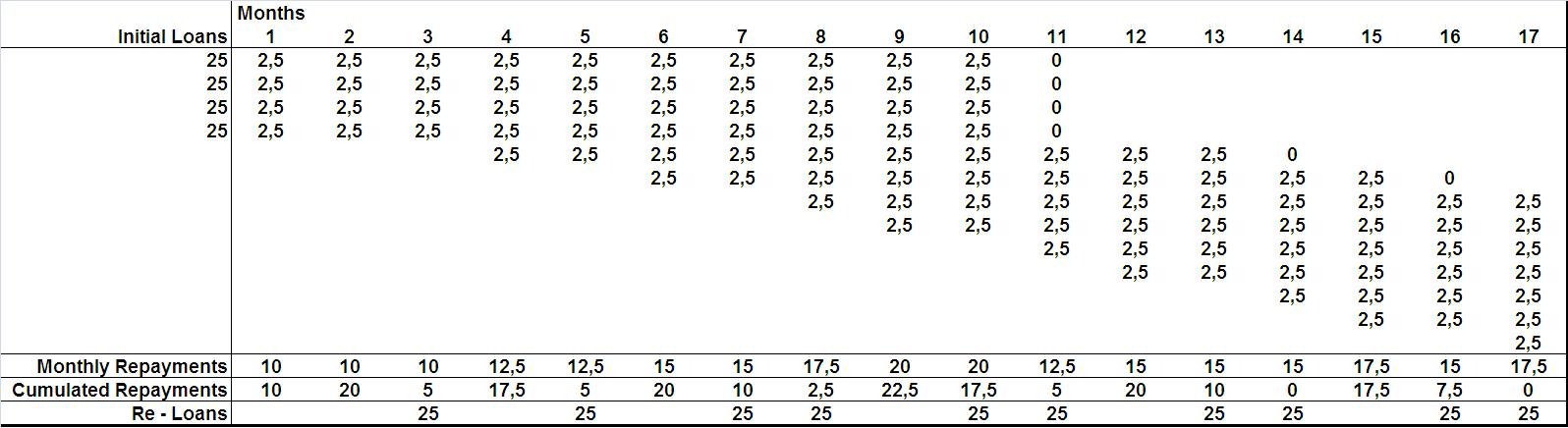
Let’s see an example in which you start lending 25$ to 4 different projects (e.g. handicraft in Peru, a food market in Tanzania, a grocery store in Viet Nam and a small restaurant in Nicaragua).

Let’s imagine that all four projects will repay their loans in 10 months, starting from the next month of the loan disbursal.

You can see in the graphic that since you are collecting 10$ in the first 3 months, in that third month you can already re-loan 25$; in the fifth month you will be able to re-loan other 25$… Before the end of the 10 months you’re already helping 8 different projects. From that moment on you will be always be supporting between 6 and 7 different projects at every time.

Loans repayment "money creation".

And believe me: it’s both entertaining and rewarding to read the stories of these people, trying to grasp how they’re trying to improve their business.

Being able to chose one specific project to which you want to loan money. We are attracted by this for whatever reason: we identify ourselves with the person, we find the business especially interesting, we think it’ll have a larger impact in the community… we “put a face” to the act of lending money.

Last year I went on holidays to Peru. Since I had funded some projects in Peru I thought it would be a good idea to learn from one of those business first hand and see how Kiva is making an impact.

Reynita de Belen de Ccorao is a community founded 7 years ago in the village of Ccorao, near Cusco. It is formed by more than ten people, each of them dedicated to a different business. Together they requested through Kiva 3,950$ to “purchase more supplies for their handiwork and to buy seeds and dry grains”. They would repay in the following 8 months.

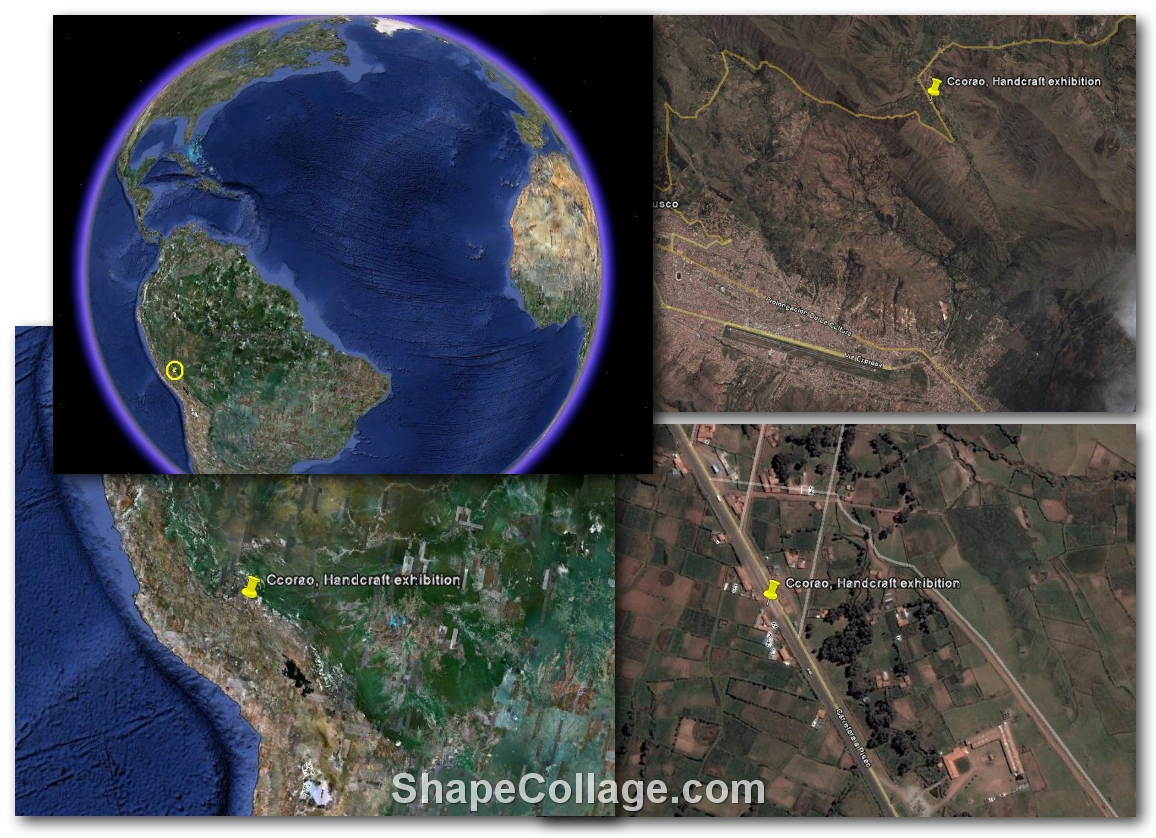
Once I was in Peru I was quite flexible about the plan of whether to visit or not this community, since I didn’t know where Ccorao was and also in the Kiva description another name was given  for the name of the village, “Corroa”, which didn’t appear in any map (it seems that Ccorao is a Quechua name, being Quechua mainly used in the Altiplano region).
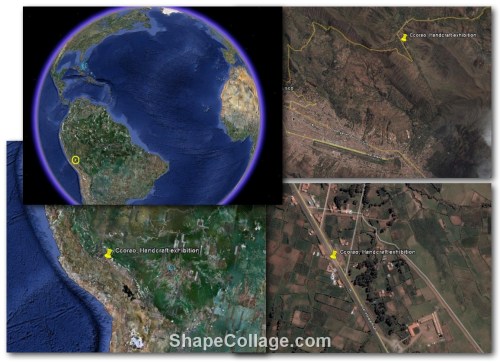
Ccorao in the World.

Luca and I were going to spend some days in Cusco and surroundings, with an intermediate escape to the Amazon Basin. During those days we wanted to visit the city of Cusco with a guided tour including the ruins of Sacsayhuaman, we would go to Machu Picchu, and make an excursion to the Sacred Valley ending in the fortress of Ollantaytambo, all these under continuous threats of transport strikes.

The day of the Sacred Valley excursion, on the way to Pisac we passed through a village with a sign post that read “Ccorao”; that immediately rang a bell and I told Luca: “This is the place”. That day in the afternoon I went to an internet cafe to check the names of the people that we would look for the next day.

The plan was simple: we had 3 hours in the morning before taking the flight back to Lima, we would use them. The following morning we took a taxi and went back to Ccorao, and with the help of the taxi driver we tried to find that group. Of course, the taxi driver had never heard of it.

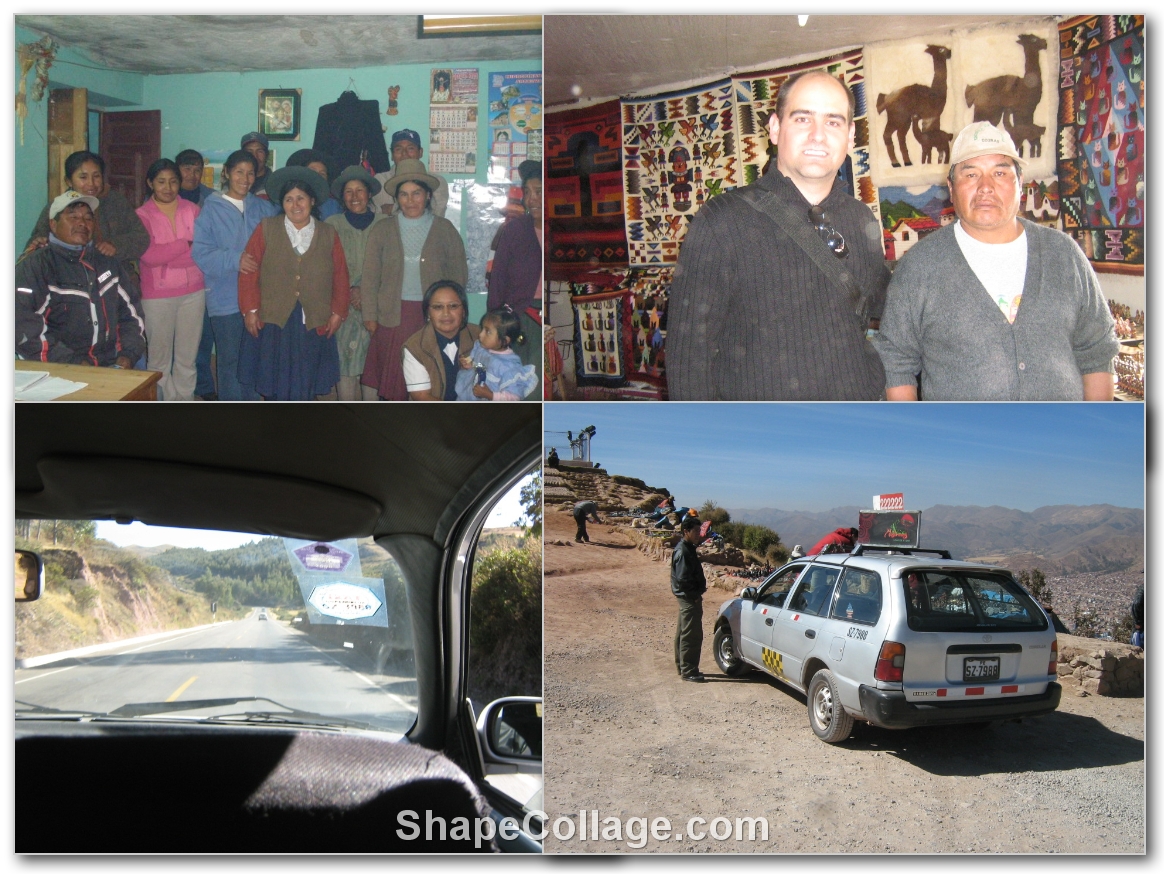
I tend to be lucky: although the first stop we made wasn’t successful, in the second one we completely hit the target. We reached Mariano Choque Raya, “Mariano”. We introduced ourselves as what we were: a couple of tourists that had lended money to a group through Kiva. Mariano had never heard of Kiva, or if he had he didn’t recall the name, but he knew very well Arariwa, the field partner Kiva works with in that region. He not only had taken loans from Arariwa but had received certain financial education from it.
Reynita de Belen, Mariano and our way to Ccorao.

The group had taken several loans from Arariwa and from other lending institutions. This particular loan was fully repaid in November 2009.

He showed us their handicraft exhibition and went on explaining how they had grown their business. The first loans he used were employed in buying grain and feeding cuys (guinea pigs) that he would grow to later sell them to restaurants in Cusco. Then, as tourism grew, they focused on the handicraft business and he advanced in the value chain of the cuy business: he continued to grow them but instead of selling them he started running an eatery post that opened only during the weekends and there he would cook and serve his cuys, retaining more margin for himself.

With time, more and more buses filled with tourists were stopping in Ccorao in their way to Pisac. Other groups started their handicraft exhibitions along the road, so competition became fiercer (though be sure that the items we purchased came from his shop).

Thanks to Mariano’s entrepreneurship and skills, and partially to the loans offered to him, as he said: now, his children are attending to school, something his generation couldn’t afford to, and he is able to save some money for his retirement as he won’t have any pension when that moment comes.

Kiva: loans that change lives.
13 Comments

Filed under Helping others, Investing, Travelling

A ‘Gol’ to Ryanair

Luca and I are planning a trip to Brazil at the end of March. Two days ago I received an email from Gol, the airline which will take us to 4 different places in six different flights. They informed us that one of our flights had been re-scheduled. We just needed to accept the change by clicking to a link in that email. So far it was like the process with other airlines.

The problem was that with the new flight we would be arriving to Sao Paulo Congonhas airport 5 hours later than the departure of another flight we had booked also with Gol. I had previously introduced some changes of flight dates once booked in the Gol website, so I just went on.

This time I encountered a problem. At some moment in the process the website switched from English to Portuguese, which was not a problem until the payment page, where I was asked to introduce my CPF, a fiscal code that I don’t have since I’m not a resident in Brazil. Then I tried to proceed with the payment through other method… but that also didn’t work. When I tried to perform again the whole process, I found that the current status of my flight was the new one but appeared a ‘Payment: pending’ status. Nothing else that I could do. No way to proceed, to cancel or to change again the flight data. A kind of dead-end situation.

I wrote an email to Gol customer services about this situation. Late in the afternoon I phoned their Call Center in Brazil. I was explaining the whole situation to a lady… ‘and now I would like to know how can I proceed to pay this remaining amount (20R$, about 8€)’. She paused for less than one second… ‘ok, I’ll proceed to cancel this extra payment of 20R$, so you don’t have to pay more, confirm the new flight, and send you emails of confirmation of the two last changes of flights, the one that originated the issue and this new one’. I could only muster an ‘oh, that would be ok’. One minute later everything was arranged and I had already received those emails. One hour later I got a reply from customer services to my email of the morning: they had gone through my records and seen that everything was correct now and would archive they case.

Let me show you the ‘Terms and Conditions’ of Ryanair related to Flight and name changes:

Flight dates, times and routes are changeable (subject to seat availability). If booked online the change rate of £25/€25 per one way flight/per person applies or if booked at an airport or reservation centre the rate of £55/€55 per one way flight /per person applies. In addition, to these flight change fees, any price difference between the original total price paid and the lowest total price available at the time of the flight change is charged. Please note that if the total price on the new flight is lower, no refund will be made.

One may argue: Ryanair model is based on charging little money on the original flight and adding up revenues with other services, changes, penalties, etc… The Gol flight I was changing cost: 119R$ per person, about 45€, as little as a flight with Ryanair may cost. Gol doesn’t charge anything for changes made with at least 7 days in advanced of the flight (see above what Ryanair does). The 20R$ related simply to the different fare of the new flight…

It is not about money or the abusive clauses of Ryanair that I wanted to write about but I wanted to point the difference that makes having people trained, empowered and customer-oriented in Call Centers.

1 Comment

Filed under Marketing, Travelling

A Tale of Two Cities…

I’ve just finished reading the book “Hidden Madrid. A walking guide”, by Mark & Peter Besas, two Madrileños originally from New York. The book is terrific. It has hundreds of tales, anecdotes, curiosities, pictures, etc… of the city of Madrid:

  • The origin of futbolin.
  • The suicide mission of Eloy Gonzalo at Cascorro.
  • The voices of Palacio de Linares (Casa de America).
  • The origin of Atocha.
  • The miracles of San Isidro.
  • The priviledges of Paco the dog…

Last month I read a similar book about New York, written by another New Yorker (this one originally from Ohio), John Keatts, “Tales of New York: Some Will Surprise You”.

We met John at the Circle Line boat tour around the island of Manhattan last December. He was our guide. He not only had a very pleasant voice but kept telling more and more facts, stories and anecdotes about the city and the persons who marked the history of NY during the 3-hour journey.

He mentioned that he had written a book with these stories and when we were leaving the boat, my partner Luca saw him handing his book to someone, so we decided to stop and buy it. Another terrific book. As he puts it in his web:

  • A poor farm boy who began a simple ferry boat service, and became a millionaire
  • A renowned bridge-builder whose work on a statue would change his life
  • A newspaper man who seized an opportunity
  • A man whose building forced our skyline upward…

And yet a month before I read “How to survive Holland”, by Martijn de Rooi. Another wonderful book explaining many facts (traditions, food, history, sightseeing, sports…) about the Netherlands delivered with some self-deprecating humour and irony.

All three books are strongly recommended.

1 Comment

Filed under Books, Travelling