Tag Archives: running

Boulevards de Colomiers 2014

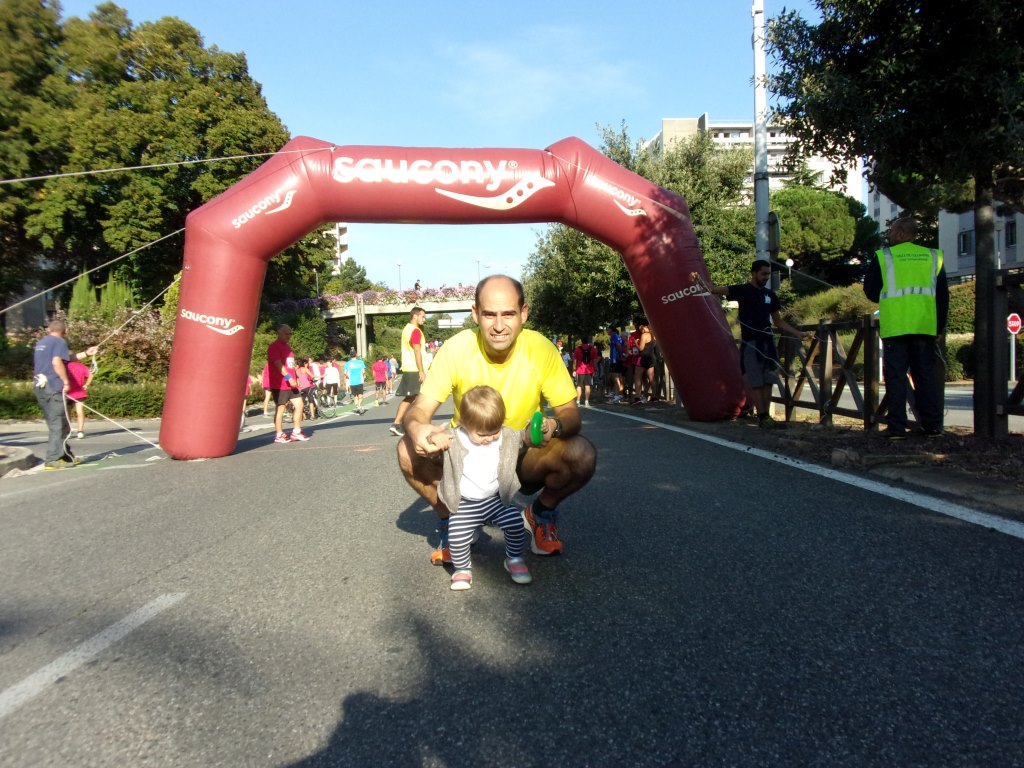
The race “Boulevards de Colomiers” (10km) is a classic of the return from summer holiday session in Toulouse area. This is the 3rd time I have run it. Last year I already wrote a post about it. I then broke the barrier of 45 minutes for the first time and made a personal best. I have since broken the “barrier” twice, setting new PBs.

This time I came to it with more or less the same preparation as last year, as I am following the same training plan, but I have not softened the training schedule to accommodate the race and thus I knew my legs would feel rather heavy.

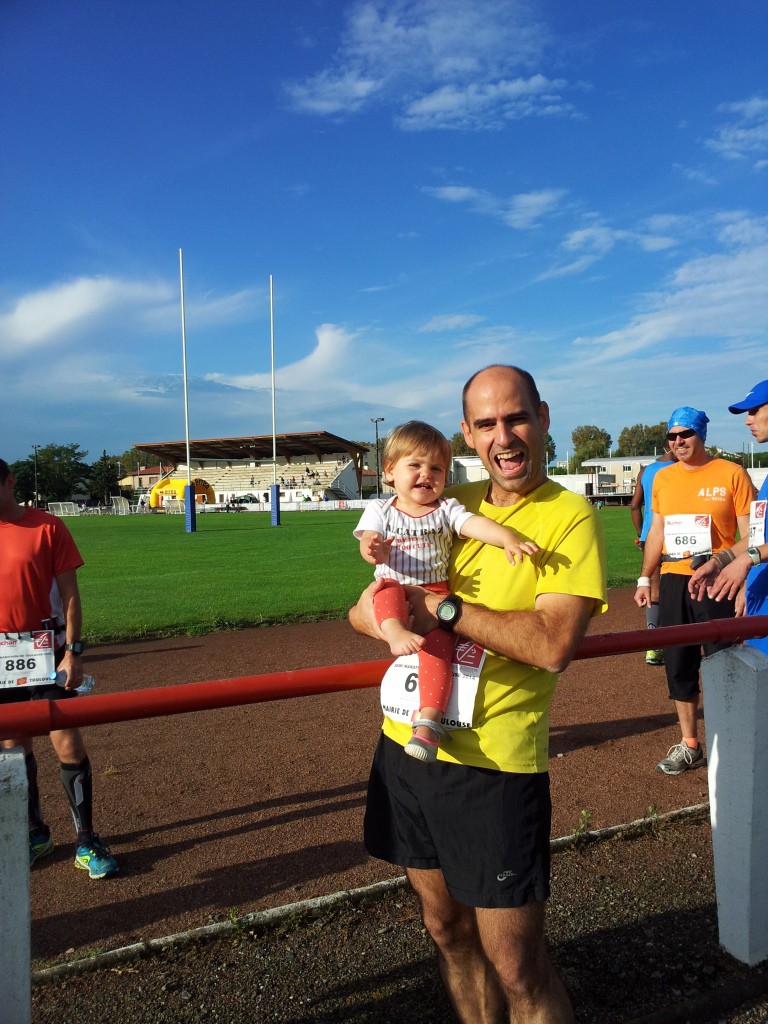
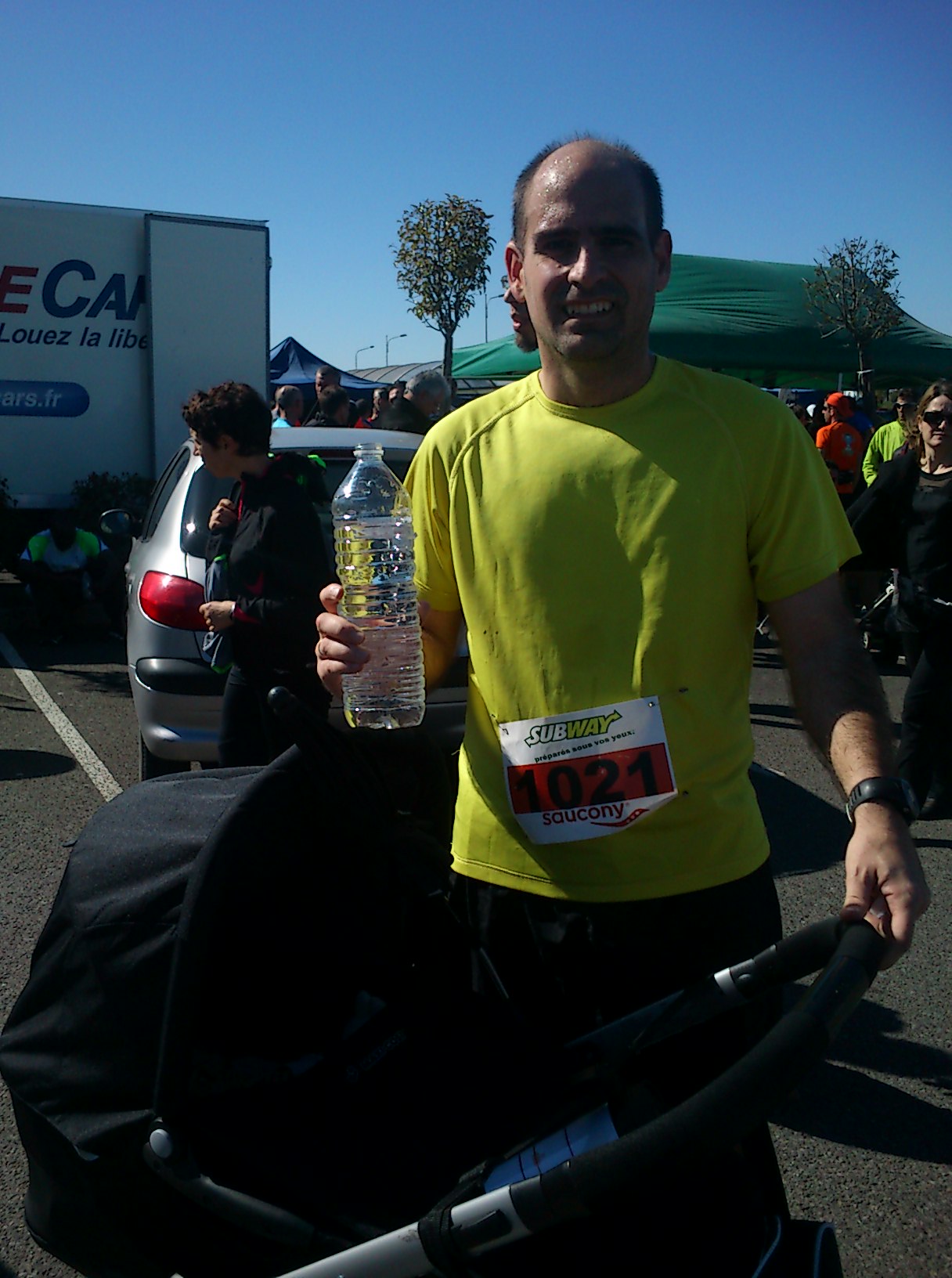
Classic picture with Andrea before the race.

Classic picture with Andrea before the race.

I started ahead of the 45′ pacer but was caught by him around the 5th km. I then let him go away some metres, as I was not feeling my best due to the heat. In the last kilometre I catched him again and took some lead in the last 400m, being able to finish just below 45′ of net time, 44:49 as per my Garmin, about 20″ slower than last year despite the heavy legs (45:02 official gross time).

I quite happy with th result, being the 4th 10k race in a row under 45′.

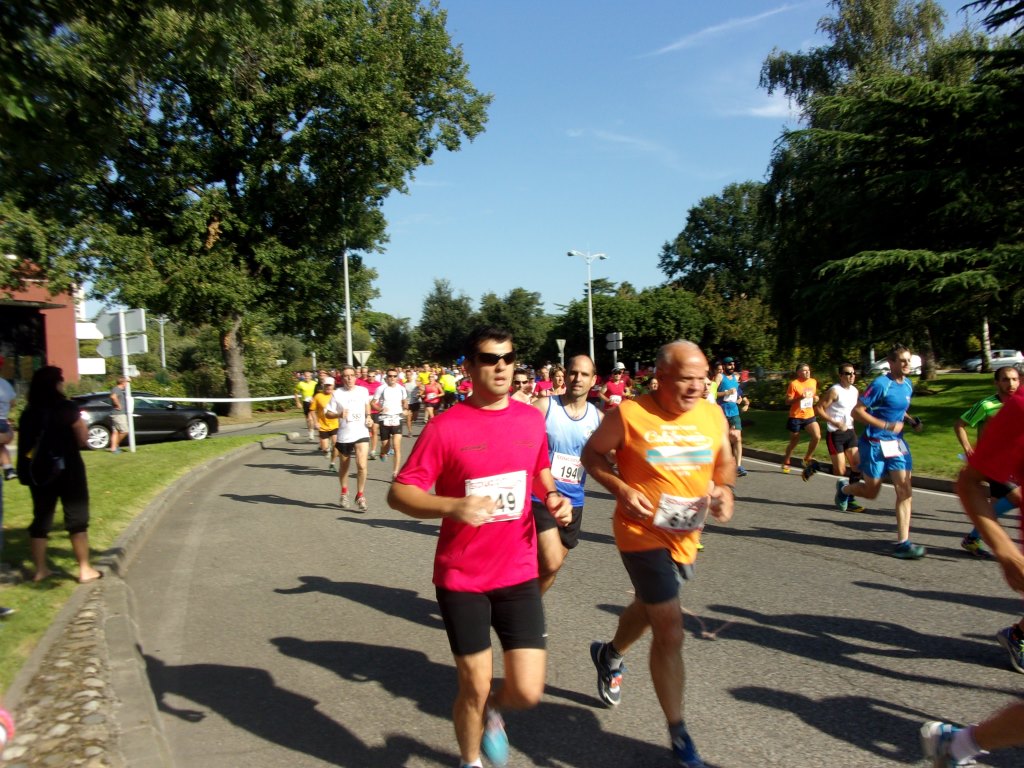
Running the first km.

Running the first km.

2 Comments

Filed under Sports

My Ice Bucket Challenge for ALS

A couple of days ago, a friend, Alvaro, nominated me for the famous Ice Bucket Challenge for ALS (or ELA in Spanish). In this post I wanted to share the following video [in Spanish] with my subsequent challenge:

In summary,

  1. I contributed to the cause by making a donation to the Spanish foundation FUNDELA (Fundación Española para el Fomento de la Investigación de la Esclerosis Lateral Amiotrófica),
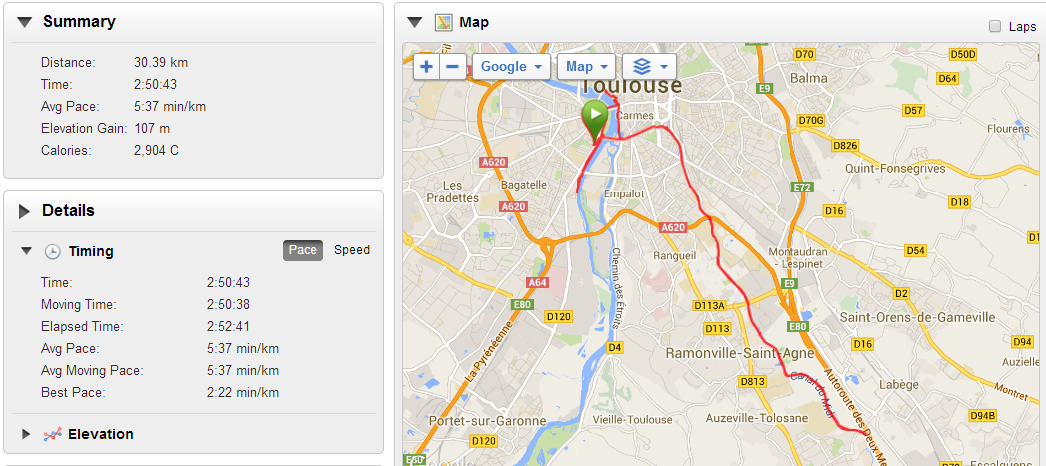
  2. I then dedicated my 30-kilometre running training session of today to the cause,
  3. After the training, I poured the so-called ice bucket, and
  4. I nominated my marathon buddies to complete the challenge, Jose Serna, my brother Jaime, Manu Vidal and Juan Hurtado.

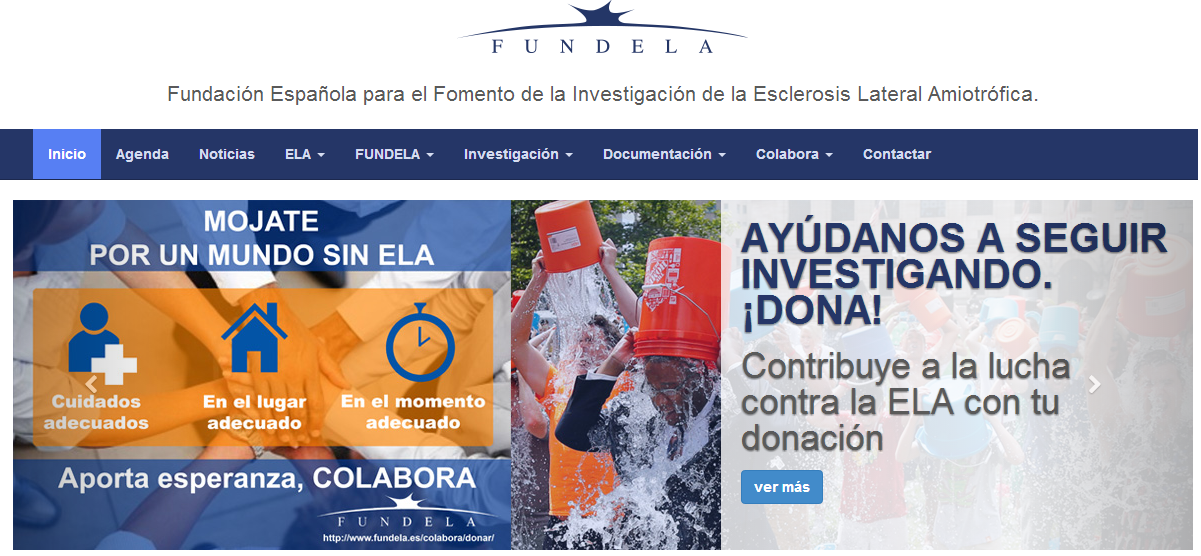
See the below the home site of FUNDELA, as you can see making a contribution is going to take you no more than 1 mouse click:

FUNDELA foundation website.

FUNDELA foundation website.

See below the data recorded by my Garmin GPS-watch of the running training session I dedicated to the cause:

My 30km Ice Bucket Challenge run.

My 30km Ice Bucket Challenge run.

NOTE: If you feel already in the mood of contributing to charities, NGOs, etc., please, check out this other blog post with the other organizations that I am supporting in this year 2014.

2 Comments

Filed under Helping others

Rotterdam marathon

Last Sunday 13th April, I completed Rotterdam marathon together with JaimeSerna and Manuel. In a race preview post I wrote that I arrived to this marathon a bit short of training, having completed just about 2/3 of the training plan. In the weeks prior to the race I had asked my brother what pace he intended to start with. Having in mind the lack of thorough training, I thought of starting at a pace slightly below 5’20” per km but not below 5′. That rhythm, if sustained through the end, would allow a new personal best (at that point 3h45’35”, achieved in Paris, April 2012).

Jaime and I started the race together, departing from the box “E”. We ran together 15 kilometres, pacing each other, ensuring we would not run too fast or too slow. At km. 15 Jaime said he wanted to soften the pace a little and since then I ran alone. My intention up to then was just to try to sustain low 5’s until km. 25, just before the climb of the Erasmus bridge back to the city centre. I thought that climb would take its toll and wanted to arrive to it with some time cushion, climb it relaxed and see if after it I could go back to a similar pace.

Just when we crossed the bridge I saw that I had not slowed down but the pace was still at 5 minutes per km. This encouraged me. I took the second energetic gel bag and ate it (I consumed the first one at km. 15) and told to myself “let’s try to run a few more kilometres at 5′, one at a time”.

… and those were the best 10 kilometres of my race, from 25 to 35, where I employed less than 50′ and enjoyed it a lot. I was overtaking runners, very focused on my own pace, breathing correctly, drinking at every supply post, eating another energy gel bar at km. 33, refreshing myself with sponges…

Rotterdam marathon: pace (min / km) evolution.

Rotterdam marathon: pace (min / km) evolution.

Running at km. 40.

Running at km. 40.

At some point, seeing that I was maintaining paces of 5′ and that I had only a cumulative 1’30” over the time for 3h30′, I thought that would be possible. However, at km. 36 I started feeling stiffer. The running was less smooth. Nevertheless, I told again to myself “let’s try to clock kilometres at about 5’20” “, and so I did with the exception of km. 41, but offset with 42. The last 500 metres I sprinted to try to clock a time under 3h35′, which I did: 3h34’52”, a new personal best time in marathon.

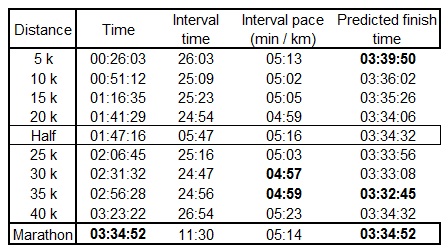
Rotterdam marathon 5k splits, paces and predicted finish times.

Rotterdam marathon 5k splits, paces and predicted finish times.

Finish photo.

Finish photo.

From the marathons I have completed in these last 3 years, Rotterdam marathon does not have the best scenery (Rome, Paris), nor is the flattest (Berlin), or the one with the best start (Rome) or finish (Athens, Berlin)… but it has been in Rotterdam where I have enjoyed the most running, where I have had the best feelings and the best race management.

One take away for me of this marathon is something which I had read often: don’t give all out from start, keep something for the second half. After the race, I have made the numbers and the comparison: Rotterdam and Paris (my previous PB) have been the slowest 2 marathons till the half marathon.

Comparison of splits in the last 6 marathons.

Comparison of splits in the last 6 marathons.

Finish photo: 11th marathon.

Finish photo: 11th marathon.

In Rotterdam, the starting at pace above 5′ was not intended in order to keep faster paces for the second half. I wish I had had such confidence and good strategy from the outset. No, we started at those paces in order to see if we could be between 3h40′ and 3h45′. But I take the lesson for the future, for the 12th marathon…

Rotterdam marathon diploma.

Rotterdam marathon diploma.

5 Comments

Filed under Sports

Running and support items

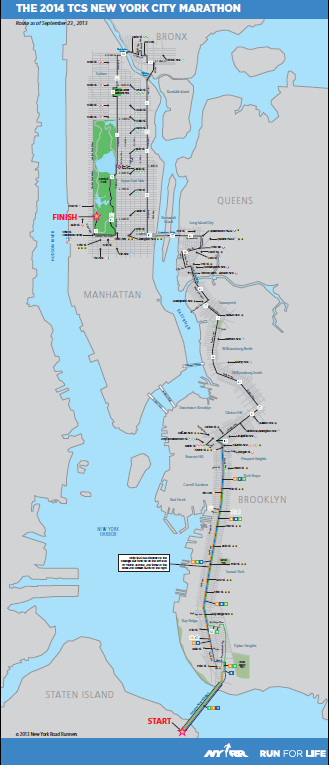
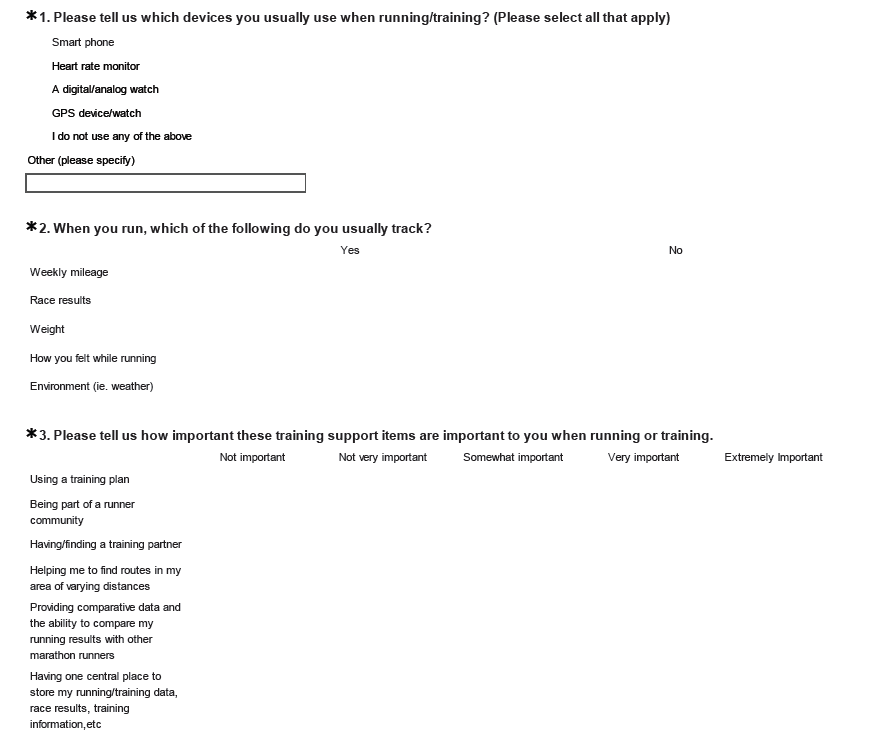
Few days ago I completed a survey from one of the sponsors of the 2014 New York Marathon, which I will run on November 2nd. I found the survey interesting and positive as it made me reflect on some topics which I would possibly would not have deemed very important to running. See some of the questions below and reflect on them in relation to your running habits.

NY Marathon survey questions.

NY Marathon survey questions.

Which devices do I usually use when running/training? The fact is that I always use a digital watch with GPS and often a heart monitor. No smart phone or iPod. What is more, if I am not wearing the GPS/watch it feels as if I had not run…

When you run, which of the following do you usually track? Mileage, results, weight… plus series times, average training paces, hear rates…

How important these training support items are important to me when running or training?

  • Using a training plan: Extremely important. Very often is essential to find the courage to go out and run, especially when the weather conditions are not the best. It is also very important to push yourself, go for the last series repeat, etc.
  • Being part of a runner community: I initially thought this was not very important. False. It is. Being able to discuss with friends how you are evolving, how you felt at races, taking part together in races, etc., also makes it much better.
  • Having/finding a training partner: I also thought that this was not important as most of the time I run alone. Nevertheless, when I have the opportunity to run in Toulouse, Madrid or wherever in Spain with my marathon pals and other friends it makes it so much better.
  • Helping me to find routes in my area of varying distances: Very important. When you have lots of distances already measured, it reduces the thought process of deciding where to go and reduces uncertainty.
  • Providing comparative data and the ability to compare my running results with other marathon runners: the comparison with other runners is not so important to me, but being able to compare my runs with previous ones to sense how I am evolving it is very important.
  • Having one central place to store my running/training data, race results, training information, etc.: again, extremely important.

What about you?

Leave a comment

Filed under Sports

Rotterdam Marathon preview

Next Sunday, April 13th, I will take part in the Rotterdam Marathon together with the usual suspects (Jaime, Serna and Manuel). I am arriving to this marathon a bit short of training as I already reflected at the time of running Blagnac’s half marathon about a month ago. I may have completed just about 2/3 of the training plan I followed, having run just about 500km in the 16 weeks preceding the marathon. Thus, in this preview instead of talking about how I arrive to it I wanted to focus on the front of the race.

Rotterdam marathon is one of the fastest marathons in the world nowadays. On top of that, I learnt a few weeks ago that Kenyan athlete Eliud Kipchoge will take part in it. Kipchoge has today the 7th best time (1) in the distance (2h4’5″), achieved in only his second attempt at a marathon, in Berlin on the 29th of September 2013, when Wilson Kipsang beat the World Record (2h3’23”). I then wondered whether on Sunday a new world record could be set.

To be clear, setting up an athletics record is not an easy feat. Especially not in a marathon. But taking that question as a departure point I deep dived a bit into the data in order to learn more about the race.

The last time the marathon WR record was set in Rotterdam was in 1988 (26 years ago), when Belayneh Densamo left it at 2:06:50. Since then the WR has been beaten 8 times; once in Chicago, once in London and 6 times in Berlin, among them the last 5 times (see here the progression). Thus, we could confidently say that Berlin is the fastest marathon nowadays.

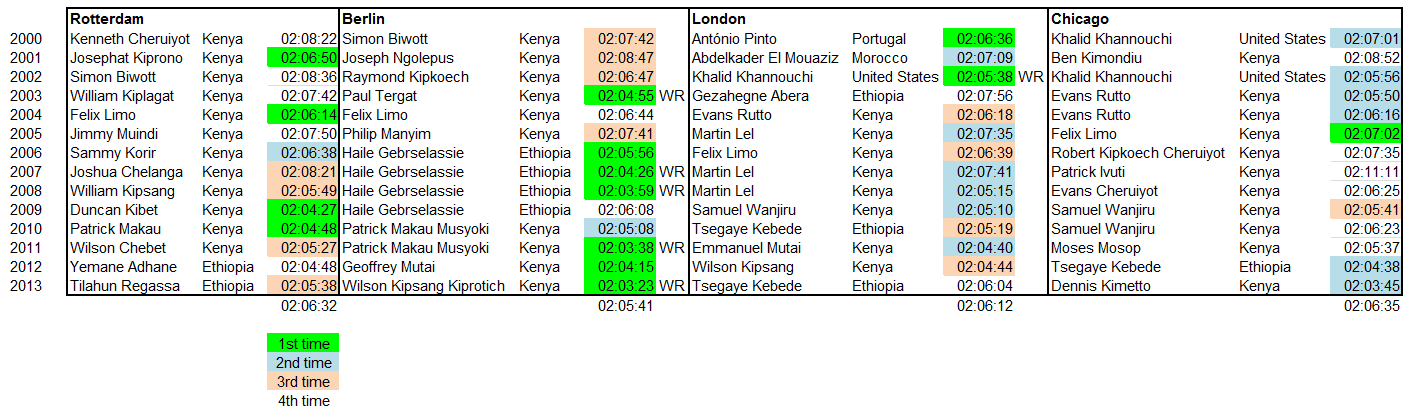
I then made a comparison of those 4 fast marathons over the last 14 years (since 2000), to see which one was the fastest race each of those years. See the results in the table below:

World fastest marathons (2000-2014).

World fastest marathons (2000-2014).

In the table you may see that out of the 14 years Berlin was the fastest of the 4 marathons in 7 (50%), however Rotterdam was the fastest marathon in 4 of those years (with a best time of 2h4’27”). By average winning times it would came 3rd (with a 2h6’32”) just after Berlin and London.

A curiosity, only twice in the past 14 years has the same runner won both Rotterdam and Berlin marathons in the same natural year: Felix Limo (2004) and Patrick Makau (2010) (2), both times each runner made a faster time in Rotterdam.

My train of thought then suggested: you are only paying attention to the winners’ times, you should compare more times to sense the profile of the race. I then found the following terrific website with all time best performances in track and field (maintained by Peter Larsson). With that database the analysis was rather simple.

I focused on the top 100 all-time marathon best times, of those:

  1. Berlin: 15 of the 100 all-time best times were achieved in Berlin, with a top 5 average time of 2h3’53” and a top 10 average of 2h4’18”.
  2. Chicago: 13/100; 2h4’29” (top 5); 2h5’4″ (top 10).
  3. Dubai: 18/100; 2h4’39” (top 5); 2h4’46” (top 10).
  4. Rotterdam: 14/100; 2h4’40” (top 5); 2h5’54” (top 10).
  5. London: 14/100; 2h5’02” (top 5); 2h5’15” (top 10).

Taking into account the top 100 times, Rotterdam marathon falls to the 4th place, seeing the irruption of Dubai as one of the top marathons, with all those times achieved in the last 6 years (run since 2000).

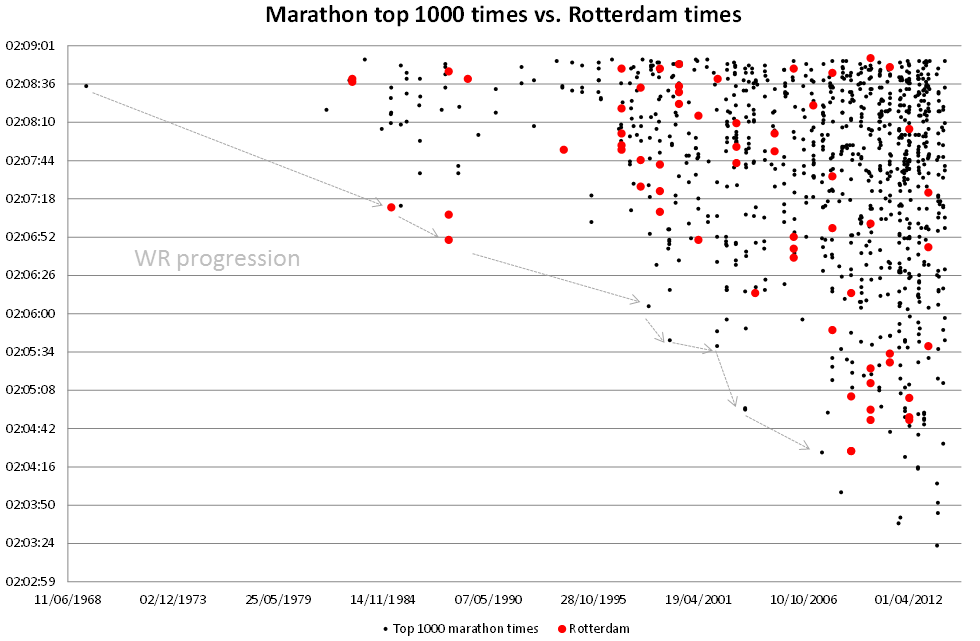
I then went a further step and made the following graph taking into account the top 1,000 times achieved in the last 45 years and highlighted in red those achieved in Rotterdam:

Marathon top 1000 times vs. those achieved in Rotterdam.

Marathon top 1000 times vs. those achieved in Rotterdam.

With those top 1,000 times, I then went back to compare the head to head of Rotterdam vs. Berlin, this time not only comparing winners times as above (Limo and Makau) but all those runners who run consecutively Rotterdam and Berlin, and checked in which race did they achieve the fastest of the 2 (or 3) times. See the results:

Runners among top 1,000 marathon times having run consecutively in Rotterdam and Berlin.

Runners among top 1,000 marathon times having run consecutively in Rotterdam and Berlin.

Of the top 1,000 marathon times, 16 runners achieved some of then running consecutively in Rotterdam and Berlin (or viceversa) (3). I made this comparison assuming that they must have been in a similar fitness (though not necessary). Of the 16, 9 of them achieved the better time in Rotterdam, 7 in Berlin. Among those times, the best 4 were achieved in Rotterdam (James Kipsang Kwambai, Patrick Makau, Geoffrey Mutai, Abel Kirui).

Then, having seen all these times, tables and graphics:

  • In the last 16 years the marathon WR has been beaten once every second year (8 times).
  • Rotterdam is arguably between the 2nd and the 4th fastest marathon.
  • However, the best time in Rotterdam (2h4’27”, Duncan Kipkemboi in 2009) is only the 14th best time overall.
  • Kipchoge PB is among the top 7 times after only his 2nd attempt at the distance.
  • Kipchoge ran in Berlin in September 2013 (2h4’5″), chances are that he beats that time running consecutively in Rotterdam in 2014.

Given the size of the feat I would not bet much on it, but I would not discard it either. Either way, I will only discover what happened about 2 hours after the race, at the front, has finished.

In case you feel like cheering me up and feel sorry for being thousands of kilometers away, don’t worry: click on this link and you will arrive at a website provided by the organization in which you can leave either one or two support messages that will be shown to me when I run by the kilometer 37 or I am just 500m from the finish line (my bib number for this race will be 1599).

Finally, find a classic picture from my brother (and marathon pal) Jaime symbolizing this marathon:

(1) Excluding times from Boston and other races not qualifying for IAAF world records.

(2) A year later, in 2011, Patrick Makau set a new WR in Berlin, 2h3’38”.

(3) Felix Limo, Geoffrey Kipsang and Jackson Koech run 3 consecutive races in a row each.

5 Comments

Filed under Sports

Blagnac half marathon 2014

After 2 months without competing, I took part today in Blagnac’s half or semi marathon.

In this 2014, I am finding it hard to find the necessary consistency with the training. I go from fulfilling a week of training to just run 2 or 3 days the following week. It’s an issue of motivation, engagements and fatigue. That is why, today, I had not in mind pursuing any personal best time in the distance (1h37’29”). I rather checked beforehand the paces needed to achieve 1h40′ and 1h45′ and I targeted at the start line for 1h40′.

The day was sunny and windy. But it was way to sunny and hot, and a bit too windy for some of the long straight streets. Nevertheless, Blagnac’s half is completely flat. Thus, the main issue today was the lack of fitness.

I started with 2 kilometres at about 4’30” and then adapted the pace to try to continue at about 4’45” in order to be under 1h40′. However, in the second half of the race I felt that I wasn’t going to make it. It was hard for me to keep the pace.  Thus, I just tried to maintain a rhythm which was not painful and at the same time would permit to clock a time below 1h45′ and so I did. That is the good thing of having a plan B, or making it (making up the numbers in your head) on the fly (or rather run).

In the end, I finished in 1h44’19” net time as recorded by my Garmin. Definitely not the best half I have done (I haven’t done so many). I take it as a training and a test for Rotterdam Marathon, in about a month (April 13th). I will need to get more serious in the remaining weeks of training prior to that date if I don’t want that marathon to be a nightmare.

After finishing Blagnac's half marathon.

After finishing Blagnac’s half marathon.

1 Comment

Filed under Sports

San Silvestre 2013

Yet another year running on New Year’s Eve the popular San Silvestre Vallecana.

This year we had some newcomers to the community: Maicol, Alicia, Almudena and Ubaldo with friends (1) and Nacho managed to run again.

Jaime was running his 15th San Silvestre in a row. Impressive!

This race is a tradition that can hardly be matched (2), that is one of the reasons why I try to spend every year New Year’s Eve in Madrid. Again, we had talked a bit about dressing some costume or preparing something for the race but we did not.

This year my second half of the race was less fun than other years. Just after the kilometre 3 I let myself lag behind our main group to join two of our runners to talk a bit. At the km 4.5, not seeing the rest of the group, I decided to go ahead again in pursuit of them. After some 2-3 kilometres running a bit faster (~5’05″/km) than we normally do in this race (~6’30″/km) I realized that I had overtaken them without seeing them. What do I do now? Wait for them? Run softly till the end? Finally, I tried to run moderately fast when the crowd permitted (very difficult in the last 2 km).

I crossed the finish line alone, something which I think had not happened to me in over 10 years… and hopefully the last time.

Final time: ~1h00’51” (best time I have managed in ages, departing at the back of the pack).

(1) Though compared to last year we missed Pablo, Juanma and Abraham.

(2) In 2013, during the honeymoon I run the Bay to Breakers in San Francisco, which in essence is very similar. Except that it is not on New Year’s Eve and there is much less of a crowd cheering the runners.

Leave a comment

Filed under Sports

Summary of (my) 2013

Let me share with you a brief recap of my 2013. (1)

I defined my 2011 as a year on the run and my 2012 as a year of change, and yet 2013 brought more running and more change that either 2011 or 2012! To me 2013 will be a family year: as Luca and I got married and we got a baby, Andrea.

At the beginning of 2013 I did not set a list of objectives to be fulfilled along the year as with the wedding preparations and the coming of Andrea I was going to have plenty of occupations. However, that does not mean that it was a quiet 2013.

Getting married.

Getting married.

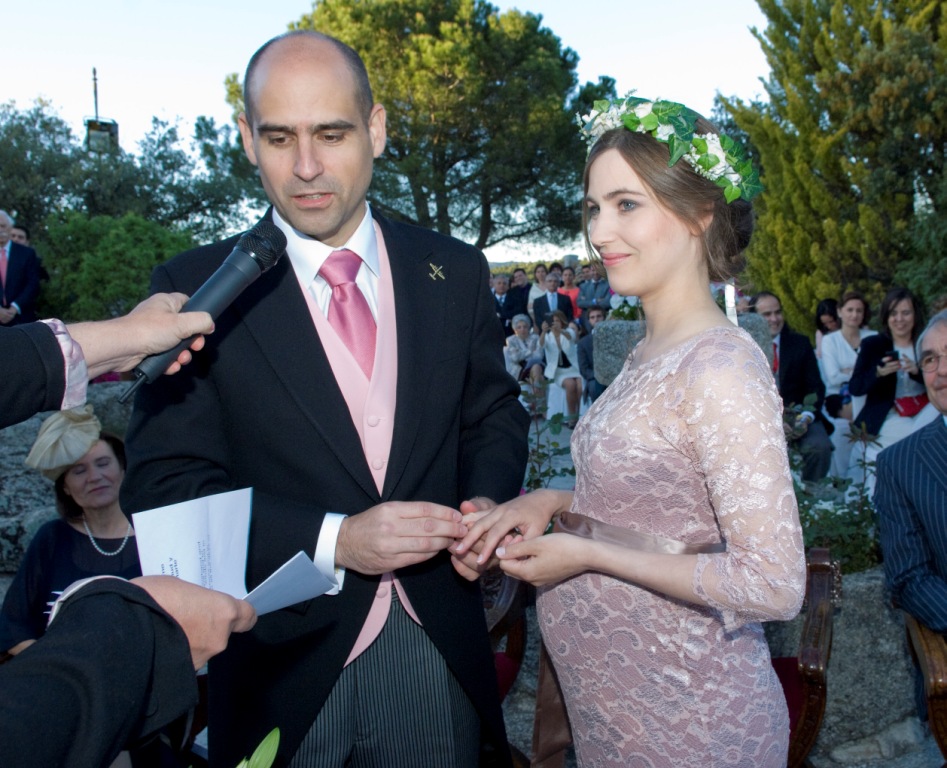
May 11, 2013. On that day Luca and I celebrated our wedding. That was our highlight of the first half of the year. We celebrated it close to my parents’ place, in the hills close to Madrid, on a great spring evening , surrounded by most of our relatives and friends (many of you, coming not only from all corners in Spain but from Canada, Brazil, The Netherlands, France, Italy, Switzerland…). Apart from being a very emotive day we had lots of fun.

The monday after the wedding we departed for a honeymoon around the US west coast. We took the opportunity to visit the usual suspects of the area (LA, San Francisco, Grand Canyon, Sequoia Park, Yosemite…) and the not so common places: the aircraft cemetery known as The Boneyard and the AF Flight Test Center (this required visiting 2 US Air Force bases: Davids-Monthan and Edwards), the aviation museums of Pima and Seattle, the Lowell observatory, the Boeing 787 / 777 /747 Final Assembly Lines…

Family Irastorza Van Veen.

In February we announced here that we were expecting a baby. On August 11th, Andrea was born in Toulouse (2).

She weighed 3,610 grams at birth and measured 50cm tall. Now, 4 and half months later she is over 7kg and over 63cm. She has been the highlight of the second half of the year.

Family 2.0. All these events made me slow down the blog posts production rate at some times during the year, though not for the lack of ideas or contents! Nevertheless, I managed to write about 90 posts! Plus the blog received over 50,000 visits in 2013 and surpassed the 100,000 since I started it in 2010.

On top of that, we saw how Luca went forward with her own blog, check it here.

Learning. What did I learn this year? The main job here has been to internalize on time the turn to becoming a father. Once that was assumed, I would say that, with the good health Andrea has had so far, it has been rather easy, albeit energy and time-consuming.

I would say that trickiest that I am finding is the balancing of time between family, hobbies and work. And it has been at the other side of the work-life balance, at the work, where another leap forward was required: in terms of new concepts, new position within the team and several challenges encountered. Though, with the great courage and support from Ruth and Loreto, the year has passed way smoother than one could have suspected.

Other than that, this year I did not manage to formally study neither French (booh! to myself) or Dutch (another big booh! to myself), and this is something that I will have to make up for in 2014 (otherwise I risk to be left out in conversations between wife and daughter!).

Online education: after getting started in 2012 with online courses, in 2013 I completed in Coursera platform the following 4 courses: “Energy 101” (Georgia Tech), “Model Thinking” (Uni. of Michigan), “Nutrition and Physical Activity for Health” (Uni. of Pittsburgh) and “Exercise Physiology: Understanding the Athlete Within” (Uni. of Melbourne). On the down side, I did not fully complete other 3 online courses for which I obtained only about 60% of the credits, even though I enjoyed them even more than the previous ones: “Game Theory” (Stanford), “A Beginner’s Guide to Irrational Behavior” (Duke) and “Understanding Einstein: The Special Theory of Relativity” (Stanford), in all three cases I missed some deadlines due to being travelling without time and proper connections to complete assignments.

Reading. This year I didn’t set any objectives in terms of books due to the reasons mentioned above. Add to that that my eReader broke at the beginning of the year and I only replaced it in June and only started to use the new eReader in December (!). I have only read 7 books in 2013 (“Thinking Fast and Slow”, “Calico Joe”, “Born to Run”, “Les Cow-boys d’Airbus”, “Personal Memoirs of US Grant”, “Moneyball” and “The Art of War” for a second time). I think I will soon write a post about them.

Sports. After about 16 years, I got to practice again skiing (!), which used to be one of my favourite sports. We went with colleagues to Val Louron, Saint-Lary and Baqueira. I also got to play soccer again after about 3 years without playing… with the misfortune of getting injured (left leg adductor) just weeks prior to a marathon.

Skiing in Val Louron (France).

Running the San Diego marathon.

As you can imagine if you are a frequent reader of the blog, what I practiced often was running. In 2013 I managed to run over 2,000 kilometres, I took part in 16 races including: 3 marathons (Rome, San Diego – while on honeymoon!- and Athens), 2 half marathons (La Latina – Madrid – and Toulouse) and 4 trails of around 20km each. For the last marathon I manage to complete a training plan to the end which made me very proud and helped to beat my 10k and half personal records.

I don’t remember from whom I picked the sentence “the running shoes, always in the suitcase”, but I follow it to the point: The year 2012 caught me running in Toulouse (all kind of corners in the French south west region), Gruissan, Madrid (the day I got married included), Torrelodones, Rome, Santander, Murcia, Santa Monica, San Diego, San Francisco (Bay to Breakers race included, and along the Golden Gate bridge), Sequoia National Park, Mojave desert, Tucson, San Diego, Everett, Oakland, San Lorenzo de la Parrilla (Cuenca), Comillas (Cantabria), Athens, Wijchen… so in a way it was also a year on the run. Many of these times I have been running with friends (Jaime, Serna, Manuel, Juan, Kike, Jon, Nacho, Gon, Juan, Nervi, Pablete…), which made it even better.

Investing & helping others: with the organization of the wedding in sight, I had a cash preference for the use of savings. With the wedding gone, I will re-start looking for investment opportunities in 2014 (hopefully the stock market isn’t so hot then).  In a few weeks I will publish how our investments (made in previous years) have fared in 2013, but they have gone well (as most of the stock markets). On the charities side: this year I directed 1.1% of my net income to different NGOs and non-profits (soon I’ll make a similar contribution, check out which ones will I support this time).

Travelling. This year either with Luca, with friends or alone, I visited Santander, Murcia, United States (LA, SF, Seattle, Mojave, Flagstaff, Tucson, San Diego…), Comillas, Greece (Athens, Delphi, Meteora, Marathon), The Netherlands (Wijchen, Den Bosch)… take the case of Andrea, who with just 4 months has been 3 times in Spain, 3 times in The Netherlands and Greece (having flown 11 times already)… those were the leisure trips; the job made me go to Madrid another 20-25 times (?), that made it tiresome and difficult to combine with other things.
My first flight on-board the A400M.

My first flight on-board the A400M.

Flying: again, 2013 has been a difficult year to find slots to fly with the instructor. Due to weather conditions, work, etc., we had to cancelled several sessions. In the end I could only fly over 13 hours. However, on August, 30, I did my first solo flight!. That was another highlight of the year. During the summer time, while my parents and in-laws were visiting to see our newborn, I could take onboard my mother and father-in-law. 

On top of that, on August 29, I got to fly onboard the aircraft I work on at Airbus Military, the A400M! (yet another highlight).

Other reasons for joy in 2013 have been:

  • Family: My brother switched jobs within the same company and will soon depart again for Germany. My sister, after completing her degree in Political Sciences, pursuing a course on Energy Security in Madrid and getting yet another certificate in English, moved to Odense (Denmark) to study a Master in Energy Security (you can follow her in her blog). My mother keeps working on her massage business, and my father is now engaged with 2 or 3 NGOs spending part of is time as a pensioner teaching maths, physics, etc., to disfavoured people in Madrid.
  • Some more friends and relatives got married: Marlies, Pablo, Jose, Unai, Marlies.
  • And apart from Andrea, these newborns will share her promotion: Julia, Aaron, Mencía, Diego, Julia, Maeva

Now it’s time to rest, celebrate and soon to plan how we want the 2014 to turn out. I believe the next year I’m going to give it a try to the processes’ approach at the time of setting goals. I have been repeating to myself for years that each year that passes is getting better than the previous one. If I see at the account above, improving 2013 seems difficult, but who am I to question that 2014 will be, again, the best year of my life!?

I wish you the same: the best for 2014, enjoy it!

Enjoy!

Enjoy!

(1) This post is becoming a classic of the blog (like those talking about aircraft discounts, best and worst posts, charities I support, etc). You can see my 20102011 and 2012 recaps.

(2) For the avoidance of doubt: despite of being born in France and due to her parents being Dutch and Spanish, Andrea is of Spanish and Dutch nationality, not French. Quoting a work colleague: “here [on the possibility of getting French nationality at birth or not], French law protects our children…” 🙂
21 Comments

Filed under Personal development & HR

Athens Classic Marathon

I heard about the modern Athens Classic Marathon from Antonio, a colleague at the office. Ever since, I had wanted to take part in it. Last week, two friends (Jose and Juan), my brother and I completed it.

In a previous post I wrote about the legend of Pheidippides and the origin of the modern marathon. In this post I will focus on my experience and will share some of the pictures that we took during this trip.

Training

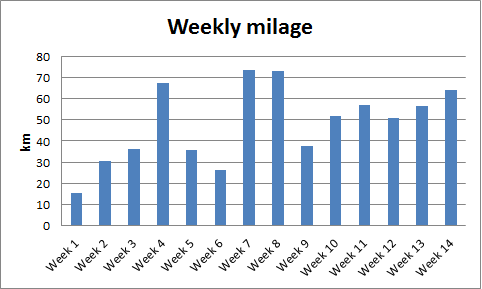
Volume of kilometres run per week.

Volume of kilometres run per week.

To prepare for this marathon I followed a 16-week training plan provided by Garmin (Level II). Each week it included between 4 and 5 days of running and often 1 day of cross-training. I fulfilled most of the plan, missing not more than two or three days of running and some more of cross-training. I did not skip any series session or long run. In all, I ran over 780km in those weeks, excluding the 42km of the race (an average of just over 50km per week).

During this training season I beat my 10k and half marathon personal records. I had not experienced any serious injury that prevented me from training during whole weeks or months as it had been the case in previous years. According to a running calculator that I use sometimes, had the race been in similar conditions as those 10k and half, I should have been around 3h30′. The profile and conditions were not the same, and despite of that I started with a pace towards 3h30′ just to see how far would I reach maintaining it and if I could be under 3h45′, thus achieving a new PR.

The day before the race we went to the marathon expo which was held at the Taekwondo pavillion of the 2004 Olympic Games held in Athens. This way we also visited the beautiful small port at Piraeus close to Faros (just past the Stadio Eirinis & Filias, where Olympiakos bastketball team plays).

At the marathon expo.

At the marathon expo.

Before the race

Marathon beach.

Marathon beach.

As I mentioned in the previous post, the race goes from the village of Marathon to Athens, replicating the route followed by Pheidippides to announce the victory of Athens in the Battle of Marathon. The Persians landed at the bay of Marathon in their attempt of invading Attica, thus Marathon is almost at sea level.

From Marathon, the race goes South more or less parallel to the sea-line for about 17 kilometres and then heads to the West to climb up the hills before the valley where the city of Athens is located.

Route of the Athens Classic Marathon.

Route of the Athens Classic Marathon.

The last part of the race is a descent from the hills to the centre of Athens where the Panathinaiko stadium is located. But by then, the damage is already done to the legs after a long climb.

Profile of the Athens Classic Marathon.

Profile of the Athens Classic Marathon.

The morning of the race, we were transported from Syntagma square to Marathon by dozens of buses early in the morning to be able to start at 9:00. Everything ran smoothly (in that and many other aspects the organization of the race was superb).

We changed clothes in Marathon, where we could take some pictures, go to the toilet, warm up and slowly get into the racing mindset.

Urinaries panoramic view.

WC panoramic view (at Marathon, picture by Jose).

We took one group picture and set for the departing line.

Pre-race group picture.

Pre-race group picture.

The week following to the race I went back to Marathon to visit the place with time and see the different spots (some of the pictures in the post are from those other days).

In the village of Marathon there is a small athletics stadium at the end of the national road from Athens to Marathon.

The 1896 Olympic marathon race started at “… the brigde at Marathon Plain”, or “… at the bridge near the entrance of the sacred city”, according to “Olympic Games 776 B.C. – 1896” by A. K. Bech, or “… The starting point will be at the 40th stadion on the Marathon – Athens national road”, according to the Athens daily “Olympia” on March 9, 1896 (as can be read in the milestone below). That point, the “40th stadion” of that national road, is marked by the milestone below.

Today, the Athens Classic Marathon starts a bit ahead at the mid-point of what is now a kind of majestic avenue at the beginning of which one can find a marble stone indicating the starting point of the olympic race, a milestone indicating that 40th stadion, and the tower where the Marathon Flame is lit after being brought from the Marathon Tomb (just 5km away).

1896 Athens marathon start

1896 Athens marathon start

40th stadion milestone

40th stadion milestone

Marathon flame tower.

Marathon flame tower.

Boston 2013 marathon memorial bracelet.

2013 Boston marathon memorial bracelet.

Just before the race start we observed 1 minute of silence for the victims of the attack at the Boston marathon earlier this year. This minute counted with the presence of president of the Boston Athletics Association. That was the 3rd such minute I had observed as during my honeymoon trip I had taken part in two races in the USA, in San Francisco and San Diego, from which I got the memorial bracelet that I wear often lately.

The race

At 9:03 our group departed and there we went my brother and I trying to pace ourselves at a bit less than 5′ per km. That was comfortable for the flat part at the beginning. Another positive point of that beginning: with less than 10,000 runners taking part the running was possible from the start.

Milestone of the km 1 of the Athens Classic Marathon Course.

Milestone of the km 1 of the Athens Classic Marathon Course.

The course of the marathon race is marked, not only by ad-hoc signals for the race, but by permanent posts along the road, such as the one of the picture for the first kilometre.

At about the km. 5 the course takes a small detour from the national road to round the commonly known as Marathon Tomb, or Marathon Tumulus, a park with a small hill where each year the Marathon flame is lit. Close to the park entrance, there is a small statue of Miltiades, credited as the one devising the tactics to defeat the Persians at the Battle of Marathon.

Statue of Pheidippides km. 18.

Statue of Pheidippides km. 18.

At the return from the tomb, already 6km had been passed. The road continued to be flat until about the 11th km, where the road started to pick up until km. 16, where there is a short and steep descent up until km. 17.

At the km. 18, there is a small statue of the legendary Pheidippides. From then on the road continues to climb more or less continuously until km. 31.

Up until the 20th km I was still at the pace of 3h30′, but in the beginning of the climb I was already feeling that it was going to be very tough to run kms at below 5’50”.

I have checked the Garmin records afterwards and I had already surpassed 167bpm at some points by the km 20th, which experience tells me that is the barrier that makes me feel fatigued.

Statue of a runner at km. 21.

Statue of a runner at km. 21.

During the race, not having read about heart rate, just by the feelings I had I decided to forget about the time and continue the climb at a more comfortable pace. With that, the 3h30 and the sub 3h45′ were gone. In the end I completed the race in 3h53’18”, but the profile nor the day (temperatures from 14ºC to 21ºC, on the hot end) were the best to attempt a PR.

At the km. 21 there is another statue of an anonymous runner.

I crossed the half marathon at slightly over 1h47′, but knowing that the following 10km would take about a full hour and not knowing how I would be for the remainder 11km.

The heat of the day called for lots of hydration, and at that point the organization was again terrific, with water posts every 2.5km and with isotonic drinks in most of the posts, plus energetic gels in some of them.

One hour later, and having reached the top of the hill I remembered the sentence one of us had read describing the race “from km. 31 you can fly down to the end”. Well, I was not fit for flying. When I tried to speed up I felt muscles starting to cramp, thus I couldn’t run any faster than 5’45”, which I tried to keep, drinking and eating well at each supply post.

Panathinaiko stadium from Acropolis.

Panathinaiko stadium from Acropolis.

Once in the centre of Athens, there were still some 3-4 kilometres to cover. I kept myself just for the last kilometre where the atmosphere close to the stadium was great, starting with the descent by Irodou Attikou street.

The last turn to the left, climbing up the ramps to enter the Panathinaiko and covering the last meters inside the stadium was overwhelming. One of the best marathon endings I can recall.

See in the panoramic below a view of how the stadium looked that day.

Panathinaiko stadium panoramic view.

Panathinaiko stadium panoramic view (picture by Jose).

I remembered then when I first visited Athens back in 2002. That time, we visited the stadium and took some pictures as if running in those tracks. Now, 11 years later, there was I, sprinting to complete the Athens Classic Marathon (my 10th), where it all began, no less.

2013 Athens marathon medal

2013 Athens marathon medal

Post-race groupe picture.

Post-race group picture with a great marathon team! Juan, Jose, me and Jaime.

5 Comments

Filed under Sports, Travelling

Καλημέρα, Marathon!

Καλημέρα, Marathon!

(Good morning, Marathon!)

At the time this post is being published, two friends (Jose and Juan), my brother and I are starting the Athens Classic Marathon; the marathon starting in the town of Marathon, in the East of Attica region, and finishing in Athens.

Today, there are hundreds of marathon-distance (and longer) races organized around the globe all along the year. The trend is growing. The numbers of people running such races is increasing year by year. But it all started here, in Attica.

Pheidippides, the legend

The basic traces of the legend are widely known: a courier named Pheidippides ran from Marathon to Athens to announce the result of the battle and perished after the arrival. However, there are some confusions in relation to the legend, as it is well explained in the respective Wikipedia article.

The first record from the legend comes in a text from Lucian:

… The modern use of the word dates back to Philippides the dispatch-runner. Bringing the news of Marathon, he found the archons seated, in suspense regarding the issue of the battle. ‘Joy, we win!’ he said, and died upon his message, breathing his last in the word Joy … – Lucian Pro lapsu inter salutandum (translated by F.G. and H.W. Fowler, 1905) 

Statue of Pheidippides along the Marathon Road (picture by Hammer of the Gods27).

What is less known is that according to the story Pheidippides (530 BC–490 BC) was first sent to Sparta to request help from the Spartans when the Persians landed at Marathon. Thus, he already had run 240km to Sparta (and back). Right afterwards, he was sent from Marathon to Athens (another 40km) to announce the victory in the battle.

To the ones having completed a marathon race this makes sense, as: how it can be that it all started with the one supposed gifted runner collapsing after completing the 40km if thousands (about half a million) people each year complete a marathon? The catch is that Pheidippides had come from twice running what today is known as the Spartathlon, a 246km ultramarathon race which is also organized yearly in Greece, between Athens and Sparta.

Thus, the feats of Pheidippides have yielded two modern running race distances and hundreds of events.

The Olympic Games

Spyridon Louis entering the Panathinaiko stadium at the end of the marathon (public domain image, author Albert Meyer).

More than two thousand years passed until the sport of marathon was established on the occasion of the first modern Olympic Games held in 1896 in Athens.

The idea of including such a race in the programme of sport events was from Michel Bréal, a friend of Pierre de Coubertin. The proposal was accepted by the Olympic committee and that first marathon race had a distance of 40,000m (the current 42,195 distance for marathons was established years later, in 1924 , based on the distance of the 1908 London Games).

That first marathon was run on April 10th of 1986.  Only 17 runners took part in that race; of which only 9 of them finished, one being disqualified after his arrival (as he had completed part of the race on a carriage) and the other 8 retired at different points of the route. The race was won by the Greek Spyridon Louis with a time of  2:58:50.

Athens Classic Marathon

From 1972, the Athens Classic Marathon is organized yearly following the route of that first marathon race in 1896 and the legend of Pheidippides (490 BC).

Today in 2013, 117 years after those first 17 runners and 2503 years after Pheidippides, the 4 of us will try to cover the distance between Marathon and Athens, to say ‘Joy, we win!’ at our arrival and this time, not to collapse.

3 Comments

Filed under Sports, Travelling