
Tag Archives: shareholders

Greg Abel’s 2025 letter to the shareholders of Berkshire Hathaway

Every last Saturday of February, a must read for the weekend comes out: the letter to the Shareholders of Berkshire Hathaway by its CEO. For decades this was Warren Buffett’s letter, today it was the first such letter by Greg Abel [PDF, 91kB], the new CEO of the company, after Buffett stepped aside, remaining as chairman of the board.

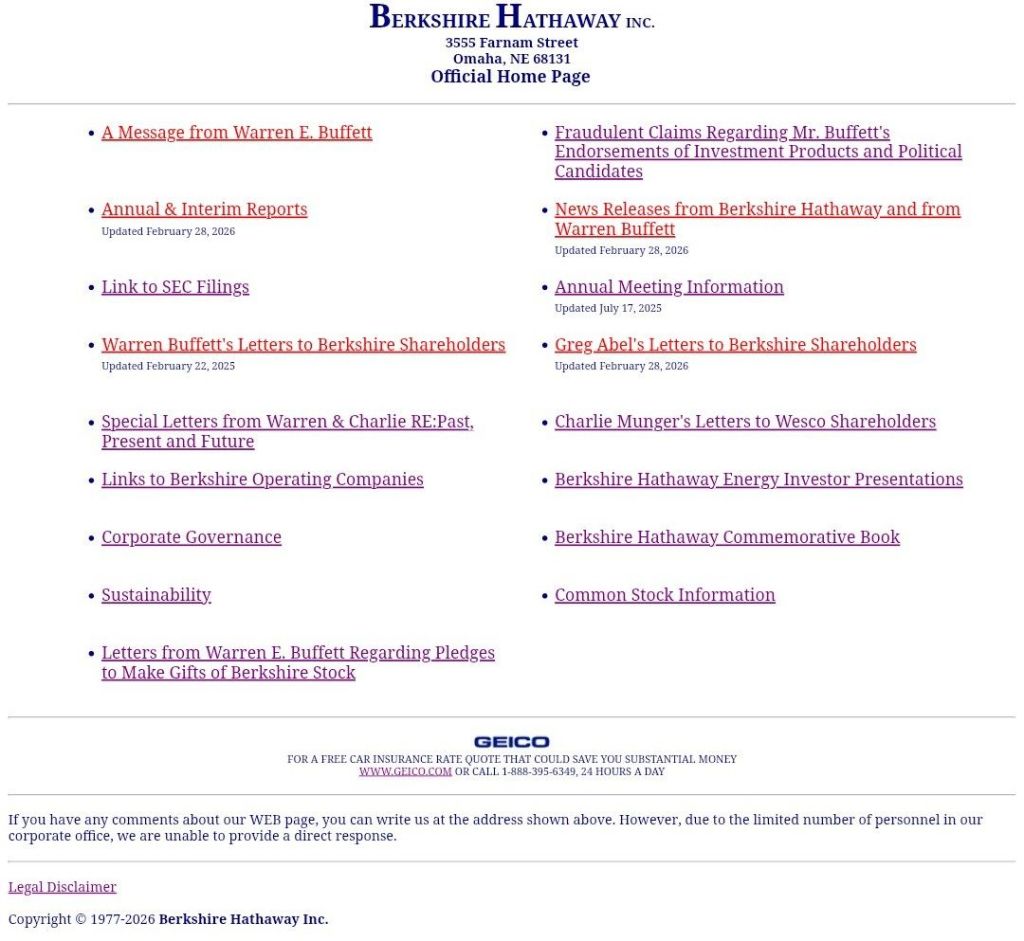
To publish Abel’s letters they have created a new section in the rather rustic website of the conglomerate:
The new CEO chose the following words to open his first letter to the shareholders:

To My Fellow Berkshire Shareholders,

He then dedicated some lines of tribute to his predecessor and later to Charlie Munger.

The overarching theme of this year’s letter was to emphasize the culture and values of Berkshire, which he is fully committed to preserve, as he reflected by sharing this past comment:

Charlie’s comment on May 1, 2021, that “Greg will keep the culture” will forever resonate with me. It was a reminder that our culture is our most treasured asset, a call to maintain what defines Berkshire, and a challenge to ensure our culture continues.

Before discussing the performance of the different businesses in 2025 he chose to share a letter he sent earlier this year to the employees, which he commented by adding further context and details at some points.

I share below some excerpts that called my attention.

On integrity, recalling the past:

… we played a clip from Warren’s 1991 Salomon Brothers Congressional testimony: “Lose money for the firm, and I will be understanding; lose a shred of reputation for the firm, and I will be ruthless.”

We know integrity is not a quality you admire on a shelf; it is an active quality that must be earned, re-earned, and maintained daily.

On the group’s financial strength:

… financial strength by using debt sparingly and prudently.

On the line between being a responsible company (integrity) accountable for its actions and defending its shareholders;

Where responsibility does not exist, it will continue to seek judicial relief. Accountability, paired with principled opposition to unwarranted liability, is essential to preserving the regulatory compact that governs utilities.

On its main equity investments, four American companies (Apple, American Express, Coca-Cola, and Moody’s; combined market value of these investments $158.6bn) and five Japanese ones ($35bn):

Taking these positions together, at year-end they totaled $194 billion in market value, representing nearly two-thirds of our $297.8 billion equity securities portfolio, providing combined dividends of $2.5 billion and yielding 10% on their original cost basis of $24.5 billion.

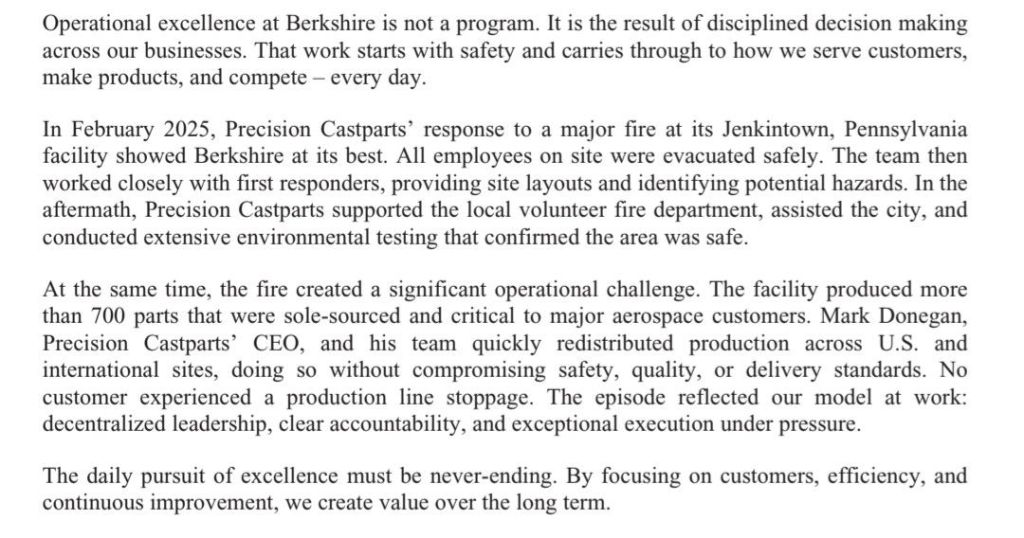
I also like the explanation of how the fire at Precision Castparts was handled, when discussing operational excellence:
Finally, he closed the letter by sharing some details about the annual shareholders meeting next May 2nd, where he confirmed he will be on stage to answer questions from the audience. The exercise will be a more choral one, compared to the old days of Warren Buffett and Charlie Munger, though in the last years Greg Abel and Ajit Jain already joined Buffett on stage.

This year’s program will include a CEO’s update on Berkshire, and two Q&A sessions – one with Ajit and me, and a second featuring Katie Farmer (BNSF), Adam Johnson (NetJets and president of consumer products, service, and retailing), and me, where Katie and Adam will discuss the challenges and opportunities they see in their respective businesses.

A new era at Berkshire Hathaway is starting.
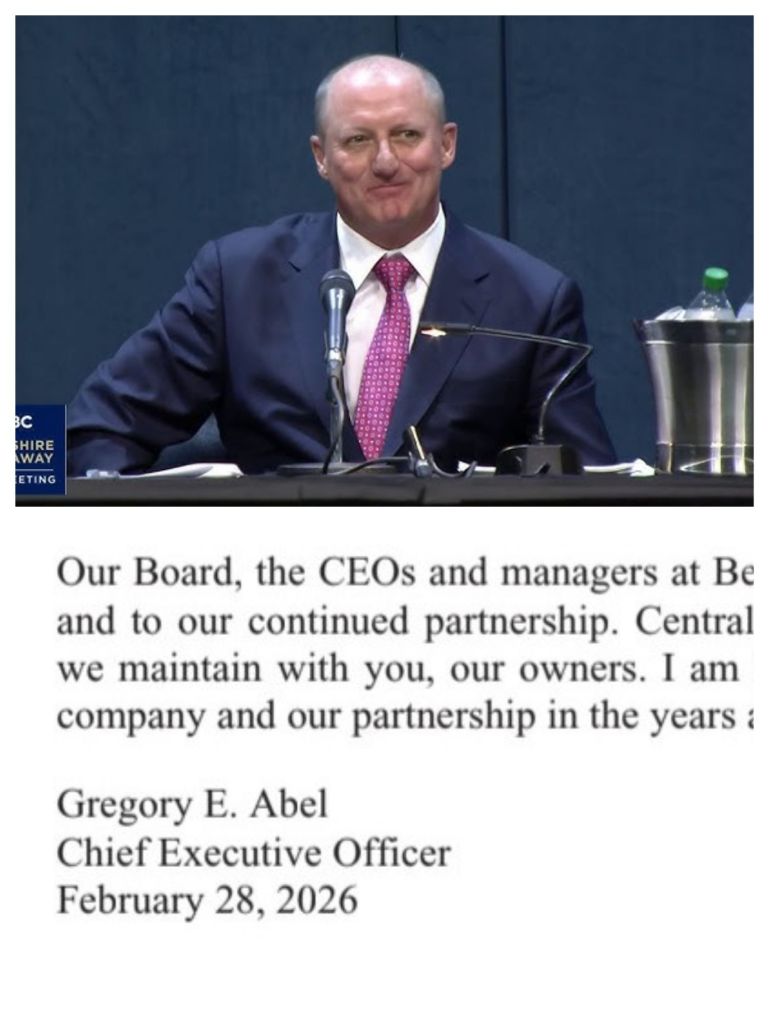
Greg Abel at the 2025 annual shareholders meeting and his signature of the letter.

(1) See the review I made of 2009, 2012, 2013, 2014 and 2015 letters.

(2) See here the review I made of the 2011 annual shareholder’s meeting when we attended it in Omaha.

Leave a comment

Filed under Investing

Stiglitz on shareholders’ mistreatment

A few days ago I published a book review of “The Roaring Nineties” by the Nobel prize Joseph E. Stiglitz. I wanted to share here some passages related to how shareholders, investors are mistreated by those who are supposed to work for them and how alignment of incentives play a role in this.

[On boards of directors] “Here again there was another conflict of interest. Boards are supposed to protect the interests of all shareholders. But some boards, whose members often receive large fees for membership and attendance, were frequently more concerned with pleasing the CEO than fulfilling their supposed fiduciary responsibilities.”

[On one-offs] “[executives] found ways to boost their earnings – through sam transactions which allowed them to book revenues even if they didn’t really have them, or by moving expenses off the books, or by using one-time write-offs (time and time again), to try to give the appearance of robust normal profits. Their objective was to create the appearance of alluring success […] and cash out before the world discovered the truth.”

[On incentives] “The bankruptcy report spoke of “numerous failures inadequacies and breakdowns in the multilayered system designed to protect the integrity of financial reporting system at WorldCom, including the board of directors, the audit committee, the company’s system of internal controls and the independent auditors”. The problem, I would argue, was deeper, and touched not only WorldCom: the problem was with incentives – for the management, and for those who were supposedly watching over management.”

[On the subject of fines] “They accepted fines of unprecedented levels […] but, in most cases, only after being assured that their CEOs would not do [jail] time. […] in many cases it was not the CEOs but the companies that paid them;  indeed, the fines imposed on corporations for such bad behavior represent a curious case where the victim is punished twice over. For ultimately, the shareholders – who have already been cheated by corporate management- bear the costs of such fines.

[On executives’ greed and regulation] “The deregulation mentality made the suggestion of increased government regulation […] an anathema. What worried many were shareholder suits, which they viewed as simply reflecting the rapacious greed of lawyers, not part of a system of checks and balances against the rapacious greed of corporate executives.”

Leave a comment

Filed under Economy, Investing

On Boards of directors and CEOs

The Economist issue published last week included an article (“From cuckolds to captains”) about the transformation of corporate boards. However, I wanted to extract the following passages:

For most of their history, boards have been largely ceremonial institutions: friends of the boss who meet every few months to rubber-stamp his decisions and have a good lunch. Critics have compared directors to “parsley on fish”, decorative but ineffectual; or honorary colonels, “ornamental in parade but fairly useless in battle”. Ralph Nader called them “cuckolds” who are always the last to know when managers have erred.

[…]

The first is that boards should focus on providing companies with strategic advice. This sort of common sense is often in short supply in the ego-driven world of boards. Boardrooms contain too many people with different priorities: corporate veterans who give lectures on how they would have handled things; egomaniacs who like to show how much they know about everything; hobby-horse jockeys who mount the same steed regardless of the race; captives of compliance who are obsessed with box-ticking. The authors say that in their experience perhaps half of the Fortune 500 companies have one or two directors they would regard as “dysfunctional”.

While reading these passages from the article I couldn’t help but remembering Warren Buffett on board of directors in his 2009 letter to Berkshire Hathaway shareholders [PDF, 116KB] (the emphasis is mine):

“In my view a board of directors of a huge financial institution is derelict if it does not insist that its CEO bear full responsibility for risk control. If he’s incapable of handling that job, he should look for other employment. And if he fails at it – with the government thereupon required to step in with funds or guarantees – the financial consequences for him and his board should be severe.

It has not been shareholders who have botched the operations of some of our country’s largest financial institutions. Yet they have borne the burden, with 90% or more of the value of their holdings wiped out in most cases of failure. Collectively, they have lost more than $500 billion in just the four largest financial fiascos of the last two years. To say these owners have been “bailed-out” is to make a mockery of the term.

The CEOs and directors of the failed companies, however, have largely gone unscathed. Their fortunes may have been diminished by the disasters they oversaw, but they still live in grand style. It is the behavior of these CEOs and directors that needs to be changed: If their institutions and the country are harmed by their recklessness, they should pay a heavy price – one not reimbursable by the companies they’ve damaged nor by insurance. CEOs and, in many cases, directors have long benefitted from oversized financial carrots; some meaningful sticks now need to be part of their employment picture as well.”

[…]

“In evaluating a stock-for-stock offer, shareholders of the target company quite understandably focus on the market price of the acquirer’s shares that are to be given them. But they also expect the transaction to deliver them the intrinsic value of their own shares – the ones they are giving up. If shares of a prospective acquirer are selling below their intrinsic value, it’s impossible for that buyer to make a sensible deal in an all-stock deal. You simply can’t exchange an undervalued stock for a fully-valued one without hurting your shareholders.

Imagine, if you will, Company A and Company B, of equal size and both with businesses intrinsically worth $100 per share. Both of their stocks, however, sell for $80 per share. The CEO of A, long on confidence and short on smarts, offers 1 1⁄4 shares of A for each share of B, correctly telling his directors that B is worth $100 per share. He will neglect to explain, though, that what he is giving will cost his shareholders $125 in intrinsic value. If the directors are mathematically challenged as well, and a deal is therefore completed, the shareholders of B will end up owning 55.6% of A & B’s combined assets and A’s shareholders will own 44.4%. Not everyone at A, it should be noted, is a loser from this nonsensical transaction. Its CEO now runs a company twice as large as his original domain, in a world where size tends to correlate with both prestige and compensation.

If an acquirer’s stock is overvalued, it’s a different story: Using it as a currency works to the acquirer’s advantage. That’s why bubbles in various areas of the stock market have invariably led to serial issuances of stock by sly promoters. Going by the market value of their stock, they can afford to overpay because they are, in effect, using counterfeit money. Periodically, many air-for-assets acquisitions have taken place, the late 1960s having been a particularly obscene period for such chicanery. Indeed, certain large companies were built in this way. (No one involved, of course, ever publicly acknowledges the reality of what is going on, though there is plenty of private snickering.)

[…]

“I have been in dozens of board meetings in which acquisitions have been deliberated, often with the directors being instructed by high-priced investment bankers (are there any other kind?). Invariably, the bankers give the board a detailed assessment of the value of the company being purchased, with emphasis on why it is worth far more than its market price. In more than fifty years of board memberships, however, never have I heard the investment bankers (or management!) discuss the true value of what is being given. When a deal involved the issuance of the acquirer’s stock, they simply used market value to measure the cost. They did this even though they would have argued that the acquirer’s stock price was woefully inadequate – absolutely no indicator of its real value – had a takeover bid for the acquirer instead been the subject up for discussion.

When stock is the currency being contemplated in an acquisition and when directors are hearing from an advisor, it appears to me that there is only one way to get a rational and balanced discussion. Directors should hire a second advisor to make the case against the proposed acquisition, with its fee contingent on the deal not going through. Absent this drastic remedy, our recommendation in respect to the use of advisors remains: “Don’t ask the barber whether you need a haircut.”

After these paragraphs harsh on CEOs and directors, let me finish with two references to posts I wrote some time ago: “Is talent really worth it?“, a review of a book on CEOs pay, and “Buffett on shares buy back by companies“, excerpt from 1980 letter.

Leave a comment

Filed under Investing