Tag Archives: Warren Buffett

Buffett on shares buy back by companies

I was reading last weekend Warren Buffett’s 1980 letter to Berkshire Hathaway shareholders, when I encountered the following passage about shares buy back by a company (emphasis is mine):

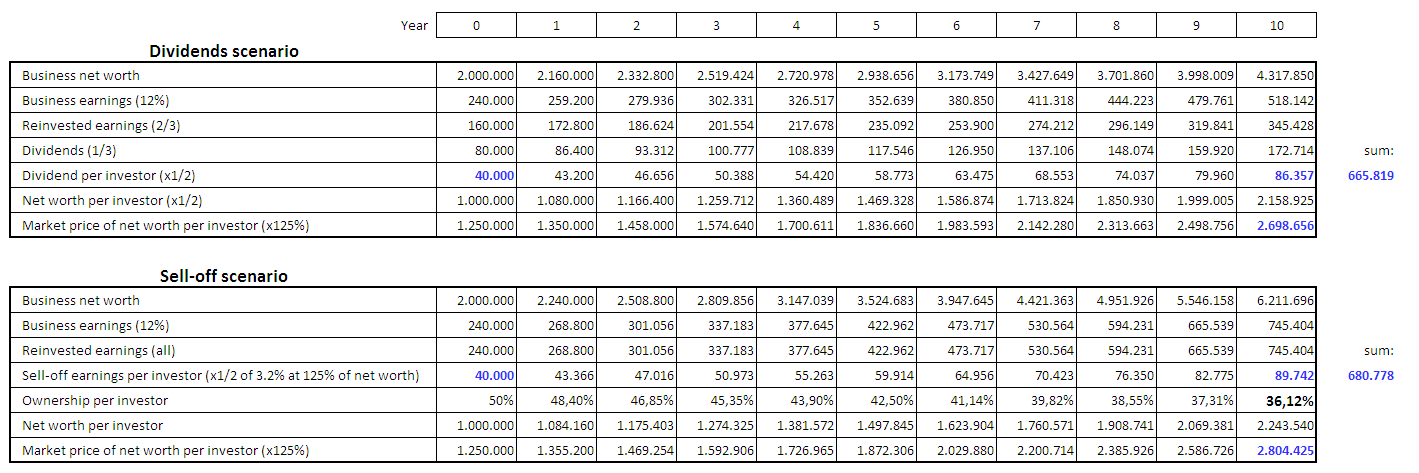
One usage of retained earnings we often greet with special enthusiasm when practiced by companies in which we have an investment interest is repurchase of their own shares. The reasoning is simple: if a fine business is selling in the market place for far less than intrinsic value, what more certain or more profitable utilization of capital can there be than significant enlargement of the interests of all owners at that bargain price? The competitive nature of corporate acquisition activity almost guarantees the payment of a full – frequently more than full price when a company buys the entire ownership of another enterprise. But the auction nature of security markets often allows finely-run companies the opportunity to purchase portions of their own businesses at a price under 50% of that needed to acquire the same earning power through the negotiated acquisition of another enterprise.”

Then, sometimes, we see companies that decide to hold excess cash while waiting for opportunities of what to do with it, or to protect themselves against uncertainty, etc. Some do as Buffett says and buy back at minimum prices. Others do the contrary, they buy back shares at maximum prices.

There is always an explanation to taking one option or the other, even if the final reason is not always told, understood…

2 Comments

Filed under Investing

How high are high taxes?

Taxes are often the subject of heated discussions. Nobody enjoys paying taxes, even if we understand that they’re needed to pay for some state services that otherwise we would not have.

People especially hate when taxes are raised. In Spain income taxes, VAT taxes and some other minor taxes or the cost of public services have been raised recently. In France there is a heated debate on whether the maximum personal income tax rate could be raised up to 75%. A similar heated discussion takes place in the USA about the effective taxes rate paid by the superrich, the top 1%, the top 0.01%… you name it.

You will hear people either claiming that taxing more the rich is what is to be done or that increasing taxes will not forever increase tax revenue collection (the famous Laffer curve); that investors, job creators, etc., will be deterred by the high taxes and take their wealth elsewhere.

Firstly, I am no expert on taxes.

However, seeing today’s tax rates levels (be it Spain, France or the USA), the heated discussions we witness and having had some conversations either with friends or colleagues on taxes, I thought it could be interesting to post in the blog some historical evolution of the different tax rates, just to put in perspective what is high taxes.

I have taken all the graphics from the Wikipedia and all refer to the case of the USA (the one for which there is always more data available). You can see below the evolution of personal income tax rate for the highest and lowest earners, of taxes on capital gains and corporate taxes.

Personal Income Taxes (what in Spain would be IRPF).

You can see in the picture below how the maximum tax rate was for some time above 90% (now is 35%). You can check yearly data on the different tax brackets in the Tax Foundation. In those years with brackets above 90%, maximum effective tax rates were around 70-88%.

“Historical Marginal Tax Rate for Highest and Lowest Income Earners” in USA, from 1912 to 2008 (by Guest2625)

Capital Gains Taxes.

You can see in the picture below how the maximum tax rate was for some time 35% (now is 15%). This is the tax that applies to most of the income of those superrich as they earn it via their investments.

Maximum Federal Tax Rate on Long Term Capital Gains (1972 – 2012) (by Guest2625)

Corporate Taxes.

These are the taxes on corporate profits. You can see in the picture below how the effective tax rate has been continuously decreasing from above 40% in the ’50s (now is under 20%).

US Effective Corporate Tax Rate 1947-2011 (by Guest2625)

Those were the rates.

Then there is a whole lot of studies proving either point or the other. That higher taxes provoke lower investment or the contrary. That higher taxes reduce tax collection or the contrary. That higher taxes reduce growth or the contrary. Pick your study and support your argument. You may have to look for one variable and hide another, pick a country and forget another, pick a decade and not the one before or after. It doesn’t matter, I guess any point can be proven.

Let me finish by sharing two more graphics, obviously handpicked, and a quote:

Top Capital Gains Tax Rates and Economic Growth 1950-2011 (by Leonard Burman).

Capital Gains Taxes and Real Investment (by Jared Bernstein).

From Warren Buffett’s op-ed  “Stop Coddling the Super-Rich” in the NYTimes (Aug. 11, 2011):

“I have worked with investors for 60 years and I have yet to see anyone — not even when capital gains rates were 39.9 percent in 1976-77 — shy away from a sensible investment because of the tax rate on the potential gain. People invest to make money, and potential taxes have never scared them off.

1 Comment

Filed under Economy

Gains with a negative performance?

I wrote some months ago a post in the blog where I showed how you lose money with swings in the market of the same percentage (e.g. -10% followed by +10% or vice versa).

In another post I explained how mutual open-ended funds define and calculate their performance based on the changes in net asset value per share.

In this post I wanted to point at some fine detail: a mutual fund may have a negative performance in a period of time (e.g. a year) yet have gained positive results during the same period. How is that possible?

As I mentioned in that previous post, the net asset value per share of a mutual fund rises and decreases as the aggregate share prices of the stocks in the portfolio rise or decrease. However, each time that there is an addition of capital, it is treated as an issue of new shares at the current price. It doesn’t matter whether those shares are issued to new or old “shareholders”. Depending on whether the net asset value has increased or decreased they are acquiring the new shares at a higher or lower price than they acquired the previous ones.

If it was the case of a company, we would say that shareholders would see their share diluted. In the case of a fund, the share of the ownership is also diluted, but that doesn’t mean a reduction in the net asset value per share, since with the new investment there is an increase of the assets of the fund (and the funds will be invested). Now, let’s see it the case with one example.

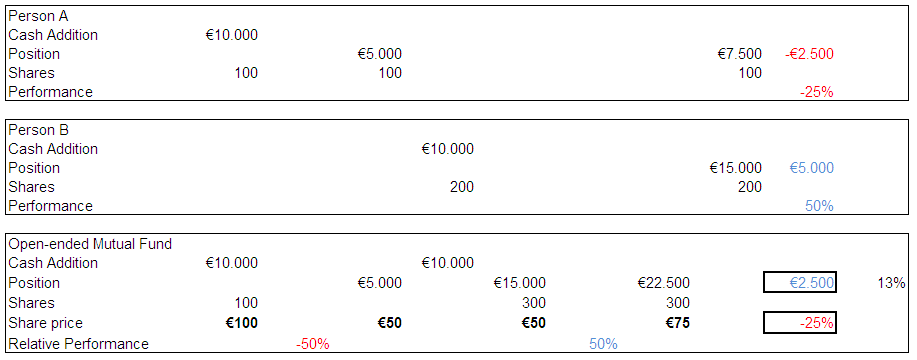
Take a fund with only one investor, A, who at the beginning of the year invested 10k€. That would be the assets of the fund at that moment. The net asset value per share could be defined as 100€, meaning that at that point there were 100 shares.

During the next months the market goes down and, along with the market, the fund’s assets. Let’s say that the reduction in value has been of 50% at half-way through the year. This means the assets of the fund would be 5,000€ (belonging to the sole investor, A). Since there were 100 shares, now the net asset value per share would be 50€.

At this low point, another investor, B, invests another 10k€ in the fund. Now, the 10,000€ would buy not 100 shares, but 200 at a price of 50€. The net asset value per share would remain unchanged at that moment, 50€. However, the assets of the fund would now be 15,000€. The total number of shares would be 300.

Imagine that during the second half of the year the performance of the fund is +50%. As I mentioned in the previous post, with consecutive market swings, -50% and then +50%, you lose. However, in this case there as been an investment in the low point and we’ll see what that means to the fund and each of the investors.

The +50% performance means to the fund an increase of its total assets up to 22,500€, or a net asset value per share of 75€ (for the same 300 shares). This is a +50% since mid-year, but a -25% from the beginning of the year. Quite a negative performance. However, the fund has received inflows of 20k€ along the year and has ended the year with +2,500€ of net gains!

For investor A: the year has meant the same -25% in both net assets and performance as he has lived through the whole period the big destruction of value in the first semester and the creation of value in the second, but, with the market swings of equal percentage value, he lost.

For investor B: the second semester has been great, as she has only lived the +50%, meaning a net gain of 5,000€.

Performance of an investment fund.

The asset manager of the fund hasn’t been in the whole a better performer allocating assets than the market, and that is what the net asset value shows. The fund has only gained in absolute terms because there was an investment at the low point.

This is nothing more than one of the points the proponents of the technique Dollar Cost Averaging defend: to invest regularly the same amounts of money to take benefit of bear markets, when the fixed amount of money may afford more shares of a given stock. In that way you don’t need to time the market to benefit of low points.

Or in another way: “Be fearful when others are greedy, be greedy when others are fearful”, Warren Buffett.

Leave a comment

Filed under Investing

The Unwritten Laws of Finance & Investment

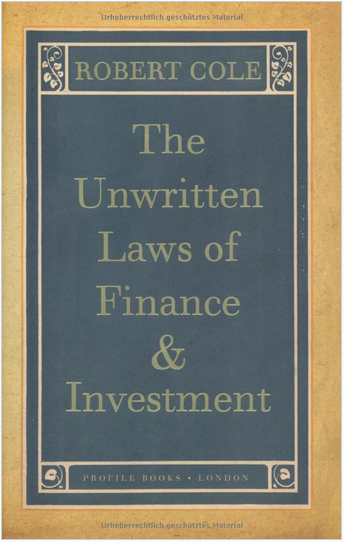
The Unwritten Laws of Finance and Investment, by Robert Cole.

I believe I have already mentioned at some point in the blog the ritual I have almost every time I get into an airport of going to one of the book shops to check whether I can find something to take with me.

I found “The Unwritten Laws of Finance & Investment”, by Robert Cole, at Frankfurt’s airport some months ago during a scale from Amsterdam to Toulouse.

The book is a collection of investment and finance maxims, advice, quotations, etc. It can be read in one shot (159 light pages).

If you are to read this book probably nothing of what you may find in it will be completely new to you, but the compilation and the witty style in which the “laws” are written make it an entertaining read and serve as repository where to find well established ideas.

Let me finish by quoting some passages from the laws that I enjoyed the most:

  • “I don’t want a lot of good investments; I want a few outstanding ones”, Philip Fisher.
  • It is impossible for investors to get their timing precisely right always. [I will come back to this in the future].
  • “In this business, if you’re good, you’re right six times out of ten. You’re never going to be right nine times out of ten”, Peter Lynch.
  • Before you go in, look for the way out. – This one is beautifully explained with a story from Winnie-the-Pooh. [I will come back to this in the future].
  • “Bull markets are born on pessimism, grow on scepticism, mature on optimism and die one euphoria”, Sir John Templeton. – This one reminds us to that of Warren Buffett “Be fearful when others are greedy and greedy when others are fearful”.
  • “There are huge mathematical advantages to doing nothing”, Warren Buffett (on compounding interest).
  • “The rich rules over the poor, and the borrower becomes the lender’s slave”, the Book of Proverbs 22:7, The Bible.
  • “The practice of contracting debt will almost infallibly be abused in every government. It would scarcely be more imprudent to give a prodigal son a credit in every banker’s shop in London, than to empower a statesman to draw bills, in this manner, upon posterity”, David Hume.
  • “The four most expensive words in English language are ‘This time is different'”, Sir John Templeton. [I will come to this in the future].
  • “Investment is most intelligent when it is most businesslike”, Warren Buffett.


Leave a comment

Filed under Books, Investing

Risk

Few days ago I wrote a post about what was supposedly my risk profile as an investor. I mentioned in that post that the mainstream perception of risk is quite different to the one I had. Which is the perception I have?

My perception of risk is 100% shaped by that of Benjamin Graham, and so well described by Warren Buffett several times. I looked for a good example in the internet that I could quote and refer you to, here it is:

Finance departments believe that volatility equals risk. They want to measure risk, and they don’t know how to do it, basically. So they said volatility measures risk. I’ve often used the example of the Washington Post’s stock. When I first bought it in 1973 it had gone down almost 50%, from a valuation of the whole company of close to $170 million down to $80 million. Because it happened pretty fast, the beta of the stock had actually increased, and a professor would have told you that the company was more risky if you bought it for $80 million than if you bought it for $170 million. That’s something I’ve thought about ever since they told me that 25 years ago and I still haven’t figured it out.

If you want to read more about it and other related issues, take a look at the website from which I got this quote, Buffett FAQ.

1 Comment

Filed under Investing

My experience at BRK2011

Berkshire Hathaway was a small textile company in Rhode Island. As many other textile companies it was struggling due to cheap labour competition elsewhere. Warren Buffett had already invested in the company before realising that it was headed for the worst. He was about to sell his stake when he felt irritated by an underbid from the managing director, then he decided not only not to sell his shares but to invest until gaining control, sacking the CEO and completing what he later referred to as his worst investment mistake he ever made…

Today Berkshire is a very different outfit: a big conglomerate, with over 130 billion USD in revenues, with a big insurance arm, dozens of operating companies and large investments in securities. Warren Buffett, his current CEO, regarded as the best investor ever.

Berkshire Hathaway annual shareholder meeting (BRK 2011, for this year’s event) is an extraordinary event, widely covered by press and attended by over 30.000 investors and relatives.

I explained in a previous post how I became interested in investing and when and why Luca and I became shareholders of Berkshire, now I want to give a small account of my experience in my baptism in the Woodstock for Capitalists (pictures below)…

… on Thursday 28th April Luca and I picked a rental car in Chicago, from where we would drive 800km to Omaha, Nebraska, with a stop over in Des Moines. Early in the afternoon Friday 29th we arrived at our hotel in Omaha, where the receptionist informed that there was a package waiting for us: our credentials for the weekend (thanks Debra!).

The event is not restricted to just the shareholders meeting, it is composed of a series of events covering the whole weekend. Let me describe them.

Cocktail at Borsheims. On Friday evening several buses would pick shareholders up from an infamous mall to bring us to Borsheims, the group’s jewellery shop. In front of the shop there was a big tent with live music, drinks and food. The shop was open, with re-doubled staffing to attend shareholders in eventual sales (as Buffett says “what better occasion to propose to your girlfriend than at BRK shareholders meeting?”).

Shareholder meeting on Saturday morning. The meeting started at 8:30am, doors opened at 7:00am and Luca and I arrived at 6:45am when there was already a huge queue. The meeting is held at the Qwest Center, a big convention center, which has room for exhibition and a sports indoor arena where the meeting is held. The exhibition area is packed by stands selling all kinds of goods from the group subsidiaries: boots, construction tools, books, sports wear, insurance… anything at a nice discount for shareholders. What better place to go shopping than to your own shop at a discount? To open the day some very funny videos and commercials were displayed. One featuring cartoons of Buffett, Munger and Schwarzenegger as Governator was especially welcomed.

Q&A session. Most of the meeting, until about 15:30 in the afternoon is a questions and answers session. This is when everybody wants to test and listen to the insights from the “Oracle of Omaha”. They made room for approximately 60 questions. Half were selected by 3 journalists from the thousands sent in by shareholders and the other half were drawn just before the meeting from volunteering shareholders in the floor.

This Q&A session is the most widely event reported by media. If you have read anything about the meeting, it was most probably said there. Instead of me telling here again what’s that was said, let me just refer to my first and second favourite accounts from other sources.

Charlie T. Munger. He is the vice chairman of the company and doesn’t get nearly as much coverage in the media as Buffett, however Warren has for him the highest regard. Munger has written a book, “Poor Charlie’s Almanack”, which is a treasure of wit and wisdom (and heavy as a brick).

At the meeting he is sitting side by side Warren all day during the meeting, looking half asleep and eating candies. Every now and then he replies with a “I have nothing to add” whenever Warren asks him for comment, except for a few times when he gets to give his point. That point goes without cosmetics straight to the issue at hand: “Much of the present crisis was caused not so much by evil but by stupidity”, [on financial projections] “seeing them in paper or in a screen makes some people believe they’re something serious”, “It seems both parties are competing to see which can be the most stupid. What it’s worse, they’re topping each other”, “Insurance is a difficult business: there are many temptations to be stupid… like in banking”…. after hours of this is when Warren came with his “If there’s anybody we’ve forgotten to insult, pass a note up and we’ll get to you.”

Business meeting. Just as a reminder I will say that this was a shareholders meeting. I hadn’t been in any other before though I had seen some either by streaming or podcast. Luca had attended one of EADS. At BRK the shareholders meeting itself lasted… 20 minutes? Reports, directors for the next year, etc., were voted in a matter of seconds. The only issue which took longer was a proposal to get all subsidiaries to report their carbon impact anticipating eventual legislation. Several shareholders took the word for and against and it was finally turned down… this is America.

Picnic at the Nebraska Furniture Mart. Once the shareholders meeting was finished, we all headed for NFM to enjoy a very professionally organized picnic as well as to visit the furniture shop (largest one in North America). This is another BRK subsidiary founded by Mrs. Rose Blumkin, a strong woman who emigrated from Russia at the beginning of the XX century and started the business at her place,  and after a disagreement with Warren went on to open a new business well into her ‘90s, being involved in the operations until shortly before her death at 104.

Brunch at Borsheims. On Sunday morning shareholders could go back to the jewellery shop to have a brunch while shopping, playing bridge or chess, seeing the performance of a magician, etc… It sounds all fine for a Sunday morning plan, the singularity comes from that jewels were sold by Warren Buffett himself, you could play bridge with or against Bill Gates, the chess game was against US champion, etc.

Lunch at Gorat’s. On Sunday two steak houses in Omaha closed doors for shareholders of BRK. Luca and I booked a place in both; one for lunch, the other for supper. Both are Buffett’s favourite places and this is why he recommends them (not being part of the group). Food was wonderful, just too much for us to finish everything.

Dinner at Piccolo’s. This would be our last event in the weekend. We had finished lunch just 5 hours before and were not really hungry. In fact, we were not hungry at all, but we went on with the plan. While we were having our burgers, Warren and Bill came in with their entourage to have dinner at a table 2 tables away from ours. It felt awkward to say the least but this how we closed our BRK2011, our first.

This slideshow requires JavaScript.

8 Comments

Filed under Investing, Travelling

Woodstock for Capitalists

Right now, while this is being published and if everything is going as planned, Luca and I are in Omaha, Nebraska. By now we should be already registered to attend tomorrow the annual shareholders meeting of Berkshire Hathaway, company famous for its CEO and Chairman, Warren Buffett.

While studying an MBA at EOI business school in Seville some 5 years ago, I developed a special interest in investing. I started reading some books and this led me to the bible of them all, Benjamin Graham’s “Intelligent Investor”, which I have referred to in this blog a number of times.

Warren Buffett, of World fame, was one of Graham’s disciples. He started very early setting up small businesses and investing in stocks. Decades later, he is known as the “oracle of Omaha” and considered to be on of the best investors ever.

About 2 years ago, Luca and I decided to invest in Berkshire Hathaway, mainly to acquire the right to attend this weekend’s party (you may call us freaks, right). Sure, we have arranged a nice holiday trip around it passing by Montreal, DC, Chicago and even Des Moines (!). But the end of this trip, was attending the shareholders’ meeting (others travel to attend a concert of U2!).

If you want to grasp what the experience may feel like, start by reading one of his letters to the shareholders of BRK, e.g. this year’s letter [PDF]. It’s 26 pages, ok, but it won’t take you more than 1 or 2 hours, and who knows, it may change your view of saving, investing, managing businesses, doing you a great favour. Apart from that, you’ll have a great fun reading it, as it is a very entertaining and humorous piece.

Finally, a positive note from an extract of the letter to reflect on, in today’s times:

“Don’t let that reality spook you. Throughout my lifetime, politicians and pundits have constantly moaned about terrifying problems facing America. Yet our citizens now live an astonishing six times better than when I was born. The prophets of doom have overlooked the all-important factor that is certain: Human potential is far from exhausted, and the American system for unleashing that potential – a system that has worked wonders for over two centuries despite frequent interruptions for recessions and even a Civil War – remains alive and effective.”

2 Comments

Filed under Investing

Snowball (Compound interest)

I wanted to share with you in this post a speech I gave last Saturday at Rosemasters club contest. I was not contesting but a speech was needed for the evaluation contest, so I volunteered.

Why do I share this speech in particular? Not because it was especially good (nor especially bad), but because it has some insights that could help some of you in case you hadn’t reflected on them or made the numbers yourself.

I titled the speech “Snowball” but a more suitable title would have been “Snowball, or the beauty of compound interest”. Please, note that the metaphor of the snowball it’s not mine, so no need to praise my originality here. I borrowed it from Alison Schroeder’s biography of Warren Buffett “Snowball”, which I reviewed in other post in this blog (I take the opportunity to recommend the book again).

Below you can watch the video uploaded in Youtube (from the second 0:42 some helping hand lifts the camera, please be patient during those first seconds). Below the video I share the script of the speech so you can actually see the formula and the charts I showed. Reflect on it; it may help you a lot a long way down the road.

—–

Script:

“How many of you used to play with snow when you were a child?

Do you remember what the process you followed to build snowballs was? You started by making a small ball with your hands, like this. Then, you left it on the ground and let it roll over itself, so it was gaining more snowflakes and thus getting a bit bigger with every roll… for you it was a small effort, and after some time of rolling and rolling over, you easily could end up with big snowball like this.

Mr Contest chair, fellow members and guests,

Today I haven’t come to talk about snow. I want

  1. to explain the concept of compound interest
  2. to show how important it can be for or future and
  3. maybe to persuade you to take some action.

Let’s start:

This is the formula.

It shows what is the future value (FV) of an investment’s present value (PV) that gains a fixed interest rate (i) for n periods.

To put it simple, it means that the interest that we earn over the investment in the first year, will enter the calculation in the second year. In a very similar way that small snowflakes are making the snowball bigger.

  • The importance of compound interest for our future.

Who is the younger member of the audience today? I will ask you one question, let me see if I get the answer I want.

Are you saving and investing with your retirement in mind? Do you have pension plan or fund?

An extremely important factor in this discussion is that time in the formula appears in the exponent. This means the longer the time period, the better. Or put it in another way, the sooner we start investing or saving, the better.

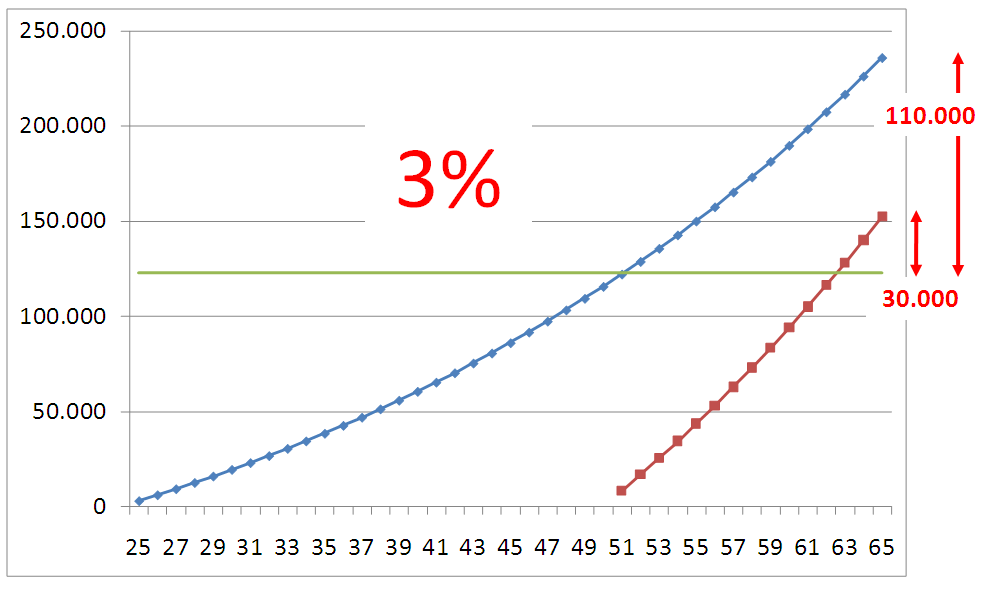
I made two quick calculations to show you. Imagine a 25 year old person who just started working. If he or she is able to save 250 euros per month, that is 3,000 euros per year, and puts it in a conservative fund which earns 3% a year… by the time he is 65 he will have around 230.000€. His yearly contribution would have been 123.000€. So another 110.000€ will have come from the interest. He will practically have doubled his money.

On the other hand, take a 50 year old person who never saved any money beforehand. He will have to save it in only the last 15 years of his working life. To make the comparison, I supposed that he contributed the same 123.000€ in those 15 years, for this he has to save 8.200 per year or 680€ per month… when he is 65 he will have 150.000€, having earned about 30.000€ from the interests, 4 times less!

Effect of a 3% compound interest over 40 years.

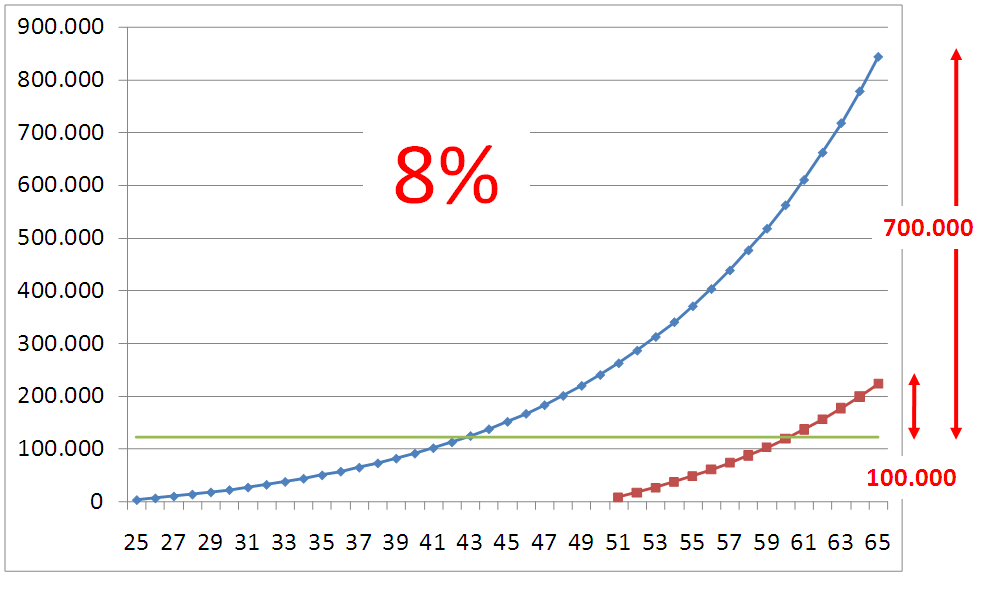
If the young person would invest in more volatile asset, for example the stock market, which historically earns about 8% every year, the new figures would be these ones.

  • 840.000 – earning 720.000 from interests
  • 222.000 – earning 100.000 from interests / 7 times less.

Effect of a 8% compound interest over 40 years.

Finally, with this discussion I wanted to explain little bit the compound interest, how it is making your savings grow, and even though at the beginning the growth seems very slow this is because the growth with time is exponential and we human beings are not very patient, thus it is important to start early saving small amounts, as snowflakes… in the end you will have a big snowball.

Start saving and see you at the retirement age.”

—–

Final comment: as you may have noticed there several passages when what I say differs from the script. I didn’t learn it by heart. During my first speeches in Toastmasters I tried to do so. Now I am departing from that approach. However, I do write the speech to give it a clear structure, to polish some parts, spot words I may have difficulty in pronouncing (so I can replace them for others) and count the amount of words so I am sure it fits in 5 to 7 minutes (often 7’30”… never more or fellow Toastmasters will start clapping).

5 Comments

Filed under Investing, Toastmasters

Resist the bias to act

Some days ago I tweeted about the swings of Mr. Market lately. The consideration of the stock market as Mr. Market is a metaphor that we owe it to Benjamin Graham.

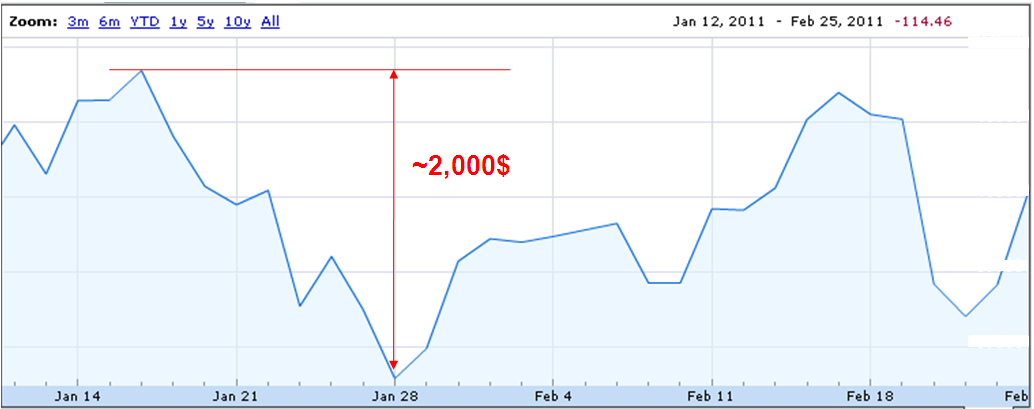
Since a picture is worth a thousand words, I wanted to share a snapshot of the swings of our “J&L” ( 😉 ) portfolio in the past few weeks. One could read the picture as “you have lost 114$ in the past weeks”. That same person on January 28th would have said “you’ve lost 2,000$ in the last 10 days”.

"Resist the human bias to act", Charlie T. Munger

In fact we have not lost a nickel in these weeks, since we haven’t sold any stock. I love a quote from Charlie T. Munger, Berkshire Hathaway vice chairman, which goes: “Resist the natural human bias to act”.

You actually don’t need to buy or sell stock when the market is in the mood. It is as easy as not doing it. You may buy only when you see a margin of safety and sell only when the stock has reached what you considered it to be at its intrinsic value.

You can see that in these 5 weeks we could have lost up to 2,000$ twice; we didn’t. The only tools we counted with: patience and not “listening to Mr. Market”.

Precisely today, it is published the letter of Warren Buffett to Berkshire shareholders. Whether you are planning to invest in stocks or only want to have a fun read, take a look at it.

2 Comments

Filed under Investing

The Snowball, Warren Buffett bio (book review)

Last Christmas, my brother gave me “The Snowball: Warren Buffett and the Business of Life“, by Alice Schroeder. He completely hit on the spot, though I only started reading it during last August holidays (Luca also started reading it to the point that she ended up buying her own Kindle version of it!).

The book is a thorough review of Buffett’s life, including relationships with family & friends and investment decisions. I had previously read other books about Buffett, but they were merely about his investment “strategy” so to say, nothing compared to this one. To complete the book, the author made over 250 interviews, so you can imagine the many insights contained in it.

There are many lessons or just ideas that can be taken from this book. Let me just point the few I can recall at the moment of writing this post:

  • The Inner Scorecard: the idea of acting and valuing yourself according to what you care about and not according to what others’ deem important.
  • The concept of margin of safety: from Benjamin Graham (recommended reading “The Intelligent Investor“).
  • Circle of competence: the idea of looking for simple business that have an enduring competitive advantage (technology companies are not that simple).
  • Cigar butts: companies which are worth more “death than alive” (looking for cheap price to book).
  • Snowball: the idea that compounding interest acts as a snowball falling down the hill, the sooner you start the larger the ball will be down the road (thinking about retirement here).
  • The story of the genie: or that you should invest in your own health as your body is the only one you are going to be given in this life.
  • The Ovarian lottery and the idea that philanthropy achieves more if exercised now and trying to maximize its impact.

Throughout the book you get to learn about many great entrepreneurial characters (e.g. Rose Blumkin, Bill Gates); about the workings of the board of directors of some companies (e.g. Coca Cola, Berkshire Hathaway); about some of the most impressive falls in corporate history (e.g. Solomon Brothers, Long Term Capital Management); about several depressions, recessions and crisis; and above all you learn about what were the thoughts and calculations behind some of Buffett’s investments decisions since the early 1940’s to date.

I definitely recommend this book (700+ pgs.).

5 Comments

Filed under Books, Investing