Yesterday (July 20th 2012) the Tour de France departed from Blagnac, the village close to Toulouse which hosts Airbus HQ. In a place wich such an aeronautical tradition what better way to start the race than with an aerial exhibition: the A380 in formation flight with the Patrouille de France (Dassault/Dornier Alpha Jet).
This post is just to share the short video I took from the office (comments in French by my colleague Sylvain):
I often use a version of Eleanor Rooselvet‘s famous quote “do one thing that scares you everyday“. It’s not that I try to do something that scares me, but something which either brings me out of the comfort zone or that I simply would tend to procrastinate.
Today’s scary thing is flying together with my friend Asier and his flight instructor, Jean-Louis, to Corsica. Prior to taking the decision of joining this “adventure” about 2 months ago, I had barely made 10 flights amounting to less than 8 flight hours… in the last week I was learning with my instructor, Thierry, the basics of flight navigation, the use of charts in flight, the use of VOR, etc., in order to profit the most from this experience. It definitely feels less scary now. And then, I’ll always have Jean-Louis by my side at the time of piloting the airplane. I’m happy to be stretching the comfort zone.
In the previous days I also learnt a lot with Asier on how to plan the route, noting headings, altitudes, radio frequencies, air spaces, aerodromes, etc.
Planning the flight to Corsica.
The head of the MBA I studied in Seville used to describe it as a “experiences accelerator”; in the context of flying this trip to Corsica (a group activity of the Airbus Aviation Society I belong to) really feels like such an experience accelerator.
If everything goes well, we’ll be in Propriano (LFKO) before 15:00. Then we could have one or two days of visiting the island, either by car… or by plane. Ajaccio, where Napoleon was born; Bonifacio; the dolmens close to Ajaccio… I’ll keep you updated when we’re back :-).
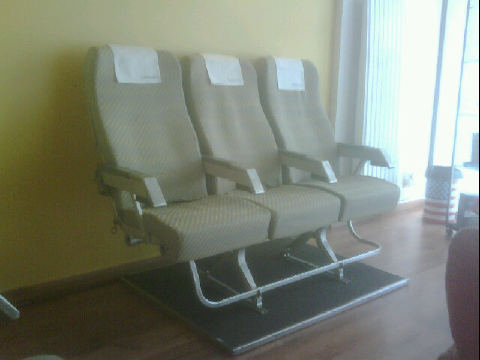
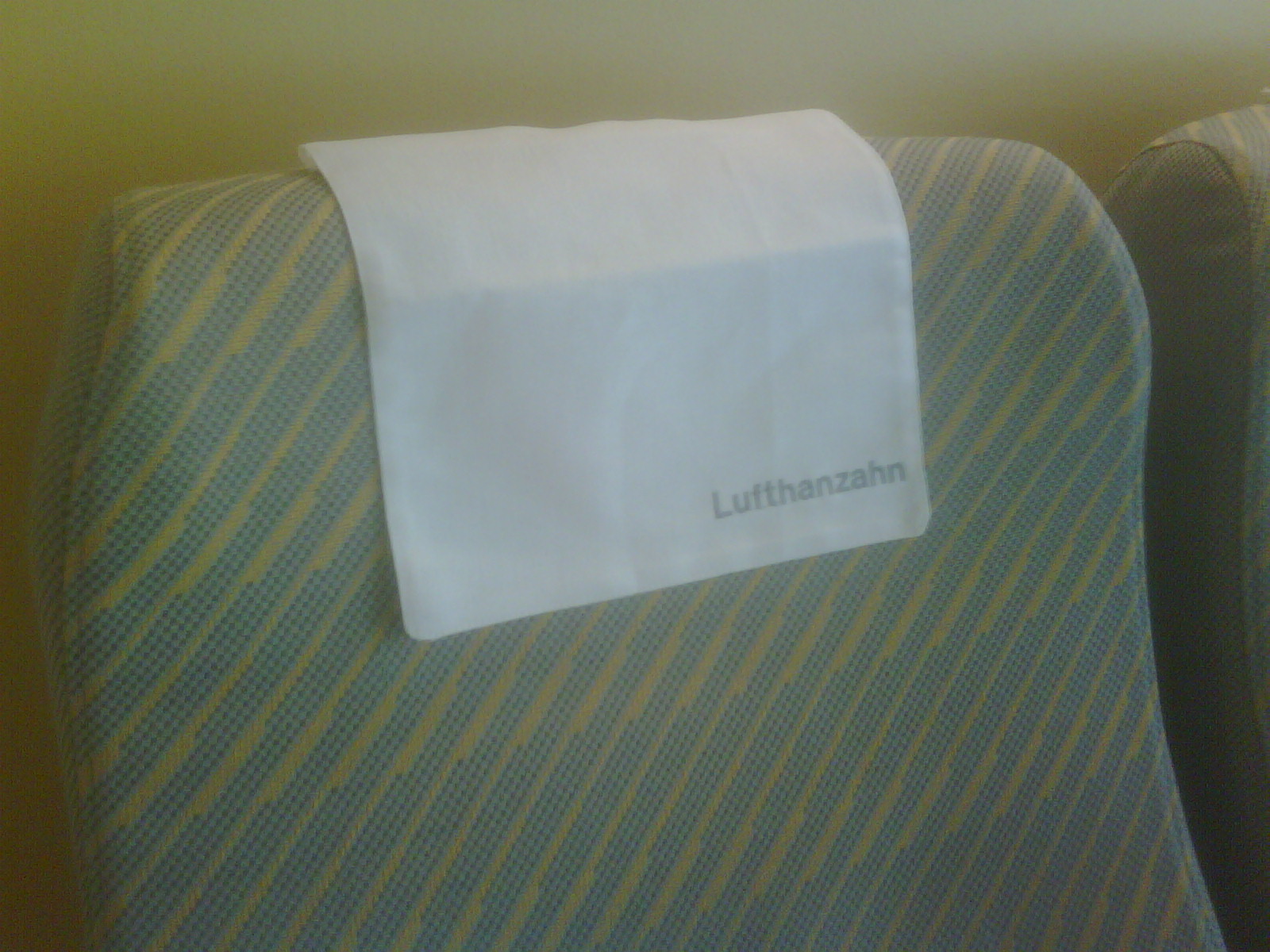
Some time ago I wrote about the impact of Airbus in the employment in the Toulouse area. Some weeks ago I went to a dentist in Blagnac, a village close to Toulouse (where Airbus is in fact based). There I could see how Airbus is impacting Toulouse area in other ways. I then tweeted the following with the picture below attached:
I found myself thinking back in the National Air & Space Museum recently. Firstly, because a friend announced that she had just visited it and secondly because yesterday we oversaw reciprocating engines at the class of the theoretical course for the private pilot licence.
The class itself was not telling nothing completely new, but it reminded me that I had a video of a demo of a radial engine recorded last year at the NASM in Dulles. I filmed it in order to upload it at some point… here it is:
For those not initiated, you may find how reciprocating engines work here, and more specifically how radial reciprocating engines work here.
I’ll never get tired of praising the Smithsonian institution.
Albi is small city close to Toulouse. It is mainly famous for its UNESCO World Heritage Site Cathedral Sainte Cécile and the museum of the painter Toulouse-Lautrec. I had been there twice, but I hadn’t yet written a post about the city. Today I’ll write about another special feature it has.
In Albi there is a car racing circuit. I have a colleague who likes cars, motor-bikes and has been already using that circuit in one of its open days.
Let me connect the dots. On Saturday, while having lunch, our colleague told us that the circuit in Albi was having an open day that precise day. He encouraged us to propose to our instructor to fly to Albi. And here comes the catch: “Why?” Because the aerodrome of Albi, our colleague explained to us, is embedded in the car racing circuit!
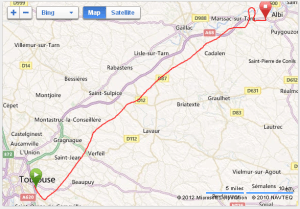
We gave it a try, demanded our instructor to go to Albi and succeeded. See below the flight path recorded with my Garmin:
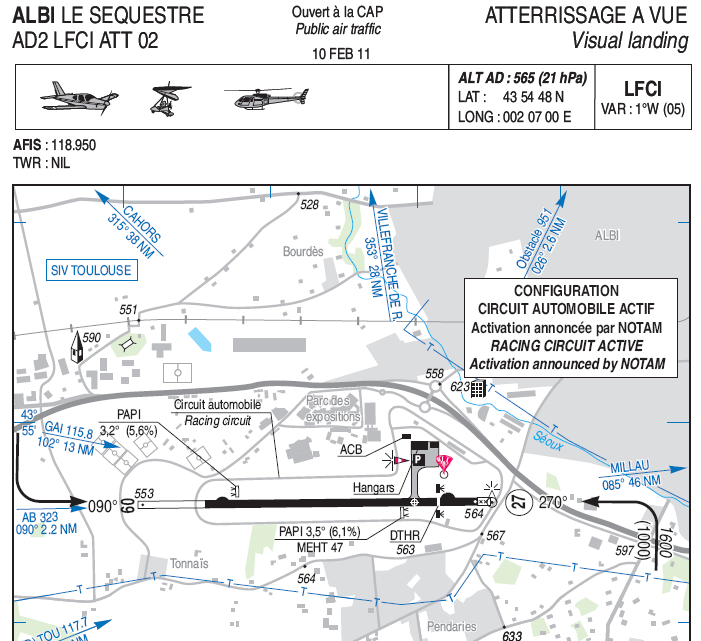
In the following screenshot of the Visual Approach Chart (carte VAC) you may see how when the circuit IS active the runway of the aerodrome is shortened as the circuit crosses the runway! (You may download the chart here, PDF, 360KB).
Visual Approach Chart (VAC) for Albi aerodrome when the car racing circuit is active.
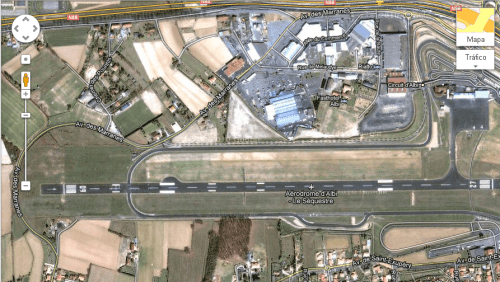
You may see it better below, in the Google maps view, how the circuit intersects the runway:
Albi car racing circuit and aerdrome.
Finally, enjoy the video of the final approach of our flight. If you pay attention to it, you’ll notice the cars racing in the circuit while we are approaching and how we are in fact touching down only within the allowable space when the circuit is active:
Yesterday, I wrote about a documentary on the AF447 accident. Within the video, a flight instructor performs a real stall exercises and he mentions that this is taught in the first lectures of flight instruction.
As I mentioned in the post, I learnt about the documentary while having lunch with 2 colleagues. I was telling them “I’d like to perform those stall exercises to see what feeling does your body have and how you instinctively react to it and how you have to consciously correct that reaction”. As the old adage goes “be careful what you wish for ’cause you might get it”.
After lunch, we headed to the aeroclub to have our class. Thierry, our instructor, opened by asking whether we had seen that documentary we had been talking about. Then, he mentioned “let’s do today stall exercises!” 🙂
[…] a stall is a reduction in the lift coefficient generated by a foil as angle of attack increases. This occurs when the critical angle of attack of the foil is exceeded. […]
Stalls in fixed-wing flight are often experienced as a sudden reduction in lift as the pilot increases angle of attack and exceeds the critical angle of attack […].
The theory of the exercise was easy: fly up to 3,000 ft, reduce the power of the engine down to idle, try to keep the altitude by pulling the stick backwards (nosing up), keep pulling the stick backwards when the stall alarm sounds off, wait until the aircraft starts buffeting, cannot maintain altitude and falls off… then push a little the stick (nose down), recover speed (above stall speed), start nosing up again while increasing power up to max rpm, get to 3,000 ft again. Easy.
The practice… well, my colleague was doing his exercises first while I was sitting at the back. I went from being warm due to the sunny weather to feeling uneasy to experiencing this cold sweat…
You may see the video below with one of the stall exercises performed by my colleague. You’ll notice the stall alarm (in this case it is just an alarm, not a voice saying “stall”):
Apologies for 1) bad quality of the video performed by my not-so-smartphone and 2) for not having recorded a video of my own stall exercises… I was too stressed with them 🙂
—
Note: For the record, in the documentary it is mentioned that pupils get to practice stall in their first lessons. Yesterday’s was my 10th flight in order to obtain the PPL (private pilot licence), up to then I had completed just slightly above 6 flight hours.
The accident of the flight Air France 447 was deadliest in the history of the airline and, since it happened almost 3 years ago, has appeared every now and then in the media. Today, while having lunch with two colleagues I learnt about a documentary about it that was shown in French TV channel France 5 last Wednesday.
The documentary, produced by Bernard Vaillot, is titled “Vol Rio-Paris, les raisons d’un crash“, lasts about 50 minutes, and the programme in which it was emitted included an interview afterwards (complete programme duration 1h08′).
The documentary includes as main attraction a reconstruction of the last 4 minutes of the flight. This reconstruction is built from the cockpit voice recorder (CVR) and the flight data recorder (FDR), often referred as black box. A complete transcription, with comments, interpretation and an exhaustive description of the events can be found in the different interim reports, briefings and releases made by the French BEA (Bureau d’Enquêtes et d’Analyses), the body in charge of the accident investigation.
In the BEA reports [PDF, 10.3MB, New Findings, pgs. 77-78] some facts were established: such as the loss of correct speed indication due to the icing of the pitot probes, the disconnection of the autopilot and the subsequent reaction from the pilot, pulling the stick towards him nosing up the aircraft, increasing the angle of attack until the aircraft enters in stall.
Other interesting features of the documentary are the testimonies of different pilots, including a real stall exercise performed by a flight instructor (from minute 25). He first shows how to recover from a stall, then he simulates the wrong reaction from the AF447 pilot, pulling the stick towards him, pitching up, while the stall alarm was still sounding.
You may see the following trailer below before venturing to see the whole programme.
EDIT: The trailer video has been deleted from Youtube, however, now the full video is available:
Unfortunately, I haven’t yet seen a subtitled or doubled version of it.
As part of the preparation of a flight, the pilot shall make sure that the total weight of the aircraft (including fuel and passengers) is at or below the limits, and that the center of gravity is within a certain area. This is what is called weight and balance.
Some months ago, in our private pilot licence course we had a class where we reviewed this. I remember that one pupil asked “is it possible that the aircraft gets knocked over backwards on ground?” (imagine the aircraft “sitting” on its tail).
This question led me to make the numbers to see whether this was possible with the aircraft we are using for our lessons, a Robin DR 400.
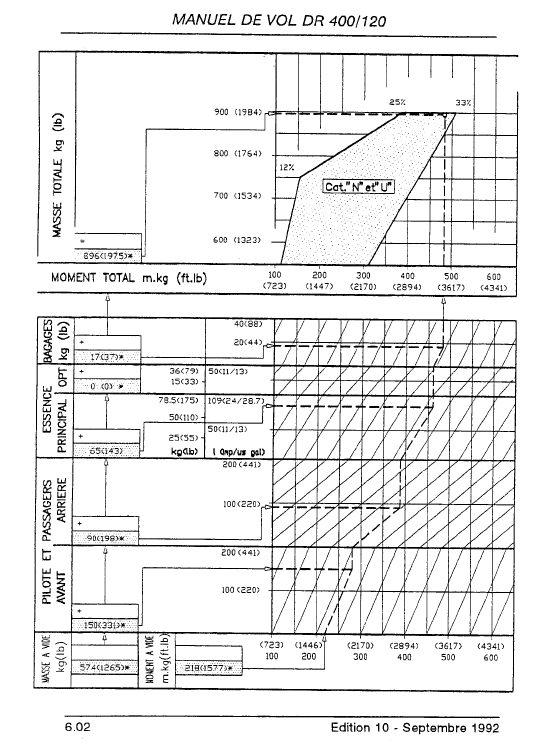
Centrogram for a DR400-120.
For this purpose we use a centrogram, which is nothing but a small “map” where the different possible weights that can be loaded into the aircraft and its momentum are already drawn so the center of gravity can be easily calculated and checked whether it falls or not in the allowed area. This centrogram is included in the flight manual of the aircraft.
I found that, carrying 2 pilots (~154kg) plus 2 passengers (~154kg), you could never load much weight into the rear compartment reserved for baggage. As that area is the one behind the main landing gear, you wouldn’t knock over the aircraft on ground.
If instead of 2 pilots and 2 passengers, you had only 1 pilot and you would load the same weight (~231kg) as baggage, the aircraft would be unbalanced but still wouldn’t fall backwards and sit on its tail. Even if the center of gravity of the baggage compartment is behind the landing gear, the weight of the empty aircraft with a center of gravity between the nose and main landing gear over compensates our trick.
Once I had calculated this, I went one step further: in which cases being under the maximum take-off weight (MTOW, 1,000 kg for a DR400-140) given by the designer could the aircraft be unbalanced? That is, what is required to get the centre of gravity out of the allowable range?
I found that to get the aircraft unbalanced basically you would need to load it in two different ways that at first seemed quite bizarre to me:
You would need to carry only 1 pilot and 2 passengers (plus at least 25 kg of baggage and bearing in mind not to exceed the MTOW), but instead of two of them occupying the front positions and one sitting at the back, you would have a single adult piloting the aircraft and the other two at the back. I’ve never seen that.
You would need to have 1 or 2 adults piloting the aircraft, no passenger at the back plus at least 100 kg of baggage at the back. Why would one person carry so much baggage for a short trip with a Robin DR 400? Here I would add that the designer of the aircraft placed a small plaque indicating that no more than 40kg should be loaded in the baggage compartment.
Well, the two cases can be referred respectively to the following situations:
A couple formed by future groom and bride flying alone with a pilot. Maybe that flight was used by the man to propose the marriage. Well, now you know it, that’s not a good idea, it could make the aircraft unstable (takeaway: no proposals in small aircraft).
Drug-trafficking. I can imagine such small aircraft being used to carry as many drugs as possible… well, apart from being illegal, if someone would carry too much (that is over 100kg), even when below the maximum allowed weight, would make it unstable.
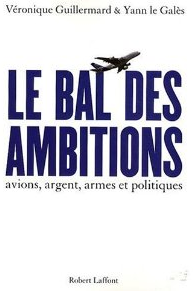
I learnt about the book “Le Bal des Ambitions” in 2009, when a former colleague mentioned it and asked me to buy it in one of my trips to Paris. By then, I did not know French so as to read it, but some months ago I found it again in the aerospace boutique in Blagnac and grabbed it.
The book is written by two journalists, Véronique Guillermard and Yann le Galès, that in my opinion give an image history of EADS and the main characters who shaped it a bit too much thriller-like. Nevertheless, I found it interesting as I could recall many of the names and chapters, even though most of the stories happened either when I was still a student or had recently joined the company.
Some of the topics covered in the book:
Who are the so-called Lagardère boys, the relationships among them and with J.L. Lagardère. (I got to know who from some of top managers came from Matra and who from Aérospatiale.
It describes the merger discussions between Aérospatiale–Matra, BAE and DASA.
You get a glimpse of the role played by the grandes écoles in French networks.
The case of insider trading affecting top management of EADS in 2006.
Some of the issues behind the delays of A380 in 2006.
I guess that for a French native the text hasn’t got much quality, but for me, being my second book in French language, it was just perfect.
Some weeks ago, Boeing released 2011 results [PDF, 252KB]. The company reported revenues of almost 69bn$, 477 commercial deliveries and 805 net orders for its commercial aircraft. All these were widely reported by the media and mean a good year for Boeing.
Last years I wrote in some posts what was my estimate of Boeing discounts: the relation between what is announced by the press, what appears in its list prices and sometimes as backlogs and what it is indeed computed into the profit and loss account. In this post I wanted to update, if necessary, the figure I calculated for the average discount of Boeing.
Most of the necessary information can be found in its website. Boeing list prices can be found here.
The number of gross and net orders (after cancellations) year by year can be found here.
Last year deliveries can be found in the report of financial results. From there we can also deduct the figure of Boeing Commercial’s sales of services. That is not directly reported but can be deducted (all Boeing services-related sales are reported as well as Boeing Capital Corporation division and Boeing Defense’s “Global Services & Support” unit)
As in the post of last year:
I needed to make one assumption: new orders come with a 3% down payment in the year of the booking, while the remaining cost I assumed that was paid on the year of delivery (for simplicity I didn’t consider more intermediate revenue recognition milestones linked to payments, the 3% figure was taken from the AIAA paper “A Hierarchical Aircraft Life Cycle Cost Analysis Model” by William J. Marx et al.). [1]
Having put all the figures together, the calculation is immediate. Boeing Commercial Aircraft revenues in 2011 (36,2bn$) are the sum of:
the discounted prices times the delivered aircraft in the year (including possible penalties from delays),
less the down payment of the current year delivered aircraft, as the down payment was included in previous years results,
plus the down payment of current year net orders (this year’s this calculation was a bit trickier as it included 737NG deliveries BUT 737 MAX orders),
plus services revenues.
The discount figure that minimized errors last year was 41%. Using this figure, the error obtained this year in relation to Boeing Commercial Aircraft reported revenues is 0.1%. That is a little higher discount than previous years (39% for 2010 and 38% for 2009). The only explanation for that would be the built-in penalties for 787 and 747 delays into revenues plus the launch of a new aircraft, 737 MAX.
Thus, the updated discount for Boeing commercial aircraft is 41% (!).
—
[1] Last year, I received a comment from the analyst Scott Hamilton on the level of downpayments. He mentioned they could reach up to 30%. I tried this time to compute the calculation using that input, but the figures of discounts to be applied each year to minimize errors are not consistent, thus I stayed with the 3% used in the above-mentioned published paper.



 The Blog by Javier