Category Archives: Aerospace & Defence

Reconstruction of AF447 accident

The accident of the flight Air France 447 was deadliest in the history of the airline and, since it happened almost 3 years ago, has appeared every now and then in the media. Today, while having lunch with two colleagues I learnt about a documentary about it that was shown in French TV channel France 5 last Wednesday.

The documentary, produced by Bernard Vaillot, is titled “Vol Rio-Paris, les raisons d’un crash“,  lasts about 50 minutes, and the programme in which it was emitted included an interview afterwards (complete programme duration 1h08′).

The documentary includes as main attraction a reconstruction of the last 4 minutes of the flight. This reconstruction is built from the cockpit voice recorder (CVR) and the flight data recorder (FDR), often referred as black box. A complete transcription, with comments, interpretation and an exhaustive description of the events can be found in the different interim reports, briefings and releases made by the French BEA (Bureau d’Enquêtes et d’Analyses), the body in charge of the accident investigation.

In the BEA reports [PDF, 10.3MB, New Findings, pgs. 77-78] some facts were established: such as the loss of correct speed indication due to the icing of the pitot probes, the disconnection of the autopilot and the subsequent reaction from the pilot, pulling the stick towards him nosing up the aircraft, increasing the angle of attack until the aircraft enters in stall.

Other interesting features of the documentary are the testimonies of different pilots, including a real stall exercise performed by a flight instructor (from minute 25). He first shows how to recover from a stall, then he simulates the wrong reaction from the AF447 pilot, pulling the stick towards him, pitching up, while the stall alarm was still sounding.

You may see the following trailer below before venturing to see the whole programme.

EDIT: The trailer video has been deleted from Youtube, however, now the full video is available:

Unfortunately, I haven’t yet seen a subtitled or doubled version of it.
5 Comments

Filed under Aerospace & Defence

Weight and balance

As part of the preparation of a flight, the pilot shall make sure that the total weight of the aircraft (including fuel and passengers) is at or below the limits, and that the center of gravity is within a certain area. This is what is called weight and balance.

Some months ago, in our private pilot licence course we had a class where we reviewed this. I remember that one pupil asked “is it possible that the aircraft gets knocked over backwards on ground?” (imagine the aircraft “sitting” on its tail).

This question led me to make the numbers to see whether this was possible with the aircraft we are using for our lessons, a Robin DR 400.

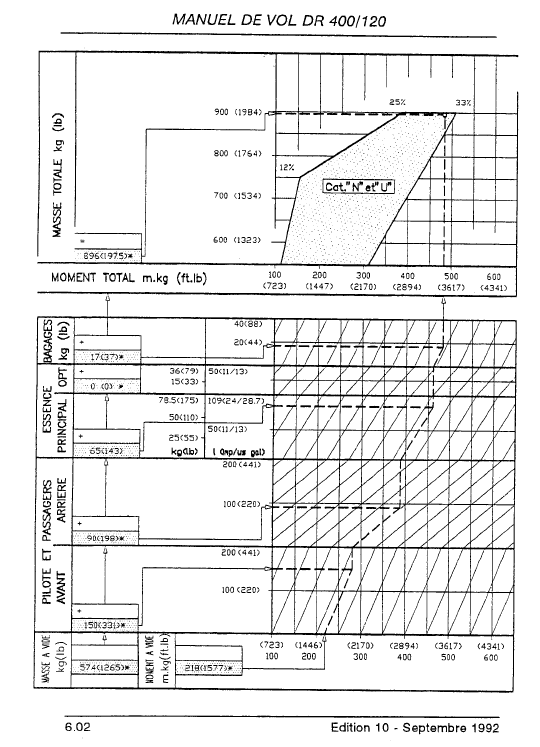
Centrogram for a DR400-120.

For this purpose we use a centrogram, which is nothing but a small “map” where the different possible weights that can be loaded into the aircraft and its momentum are already drawn so the center of gravity can be easily calculated and checked whether it falls or not in the allowed area. This centrogram is included in the flight manual of the aircraft.

I found that, carrying 2 pilots (~154kg) plus 2 passengers (~154kg), you could never load much weight into the rear compartment reserved for baggage. As that area is the one behind the main landing gear, you wouldn’t knock over the aircraft on ground.

If instead of 2 pilots and 2 passengers, you had only 1 pilot and you would load the same weight (~231kg) as baggage, the aircraft would be unbalanced but still wouldn’t fall backwards and sit on its tail. Even if the center of gravity of the baggage compartment is behind the landing gear, the weight of the empty aircraft with a center of gravity between the nose and main landing gear over compensates our trick.

Once I had calculated this, I went one step further: in which cases being under the maximum take-off weight (MTOW, 1,000 kg for a DR400-140) given by the designer could the aircraft be unbalanced? That is, what is required to get the centre of gravity out of the allowable range?

I found that to get the aircraft unbalanced basically you would need to load it in two different ways that at first seemed quite bizarre to me:

  1. You would need to carry only 1 pilot and 2 passengers (plus at least 25 kg of baggage and bearing in mind not to exceed the MTOW), but instead of two of them occupying the front positions and one sitting at the back, you would have a single adult piloting the aircraft and the other two at the back. I’ve never seen that.
  2. You would need to have 1 or 2 adults piloting the aircraft, no passenger at the back plus at least 100 kg of baggage at the back. Why would one person carry so much baggage for a short trip with a Robin DR 400? Here I would add that the designer of the aircraft placed a small plaque indicating that no more than 40kg should be loaded in the baggage compartment.

Well, the two cases can be referred respectively to the following situations:

  1. A couple formed by future groom and bride flying alone with a pilot. Maybe that flight was used by the man to propose the marriage. Well, now you know it, that’s not a good idea, it could make the aircraft unstable (takeaway: no proposals in small aircraft).
  2. Drug-trafficking. I can imagine such small aircraft being used to carry as many drugs as possible… well, apart from being illegal, if someone would carry too much (that is over 100kg), even when below the maximum allowed weight, would make it unstable.

2 Comments

Filed under Aerospace & Defence

Le Bal des Ambitions

Le Bal des Ambitions, 2009.

I learnt about the book “Le Bal des  Ambitions” in 2009, when a former colleague mentioned it and asked me to buy it in one of my trips to Paris. By then, I did not know French so as to read it, but some months ago I found it again in the aerospace boutique in Blagnac and grabbed it.

The book is written by two journalists, Véronique Guillermard and Yann le Galès, that in my opinion give an image history of EADS and the main characters who shaped it a bit too much thriller-like. Nevertheless, I found it interesting as I could recall many of the names and chapters, even though most of the stories happened either when I was still a student or had recently joined the company.

Some of the topics covered in the book:

  • Who are the so-called Lagardère boys, the relationships among them and with J.L. Lagardère. (I got to know who from some of top managers came from Matra and who from Aérospatiale.
  • It describes the merger discussions between Aérospatiale–Matra, BAE and DASA.
  • You get a glimpse of the role played by the grandes écoles in French networks.
  • The case of insider trading affecting top management of EADS in 2006.
  • Some of the issues behind the delays of A380 in 2006.

I guess that for a French native the text hasn’t got much quality, but for me, being my second book in French language, it was just perfect.

1 Comment

Filed under Aerospace & Defence, Books

Boeing commercial aircraft discounts (update for 2011)

Some weeks ago, Boeing released 2011 results [PDF, 252KB]. The company reported revenues of almost 69bn$, 477 commercial deliveries and 805 net orders for its commercial aircraft. All these were widely reported by the media and mean a good year for Boeing.

Last years I wrote in some posts what was my estimate of Boeing discounts: the relation between what is announced by the press, what appears in its list prices and sometimes as backlogs and what it is indeed computed into the profit and loss account. In this post I wanted to update, if necessary, the figure I calculated for the average discount of Boeing.

Most of the necessary information can be found in its website. Boeing list prices can be found here.

The number of gross and net orders (after cancellations) year by year can be found here.

Last year deliveries can be found in the report of financial results. From there we can also deduct the figure of Boeing Commercial’s sales of services. That is not directly reported but can be deducted (all Boeing services-related sales are reported as well as Boeing Capital Corporation division and Boeing Defense’s “Global Services & Support” unit)

As in the post of last year:

  • I needed to make one assumption: new orders come with a 3% down payment in the year of the booking, while the remaining cost I assumed that was paid on the year of delivery (for simplicity I didn’t consider more intermediate revenue recognition milestones linked to payments, the 3% figure was taken from the AIAA paper “A Hierarchical Aircraft Life Cycle Cost Analysis Model” by William J. Marx et al.). [1]

Having put all the figures together, the calculation is immediate. Boeing Commercial Aircraft revenues in 2011 (36,2bn$) are the sum of:

  • the discounted prices times the delivered aircraft in the year (including possible penalties from delays),
  • less the down payment of the current year delivered aircraft, as the down payment was included in previous years results,
  • plus the down payment of current year net orders (this year’s this calculation was a bit trickier as it included 737NG deliveries BUT 737 MAX orders),
  • plus services revenues.

The discount figure that minimized errors last year was 41%. Using this figure, the error obtained this year in relation to Boeing Commercial Aircraft reported revenues is 0.1%. That is a little higher discount than previous years (39% for 2010 and 38% for 2009). The only explanation for that would be the built-in penalties for 787 and 747 delays into revenues plus the launch of a new aircraft, 737 MAX.

Thus, the updated discount for Boeing commercial aircraft is 41% (!).

—

[1] Last year, I received a comment from the analyst Scott Hamilton on the level of downpayments. He mentioned they could reach up to 30%. I tried this time to compute the calculation using that input, but the figures of discounts to be applied each year to minimize errors are not consistent, thus I stayed with the 3% used in the above-mentioned published paper.

6 Comments

Filed under Aerospace & Defence

Savings and consultants

Last Friday, I wrote a post about a measure by the US DoD to produce efficiencies by publishing the actual cost of the preparation of each report and study in the front of each document.

As part of that same  “Defense Efficiencies Initiative” launched in 2010 by former Secretary of Defense Robert Gates, there were as well the following two:

“[…] immediately cut the dollars allocated to advisory studies by 25 percent.”

“[…] cut the size of the staff support contractor cadre by 10 percent per year for three years […]”

Another report (1) by the Congressional Research Service  [PDF, 86KB] assessing the efficiency of Gates’ initiatives found these ones as the ones with the higher potential savings for the DoD.

Nearly everyone working in a big corporation can sympathise with such initiatives, having sometimes wondered where is the added value of certain reports or the cost/benefit of shiny consultants’ teams brought in to solve an important issue based on noise-affected inputs received by insiders in too-short time to digest them only to produce yet another costly report and leave having created barely anything else but costly entropy.

A former colleague has a wall in his office covered by a collection of tens of leaflets from what he calls “strategic consultants”. I took on his habit of picking those leaflets, and even though I don’t collect them I do publish them in my Twitter account from time to time:

https://twitter.com/#!/javierirastorza/status/96623169644924928

https://twitter.com/#!/javierirastorza/status/131786083699662848

https://twitter.com/#!/javierirastorza/status/154655970201567232

That much for the perceived value of consultants.

—

(1) Cost of Congressional Research Service assessment not available.

4 Comments

Filed under Aerospace & Defence, Twitter & Media

Savings and reports

Yesterday I had a hilarious conversation with 3 work colleagues on the cost of several things: ranging from the cost of having 30 people enclosed in a day-long meeting to the cost impact of having the toilets of a whole office building not working for two days (cost measured by the extra time needed for fulfilling physiological needs).

This reminded me of the US Department of Defense’s “Defense Efficiencies Initiative” launched in 2010 by former Secretary of Defense Robert Gates.

One of the initiatives was to:

“[…] publish the actual cost of the preparation of each report and study prepared by DOD in the front of each document. “

See the implementation in the picture below:

Cost of DoD Strategic Management Plan FY 2012 - FY 2013: $169,010 (FY 11 dollars).

The cost of preparing the Department of Defense Strategic Management Plan FY 2012 – FY 2013 was $169,010. You may see the document here [PDF, 1.6MB] and judge by yourself whether you find it worthy of those 169k$.

Now, imagine if in the next crowded meeting you are attending the first slide of the first presentation said “Gentlemen, with this meeting today we’re consuming: xxk€”. The same applies for IT systems down, facilities not operating as they should, etc.

—

NOTE: Researching and writing this post took me about an hour. The cost of that hour? You name it 🙂

5 Comments

Filed under Aerospace & Defence

First Take-Off

The 17th of December will always be an important day in the history of aviation for the following 2 reasons:

  1. The 17th of December 1903, Orville Wright performed the first flight aboard their Flyer I,
  2. Today, 17th December 2011, I made my first take-off aboard a Robin DR-400-120 :-).

As part of my training towards obtaining the PPL licence, today we performed the 5th flight, the first in which I was fully at the controls during take-off.

My colleague, Miguel, took the following video:

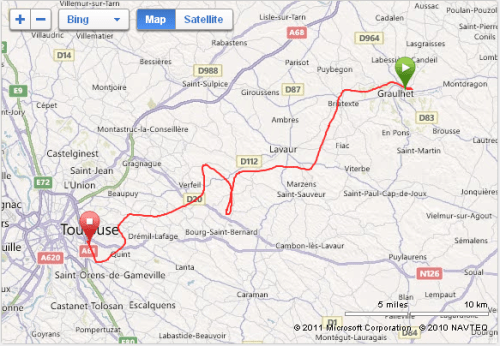
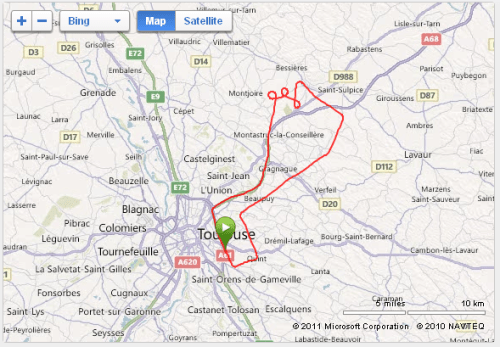
You may see the route we followed from Graulhet (LFCQ) to Toulouse-Lasbordes (LFCL) aboard the Robin DR-42 (F-GORM), as I recorded it with my Garmin GPS:

Flight route: LFCQ - LFCL

4 Comments

Filed under Aerospace & Defence

Wooden aircraft, cloth wings and pressure

Most of you, the readers of this blog, probably know that an airplane flies due to the difference in pressure between the upper (extrados) and lower (intrados) sides of its wing. This difference in pressure is due to the difference velocity of the airflow around both sides of the wing as you may see in the picture below:

Airflow around an airfoil (image from the Wikipedia, by Kraainnest).

As the speed above the wing is much higher, the difference in the pressure is mainly due to the lower pressure in the extrados. This can be seen in the following picture:

Pressure coefficient around an airfoil (by the Aircraft Aerodynamics and Design Group, Stanford University).

However, how could we see that in a real flight?

In commercial planes, of which wing skin is made of aluminium alloys this is not easily seen.

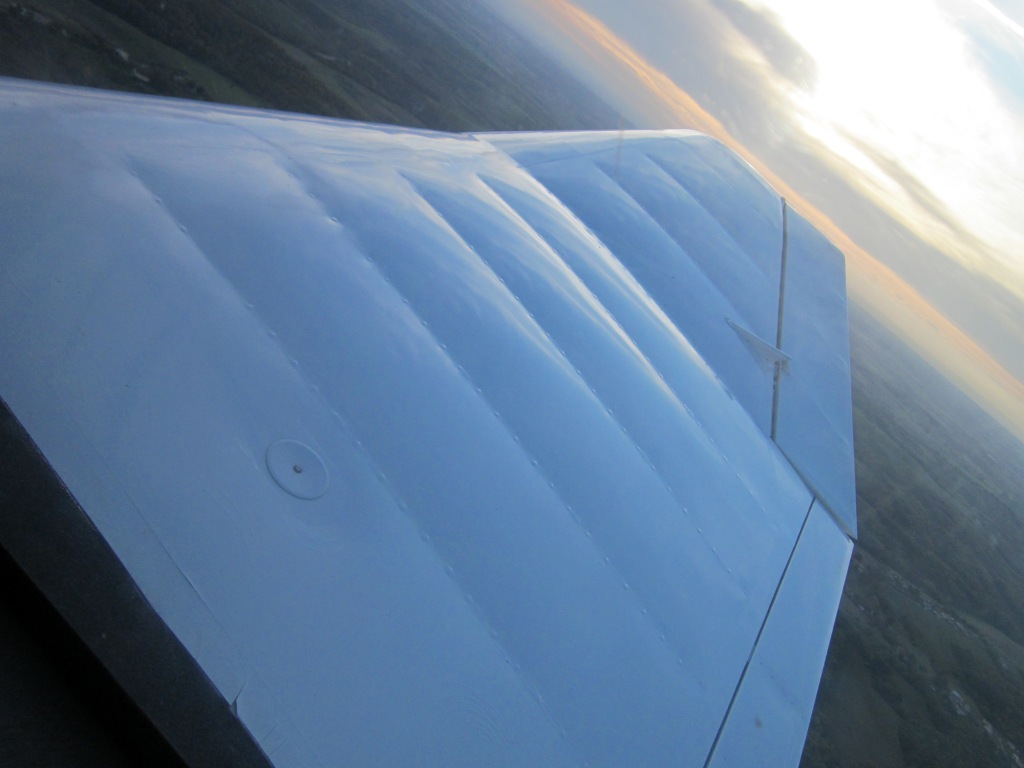
Two weeks ago, after my flight lesson was finished, I sat at the back of the plane to come back to Toulouse while my colleague had his lesson. It was then that I saw the image I captured in the following picture:

Wing extrados on air.

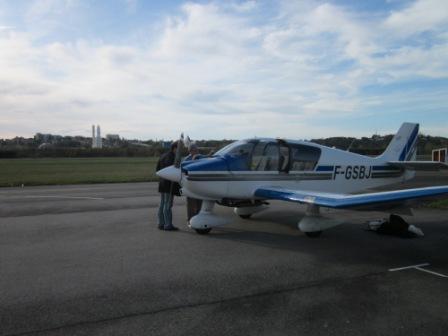
The aircraft we fly in our training lessons is a small Robin DR 400; a wooden aircraft of which wing skins are made of cloth. Not any cloth, but a type of polyester (PET) commonly used to build sailcloth, produced by Dupont and named Dacron. The surface is then lacquered with a polyurethane paint.

Robin DR 400 140

The air within the wing is at a higher pressure than the air in the extrados, and you can see how it expands and pushes up the cloth skin of the wing as you can see in the picture above.

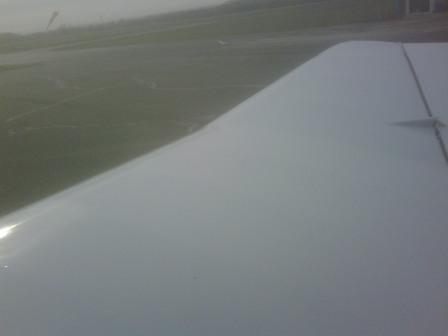
You may see below the same wing on ground. Though the picture is of a lower quality, you can see that in this case the wing doesn’t look “inflated”.

Wing extrados on ground.

9 Comments

Filed under Aerospace & Defence, Education

Flight lessons

About a month ago I started taking flight lessons at the ACAT aéro club, based in Lasbordes, a small aerodrome to the East of Toulouse.

I subscribed together with another Airbus colleague and both encouraged by a third colleague who had started some months beforehand.

Yesterday in the morning, the weather was not very good so we were not sure whether we would finally fly or not. Nevertheless, we had a theoretical lesson at first hour in the morning so we went to the aero club. At the break of the class, our instructor arrived and confirmed our flight. We took our stuff and skipped the second part of the class and headed towards the Robin DR-42 (F-GNNI) we flew.

For this second flight I decided to bring my Garmin GPS, which normally I use for sport activities, in order to record our flight, so that my colleague and I could better know where we had been flying. This will hopefully help us in getting to know better the Toulouse area from the air and with the navigation in the near future.

The flight was short and simple: practising pitching up/down, some steady turns and approach.

If you click on the map below you will be redirected to the Garmin website where you can read further information about the flight (time of the activity between switching on and off the engine) such as take-off, cruise and landing speeds. Do not pay attention to altitude figures, those reflected by Garmin are the ones of the terrain below (our track footprint).

Route of our flight: LFCL-LFCL

Some more pictures taken in yesterday’s class:

This slideshow requires JavaScript.

Clarification: as we fly two pupils plus the instructor, each time we perform 2 flights, that is why I was siting at the back when I took pictures during flight.

4 Comments

Filed under Aerospace & Defence, Education, France

787 Break Even for Dummies

My previous two posts on Boeing 787 break even (original and further discussion) were generally well received, as far as the insight they provided on the matter and the way they treated the different variables at play.

From the feedback, I understand they were quite dense regarding the amount of information they conveyed and not so easy to grasp for the general public.

In this post I will try to apply the old adage “A picture is worth a thousand words” and show everything which was mentioned in the previous posts in just four graphics.

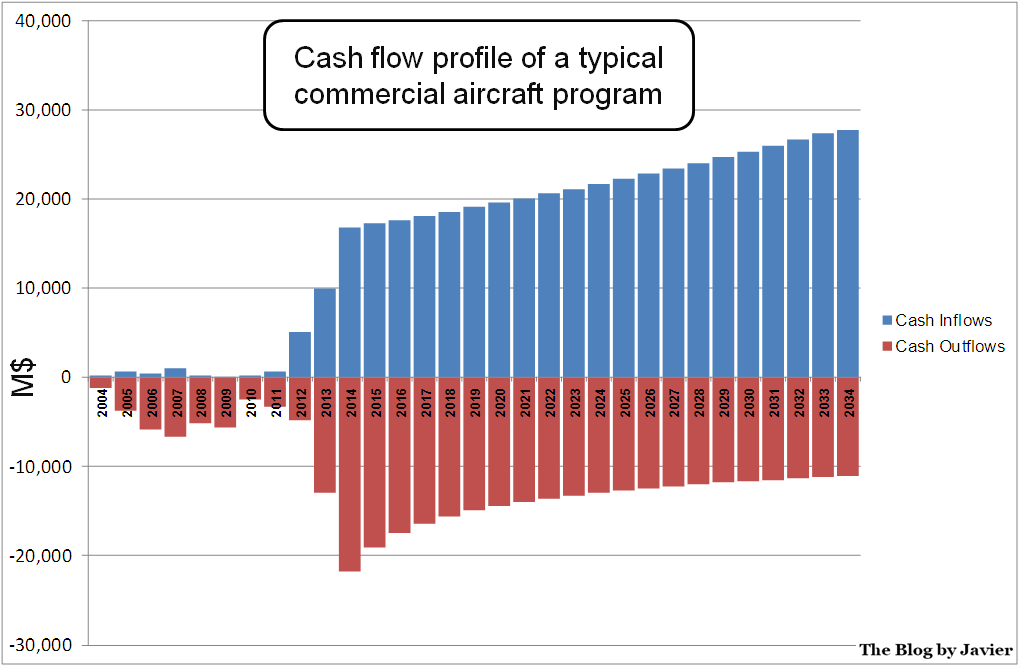
Forget the 787. Any new commercial aircraft program shows a similar cash flow profile, with initial cash outlays to cover the long the development period, a ramp-up of production and a learning curve effect once the series production advances.

Cash flow profile of a typical commercial aircraft program.

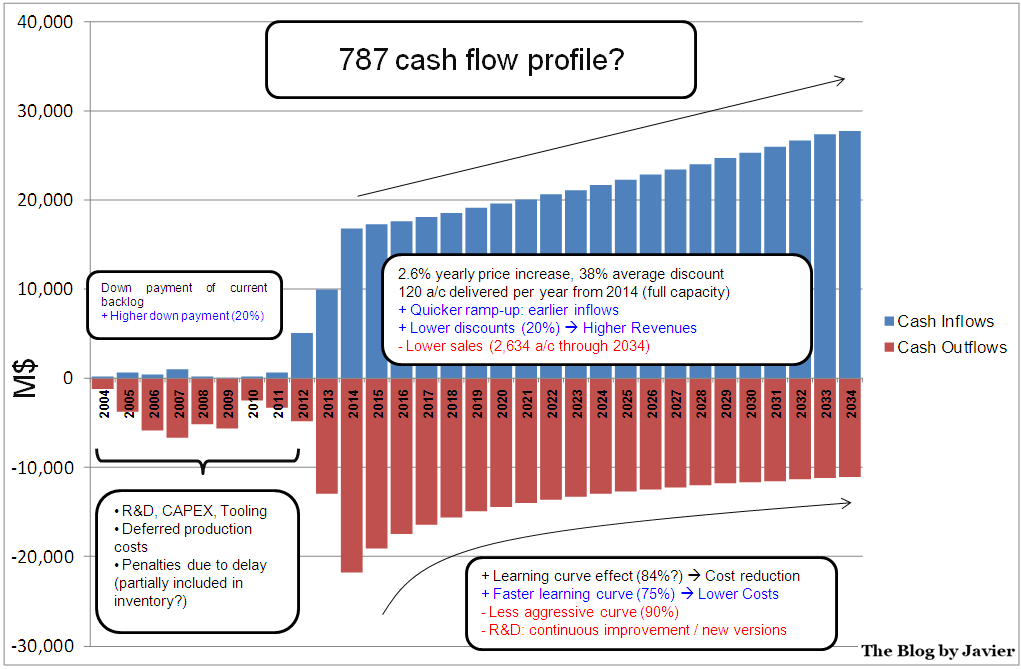
Take the case of the 787. The discussions made in the previous posts and the influence of the different variables are summarized in the different boxes of the next graphic.

787 cash flow profile?

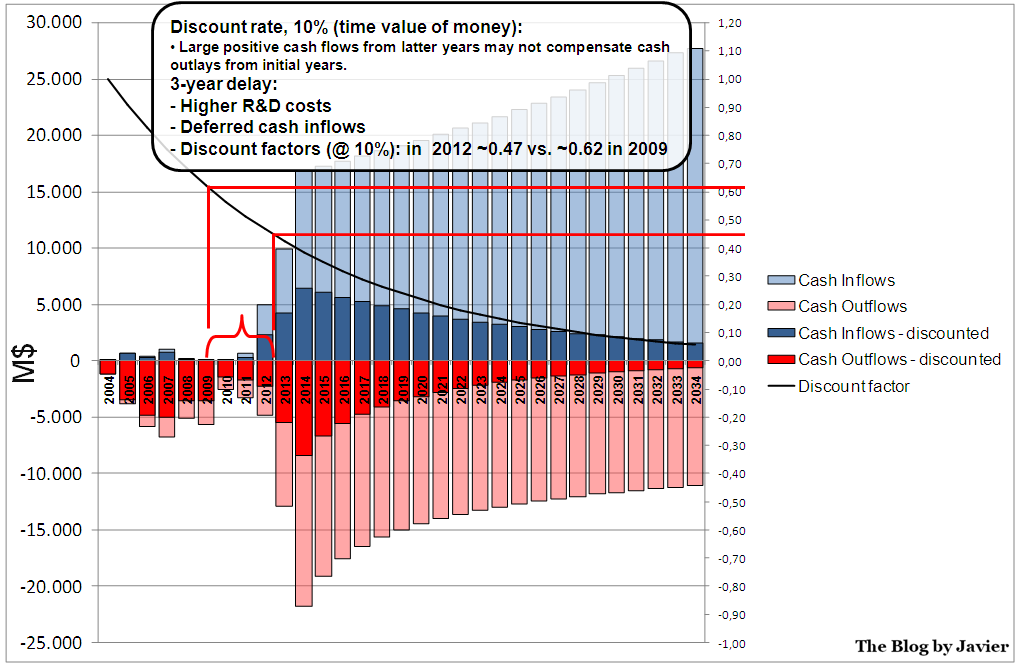
What is critical in a commercial aerospace program as an investment project? The long development period makes it difficult for the positive cash flows at the second half of the life cycle of the aircraft to compensate the initial cash outlays spent in R&D, capital investment and production of the first units. Why is that difficult? Due to the time value of money: A positive dollar of the tenth year will only compensate 39 cents of the first year (at a discount rate of 10%)…

787 cash flow profile affected by the time value of money.

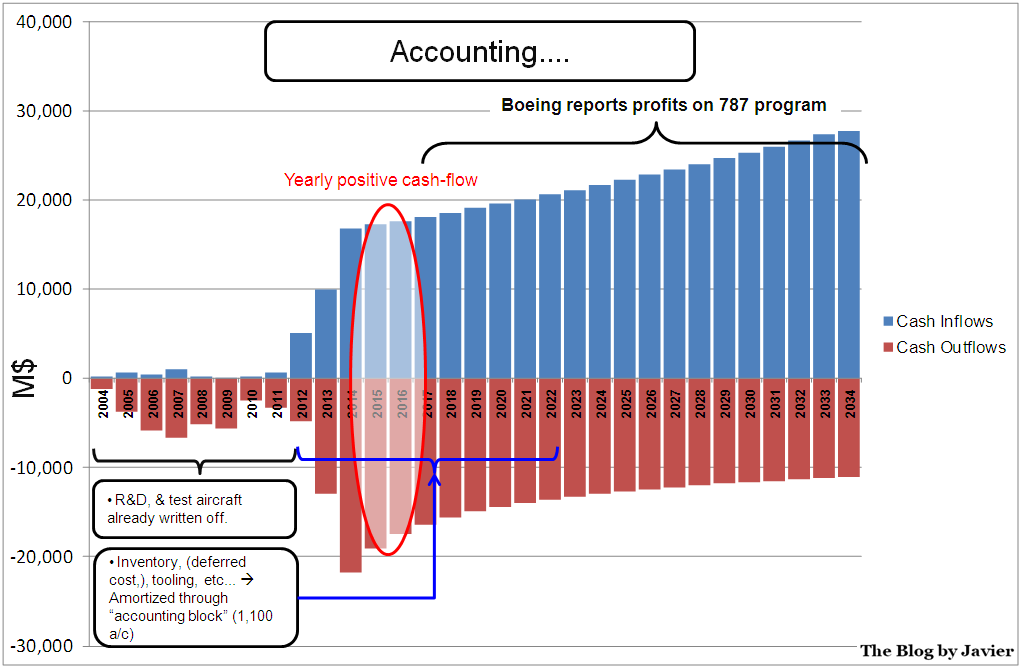
Let’s get back to the “accounting block”, what was going to happen around 2015, and whether the 787 would make profits for Boeing. In the yearly accounting, revenues are not discounted, thus the above discussion doesn’t apply. As soon as production costs plus amortization of initial investments are balanced by revenues, the 787 will make a profit for Boeing.

787 accounting block, profits...

After having shared all these plays with numbers and hopefully having shed some light over the issue, it is important to remind that these are just models and that what will finally happen will only depend on Boeing’s engineers, shop floor workers and sales teams.

“Not everything that counts can be counted, and not everything that can be counted counts.”

(Sign hanging in Einstein’s office at Princeton)

25 Comments

Filed under Aerospace & Defence