Patek Philippe Caliber 89

I confess that I am not much into fashion, complements and luxury items, not even watches. I guess all the watches I have had in the last 20 years have been presents from my mother and I don’t remember specifically having asked for any of them.

“You never really own a Patek Philippe, you merely take care of it for the next generation”, this all I knew about Patek Philippe, because of seeing its advertisements in The Economist magazine.

When I visited Geneva some weeks ago, a friend living there suggested that we could visit the Patek Philippe Museum (10 CHF) as one of the activities for the weekend, and so we did.

In the museum you almost get exhausted with the so many luxurious watches and pieces of jewellery that you see, but some of them make it definitely worth the visit.

The Caliber 89 is a commemorative watch built to celebrate the 150 years of existence of the company. The small shrine displaying the watch and its features is breathtaking. It is said to be the most complicated watch ever built. You may see below the data about the watch provided by the museum.
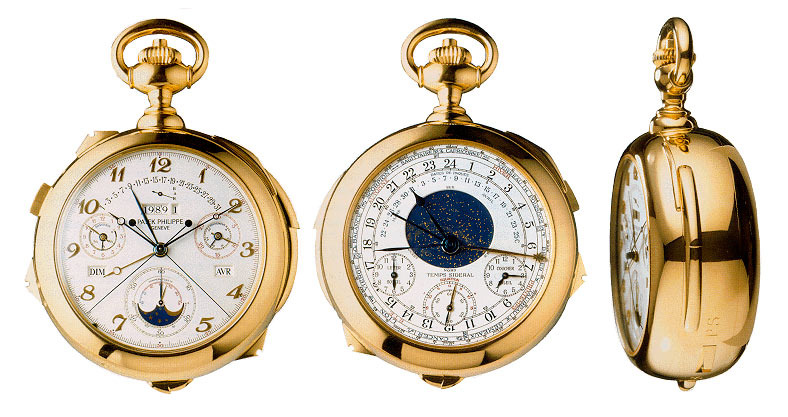
Patek Philippe Caliber 89

Total development time 9 years: 5 years for research and development, and 4 years in manufacture.

  • Total diameter 89 mm.
  • Total thickness 41 mm
  • Total weight 1100 grams
  • Case 18 ct. Gold

Number of components 1728, including:

  • 184 wheels
  • 61 bridges
  • 332 screws
  • 415 pins
  • 68 springs
  • 429 mechanical parts
  • 126 jewels
  • 2 main dials
  • 24 hands
  • 8 display dials

Functions:

  • Hours, minutes and seconds of sidereal time
  • Time in a second time zone
  • Time of sunset and sunrise
  • Equation of time
  • Tourbillon regulator
  • Perpetual calendar
  • Century leap year correction
  • Date of the month
  • Century, decade and year
  • Day of the week
  • Months
  • Four-year cycle
  • Sun hand (season, equinox, solstice, zodiac)
  • Stars chart
  • Age and phases of the moon
  • Date of Easter
  • Chronograph
  • Split-seconds
  • 30 minute recorder
  • 12 hour recorder
  • Grande Sonnerie with carillon
  • Petite Sonnerie with carillon
  • Minute-repeater
  • Alarm
  • Going train up-and-down indication
  • Striking train up-and-down indication
  • Striking train stop work
  • Twin barrel differential winding
  • Four-way setting system
  • Winding-crown position indication

You may see below two videos explaining the watch and the process of building watches by Patek Philippe.

Finally, you may find this interesting post (in Spanish) about the Caliber 89, there I found the videos.

10 Comments

Filed under Travelling

Why do I prefer Coke

Some weeks ago I read an article about why do we prefer Coke over Pepsi by the blogger Farnamstreet (1). It mentioned a marketing initiative by Pepsi some years ago, “The Pepsi Challenge”, in which blind test were organized to see whether consumers preferred one or the other. Pepsi consistently advantaged Coke in the tests.

The article mentions other studies in which it is explained why nevertheless Coke still outsells Pepsi. In the end it seems to be due to the powerful brand Coca Cola has created along history and its association with happiness and satisfaction. This is an extreme case of what Warren Buffett describes as moat:

Definition of ‘Economic Moat’

The competitive advantage that one company has over other companies in the same industry. This term was coined by renowned investor Warren Buffett.

Investopedia explains ‘Economic Moat’

The wider the moat, the larger and more sustainable the competitive advantage. By having a well-known brand name, pricing power and a large portion of market demand, a company with a wide moat possesses characteristics that act as barriers against other companies wanting to enter into the industry.

My preference for Coke

Luca and I did this kind of blind test about 4 years ago when we lived in Madrid. We had heard of these tests and I was sure I could distinguish one from the other.

Normally, I never buy Pepsi (except when you order a “cola” at some place where there is no Coke). For the test we purchased both Pepsi and Coke, and placed them in the fridge for a while. Then I got blinded. Luca took them out of the fridge and poured each in a different glass (same kind of glass) with ice cubes. Then she offered me one glass. I tasted it.

“Ok, I don’t even need to test the other one, this is Pepsi”, I said. Then, I thought “well let’s try the other to confirm my choice”. I tasted the other glass… then I tasted again the first one. I ended up completely lost. I couldn’t tell one from the other. I finally changed my initial decision.

I was wrong in the test. Since then, I have told some friends about the experiment. Most of these friends claim they would indeed distinguish one from the other. They would probably even state that they prefer Coke due to its flavour (of course, I have no friend who prefers Pepsi! Who does?)…

After having done the test, no doubt I continue to buy Coke, but now I am aware that it is partly due to some behavioural trick being played within my mind, the kind of trick explained in the article.

(1) Farnam Street being the street in Omaha where Berkshire Hathaway HQ are located.

NOTE: You may want to read this case by Charlie T. Munger, Berkshire Hathaway vice chairman, about the compounding effects that led to the tremendous success of this carbonated water drink. The essay was part of a lesson he gave at USC Business School in 1994 and appears in his book “Poor Charlie’s Almanack”.

3 Comments

Filed under Economy, Marketing, Miscellanea

Benjamin Franklin

Benjamin Franklin, by Joseph Siffred Duplessis (public domain image).

Benjamin Franklin was one of the Founding Fathers of the United States. The Wikipedia describes Franklin as a leading author, printer, political theorist, politician, postmaster, scientist, musician, inventor, satirist, civic activist, statesman, and diplomat; what is called a polymath.

Following Luca’s recommendation, I read some months ago Franklin’s autobiography. It was terrific. For the most part it describes his early life and how he was rising in the society and the origin and the work behind some of his great contributions to society: “Poor Richard’s Almanack” (which includes a collection of sayings that mark not only American culture but Western culture in general), “The Pennsylvania Gazette”, the first public lending library in America, the first fire department in Pennsylvania, etc.

One initiative that I especially liked was the creation of the Junto club; a club for mutual improvement where its members debated all kinds of questions from morals and politics, to sciences and business. This reminded me to the joy I have attending a particular Toastmasters meeting when you feel you have learnt something from the speeches you have heard. I will have to check whether there are such broad mutual improvement clubs in Toulouse (… note that he just went and created it! When he was 21!).

Other remarkable aspect was his setting of 13 virtues by which he was going to live (he did that at age 20) and apparently managed to practice for the rest of his life.

  • “Temperance. Eat not to dullness; drink not to elevation.”
  • “Silence. Speak not but what may benefit others or yourself; avoid trifling conversation.”
  • “Order. Let all your things have their places; let each part of your business have its time.”
  • “Resolution. Resolve to perform what you ought; perform without fail what you resolve.”
  • “Frugality. Make no expense but to do good to others or yourself; i.e., waste nothing.”
  • “Industry. Lose no time; be always employ’d in something useful; cut off all unnecessary actions.”
  • “Sincerity. Use no hurtful deceit; think innocently and justly, and, if you speak, speak accordingly.”
  • “Justice. Wrong none by doing injuries, or omitting the benefits that are your duty.”
  • “Moderation. Avoid extremes; forbear resenting injuries so much as you think they deserve.”
  • “Cleanliness. Tolerate no uncleanliness in body, cloaths, or habitation.”
  • “Tranquility. Be not disturbed at trifles, or at accidents common or unavoidable.”
  • “Chastity. Rarely use venery but for health or offspring, never to dullness, weakness, or the injury of your own or another’s peace or reputation.”
  • “Humility. Imitate Jesus and Socrates.”

Finally, last November, Luca and I visited the only remaining house where Benjamin Franklin once lived, for nearly sixteen years between 1757 and 1775, in one of his periods in London. I definitely recommend the visit to the house, at 36 Craven Street (2 blocks from Trafalgar Square), as it doesn’t take more than an hour and the animation that goes with it makes it highly entertaining (it goes without saying it that I highly encourage the reading of his autobiography).

2 Comments

Filed under Books, Travelling

Hazard and probabilities

Two weeks ago I visited Geneva for the first time. Among other things we visited a museum out of “our programme”, the History of Science Museum.

The ground floor of the museum had some tools that were in use in the past century in science research (microscopes, telescope, Earth globes…). In the upper floor there was a temporary exhibition about hazard, probability and games (“Les jeux sont faits! hasard et probabilités“). That one was great. Few times I had a better time in a museum than there. To name but a few of the games and tricks it had: rigged dice for the visitor to throw (and contribute to the experiment by noting down results), the game of the three-door game with a prize behind one of them (always change of choice when given the chance!), a small casino roulette (not only I didn’t lose any cash this time but finally I could throw the ball and say “rien ne va plus!”), a russian roulette, etc.

The interactive experiment that I enjoyed the most was one that challenged the visitor to guess the weight of a die. As a reference there were given three weights of 1, 3 and 5 kg to compare the die with (there was no scale). You had to enter your guess in a screen (my guess was 2.5 kg). Right afterwards you got information of previous visitors’ guesses: from 1 to 9.5kg (!), average weight guess of about 2.83kg… no one would tell you the solution. I don’t know how, but I hope I’ll get to know the solution to the quiz, even if it won’t be published until the exhibition finishes (January 2013).

Another feature that I loved of the museum was that in many of its rooms it had small brochures to be taken by the visitor as a complement of the visit. I took many of them to read them afterwards. It happens to me many times that after a couple of hours of slowly walking and reading lots of different interesting things in a museum I simply can’t take anymore of it. With these brochures you can make a lighter visit, knowing that the details you skip while at the museum can be read later on.

This slideshow requires JavaScript.

I highly recommend the visit to the museum. The visit will not take much longer than an hour (unless you engage yourself in every single game), it only requires a small diversion from the walk by the lake and by the way the admission is free.

6 Comments

Filed under Travelling

Radial engine

I found myself thinking back in the National Air & Space Museum recently. Firstly, because a friend announced that she had just visited it and secondly because yesterday we oversaw  reciprocating engines at the class of the theoretical course for the private pilot licence.

The class itself was not telling nothing completely new, but it reminded me that I had a video of a demo of a radial engine recorded last year at the NASM in Dulles. I filmed it in order to upload it at some point… here it is:

For those not initiated, you may find how reciprocating engines work here, and more specifically how radial reciprocating engines work here.

I’ll never get tired of praising the Smithsonian institution.

2 Comments

Filed under Aerospace & Defence, Movies

Landing at a car racing circuit

Albi is small city close to Toulouse. It is mainly famous for its UNESCO World Heritage Site Cathedral Sainte Cécile and the museum of the painter Toulouse-Lautrec. I had been there twice, but I hadn’t yet written a post about the city. Today I’ll write about another special feature it has.

In Albi there is a car racing circuit. I have a colleague who likes cars, motor-bikes and has been already using that circuit in one of its open days.

Yesterday, I wrote a post about the stall exercises we performed in last Saturday’s flight lesson.

Let me connect the dots. On Saturday, while having lunch, our colleague told us that the circuit in Albi was having an open day that precise day. He encouraged us to propose to our instructor to fly to Albi. And here comes the catch: “Why?” Because the aerodrome of Albi, our colleague explained to us, is embedded in the car racing circuit!

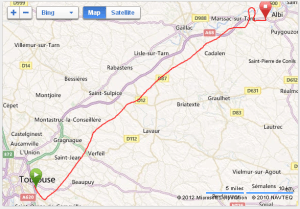
We gave it a try, demanded our instructor to go to Albi and succeeded. See below the flight path recorded with my Garmin:

Flight route Toulouse Lasbordes (LFCL) - Albi (LFCI).

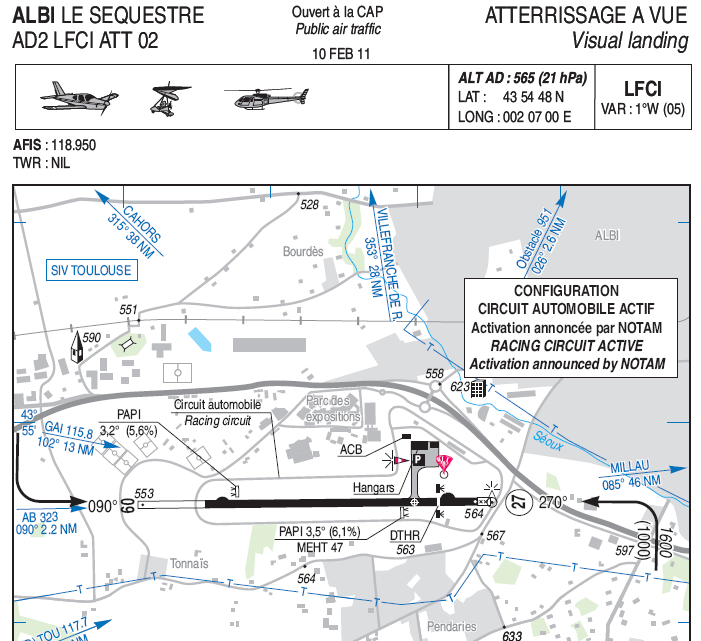
In the following screenshot of the Visual Approach Chart (carte VAC) you may see how when the circuit IS active the runway of the aerodrome is shortened as the circuit crosses the runway! (You may download the chart here, PDF, 360KB).

Visual Approach Chart (VAC) for Albi aerodrome when the car racing circuit is active.

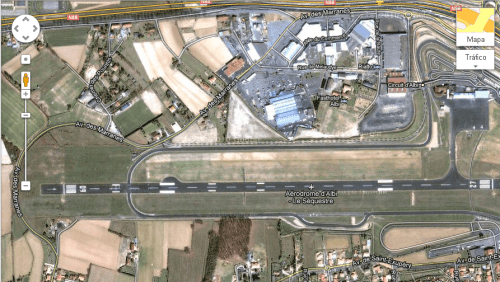
You may see it better below, in the Google maps view, how the circuit intersects the runway:

Albi car racing circuit and aerdrome.

Finally, enjoy the video of the final approach of our flight. If you pay attention to it, you’ll notice the cars racing in the circuit while we are approaching and how we are in fact touching down only within the allowable space when the circuit is active:

1 Comment

Filed under Aerospace & Defence, Movies

Stall exercise

Yesterday, I wrote about a documentary on the AF447 accident. Within the video, a flight instructor performs a real stall exercises and he mentions that this is taught in the first lectures of flight instruction.

As I mentioned in the post, I learnt about the documentary while having lunch with 2 colleagues. I was telling them “I’d like to perform those stall exercises to see what feeling does your body have and how you instinctively react to it and how you have to consciously correct that reaction”.  As the old adage goes “be careful what you wish for ’cause you might get it”.

After lunch, we headed to the aeroclub to have our class. Thierry, our instructor, opened by asking whether we had seen that documentary we had been talking about. Then, he mentioned “let’s do today stall exercises!” 🙂

Shortly, from the Wikipedia:

[…] a stall is a reduction in the lift coefficient generated by a foil as angle of attack increases. This occurs when the critical angle of attack of the foil is exceeded. […]
Stalls in fixed-wing flight are often experienced as a sudden reduction in lift as the pilot increases angle of attack and exceeds the critical angle of attack […].

The theory of the exercise was easy: fly up to 3,000 ft, reduce the power of the engine down to idle, try to keep the altitude by pulling the stick backwards (nosing up), keep pulling the stick backwards when the stall alarm sounds off, wait until the aircraft starts buffeting, cannot maintain altitude and falls off… then push a little the stick (nose down), recover speed (above stall speed), start nosing up again while increasing power up to max rpm, get to 3,000 ft again. Easy.

The practice… well, my colleague was doing his exercises first while I was sitting at the back. I went from being warm due to the sunny weather to feeling uneasy to experiencing this cold sweat…

You may see the video below with one of the stall exercises performed by my colleague. You’ll notice the stall alarm (in this case it is just an alarm, not a voice saying “stall”):

Apologies for 1) bad quality of the video performed by my not-so-smartphone and 2) for not having recorded a video of my own stall exercises… I was too stressed with them 🙂

Note: For the record, in the documentary it is mentioned that pupils get to practice stall in their first lessons. Yesterday’s was my 10th flight in order to obtain the PPL (private pilot licence), up to then I had completed just slightly above 6 flight hours.

3 Comments

Filed under Aerospace & Defence, Movies

Reconstruction of AF447 accident

The accident of the flight Air France 447 was deadliest in the history of the airline and, since it happened almost 3 years ago, has appeared every now and then in the media. Today, while having lunch with two colleagues I learnt about a documentary about it that was shown in French TV channel France 5 last Wednesday.

The documentary, produced by Bernard Vaillot, is titled “Vol Rio-Paris, les raisons d’un crash“,  lasts about 50 minutes, and the programme in which it was emitted included an interview afterwards (complete programme duration 1h08′).

The documentary includes as main attraction a reconstruction of the last 4 minutes of the flight. This reconstruction is built from the cockpit voice recorder (CVR) and the flight data recorder (FDR), often referred as black box. A complete transcription, with comments, interpretation and an exhaustive description of the events can be found in the different interim reports, briefings and releases made by the French BEA (Bureau d’Enquêtes et d’Analyses), the body in charge of the accident investigation.

In the BEA reports [PDF, 10.3MB, New Findings, pgs. 77-78] some facts were established: such as the loss of correct speed indication due to the icing of the pitot probes, the disconnection of the autopilot and the subsequent reaction from the pilot, pulling the stick towards him nosing up the aircraft, increasing the angle of attack until the aircraft enters in stall.

Other interesting features of the documentary are the testimonies of different pilots, including a real stall exercise performed by a flight instructor (from minute 25). He first shows how to recover from a stall, then he simulates the wrong reaction from the AF447 pilot, pulling the stick towards him, pitching up, while the stall alarm was still sounding.

You may see the following trailer below before venturing to see the whole programme.

EDIT: The trailer video has been deleted from Youtube, however, now the full video is available:

Unfortunately, I haven’t yet seen a subtitled or doubled version of it.

5 Comments

Filed under Aerospace & Defence

Competing

Pierre de Coubertin said “The most important thing is not to win but to take part!”. After two years serving as Area Governor in Toastmasters, last weekend speech contest at Toulouse Rosemasters was the first time in which I could take part in speech contests again. I didn’t leave this opportunity.

Some people do not see what is in the competition for them. They tend to see it as very much American. Or they may think there is someone who is a better speaker, thus, no purpose in battling in the competition. Others may be afraid not only of public speaking but even more if there is a competition around.

I may understand those points, nevertheless I still think Toastmasters’ members should give it a try. There is always something to learn from that experience. My speech in the contest was a try to explain that.

3 Comments

Filed under Toastmasters

Weight and balance

As part of the preparation of a flight, the pilot shall make sure that the total weight of the aircraft (including fuel and passengers) is at or below the limits, and that the center of gravity is within a certain area. This is what is called weight and balance.

Some months ago, in our private pilot licence course we had a class where we reviewed this. I remember that one pupil asked “is it possible that the aircraft gets knocked over backwards on ground?” (imagine the aircraft “sitting” on its tail).

This question led me to make the numbers to see whether this was possible with the aircraft we are using for our lessons, a Robin DR 400.

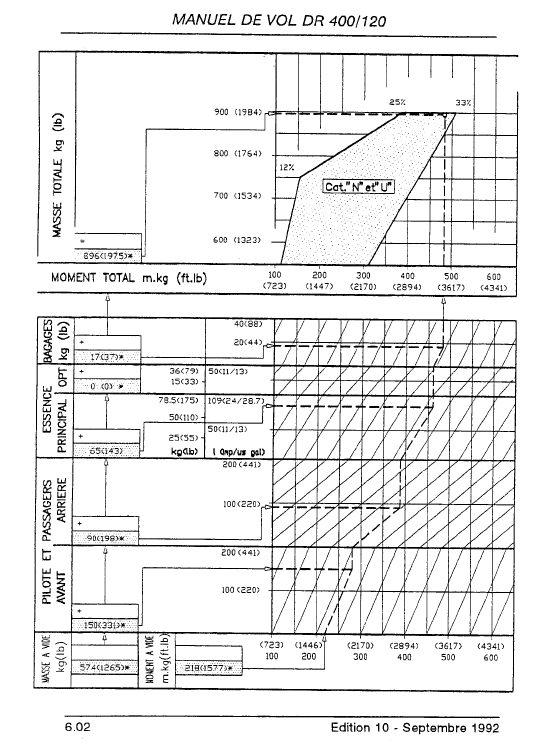
Centrogram for a DR400-120.

For this purpose we use a centrogram, which is nothing but a small “map” where the different possible weights that can be loaded into the aircraft and its momentum are already drawn so the center of gravity can be easily calculated and checked whether it falls or not in the allowed area. This centrogram is included in the flight manual of the aircraft.

I found that, carrying 2 pilots (~154kg) plus 2 passengers (~154kg), you could never load much weight into the rear compartment reserved for baggage. As that area is the one behind the main landing gear, you wouldn’t knock over the aircraft on ground.

If instead of 2 pilots and 2 passengers, you had only 1 pilot and you would load the same weight (~231kg) as baggage, the aircraft would be unbalanced but still wouldn’t fall backwards and sit on its tail. Even if the center of gravity of the baggage compartment is behind the landing gear, the weight of the empty aircraft with a center of gravity between the nose and main landing gear over compensates our trick.

Once I had calculated this, I went one step further: in which cases being under the maximum take-off weight (MTOW, 1,000 kg for a DR400-140) given by the designer could the aircraft be unbalanced? That is, what is required to get the centre of gravity out of the allowable range?

I found that to get the aircraft unbalanced basically you would need to load it in two different ways that at first seemed quite bizarre to me:

  1. You would need to carry only 1 pilot and 2 passengers (plus at least 25 kg of baggage and bearing in mind not to exceed the MTOW), but instead of two of them occupying the front positions and one sitting at the back, you would have a single adult piloting the aircraft and the other two at the back. I’ve never seen that.
  2. You would need to have 1 or 2 adults piloting the aircraft, no passenger at the back plus at least 100 kg of baggage at the back. Why would one person carry so much baggage for a short trip with a Robin DR 400? Here I would add that the designer of the aircraft placed a small plaque indicating that no more than 40kg should be loaded in the baggage compartment.

Well, the two cases can be referred respectively to the following situations:

  1. A couple formed by future groom and bride flying alone with a pilot. Maybe that flight was used by the man to propose the marriage. Well, now you know it, that’s not a good idea, it could make the aircraft unstable (takeaway: no proposals in small aircraft).
  2. Drug-trafficking. I can imagine such small aircraft being used to carry as many drugs as possible… well, apart from being illegal, if someone would carry too much (that is over 100kg), even when below the maximum allowed weight, would make it unstable.

2 Comments

Filed under Aerospace & Defence