Tag Archives: Berlin

Marathon world record evolution (2026)

Last year I wrote an update of the all-time men’s marathon best times and the world record evolution (post here, following an older one from 2014, ahead of running that year’s Rotterdam marathon). This is a new update including 2026 best time as this has been an extraordinary year: the world record has been beaten and the two hours barrier has been broken in an official race for the first time in history. The 2026 version of the post includes all marathon times below 2h08′ up to and including today’s New York marathon.

As in the previous posts, I use the website “Track and Field all-time Performances” (maintained since years ago by Peter Larsson). As Larsson has not updated his marathon times list since mid August, this time I completed the dataset with World Athletics all-time toplists (which added 86 times from the races between late September and late October) and with today’s New York marathon results (from LetsRun, still provisional at the time of writing, as NYRR has not yet published the official ones).

With the data of all-time best men’s marathon I plotted the chart below with the best 2,239 times, i.e., all those below 2h08′, and their dates, highlighting marathon times by Haile Gebrselassie, Wilson Kipsang, Eliud Kipchoge, Kenenisa Bekele, Kelvin Kiptum, Sabastian Sawe, Yomif Kejelcha, Jacob Kiplimo and Amos Kipruto.
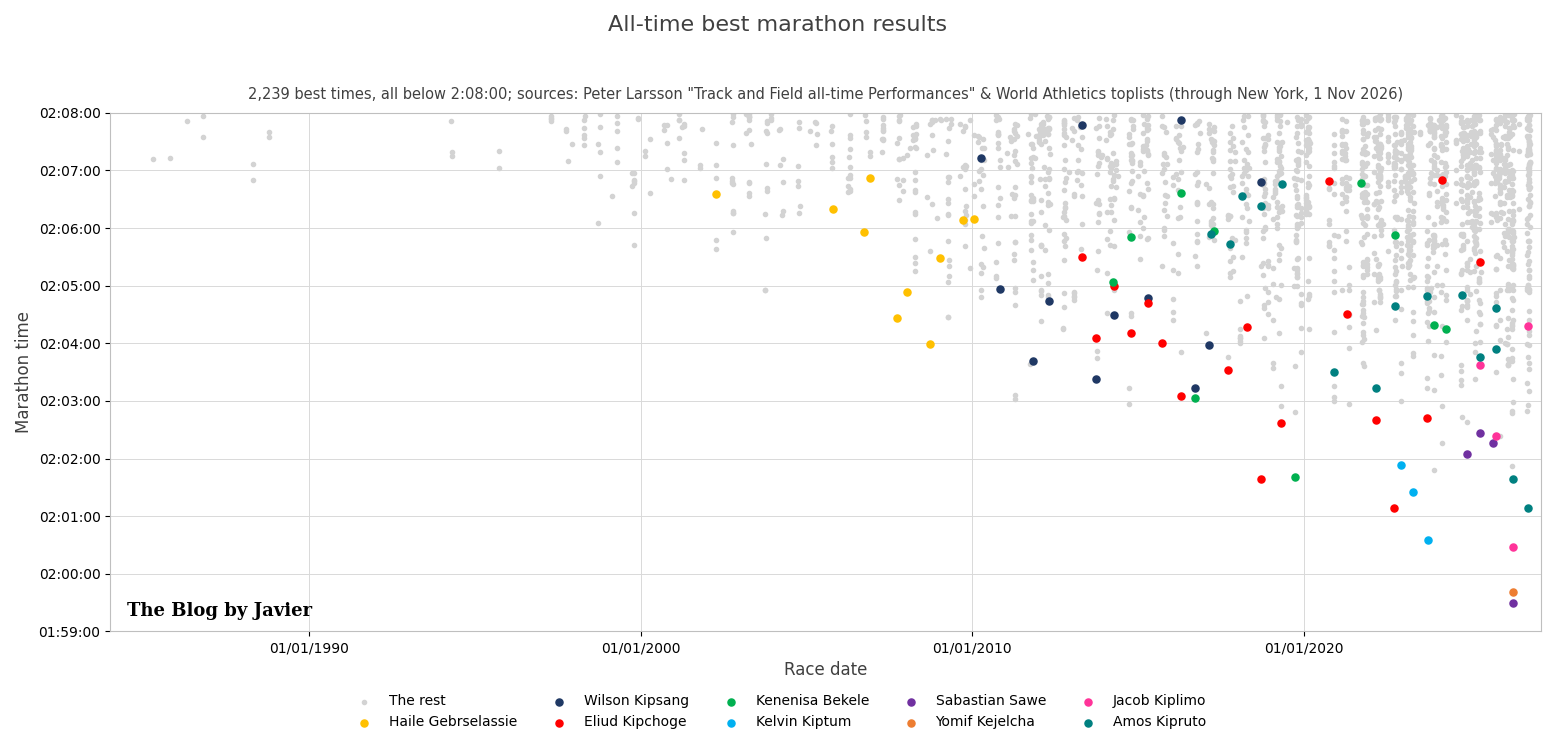
All-time best marathon results, 2,239 times below 2h08

Some stats in relation to those 2,239 times under 2h08′ (they were 1,903 when I reviewed them in September 2025; 249 of them have been achieved in 2026 alone, more than in any previous year!):

  • Countries of which athletes achieved most such times: Kenya 959 times or 42.8%, Ethiopia 666 times or 29.7%, Japan 138 (6.2%), Morocco 51 (2.3%), Eritrea 51 (2.3%), USA 34 (1.5%), Uganda 27 (1.2%), Spain 27 (1.2%), Israel 26 (1.2%). Those are the top 9 countries, there are another 35 from which athletes have run below 2h08′ (for a total of 44 countries).
  • There are 872 athletes that have run below 2h08′. The individuals who have done so more often: Eliud Kipchoge 18 times (he still runs marathons, he even won the Melbourne marathon 3 weeks ago in 2h09 at 41 years old!), Sisay Lemma 17, Tamirat Tola 16, Amos Kipruto 15, Tsegay Kebede 15, Benson Kipruto 14, Abel Kirui 13, Evans Chebet 12, Wilson Kipsang 12, Geoffrey Kamworor 12, Bernard Kiprop 12, Birhanu Legese 11, … Kenenisa Bekele 10, Haile Gebrselassie 10…

Now, if we raise the bar to see the times at or below 2h05′, we find 301 times (they were 231 a year ago):

  • Countries of which athletes achieved most such times: Kenya 135 times or 44.9%, Ethiopia 121 times or 40.2% (both combined 85.1%!), Uganda 7 (2.3%), Tanzania 7 (2.3%), Belgium 5 (1.7%), Germany 5 (1.7%). Those are the top 6 countries, there are another 15 from which athletes have run at or below 2h05′ (for a total of 21 countries, 5 more than last year).
  • There are 154 athletes that have run at or below 2h05′ (30 more than last year). The individuals who have done so more often: Eliud Kipchoge 14 times, Amos Kipruto 10, Tamirat Tola 10, Wilson Kipsang 8, Sisay Lemma 7, Birhanu Legese 6, Gabriel Geay 5, Alexander Mutiso 5, Leul Gebrselassie 5, Sabastian Sawe 4,  Kenenisa Bekele 4, and several other athletes with 4, and with 3 times including Kelvin Kiptum, Dennis Kimetto, Geoffrey Mutai and Haile Gebrselassie.
  • Which are the fastest marathons? The cities where most of those 301 times at or below 2h05′ have been achieved are: Berlin 41, Valencia 39, London 33, Amsterdam 28, Dubai 27, Chicago 24, Rotterdam 22, Tokyo 21. Those are the top 8 cities (accounting for 78% of those 301 times), there are other 17 cities where such fast times have been achieved.

Now let’s look at the evolution of the World Record since 1985 in this other chart:
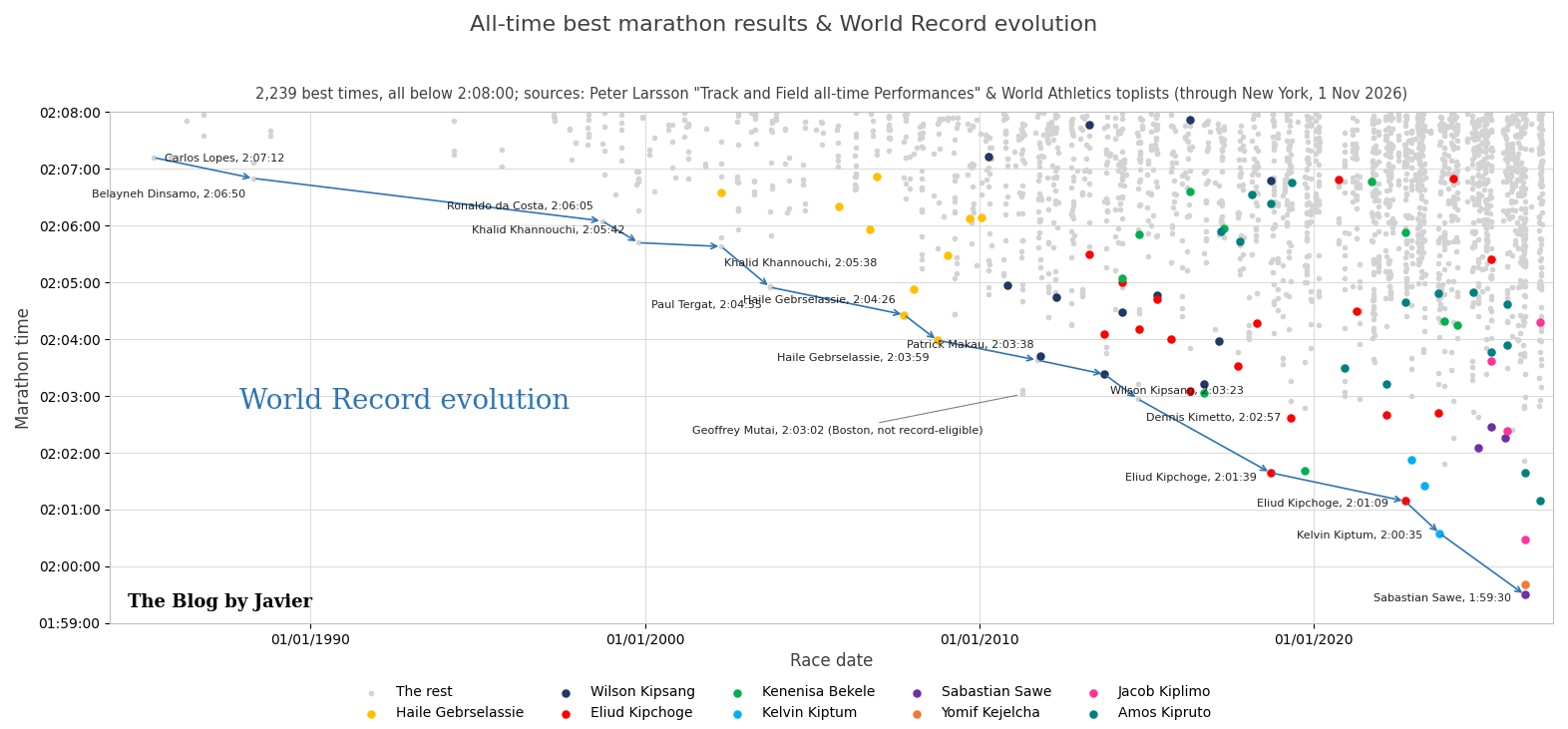
World record evolution since 1985, ending with Sawe 1:59:30 in 2026

Some comments to the chart:

  • In the last 41 years, the record has been beaten 14 times.
  • The current world record was set by Sabastian Sawe in London on 26 April 2026 with 1h59’30”, at the age of 31. It is the first official time below 2 hours and it was ratified by World Athletics in July (Eliud Kipchoge had run 1:59:41 in Vienna in 2019, but that exhibition, with rotating pacemakers, was not record-eligible).
  • That London race was historic beyond the record: Yomif Kejelcha (1h59’41”) and Jacob Kiplimo (2h00’28”) also finished under the previous world record, with Amos Kipruto 4th in 2h01’39”, Tamirat Tola 5th in 2h02’59” and Deresa Geleta 6th in 2h03’23”.
  • Sawe took 1’05” off Kiptum’s record, which had lasted two years and a half. The biggest improvement of the record was still made by Eliud Kipchoge, who took 1’18” off Dennis Kimetto’s previous record in 2018.
  • The record that lasted the most was Dinsamo’s 2:06:50 in 1988, which took just over 10 years to be beaten by Ronaldo da Costa in 1998.
  • 3 athletes have set the world record twice: Khalid Khannouchi, Haile Gebrselassie and Eliud Kipchoge.
  • Geoffrey Mutai ran in 2h03’02” in Boston 2011 and this year John Kipkosgei won Boston in 2h01’52”; as Boston is a downhill point-to-point course, those times do not count for the record.
  • In the same day in London, Tigst Assefa set a women-only world record of 2h15’41” (improving her own mark from 2025), with Hellen Obiri (2h15’53”) and Joyciline Jepkosgei (2h15’55”) completing the first race ever with 3 women below 2h16′ (see World Athletics report and London Marathon).

Other remarkable marathon facts from 2026:

  • Amos Kipruto won Chicago in 2h01’09”, equalling to the second the world record that Kipchoge had set in Berlin 2022.
  • Guye Adola won Berlin in 2h02’50”, and Tamirat Tola won Beijing in 2h03’10”.
  • Eliud Kipchoge, close to turning 42, ran won Melbourne two weeks ago.
  • Today in New York, Andreas Almgren (the reigning world half marathon champion) won in his marathon debut with 2h06’01”; 13 men ran below 2h08′.

What is the best age to run marathons?

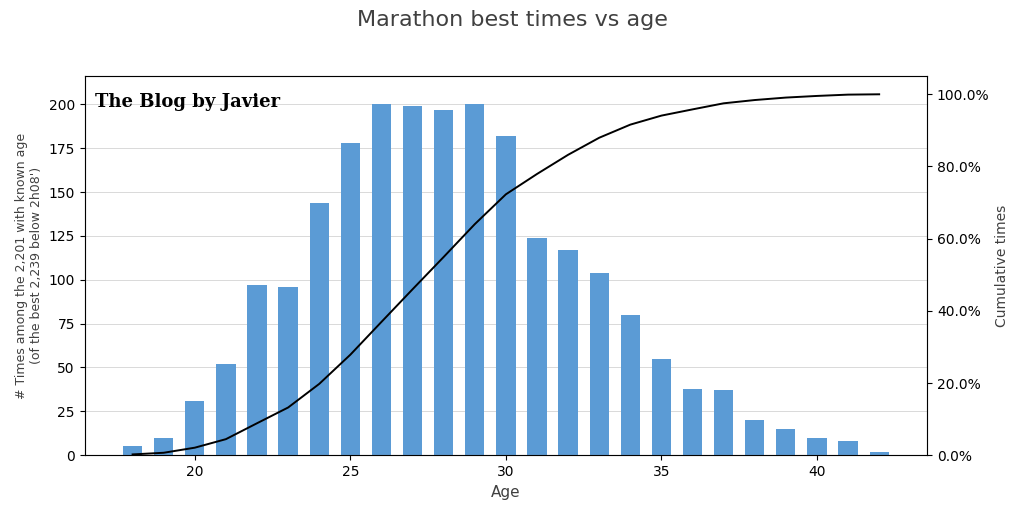
I plotted this other chart looking at the best 2,239 marathon times vs the age the runners had at the time of completing each of those races (for the 2,201 of them for which the sources include the full birth date).
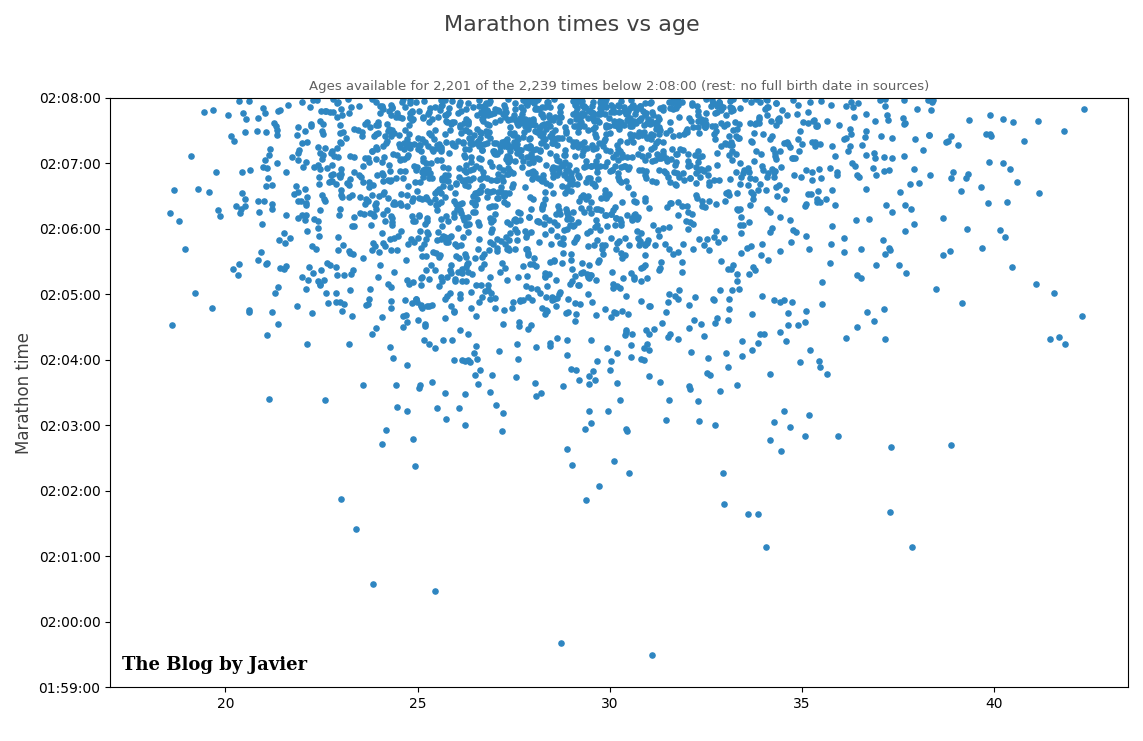
Marathon times vs age

Most of the times below 2h08′ are achieved between 23 and 33 years old, and the very best ones are spread between 25 and 37, with the exceptions of the 3 marathons ran by Kelvin Kiptum, including his former world record at 23.9, Tadese Takele (2h03’24” at 21.1) and the 2h00’28” by Jacob Kiplimo at 25.4. Sawe’s world record, on the contrary, was set at 31.1. The youngest ever to run such a fast marathon was Tsegaye Mekonnen: 2h04’32” in Dubai 2014 at 18.6.

Another interesting chart to relate best times and age is the histogram below. In that one we can see that effectively most of the times below 2h08′ are achieved between 24 and 30 years old, and between 23 and 33 (both included) 79% of those times are achieved.
Histogram of marathon best times by age

Let’s see what Valencia brings in December with Yomif Kejelcha and John Korir on the roster.

Leave a comment

Filed under Sports, Uncategorized

Holocaust Memorial (Berlin) and unintended consequences

The Holocaust Memorial or Memorial to the Murdered Jews of Europe was inaugurated in Berlin about 7 years ago close to the Brandenburg Gate.

If you see the following picture from Wikimedia, you get a glimpse of what could be a huge cemetery of concrete slabs.

Holocaust Memorial (by de:Benutzer:Schreibkraft).

The memorial is described in the Wikipedia with the following words:

“It consists of a 19,000 square metres (4.7 acres) site covered with 2,711 concrete slabs or “stelae“, arranged in a grid pattern on a sloping field. […] According to Eisenman’s project text, the stelae are designed to produce an uneasy, confusing atmosphere, and the whole sculpture aims to represent a supposedly ordered system that has lost touch with human reason.“

However, the memorial is not to be contemplated from the air as seen above, but from the ground and people can walk through it.

If you visit the site you’ll experience or watch some unintended consequences:  people tend to sit on the stones, run between them, jump from one to another, play “hide and seek”… the least people do is to experience with light and shadows, distances, slopes…

This slideshow requires JavaScript.

Then there is a poor security guard calling on people (sometimes bunches of playful students) to “behave”, not to run, jump, etc.

1 Comment

Filed under Travelling

Old Berlin key lock system

During our last stay in Berlin we were lodged at a hostel in Fasanenstrasse, close to Kurfürstendamm (Charlottenburg). The pension was in an old building which was protected by some urbanism laws which prevented the owners to perform some works.

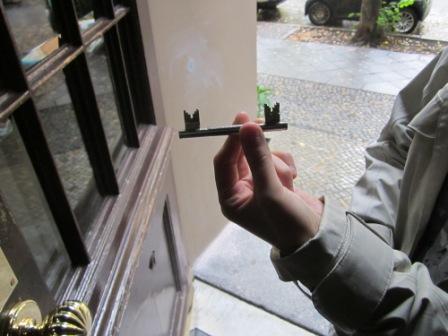
Thus, the building maintained a curious key lock system at the front door which was activated by night. The key was double sided as it can be seen in the picture below.

Old Berlin front door key.

In order to open the door you would have to introduce the key in the lock, unlock it and then fully insert the key in the door until it would appear in the interior of the house. You would then have to lock it from the inside and remove the key from the inside by pulling from the other end of the key.

We found it funny and curious, so we recorded this short video showing the system:

2 Comments

Filed under Travelling

Berlin Tempelhof Airport

Berlin Tempelhof Airport was one of the spots that we wanted to visit in Berlin. The airport was built in the 1920’s and had been an iconic airport for decades, e.g., by the famous Berlin Airlift which with the allied forces supplied West Berlin once surface traffic was blocked by the Soviet Union in 1948.

Other historic events happening in the airport (quoted from Wikipedia):

In 1909, Frenchman Armand Zipfel made the first flight demonstration in Tempelhof, followed by Orville Wright later that same year. Tempelhof was first officially designated as an airport on 8 October 1923. Deutsche Luft Hansa was founded in Tempelhof on 6 January 1926.

[…] described by British architect Sir Norman Foster as “the mother of all airports”.

The airport closed operations in 2008.

The coincidence was that the Berlin marathon fair was organized at Tempelhof thus we didn’t need to schedule the visit since we would go there to pick the running bibs.

See below some pictures from the airport.

This slideshow requires JavaScript.

I had some fun with my brother remembering that the airport is also featured in the movie “Indiana Jones and the Last Crusade” (when they get into a zeppelin). I tried to find in Youtube some scenes in which the airport could be recognised, but the only scene that I find related to it is when Indiana and his father are already aboard the zeppelin:

3 Comments

Filed under Aerospace & Defence, Travelling

East Side Gallery (Berlin)

A whole decade has passed since the first time that I visited Berlin with my brother. This time again, we dedicated some time to visit some touristic highlights. I will write some posts in relation to that visit.

This first one will be dedicated to the East Side Gallery. From the Wikipedia:


The East Side Gallery is an international memorial for freedom. It is a 1.3 km long section of the Berlin Wall located near the centre of Berlin on Mühlenstraße in Friedrichshain-Kreuzberg. […]
The Gallery consists of 105 paintings by artists from all over the world, painted in 1990 on the east side of the Berlin Wall. […]
It is possibly the largest and longest-lasting open air gallery in the world. […]
The paintings at the East Side Gallery document the time of change and express the euphoria and great hopes for a better and free future for all people of the world. […]

The wall has been damaged by several reasons and gone through subsequent series of restorations.

See below some pictures from the East Side Gallery (status from September 2012):

This slideshow requires JavaScript.

1 Comment

Filed under Travelling

Berlin marathon breakfast run

One of the events that include some big marathons is a morning run the previous day, the so-called “breakfast run”.

When we ran the marathon in Paris, only our friend Serna attended that run. This time we went together and Luca and my brother Jaime waited for us at the end.

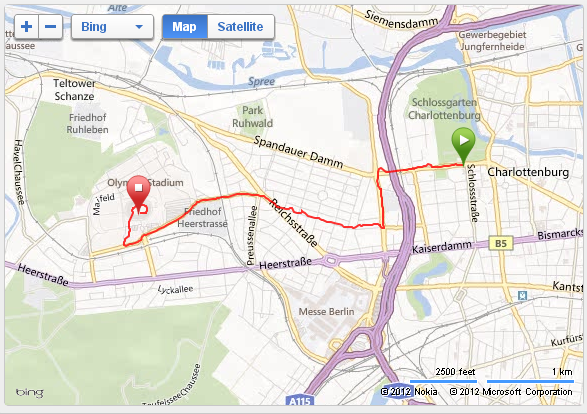
The run, a very easy run of almost 6 km, departed in front of the beautiful Palace of Charlottenburg and ended at the Olympia Stadion.

This stadium today hosts Hertha Berlin football matches, but it is better known as the stadium where the summer olympic games of 1936 were celebrated: the first ones televised, inaugurated by Adolf Hitler and the ones in which the athlete Jesse Owens won 4 gold medals.

See below some of the pictures we took during that morning run:

This slideshow requires JavaScript.

Hopefully the next time we’ll remember to bring either flags or a festive costume as many of the other runners typically do.

See the route we followed from the palace in Charlottenburg to the stadium as recorded by my Germin GPS:

Breakfast run route.

Finally, I found two interesting documents in relation to the stadium and the games:

  • The stadium plan [PDF, 1.7 MB] from today’s stadium website. In it you can see the location of the Maifeld (used for Hitler’s government celebrations and during the olympics for the equestrian events), the Bell Tower, the stadium and the Olympischer Platz.
  • The official report [PDF, 42.4 MB, 640 pages] of the games. It contains all kind of info about the International Olympic Committee at the time, hundreds of pictures of the Games and all of results of the different events.

1 Comment

Filed under Sports, Travelling

Berlin marathon

Last September 30th I completed the Berlin marathon together with my friend Serna and brother Jaime. This was the second marathon we ran together (the previous one being Paris 2012). The sixth one I ran.

Jose, Jaime and I in the runners’ fair.

The morning of the marathon I published a post in which I explained how I arrived at it in terms of training: I suffered an injury about 1.5 months prior to the race which didn’t allow me to practically train during the last month. Previously I had been training well and accumulating many kilometres.

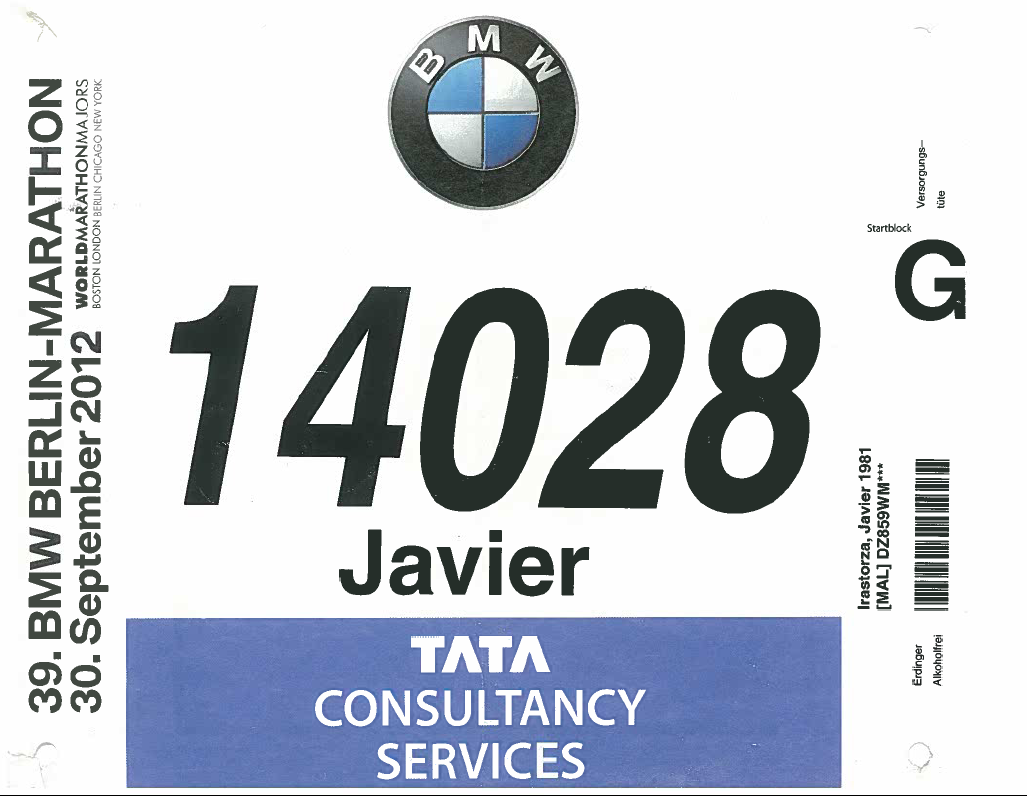
My bib number for the race:

My Berlin Marathon bib number: 14028.

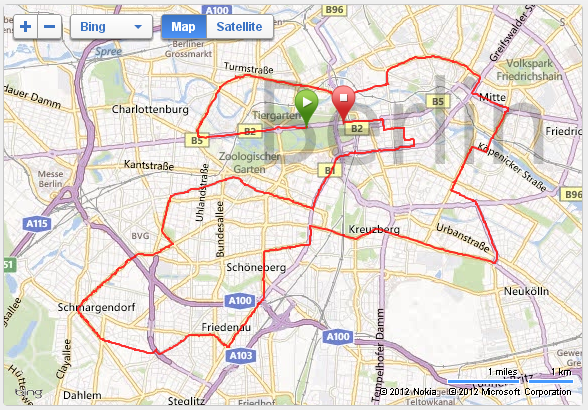
You may see the route of the marathon and my performance as recorded by my Garmin GPS here:

My Berlin Marathon Garmin records.

I started with a bracelet with references for a 3h40′ marathon, 5 minutes lower than in Paris. My plan was to start at that pace (5’13” per km) and keep it until I could. I was expecting that I would not be able to run the whole of it and that I would have to walk in case the Achilles tendon was hurting again. If that happened the later it occurred the better. Thus the faster I could go at the beginning the better for having to walk less distance at the end.

I did the half marathon in slightly above 1h47′, better than in Paris and was still feeling OK. Though at km 23 I started feeling hard to make kilometres under 5’20” (lack of speed endurance work and series in the last month)… I started to think of managing the margin I had built.

Finishing the marathon (km. 42).

However, 5 kilometres later I started to feel the ankle getting harder and some cramps in the quadriceps of the right leg (lack of kilometres and long runs in the last month). I then decided to slow down, otherwise I would have to start walking soon (when you get these cramps, the following step is feeling the muscle like a rock and not being able to run… experience from marathons 1 and 3).

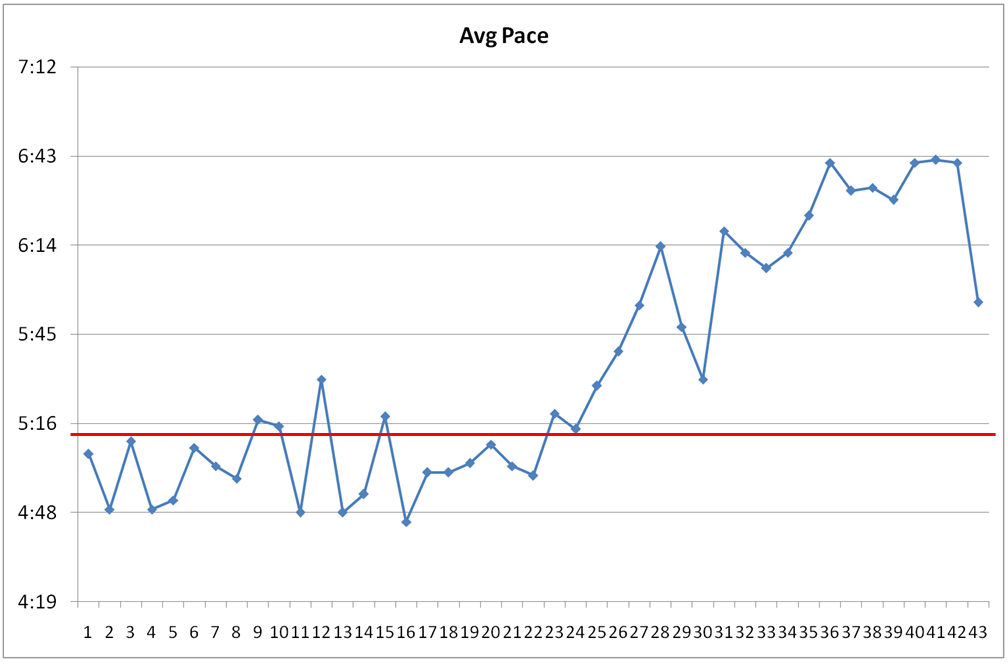
From then on I clocked 6′ per km, then 6’20”, 6’35”, 6’40″… but I was still quite happy as at every kilometre I was making the numbers in my head: “if I keep this pace, I can finish in 3h53′ “, then “3h55′ “… I finally clocked: 3h57’48”, but at all times I knew I could complete it and that I was going to be under 4 hours, thus I just kept on running and smiling.

See the analysis of Garmin records by kilometre below. You can see how the pace was at each stage as I explained it above.

My Berlin Marathon running pace per km (mm:ss).

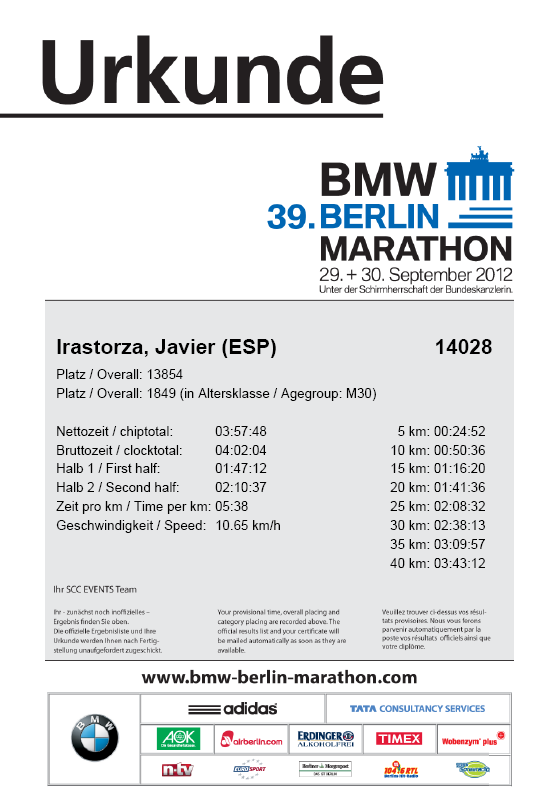
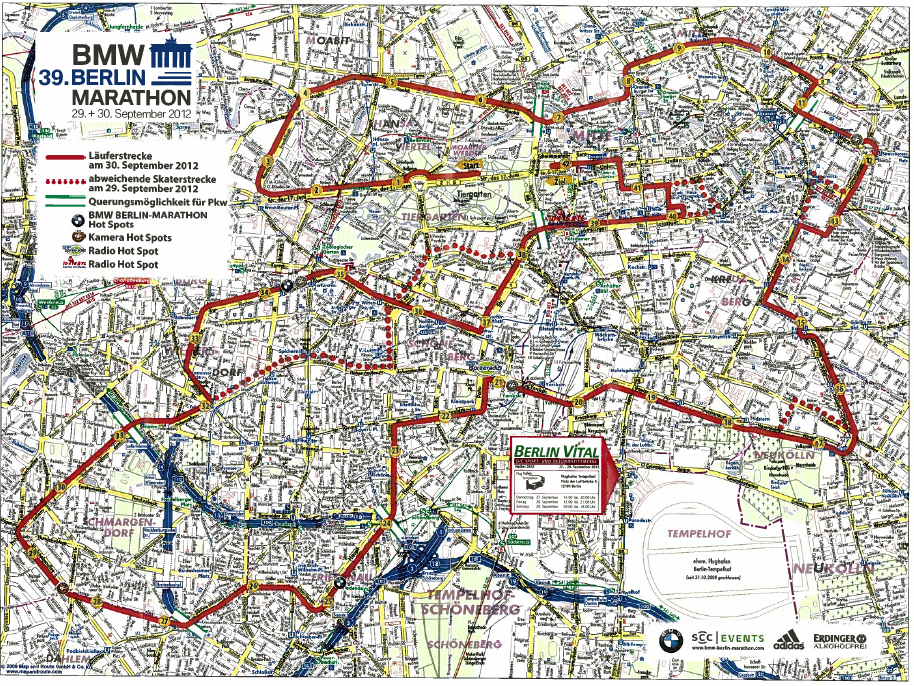
Two more pictures to complete this post: my finisher diploma and the detailed street map of the route.

Berlin Marathon detailed street map.

Next stop: Maratona di Roma, 17th March 2013.

5 Comments

Filed under Sports, Travelling

Good morning, Berlin!

This morning, as this post is being published I’ll be starting the 39th Berlin marathon, together with my friend Serna and brother Jaime.

At mid-point through the training, beginning of August, I wrote a post about the good amount of kilometres I had been able to train in July. Two weeks later I got injured in the Achilles tendon when training in the hills of Torrelodones. I took a one-week rest and slowly re-started training. That week finished with a 10k race in Colomiers where I achieved a new PR in the distance but got pain in the same tendon again.

I took a 10-day rest and tried to run again: 3.5km, 7km and then 12km… but got the pain back and had to cancel my participation in Toulouse half marathon.

As you can see in the graphic below, the training season can be divided in 3 weeks of getting into the habit, 7 weeks of good training and 6 weeks of struggling to recover, plus few days of running and swimming.

Berlin training season. Kilometres run per week and average heart rate (bpm).

During the season I should have run over 1,000km, but in the end I have only completed 643km. This is more than I could run in preparation for the last marathon in Paris, but this time I arrive to the starting line without having run recently and the bunch of the training was done more than a month ago…

As Jaime says, this time the race will not be about the time, but just about trying to complete it… a day for the epic.

Lastly, I wanted to raise awareness about one thing I love of some races: the support of charities and NGOs. We subscribed to this marathon last year and, when doing so, each of us contributed with 42€ (1 € per km run) to the charities supported by the organization.

2 Comments

Filed under Sports