Tag Archives: Global Market Forecast

Airbus vs. Boeing, comparison of market forecasts (2011)

Some days ago, John Leahy, Airbus COO Customers, unveiled at a press conference in London the new figures of 2011-30 Airbus’ Global Market Forecast (GMF, PDF 28.8MB).

Last year, I already published a comparison of both Airbus’ and Boeing’s forecasts (Current Market Outlook, CMO, PDF 3.2MB). You can find below the update of such comparison with the latest released figures from both companies.

Comparison of Airbus GMF and Boeing CMO 2011-2030.

Some of last years’ comments still apply:

  • Boeing sees demand for 15% more aircraft with a 21% more value (excluding regional a/c).
  • Boeing continues to play down A380 niche potential (57% less a/c than Airbus’ GMF), though it has increased its Very Large market forecast by 40 a/c, or 7.5% (Did Emirates new order at ILA change their minds?)
  • On the other hand, Boeing forecasts about 600 twin-aisle and 4,000 single-aisle more than Airbus, clearly pointing to its point-to-point strategy.
  • In terms of RPKs (“revenue passenger kilometer”), that is, the number of paying passenger by the distance they are transported, they see a similar future: Airbus forecasts for 2030 12.3 RPKs while Boeing forecasts 13.3 (in trillion).

The main changes from last year’s forecasts are:

  • Both manufacturers have drastically increased their single-aisle forecast: +1,300 a/c in the case of Airbus and +2,200 in the case of Boeing.
  • In general all numbers have been increased: single-aisle (as mentioned above), twin-aisle (between 50-150 more), large aircraft (between 40-80 more), value of aircraft and RPKs… it seems that for commercial aircraft manufacturers not only the crisis is passed but they see a rosy future lying ahead.

Again, I strongly recommend both documents (GMF and CMO) which, differences apart, provide a wealth of information of market dynamics. I am especially happy to have encountered this year again full version of Airbus GMF, not only a short one [PDF, 4.7MB].
7 Comments

Filed under Aerospace & Defence, Marketing

Air traffic growth vs. aircraft orders

Taking the topic of the headline of this post I want to share some reflections on the commercial aircraft market.

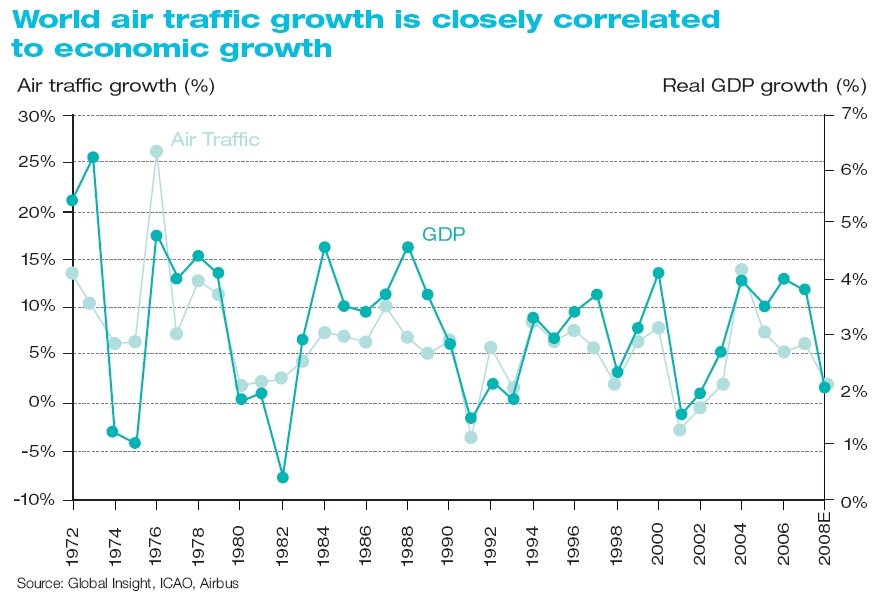
The first is how closely air traffic growth is correlated to world economic growth. This sentence and the following graphic are taken directly from the Global Market Forecast [PDF, 7.9MB] produced by colleagues at Airbus.

Air traffic growth vs GDP growth (source: Airbus).

You may see in the graphic the correlation (correlation coefficient above 0.7) and how the air traffic growth is however much more volatile than the economic growth. This is very intuitive. The better the economic situation the more business trips, family visits and holiday trips will take place. Nevertheless Airbus explains that in some situations and regions this is not enough to forecast traffic and thus they produce hybrid models.

Then, I wondered: how do airlines translate this growth in traffic into airplane orders?

I made some numbers and played with them. I gathered aircraft orders for both Boeing and Airbus in the last ~20 years, plus air traffic and GDP growth over the same period of time. Then, I tried to connect one with another and see how best they would correlate with each other. Even though correlation does not imply causation, it may indicate existence of such causal relations that it’s why I searched for such results.

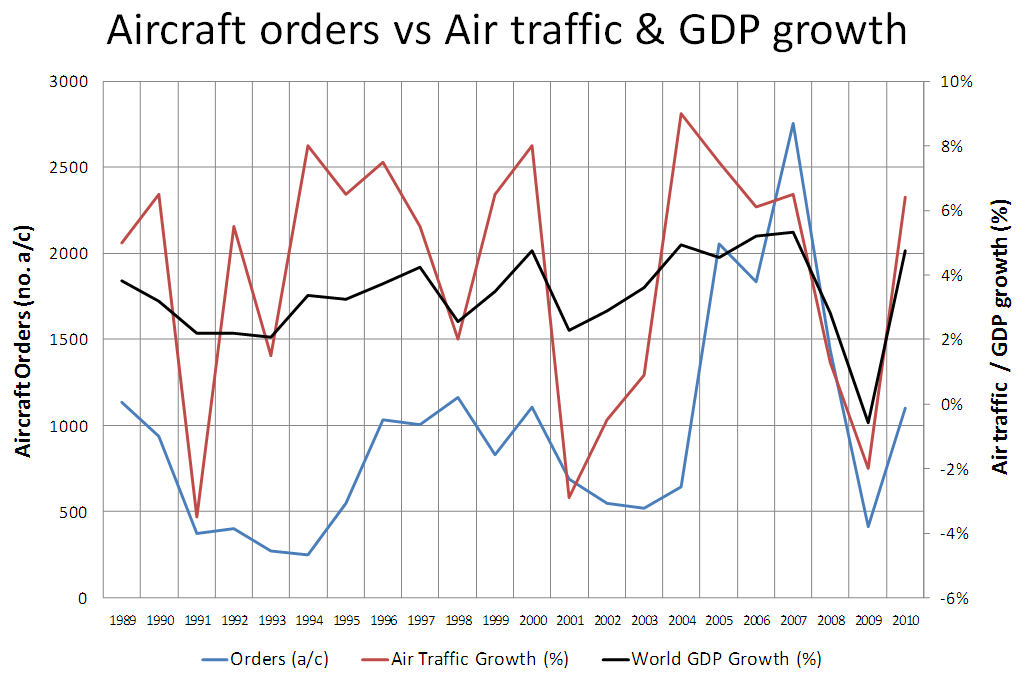
Here I plotted GDP growth (IMF), traffic growth (ICAO) and aircraft orders:

Aircraft orders vs. air traffic and GDP growth.

One could expect that airlines, after collecting first hand data of traffic growth plus the aggregate demand from industry sources (IATA, ICAO) and after applying their complex planning models would order aircraft from manufacturers. Thus, a correlation might be expected between traffic growth and aircraft orders. What we don’t know is whether airlines would place orders in the same year where the traffic growth actually takes place or there would be a lag (due to the airline analysis process, the negotiation with the manufacturer, arranging the financing, waiting for the next air show…).

The correlation results I got between these 2 variables are satisfactory though not that high. Matching data of the same year yields a 0.35 correlation coefficient. If however, we apply a 1-year lag in between air traffic growth data and orders the correlation is better, 0.44 (a lag of 2 years would worsen it down to 0.27 and so forth).

I found it curious that correlation between orders and GDP growth is much better! Matching data of the same year yielded a 0.61 correlation coefficient (which is rather high). A lag of a year would produce a still high 0.56 (2-year lag, 0.41; 3-year, 2.6…).

This was a striking result for me. After all, even though individual airlines do have complex models and experienced analysts behind them, taking the aggregate of the market, it seems that orders are placed less on data of traffic and more relying on data of economic growth, and rather soon, acting within the same year or a year later!

Who knows how the process within the airlines actually works… I can imagine thoroughly thought and thick studies coming from planning & analysis departments being put aside in the board room where one or two directors (more assertive than the average) convince the rest of the soundness of an operation based half in broad economic prospects (world GDP growth) and half in gut-feeling… wouldn’t surprise me much.

Leave a comment

Filed under Aerospace & Defence, Economy

New entrants in the commercial aircraft business

In a previous post, I mentioned the new entrants in the large commercial aircraft business (Bombardier CSeries, Embraer, Russian MS-21, Sukhoi SuperJet, Comac C919, Mitsubishi…). Now that the latest market forecasts both from Airbus (Global Market Forecast) and Boeing (Current Market Outlook) are available, I wanted to briefly note how they are treating the segment that most of these entrants would enter: single aisle jet aircraft.

For example, Boeing in this year’s CMO already splits the single aisle between 90-175 passengers (where new entrants would fall into) and over 175 passengers (still the safe harbor?). In previous studies Boeing didn’t offer such sub-segmentation. On the other hand, Airbus hasn’t published yet such differentiation.

It is even more interesting to compare last year’s GMF and CMO with this year’s ones.

  • Airbus saw a demand for 16,977 single aisle aircraft in 2009 while in 2010 sees a demand for 17,870.
  • Boeing saw a demand for 19,460 single aisle aircraft in 2009 while in 2010 sees a demand for 21,150.

In other words Airbus has increased the single aisle market forecast in 893 aircraft, while Boeing has increased it in 1,690 aircraft… Both have made the forecasted pie bigger before it will have to be shared.

On average, they see ~1,300 more single aisle aircraft than what they saw last year… In the case that these extra aircraft was room made for new entrants, that would leave the new entrants a market share of 6.7% of the single aisle market… not much.

However, those entrants are not yet delivering in that segment and most of their deliveries would come at the second half of the 20-year period. By 2029, it could well be possible that their combined market share is around 10%… still not a big share, but already ~7bn$ yearly business (in 2010 dollars); a ~4.4bn$ after discounts, an amount the size of Embraer revenues (the 3rd company in commercial aviation, reason enough for them to enter the segment).

Boeing even concedes that of the 21,150 single aisle aircraft, 86% of them will be between 90-175 passengers, precisely the market sub-segment that will be ferociously fought.

Leave a comment

Filed under Aerospace & Defence

Commercial aircraft market size after discounts (update)

In an older post I already made an analysis of the aircraft discounts related to the published list prices (by the way, Boeing just raised its list prices 5.2% a couple of days ago). In that case, I used the revenues and deliveries of Boeing in the previous 3 years (38% discount was the result!).

Using that information, now that the latest market forecasts both from Airbus (Global Market Forecast) and Boeing (Current Market Outlook) are available, we can say that the real market size in the next 20 years will be in the order of 2,100bn$ (average of both forecasts in 2010 dollars).

Flow of airplanes

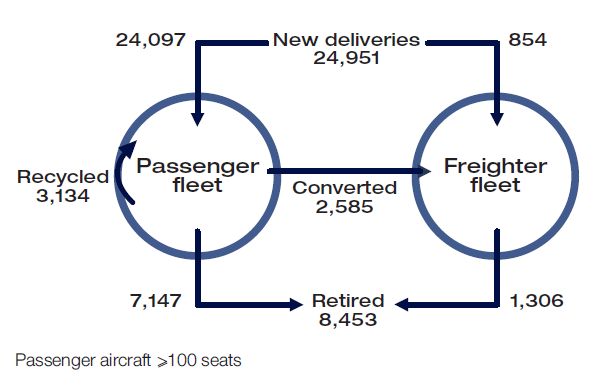
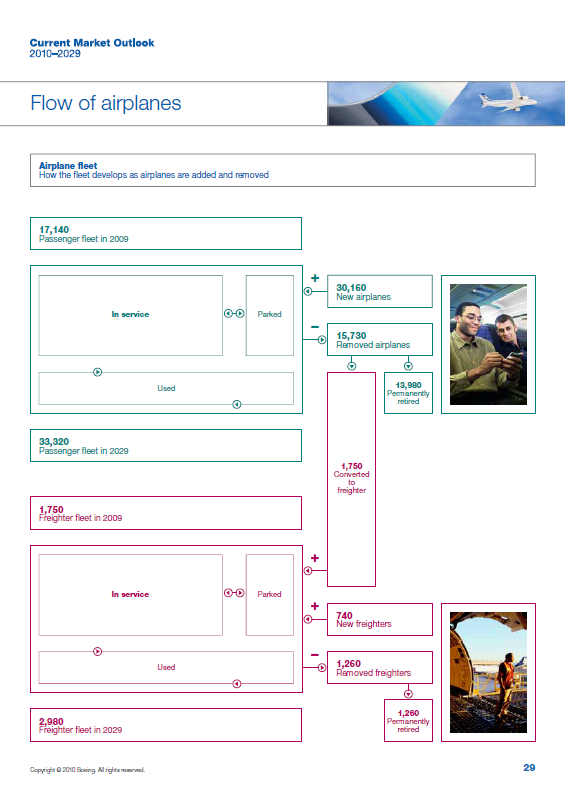
Another very interesting feature that Airbus published in last year’s GMF (it is not yet in this year’s publication) and Boeing used for this year’s CMO is a graphic showing the dynamics of aircraft. In it you may understand how from today’s fleet, adding new deliveries, retiring old aircraft, converting some from passenger to freight transport they arrive to the forecasted fleet in 2029.

I include below both graphics.

Leave a comment

Filed under Aerospace & Defence

Airbus vs. Boeing, comparison of market forecasts

Airbus announced on Monday its latest Global Market Forecast (PDF, 4.6MB) for the 20-year period 2010-2029. Media has already highlighted the main points: ~26,000 new aircraft will be delivered with a market value of ~3,200bn$.

Some months ago, Boeing published its equivalent study, the Current Market Outlook (PDF, 8.2MB) for the same period.

It is interesting to compare the two of them. In that way we can see how each other treat competitors’ products (mainly A380) and how they try to shape the market and send messages to it (point-to-point & hub-spoke).

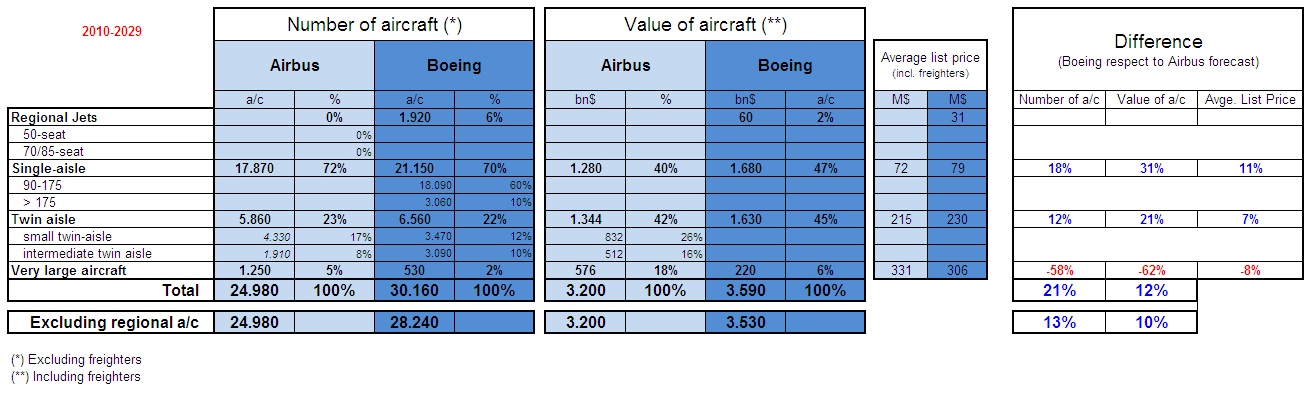
However, it is not easy to compare the studies as they use slightly different segmentations, disclose in different ways the value of aircraft for the segments (list prices) and is not always clear how to discount freighter aircraft from global figures. I dig for some time into those numbers and arrived to the following table:

Comparison of Airbus GMF and Boeing CMO 2010-2029.

Some comments on the comparison:

  • Boeing sees demand for 13% more aircraft with a 10% more value.
  • However, this higher demand is not applicable to all segments: Boeing sees ~60% less A380s or equivalent being delivered over the next 20 years, while 18% more single aisle (A320s) and 12% more twin aisle (A330/A350s).
  • Boeing plays down A380 potential, but sees a very similar number of RPKs (“revenue passenger kilometer”), that is, the number of paying passenger by the distance they are transported. Airbus forecasts for 2029 12.03 RPKs while Boeing forecasts 12.60 (in trillion).
  • The difference of less than 5% in RPKs means that out of the 13% difference in aircraft deliveries over 8% comes from the different business model each company is trying to push.
  • Finally, we can see that Boeing uses again higher average prices for smaller aircraft and a lower reference price for A380s.

Enjoy the two documents, differences apart, they gave a very good piece of information and insight about the market.

7 Comments

Filed under Aerospace & Defence