Stock markets have been very volatile recently. Mr. Market’s got a very fragile mood. One day is up, the next is down.
In this post, I just wanted to make an obvious remark for most of you but a small insight for those who are not very acquainted with numbers.
Whenever the market moves up and down in consecutive moves of the same percentage, no matter which move comes first, you lose.
Imagine you have 100$ in the stock market. One day your stock moves up 2%, so you end having 102$. If the following day your stock goes down again by the same 2%, you’ll end up with 99.96$. Less than what you had before day one.
Then take the reverse case. If your stock went down 2% in the first place, you’d have 98$. If the following day it went up again 2%, you’d end up with the same 99.96$ (nothing more than the commutative property of the product).
Anyway, with those consecutive moves you would end losing some cash. You may believe that 4 cents are not worth the comment.
Think then about your savings (e.g. 10,000$) and about possible yearly performances (e.g. +/- 20%)… now you will see that at the end of the second year instead of 10,000$, you would have 9,600$, down 4% from the beginning (about -2% per year).
I just wanted to leave this small note here in the blog, obvious for some and not so for others, as I will come to it at a later point in time.
If I tell you that investment banks way of making you rich is advising you to “Buy high and sell low”, you’d call me stupid, you’d think I got the sentence wrong (obviously the way to become rich is “buying low and selling high”).
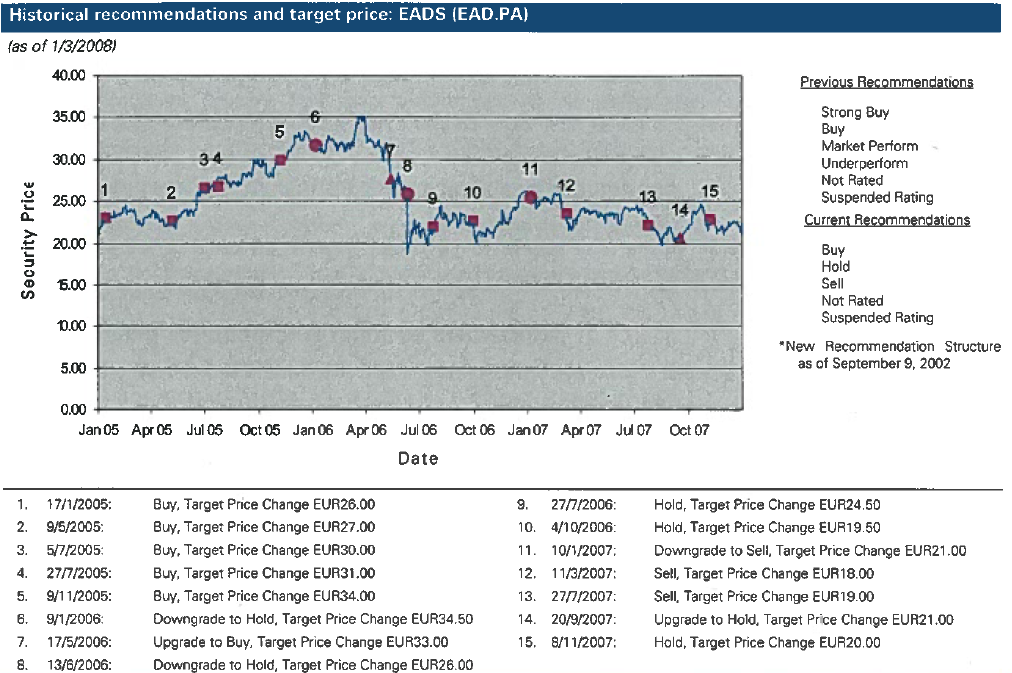
Take a look at the chart below. It’s taken from an investment bank report of EADS at the end of 2007 (let me omit the name of the bank out of courtesy… nevertheless, all banks incur in the same vices).
EADS historical prices from 2005 to end 2007 and investment bank's target prices and recommendations.
Along almost 3 years time, the bank recommends you to buy at 6 different points in time with prices ranging from 26€ to 34€. In the same period it recommends selling 3 times with prices ranging from 18€ to 21€. That is indeed buying high and selling low.
Margin of Safety
Each time that the bank recommended “Buy” the stock actual price was just between 7-16% below the bank’s estimated target price (e.g. 31.5€ vs 34€, -7%). Benjamin Graham concept of “margin of safety” advises you to invest only when the margin between the price you’ve estimated as the stock’s intrinsic value and its current price is above 30%, otherwise possible errors in your judging of the price will eat away possible gains.
That means, that if the intrinsic value of EADS had been well estimated at 34€, and the price was 31.5€, still the recommendation should have been “hold” or “sell”, never “buy”. A “buy” should have come only when price was below 23.8€ for a target of 34€…
That was regarding the margin of safety… was the intrinsic value of EADS really 34€? I have checked statements of EADS several times since its creation. I have never come to that figure as its intrinsic value. Even discarding all the one-offs that have occurred in the last years, the conservative price I reached never went upper than 24€ (a price reached at some point in 2011 – when I sold my stock). That means that the stock would have been a “buy”, had I been the banker, only when its price was under 17€ (which was never the case in the period shown in the report – but for a long period afterwards).
Few days ago I wrote a post about what was supposedly my risk profile as an investor. I mentioned in that post that the mainstream perception of risk is quite different to the one I had. Which is the perception I have?
My perception of risk is 100% shaped by that of Benjamin Graham, and so well described by Warren Buffett several times. I looked for a good example in the internet that I could quote and refer you to, here it is:
Finance departments believe that volatility equals risk. They want to measure risk, and they don’t know how to do it, basically. So they said volatility measures risk. I’ve often used the example of the Washington Post’s stock. When I first bought it in 1973 it had gone down almost 50%, from a valuation of the whole company of close to $170 million down to $80 million. Because it happened pretty fast, the beta of the stock had actually increased, and a professor would have told you that the company was more risky if you bought it for $80 million than if you bought it for $170 million. That’s something I’ve thought about ever since they told me that 25 years ago and I still haven’t figured it out.
If you want to read more about it and other related issues, take a look at the website from which I got this quote, Buffett FAQ.
If in a previous post, pencils were treated as a supposedly safe haven in case of a recession. In this post I just wanted to mention that I don’t see anything more value in gold or silver than I see in pencils.
That may sound shocking, as we are used to have gold items in great praise. Well, as a commodity, as an asset, I don’t see much difference between gold and other materials. What it is valuable is the company that continues to produce goods out of those commodities, with ever greater productivity and value added to its products.
Gold by itself is just like a pencil, assuming that you continue to find someone in the future willing to pay something for both commodities (certainly not more than it is worth at any given moment).
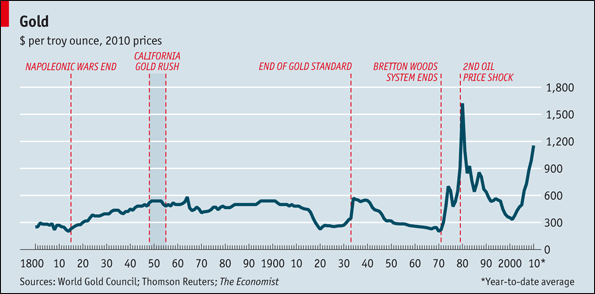
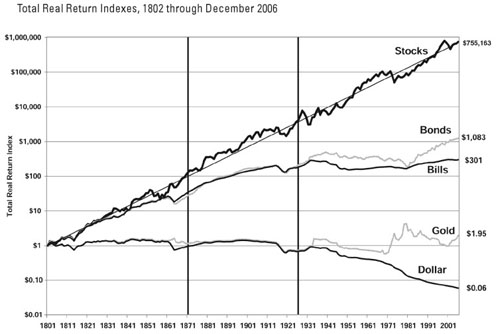
It is easy to say this now that both silver and gold have seen its prices plummet after the summer, but more than using the recent fall as basis for the argument, I have in mind these other long-term (as in centuries’ trend) graphics below:
Gold price fluctuations since 1800. Source: The Economist.
From the previous graphic, gold went up to 1,900 in the summer of 2011 and then fell again to around 1,600$ per ounce, in September. Well, I see no reason why it shouldn’t be around 300-600$ again, as it has always been.
Gold as an "investment"... Source: Jeremy Siegel
In this other graphic you may see how much gold is worth as an investment… well, it is more valuable than cash, but we already discredited cash in a previous post.
And still, you’ll find people running towards gold when there is a crisis… I never understood that. What are the gold price fluctuations based on?
Personally, I prefer to go to the Casino in Torrelodones once a year, lose at most some 50€, if that is the case, and kill altogether the speculative behaviours until the next year.
My previous post discussed why it is better to be invested in real assets vs. cash or bonds in order to protect your savings in case of a recession.
Even though all the references were to stocks, I kept the word “assets” instead of “stocks” in the title and conclusion of the previous post in order to come back to it a later time, in this post.
Bestinver fund managers, in their conferences, have often given examples of assets to be invested in to protect your wealth such as pencils, chairs, and, this year, books.
If by the time a recession came and inflation started to build up, you had all your fortune invested in pencils, the same discussion that was made in the previous post with stocks would hold true for pencils.
For example, say that Southern Europe (Greece, Portugal, Italy…) in a near future needs to kick Germany out of the Euro due to its fiscal irresponsibility. Germany would then have to use another currency, e.g. the Deutsche Mark. Say that at day one the mark would be worth 2DM = 1 Euro, as it was more or less 10 years ago.
Due to the inevitable capital runaway from Germany, Germany would most probably undergo a period of hyperinflation and mark devaluation that could very well end with 1 Euro being worth ~ 2.000 DM. Obviously, the prudent Bavarian who had all her savings in cash would have nearly lost all of them.
However, if this Bavarian had instead purchased pencils in order to protect her wealth, she would have seen a different outcome. Say a pencil cost 0.5€ at the beginning, or 1DM. After all the hyperinflationary period, and if German students still needed pencils for their classes a pencil would sell for ~1,000DM. Thus, as the theory goes, the Bavarian investor would have protected her wealth just by being invested in real assets, i.e. pencils.
Of course, if you wanted to see your wealth grow pencils wouldn’t be the best assets to be invested in, as they do not reproduce, or any other assets are taken out of them, but to protect your savings they would work just fine.
During the last weekend, I spent some hours watching the webcast of the annual investors’ conference of Bestinver, a Spanish investment fund.
I find the conference itself not only entertaining and informative but quite funny due to the way the fund managers show their value investing principles and how stubborn they’re with them (luckily for investors). The experience is comparable to that of Berkshire Hathaway annual general meeting.
As in previous years the managers defended how not only to have profits but to defend your savings during recessions it is much better to be invested in real assets than to have your money in cash, state bonds, etc.
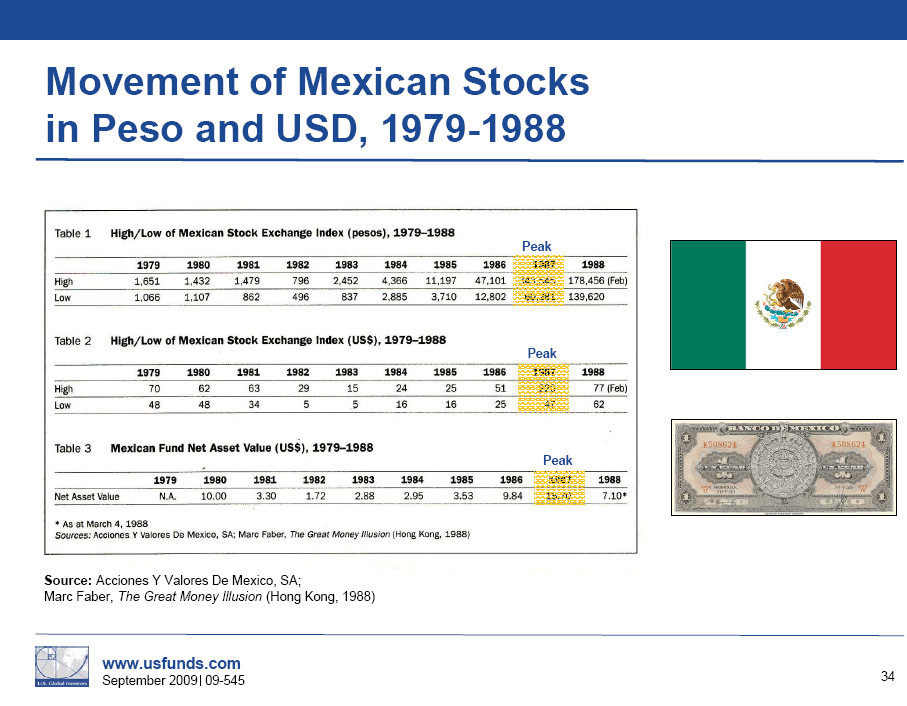
This time they raised the case of Mexico during 1979-1988 (in previous cases they had referred to the Weimar Republic or Argentina), based on an analysis by Marc Faber (a presentation containing the same info can be retrieved here, PDF 4.8MB). During those years the Mexican peso suffered an extreme hyperinflation explained in the Wikipedia as follows:
In spite of the Oil Crisis of the late 1970s (Mexico is a producer and exporter), and due to excessive social spending, Mexico defaulted on its external debt in 1982. As a result, the country suffered a severe case of capital flight and several years of hyperinflation and peso devaluation. On 1 January 1993, Mexico created a new currency, the nuevo peso (“new peso”, or MXN), which chopped 3 zeros off the old peso, an inflation rate of 10,000% over the several years of the crisis. (One new peso was equal to 1000 of the obsolete MXP pesos).
Mexican peso evolution vs USD. Source: Ron Griess
Obviously, anyyone who either held savings in cash in pesos or Mexican bonds at that time virtually lost all his money.
However, the same author made the analysis of what would have happened during those years to an individual holding Mexican stock, for which he used the Mexican Stock Exchange Index. The result is that at the end of the decade that person would have kept his wealth in US dollar terms, as the nominal value of the Mexican stocks raised at par with the hyperinflation and peso devaluation going on in the country.
Evolution of Mexican Stock. Source: Marc Faber
Conclusion: better be invested in assets if only to keep your savings safe in the long run.
In this post I just wanted to share a couple of thoughts that I discussed with my father and older brother some months ago on the welfare state that we enjoy in Europe.
Luca and I went on a holiday trip to Japan 3 years ago. There, while in Kyoto and thanks to a cultural association, we enjoyed an activity consisting of spending the afternoon and evening with a Japanese family at their place.
The Takatori family lived in the centre of Kyoto (a wonderful city). He was an engineer who worked for a big electronics company (I forgot the name), thus I imagine that he earned a decent salary. The family lived in a 40-50 sqm flat, without bedrooms for the teenage children as they slept in futons in the living room. The Takatoris had no car and travelled either by bike or public transport every where.
At some point in the conversation we talked about travelling, holidays, etc., and then I asked him how many holidays did he had? “120 days.” I was surprised, “120 days?!?” He explained it better: “There are 120 days a year in which I don’t work, including weekends”… I started making the numbers: since the year has 52 weeks, 104 days are weekends, these left only 16 days off for Mr. Takatori, including bank holidays. This was in Japan and a medium class family.
I take it that in the rest of East Asia the conditions will be lower and work ethics will be at par with Japan (think of Chinese shops opening schedules in Europe).
When I compare that with Europe: 35 hour work-week (in France), a collective bargaining agreement with 211 working days a year (or 154 non-work days as Takatori viewed it – since weekends are the same here and in Japan, that means we enjoy 34 days more of holidays, or 7 more full weeks!), subsidies for a myriad of things, retirement at 60 (in France, with protests when raised to 62)… well, there’s simply no comparison.
Sure, the system we have here is something to be proud of, but then again, will it last? It’s not like the Takatoris of Japan, China, South Korea, etc., will refrain to: work an hour or a day more, lower a dollar in a price, retire a year later, etc., so we can continue to enjoy our welfare state.
Will it last? I have no answer, it escapes my power of analysis, but if I were you, I’d start saving yesterday.
Right now, while this is being published and if everything is going as planned, Luca and I are in Omaha, Nebraska. By now we should be already registered to attend tomorrow the annual shareholders meeting of Berkshire Hathaway, company famous for its CEO and Chairman, Warren Buffett.
While studying an MBA at EOI business school in Seville some 5 years ago, I developed a special interest in investing. I started reading some books and this led me to the bible of them all, Benjamin Graham’s “Intelligent Investor”, which I have referred to in this blog a number of times.
Warren Buffett, of World fame, was one of Graham’s disciples. He started very early setting up small businesses and investing in stocks. Decades later, he is known as the “oracle of Omaha” and considered to be on of the best investors ever.
About 2 years ago, Luca and I decided to invest in Berkshire Hathaway, mainly to acquire the right to attend this weekend’s party (you may call us freaks, right). Sure, we have arranged a nice holiday trip around it passing by Montreal, DC, Chicago and even Des Moines (!). But the end of this trip, was attending the shareholders’ meeting (others travel to attend a concert of U2!).
If you want to grasp what the experience may feel like, start by reading one of his letters to the shareholders of BRK, e.g. this year’s letter [PDF]. It’s 26 pages, ok, but it won’t take you more than 1 or 2 hours, and who knows, it may change your view of saving, investing, managing businesses, doing you a great favour. Apart from that, you’ll have a great fun reading it, as it is a very entertaining and humorous piece.
Finally, a positive note from an extract of the letter to reflect on, in today’s times:
“Don’t let that reality spook you. Throughout my lifetime, politicians and pundits have constantly moaned about terrifying problems facing America. Yet our citizens now live an astonishing six times better than when I was born. The prophets of doom have overlooked the all-important factor that is certain: Human potential is far from exhausted, and the American system for unleashing that potential – a system that has worked wonders for over two centuries despite frequent interruptions for recessions and even a Civil War – remains alive and effective.”
This is an ad I see every day on my way to the office: “For Living or Investing”. They sell villas and apartments up to 4 rooms.
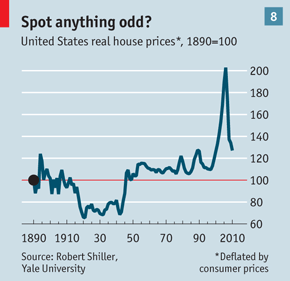
I have often defended the position that a house cannot be considered an investment. Recently I read yet another article at The Economist, in which they showed the latest graphic of the Case-Shiller index (below). I showed this graphic in a post last year. Now the prices have decreased some percentage points more. Most importantly, the curve and the article point that a further decrease will come. Down to the point where the prices stay stable along the last 130 years once inflation is adjusted.
Case-Shiller index.
Taking that into account, when I see that ad in the morning I can only smile and think of that other story which I included in another post about a message from the future describing how the housing craze continues to go on in Spain for decades… (extremely funny – in Spanish).
I have only one complain to the promoter of these houses in the ad: they are using land so close to the city to build houses for investing… if these houses are just meant for investing, and not necessarily for living, they could have built them under the sea and leave the land in Toulouse for living, public parks, roads, etc…
I wanted to share with you in this post a speech I gave last Saturday at Rosemasters club contest. I was not contesting but a speech was needed for the evaluation contest, so I volunteered.
Why do I share this speech in particular? Not because it was especially good (nor especially bad), but because it has some insights that could help some of you in case you hadn’t reflected on them or made the numbers yourself.
I titled the speech “Snowball” but a more suitable title would have been “Snowball, or the beauty of compound interest”. Please, note that the metaphor of the snowball it’s not mine, so no need to praise my originality here. I borrowed it from Alison Schroeder’s biography of Warren Buffett “Snowball”, which I reviewed in other post in this blog (I take the opportunity to recommend the book again).
Below you can watch the video uploaded in Youtube (from the second 0:42 some helping hand lifts the camera, please be patient during those first seconds). Below the video I share the script of the speech so you can actually see the formula and the charts I showed. Reflect on it; it may help you a lot a long way down the road.
—–
Script:
“How many of you used to play with snow when you were a child?
Do you remember what the process you followed to build snowballs was? You started by making a small ball with your hands, like this. Then, you left it on the ground and let it roll over itself, so it was gaining more snowflakes and thus getting a bit bigger with every roll… for you it was a small effort, and after some time of rolling and rolling over, you easily could end up with big snowball like this.
It shows what is the future value (FV) of an investment’s present value (PV) that gains a fixed interest rate (i) for n periods.
To put it simple, it means that the interest that we earn over the investment in the first year, will enter the calculation in the second year. In a very similar way that small snowflakes are making the snowball bigger.
The importance of compound interest for our future.
Who is the younger member of the audience today? I will ask you one question, let me see if I get the answer I want.
Are you saving and investing with your retirement in mind? Do you have pension plan or fund?
An extremely important factor in this discussion is that time in the formula appears in the exponent. This means the longer the time period, the better. Or put it in another way, the sooner we start investing or saving, the better.
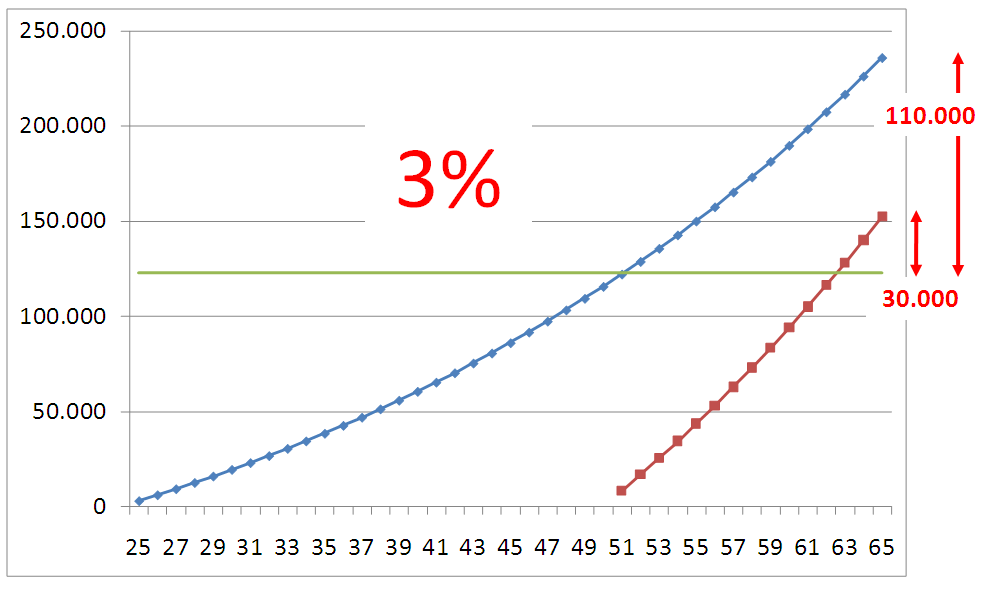
I made two quick calculations to show you. Imagine a 25 year old person who just started working. If he or she is able to save 250 euros per month, that is 3,000 euros per year, and puts it in a conservative fund which earns 3% a year… by the time he is 65 he will have around 230.000€. His yearly contribution would have been 123.000€. So another 110.000€ will have come from the interest. He will practically have doubled his money.
On the other hand, take a 50 year old person who never saved any money beforehand. He will have to save it in only the last 15 years of his working life. To make the comparison, I supposed that he contributed the same 123.000€ in those 15 years, for this he has to save 8.200 per year or 680€ per month… when he is 65 he will have 150.000€, having earned about 30.000€ from the interests, 4 times less!
Effect of a 3% compound interest over 40 years.
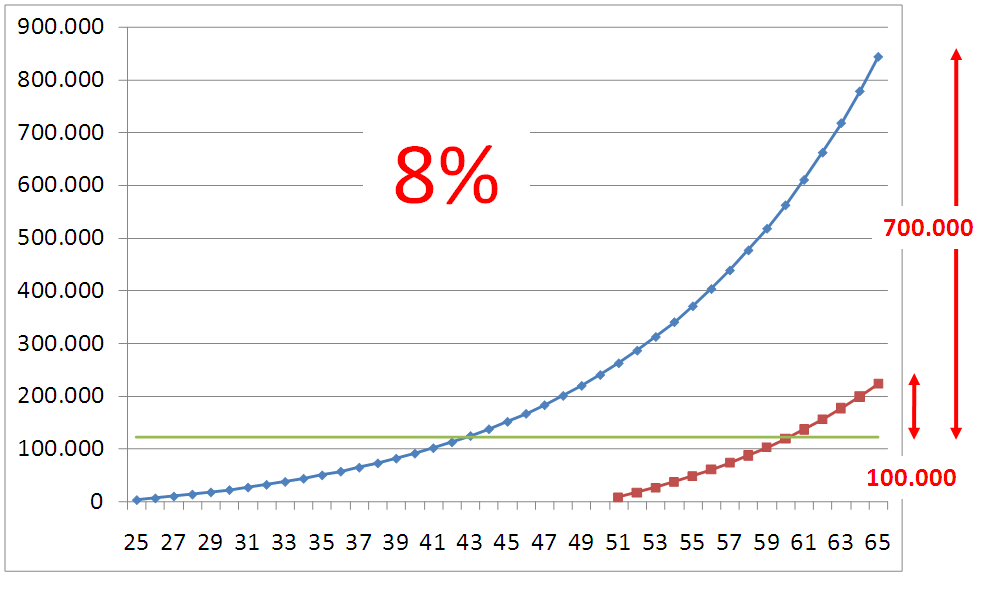
If the young person would invest in more volatile asset, for example the stock market, which historically earns about 8% every year, the new figures would be these ones.
840.000 – earning 720.000 from interests
222.000 – earning 100.000 from interests / 7 times less.
Effect of a 8% compound interest over 40 years.
Finally, with this discussion I wanted to explain little bit the compound interest, how it is making your savings grow, and even though at the beginning the growth seems very slow this is because the growth with time is exponential and we human beings are not very patient, thus it is important to start early saving small amounts, as snowflakes… in the end you will have a big snowball.
Start saving and see you at the retirement age.”
—–
Final comment: as you may have noticed there several passages when what I say differs from the script. I didn’t learn it by heart. During my first speeches in Toastmasters I tried to do so. Now I am departing from that approach. However, I do write the speech to give it a clear structure, to polish some parts, spot words I may have difficulty in pronouncing (so I can replace them for others) and count the amount of words so I am sure it fits in 5 to 7 minutes (often 7’30”… never more or fellow Toastmasters will start clapping).





 The Blog by Javier