Tag Archives: Liverpool

How does UEFA weigh club honours? (football clubs’ coefficients, 2024 update)

This is an update of a post I wrote 6 years ago (here, in Spanish) explanining how UEFA weighs club honours and now sharing the current (end of 2023/24 season) ranking.

UEFA publishes various rankings of football clubs, football federations and national teams. For that purpose UEFA assigns a series of points according to results achieved in the competitions organized by UEFA itself. From those, one can see at the end of each season the club which reached the highest scoring.

With the scoring of different years, UEFA publishes two different club rankings: the 5-year club ranking and the 10-year club ranking.

The 5-year club ranking is the one that UEFA generally employs to rank the teams (when UEFA publishes the team leading the ranking at any given point, it refers to the team leading that 5-year ranking, not the one with the highest score on that particular year). UEFA also uses the 5-year club ranking at the time of seeding the draw of the different groups of the Champions League.
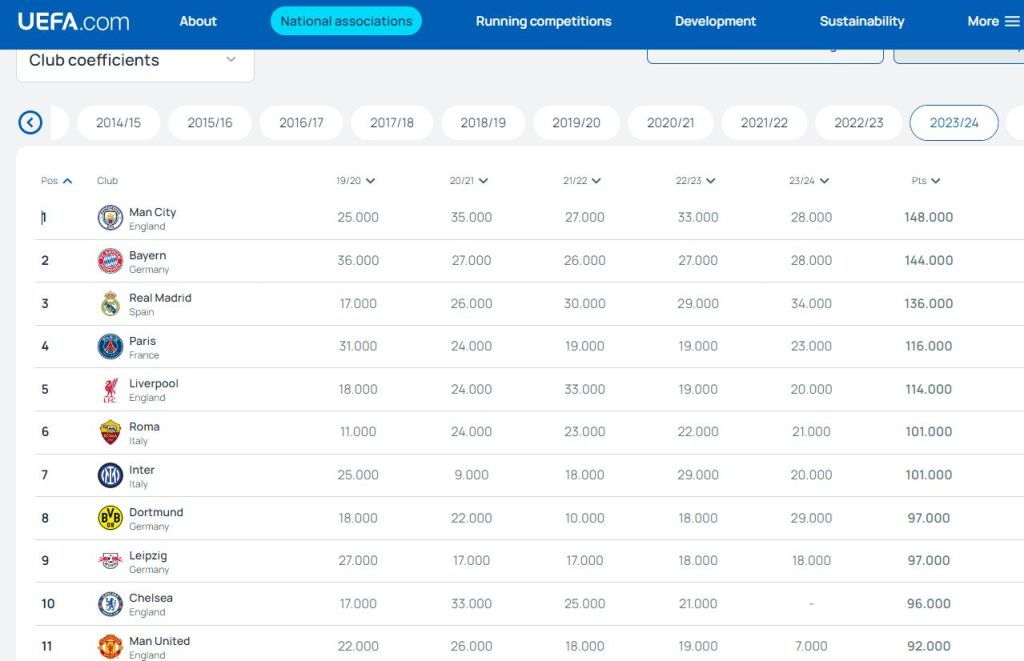
5-year club coefficients (2023/24)

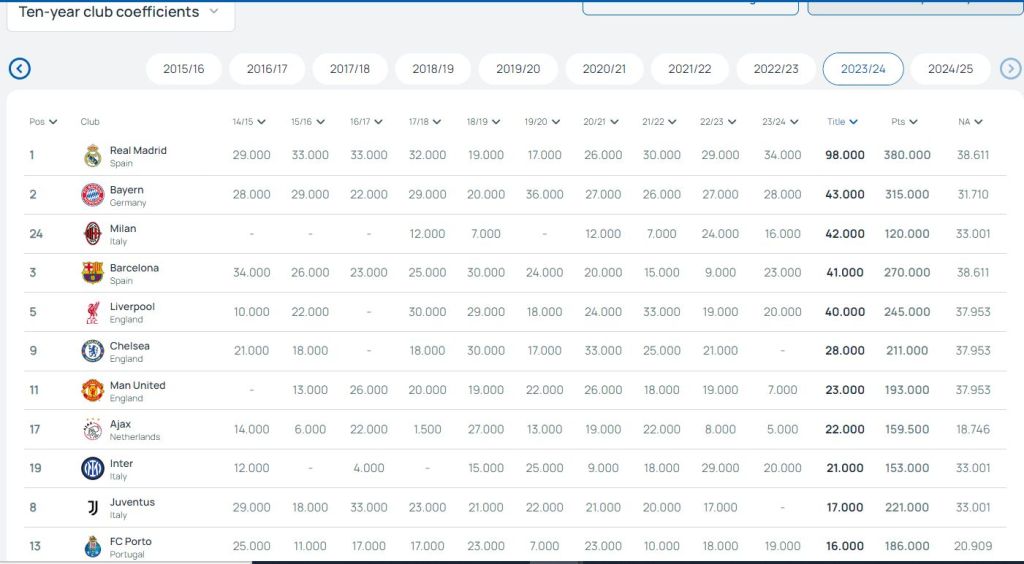
On the other hand, UEFA uses a slightly different 10-year club ranking as one of the criteria in order to distribute the money prizes among the different clubs. To compute that 10-year club ranking UEFA collects the yearly scoring of clubs in the last 10 years, and to that sum it adds another coefficient that UEFA calls “Title“, which is the coefficient I wanted to write about, and that shows the weighing that UEFA does of clubs’ honours.
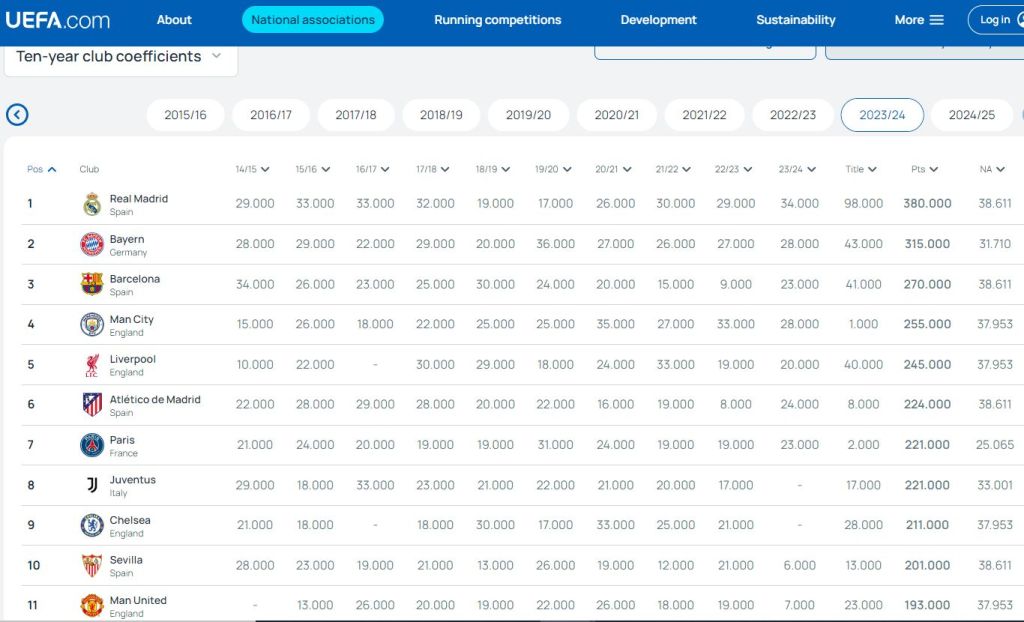
10-year club coefficients (2023/24*)

I leave below the the 10-year club ranking sorted by the column “Title:

10-year club coefficients (2023/24*) sorted by the column Title

The table shows that Real Madrid leads the “Title” ranking with 98 points, followed by Bayern Munich with 43, AC Milan with 42 and Barcelona with 41…

How does UEFA compute that “Title” coefficient?

  • UEFA Champions League / European Cup:
    • 12 points for those won in the last 5 seasons, i.e., 2019/20 to 2023/24
    • 8 points for those won since the creation of the Champions League up to 6 seasons ago, i.e., 1992/93 to 2018/19
    • 4 points for the European Cups won from 1955/56 to 1991/92
  • European Cup Winners’ Cup / UEFA Cup / UEFA Europa League:
    • 3 points for those won in the last 5 seasons, i.e., 2019/20 to 2023/24
    • 2 points for those won since the creation of the Champions League up to 6 seasons ago, i.e., 1992/93 to 2018/19
    • 1 point for the Cup Winners’ Cup / UEFA Cup won from 1960/61 or 1971/72 to 1991/92
  • UEFA Super Cup does not compute for UEFA Title coefficient (if it did, Real Madrid leads that ranking as well with 6 titles)
  • Intercontinental Cup / FIFA Club World Cup do not compute for UEFA Title coefficient (if they did, Real Madrid leads that ranking as well in both of them with 3 and 5 titles, respectively)
  • National competitions do not compute for UEFA Title coefficient

After having gone through the explanation, some comments to it:

  • UEFA has not updated this Title since the end of 2021/22 season; you can see that Manchester City’s Title coefficient shows 1 point only, which is related to the European Cup Winners’ Cup they won in 1969/70 and does not include the 12 points for the Champions League won in 2022/23. Similarly, Real Madrid updated figure should be 106 points, as you can see in the table below
  • Among the competitions that UEFA organizes it weighs the Champions League as 4 times more important than either the UEFA League, or the extint UEFA Cup and European Cup Winners’ Cup
  • UEFA applies a time weighing as described above: titles in the last 5 seasons get a given amount of points, titles since 1992/93 to 6 years ago get 2/3 of those points and everything older than 1992 get 1/3 of those points
    • That time weighing makes teams having won titles more recently (Chelsea, 6 major titles) be better placed than others with older titles (Juventus, 6 major titles)
  • The extint Inter-Cities Fairs Cup (played between 1955 and 1971) does not compute for UEFA Title coefficient as it was not organized by UEFA and there were not qualifying criteria to take part in it. Interestingly enough, this competition is much talked about in Spain to make up for the lack of sufficient honours on the part of Barcelona when compared to Real Madrid

Which European club has the largest honours sheet?

The answer is clear, Real Madrid. So clear that the Title coefficient it has (either the outdated 98 or the updated 106, see below) is as high as the sum of the coefficients of all the other clubs that played the Champions League finals in the last 4 seasons (2020/21 to 2023/24) combined: Chelsea (27), Manchester City (13), Liverpool (36), Internazionale Milan (21) and Borussia Dortmund (9).

To conclude, I leave below a table where I show the computation to get the coefficients for the top 4 clubs (Real Madrid, Bayern, Milan and Barcelona) with the results up to the end of the 2023/24 season. I invite the reader to compute the updated figures for City, Chelsea or Liverpool that I referred to above.
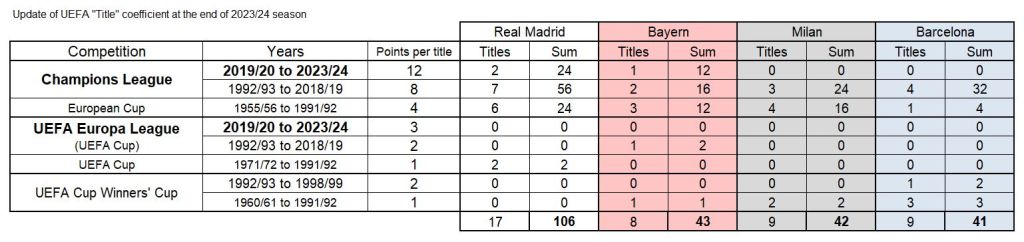
Title coefficient computation, updated to the end of 2023/24 season for the top 4 clubs

Leave a comment

Filed under Sports

Repaso a la evolución histórica del palmarés de la Copa de Europa (2024)

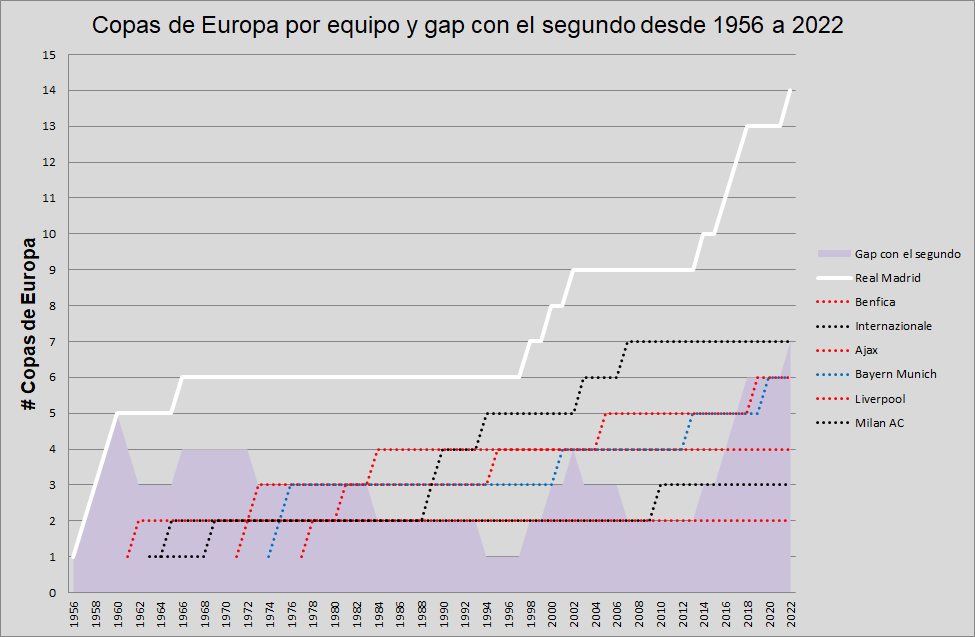
Esta es una pequeña entrada futbolera para compartir la gráfica de debajo tras la consecución de la decimoquinta Copa de Europa de fútbol por el Real Madrid.

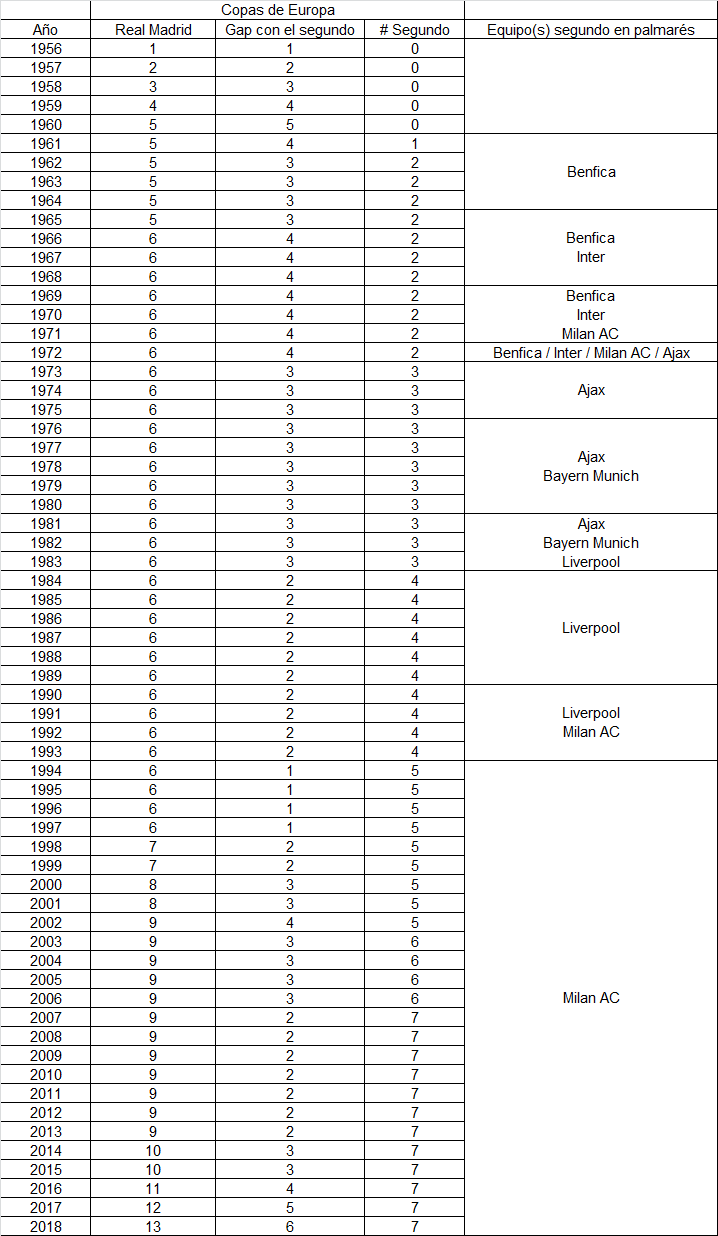
La gráfica presenta la evolución de las Copas de Europa conseguidas por el Real Madrid y todos aquellos clubes que en algún momento de la historia han sido el segundo equipo con más copas. Por orden: Benfica (Lisboa), Internazionale (Milán), Milan AC, Ajax (Ámsterdam), Bayern Munich, Liverpool y de nuevo Milan AC.

Algunas curiosidades que se observan en la gráfica:

  • Es ahora, en 2024, cuando con 8 la distancia, medida en Copas de Europa, entre el Real Madrid y el segundo club con más títulos es más grande.
  • Históricamente la distancia media ha estado en 3,1 copas.
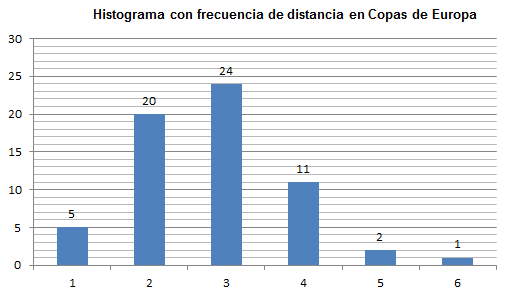
  • La moda, es decir la distancia más veces repetida entre el Madrid y el segundo, ha sido de 3 copas. Esa fue la distancia en 24 años, el 35% de estos 69 años de Copa de Europa (ver histograma debajo).
  • La distancia mínima se dio entre 1994 y 1998, tras ganar el Milan AC su quinta Copa de Europa en Atenas y hasta la consecución de La Séptima por el Real Madrid en 1998 en Ámsterdam.

A partir de esas curiosidades, me surgieron después otras tres ideas muy visuales que incluyo más abajo:

  • Un histograma con el número de años que se ha dado cada distancia en Copas de Europa.
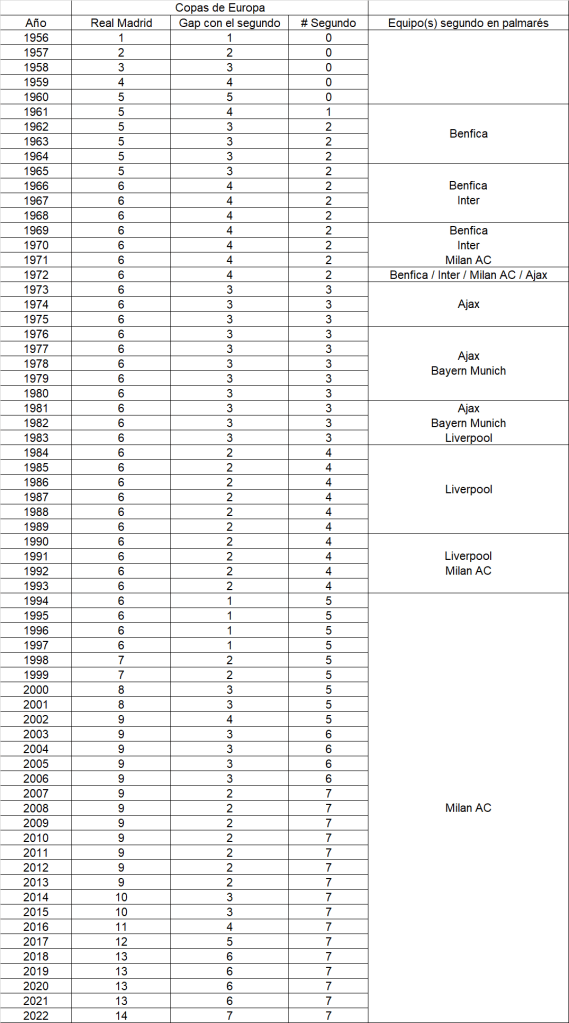
  • Una tabla donde se muestra en cada momento qué clubes eran los segundos en el palmarés.
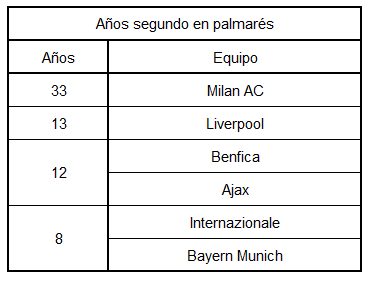
  • Otra tabla donde se muestra cuántos años ha sido cada uno de esos el segundo en el palmarés.

Leave a comment

Filed under Sports

Repaso a la evolución histórica del palmarés de la Copa de Europa (2022)

Esta es una pequeña entrada futbolera para compartir la gráfica de debajo tras la consecución de la decimocuarta Copa de Europa de fútbol por el Real Madrid.

La gráfica presenta la evolución de las Copas de Europa conseguidas por el Real Madrid y todos aquellos clubes que en algún momento de la historia han sido el segundo equipo con más copas. Por orden: Benfica (Lisboa), Internazionale (Milan), Milan AC, Ajax Amsterdam, Bayern Munich, Liverpool y de nuevo Milan AC.

Algunas curiosidades que se observan en la gráfica:

  • Es ahora, en 2022, cuando con 7 la distancia, medida en Copas de Europa, entre el Real Madrid y el segundo club con más títulos es más grande.
  • Históricamente la distancia media ha estado en 3,0 copas.
  • La moda, es decir la distancia más veces repetida entre el Madrid y el segundo, ha sido de 3 copas. Esa fue la distancia en 24 años, el 36% de estos 67 años de Copa de Europa (ver histograma debajo).
  • La distancia mínima se dio entre 1994 y 1998, tras ganar el Milan AC su quinta Copa de Europa en Atenas y hasta la consecución de La Séptima por el Real Madrid en 1998 en Ámsterdam.

A partir de esas curiosidades, me surgieron después otras tres ideas muy visuales y rápidas de ejecutar y que incluyo más abajo:

  • Un histograma con el número de años que se ha dado cada distancia en Copas de Europa.
  • Una tabla donde se muestra en cada momento qué clubes eran los segundos en el palmarés.
  • Otra tabla donde se muestra cuántos años ha sido cada uno de esos el segundo en el palmarés.

Leave a comment

Filed under Sports

Repaso a la evolución histórica del palmarés de la Copa de Europa

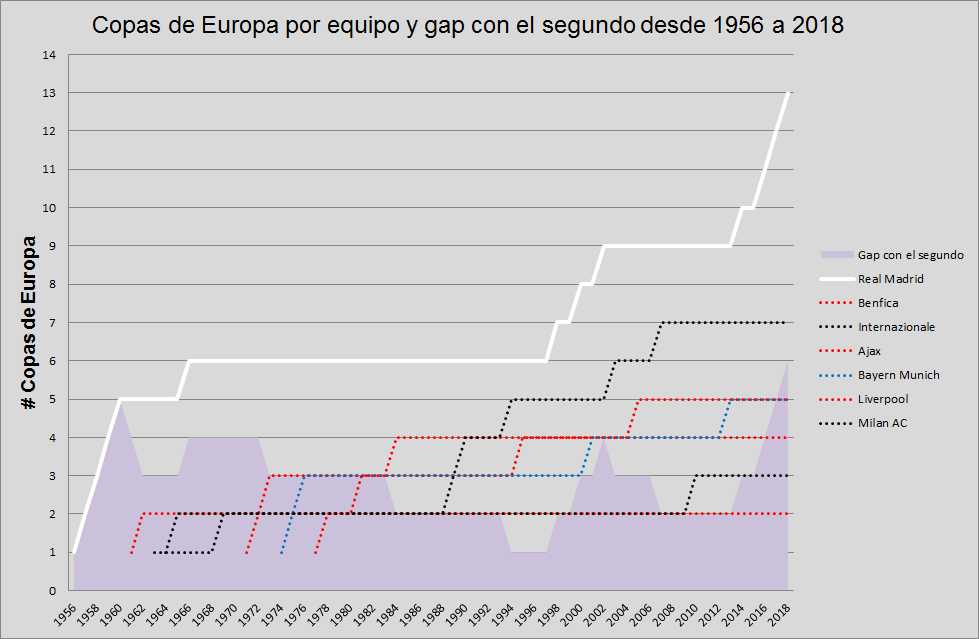
Esta es una pequeña entrada futbolera para compartir la gráfica de debajo tras la consecución de la decimotercera Copa de Europa de fútbol por el Real Madrid.

Copas de Europa & gap

La gráfica presenta la evolución de las Copas de Europa conseguidas por el Real Madrid y todos aquellos clubes que en algún momento de la historia han sido el segundo equipo con más copas. Por orden: Benfica (Lisboa), Internazionale (Milan), Milan AC, Ajax Amsterdam, Bayern Munich, Liverpool y de nuevo Milan AC.

La idea me surgió tras un intercambio tuitero con Andrés a raíz de este tuit.

Algunas curiosidades que se observan en la gráfica:

  • Es ahora, en 2018, cuando con 6 la distancia, medida en Copas de Europa, entre el Real Madrid y el segundo club con más títulos es más grande.
  • Históricamente la distancia media ha estado en 2,8 copas.
  • La moda, es decir la distancia más veces repetida entre el Madrid y el segundo, ha sido de 3 copas. Esa fue la distancia en 24 años, el 38% de estos 63 años de Copa de Europa (ver histograma debajo).
  • La distancia mínima se dio entre 1994 y 1998, tras ganar el Milan AC su quinta Copa de Europa en Atenas y hasta la consecución de La Séptima por el Real Madrid en 1998 en Ámsterdam.

A partir de esas curiosidades, me surgieron después otras tres ideas muy visuales y rápidas de ejecutar y que incluyo más abajo:

  • Un histograma con el número de años que se ha dado cada distancia en Copas de Europa.
  • Una tabla donde se muestra en cada momento qué clubes eran los segundos en el palmarés.
  • Otra tabla donde se muestra cuántos años ha sido cada uno de esos el segundo en el palmarés.

Histograma


Tabla_segundos


Tabla_anos_segundo

De momento, y hasta la vuelta del gran Milan AC, el Real Madrid podrá disfrutar de la delantera en el palmarés hasta al menos 2026.

Leave a comment

Filed under Sports

Scotland

On the 2nd of June I flew in the morning from Toulouse to London Gatwick. At more or less the same time Luca flew from Amsterdam, our friend Elena from Madrid and Maicol drove from Bournemouth, in the South of England. From then on, we embarked into the adventure of seeing as much as possible of Scotland in a week. There we go!

Day 1: Gatwick, York, Riding Mill.

Day 1

At first we encountered heavy traffic in the road, thus we arrived to York later than we wished. We could have a walk around the city. We then followed to Riding Mill where we would sleep at the Low Fotherley Farm, the first of the many Bed & Breakfasts that we would be hosted at. This is a feature which I loved of the trip: those breakfasts! I also enjoyed much the suppers at pubs.

Day 2.

Day 2: Scottish Borders, Markinch, St. Andrews, Edinburgh

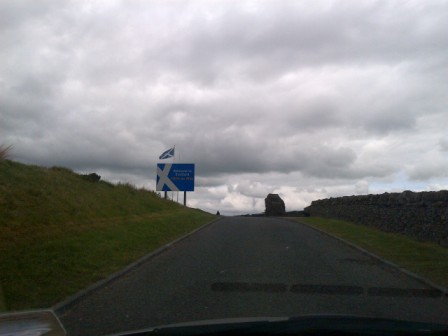
We continued our way to the North, making our first stop at the Scottish Borders, listening for the first time to the pipes and starting to see Scottish flags (St. Andrew’s cross). We then reached Edinburgh and passed it as we wanted to reach Markinch to witness the Highland Games, of which I already wrote one post.

Scottish Borders.

We then went to St. Andrews to visit the Old Course, which I explained in a post about golf in Scotland, and back to Edinburgh where we arrived just in time for dinner.

Day 3.

Day 3: Edinburgh, Stirling, Glamis, Cairngorms, Balmoral, Aberdeen

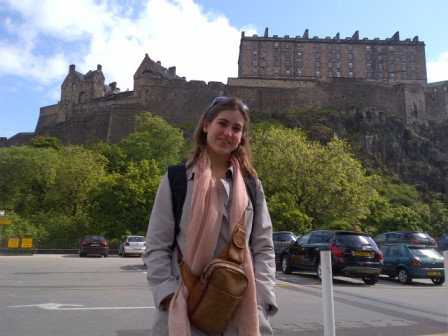
In Edinburgh we slept near Arthur’s Seat, but we decided to skip the trekking to the hill and head to the city centre. We then visited the Castle, where they were getting prepared for the Military Tattoo (where this year an official name for A400M may be given!).

In the castle we saw Mons Meg cannon, St. Margaret’s chapel, the Great Hall, the Scottish War Memorial, the One O’Clock Gun firing at 13:00, the Stone of Scone… We then went down to walk along the Royal Mile to see some more highlights of the city, such as the Cathedral or the statue to Adam Smith.

Edinburgh Castle.

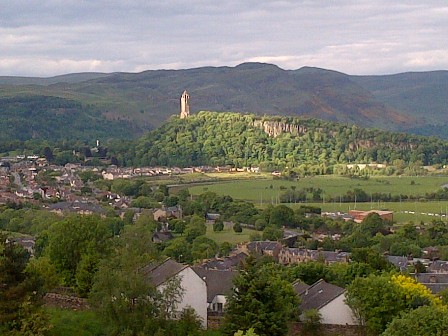
We then went to visit the Stirling Castle, but was already closed (as were Glamis Castle and Balmoral, which we also passed by later on in the day). We took a look of the views of the fields around the castle, where many battles central to Scotland’s history were fought, among them those involving William Wallace and Robert the Bruce, who has a statue just at the entrance of the castle.

Fields at Stirling.

Instead of taking the fastest way by the coast to Aberdeen, we decided to take the route through the national park of the Cairngorms, where the highest mountains of Scotland are. There we saw plenty of deers (we almost bumped onto some of them suddenly crossing the road!), cows, rabbits, etc.

Cairngorms.

Day 4: Aberdeen, King’s College, Loch Ness, Badbea, Dunnet Head, Thurso.

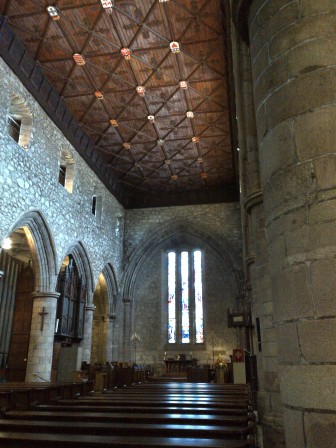
In the morning we took a walk around Aberdeen, the silver or granite city. It was a pity that the cathedral and other places were closed. We could visit the Maritime Museum. We then headed for the beach. We did not take a bath yet, as we were not enough in the North. Close to the beach we saw the football stadium of Aberdeen football club, one of the two which defeated Real Madrid in a Cup winners’ Cup (Recopa) final in one of the four times it took part in the competition. We then went to see King’s College, founded in 1495, with its idyllic campus. Close to the university we visited St. Marchar’s Cathedral where we enjoyed its heraldic ceiling with the coat of arms of many European kingdoms of the time (including Castile, Leon, Navarra…), and where a quarter of William Wallace is supposed to be buried in the walls.

St. Marchar’s Cathedral heraldic ceiling.

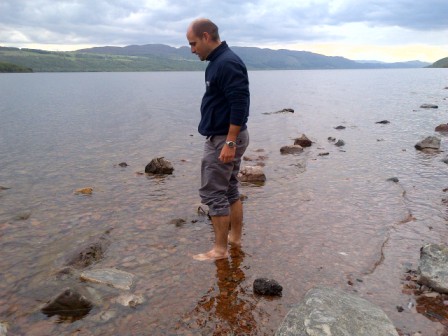
Nessie, at Loch Ness.

Once we left Aberdeen we went to Inverness and crossed it to see the Loch Ness, and we did found Nessie!

On the way to the north coast we stopped at Badbea, a former village by the cliffs of the east coast established during the Highland Clearances, a dark episode in Scottish history.

Badbea (what it’s left of it).

We finally reached Thurso, on the north coast, but that was not enough, we needed to reach Dunnet Head, the northernmost point of the island (being this the one and not John o’Groats). There we could see the lighthouse and some fortifications built during WWII.

Day 5.

Day 5: Thurso, Bettyhill, Durness, Ullapoll.

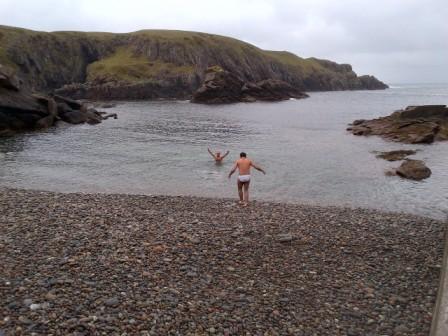
We departed from Thurso and started our tour along the north coast of Scotland, one of the requirements for the trip. We made some stops along the way, to see some sight spots, to have a swim at the North Sea (close to Bettyhill), to visit the Smoo Cave at Durness, to see Durness’ beach and unexpectedly to play golf at Durness Golf Club, as I already explained in an earlier post.

Having a bath at the North Sea.

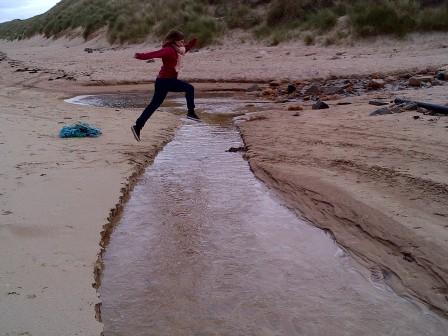
Luca “flying” at Durness beach.

Day 6.

Day 6: Ullapoll, Isle of Skye, Glencoe, Goban.

We had been recommended the visit of the Isle of Skye, as the most beautiful of the islands. After almost rounding it completely we do not recommend the visit. We had some lunch at Portree, which we didn’t either find particularly beautiful. Sincerely, we found dozens of more beautiful spots driving down the west coast of Scotland.

Continuing with our tour we made two short stops: at Glencoe, to visit the memorial of the massacre, where most of the MacDonald clan was killed, and at Goban, a nice port city.

Day 7.

Day 7: Islay

In Islay the main attraction was to visit Bowmore distillery, which I described in an earlier post. We had a walk around the village and then went on to visit the other villages of the island, Port Ellen and Porthaven, where we had some coffee.

Day 8.

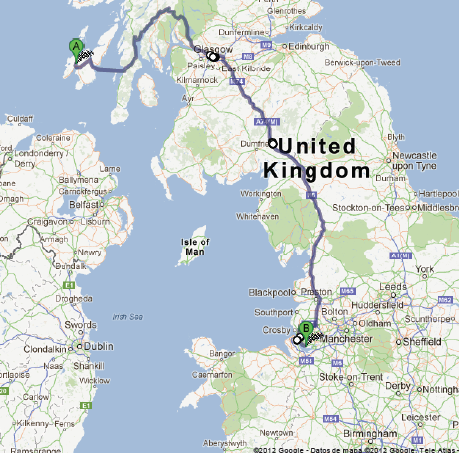
Day 8: Islay, Glasgow, Lockerbie, Liverpool.

On the way to Liverpool we stopped to have a walk in Glasgow, where we had lunch at the restaurant “The Willow Tea Room“, designed by Charles Mackintosh in 1904. Later on, as we saw in the road the signpost of Lockerbie we drove by to see if there was any memorial of the tragedy with the Pan Am Flight 103 which exploded on air; we didn’t find it.

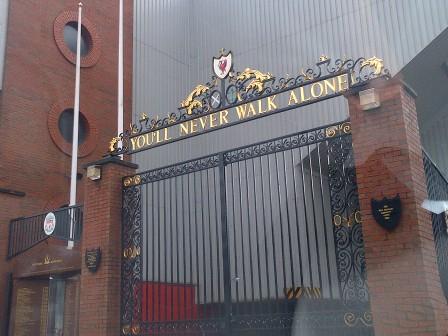
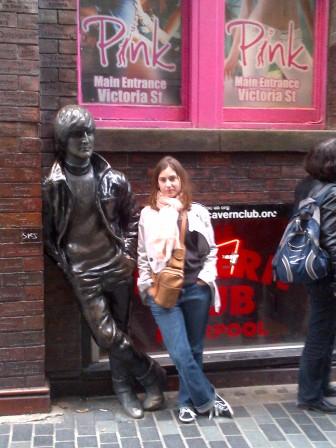
In Liverpool we went by Anfield, though we were late for taking on any guided tour. This is something for which I’ll have to come back. We then moved to the centre to visit The Cavern Club (where The Beatles made their first performance) and have some dinner.

Anfield, “You Will Never Walk Alone”

Luca at The Cavern Club.

Day 9.

Day 9: Liverpool, Gatwick.

This was the last day of the tour, with the only goal to get to Gatwick in time for our flights. The only remarkable thing we saw were some paratroopers being dropped from a C-130J-30 from the UK Royal Air Force, some miles to the East of Brize Norton air base.

1 Comment

Filed under Travelling