St. John’s College is the third oldest college in the United States, founded in 1696 as King William’s School in Maryland.
In 1937 Stringfellow Barr and Scott Buchanan implemented their big idea, the New Program, which the college still follows today.
At the heart of St. John’s is a liberal arts curriculum focused on reading and discussing many of the greatest books and most important questions in history. This is perhaps the most distinctive undergraduate curriculum of any college in America.
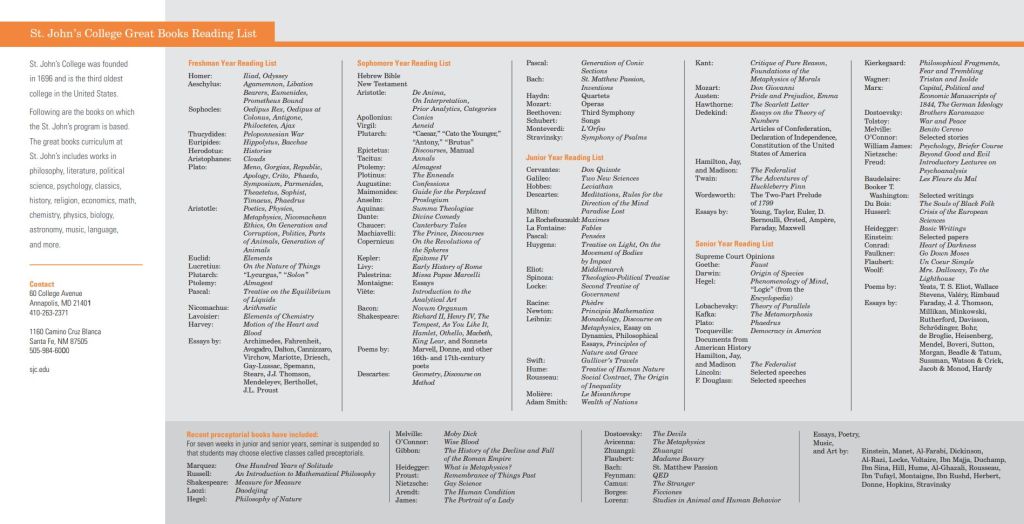
The program can be consulted on their website and it’s subject to some changes (mostly in the elective books which count with some more recent ones). The version I use is this one from some years ago:
St. John’s College Great Books Reading List.
As you can see, the undergraduate program reading list follows some chronological order in the selection of its books for the different years; Freshman, Sophomore, Junior and Senior. In all, the program requires reading over 160 great books in the curriculum and over 20 elective ones.
Scott Buchanan, an American philosopher and educator, met Mortimer J. Adler and Richard McKeon while working at the People’s Institute in New York in the 1920s. There they conceived the idea of setting up this kind of Great Books curriculum, which they pursued with different degrees of success in different institutions. Buchanan tried it at the University of Virginia, the University of Chicago and finally succeeded at St. John’s College. Adler worked on such an initiative together with Buchanan and Robert Maynard Hutchins at the University of Chicago.
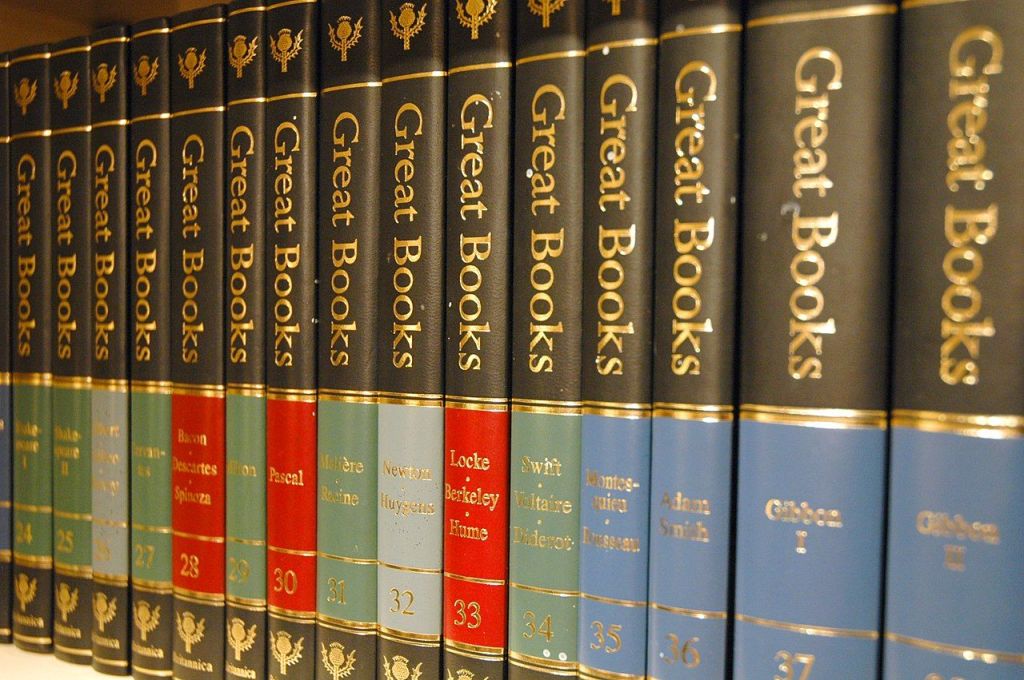
Adler and Hutchins later worked to launch the Great Books of the Western World book series, originally published in 1952 by the Encyclopædia Britannica, with 52 volumes in the first edition and 60 in the 1990 edition. This collection eventually sold a million copies. In the presentation of the first edition, Hutchins said:
“This is more than a set of books, and more than a liberal education. Great Books of the Western World is an act of piety. Here are the sources of our being. Here is our heritage. This is the West. This is its meaning for mankind.“
The Great Books of the Western World (2nd edition, 1990) in 60 volumes. Credit: Rdsmith4.
In this post I wanted to share the list of books I read along the year (1) with a small comment for each one. I have also included a small rating from one to three “+” depending on how much I do recommend its reading.
“Gobierno omnipotente” (Omnipotent Government: The Rise of the Total State and Total War) by Ludwig von Mises (++): Written in 1944, the book shares a critique of state interventionism and central planning on their diverse varieties (socialism, Marxism, nationalism, Nazism), analyzing similarities and differences among them, and the economic and social disasters generated by them in the first half of the XX century, including disastrous wars. [Twitter thread]
“El origen de las especies” (On the origin of species) by Charles Darwin (++): In this famous book written in 1859, Darwin shares his theory of natural selection and survival of the fittest. The book includes numerous examples of evolutionary changes, variations, mutations in different species across the world, counter points and many references to previous studies on the topic (the theory didn’t occur to him out of the blue, but this book is more a compendium of different elements supporting it). The laws that in general terms define evolution are: growth with reproduction, heritage, variation (due to changes of life conditions, use or lack of use), a rate of growth so great that leads to the fight for survival and as a consequence of this natural selection determined by a divergence of characters and the extinction of the less perfect forms. The 6th edition that I read includes as well a review of previous criticisms made to his first editions. The book also includes a discussion of how evolution can still work with the divine creation of a short number of different forms that later evolve. [Twitter thread]
“La mayor ocasión que verá el siglo XXI” by Rafael Acedo (+++): Rafael Acedo is one of my former bosses at Airbus Military and most importantly a senior executive of the company that held different positions, in particular in Programme management and Engineering. This book tells with a unique point of view the fascinating story of the genesis of the A330 MRTT (multi role tanker transport) aircraft. The book offers a blend of technical aspects of the design and development, insight into the sales campaigns with their various requirements that shaped the products, the personnel selection searching for the right engineers to lead those developments, the leadership struggles and styles at CASA and with the integration into EADS… It is an excellent book.
“A room of one’s own“, by Virginia Woolf (+): This short book is based on 2 lectures given in 1928 about women and writing. It emphasizes the need for financial independence, a room without interruptions, access to education and time (“give her hundred years“) for women to shine in literature. [Twitter thread]
“Tractatus logico-philosophicus” by Ludwig Wittgenstein (-): Essay written in 1918 about language, logic, mathematics and their limits, and how the meaning of the world, ethics, mysticism are outside of what can be expressed. The language used and writing style make for a very difficult read even if it is a very short book. [Twitter thread]
“La cuestión P vs. NP” by Jordi Delgado Pin (-): This is a short book from a collection of Mathematics books I started reading some years ago. This particular one is an introduction to computational complexity, and the analysis of the time it takes to solve problems. Too technical for a reader that it’s not into programming like myself. [Twitter thread]
“Elements” by Euclid (++): The book I read is Simson’s translation of 1774, and includes the books I to VI, XI and XII of the geometry manual of the 3rd century BC by Euclid, a classic of Western civilization. Throughout the different books Euclid departs from few definitions, postulates and axioms and goes into graphically calculating different distances, angles, surfaces, etc., with the help of what has been proven before. Some of those exercises are studied in a high school technical drawing course (e.g., how to circumscribe a circle about a triangle) many others are technical drawing on steroids. [Twitter thread]
“Faust” by Goethe (+): Written in 1832, the book is a dramatic poem (in rhyme in the original German) where Faust makes a pact with the devil Mephistopheles to grow in knowledge and live all kinds of experiences; including the love of Grechten and Helen, various parties and military conquests. [Twitter thread]
“Politics” by Aristotle (++): The book, written in the IV century BC, offers a critique of Plato’s Republic, and it’s essay on constitutions for different states, forms of government (monarchy, aristocracy, democracy, oligarchy, tyranny), on virtues, citizens, the separation of powers, the different magistracies, about private property, slaves, women, the natural inequalities among individuals… [Twitter thread]
“Peter Pan” by James M. Barrie (++): Narrated form (1911) of the play (1904) about the adventures of Peter Pan, Wendy, Hook, Tinker Bell… Peter Pan is today a character of world fame, a boy who refuses to grow up and goes to live in Neverland. An aviation angle: his passion for flying and the fact that to fly the only thing which is required are happy thoughts. [Twitter thread]
“Dinero, crédito bancario y ciclos económicos” (Money, bank credit and economic cycles) by Jesús Huerta de Soto (+++): Huerta de Soto is a Spanish economist of the Austrian School of economics. The book, written in 1998, calls for a system of free banking with 100% reserve requirement for deposits, the elimination of central banks and a return to the gold standard. To arrive at those proposals the book analyzes the business cycles and how fractional reserve banking distorts investments decisions, capital allocation, creates inflation and crises. The book offers a comprehensive historical overview of several authors and schools of thought (back to the Middle Age), with numerous citations and an extensive bibliography. [Twitter thread]
“Historiones de la Geografía” by Diego González (+++): The book is a collection of short stories and curiosities about islands, remote territories, unique borders, time zones… Very much like the blog Fronteras (in Spanish) but now compiled in a book, with the fresh style of its author Diego.[Twitter thread]
“La energía nuclear salvará el mundo” (Nuclear energy will save the world) by Alfredo García (+++): A brilliant exercise in popularizing nuclear energy, the science and technology behind it, its unique safety levels (contrary to popular beliefs and the defamation campaigns against it; in particular I loved the detailed analysis of how there’s no risk with eating fish from Fukushima! Much less than with eating bananas), the most well-known accidents (their origin, an account of what happened and what not! i.e., it turns out that most of those accidents are success stories despite how they have stayed in the collective memory), waste management, the need for nuclear energy in the energy decarbonization path, new technologies… The author, Alfredo , works at a nuclear plant and is very active in Twitter / X, follow him (in Spanish) for more information.[Twitter thread]
“Annals” by Tacitus (+): Written around 102 AD, it describes year by year (consulship by consulship), from the death of Augustus in the year 14 to the fall of Nero in 68, with large gaps not preserved. The book mainly deals with the reigns of Tiberius and Nero. Every year it gives an account of the relevant events of the empire: about wars and their development, conquests and appointments in the provinces; discussion of some laws being passed, trials, betrayals, notable executions and suicides in Rome. [Twitter thread]
“Cyrano de Bergerac” by Edmond Rostand (+++): Written in 1897, the book is a theatre play entirely in verse, which is based on some true characters of the XVII century and which has as themes the choice (that Roxane has to make) between beauty (Christian) and the talents, the words and the pen of Cyrano. Along the play the characters exhibit honor, humor, the Gascon spirit, freedom (“panache“). Only by the end, when it might be too late, Roxane discovers what had been going on and how wrong she was. A very amusing and dynamic opening. [Twitter thread]
“Human Action, a treatise on economics“, by Ludwig von Mises (+++): Written in 1949, Human Action is the main work of Von Mises (4 volumes), an economist from the Austrian school. In the book he defends that human action is directed to reduce current uneasiness, that there’s a time preference, that humans are beings that show social cooperation that allows division of labor, which enables individuals to save and accumulate capital. This will lead to an increase of productivity, increasing added value, offering better products at lower prices, the beauty of capitalism, the market economy, prices, consumer satisfaction as the ultimate goal and profits only accrued when that has happened… as opposed to government intervention, socialism and lack of economic calculation, leading to miss allocation of capital, increase in poverty, etc.
“Réconciliation. Mémoires” by King Juan Carlos I & Laurence Debray (+++): In this rare autobiography by a king, Juan Carlos talks about childhood in exile (Italy, Switzerland, Portugal) and in Madrid during the Franco regime (where he was raised away from his family). The formation of his family in the 1960s and his relationship with other royal houses. He shares some of his exchanges with Franco and the dictator left to the future king some of the reforms to be made. He talks about coronation, how he shaped the government that would launch the transition to democracy and the following modernization of Spain. He also discussed his abdication, his current retirement in Abu Dhabi and he explains the sadly limited relationship he has now with his son, king Felipe VI. An overarching theme in the book is the importance of the Crown for the unity of the country and its long term vision. Finally, he explains that he is publishing this book to counter the attacks on the Crown by the current socialist government and its revisionism of History.
This year I read more than in 2024, with a good habit in the first half of the year and the last 3 months, but struggling to find continuity in the summer months, when I was stuck with Annals. In the end I read 17 books and nearly 7,300 pages (~20 pages a day on average), most of them in Spanish with a couple of books in English and another couple in French. Among them I read 5 books out of the Great Books list.
A resolution for 2026 will be to keep the habit, for which I will be following these two tips that I share every year:
a blog post from Farnam Street blog “Just Twenty-Five Pages a Day“, which was published well after I had adopted such an approach to reading but captures it very well,
the Wikipedia article about the Pomodoro Technique, which enables you to efficiently use the last hours of the day.
Another question that I have got a few times is about the source of the list of some of the classics that I read. That one comes from yet another blog post from Farnam Street blog. That post mentioned the Great Books curriculum for the bachelor in arts of Saint John’s College in Annapolis. You can get the list from the Wikipedia or directly from the college website. As I am not reading exclusively those books I advance at a pace of 5 to 8 books out of that curriculum per year, thus it will take me other 20 years to finish the program.
In this post I wanted to share the list of books I read along the year (1) with a small comment for each one. I have also included a small rating from one to three “+” depending on how much I do recommend its reading.
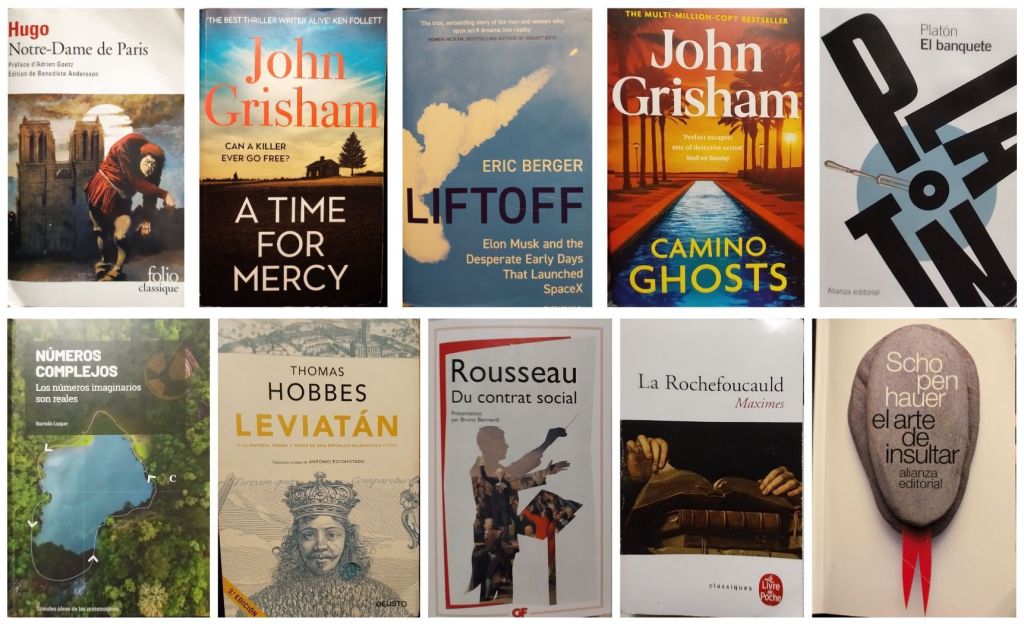
“Notre-Dame de Paris” (The Hunchback of Notre-Dame) by Victor Hugo (++): this is the second book of the author I have read after Les Misérables. The key theme and word of the book is the fatality, Quasimodo’s fate in his attraction for the street artist Esmeralda. The book is set in the Paris of the XV century with very detailed descriptions and maps of its streets, buildings, atmosphere and especially of the cathedral (which I guess can be delicious for the history of art lover, though sometimes it is quite dense). The plot narrates the interconnected lives of Quasimodo, his caretaker the priest Frollo, Esmeralda, Gringoire and the captain Phœbus de Châteaupers, the love some have for others and its impossibility. The plot also denounces the injustice suffered by those in the lower classes with some undue legal processes (a recurrent theme for Hugo). What I liked the most was the unbending commitment of Quasimodo in the last part of the book, to the very end of his life.
“A time for mercy” by John Grisham (++): this is another legal thriller around the courtroom in Clanton, with the lawyer Jake Brigance defending a minor convicted of capital murder (of his mother’s partner after months of abuses and threats). As in some of his books of 20+ years ago, he takes time to guide the reader through the jury selection process and later laying up the strategy for the ambushes that will happen during the trial.
“Liftoff” by Eric Berger (+++): I received the book as a gift from my friend Asier and quickly started reading it. The book tells the story of SpaceX in its early years. It takes time to dwell in the details of some of its first engineers, the technical challenges they faced and what they went through (administrative burdens, financing troubles, changes of location, first failures…) up to the first successful launch of the Falcon 1 in its 4th flight and some insights into SpaceX’s transition towards the Falcon 9 program. The book is energising, and exudes passion for engineering and the extreme dedication of those individuals. [Twitter thread]
“Camino ghosts” by John Grisham (+): this is a legal thriller linked to Grisham’s character Bruce Cable (a bookshop owner and old books collector in South Florida) with an old lady author descendant of African slaves as the centre of the plot (Lovely Jackson) and an enchanted little island off the coast where her ancestors lived. At the time of the novel a real estate development company wants to work on the island to build some housing and a resort. Lovely wants to preserve the island off the hands of the developers and claims the property of the island which triggers the legal action. This is one of the books I have liked the least by the author (after having read over 25 of his) mixing beliefs in black magic, enchantments on the island, misticsm and the praise of the oppressed political agenda of the past decade.
“El banquete” (Symposium) by Plato (+): this book is a short dialogue after a banquet in which several attendees to the meal are asked to give a speech praising love and Eros, the Greek god. These praises include the controversial relationship at that time between minor pupils and their adult instructors. One of the last passages of the book includes the praise by the young and ambitious Alcibiades of his instructor Socrates, as the latter didn’t attend to the approaches of the former as Socrates was focused on his search for truth.
“Leviatán” (Leviathan) by Thomas Hobbes (++): published in 1651 (during the English civil war), the book portrays the republic as a mortal God (Leviathan) needed for the defence of the individual. The book discusses different types of government (with monarchy as the preferred one for the author) and the relationship between the civil power and the Church (to which christians have an allegiance and commandments to follow), for which the author discusses in depth different passages of the Bible.
“Números complejos” by Bartolo Luque (++): this is a short book from a collection of Mathematics books I started reading some years ago. This particular one was written by an Applied Math teacher I had at the engineering school. It explains the appearance of complex numbers from Heron of Alexandria up to the the first labeling of imaginary by Descartes. The book explains some of their applications such as the Zhukovsky transformation (very much used in aerodynamics), the art of Escher and goes into the Riemann hypothesis. The book doesn’t spare mathematical expressions thus it is not recommended to the untrained reader. [Twitter thread]
“Du contrat social” by Jean-JacquesRousseau (+++): written in 1762, the book describes how the people in a community (the Sovereign) come to be organized (Social pact) in order to be defended and have their natural rights as individuals upheld. The book discusses different forms of government (monarchy, aristocracy and democracy), which of those forms suit best to different countries based on their size and wealth, who is the legislator, different types of laws. [Twitter thread]
“Maximes” by La Rochefoucauld (++): La Rochefoucauld was a duke in XVII century France (also known as Prince de Marcillac). In 1665 he published the first edition of the reflections known today as his “Maximes”, out if which some originated from his acquaintances at the time. Once drafted he shared the volume with friends and continued to edit them with additions and removals. The present edition includes all those and some of the exchanges and critiques of the volume made at the time. The topics of the reflections are virtues and vices of humans, with the particularity that the author takes a rather sceptical view on human nature pointing at the weaknesses, the pride being at the centre of many of our actions… and even portraying sloth as our main virtue (!) as it subdues our passions preventing us from taking action and falling prey of our vices more often. [Twitter thread]
“El Arte de insultar” by Schopenhauer (+): the book wasn’t really written as such by Schopenhauer but it is a compilation of rants he wrote throughout his different publications. In the book the insults and rants are classified per topic in alphabetical order. Which are the most recurrent subjects? Other philosophers (in particular Hegel), the French language, women (several times, placing women as a secondary sex), university professors / deans, journalists, writers… [Twitter thread]
This year I read a bit more than in 2023 but not as much as I would have liked, as I found myself not finding time sometimes during the year and other times I was stuck with a couple of books.
A resolution for 2025 will be to keep the habit and read a bit more, for which I will be following these two tips that I share every year:
– a blog post from Farnam Street blog “Just Twenty-Five Pages a Day“, which was published well after I had adopted such an approach to reading but captures it very well, – the Wikipedia article about the Pomodoro Technique, which enables you to efficiently use the last hours of the day.
In this post I wanted to share the list of books I read along the year (1) with a small comment for each one (2), links to Wikipedia articles about the book (if available) and to the authors (in case you want to read about them). I have also included a small rating from one to three “+” depending on how much do I recommend its reading:
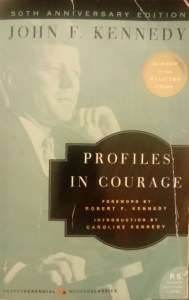
“Profiles in Courage“ (by John F. Kennedy) (++): written by then senator Kennedy when he was convalescent from a back surgery in the 1950s, this book analyzes the context, figures and controvert decisions made by 8 different US senators mainly from the XIX century (from John Quincy Adams, Daniel Webster… to Robert A. Taft), decisions that were not popular at the time in their constituencies but the politicians understood were needed to be taken and demanded courage to do so. For this book Kennedy obtained a Pulitzer prize in 1957. From the analysis, Kennedy extracts some lessons in the last chapter that are well encapsulated in the following dilemma: “[…] the loyalties of every Senator are distributed among his party, his state and section, his country and his conscience. On party issues his party loyalties are normally controlling. In regional disputes, his regional responsibilities will likely guide his course. It is on national issues, on matters of conscience which challenge party and regional loyalties, that the test of courage is presented.”
“El arte de ser padres” (by Fitzhugh Dodson) (++): a loan from my parents to help us in the quest of upbringing our daughter, the book, written in the late 1970s, did help in removing weight from some situations when the child was at the turn of being 2 years old. Among other things, it teaches you to get more relaxed, laid-back, not to enter into conflict trying to impose things, etc. It was also interesting to see how society and some social conventions have changed from the 1970s to today (e.g. drinking and smoking during pregnancy).
“The Spirit of Saint Louis“ (by Charles A. Lindbergh) (++): this autobiographic book describes one of the great adventures of the XX century, the first non-stop flight across the Atlantic ocean in May 1927. For this book Lindbergh received a Pulitzer prize in 1954. The beginning of the book covers the days of Lindbergh working for the postal service of Robertson Aircraft Corporation and how he gets engaged into the race of who would be the first pilot(s) to cross the ocean. He later describes the conception, development and testing of the Ryan aircraft he flew for the feat. He finally gives a detailed account of the 33h30′ flight; hour by hour, alone, squeezed in his seat, with scarce food and water supplies, cold, flying day (within the clouds at times) and night, thrilling and semi-unconscious (asleep) at times, until he lands in Le Bourget. I wrote a post review the book, find it here.
“El General en su Laberinto“ (by Gabriel García Márquez) (+): this book is a novel trying to figure out how the last days of the Venezuelan revolutionary Simon Bolivar were. The characters, trips, locations, etc., are real. The dialogues, thoughts, feelings, are the work of Garcia Marquez. As always with Garcia Marquez, there are very vivid dialogues and reflections in the book by way of its characters, however this wasn’t the book I liked the most from him. On the hand, to get a better feeling and description of the last days of a person I very much preferred for the uneasiness it puts you as a reader “The Death of Ivan Ilyich“ by Tolstoy.
“Pensar con Arte“ (by Manuel Conthe) (++): this book shows how our minds work in their way of thinking with their biases and the situations that may arise. The concepts covered are similar to other books that I have read in the past (Thinking Fast and Slow, Seeking Wisdom: From Darwin to Mungeror Poor Charlie’s Almanack), the originality here comes from the parallels and connections that the author brings and offers with the arts (literature, paint, cinema, music…), showing examples from different art craft.
“España 3.0: Necesitamos resetear el pais“ (by Javier Santiso) (+++): this book is call for action, for change, for resetting Spain into a country which bases its economy and growth on innovation, education and technology. It starts by offering a rather harsh and in my opinion good diagnostic of many of the ailments of the country. Then shows how several things do work in the country and how in previous occasions the country has raised up to similar challenges and it can and has to do so again. The sooner the better.
“The Diary of a young Girl“ (by Anne Frank) (++): the diary of a 13-year-old girl when she starts writing it and 15-year-old when it finishes, Anne Frank describes how she, her family and some others live day by day in hiding from the Nazis. Throughout the book there are many comments, appreciations, worries, misunderstandings, etc., very typical of that age. Despite of that, at some points of the book Anne provides a great example of resilience, attitude and hope: e.g. at times she reflects that all in all she cannot complain, she doesn’t lose time and imposes onto herself a rigorous studying and reading time schedules, etc. In that extent, her attitude and the diary reminded me of another book I have often seen recommended that I must read, “Man’s Search for Meaning” by Viktor Frankl, a jew imprisoned at a concentration camp.
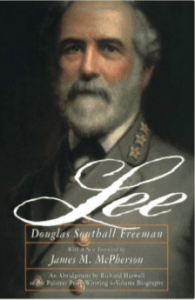
“Lee“ (by Douglas Southall Freeman abridged version by Richard Harwell) (++): this is the biography of Rober E. Lee the general of the Army of Northern Virginia on the Confederate side during the US civil war. The book covers from the origins of the family, the birth and early education of Lee, his days at West Point where he specialized as an US army engineer, and how as the different states start seceding and viewing that his allegiance shall remain to Virginia he resigns from the US army. The book then describes the different battles, the style of Lee during the war and the surrender at Appomattox. Then it covers his final years as president of the Washington college in Lexington. For the extended version of this biography, Douglas Southall Freeman received a Pulitzer prize in 1935.
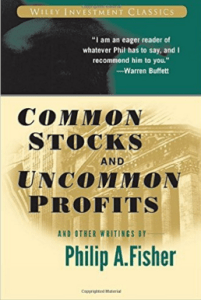
“Common stocks and uncommon profits and Other Writings“ (by Philip A. Fisher) (++): a classic book about investing strongly recommended by many, among others Warren Buffett. The first edition was written in 1950s, the edition I read dates from the 1970s and includes some reflections of what he wrote in the first one. The main contribution of the book is what the author calls the scuttlebutt (rumor, gossip) technique, that is the thorough research ground work an
investor must make before investing in any stock by way of talking to sales men of competitor companies, customers, experts on the field, academics, management of the company, etc., and which he summarizes in 15 points. A quick takeaway from the book is that, if you lack the time to thoroughly proceed with the scuttlebutt, it might be better to leave for others, who have, the task of picking your stocks. The Other Writings included in the book relate to what is and how it was developed his investment philosophy and on whether the markets are efficient.
“The gospel of wealth and other timely essays“ (by Andrew Carnegie) (++): In the main essay of the book (The Gospel of Wealth), Carnegie, discusses the moral obligation of the wealthy to redistribute their wealth in life back to the society. He positions himself against charity and offers several options that would have a great impact in lifting those among the poor willing to work in their own progress: funding of educational institutions, hospitals, libraries, parks, monuments, etc. Other essays relate to whether the United States (the Republic) should or not follow the path of Britain in having colonies and dependencies (in relation to the Philippines), a speech explaining the arrangements of the American constitution, critiques on proposals for free trade agreements between Britain and its colonies, etc. A good review of business and politics at the end of the XIX century.
“Vol de nuit“ (“Night Flight”, by Antoine de Saint-Exupéry) (++): in Saint-Exupéry’s second novel he describes the operations of an air mail business based in Buenos Aires and with aircraft incoming from different locations in South America. The book describes the difficulties of night flight at the time and of developing this new type of service. One particular flight under cyclonic conditions will put into question the whole operation and the different characters, the pilot, her wife, the line operations’ chief, radio operators, etc.
(2) In this 2015 I have not written many dedicated posts about the books I have read (just one about the “The Spirit of St. Louis“), but I do not discard making a review of some of them in the future.
At the beginning of the year I set as a personal objective to read at least 15 books. This will be a low number for some of you and a high one for others. To me it looked challenging but achievable… though, I did not achieve it. I completed 10 books and started other 4 which I have not yet finished (they’ll be included in the next year reading list).
See below the list with a small comment for each one, the link to a post about the book in the blog (when applicable), links to Amazon (in case you want to get them) and sometimes to the authors. I have also included a small rating from one to three “+” depending on how much do I recommend its reading:
“Le Petit Prince” (by Antoine de Saint-Exupéry) (++): even if narrated as a children’s book, it contains several idealistic messages, fine criticisms of how adults behave, etc. The teachings are mainly transmitted through conversations between a child and the prince and encounters with other characters… I wrote a post about it “Le Petit Prince“.
“The consequences of the peace” (by John M. Keynes) (+++): the book was written at the time of the Versailles Conference after the World War I, which he attended as a delegate from the British Treasury. In the book, Keynes explained how the disaster in the making was being produced, due to lack of communication between representatives from USA, UK, France and Italy, and the intention from Clemenceau of taking as much as possible from Germany. Keynes makes a series of estimates of Germany’s production capabilities and that of the regions being taken from it and comparing them with the pretensions that were being included in the negotiations of the treaty. In the book, he warns well in advance the economic and social disaster that the treaty is going to send Germany into. (I have not yet written a specific review of the book, but since I had underlined several passages I don’t discard writing it).
“Le bal des ambitions” (by Véronique Guillermard and Yann le Galès) (+): the book tells the story behind the creation of EADS and its first years. Very much like in a thriller, it gives account about the characters involved, the battles for power, etc. I wrote a post about it “Le Bal des ambitions“.
“Desolé, nous avons raté la piste” (by Stephan Orth and Antje Blinda) (+): The book consists of a series of awkward situations in a flight described by passengers, pilots and cabin crew, mainly miscommunications between the crew and passengers or funny messages received from the cockpit. The book originated after a collection of the anecdotes posted by readers of the online version of Der Spiegel. . See the review I wrote about it “Sorry, I missed the runway“.
“Poor Charlie’s Almanack: The Wit and Wisdom of Charles T. Munger” (by Charlie Munger, compiled by Peter D. Kaufman) (+++): the book is a compilation of Munger’s speeches, quotes, interviews, articles, letters, etc. Some of his speeches are available in Youtube (e.g. this one given for the commencement of USC Law in 2007). One of the main takeaways is the use of several mental models to analyze situations we live in our lives (instead of being stalled in the few models which we are more comfortable with). Another recurring topic is the lack of training in psychology that we get (or even his criticism of how psychology is taught in faculties). I haven’t written a post about the book, but I think I should, if only to share more of his wit and wisdom with you.
“The Peter Principle: Why Things Go Wrong” (by Laurence J. Peter) (+++): the book is a hilarious account of situations that arise in companies and institutions of why and how people are promoted, cornered, etc., or in his words is a treatise on hierarchology. The name of the book comes from the Peter Principle which says: “In a hierarchy, every employee tends to rise to his level of incompetence”. I already wrote about it here.
“2010 Odyssey Two” (by Arthur C. Clarke) (++): the book is a sequel to the famous “2001: A Space Odyssey“, and there is a movie as about this book. The story starts with doctor Heywood Lloyd travelling in a combined Soviet-American mission to Jupiter in order to find the spaceship Discovery One from the previous mission and what went wrong with it… I won’t tell more of the plot to avoid spoiling it for someone. I would say that I liked more this book (and movie) than the first one.
“The Litigators” (by John Grisham) (++): this novel is very much like most of John Grisham. In this one the plot is about a star young lawyer graduated from Harvard Law School who cannot stand the pressure from a big firm and quits it to join a mediocre small firm with two partners who chase victims of small accidents to help them get some compensation from insurance companies, with the hope of reaching the big class action which could make the rich.
“Soccernomics” (by Simon Kuper and Stefan Szymanski) (+++): the authors use economics’ techniques, plenty of data, statistics, citing several papers, studies, etc., in order to bring up uncovered issues about football (such as transfer market, what makes some nations more successful in football…) or refocus the attention about other ones. See the review I wrote about it.
I also completed two other partial objectives: to read at least 2 books in French and 2 about politics/economy. And as always, on the learning side from reading there is Twitter (a source of information or distraction?), the subscriptions delivered to home of the weekly The Economist and the two monthly magazines Scientific American and Toastmasters.


 “
“ “
“
 The Blog by Javier