Category Archives: Aerospace & Defence

Airbus vs. Boeing, comparison of market forecasts (2011)

Some days ago, John Leahy, Airbus COO Customers, unveiled at a press conference in London the new figures of 2011-30 Airbus’ Global Market Forecast (GMF, PDF 28.8MB).

Last year, I already published a comparison of both Airbus’ and Boeing’s forecasts (Current Market Outlook, CMO, PDF 3.2MB). You can find below the update of such comparison with the latest released figures from both companies.

Comparison of Airbus GMF and Boeing CMO 2011-2030.

Some of last years’ comments still apply:

  • Boeing sees demand for 15% more aircraft with a 21% more value (excluding regional a/c).
  • Boeing continues to play down A380 niche potential (57% less a/c than Airbus’ GMF), though it has increased its Very Large market forecast by 40 a/c, or 7.5% (Did Emirates new order at ILA change their minds?)
  • On the other hand, Boeing forecasts about 600 twin-aisle and 4,000 single-aisle more than Airbus, clearly pointing to its point-to-point strategy.
  • In terms of RPKs (“revenue passenger kilometer”), that is, the number of paying passenger by the distance they are transported, they see a similar future: Airbus forecasts for 2030 12.3 RPKs while Boeing forecasts 13.3 (in trillion).

The main changes from last year’s forecasts are:

  • Both manufacturers have drastically increased their single-aisle forecast: +1,300 a/c in the case of Airbus and +2,200 in the case of Boeing.
  • In general all numbers have been increased: single-aisle (as mentioned above), twin-aisle (between 50-150 more), large aircraft (between 40-80 more), value of aircraft and RPKs… it seems that for commercial aircraft manufacturers not only the crisis is passed but they see a rosy future lying ahead.

Again, I strongly recommend both documents (GMF and CMO) which, differences apart, provide a wealth of information of market dynamics. I am especially happy to have encountered this year again full version of Airbus GMF, not only a short one [PDF, 4.7MB].

7 Comments

Filed under Aerospace & Defence, Marketing

Cité de l’Espace

I visited the Cité de l’Espace with my sister during last August holidays. Believe it or not, I had never been there before so I was looking forward to it.

The museum / park is very comprehensive and informative, especially for children and people who would like to know some basics about rockets, satellites and space exploration. Among the different interactive devices you can play with a gyroscope, try to dock into the ISS, launch a vehicle into a stable orbit, experiment how a satellite’s orbit parameters affect its ground-track…

I especially liked the exhibitions about celestial mechanics, space exploration and life in space, the path to the infinite and the real-size replica of the MIR space station.

This slideshow requires JavaScript.

The only downside I find is the price of the ticket, above 20 €. It’s true that there are discounts for students, Airbus employees, etc., but when I compare it with the National Air and Space museums of the Smithsonian institution in DC which are entry free I am disappointed. I believe museums and especially science-related museums should be very affordable for families with small children, when they are most captivated by science at play.

The Cité de l’Espace was definitely worth a visit.

1 Comment

Filed under Aerospace & Defence, France

Space Shuttle last ride

I already wrote that my childhood dream job was to be an astronaut and that led to pursuing aerospace studies. In the same post I recalled a small toy of the Challenger Space Shuttle and how this toy contributed to that dream. Well, this post is just an homage paid to the Space Shuttle, or officially the NASA Space Transportation System, STS.

The last mission of the STS is scheduled for next Friday, July 8th. When the Atlantis is supposed to make the last lift-off for the mission STS-135 which, after 12 days, will end the 30 years of Shuttle flights.

During our last visit to the USA, Luca and I had the chance to see one of the Space Shuttle vehicles at the National Air & Space Museum (NASM). The vehicle at display there is the Enterprise.

I already mentioned in that post there that the Enterprise is the only vehicle of the fleet which never went to outer space. It was used for training purposes, to let the astronauts train the gliding descend they would have to make once the vehicle re-entered in the atmosphere. Thus, some parts of that vehicle are dummies.

The Enterprise hasn’t got the same thermal protection tiles since it wouldn’t need them, however its surface replicates the tiles with some kind of rubber ones so the flow of air around them would be the same as in the other vehicles. Another difference is in the engines at the back. The 3 engines that the Shuttle has at the back are its orbital maneuvering system, which allow it to adjust its orbit (they’re not atmospheric engines to propel the Shuttle in its flight back to Florida). Again, since the Enterprise would never go to outer space it wouldn’t need to adjust its orbit and the engines it has are just dummies to provide the same distribution of weight and forms in the vehicle.

I also mentioned in the previous post about the visit to NASM that the vehicle was going to be named Constitution until a public campaign achieved its goal of naming it Enterprise after the spaceship featured in Star Trek.

Find below some pictures of the Enterprise at NASM:

This slideshow requires JavaScript.

The Economist features this week 3 articles about the Space Shuttle program. I found parts of them very critic of the costs of the program, but nevertheless they give a somewhat complete picture of the history of the Space Shuttle and what may lay ahead for space exploration.

The different Shuttle vehicles (and other related materials) will be distributed among several museums and educational institutions. The Enterprise will leave the NASM and will go to the USS Intrepid in NYC while the Discovery will be hosted at NASM. You may find other locations in this article.

Finally, NASA just unveiled last Friday a wonderful documentary (80 minutes) about the history of the program: its launch, the vast engineering undertaking, the first mission, the Challenger and Columbia accidents, the improvements that the accidents brought, etc. To close the circle, the documentary is narrated by William Shatner, an actor of Worldly fame as he featured James T. Kirk, captain of the USS Enterprise in Star Trek. See a small trailer of the video:

PD: In the full length video, in the images shown of the mission STS-95 which brought John Glenn back to Space at age 77, appears Pedro Duque a Spanish astronaut that coincidentally was my teacher at the aerospace engineering school.

Leave a comment

Filed under Aerospace & Defence, Movies

Iowa Aviation Museum

“What made you come here?”

“We saw a sign at the interstate and decided to come.”

“Great, it’s nice to see that advertisement works”…

This was our first exchange with the clerk at the Iowa Aviation Museum. We had just bought our tickets for 7$ and registered our names in a pristine visitors’ list. I guess we were the first visitors of that day, probably of the week, conceivably of the month, who knows if even in the year.

Luca and I were in our way from Des Moines to Omaha. I thought it would take 4 hours but soon discovered that we would arrive much earlier than we wanted. Having already passed the exit for the John Wayne birth place, when I saw the sign for the “Iowa State Aviation Museum” I didn’t think it twice. I turned the wheel and took the exit.

We had to drive another 10 miles on a more than boring road and then 2 more miles to reach the museum at the aerodrome or the Greenfield Municipal airport.

The museum had some unique pieces from the early days of aviation (e.g. the 1st airplane ever to carry the name “Piper”, the J-2… a one derived from it was the plane I flew in Poland). Nevertheless I wanted to commend the museum for 3 other things:

  • Diffusion of passion for aviation: I find it admirable that in such remote places, they do gather some resources, collect some assets and put up a museum for the delight of fans, to spread the passion for aviation and seed the souls of future engineers.
  • Scheme of contributors to the museum: to finance that museum they have in place a scheme in which both companies and individuals contribute to its sustaining. In exchange they get public recognition in the form of a golden plaque at the Hall of Fame of the museum.
  • Hall of Fame: I also admire the tribute paid to pioneers from the region and people who played a key role in aviation in the form of that Hall of Fame.

In that Hall of Fame you learn that an Iowan volunteer became the youngest aviator in US Army Aviation Section in WWI (Clifton P. Oleson); another Iowan built the 1st multi-passenger seaplane, the 1st twin-engine bomber, designed the 1st honeycomb structural supports and was the founder one of the companies behind today’s Lockheed Martin (Glenn L. Martin); another Iowan, this time a woman nurse, unsuccessfully sought a pilot position at Boeing Air Transport, but influenced the president with her idea of placing nurses on-board airplanes to make passengers feel more comfortable with flying (Ellen Church became the first stewardess in history); and another 2 Iowans were the chief engineer and the first pilot to fly the famous Lockheed SR-71 Blackbird (William J. Fox & Louis W. Schalk).

In the hall you also find out that an Iowan lost the first ever race between a car and an airplane (Carl S. Bates) and that a cloth sewn by the wife of a first cousin of the Wright Brothers is worthy enough to make it to the Hall of Fame (especially if that cousin happens to be the great, great, great-grandfather of a fellow from Greenfield…).

Barnstorming is a term I learnt at the museum (well, you go to museums to learn, don’t you?) that refers to the entertainment that first aviators provided in different villages in the 1920s, where they would fly as in a circus to show the airplanes to villagers, perform some stunts and get some cash by carrying affluent citizens in short demonstration flights. This, also contributed to spread the passion for flight.

This slideshow requires JavaScript.

PD: I join the legion of admirers of Luca for standing these #avgeek visits not only stoically but even enthusiastically.

6 Comments

Filed under Aerospace & Defence, Travelling

Preferred employer both in Spain and Europe…

Yesterday I wrote about what was my dream job as a child: being an astronaut. I work now for Airbus, and for many people, that seems to be the dream company to work for according to some studies.

Already last year, I posted about the study made by Randstad which placed EADS (mother company of Airbus) as the most preferred one in Spain.

This year, the same study by Randstad [PDF, 1.5Mb] has placed again EADS as the favourite company for workers (out of a study including the 150 largest companies in the country), even though the sector Aviation placed only as the third most wanted one.

Apparently the 3 factors in which EADS led the rankings were: the quality of in-company education, the interest of the work performed and the pay policy.

Moreover, recently it was released another study, this time targeted to engineering students across Europe. This one placed again EADS in the top 3 preferred employers behind Google and Audi, and ahead of BMW and Apple.

The good news: EADS will be recruiting over 4,000 employees in 2011.

Leave a comment

Filed under Aerospace & Defence

What was my childhood dream job?

Some days ago, I got an email from a source-of-ideas-for-blogs service called Plinky, from which I have already picked some good ideas to write about in posts in the past (on charities, advice…).

The question I liked this time from the email was:

“What was your childhood dream job?”

I don’t know whether I have been posed this precise question many times or not, what I know is the answer to it and that I have given that answer many times to other questions.

When I was a child I wanted to be an astronaut. I don’t know exactly why, but that was my dream job. Surely, I can recall memories of toys related to space, such as a model of the Challenger that my brother and I played with (I presume it came before the accident), or toys related with Star Wars, etc.

This passion, among other factors, led me to study aerospace engineering, and then work for Airbus, which is not working as an astronaut but is still working in the aerospace business. Many times, I have been asked why I studied what I did, sometimes by corporate HR quizzers, and this is what came as a response.

Would I still want to be an astronaut?

Sure! But, yes, I am not pursuing it. I guess I am just waiting for the moment when commercial space flight costs not 20M$ but about 100k$, and if by then I can afford it I guess I would pay for enjoying a stunt out there.

7 Comments

Filed under Aerospace & Defence

Muret Air show 2011

The Red Arrows are the UK Royal Air Force Aerobatic Team. They are one of the most famous acrobatics teams worldwide. They were formed in the ‘60s when several unofficial teams were united under the new official team of the RAF.

The Red Arrows were performing yesterday at Muret Air exhibition, just 12km away from Toulouse so I went there to spend the day with some colleagues from Airbus (which kindly sponsored the show providing fuel for the aircraft). The organization of the event left the Red Arrows for the end of the day. The team is composed of 9 pilots plus an extra one who acts as road manager and commentator during the show (animator I should say). They fly BAE Hawk airplanes and are about 33 years old on average.

The several figures in different formation patterns that they performed were impressive (Diamond, Apollo, Vixen, Heart, Palm tree, etc.). I must admit that this was the first exhibition I attended, as the only other time when I witnessed acrobatics was at the Red Bull Race in Budapest in the summer of 2007, when I was on holidays there with friends.

I took several pictures and videos of their performance, but somehow I didn’t manage to save most of the videos correctly, so I can only show below the pictures in the slide show below:

This slideshow requires JavaScript.

There were another two teams performing: the French Air Force Cartouche Doré (flying 3 TB30 Epsilon, made by Socata, a filial of EADS) and the Breitling Jet Team. The latter is a civilian acrobatic team (the only one) based in France. They fly L-39 Albatros.

Apart from these teams, there were several other planes that were flying in the show: L-39 Albatros, Cap 232, ATR-42, Beech King Air 200, some Pipers (simulating a fight between a police airplane and another one), P40… but the only ones my smartphone saved correctly in videos were the flights of the A380 and the A400M (no kidding, I did over 20 videos and discovered only these 2 were stored in the memory), enjoy them:

It was a good experience, perfect for a sunny Saturday. I wanted to remark the importance of having a good commentator and music to enhance the show. In Muret the commentator was great (apparently he is famous in France and engaged in all air shows) but the music was not always the best, though when it was it really made you (seriously) think “I want to fly one of those”…

1 Comment

Filed under Aerospace & Defence, France

National Air & Space Museum at Dulles

Let me quote from the Wikipedia:

“The Smithsonian Institution was founded for the “increase and diffusion of knowledge” from a bequest to the United States by the British scientist James Smithson (1765–1829), who never visited the new nation. In Smithson’s will, he stated that should his nephew, Henry James Hungerford, die without heirs, the Smithson estate would go to the government of the United States to create an “Establishment for the increase & diffusion of Knowledge among men”.

“The Smithsonian Institution is the largest museum complex in the world, and many of its buildings are historical and architectural landmarks.”

During our last trip to USA, Luca and I visited both locations of the National Air & Space Museum of the Smithsonian institution. I had already been at the one in the Mall and I already talked about it briefly in a previous post. I wanted to write about the museum at Dulles, close to DC international airport.

That museum is named after Steven F. Udvar Hazy, who is the CEO of Air Lease Corp, an airplanes leasing company. Previously he was chairman and CEO of ILFC, another leasing company, together with GECAS, one of the 2 biggest. The guy is a living legend or commercial markets: when he blessed or criticizes an aircraft it is seriously noticed by the manufacturers. He donated 65M$ to the Smithsonian to set up this museum and that’s why it carries his name. Thanks Steve! What a museum! The NASM is awesome!

The museum has dozens if not over a hundred of airplanes, satellites, rockets, helicopters, etc., in display, all tagged with small explanation of the aircraft.

On our visit we joined a free guided tour, another fabulous feature of the museum. Our guide was Bill Laux, a veteran pilot from the Navy. He was originally from Omaha where we would be going in a couple of days while he would be heading also in a couple of days to Belgium… crossing roads.

We stayed with Bill for about 2 hours, following one explanation after the other, one curiosity here, another detail there, etc. I remember visiting Ellis Island in NYC 2 years ago with a ranger who also filled the tour with stories. This is something I really like: instead of paying for a quick tour or audio-guide, they make use of the willingness of these volunteers to pass on their knowledge.

I have to admit that the session was for core aviation geeks, and I want to commend Luca for standing it. At the beginning we were a group of 10-12 people, wives and children included. The guide asked: “Who has got an aerospace background?” 4 or so of us raised hands… after 30 minutes of tour only Luca and those with aviation background continued with the tour (no sight of wives and children). After 1 hour 30 minutes, only Luca and me. After 2 hours the guide went “well, we’ve seen pretty much everything” :-). Thanks Bill!

I scanned one of the sides of the map of the museum to post it here. The map covers the Boeing hangar, but bear in mind that there is another hangar missing (James S McDonnell, which hosts a Space Shuttle), an IMAX cinema, the restoration hangar and the control tower.

I wanted to post it here so you can get a grasp of what we’re talking about. Airplanes packed side by side, one of top of the other… and not any airplane, some are unique pieces. Let me just comment on a few of them (of which below you can find the pictures):

  • The Space shuttle Enterprise: which never went to outer space as it was used only for training purposes, to let astronauts command the powerless flight after re-entry. Believe it or not, it was going to be named “Constitution”, trekkies had not stepped in.
  • A Lockheed SR-71A Blackbird: the reconnaissance aircraft which set the record as fastest aircraft back in 1976.
  • The Boeing 367-80 “Dash-80”, which as I already mentioned in a previous post, was the prototype Boeing built to test and market a new configuration for commercial jet aircraft, a configuration which all commercial aircraft have followed more or less ever since.
  • A Concorde.
  • The famous B-29 Enola Gay.
  • The Langley Aerodrome A: a model that Samuel Pierpont Langley (a manned flight pioneer and secretary of the Smithsonian institution at the time) used to try to set the first heavier-than-air flight… he didn’t, as the model crashed in the Potomac river.
  • A Junkers 52 built by the Spanish CASA.
  • A Boeing 307 Stratoliner: the first pressurized commercial aircraft.

This slideshow requires JavaScript.

I would only give one point of improvement for the museum: now you cannot get into the aircraft except for simulators, if they would just change that policy it would be just perfect (in the Mall you can actually enter in some models, e.g. Spacelab).

I forgot to mention some extras: the museum is free (free as in zero dollars), it has a transport leaving every hour to and from Dulles airport which costs just 50 cents, has lockers for big luggage free of charge, has a nice souvenir shop with plenty of aviation books and even a McDonald’s to recover some strength at half way of the visit…

In future posts I will comment some of the details of some aircraft… give credit to Bill, our guide.

17 Comments

Filed under Aerospace & Defence

Beluga vs. Dreamlifter

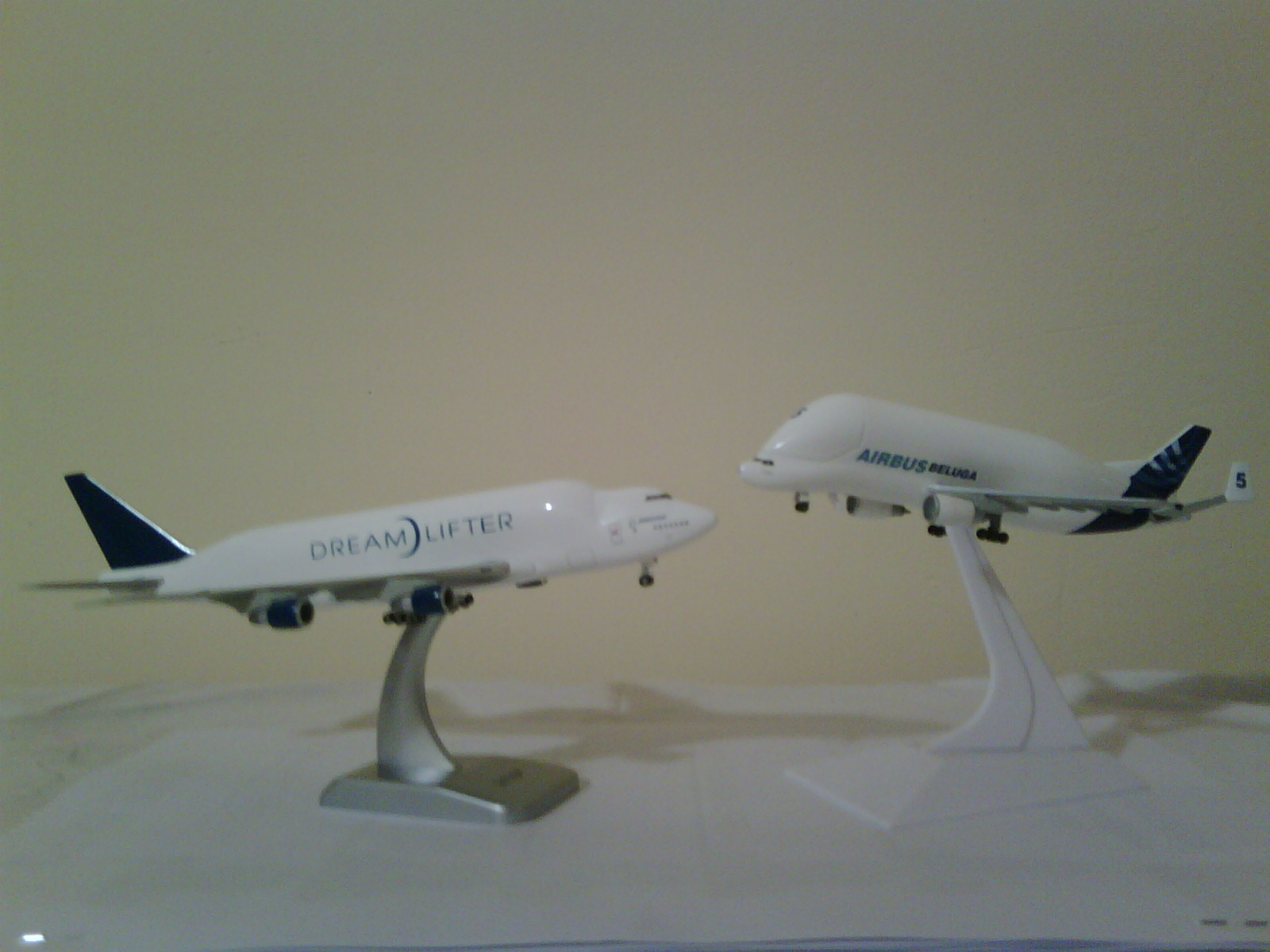
While looking at the small-scale models of aircraft at home, some days ago, I locked on the Beluga and the Dreamlifter (Airbus and Boeing transport aircraft to bring major components from one factory to another). I had become used to the sight of the Beluga but seeing then both together I realized that they are indeed bizarre.

While Airbus relied on the Beluga since years ago (and before, it used the Super Guppy; now resting at the museum by Airbus factory in Toulouse), Boeing only decided to modify 747s for this purpose to reduce transportation times in the 787 manufacturing.

In this post I didn’t want to make any technical comparison, just wanted to show this picture and ask: which one do you think is the prettiest (or the ugliest)? I haven’t made up my mind yet.

Dreamlifter vs. Beluga.

10 Comments

Filed under Aerospace & Defence

747

I attended a course at the AirBusiness Acedemy of Airbus some weeks ago. In one of the coffee breaks I hanged around in the building’s library and I found a book that I wanted to read, so I picked it: “747”, by Joe Sutter with Jay Spencer.

Joe Sutter is the engineer who led the engineering development of the Boeing 747, the Jumbo. The book, a biography of Sutter, covers all his life but it is mainly centered in the happenings, decisions, struggles, individuals, etc., involved in the development of the 747 and other aircraft.

I particularly liked the many engineering problems that he mentioned in the book, why & when they encountered them and how they overcame them: e.g. how they debugged the B 377 Stratocruiser, the decision of placing 737 engines under the wing, going for 4 main landing gears in the 747, etc., and the innovations that they introduced in commercial aviation with different aircraft: first pressurized aircraft (B 307 Stratoliner, with the issue they had with the vertical stabilizer), the jet engine mounted in pylons under the wings (with the B 367-80 prototype –now resting at the Air & Space museum at Dulles, DC- which evolved in the 707; configuration mainly used until today), the first wide-body aircraft (B 747), etc.

He also described many details about dealings with customers (e.g. Juan Trippe in Pan Am, Iraqi customers), competitors (including Russian delegations during Cold War), and colleagues at Boeing (with some heated discussions and internal politics, where he doesn’t save any detail).

As a curiosity, I finished the book while flying from Chicago to Frankfurt some days ago aboard a B 747, the first time I flew in one. I was sitting by the wing and took some pictures of the wing (first with a triple-slotted flaps) at different moments of the flight.

This slideshow requires JavaScript.

The book is a very interesting read which I recommend to anyone with passion for aircraft (engineer or not).

6 Comments

Filed under Aerospace & Defence, Books