Category Archives: Economy

Las casas son para invertir y no para vivir.

Como nota de humor en medio de la crisis, y para abundar en el argumento de que las casas no pueden ser un vehículo de inversión, pego el texto de un email que circulaba en verano de 2006 y que a mí me llegó a través de mi amigo Álvaro mientras estudiábamos en Sevilla:

“Me he decidido a coger mi máquina del tiempo y contaros como van las cosas por el futuro:

Afortunadamante no se han cumplido las previsiones de tantos agoreros burbujistas y la vivienda en España ha seguido subiendo un 17% anual durante los últimos 50 años, de este modo nos hemos convertido en el país mas rico del mundo, porque por ejemplo un ático en la castellana cuesta mas que el estado de California y el palacio imperial de Tokio juntos; claro que ya nadie vive en la Castellana ni en ningún otro sitio de Madrid, por que esas casas son para invertir y no para vivir.

Yo por ejemplo aunque trabajo en Madrid me he comprado un piso de 40 metros la mar de apañao en un pueblo del Norte de Burgos, que con la autovía queda a un paso; para pagar la hipoteca nos hemos juntado con otras tres familias: un notario casado con una catedrática de universidad, un subinspector de hacienda casado con una abogada del estado y un magistrado del supremo (subcontratado a traves de una ett) casado con una arquitecta. De este modo destinamos cinco sueldos a la hipoteca y uno para vivir; estamos contentisimos con la compra porque aunque al principio nos está costando un poco luego seguro que ni se nota, además desde que lo compramos hace un año ya ha subido un 17% y por si fuera poco la mujer del notario esta de buena que lo flipas.

Aunque profesionamente no me va mal (soy director general adjunto de una multinacional, aunque también subcontratado a traves de una ett) la verdad es que la inflación que sufrimos al ser el país mas rico del mundo hace que nos tengamos que apretar un poco el cinturón; de todos modos es cuestión de acostumbrarse, cuando tuvimos que empezar a comer chopped de lagartijas todos nos quejamos y ahora se le da vuelta y vuelta en la plancha y tan rico que queda. De cualquier forma, aprovechando que han bajado la edad laboral a los 10 años a ver si saco al churumbel del colegio y lo meto en la ett, que un sueldo mas seguro que ayuda para la hipoteca.

Mi sueldo es de 2.000 tochos netos, el tocho es la moneda que sustituyo al euro cuando nos echaron de la UE a patadas (que fea y que mala es la envidia) y se cotiza a un centimo de euro. En la caja fuerte del banco de españa ya no se guardan lingotes sino ladrillos, que en este país han demostrado ser un valor mucho mas seguro y rentable que el oro.

Tras las guerras atómicas provocadas por los propietarios de vpo de andalucía la población ha quedado reducida a 5 millones de españoles y 50 millones de ecuatorianos trabajando de paletas, se han seguido construyendo 800.000 viviendas anuales (la construcción supone ya el 98% del PIB) y ahora tocamos a unas 20 viviendas por habitante (casi todas vacías porque como dije son viviendas para invertir, no para vivir) . El 90% del suelo esta ya urbanizado y se plantea empezar a construir ciudades en el fondo del mar (no se puede vivir en el fondo del mar, así que serían ciudades solamente para invertir) . Esto es lo que en el mundo se conoce y admira como “el milagro español” y es objeto de numerosos estudios y tesis doctorales en el campo de la psiquiatría. Cada año nos visitan miles de estudiosos de la mente humana de todo el mundo. No me extrañaría que muchos de esos científicos se quedasen porque la verdad es que como en España no se vive en ningún sitio.

Y eso es todo lo que os puedo contar de lo que os espera; voy a ver si cazo unas lagartijas para cenar

Viajero del futuro”
2 Comments

Filed under Economy, Investing

A house is no investment

In a previous post I commented that in times of crisis it was much better to have your investment in real assets than in government bonds. I gave the typical examples given by Bestinver managers: real assets being portions of an enterprise (stocks), chairs, and pencils, even houses

While this is true in order to make sure you keep the value of your assets through the crisis period, it is another story when we are talking about investing as in “To commit (money or capital) in order to gain a financial return”. Then I dare to say that buying a house is no investment. When buying a house there are not goods or services produced for others in the hope of a profitable sale; so if someone buys it in the hope of realising some profit that is pure speculation.

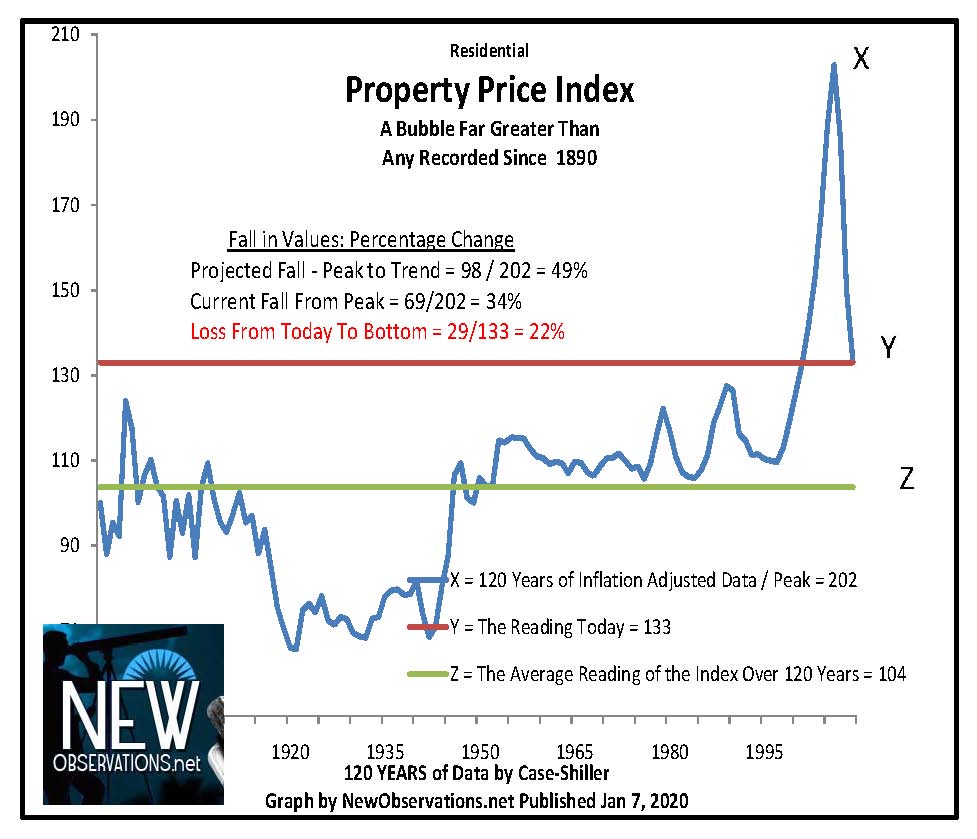
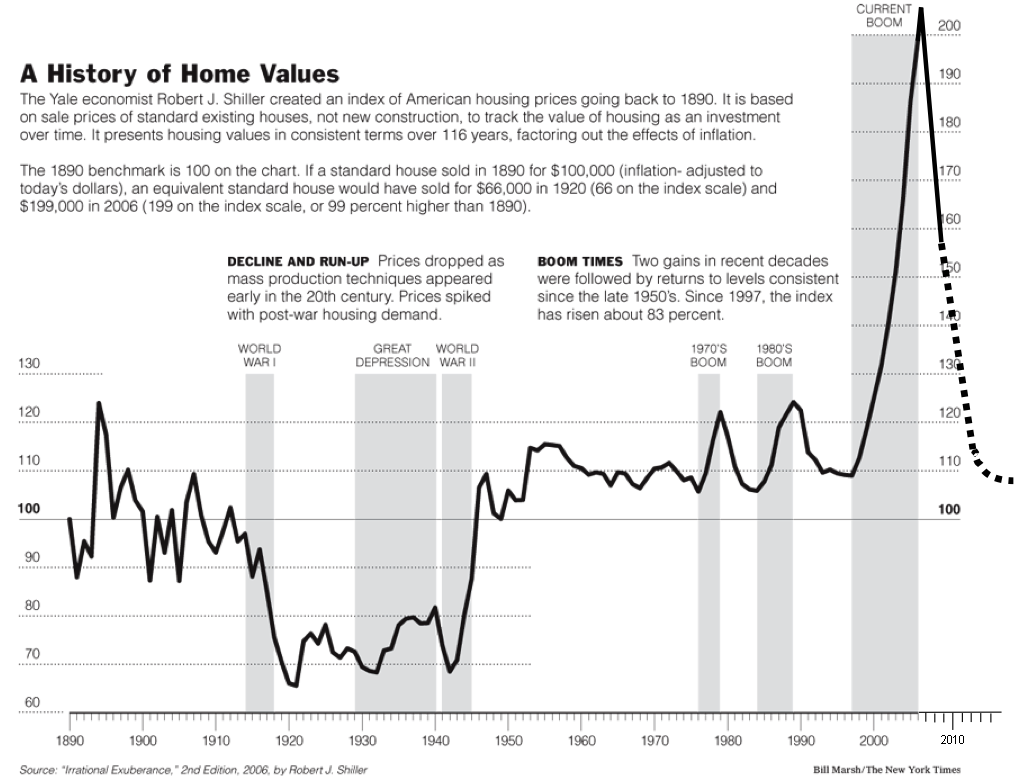
After having said this, I wanted to share two graphics from Case-Shiller Home Price Indices for American houses since 1890… In the first graphic you can see that after adjusting for inflation at the end of the 20th century, in absence of crisis and booms the value of a house was nearly the same than 100 years before, merely 10% higher. Why should it be higher if no goods/services are produced? Then you can see the boom that took place in the 2000’s up to mid 2006. That was pure greed and speculation.

Case-Shiller Home Price Indices for American houses, 1890-2006.

In the second graphic you may see the prediction made based on Case-Shiller Home Price Index. The prediction is pretty simple: there is no reason to forecast that homes prices have to stabilise at a higher point than the average of the past 120 years… other way to say that a home does not generate any value (still, it doesn’t destroy value either!).

Case-Shiller Home Price Indices for American houses, 1890-2009 and forecast.

4 Comments

Filed under Economy, Investing

Stocks vs. Bonds, 200 years

Some weeks ago I had two different conversations with friends. The issue: whether Greek bonds would be a good investment given the yields they are being offered at. I then argued that I didn’t think it was a safe investment, that many countries had defaulted payments, and as a value investor in the making I tried to explain that a much better investment would be to find out there some great stocks at a big discount.

I was also looking for some graphics to send them to prove the point. I had seen those graphics at the annual investors’ forum of the asset management firm Bestinver in different years. They represented how different the outcome of an investment would be for a person living either in Germany in the 1920-30’s or in Argentina in the last 15 years in case this person had invested in the stock market or in government bonds, supposedly safer.

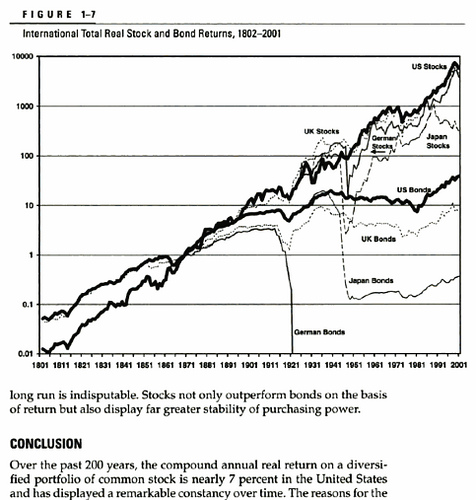
In both cases the investment is much better off when it’s composed of stocks, as they represent a portion of a real company that continues to operate after the crisis and the currency devaluation/hyperinflation period that typically follows. The value of the investment in bonds is suddenly reduced to nearly zero… At that time I didn’t find any of those graphics in the Net, but the other day I found a similar one. Here it goes (note the scale is logarithmic):

Stocks vs. Bonds, 200 years comparison.

Please, note the difference especially between German and Japanese bonds and stocks. But also with US and UK stocks and bonds the difference persists.

The managers of Bestinver year after year repeat the same example: in those situations is much better to be invested in real assets, be it portions of an enterprise (stocks), chairs, and pencils, even houses… all these are assets that once the crisis is over will retain the value they have. However the paper money has no value once the nominal value is devalued.

2 Comments

Filed under Economy, Investing

Budgets and Gadgets

A couple of Sundays ago I was discussing with my father about Spanish public debt, budget deficits, etc. We both had some figures in mind and I also had some others recorded in the mobile phone, from a conference I had attended at EOI Business School some months before (see the slides below).

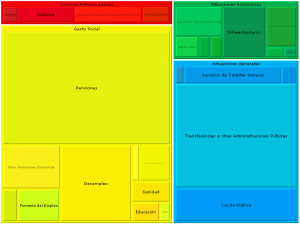
Over the table, my father and I were trying to figure out whether the Spanish public debt could reach or not 75% of GDP in two years from now: “given that budget is around 35% of GDP and public debt is around 53% of GDP, then if budget deficit is 12% this would add to the public debt no more than 4% debt over GDP a year”… at that moment I missed having had at hand a detailed view of the Spanish Government Budget of 2010. I wanted to have some TreeMap of the budget like the one I had recently seen from the US 2011 Budget request at The New York Times website.

So I put myself into it. Google docs spreadsheet has among its many gadgets the possibility to draw a Tree Map which is precisely what I wanted to have. First I used some already prepared data from the my job to see how it worked, and, once I saw it was easy, I gathered the data about Spanish Government from the following website (of which I also liked much the way of presenting).

I had seen some treemaps before at the job, but so far not so many outside. So, the main purpose of this post is not to talk about budgets, but to let you know about this gadget which maybe useful in your job. You may see below the gadget I prepared and if you click on it you may see the detailed figures for each one of the chapters, grouped by category.

The one thing I didn’t like much, again, is that WordPress.com is not enabling its users to directly embed this kind of gadgets into the blog… but this has a simple solution that I keep postponing…

4 Comments

Filed under Economy