Category Archives: Sports

Historias del Fútbol Mundial

Tengo la costumbre de, siempre que paso por un aeropuerto, visitar la tienda de libros y revistas, a ver si encuentro algún libro. Siempre que vuelo ya llevo algo de lectura conmigo y estas visitas a la tienda de turno las hago por si encuentro algo interesante. A veces lo encuentro.

El año pasado antes de emprender un viaje a Holanda, cuando se estaba jugando la Copa del Mundo en Sudáfrica, encontré en Barajas el libro “366 Historias del Fútbol Mundial”, de Alfredo Relaño. Tras ojearlo un poco, lo compré pensando que estaría bien como complemento al evento futbolístico del momento que tan bien acabó para España. Digamos que para imbuirme un poco más del espíritu futbolístico.

El libro no tiene un hilo argumental, sino que está estructurado a modo de calendario. Ordenadas según los meses del año, el libro tiene una historia por cada uno de los días del mismo. Cada historia una hoja, dos páginas. Perfecto para tener en la mesilla y leer unas pocas historias de vez en cuando.

Muchas de las historias son muy conocidas, algunas casi contemporáneas, y otras tantas no tanto. Por ejemplo, en estas semanas de abril y principios de mayo, cuando se van a vivir tantos partidos entre Real Madrid y Barcelona, en el libro aparece una historia con bronca entre ambos equipos en las semifinales de copa de 1916 tras la cual estarían hasta 10 años sin volver a enfrentarse. ¿Qué diría la prensa durante 10 años sin un partido del siglo cada semana?

Otras historias de estas semanas:

  • El plante del Barcelona en la vuelta de la semifinal de Copa del Rey contra el Atlético de Madrid en el año 2000.
  • La victoria de España en la Copa del Mundo Sub-20 en Nigeria, con Xavi y Casillas. Preludio de lo que ocurriría 10 años después un poco más al sur.
  • El nacimiento de la expresión del “miedo escénico” del Bernabéu en la final a doble partido de la UEFA contra el Colonia en 1986.
  • El accidente que acabó con el Torino en el monte de Superga en 1949.
  • El nacimiento de la Copa en 1902, cuya primera edición duró 3 días y ganó un equipo conjunto formado por jugadores del Athletic y el Vizcaya de Bilbao (que más tarde se fusionarían); o del Scudetto en Italia, cuya primera edición duró 1 día y ganó el Génova.
  • La derrota del Barcelona en la final de la Copa de Europa en Sevilla frente al Steaua de Bucarest.
  • La aparición de las tarjetas amarillas.

Y así hasta 366…

Todavía no he terminado de leer todas las historias del libro, pero las que llevo leídas (algunas releídas) ya me permiten recomendar el libro sin miedo a equivocarme.
3 Comments

Filed under Books, Sports

San Silvestre 2010 (pics)

Last week I, together with 8 friends, ran the popular San Silvestre Vallecana as a farewell event for 2010 year.

The first time I took part in it was back in 1998. In the 1999 edition I ran together with my brother, that year we were less than 9,000 runners inscribed. This year there were 34,000 inscriptions available (though we did not inscribe ourselves). It took us 45 minutes to start running, by then the winner had finished long before (the winner finished in 29 minutes).

I believe that this has been the time have gathered more friends to run it; 9 of us. Also this year was different in that some of us were using Twitter till the last minute, smartphones to track the route, meters to check heart rate… quite a tech sport event.

The time: around 1h 5’ for 10km.

Enjoy the pictures:

This slideshow requires JavaScript.

3 Comments

Filed under Sports

La prairie des Filtres

Today, I found in the mailbox the first issue of The Economist to arrive at my new place. I took it and went for a walk to read it in a park by the river.

The park I went to is called “La prairie des Filtres”, named after the infiltration galleries used to purify muddy water pumped from the river Garonne, cleaned and brought up to the water tower of Toulouse. The system was first established back in 1821.

This park was also the place that served as the first field for the rugby matches of the Stade Toulousain, the local team which happens to be the most laureate club in France and Europe (having won 4 European Cups, more than any other club). The team now plays sometimes at the Stadium of Toulouse, just across the river, though most of the times plays at the Ernest Wallon stadium at the other side of the city. I guess I’ll have to pay a visit to one of its matches.

Now… the park is where I read the paper and run by the riverside…

Enjoy the pictures:

This slideshow requires JavaScript.

4 Comments

Filed under France, Sports

Book review: How Soccer Explains the World

I was given the book “How Soccer Explains the World” as a present by Luca & her mother about 2 months ago. They bought it in the London bookshop Daunt Books, and it came with a bookmark of the shop… impressive. Take a virtual tour around the book shop, it definitely deserves a stop in the next visit to London.

The book… since I have been questioned about it many times: no, soccer does not explain the World. However, it is a very interesting book drawing parallels about historical moments in recent history and how they were connected with football issues going on at the moment in the same places.

The first chapter for example tells about Serbian paramilitary groups, their connection with football and how they were instrumental in the Yugoslavian wars. In that chapter you read lots of names that ring a bell from having followed football recently: Obilic, Arkan, the great Red Star of 1991 (Prosinecki), Ognjenovic (a singing of Real Madrid), Zvonimir Boban… all these names let the reader connect with the story. In my case, having been in these locations and having good friends from both Serbia and Croatia increased the interest of it.

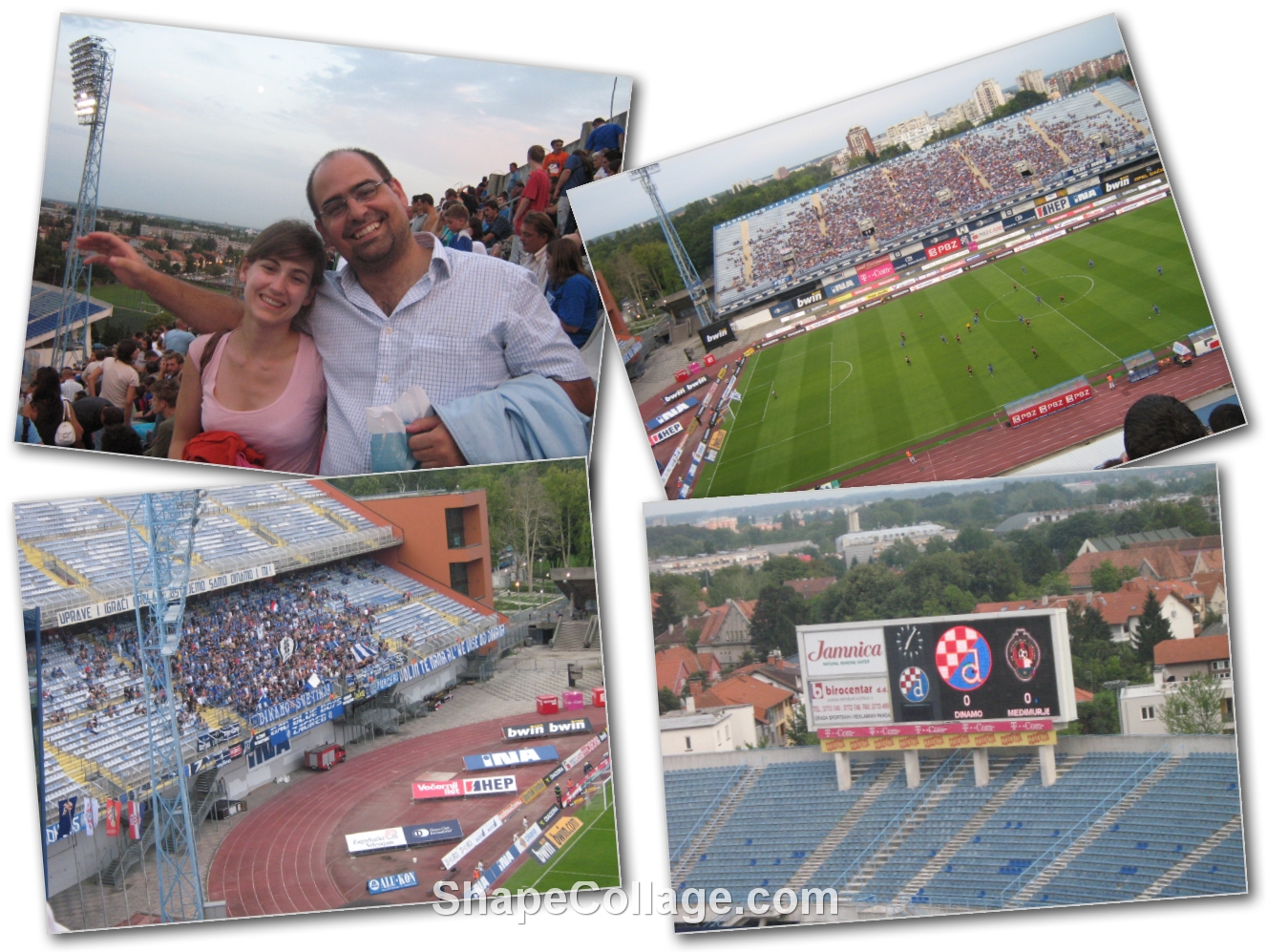
Luca & I attending the game Dinamo Zagreb vs. Medimurje (Croatian league) in 2007... because Dinamo offered an open-doors day after having made a good selling of tickets against Werder Bremen the previous week...

There are other chapters that may draw the attention of many: a whole chapter dedicated to F.C. Barcelona (the favourite team of the writer, Franklin Foer… an American, you see), other to Celtic-Rangers rivalry, disdain for soccer in the USA, Ajax, racism in football…

I recommend this book, especially in times of a World Cup.

3 Comments

Filed under Books, Sports, Travelling

Bye, Vistalegre

On Wednesday 2nd June I attended Real Madrid – Caja Laboral basketball match at Vistalegre. Even in the case of winning, I was not going be able to attend the following match on Friday 4th and I had a gut feeling that it was going to be the last match I watched at Vistalegre since Real Madrid is moving to La Caja Mágica next season. Moreover, I am not sure whether next year I will take the season-ticket again, so I felt like taking pictures to remember the last 3 years of basket experience.

Even though the team has not won a single title since we started attending matches I must say that it has been a great fun. It all started on the late summer of 2007, when my two friends Pablo´s talked about taking those tickets, and I joined them.

We have had the chance to see great teams (CSKA Moscow, Panathinaikos, Barcelona, Maccabi, TAU…) and great players (Navarro, Rudy, Garbajosa, Papaloukas, Jasikevicius…).

Each year we had to learn about the new signings, which all seemed promising then they weren’t that good (Smith, Tunceri, Pelekanos, Tomas, Hosley, Massey, Papadopoulos, Velickovic, Lavrinovic, …) and the team had to rely mostly on the same players than years before.

This last year seemed even more promising than the previous two: we had signed the best coach in Europe, all new players seemed very effective from the start, the speaker of the stadium really cheered the audience, we were doing great in all competitions, the club even reinstated cheerleaders, when we had a setback an even flashier player would come (Jaric), but then, the year has ended as the previous ones.

One of the best things along these years have been the matches on Thursdays, meaning a break in the work week, a chance to meet friends and have a kebab for dinner where to continue talking about planes, the company, etc.

Maybe next year will be a better one, though I’m afraid I won’t be in the North side whistling rival attacks and referees decisions…

This slideshow requires JavaScript.

6 Comments

Filed under Sports

Speech about Minifutbol

Since I started the blog, I wanted to write about Minifutbol, a competition I play in Torrelodones. On March 17th I gave one speech about it at Toastmasters (supposedly a humorous speech), so what better way to explain what Minifutbol is that to share the script of that speech with you here:

“Mr Toastmaster, fellow members, guests,

This is the t-shirt of team with which I won last summer Minifutbol championship in Torrelodones… I am proud of it because that was the first championship I won in Minifutbol, I’m so proud that I’ll wear it here. I wear it here, because my partner Luca doesn’t allow me to wear it at home. She doesn’t like Minifutbol. On the awards ceremony after that tournament I was given a very big, shiny trophy… her reaction: “You’re not bringing this home! Not until you get rid of the rest of the trophies”. Once bitten, twice shy… now the trophy is somewhere hidden.

Fellow members, I want to tell you about Minifutbol, a kind of football being played in Torrelodones.

It all started 40 years ago with a group of friends in their twenties wanting to meet their old friends with the excuse of playing football matches.

Nowadays, in the village we are more than 600 people participating in it. We are divided in the following categories: “embryos”, “dummies”, “immature teens” (pavosos inmaduros), matures and veterans.

And there has always been a huge waiting list of people wishing to play, some applied in the 70s for the embryo category and still waiting and looking forward to join the veterans now.

As I told you, this T-shirt is of the team I played with last summer and won the summer tournament, now I am playing in another team. With this team we didn’t win the winter championship… no, we have been the last ones. We just won 2 matches out of 16… I don’t care, I’m even happy: in these competitions everybody gets a prize: I’ll be given a smaller trophy that will fit better in the living room of the house. Luca may not oppose this time.

Why did I switch teams? Minifutbol has a social ambition attached to it. There you get to know different people from the village. We switch teams every year and they are formed randomly: every year I inscribe myself individually and then by draw I’m placed in a team with other 7-8 players. At least this is what I’m told… actually, I never saw the draw taking place… It could be that each year my previous team is just getting rid of me.

Going back to the competition, we lost, ok, but let me tell you one rule of the competition that describes well the spirit of it: each player has to play at least a minimum of 10 minutes in every match. So it can’t happen that the best player of the team plays the whole of it and the worst doesn’t get to participate. In the case of our team we could say that we want everyone to feel part of the failure of the team.

Ok, failure is a strong word… let me put it in another way. What would you say is the most important thing in football, the success factor?… ok, so the more goals the better the match, the better the show. This year, I am in a team devoted the show, which in football means goals… we are so devoted to it that we try not to interfere with it; we have been scored 160 goals, about 10 goals per game. Sometimes we even had to score those goals ourselves. I had to score one myself.

Life goes on. In spring we play yet another tournament: the Cup. With the same teams we played in winter.

Now we have the chance to be the revelation team in the cup tournament… as you can imagine the pressure is very high among us, the expectations in us however are very low among the rest…

It never happened that the very worst team in the league has been able to win the cup.

I received the following message from the captain of the team trying to encourage us:

“Guys, I also think we can be the revelation team. Let’s do something that has never been done by anybody else, something never seen, something surprising and that will leave everybody with their mouths wide open…

… let’s play naked next Sunday.”

Mr Toastmaster.”

Of course, this post still leaves open the door to another post in which I talk about Toastmasters, but that one will come for sure.

That “next Sunday” indeed was 14th March, we didn’t play naked and we won the first match of the cup 11-5… sometimes you have to make up some facts in the speeches… the show is the show.

3 Comments

Filed under Sports, Toastmasters

FC Barcelona copying Real Madrid

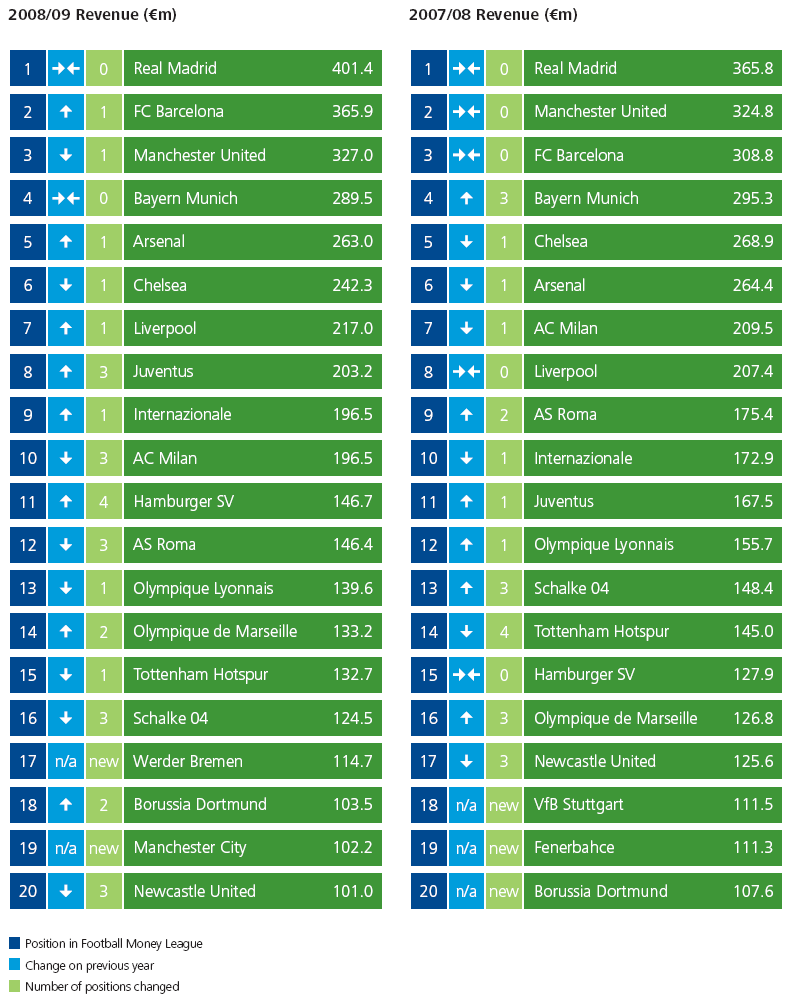
The Sports Business Group from Deloitte recently published its 2009 Football Money League report. It is a quite interesting report for football fans.  

The first remarkable table is that showing Real Madrid and Barcelona well ahead other European clubs. 

2009 Money League ranking.


I was reading parts of it and I was wondering… what is the difference between Real Madrid’s and Barcelona’s model? 

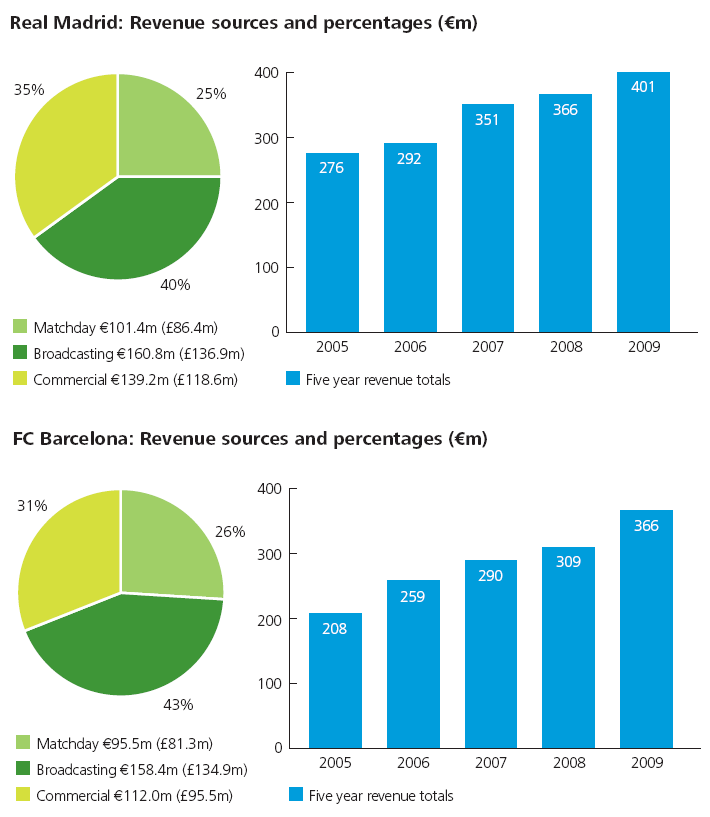
In the graphics below you may see the revenue sources for both clubs. The differences are minimal in two chapters: Matchday (6M€, 6% higher for Real) and Broadcasting (2.5M€, 1.5% higher for Real). The main difference comes from Commercial revenues: with Real Madrid earning 139.2M€, 27.2M€ more than Barcelona. The main driver for this difference are revenues generated by shirt sponsorship, which according to the report are worth 15-20M€ for Real while Barcelona is not charging Unicef for this concept. 

Real Madrid & FC Barcelona revenue sources.


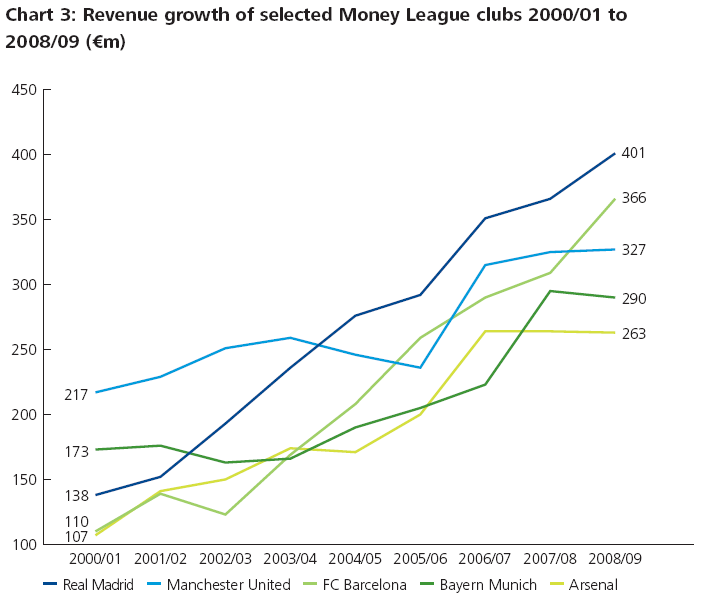
In this other graphic you may compare the skyrocketing revenue growth for both clubs. Real Madrid’s positive trend starting in 2000, when Florentino was elected President and Barcelona’s starting in 2003, when Laporta was elected President. 

Real Madrid & FC Barcelona revenue growth.


David Allen and Raúl Eguía, from the Instituto de Empresa, published a very interesting study: “FC Barcelona: Changing the rules of the game” in October 2004. 

That report reviews the months before and after Laporta’s election as president, his campaign as candidate, his relations with different groups, his plans for Barcelona and the first year as president of the club. 

We can read some excerpts from interviews with members of his board of directors. For example, the Vice-chairman of the Social Area, Alfons Godall is quoted saying: “We had all the financial information about the club from 1996. This enabled us to put together a very specific analysis which led us to the conclusion that sports and economic management were closely related. It is very important to have a clear policy for salaries and signings, as well as for bringing in players from the youth teams. In short, to run a club like Barça you have to have a model and we had been working on such a model.” 

This sounds very familiar to the “Zidanes y Pavones” slogan from Florentino. 

We have often heard words from Barça’s president such as “chollo”, “pelotazo”, etc… describing the model of Florentino Pérez in Real Madrid. Let’s review the corner stone of Laporta’s first project in Barcelona: “At the beginning of December 2003, FC Barcelona reached an agreement with La Caixa, a bank which was to front a syndicated credit for €151 million48 together with other entities such as Banco Sabadell, Caixa Catalonia, Banco Popular, Banesto, Caja Mediterráneo (CAM), Cajamar and Deutsche Bank. The transaction, which was spread over seven years, would make it possible for the current sports project to go ahead and for the sports centre in the Barcelona town of Sant Joan Despí to be completed.” 

Leaving aside the demagogy of Laporta, can anyone tell me difference in the model of either club? See the famous “virtuous circle” of Barcelona… 

FC Barcelona's "circulo virtuoso".


The answer “the difference is point number 2: Great sports results” is too easy…

7 Comments

Filed under Books, Sports

From climbing to merely walking

On Saturday 13 February, some friends and I joined the “Grupo de Empresa” hiking group in a walk around the Sierra. It’s been years since I haven’t gone walking one of these routes. I kind of missed it.

This time we went to La Pedriza, close to Manzanares El Real. The march took almost 6 hours. At moments we found it quite complex and very exhausting. Maicol kept telling us that the difficulty was 3… but 3 what?

I did some research.

First, from the Wiki we learn that what we did was just senderismo. We indeed saw all the signs described in the Wikipedia, thus that path was registered in the Federation.

From the colour of the signs we saw, we can also learn that we did a Pequeño Recorrido  instead of a Gran Recorrido. Following this lead, we can find that there are 37 of those in Madrid, and that the one we did was: “PR-M-1, Circular a La Pedriza” (the M stands for Madrid). Those are supposed to have between 10 and 50km length, thus ours is just within the minimum distance of that margin.

I found another site (in Spanish as well) with different ways to rate these paths:

  • Rating the kind of terrain: ours would be type 3 (from 1 to 7).
  • Rating the differences in height: it would be no more than 3 or 4 (from 0 to 7).
  • All in all, the web proposes one single rating: in which difficulty 3 would be just “moderate” (from 1 to 6).

Next time, we might consider giving less drama to such a heroic achievement.

4 Comments

Filed under Sports, Travelling