Category Archives: Travelling

Shopping in Soviet times

I have been to Moscow about 5 times, all of them in the 2000s, long after the fall of the Soviet Union in 1991. I have not been in Cuba or any other communist country. I however remember the stories that a former boss I had, now retired, used to tell about when he indeed often visited Moscow in the Soviet era.

One of those anecdotes involved the shops of the GUM market in the Red Square (Glavnyi Universalnyi Magazin; “main universal store”), then a department store and now a private shopping mall hosting all the Western luxury brands.

In his experiences, he used to describe the full employment, low labour productivity and poor service received in those shops. He said something along the line:

“… to make the most simple purchase you would have to deal with a dozen attendants. The one who opened the door for you, the one to whom you asked about the product, the one to whom you said you wanted to buy it, the one who would pack it, the one who put it in the bag, the one who checked you out, the one… It took a long time and dozens of interactions to purchase the simplest thing. One thing is for sure, that way full employment was assured”

In a recent viPad miniisit to the US, in Philadelphia, it occurred to us that we could buy an iPad mini and thus we approached the local Apple store on a Tuesday evening.

“You need to wait 30 minutes to be attended”

We left the shop and decided to come back the morning after. We did.

“We will be able to attend you in 15 minutes”

More than 15 minutes passed by, but in the end we succeeded in buying the product. Not without seeing flocks of Apple employees wandering around:

The guards at the entrance (outside and inside the entry door), the ones who just noted down your name (though later on nobody addressed you by your name), the “trainers” (who came in pairs, “no, we cannot take your order, we’re just making customers familiar with the products”), the ones at the “genius bar” (answering specific questions – do not bother them with the purchasing process), the one who brought the iPad from the back of the shop to the cashier, the one who cashed you out…

“Do you want it packed for a gift?” “No, please!” (at that point we only wanted to get out as soon as possible, who knows how many Apple middle men are necessary to wrap colourful paper around a box!)

I think that in 2014, an Apple store is the closest I have found to the communist era of shopping (1).

(1) No wonder that the products themselves are made in China.

Leave a comment

Filed under Travelling

Sarajevo, Gavrilo Princip and the assassination of Archduke Franz Ferdinand

Yesterday, June 28th, marked 100 years since the assassination of Archduke Franz Ferdinand of Austria and his wife in Sarajevo. The event triggered the start of World War I. On this occasion, I wanted to read the Wikipedia article about the assassination to be refreshed the sequence of events.

The sequence of events and the ambush that was prepared are dramatic. A group of six terrorists waiting in the quay to kill the archduke with guns and bombs. A first bomb being thrown to the car but bouncing off from it to the ground and exploding seconds after under the following car of the convoy injuring about 20 people. After this first attempt the procession sped ahead and the killing was frustrated. However, at the time of returning from the Town Hall and in the way to the hospital which was the purpose of the visit of the archduke to Sarajevo, the events turned even more dramatic…

After learning that the first assassination attempt had been unsuccessful, Princip thought about a position to assassinate the Archduke on his return journey, and decided to move to a position in front of a nearby food shop (Schiller’s delicatessen), near the Latin Bridge. At this point the Archdukes’ motorcade turned off the Appel Quay, mistakenly following the original route which would have taken them to the National Museum. Governor Potiorek, who was sharing the second vehicle with the Imperial couple, called out to the driver to reverse and take the Quay to the hospital. Driver Lojka stopped the car close to where Princip was standing, prior to backing up. The latter stepped forward and fired two shots from a distance of about one and a half metres (5 feet) using a Belgian-made 9×17mm (.380 ACPFabrique Nationale model 1910 semi-automatic pistol

Gavrilo Princip was the Bosnian Serb who fired the gun in this conspiracy. He was sentenced to 20 years imprisonment together with many other conspirators, some of which were sentenced to death. The house where Princip lived could be visited as part of a museum for some time but in the subsequent war was destroyed. The ground from which Princip fired had some steps as memory, but they were also destroyed in the 90s. Today, there is only a plaque in the wall in the place from which Princip shot the archduke death. We visited the place back in the summer of 2007. I wanted to share 2 pictures from those iconic places.

Plaque at the point from which Gavilo Princip shot Franz Ferdinand.

Plaque at the point from which Gavrilo Princip shot Franz Ferdinand.

Latin Bridge.

Latin Bridge.

Sarajevo is a wonderful city despite of having been devastated by so many wars. However, at the time we visited the place, there was not much to see in relation to this historic event. Nevertheless, in different museums the different pieces of the story can be seen: the car and the gun can in Vienna, the bullet, in Czech Republic.

Leave a comment

Filed under Travelling

Swimming with dolphins in Mauritius

Mauritius is an island nation some 2,000 km off the East coast of Africa, in the Southern hemisphere, about 1/4th the size of the region of Madrid. Most of its surface is covered by sugar cane fields and a national park. The beaches are splendid. A major part of its coast is surrounded by coral reef. The service by Mauritians is terrific.

We have just come from spending a relaxing week over there and in this blog post I wanted to share one experience that marked me from this trip: swimming with dolphins in open waters.

One of the excursions offered was to go one day very early in the morning to take a boat off from Tamarin port in order to spend about 2 hours swimming with dolphins. One tourist from our group asked “what are the chances of actually seeing dolphins?”, “over 95%” confidently said the tour operator who tried to sell the different packages.

As the experience promised to be unique we went for it. And unique it was.

After having driven for almost 2 hours to cross the island, at 7am we were in the boat already seeing dolphins. We put on the snorkelling kit: flippers, mask and tube and off to the water.

At first, the anxiety made me lose my breath. After less than one minute you get used to it. In less than 2-3 minutes you get to locate the dolphins just by seeing their fins some meters away. Then you start swimming trying to chase them. “Look down!” said the guide. Once, you look down, you get to see some dolphin swimming some meters below. Then 2, 3, 4… and off you go swimming along with them. With the flippers it doesn’t even cost a lot of effort to keep pace with them. Soon enough you see yourself surrounded by over 10 dolphins. You think that they are not more than 20 centimetres away, you extend your arm but cannot touch them. They’re probably not far away, but not that close either. They swim on the surface, breath and go down some metres under the surface. You follow them from up above until they come up again. This sequence is repeated once and again. Until at some point you lose that group. Back to the beginning. You locate some dolphin, swim towards it and then find a group… it went on and on for almost 2 hours.

See a video we took and some pictures below (1).

This slideshow requires JavaScript.

If you ever have the chance, do not miss it.

(1) In Youtube you may find much better videos taken with cameras under the water surface.

1 Comment

Filed under Travelling

Musee Mecanique (San Francisco)

Luca and I visited the Musee Mecanique during our honeymoon last year. It is located at the Pier 45 in San Francisco and it includes a private collection of hundreds of mechanically operated musical instruments, arcade games, voyeurism slot machines and, possibly, the only existing steam engine motorcycle (built in 1912). The entry to the museum is free of charge and you will go by spending some quarters by playing to the different games, as we did. Fair deal.

The owner of the museum, Edward Galland Zelinsky, explains in its website how the collection originated.

Musee Mecanique

Musee Mecanique

We had a great time there discovering what kind of games were played decades ago in feasts, remembering the kind of games we did play in the late 80s and 90s and seeing the great commonality in the mechanisms that operate otherwise seemingly different games. The same or similar mechanisms are used to make games of soccer, baseball or ice hockey. Or the contrary, different mechanisms are used to conceive very dissimilar machines to play baseball.

See some of the pictures we took in the museum.

This slideshow requires JavaScript.

We definitely recommend the visit to the museum as part of a walk to the Piers of San Francisco.

1 Comment

Filed under Travelling

Museum of Playing Cards (Paris)

During the past week we spent some days in Paris and we were staying at a hotel in the suburb Issy-Les-Moulineaux (1). One of those days, I had to spend some time while Luca was studying and I decided to go and visit the Musée Français de la Carte à Jouer (French Museum of Playing Cards), which I learnt that same day that it was located just some blocks away from our hotel.

The museum is the only museum dedicated in France to playing cards and one of a few in Europe (apparently it received in 1999 the European prize for the museum of the year). The museum covers the origin of playing cards (certainly from the far East, even if there are different hypothesis), the uses they are given (to play, to learn (to memorize things, to learn to count…), to fantasize (tarot)), some historical facts related to the cards, etc.

At first I thought it would simply cover the playing cards we are used to when playing poker or bridge and explain different games, but I was mistaken. It did not enter into the games themselves, but it covered many other types and variations of cards, used for different games. Think of role plays, think of the cards used in games such as Monopoly, think of theme cards, etc…

As always that one visits a museum I was looking for some practical take away to learn.

  • Taxes: it was Charles V (or I, in Spain) who charged taxes over playing cards for the first time in history, in Castile in 1543. That measure was quickly copied in other countries. In France, those taxes were introduced by Henry III in 1581. In the France right after the revolution a fiscal framework for playing cards was established that lasted till 1945. It reserved to the National Print the right to print in black the cards of the figures… In England it was ace of spades the card that the administration kept the right to print.
  • Spanish playing cards: in the picture below you may see 3 packs of Spanish playing cards, printed by Heraclio Fournier (2). You may notice that the suits are different, using golds-cups-swords-batons instead of spades-hearts-diamonds-clubs. Secondly, you may notice that there are slight differences in the figures are dressed and the symbols are drawn. That is because the 3 different sets use different portraits:
    • (left) today’s called Catalan portrait: that was the old Spain’s national portrait, not used anymore in Spain but the one most often exported (to Argentina, Uruguay, Brazil…).
    • (middle) Cadiz‘ portrait: also derived from the national Spanish portrait but differentiated in kind of clothes used and the inscription “Ahi va” (there it goes!) in the knight of cups. This portrait is also mainly used in exports (Mexico).
    • (right) portrait of Castile: its creation is relatively recent (end of XIX), at the initiative of the company Fournier, and is the one commonly used in Spain nowadays. (3)
Sets of Heraclio Fournier palying cards (printed in Vitoria, Spain).

Sets of Heraclio Fournier playing cards (printed in Vitoria, Spain).

If you happen to be by Issy-Les-Moulineaux, I recommend the visit of the museum (4.5 euros entrance fee).

Finally, the museum includes a documentation centre of the village which includes a small room dedicated to the history of aviation in Issy. This makes the museum a must-see of Paris (4). But I will discuss that in another blog post.

(1) If you are curious (as I was) about the etymology of the name of the village, Issy-Les-Moulineaux, can be found at the corresponding article of the Wikipedia. As a side note: the termination -y in the name of several villages in France is derived from the Latin -acus (“land of”), as Luca explained in her blog post “Ac Alors!“.

(2) There is in Vitoria a playing cards museum related to the company, see information about it here.

(3) I will leave to another day the explanation of my firm belief on the superiority of the Spanish game mus over any other playing card game that the reader may know.

(4) To my taste, at par with the Louvre museum ;-).

1 Comment

Filed under Travelling

Wells Fargo History Museum at San Francisco

While reading Warren Buffett’s 2013 letter to the Shareholders of Berkshire Hathaway a few days ago, I was reminded of the Wells Fargo bank and its History Museum at San Francisco, that we visited during our honeymoon last year.

As we could learn in the museum the history of the bank is very much linked to the expansion of the nation to the West in the XIX century, the discovery of gold in California, and mail and express services.

Both founders, Wells and Fargo, were prominent figures in the express services (what now would be UPS or FedEx). They had already formed American Express, and wanted to expand to the West, however most directors doubted about the idea, and Wells and Fargo decided to start that venture in 1852 independently, with the aim of providing express and banking services in California.

After a bank run in 1855, Wells Fargo emerged as a sound, dependable bank practically without competition in California. The fate of the West expansion was since linked to the bank, which provided not only banking and express services, all types of other services of transportation, communications, the iconic stagecoach service, the Pony Express, etc.

Thus, the visit of the bank’s museum becomes a discovery of some of the details and processes that helped and fueled the expansion to and development of the West coast.

This slideshow requires JavaScript.

The museum is located besides the HQ of the bank at Montgomery Street, the entrance is free and I do recommend the visit.

1 Comment

Filed under Travelling

Livonian, an endangered language

The Livonian is a language of the Finnic family, closely related to Estonian and spoken in the region of Livonia, in the North of Latvia and South of Estonia. I first came across the language in March 2003, during a students’ exchange in the framework of the European Commission Youth programme organized by the students associations of AEGEE Zaragoza and Tartu (Estonia).

During that exchange, in one of the evenings we attended an especially arranged concert in a small bar. The place looked like a cellar. The group of music was introduced to us as the only group singing in the Livonian language. I now wonder whether that group was “Tuļļi Lum“. Sincerely, I cannot remember the name of the group that played that night, other than being presented as the only band singing in Livonian. On the other hand, Tulli Lum was already existing then and the singer studied music in Estonia… who knows.

The Livonian is an endangered language. In 2003, it was introduced to us as being spoken by no more than ~120 people in the World. Today the Wikipedia mentions that the last known native Livonian speaker, Grizelda Kristiņa, died in 2013. Livonian may be spoken as a second language by over 200 people, just about 40 of those with a level of B1 or upper.

In that night in 2003, we were explained that the language was being supported by some European institution funds. It was 10 years ago, I cannot recall the details. I guess they referred to the European Bureau for Lesser-Used Languages (EBLUL). The EBLUL was a NGO set up to promote linguistic diversity and languages. It was founded in 1982 and had close ties with both the European Parliament and the Council of Europe, and was funded by both the European Commission and local and regional governmental organisations.

The European Bureau for Lesser-Used Languages was closed by a decision of its Board of Directors on January 27, 2010. The main official reason given was that “the funding mechanism of such an organisational model [was] not suitable in current circumstances”.

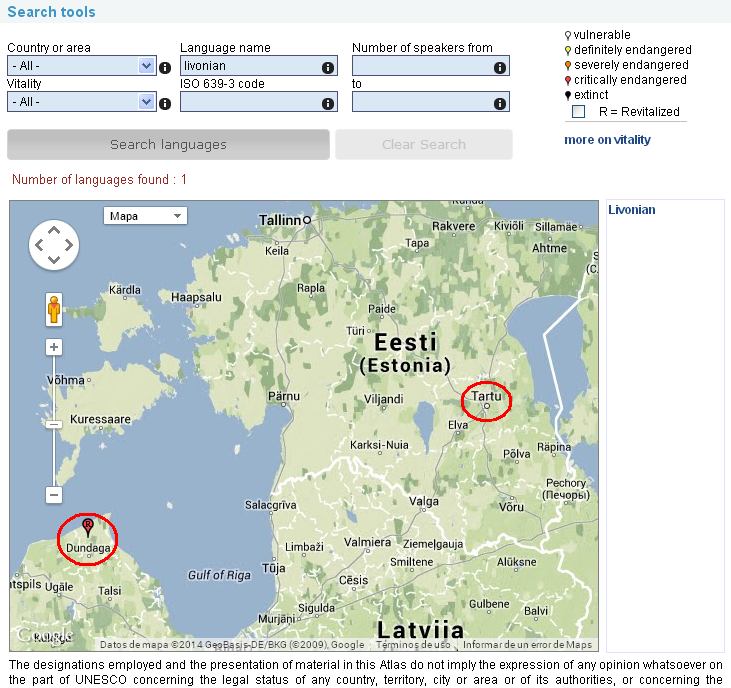
I came across Livonian again when playing with the UNESCO Atlas of the World’s Languages in Danger, which I discovered via Twitter. See a screenshot from the tool below, with the situation of Livonian, “critically endangered” and “revitalized”.

Livonian, UNESCO Atlas of the World's Languages in Danger.

Livonian, UNESCO Atlas of the World’s Languages in Danger.

I found this tool from UNESCO interesting. I suggest you try it out a bit.

In respect to Livonian:

  • I am happy for those people who played music for us that night back in 2003 that the language seems to be revitalized, though I have no way to measure or sense that.
  • On the other hand, and despite of the criticism that my position may create, and as I have mentioned in several conversations in the past: I see no wrong in letting the language die. I do not see the purpose in pumping public European funds so that a language can be taught to non-native students at some universities. I am almost glad to see that the EBLUL has closed down and clearly understand why “the funding mechanism of such an organisational model [was] not suitable in current circumstances”.

Surely, this is my opinion and I respect those who believe that each and every language should be preserved no matter what costs in the name of culture, historical heritage, and you name it. In UNESCO’s words:

Every language reflects a unique world-view with its own value systems, philosophy and particular cultural features. The extinction of a language results in the irrecoverable loss of unique cultural knowledge embodied in it for centuries, including historical, spiritual and ecological knowledge that may be essential for the survival of not only its speakers, but also countless others.

My view: I am a native Spanish speaker thanks to some language evolution that meant that once almighty Latin is no longer spoken outside of the Vatican City, plus the extinction of who knows how many ancient languages spoken by my ancestors.

It especially strikes me the language used by UNESCO: “ecological knowledge that may be essential for the survival of not only its speakers, but also countless others.” I guess it’s quite the contrary. Had a certain language been so essential to the survival of its speakers and its extinction would have not taken place (or am I getting something wrong with what evolution means?). 

Luckily, the same evolution process has happened in all parts around the world: allowing over 400 million of people to speak Spanish as a mother tongue and allowing us to fairly understand each other in several corners of the world.

Language is the human capacity for acquiring and using complex systems of communication, and a language is any specific example of such a system.

2 Comments

Filed under Miscellanea, Travelling

Pricing beer in Greece

There is something puzzling that we constantly found in the different restaurants we dined at in Greece: the inconsistent pricing of beer. Or rather, the consistent pricing of it in a different fashion as it is done in other places in the West.

Take a look at the menu below.

You may see that Alpha draft beer is sold in two quantities:

  • 300mL for 2€ and,
  • 400mL, for 3€ euros.

That yields a price of 6.7€/L for the 300mL and a price of 7.5€/L for the 400mL.

Read the previous line again.

Then, who would buy the larger quantity if it is sold at a higher price per litre (12.5% higher)? Normally, one would expect some discount linked to volume. Well, not in Greece with beer :-).

Pricing beer in Greece.

Pricing beer in Greece.

We found restaurants in which the differences in pricing were more striking but only took this picture.

Another puzzling fact which we didn’t record was that for a same beer (say Alpha) in most places they sold the bottled beer cheaper than the drafted one (for a same volume). Again this was surprising, as we normally see draft beer sold cheaper, and there are certainly cost advantages to selling draft beer. But then the difference in pricing strategy versus how it is done in the West could have been explained from the demand side (not the supply) if the Greeks value much more draft beer.

1 Comment

Filed under Economy, Travelling

Battle of Thermopylae

During our recent trip to Greece, on the way back from Meteora to Marathon we decided to make a short stop at the Thermopylae. Many battles have been fought at that place, but perhaps, the most known today is the one fought in 480 BC between an alliance of Greek city-states, led by King Leonidas of Sparta, and the Persian Empire of Xerxes I. I was curious to visit the place.

That is the battle in which the movie “300” was inspired (*). We saw the movie again right after returning from the trip.

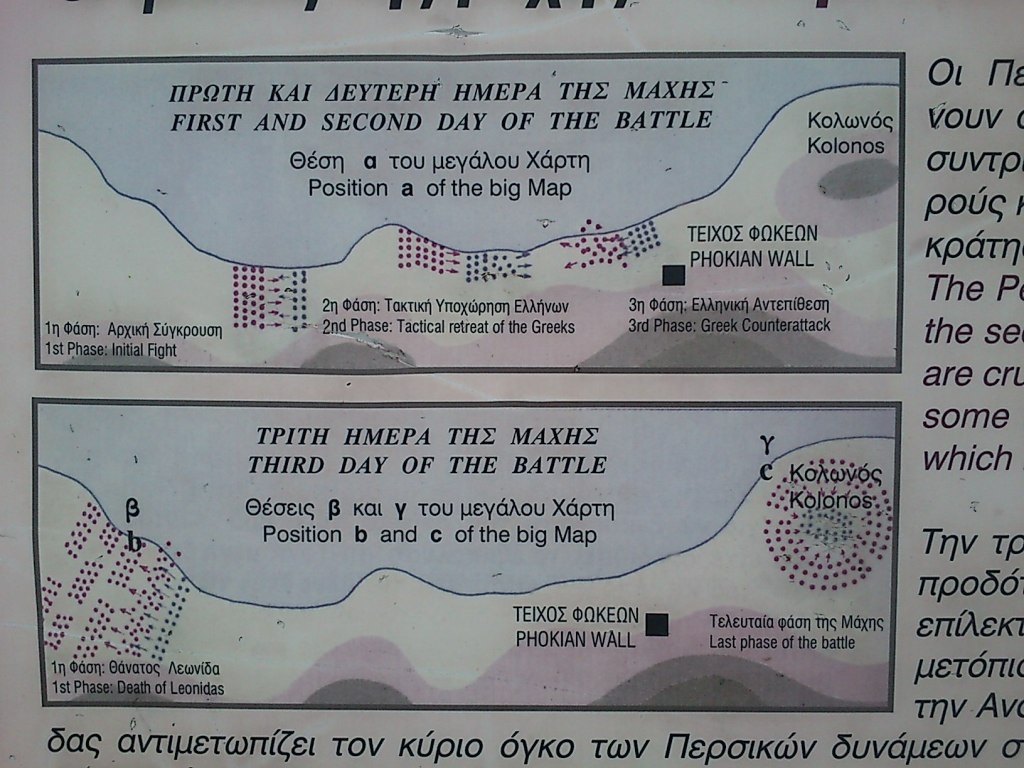
As it usually happens, the movie puts some more drama to the story. In the movie the battle field is a tight pass close to a cliff, whereas the Thermopylae are not such tight, and certainly there are not cliffs, rather plains from the mountains to the sea.

The movie has Leonidas as the very last Spartan to pass by in the fight, whereas in the explanation panels at the Thermopylae it is stated that he died in the very first phase of the battle, far from Kolonos hill (reading the Wikipedia article it seems that he could have survived to the last day).

Description of the battle.

Description of the battle.

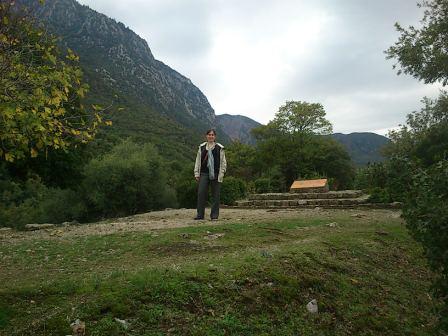
That Kolonos hill is a small promontory where the last Spartans retreated to fight the Persians till death. Several arrow heads were found in the hill-top in a 20th century expedition. Today, there is an epitaph by Simonides which reads as follows:

“Go tell the Spartans, stranger passing by,
That here, obedient to Spartan law, we lie.”
Kolonos Hill.

Kolonos Hill.

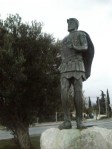
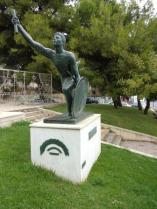
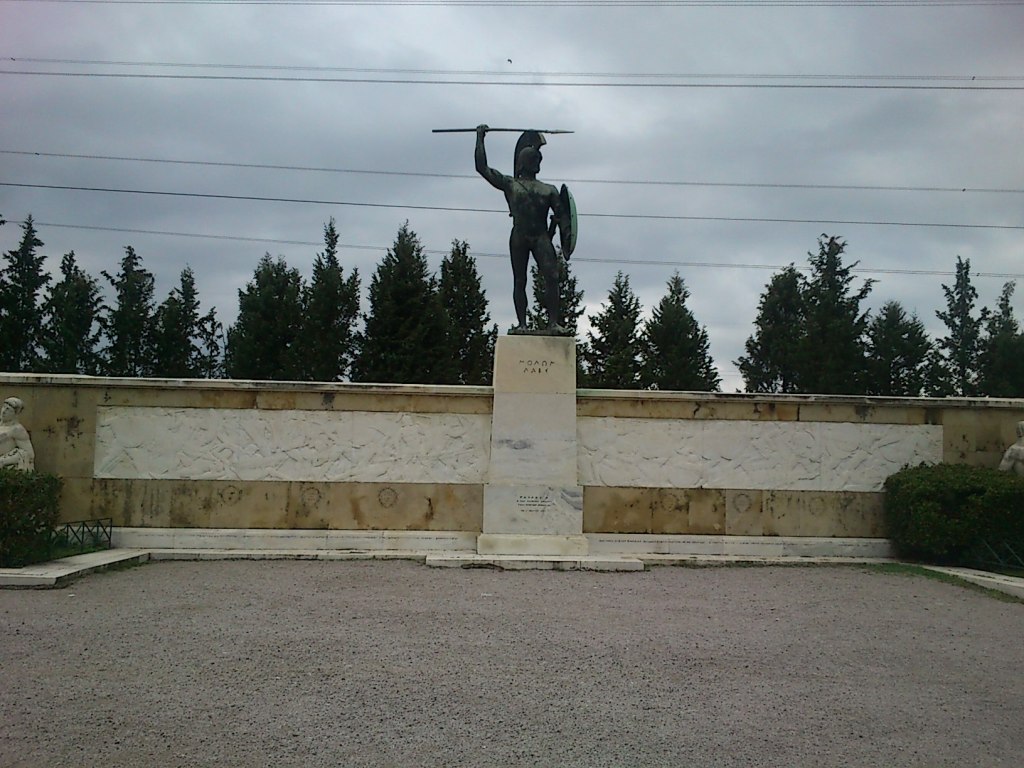
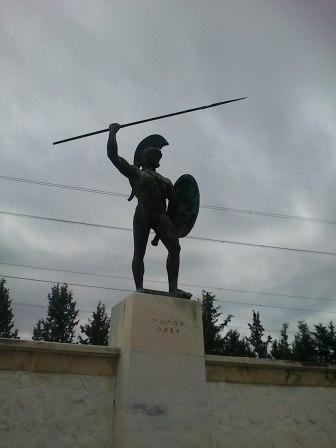
In the place there is a statue of king Leonidas, with the now famous inscription ΜΟΛΩΝ ΛΑΒΕ (“Come and get them!”) which was Leonidas response when he was asked to turn their weapons. Today those words are used as a motto in several armies.

Statue of King Leonidas.

Statue of King Leonidas.

ΜΟΛΩΝ ΛΑΒΕ.

ΜΟΛΩΝ ΛΑΒΕ

There are many other sentences supposedly used by Leonidas that are repeated today, if only by the impact of the movie 300.

Leonidas: Spartans! What is your profession?
Spartans: HA-ROO! HA-ROO! HA-ROO!
Persian Emissary: […] Our arrows will blot out the sun!
Stelios: Then we will fight in the shade.
Leonidas: Spartans! Ready your breakfast and eat hearty… For tonight, we dine in hell!

I expected to have found some more merchandising or tourism-related business created around the battlefield but we only saw the epitaph and statues, not a single selling post. Possibly in high season, during, summer time there are some, but not in late Autumn. I searched through the web and there are indeed Greek businesses which sell memorabilia related to the movie and the battle, it is only that they sell online and we didn’t encounter them at the place (compare that with the setting up of a food franchise business out of the movie “Forrest Gump“).
I encourage anyone travelling through the Greek A1 on holiday to make the brief stop, as it doesn’t require a long detour from the highway and lets you quietly (and free) contemplate a place charged with History.

(*) A sequel of that movie will be released in 2014, “300: Rise of an Empire“.

Leave a comment

Filed under Travelling

Athens Classic Marathon

I heard about the modern Athens Classic Marathon from Antonio, a colleague at the office. Ever since, I had wanted to take part in it. Last week, two friends (Jose and Juan), my brother and I completed it.

In a previous post I wrote about the legend of Pheidippides and the origin of the modern marathon. In this post I will focus on my experience and will share some of the pictures that we took during this trip.

Training

Volume of kilometres run per week.

Volume of kilometres run per week.

To prepare for this marathon I followed a 16-week training plan provided by Garmin (Level II). Each week it included between 4 and 5 days of running and often 1 day of cross-training. I fulfilled most of the plan, missing not more than two or three days of running and some more of cross-training. I did not skip any series session or long run. In all, I ran over 780km in those weeks, excluding the 42km of the race (an average of just over 50km per week).

During this training season I beat my 10k and half marathon personal records. I had not experienced any serious injury that prevented me from training during whole weeks or months as it had been the case in previous years. According to a running calculator that I use sometimes, had the race been in similar conditions as those 10k and half, I should have been around 3h30′. The profile and conditions were not the same, and despite of that I started with a pace towards 3h30′ just to see how far would I reach maintaining it and if I could be under 3h45′, thus achieving a new PR.

The day before the race we went to the marathon expo which was held at the Taekwondo pavillion of the 2004 Olympic Games held in Athens. This way we also visited the beautiful small port at Piraeus close to Faros (just past the Stadio Eirinis & Filias, where Olympiakos bastketball team plays).

At the marathon expo.

At the marathon expo.

Before the race

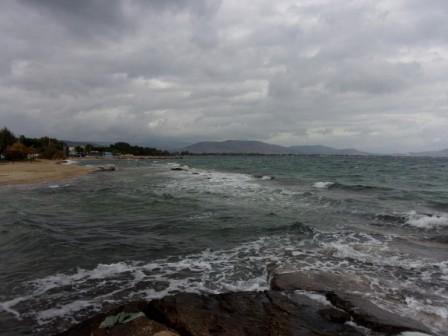
Marathon beach.

Marathon beach.

As I mentioned in the previous post, the race goes from the village of Marathon to Athens, replicating the route followed by Pheidippides to announce the victory of Athens in the Battle of Marathon. The Persians landed at the bay of Marathon in their attempt of invading Attica, thus Marathon is almost at sea level.

From Marathon, the race goes South more or less parallel to the sea-line for about 17 kilometres and then heads to the West to climb up the hills before the valley where the city of Athens is located.
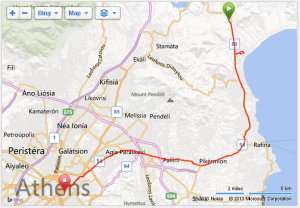
Route of the Athens Classic Marathon.

Route of the Athens Classic Marathon.

The last part of the race is a descent from the hills to the centre of Athens where the Panathinaiko stadium is located. But by then, the damage is already done to the legs after a long climb.

Profile of the Athens Classic Marathon.

Profile of the Athens Classic Marathon.

The morning of the race, we were transported from Syntagma square to Marathon by dozens of buses early in the morning to be able to start at 9:00. Everything ran smoothly (in that and many other aspects the organization of the race was superb).

We changed clothes in Marathon, where we could take some pictures, go to the toilet, warm up and slowly get into the racing mindset.

Urinaries panoramic view.

WC panoramic view (at Marathon, picture by Jose).

We took one group picture and set for the departing line.
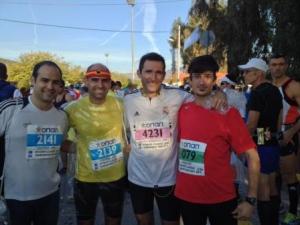
Pre-race group picture.

Pre-race group picture.

The week following to the race I went back to Marathon to visit the place with time and see the different spots (some of the pictures in the post are from those other days).

In the village of Marathon there is a small athletics stadium at the end of the national road from Athens to Marathon.

The 1896 Olympic marathon race started at “… the brigde at Marathon Plain”, or “… at the bridge near the entrance of the sacred city”, according to “Olympic Games 776 B.C. – 1896” by A. K. Bech, or “… The starting point will be at the 40th stadion on the Marathon – Athens national road”, according to the Athens daily “Olympia” on March 9, 1896 (as can be read in the milestone below). That point, the “40th stadion” of that national road, is marked by the milestone below.

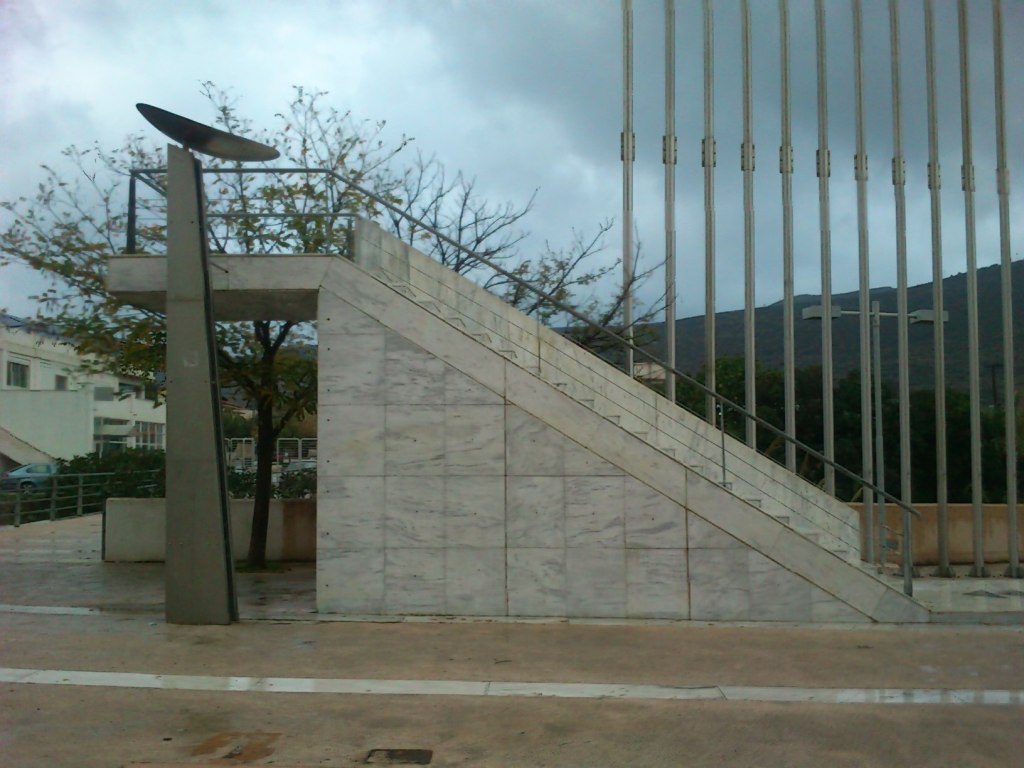
Today, the Athens Classic Marathon starts a bit ahead at the mid-point of what is now a kind of majestic avenue at the beginning of which one can find a marble stone indicating the starting point of the olympic race, a milestone indicating that 40th stadion, and the tower where the Marathon Flame is lit after being brought from the Marathon Tomb (just 5km away).

1896 Athens marathon start

1896 Athens marathon start

40th stadion milestone

40th stadion milestone

Marathon flame tower.
Marathon flame tower.

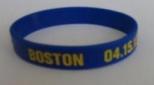
Boston 2013 marathon memorial bracelet.

2013 Boston marathon memorial bracelet.

Just before the race start we observed 1 minute of silence for the victims of the attack at the Boston marathon earlier this year. This minute counted with the presence of president of the Boston Athletics Association. That was the 3rd such minute I had observed as during my honeymoon trip I had taken part in two races in the USA, in San Francisco and San Diego, from which I got the memorial bracelet that I wear often lately.

The race

At 9:03 our group departed and there we went my brother and I trying to pace ourselves at a bit less than 5′ per km. That was comfortable for the flat part at the beginning. Another positive point of that beginning: with less than 10,000 runners taking part the running was possible from the start.

Milestone of the km 1 of the Athens Classic Marathon Course.

Milestone of the km 1 of the Athens Classic Marathon Course.

The course of the marathon race is marked, not only by ad-hoc signals for the race, but by permanent posts along the road, such as the one of the picture for the first kilometre.

At about the km. 5 the course takes a small detour from the national road to round the commonly known as Marathon Tomb, or Marathon Tumulus, a park with a small hill where each year the Marathon flame is lit. Close to the park entrance, there is a small statue of Miltiades, credited as the one devising the tactics to defeat the Persians at the Battle of Marathon.

Statue of Pheidippides km. 18.

Statue of Pheidippides km. 18.

At the return from the tomb, already 6km had been passed. The road continued to be flat until about the 11th km, where the road started to pick up until km. 16, where there is a short and steep descent up until km. 17.

At the km. 18, there is a small statue of the legendary Pheidippides. From then on the road continues to climb more or less continuously until km. 31.

Up until the 20th km I was still at the pace of 3h30′, but in the beginning of the climb I was already feeling that it was going to be very tough to run kms at below 5’50”.

I have checked the Garmin records afterwards and I had already surpassed 167bpm at some points by the km 20th, which experience tells me that is the barrier that makes me feel fatigued.
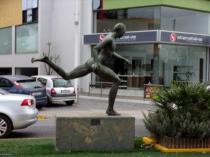
Statue of a runner at km. 21.

Statue of a runner at km. 21.

During the race, not having read about heart rate, just by the feelings I had I decided to forget about the time and continue the climb at a more comfortable pace. With that, the 3h30 and the sub 3h45′ were gone. In the end I completed the race in 3h53’18”, but the profile nor the day (temperatures from 14ºC to 21ºC, on the hot end) were the best to attempt a PR.

At the km. 21 there is another statue of an anonymous runner.

I crossed the half marathon at slightly over 1h47′, but knowing that the following 10km would take about a full hour and not knowing how I would be for the remainder 11km.

The heat of the day called for lots of hydration, and at that point the organization was again terrific, with water posts every 2.5km and with isotonic drinks in most of the posts, plus energetic gels in some of them.

One hour later, and having reached the top of the hill I remembered the sentence one of us had read describing the race “from km. 31 you can fly down to the end”. Well, I was not fit for flying. When I tried to speed up I felt muscles starting to cramp, thus I couldn’t run any faster than 5’45”, which I tried to keep, drinking and eating well at each supply post.
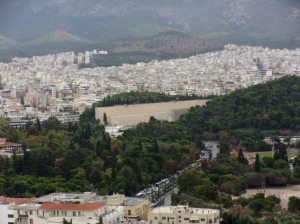
Panathinaiko stadium from Acropolis.

Panathinaiko stadium from Acropolis.

Once in the centre of Athens, there were still some 3-4 kilometres to cover. I kept myself just for the last kilometre where the atmosphere close to the stadium was great, starting with the descent by Irodou Attikou street.

The last turn to the left, climbing up the ramps to enter the Panathinaiko and covering the last meters inside the stadium was overwhelming. One of the best marathon endings I can recall.

See in the panoramic below a view of how the stadium looked that day.
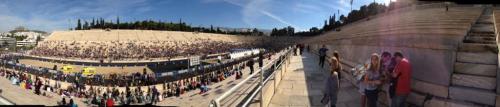
Panathinaiko stadium panoramic view.

Panathinaiko stadium panoramic view (picture by Jose).

I remembered then when I first visited Athens back in 2002. That time, we visited the stadium and took some pictures as if running in those tracks. Now, 11 years later, there was I, sprinting to complete the Athens Classic Marathon (my 10th), where it all began, no less.
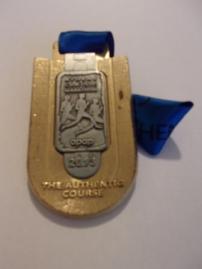
2013 Athens marathon medal

2013 Athens marathon medal

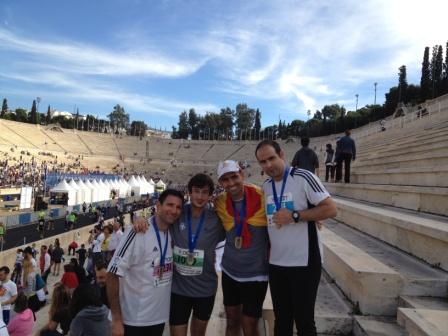
Post-race groupe picture.

Post-race group picture with a great marathon team! Juan, Jose, me and Jaime.
6 Comments

Filed under Sports, Travelling