“The next time you’re in the USA, run a marathon there”. Those were the words from by brother Jaime after he took part in Chicago marathon in 2011.
It has taken me 2 years to go back there. This time for my honeymoon. This did not stop me to follow the advice. I went through a website with all the marathons in California and found that San Diego Rock’n’Roll marathon was taking place on the very last day of the trip. Perfect! That way the muscle soreness of the following days would not interrupt the tourism activities.
June 2nd, the day of the race was only one month and a half after March 17th, when we ran Rome marathon, thus I did not follow any special training plan for this marathon. I just tried to keep the form with which I arrived to Rome by running often, though I didn’t do any series session and only one long run… I paid for that.
The atmosphere was very good but only in some neighbourhoods, in others not so many people cheering the runners. Along the road 163, during the steepest (up to 6% along 1km) and longest (about 4km) climb there was almost nobody. Even if the overall profile is a descent I found the course quite tough. The times of the first 3 runners seem to say the same (2h15 for the winner, 20 minutes more for the second…). The other thing that I didn’t like much was the solid or the lack of abundant and varied solid supplies along the course. I thus only relied on my 3 energetic gels and drinks.
Course of San Diego marathon as recorded by my Garmin.
San Diego marathon profile.
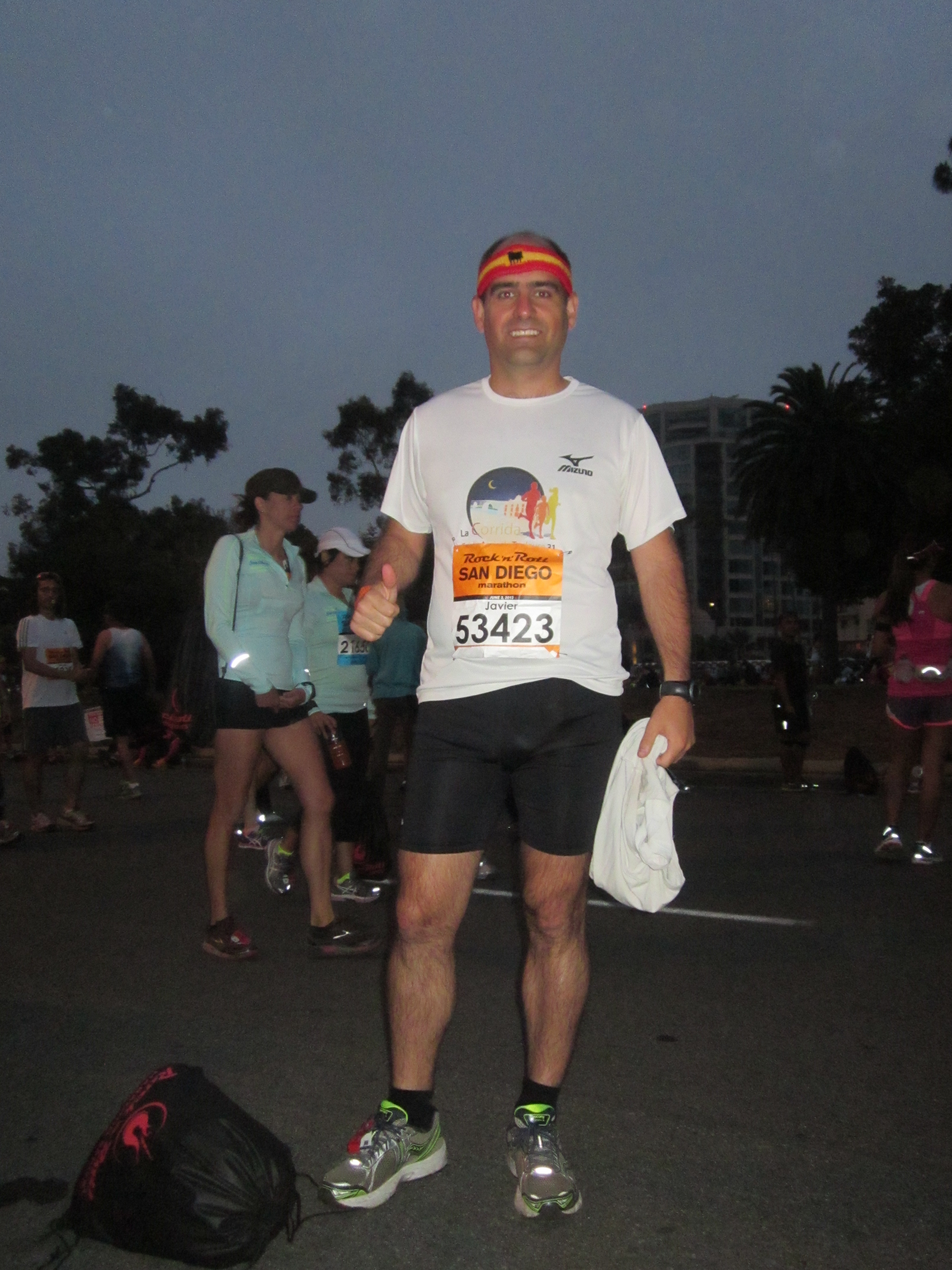
At 5:30am, before departing.
I went quite well at the expected pace (below 5’20” / km) for the first 28 kilometres, then I started to miss endurance and right afterwards the long climb “killed” me. I, however, did not stop and kept running up, if very slow (most of the runners in my time -between 3h45 and 4h- where walking during those kms). I’ve gone through much tougher situations in the last years, thus I only thought “well, slow the rhythm and the climb will finish at some point, keep up”.
Running at some point of San Diego marathon.
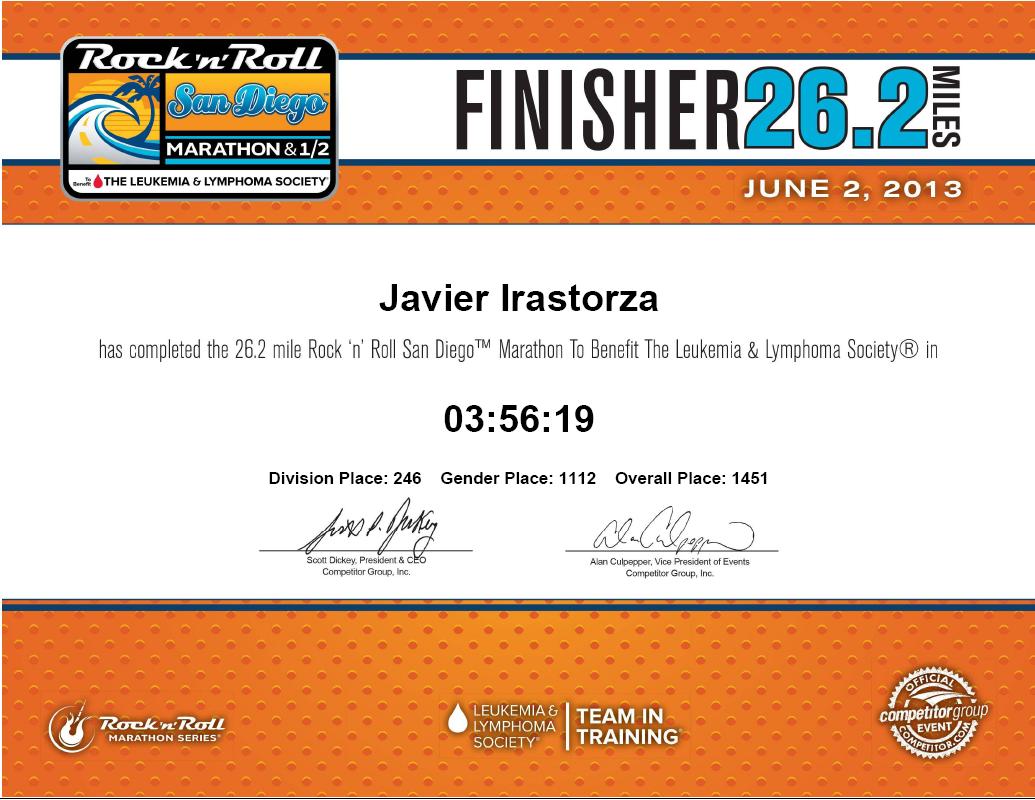
In the end I finished in some 3h56’19” as clocked by the official chip (see the report of the race as recorded by my Garmin here). I was happy enough with the result and with having finished the second marathon in the year, another sub-4-hour marathon (the 4th in a row under 4h) and the 9th overall.
San Diego marathon finisher diploma.
San Diego marathon medal.
9 marathons!
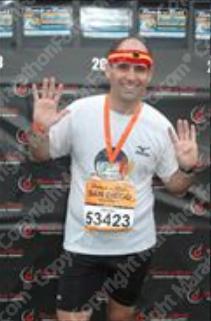
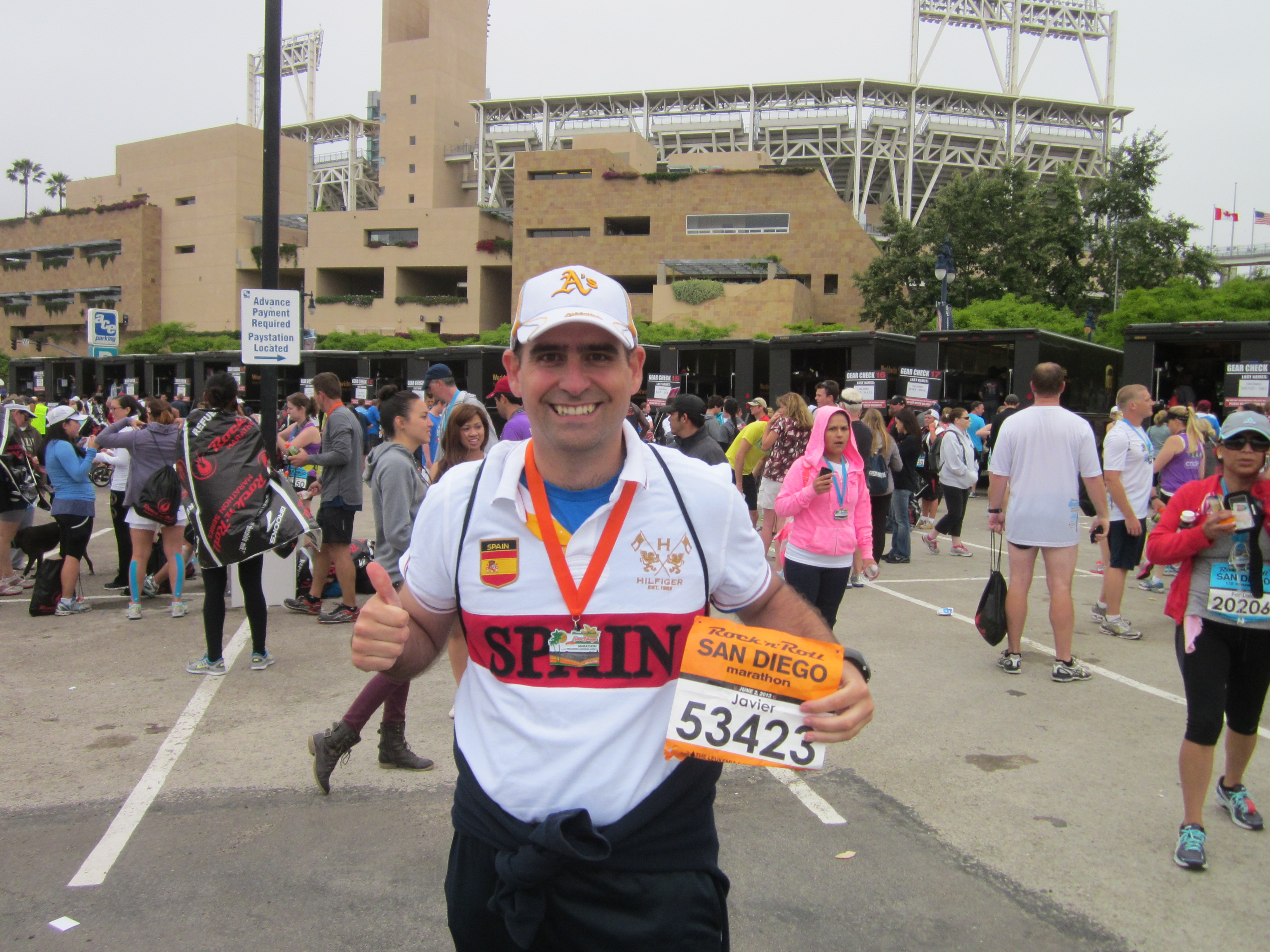
Enjoying the feat (behind me: San Diego Padres baseball stadium).
During the recent honeymoon trip to the USA, Luca and I managed to visit 5 aerospace museums, 3 airplane assembly lines, 2 US air force bases and 1 space observatory… be sure some of the coming posts will be related to that side of the trip.
Air Force Flight Test Center Museum at Edwards AF Base
Since we were going to visit California and we would be around the desert of Mojave I thought that we could make a detour to visit Edwards Air Force Base, where the Flight Test Center of the USAF is located.
The Flight Test Center has got a museum which is open to the public, for which identification is needed and no carry on items able to take pictures of videos are permitted. The museum is free and opens 5 days a week. On top of that there is a monthly guided visit of the air base, flight line included. This tour is offered only once a month and you have to subscribe with some time in advance.
Several dozens of aircraft have first flown at Edwards and that, together with Rogers dry lake is what makes the place so special.
First Flights Wall at Edwards AFB (public domain image).
Some very famous flights at Edwards: the Bell XS-1 which first reached the speed of sound with “Chuck” Yeager at the controls, the test campaigns of the YC-130 (Hercules), C-17 Globemaster III (and the prototype YC-15 from which it got many features), testing of the Space Shuttle, testing of today’s state of the art fighters F-22 and F-35… take a look at the wall to get an idea.
Rogers Dry Lake is by itself a national historic landmark. The lake formed thousands of years ago, and today it’s mostly dry along the year and the strength of the ground permits it to have several unpaved very long runways in its lakebed. The longest one being over 12 kilometers long. It also has the world’s greatest compass rose marked into the lake to help flight test pilots guide themselves. It was there, in the lake, where the now retired Space Shuttle would land in its return from space.
Rogers Dry Lake at Edwards (public domain image).
The exhibit at the museum displays a replica of the XS-1, the first 2 F-22 prototypes, an exhibit about the formation of the lake, the history of the base, some remarkable test pilots, etc. The outdoors display has as a highlight a Lockheed SR-71 Blackbird (a classic in US aviation museums).
Lockheed SR-71 Blackbird at Edwards (public domain image).
The area of the base is of 1,200 km2 (this is about 1/7th of the region of Madrid). The visit to it, museum included, lasts about 3 hours. There are veterans offering explanations at the museum and at one restoration hangar within the base. Our guided tour was led by a young aerial photographer, Jet Set (what a name! :-)), who made if very enjoyable.
Along the flight line of the base, for the pleasure of European-based spotters (who don’t have the chance to see them often), were some test F-35s, F-22s, C-17s, Global Hawks, F-16s, etc. Apart from some aircraft flying around. I, however, missed seeing the B-2 that was somewhere “hidden” in the base (next time!).
Edwards AF Base entrance.
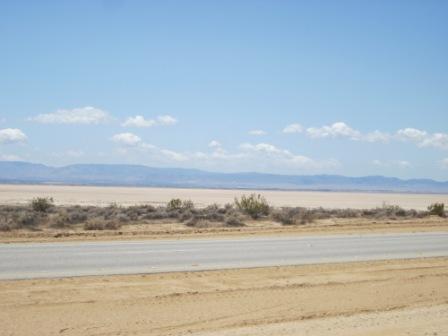
Rosamond Dry Lake (a lake close to Rogers Dry Lake).
After many weeks here I am, back with the blog. Married and with a honey moon just finished, you can bet that most of the coming blog posts will be related to experiences we have lived during the trip. I will post them randomly, as I get to write them, without theme or chronological order…
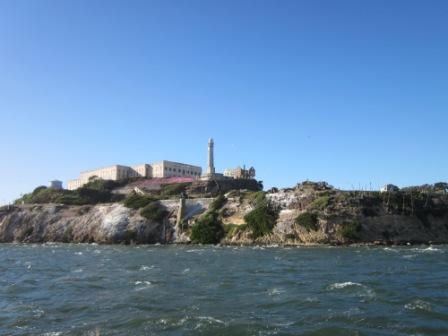
Alcatraz Federal Penitentiary
This was one of the visits that we had arranged in advance. As you probably know Alcatraz was a high-security federal prison which is now closed, quite famous for having hosted some specific inmates such as Al Capone. There were many facts and stories about the prison that I wasn’t aware of before coming and called my attention. To name a few:
The fact of being a federal prison versus a state prison made that many of the inmates were not particularly dangerous in my eyes (as in serial killers, let’s say) but offenders of federal crimes such as tax evasion. On the one hand we could think tax evaders not as especially dangerous types so why would you put them in such a place, on the other hand and seeing the levels of corruption we suffer nowadays, it could be exemplary to put tax evaders right away in maximum security prisons, as indeed they’re committing a crime against all of us.
Contrary to some vague image I had in my mind, also due to being a federal prison instead of a state one (with fewer resources) made conditions in Alcatraz even better for the inmates (such as food).
The fact that within the island some officers’ families were living at that time, kind of uneasy feeling. But hearing the memories of some of the girls whose father worked at the prison, the island felt to them as an ideal place to live!
Together with the ticket you get an audio guide which provides a terrific amount of information and voices that really get you into the atmosphere and do guide you through the place. You get to see the cells of some famous inmates, isolation cells, the library, dinning room, you receive explanations about riots that happened within the prison and escape attempts, etc.
We took one of the night tours (and we recommend doing so), which departs late in the afternoon and includes a whole series of extra activities at night once the general visit is finished: a detailed explanation of the June 1962 Alcatraz escape (possibly the only successful one), a demonstration of the cells’ doors’ opening and closing system (see the video below), the hospital, etc. In the end we spent over 3 hours in the island.
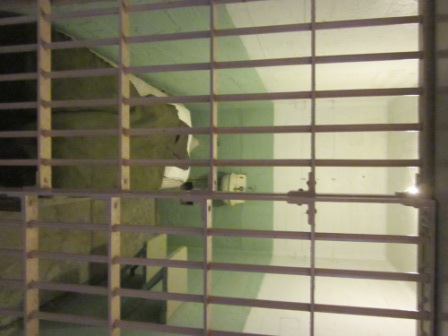
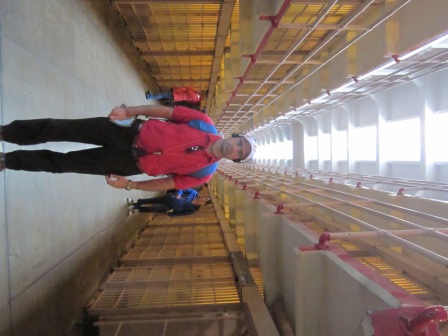
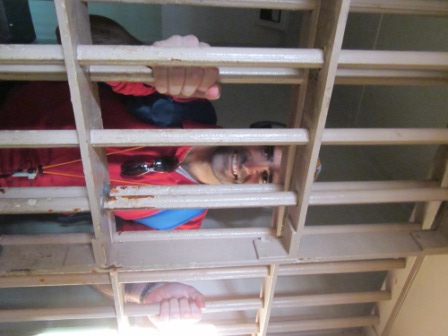
See some of the pictures we took below:
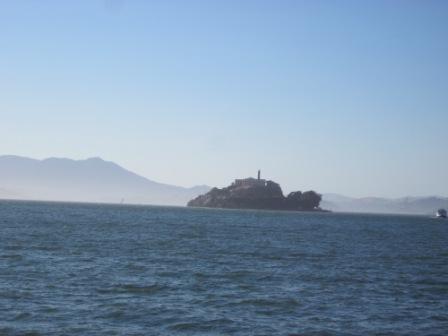
Alcatraz from afar.
Up close view of Alcatraz.
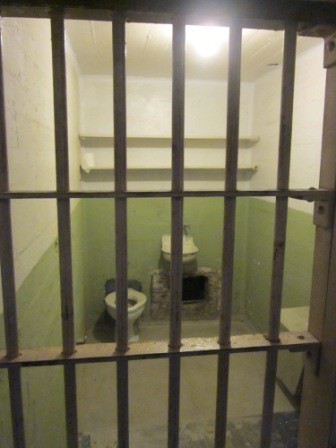
One of the cells.
In one of the corridors.
Behind the bars.
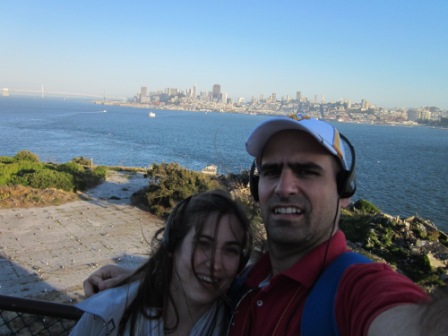
Great views of San Francisco from the island.
Hole used in the June 1962 escape.
Listen to the slamming of the cells doors (the guide made some emphasis to us trying to think what did that sound convey us):
Last May 14, it took place the premier of the movie “El cosmonauta”. You can read about the event that took place in the cinema Callao in the post from the blog of the project.
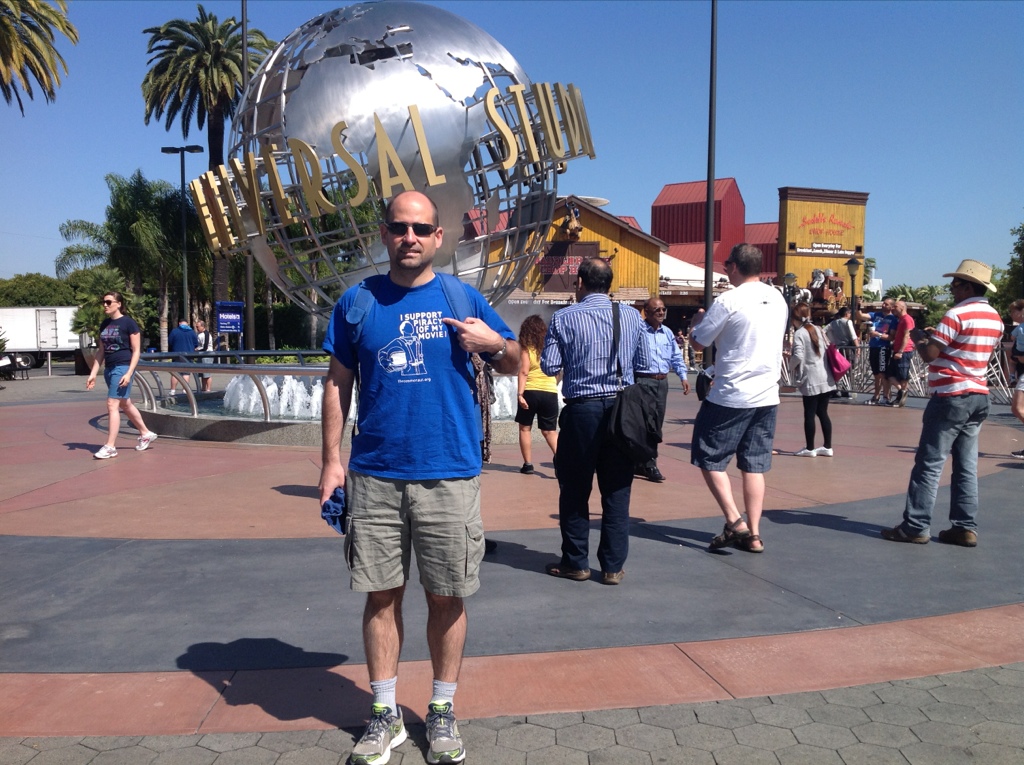
That same day Luca and I were visiting Hollywood and the Universal Studios theme park, and yes, you can imagine which t’shirt did I dress for the occasion: “I support piracy (of my movie)”.
El Cosmonauta in Hollywood (“I support piracy”)
PD: during the whole day I only got one comment from Universal’s staff :-).
The Château de Montségur used to be a Cathar castle dating from late XII / early XIII century. For some time it was the centre of the Cathar church, though today only some ruins remain. The castle is at the top of a 1,200m-high rocky mountain, some kilometres away from the small village of Lavelanet out of which the Trail des Citadelles started.
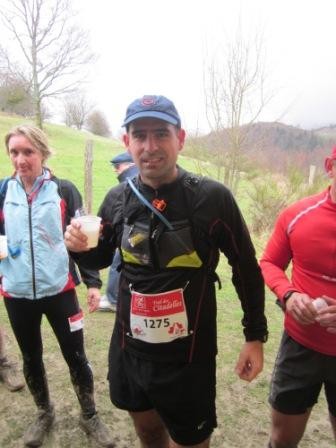
This was my first long run and first race just 2 weeks after completing Rome marathon. I had only run 2 days between then and today, thus I took it more as a run in the nature than as a race, no stress from the departure. I even took the photo camera as I suspected I could take some nice pics.
The race consisted of 20km from Lavelanet to the castle and back, going as much as possible through the forest and as little as possible through paved roads (basically the first and last kilometres and little else). The rain of the previous days, of that precise morning and the passing of hundreds of runners left many of the paths impracticable, completely muddy and enabling the funniest situations.
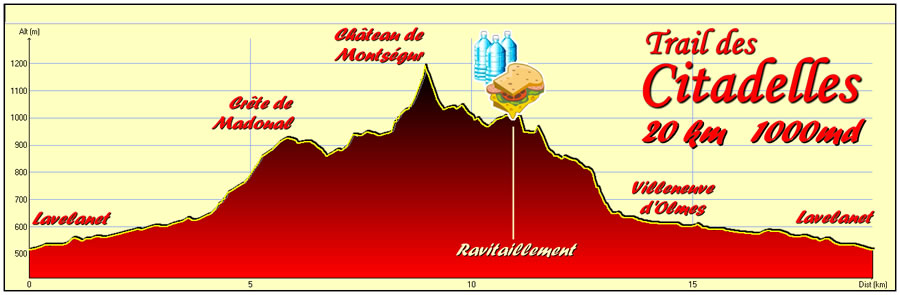
Trail des Citadelles (20km) profile.
Before having completed the 2nd kilometre my running shoes and socks were already completely soaked. Before the 3rd kilometre we had been running through some stretches in which the feet were covered up to the ankles with mud (chop, chop, splash!).
I love trails for they put you in close contact with nature, the variety of their landscapes, the absence of time pressure; even if I acknowledge that I am not particularly good with difficult descents which require some technique and equipment that I lack of.
Today I missed some mountain sticks. At the starting line I saw many people with them. I wasn’t sure if it was because they would walk instead of run. Indeed. The thing is that I would also have to walk a lot, uphill, through rocks covered with very slippery mud. Only during the race I understood why they brought them. Between the 4th and 5th kilometre we started to walk uphill more than run, and it lasted like that for almost the next 7 kilometres.
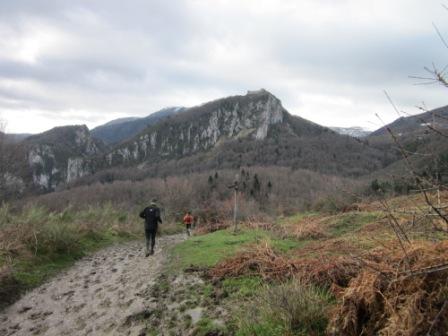
Montségur castle from afar at the top of the mountain (notice the footprints in the mud). Picture taken at about km. 5
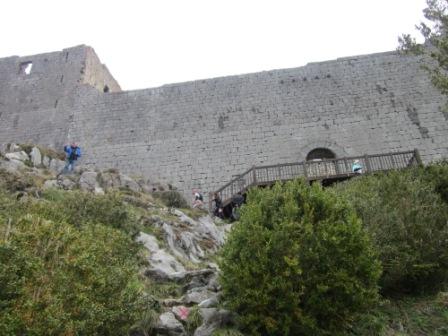
The mostly walking uphill took a full hour to cover about 5 kilometres to the bottom of the castle stairs.
Montségur castle from below.
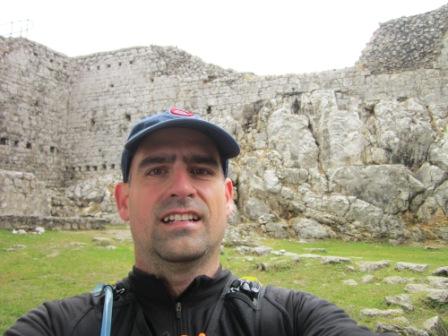
Inside the castle.
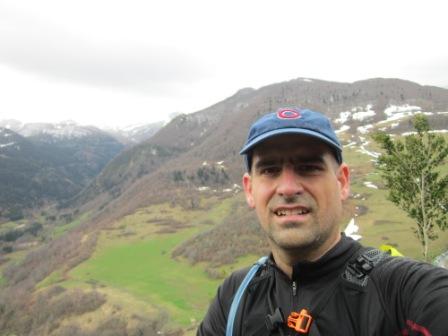
The views from the castle are stunning. The picture below does not make enough justice so I took a panoramic video.
Views from the castle.
From the castle to the end of the race most of the time we would be descending. In theory, this should have made it easier. But that was only the theory. That is when the fun began (to call it that way).
The way down started with the same stairs of the castle, which we descended with much care. Then some hundreds of metres of going up and down over more or less dry surface and finally the same kind of very steep descent, sometimes along and others crossed by water flows, fully covered with slippery mud.
I lost count of how many times I slid without any control on the verge of falling down. I do keep count of the 5 times that these detours ended with me, my face, arms, whatever it was… in the mud. They were not especially painful, but left you with hands and face covered of mud, having to wash yourself in the next current of brownish water. Other times the sliding left you looking uphill to the wrong side of the race hands in the ground to prevent a full-blown fall. As I was not the only one going through this, you can get an idea of the image…
Eating at ~ km. 12.
Around the kilometre 11-12 there was the only point of supply so I did a little stop to drink some Coke, eat some chocolate, etc.
After this stop, the mix of sliding / running continued for about another kilometre until we entered a forest of pine trees where the ground was a bit drier. There I was happy as I started running faster, less worried about falling and more focused on keeping the pace… until I bent my ankle… the same ankle I strained 3 times during winter. That one was painful. I had to stop and walk for some 2-3 minutes to recover from it.
It was then that I took the camera to film another short video as an update of the race so far at 13.4 km (in Spanish):
The making of the video, the self-deprecating humour of the situation lifted my morale. I tried the ankle, which responded positively, so I started running again.
During the last 5 kilometres, more or less flat, even if still going at times through water flows or mud, I tried to enjoy running a little. I think it was only at this point that I was overtaking others instead of being overtaken :-). I discovered then that instead of avoiding water flows and poodles, it was indeed better going through them as their bottom used to be firmer. The guys of the organization took it seriously and somehow made us literally run along the river for about 200m! That was another high moment of the trail, which I recorded here (excuse my French):
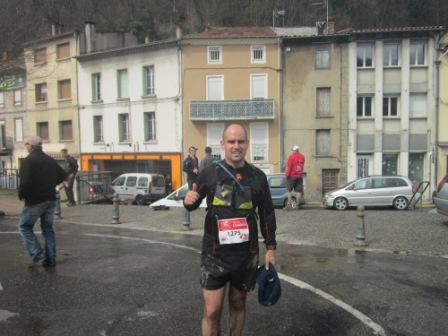
When arriving at the village, one final sprint and done. I mean, done.
Finish line.
My performance: 2h49’16”, 201 out of 366 finishing within the time given of 3h30′ (see Garmin records).
—
PD: All this happened in the 20 km race; bear in mind that at the same time 2 other races were taking place one of 40 km and one of 73 km (the runners having departed at 6am to run… 9 hours? 12?). My admiration to all those heroes.
This morning, as this post is being published I’ll be starting the 19th Rome marathon, together with my friends Serna, Manuel and brother Jaime.
I am very satisfied with the way I could train towards this marathon, no injuries this time.
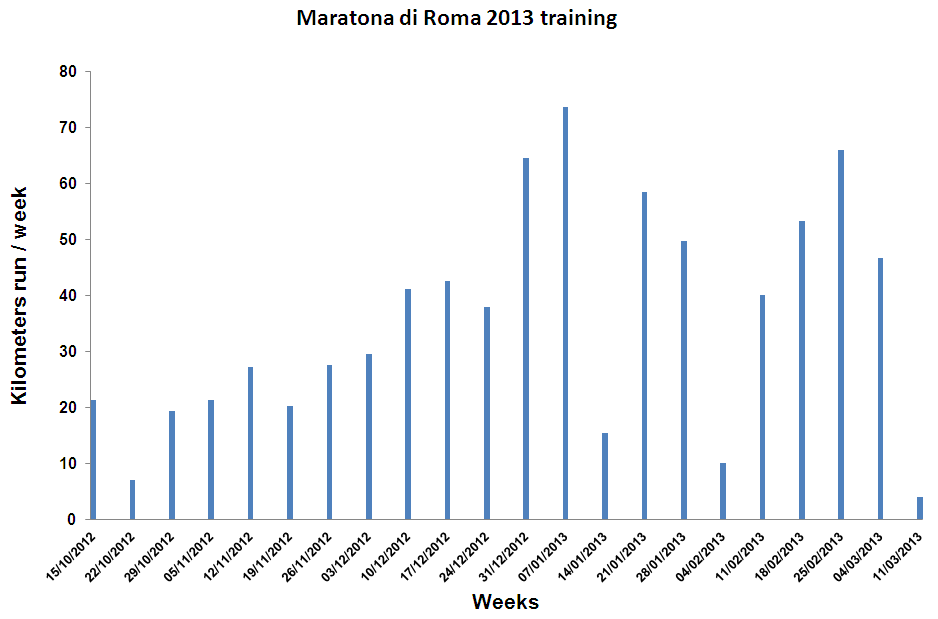
Since running Berlin marathon last September 30th, I only stopped for a couple of weeks and swiftly started running again. Even if I started a bit late to pick up with the number of miles run per week (from mid December instead of mid November) I have amounted almost 800km in these last months, including:
5 days of tough series training: 12x400m, 14x400m, 8x800m, 9x800m and 10x800m.
7 long runs of over 16km each, 4 of them over 20km.
5 races: San Silvestre Vallecana (10km), Course des Rois (10km), Le Deca d’Escalquens (10km), Trailhounet (18km) and Media Maratón de La Latina (21km).
You can see below the mileage run per week:
Maratona di Roma 2013 training season. Kilometres run per week.
A lesson learned from previous training sessions: when I noticed that some muscle or tendon was getting sore from too much training I did not hesitate in slowing down that week, instead of keeping up with the training until getting seriously injured. Let’s see today how it goes, anyway, as Jaime says, it’ll sure be a day for the epic :-).
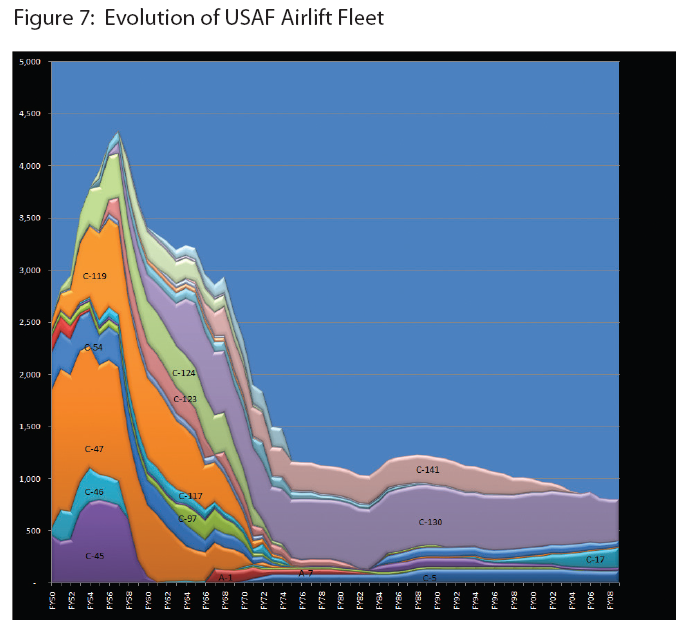
I wanted to bring forward some comments and two graphics:
“To put matters into perspective, a single C-17 can carry the equivalent of 15 C-47 loads (as well as cargo that could never fit inside a C-47) and deliver that cargo anywhere in the world within hours without requiring en-route staging bases.”
“The average cost of a flying hour over the past decade is around $23,000 (in constant FY11 dollars), compared to about $11,000 in 1985 and roughly $4,800 in 1970.”
“For example, a single B-2 now armed with 80 Joint Direct Attack Munitions (JDAMs) could strike as many targets as five of the 75-aircraft 1991 Gulf War era packages.”
Reading in Leeham News and Comment aerospace blog about the appearance of Ray Conner, CEO of Boeing Commercial Airplanes, at JP Morgan aerospace conference I picked the following lines:
Joe Nadol (JN) of JP Morgan: Is there pricing pressure?
Ray Conner (RC): I think margin will be OK [for 737NG]. Some initial launch deals for MAX can be a little more aggressive, but we’re seeing that become more stable.
JN: MAX–I thought pressure would be more on late NGs than on the MAX.
RC: We were a little late getting into the marketplace with MAX and there was pricing pressure on NGs. We were about a year late so we were more aggressive than we would have been had we not been late.
For the last years I have been trying to estimate averages for the discounts Boeing applies to its commercial aircraft using as departing information Boeing year-end financial results, list prices, net orders, deliveries and services revenues. You can see the results for 2012, 2011, 2010 and 2009. In each of the posts you can see a detailed explanation of the methodology I followed.
Why do I comment this? Since 2009 I have noticed that the average discount has gone from ~38% (2009), 39% (2010), 41% (2011) to 45% (2012)!!
Find below the explanation I could find for that hike in the discount:
The explanation I can find for that increase shall be linked the built-in penalties for 787 (net orders for 2012 being -12 a/c) and 747 delays (1 single net order) into revenues plus the launch of a new aircraft, 737 MAX (forced by A320neo sales success in 2011).
After 6 months running together, it has come the time to retire the old Saucony Triumph 8 running shoes and start using the new Saucony Triumph 9.
Saucony’s: old Triumph 8 and new Triumph 9.
Let this short post be a tribute to the Triumph 8s, which have run to date over 770km, in several cities and countries, and including 6 races, among them a marathon and a half-marathon. A similar curriculum awaits the Triumph 9 pair: several races including 2 marathons and no less than 700 km in a few months.
Triumph 8s will live side by side with the 9s, as casual sport shoes from now on, instead of running shoes.
Last Saturday Warren Buffett’s 2012 letter to the shareholdersof Berkshire Hathaway [PDF, 155 KB] was released. As always, I strongly encourage you to read it (23 pages).
From this year’s letter, I wanted to comment on 3 things:
Lesson on dividends’ policy
Books
Running
****
Dividends’ Policy
In my opinion the great lesson from this letter starts at page 18, when Warren explains the different ways a company has to allocate earnings. He makes a comparison between dividends and what he calls the “sell-off” scenario, where a shareholder can be better off when the company is not paying dividends and instead reinvesting all earnings while the shareholder sells part of his shares to obtain some cash.
See the explanation below (bit long):
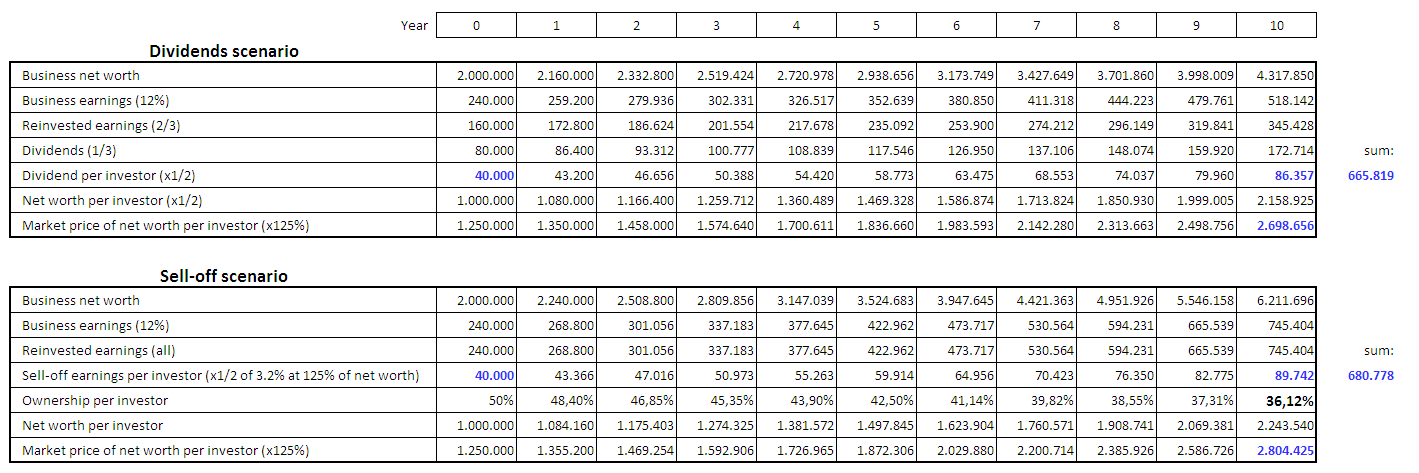
“We’ll start by assuming that you and I are the equal owners of a business with $2 million of net worth. The business earns 12% on tangible net worth – $240,000 – and can reasonably expect to earn the same 12% on reinvested earnings. Furthermore, there are outsiders who always wish to buy into our business at 125% of net worth. Therefore, the value of what we each own is now $1.25 million.
You would like to have the two of us shareholders receive one-third of our company’s annual earnings and have two-thirds be reinvested. That plan, you feel, will nicely balance your needs for both current income and capital growth. So you suggest that we pay out $80,000 of current earnings and retain $160,000 to increase the future earnings of the business. In the first year, your dividend would be $40,000, and as earnings grew and the onethird payout was maintained, so too would your dividend. In total, dividends and stock value would increase 8% each year (12% earned on net worth less 4% of net worth paid out).
After ten years our company would have a net worth of $4,317,850 (the original $2 million compounded at 8%) and your dividend in the upcoming year would be $86,357. Each of us would have shares worth $2,698,656 (125% of our half of the company’s net worth). And we would live happily ever after – with dividends and the value of our stock continuing to grow at 8% annually.
There is an alternative approach, however, that would leave us even happier. Under this scenario, we would leave all earnings in the company and each sell 3.2% of our shares annually. Since the shares would be sold at 125% of book value, this approach would produce the same $40,000 of cash initially, a sum that would grow annually. Call this option the “sell-off” approach.
Under this “sell-off” scenario, the net worth of our company increases to $6,211,696 after ten years ($2 million compounded at 12%). Because we would be selling shares each year, our percentage ownership would have declined, and, after ten years, we would each own 36.12% of the business. Even so, your share of the net worth of the company at that time would be $2,243,540. And, remember, every dollar of net worth attributable to each of us can be sold for $1.25. Therefore, the market value of your remaining shares would be $2,804,425, about 4% greater than the value of your shares if we had followed the dividend approach.
Moreover, your annual cash receipts from the sell-off policy would now be running 4% more than you would have received under the dividend scenario. Voila! – you would have both more cash to spend annually and more capital value.”
As always, I believe that the best way is to make (play with) the numbers yourself, so you get to understand it once and for all. I paste here the numbers for those not being number-crunchers:
There is another book that I should read, according to the following passage in the letter:
“Above all, dividend policy should always be clear, consistent and rational. A capricious policy will confuse owners and drive away would-be investors. Phil Fisher put it wonderfully 54 years ago in Chapter 7 of his Common Stocks and Uncommon Profits, a book that ranks behind only The Intelligent Investor and the 1940 edition of Security Analysis in the all-time-best list for the serious investor. Phil explained that you can successfully run a restaurant that serves hamburgers or, alternatively, one that features Chinese food. But you can’t switch capriciously between the two and retain the fans of either.”
I’ve got all three books in the shelf since 5 years ago, it’s a shame that I have not yet read or gone through the first one!
Running
I found one final surprising and hilarious passage at the end of the letter embedded in the information related to the shareholders meeting:
“On Sunday at 8 a.m., we will initiate the “Berkshire 5K,” a race starting at the CenturyLink. Full details for participating will be included in the Visitor’s Guide that you will receive with your credentials for the meeting. We will have plenty of categories for competition, including one for the media. (It will be fun to report on their performance.) Regretfully, I will forego running; someone has to man the starting gun.
I should warn you that we have a lot of home-grown talent. Ted Weschler has run the marathon in 3:01. Jim Weber, Brooks’ dynamic CEO, is another speedster with a 3:31 best. Todd Combs specializes in the triathlon, but has been clocked at 22 minutes in the 5K.
That, however, is just the beginning: Our directors are also fleet of foot (that is, some of our directors are).
Steve Burke has run an amazing 2:39 Boston marathon. (It’s a family thing; his wife, Gretchen, finished the New York marathon in 3:25.) Charlotte Guyman’s best is 3:37, and Sue Decker crossed the tape in New York in 3:36. Charlie did not return his questionnaire.”
I would have loved to take part in that race. I will probably do so in some other year :-).
This year, Luca and I will get married on May 11th, but one of the dates we considered was April 27th, and one of the drivers behind it was to be able to attend 2013 BRK meeting during the honeymoon…









 The Blog by Javier