Tag Archives: A380

Airbus vs. Boeing, comparison of market forecasts

Airbus announced on Monday its latest Global Market Forecast (PDF, 4.6MB) for the 20-year period 2010-2029. Media has already highlighted the main points: ~26,000 new aircraft will be delivered with a market value of ~3,200bn$.

Some months ago, Boeing published its equivalent study, the Current Market Outlook (PDF, 8.2MB) for the same period.

It is interesting to compare the two of them. In that way we can see how each other treat competitors’ products (mainly A380) and how they try to shape the market and send messages to it (point-to-point & hub-spoke).

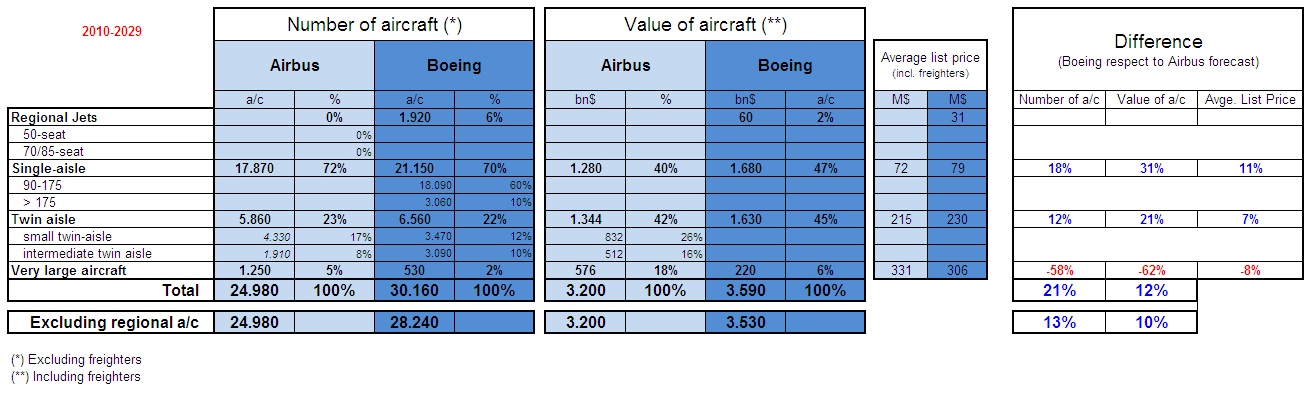
However, it is not easy to compare the studies as they use slightly different segmentations, disclose in different ways the value of aircraft for the segments (list prices) and is not always clear how to discount freighter aircraft from global figures. I dig for some time into those numbers and arrived to the following table:

Comparison of Airbus GMF and Boeing CMO 2010-2029.

Some comments on the comparison:

  • Boeing sees demand for 13% more aircraft with a 10% more value.
  • However, this higher demand is not applicable to all segments: Boeing sees ~60% less A380s or equivalent being delivered over the next 20 years, while 18% more single aisle (A320s) and 12% more twin aisle (A330/A350s).
  • Boeing plays down A380 potential, but sees a very similar number of RPKs (“revenue passenger kilometer”), that is, the number of paying passenger by the distance they are transported. Airbus forecasts for 2029 12.03 RPKs while Boeing forecasts 12.60 (in trillion).
  • The difference of less than 5% in RPKs means that out of the 13% difference in aircraft deliveries over 8% comes from the different business model each company is trying to push.
  • Finally, we can see that Boeing uses again higher average prices for smaller aircraft and a lower reference price for A380s.

Enjoy the two documents, differences apart, they gave a very good piece of information and insight about the market.

7 Comments

Filed under Aerospace & Defence

Boeing forecast for A380

The last two issues of Boeing’s Current Market Outlook, included a slide in which Boeing wanted to prove that their forecasts have been more accurate in the last 10 years. They compare actual aircraft demand versus both Airbus and Boeing forecasts in the year 2000.

Boeing Current Market Outlook, different views.

I find it interesting that all segments are described as such, segments: “Single-aisle”, “Twin-aisle”, “Large”… except for Airbus forecast in which Boeing introduces the model “A380”. As if wanting to point that Airbus was wrong in its A380 forecast… as if wanting to steer demand.

Let’s see the numbers:

  • Actual demand (2000-09): ~300 aircraft.
  • Boeing forecast (2000-19): ~700 aircraft, assuming equal split (among the 2 decades): ~350 a/c in 2000-09.
  • Airbus forecast (2000-19): ~1,300 aircraft, assuming equal split: ~650 a/c in 2000-09 (although A380 first flight took place only in April 2005).

As of today, Airbus has sold 234 A380s, including the latest 32 from Emirates. The prospects for the aircraft seem brighter as operators started operating it, on the other hand Boeing 747-8 orders have stalled since 2007.

A bit of history.

Yesterday, I was digging into back materials and I found two interesting pieces. Both from Boeing’s website in the year 1996 (using the way back machine). The first one is from a webpage about delivering value it could be read:

“In an industry defined by continual change, customers expect Boeing to help them prepare for the challenges ahead. That’s why we work closely with customers to understand their long-term requirements.

Customers have expressed interest in many potential airplanes, including:

  • An airplane smaller than the 737-600, seating 80 to 100 passengers.
  • An airplane larger than today’s 747-400.
  • A capable and cost-effective supersonic jetliner.
  • Derivatives of current models.”

Of those potential airplanes: we have seen the Embraer 190, the Airbus A380, derivatives and the only one that never came true was the supersonic jetliner

Artist image of Boeing Sonic Cruiser.

The other piece is from a news release on the occasion of the Farnborough air show of 1996 (2010 edition is taking place right now). There, Boeing stated:

Most major aerospace companies agree that airlines will require 500 to 700 airplanes capable of carrying more than 500 passengers. Boeing forecasts 500 airplanes will be needed by the year 2015.

Much of the demand for these very large airplanes will be generated by steady growth in air travel to and from Asia, and by capacity constraints at some of the world’s largest airports.

The 747-600X, with its ability to carry 548 passengers on routes up to 7,750 nautical miles (8,900 statute miles or 14,350 km), is designed to fill this market need. It will allow airlines to accommodate traffic growth without increasing the number of departures scheduled for busy airports.

During the next 20 years, airlines also will need approximately 600 airplanes capable of carrying between 400 and 500 passengers.

The Boeing 747-400 and 747-500X are designed to fill this market need.”

At this point it is useful to remember that in 1993 Boeing together with Airbus consortium companies started the feasibility study for the Very Large Commercial Transport (VLCT). Boeing left the joint study two years later. Nevertheless, still in 1996 it stated in its website that demand of aircraft carrying above 400 seats (747 and A380 of today) in the following 20 years would be between 1,100-1,300 planes, very close to Airbus forecast of the year 2000. The reasons behind that demand were the same Airbus argues nowadays: growth in Asia, constrains in largest hubs…

Later on, Boeing changed its forecast down to 700 aircraft.

3 Comments

Filed under Aerospace & Defence

The real comfort starts from 300 kg seats

In a previous post we introduced some comparisons of aircraft by its price per kilogram. There, we could see a trend in bigger aircraft being cheaper in this per kg basis. This raises the question: do bigger aircraft require less weight per seat? Are they lighter in a kg per seat basis?      

This is what intuition seems to tell us; after all, once you have put in place the engines, wing, tail… what can be the difference between a larger or smaller fuselage…     

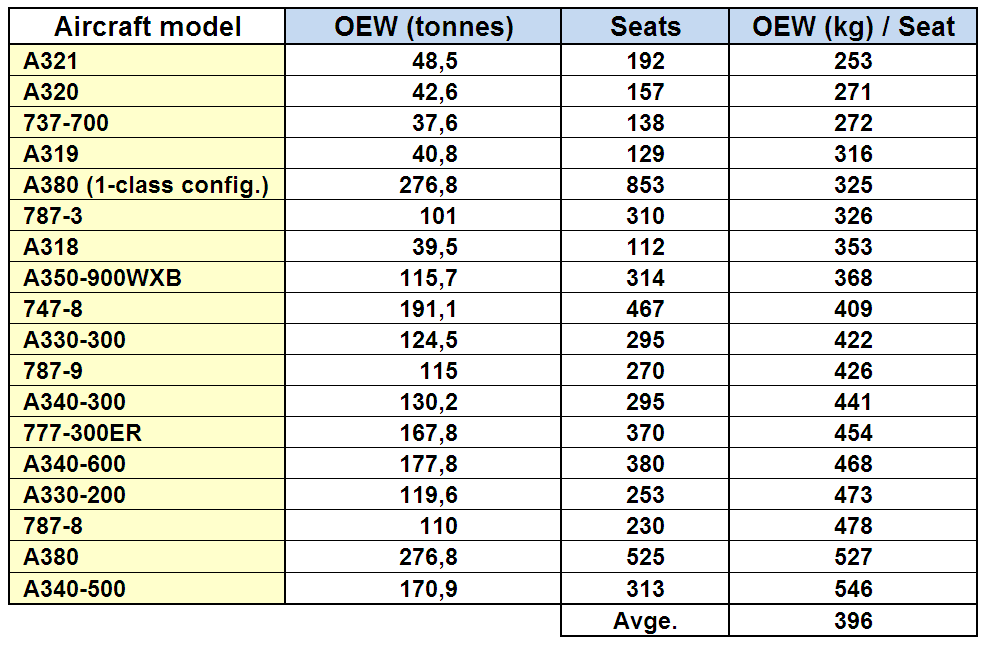
Let’s use the same sources we used in the previous post and take the typical seat configuration that the OEMs (Original Equipment Manufacturer) indicate for each aircraft model. We get the following table:     

Aircraft OEW (kg) per seat.


Our intuition wasn’t very successful again. In the upper part of the table we find the A320 family and 737s aircraft (those used by e.g. Easyjet and Ryanair in short-haul routes). In the bottom of the list we find the A380, A340, A330, 787, 777…, the biggest aircraft.     

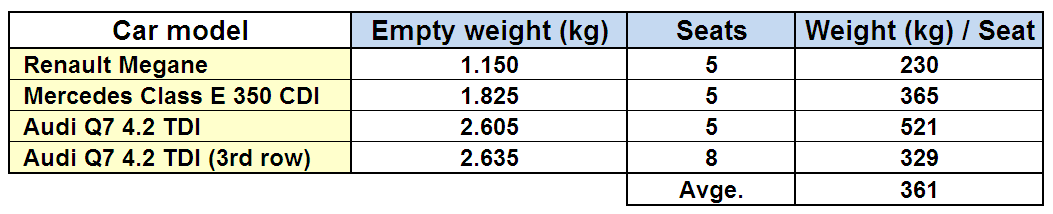
We see that the average is about 400 kg per seat. Let’s compare this figure again with cars, with the same cars as we did in the previous post. We now get following table:     

Cars empty weight (kg) per seat.


It turns out that cars also need around 300-500 kg of structure per seat (an average for these ones of 360 kg). Since most cars carry 5 passengers, here it’s easy to see the trend: bigger cars employ more kilograms per seat.     

Let’s go for a closer comparison:     

  • Small for small: take the A321 with 253 kg/seat, it is quite similar to the Renault Megane with 230 kg/seat.
  • Large for large: take the A380 with 527 kg/seat, it is almost identical to the Audi Q7 with 527 kg/seat.

One step further: The A380 used so far is the 3-class configuration with 525 passengers, but wasn’t there a high density configuration with 853 passengers in a single class? (This matches well with the jargon: cattle-class…). This configuration gives us 325 kg/seat… this is again almost identical to the 329 kg/seat given for the Audi Q7 in “high density” configuration, obtained with the optional 3rd row of seats, which only adds 35 kg to the weight of the car. Aren’t these remarkable coincidences? Is it a constant of the universe? 🙂     

Let’s compare these results with buses, city buses and minibuses:     

Buses empty weight (kg) per passenger.


When we compare the figures of touring and city buses in an all-seated configuration we get again similar figures than planes and cars (~290 kg/seat ~ A320 family). If we take a fully loaded city bus we descend to the crude reality of mass transportation and complete lack of comfort (100 kg/seat; that is cattle-class…). We may notice as well that a minibus weighs less than a Q7 and carries twice or three times as many people.     

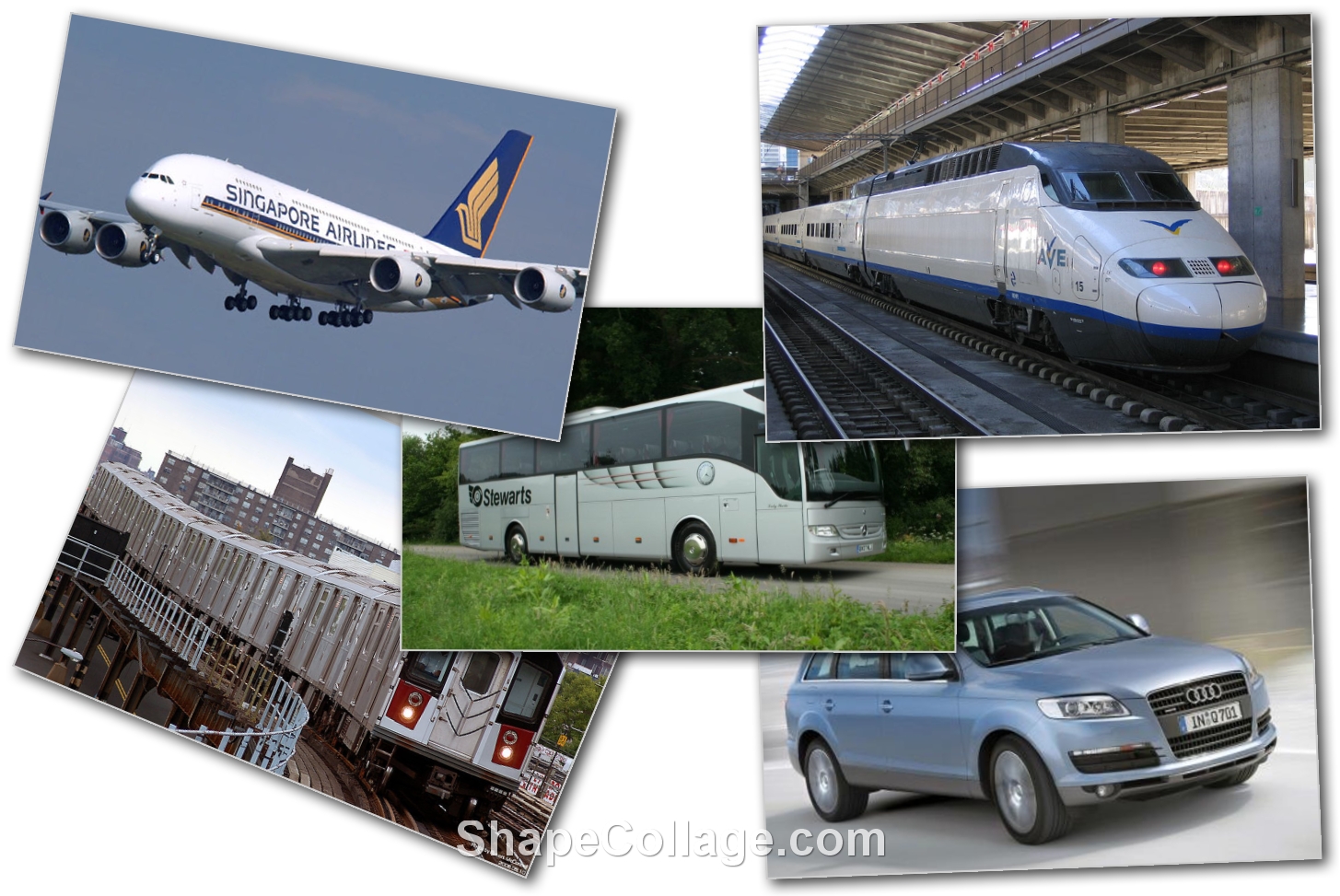
Let’s now see the train and subway. For this purpose, we’ll check the coaches R-142A and B of the subway of New York which are built by Kawasaki Heavy Industries (which a supplier for the Boeing787 as well). The train we’ll use is the AVE Series 100 of RENFE, built by Alstom, which was the first high-speed train ever used in Spain in 1992. See them in the following table:       

Subway and high-speed train weight (kg) per passenger.


The subway is below the levels of aircraft, but not that low as city buses. As far as the train is concerned: that’s another story, a luxurious experience (achieved with ~1,200 kg/seat) that can only be improved by Singapore Airlines Suites.     

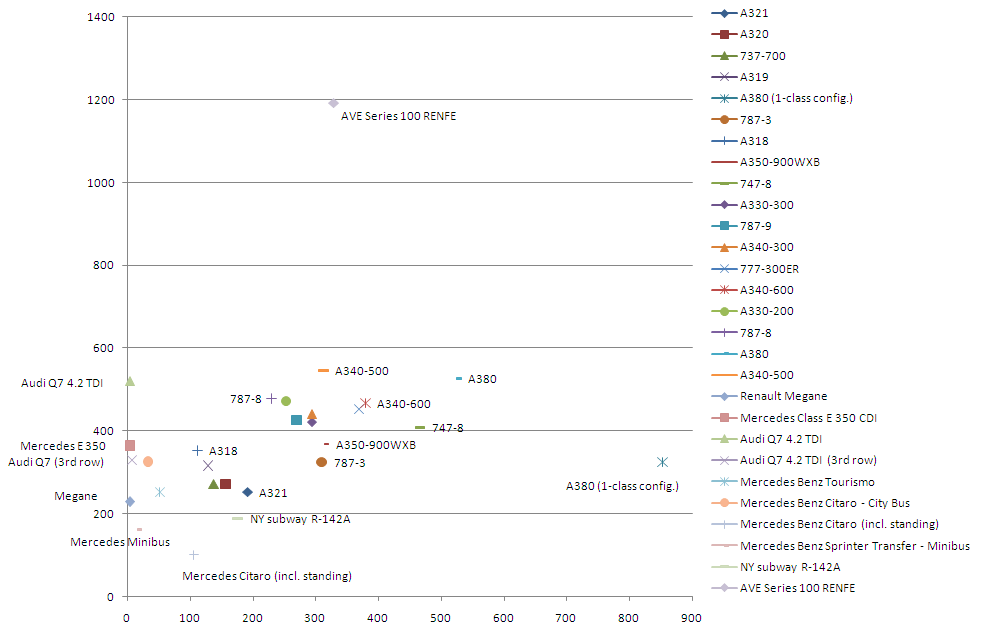
Below we can see again a graphic with all modes of transportation compared, there we may spot some trends.     

Modes of transportation weight (kg) per passenger/seat.


We could say that comfort starts above 300 kg/seat… How heavy is your car?     

Different modes of transportation.

3 Comments

Filed under Aerospace & Defence

An aircraft worth its weight in gold?

Airbus announced last January that it had raised the list prices of its commercial aircraft by an average of 5.8%. It had not updated its prices since 2008. You may see the current prices here: Airbus list prices

Boeing also discloses in its website the range of list prices of its aircraft. Those prices haven’t been increased in the last two years.  

Few years ago, I saw for the first time a comparison of prices of aircraft per kilogram. It was prepared by a teacher I had at EOI Business School in Seville, Felipe Moran, who later has become a co-worker. With this post I will start a series of comparisons, the first one being precisely that one: an update on price per kilogram of aircraft. 

We already saw where to get the prices from. The other input we are going to use is the weight of the aircraft, what is called: Operating Empty Weight (OEW). You may find this information in various places, I recommend you to pay a visit to Boeing’s “Airplane Characteristics for Airport Planning”, where you will find very detailed data of all its commercial aircraft.  (While gathering this info I also came across the following section dedicated to fun facts of the legendary Jumbo 747).  

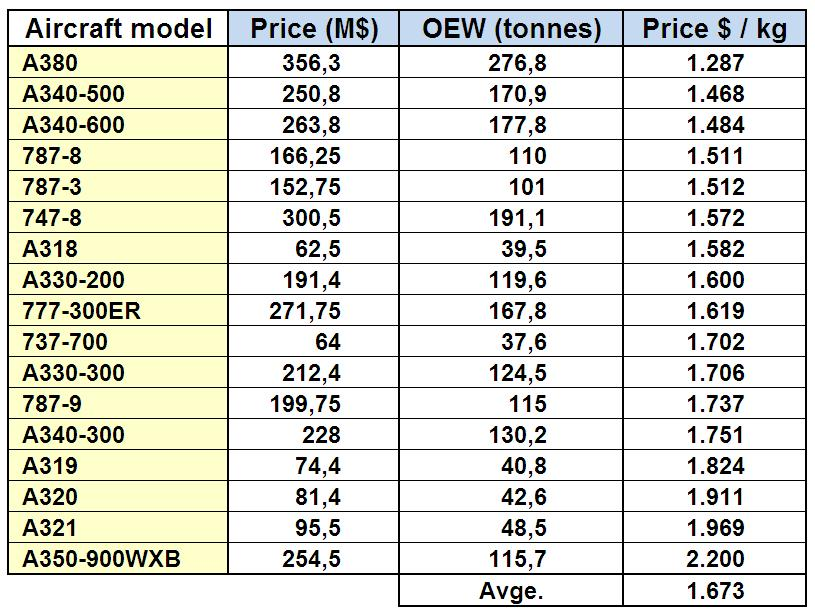
Combining these inputs we can build the following table. 
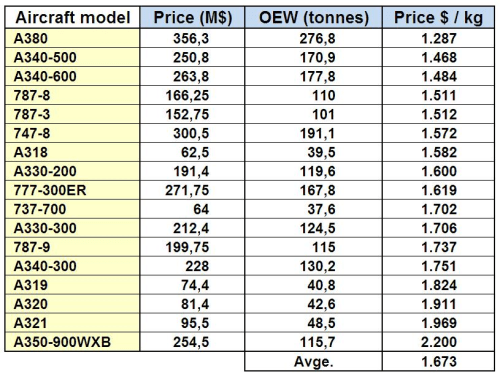
Price per kg of commercial aircraft.

Some facts may counter intuition: 

  • There doesn’t seem to be a clear discrimination between older and newer aircraft (A380 and some 787 models rank among cheapest, while A350-900 and 787-9 are among the most expensive).
  • Smaller Airbuses rank among the most expensive aircraft in a per kg basis despite the suggested price war that was reported by the specialized press in the recent years.

With the exceptions of A350-900 and 787-9 there seems to be a very slight trend in bigger aircraft being cheaper in this per kg basis. One may argue that once the frame of a certain size is built, building a bigger one might not cost that much

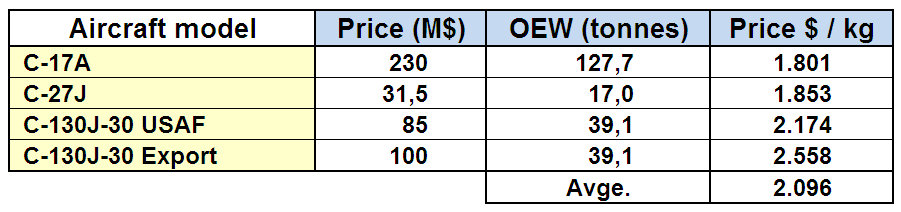
Now, let’s talk about the Military Transport business. Do we think those aircraft are more or less expensive? On one hand, those aircraft are not carrying systems such as the in-flight entertainment and, on the other, the scale of the market is smaller (with few exceptions such as the C-130) and they do carry diverse military systems, protections, etc. What is the trend weighting more in the balance? 
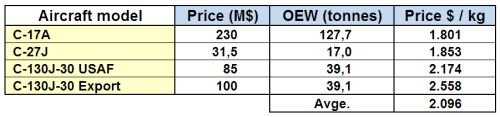
Military transport aircraft price per kg.

As you can see, military transport aircraft are on average 25% more expensive on a per kg basis. There is much more technology in them than people tends to think… they are clearly not just flying trucks. 

As you may have noted I have not included any sources for the prices of these aircraft, since they are rarely disclosed. I have used prices reported by the press and US budgets. 

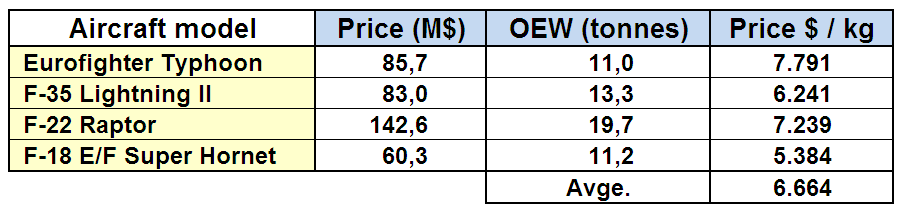
Let’s stretch the argument a bit more… What is the trend for fighter aircraft? This time scales are bigger than in military transport. Does this make them cheaper? See the table. 
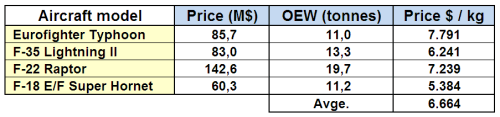
Fighter aircraft price per kg.

Not even close. Fighters are around 3.2 and 4 times more expensive than military transport and commercial aircraft, respectively, on a per kg basis.  

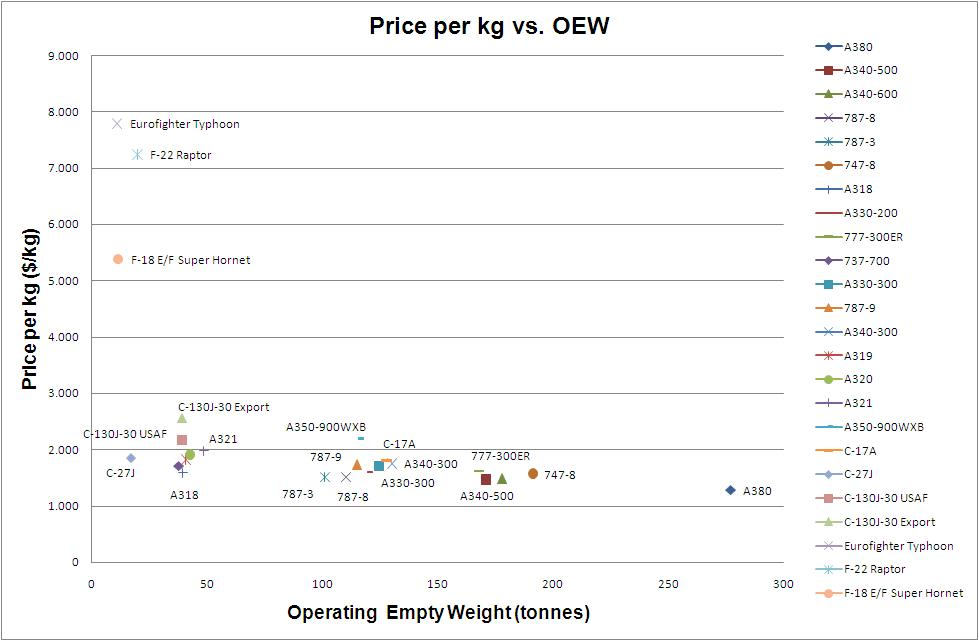
We can see in the following graphic all these aircraft together and maybe spot those trends. 
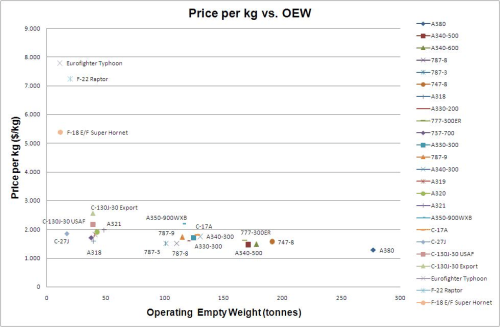
Aircraft prices per kg.

Now that we have an idea of how much aircraft cost per kg (1,700$ commercial aircraft, 2,100$ military transport aircraft and 6,700$ fighter aircraft)… is this expensive? Expensive compare to what? 

Let’s relate these prices to something closer to us. 

Cars: 

  • The best-selling car in Spain in 2009, was the Renault Megane (with 52,156 cars sold). It costs about 17,700 € (or 24 k$) and weighs 1,150 kg, this yields: 21 $/kg, clearly cheaper, about 80 times cheaper than commercial aircraft on a per kg basis. 
  • More up-scale cars such as the Mercedes Class E 350 CDI (56,000€ and 1,825 kg) or the Audi Q7 4.2 TDI (85,000€ and 2,605 kg) are more expensive per kg, 41$/kg and 44 $/kg, respectively. This is 40 times cheaper than commercial aircraft.

It may be worthy to note that in the cars we see the completely opposite trend than that we saw in airplanes: the bigger the car the more expensive on a per kg basis. 

Let’s compare this yet again with some other unrelated luxury item: Jamón Ibérico Puro de Bellota de Jabugo 5J. Today it was on offer in El Corte Ingles website for only 449€, a piece of about 7 kg, yielding: 87 $/kg. This is twice more expensive than buying a Mercedes (this may be the reason why it was an offer from Sanchez Romero supermarkets) but still 20 times cheaper than a commercial airliner. 

To end this post, let’s answer the question posed in the title of the post: 

The kilogram of gold is in the order of 35,400$, clearly more expensive than any aircraft. 

After all, nowadays, we may find no aircraft worth its weight in gold.

9 Comments

Filed under Aerospace & Defence