
Tag Archives: Amsterdam

Marathon world record evolution (2026)

Last year I wrote an update of the all-time men’s marathon best times and the world record evolution (post here, following an older one from 2014, ahead of running that year’s Rotterdam marathon). This is a new update including 2026 best time as this has been an extraordinary year: the world record has been beaten and the two hours barrier has been broken in an official race for the first time in history. The 2026 version of the post includes all marathon times below 2h08′ up to and including today’s New York marathon.

As in the previous posts, I use the website “Track and Field all-time Performances” (maintained since years ago by Peter Larsson). As Larsson has not updated his marathon times list since mid August, this time I completed the dataset with World Athletics all-time toplists (which added 86 times from the races between late September and late October) and with today’s New York marathon results (from LetsRun, still provisional at the time of writing, as NYRR has not yet published the official ones).

With the data of all-time best men’s marathon I plotted the chart below with the best 2,239 times, i.e., all those below 2h08′, and their dates, highlighting marathon times by Haile Gebrselassie, Wilson Kipsang, Eliud Kipchoge, Kenenisa Bekele, Kelvin Kiptum, Sabastian Sawe, Yomif Kejelcha, Jacob Kiplimo and Amos Kipruto.
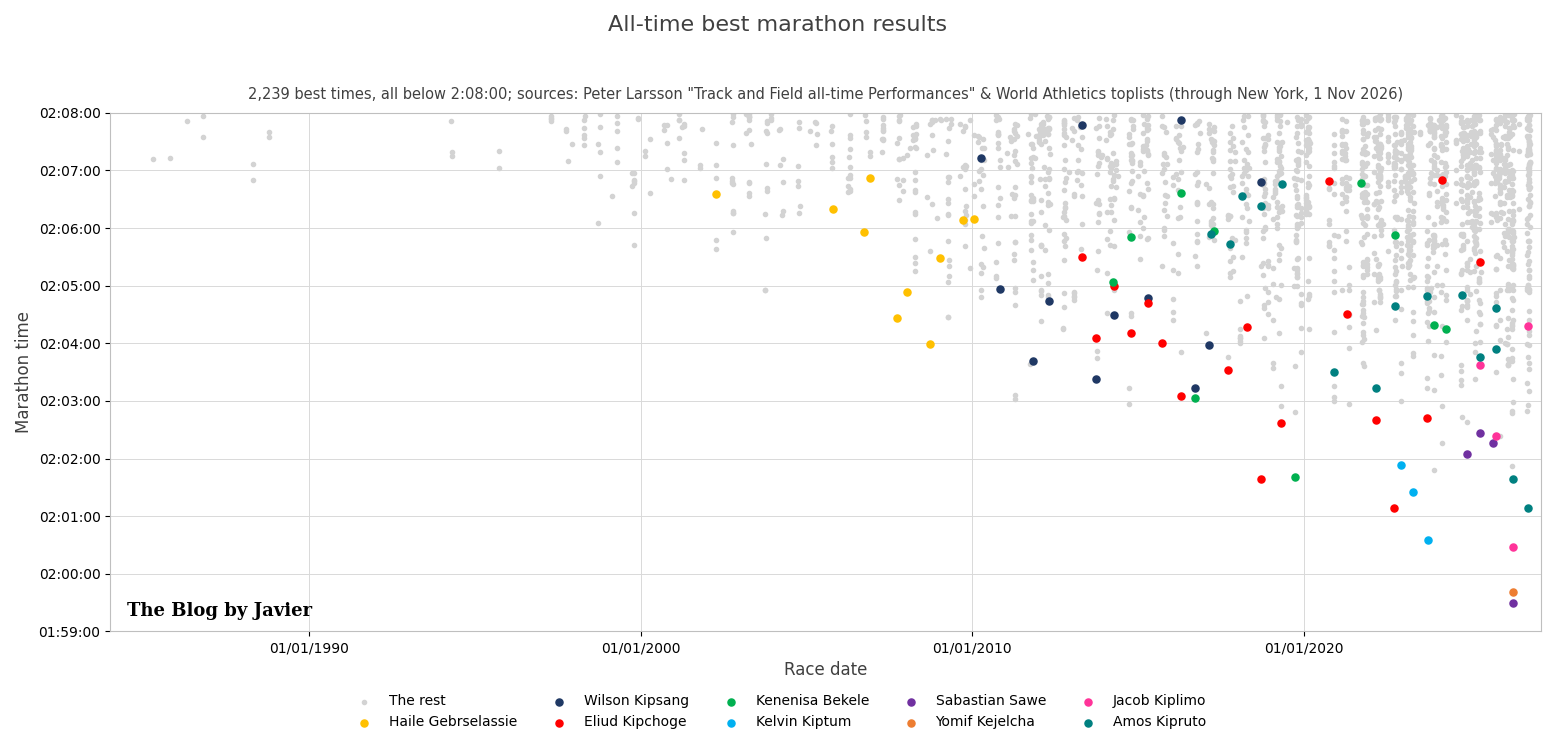
All-time best marathon results, 2,239 times below 2h08

Some stats in relation to those 2,239 times under 2h08′ (they were 1,903 when I reviewed them in September 2025; 249 of them have been achieved in 2026 alone, more than in any previous year!):

  • Countries of which athletes achieved most such times: Kenya 959 times or 42.8%, Ethiopia 666 times or 29.7%, Japan 138 (6.2%), Morocco 51 (2.3%), Eritrea 51 (2.3%), USA 34 (1.5%), Uganda 27 (1.2%), Spain 27 (1.2%), Israel 26 (1.2%). Those are the top 9 countries, there are another 35 from which athletes have run below 2h08′ (for a total of 44 countries).
  • There are 872 athletes that have run below 2h08′. The individuals who have done so more often: Eliud Kipchoge 18 times (he still runs marathons, he even won the Melbourne marathon 3 weeks ago in 2h09 at 41 years old!), Sisay Lemma 17, Tamirat Tola 16, Amos Kipruto 15, Tsegay Kebede 15, Benson Kipruto 14, Abel Kirui 13, Evans Chebet 12, Wilson Kipsang 12, Geoffrey Kamworor 12, Bernard Kiprop 12, Birhanu Legese 11, … Kenenisa Bekele 10, Haile Gebrselassie 10…

Now, if we raise the bar to see the times at or below 2h05′, we find 301 times (they were 231 a year ago):

  • Countries of which athletes achieved most such times: Kenya 135 times or 44.9%, Ethiopia 121 times or 40.2% (both combined 85.1%!), Uganda 7 (2.3%), Tanzania 7 (2.3%), Belgium 5 (1.7%), Germany 5 (1.7%). Those are the top 6 countries, there are another 15 from which athletes have run at or below 2h05′ (for a total of 21 countries, 5 more than last year).
  • There are 154 athletes that have run at or below 2h05′ (30 more than last year). The individuals who have done so more often: Eliud Kipchoge 14 times, Amos Kipruto 10, Tamirat Tola 10, Wilson Kipsang 8, Sisay Lemma 7, Birhanu Legese 6, Gabriel Geay 5, Alexander Mutiso 5, Leul Gebrselassie 5, Sabastian Sawe 4,  Kenenisa Bekele 4, and several other athletes with 4, and with 3 times including Kelvin Kiptum, Dennis Kimetto, Geoffrey Mutai and Haile Gebrselassie.
  • Which are the fastest marathons? The cities where most of those 301 times at or below 2h05′ have been achieved are: Berlin 41, Valencia 39, London 33, Amsterdam 28, Dubai 27, Chicago 24, Rotterdam 22, Tokyo 21. Those are the top 8 cities (accounting for 78% of those 301 times), there are other 17 cities where such fast times have been achieved.

Now let’s look at the evolution of the World Record since 1985 in this other chart:
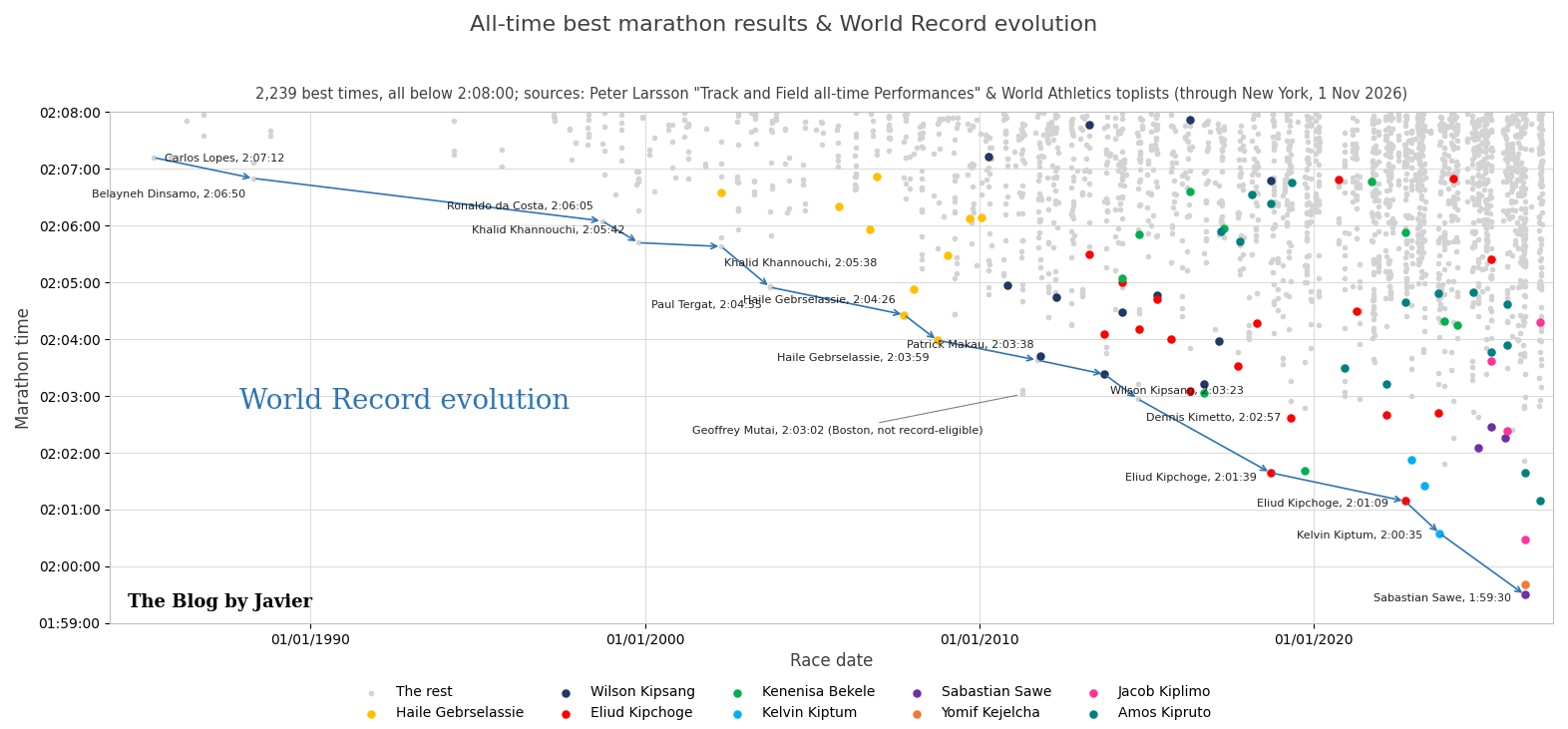
World record evolution since 1985, ending with Sawe 1:59:30 in 2026

Some comments to the chart:

  • In the last 41 years, the record has been beaten 14 times.
  • The current world record was set by Sabastian Sawe in London on 26 April 2026 with 1h59’30”, at the age of 31. It is the first official time below 2 hours and it was ratified by World Athletics in July (Eliud Kipchoge had run 1:59:41 in Vienna in 2019, but that exhibition, with rotating pacemakers, was not record-eligible).
  • That London race was historic beyond the record: Yomif Kejelcha (1h59’41”) and Jacob Kiplimo (2h00’28”) also finished under the previous world record, with Amos Kipruto 4th in 2h01’39”, Tamirat Tola 5th in 2h02’59” and Deresa Geleta 6th in 2h03’23”.
  • Sawe took 1’05” off Kiptum’s record, which had lasted two years and a half. The biggest improvement of the record was still made by Eliud Kipchoge, who took 1’18” off Dennis Kimetto’s previous record in 2018.
  • The record that lasted the most was Dinsamo’s 2:06:50 in 1988, which took just over 10 years to be beaten by Ronaldo da Costa in 1998.
  • 3 athletes have set the world record twice: Khalid Khannouchi, Haile Gebrselassie and Eliud Kipchoge.
  • Geoffrey Mutai ran in 2h03’02” in Boston 2011 and this year John Kipkosgei won Boston in 2h01’52”; as Boston is a downhill point-to-point course, those times do not count for the record.
  • In the same day in London, Tigst Assefa set a women-only world record of 2h15’41” (improving her own mark from 2025), with Hellen Obiri (2h15’53”) and Joyciline Jepkosgei (2h15’55”) completing the first race ever with 3 women below 2h16′ (see World Athletics report and London Marathon).

Other remarkable marathon facts from 2026:

  • Amos Kipruto won Chicago in 2h01’09”, equalling to the second the world record that Kipchoge had set in Berlin 2022.
  • Guye Adola won Berlin in 2h02’50”, and Tamirat Tola won Beijing in 2h03’10”.
  • Eliud Kipchoge, close to turning 42, ran won Melbourne two weeks ago.
  • Today in New York, Andreas Almgren (the reigning world half marathon champion) won in his marathon debut with 2h06’01”; 13 men ran below 2h08′.

What is the best age to run marathons?

I plotted this other chart looking at the best 2,239 marathon times vs the age the runners had at the time of completing each of those races (for the 2,201 of them for which the sources include the full birth date).
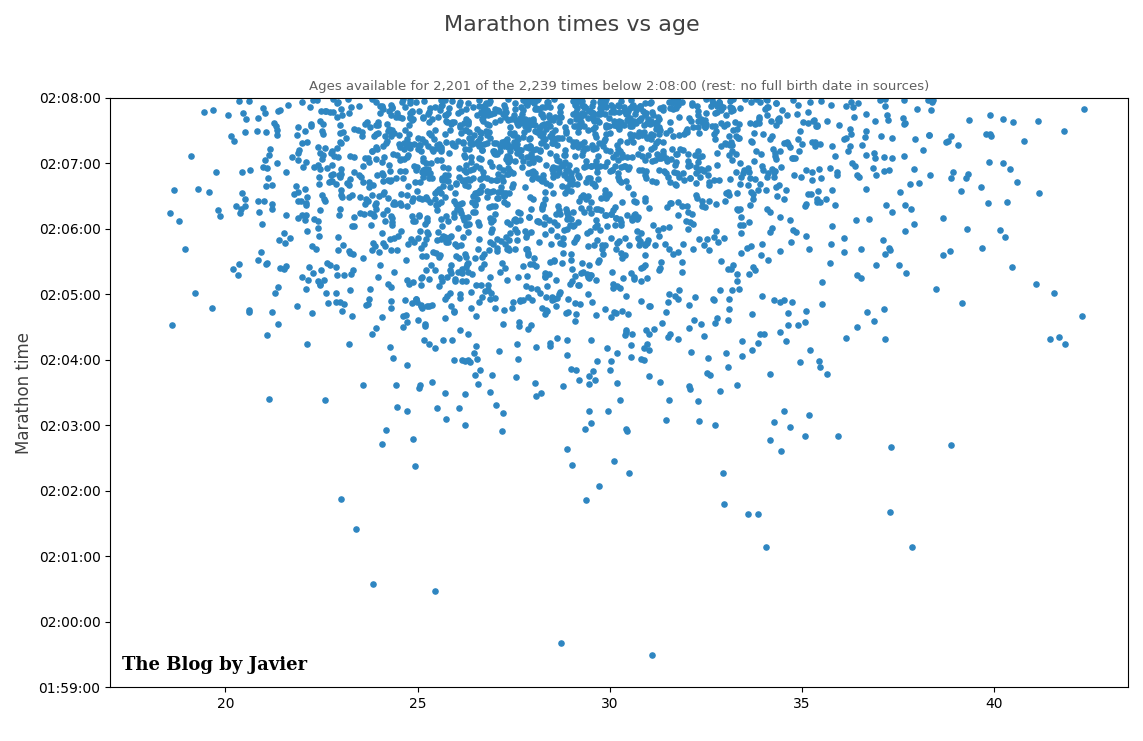
Marathon times vs age

Most of the times below 2h08′ are achieved between 23 and 33 years old, and the very best ones are spread between 25 and 37, with the exceptions of the 3 marathons ran by Kelvin Kiptum, including his former world record at 23.9, Tadese Takele (2h03’24” at 21.1) and the 2h00’28” by Jacob Kiplimo at 25.4. Sawe’s world record, on the contrary, was set at 31.1. The youngest ever to run such a fast marathon was Tsegaye Mekonnen: 2h04’32” in Dubai 2014 at 18.6.

Another interesting chart to relate best times and age is the histogram below. In that one we can see that effectively most of the times below 2h08′ are achieved between 24 and 30 years old, and between 23 and 33 (both included) 79% of those times are achieved.
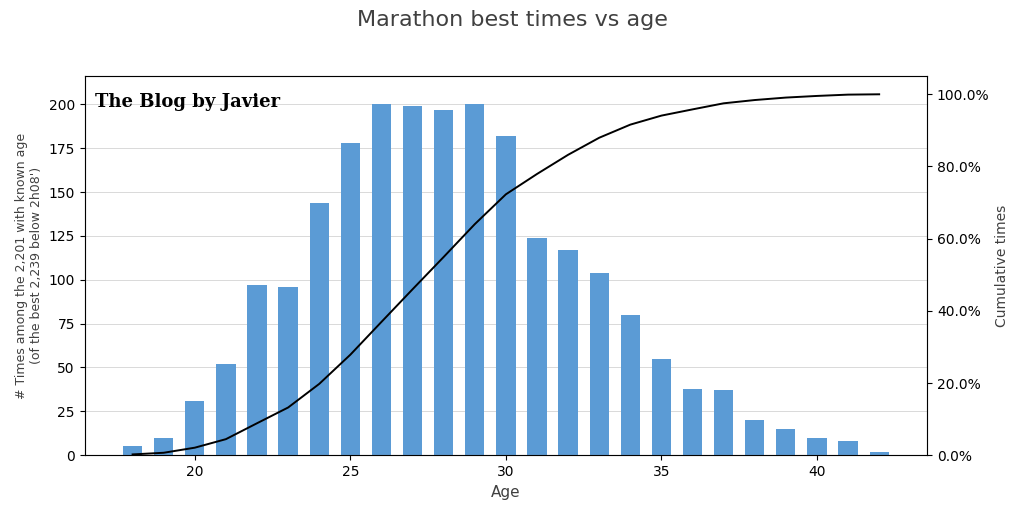
Histogram of marathon best times by age

Let’s see what Valencia brings in December with Yomif Kejelcha and John Korir on the roster.
Leave a comment

Filed under Sports, Uncategorized

Confusion of Confusions

Shuffling books among shelfs at home a few days ago, I came across “Confusión de Confusiones” by José de la Vega (“Confusion of Confusions“ in English). This is a book I had referred to a couple of times in this blog but I never wrote about it.

José de la Vega was born in the province of Córdoba in Spain in around 1650. The family, Jewish, moved to today’s Netherlands to profess its faith. In 1688, he wrote Confusión de Confusiones, the oldest book ever written about the stock exchange business. The book takes the form of a dialogue between a shareholder, a philosopher and a businessman.

I read a hard cover Spanish version of the book edited by Macanaz. The editors did a great job. The book includes a ~30-pages dictionary at the end translating old Spanish words, Latin words, providing explanations for characters and places mentioned, etc. It also includes a 5-pages recap of the main advises José de la Vega provides to investors along the book.

The Amsterdam stock market at that time suffered from all the ailments that stock markets suffer today: hysteria, bulls and bears, irrationality, information asymmetry, etc. It is worth noting that the stock market at that time consisted of: one single trading place, Amsterdam, and one single company, the Dutch East India Company (Vereenigde Oost-Indische Compagnie, VOC). This may lead to think that everything should be quieter at that time, but as the author notes (1):

[…] you shall know that the Shares have three stimuli to go up and another three to go down: the status of India, the disposition of Europe and the gambling of the Shareholders. Thus, very often the news do not produce any benefit, because they take the flows to another direction.

The health of the business, the mood in the market place and the selling and buying of investors and speculators. That is all that it takes to provoke the financial ups and downs that in the end cause stock market crashes.

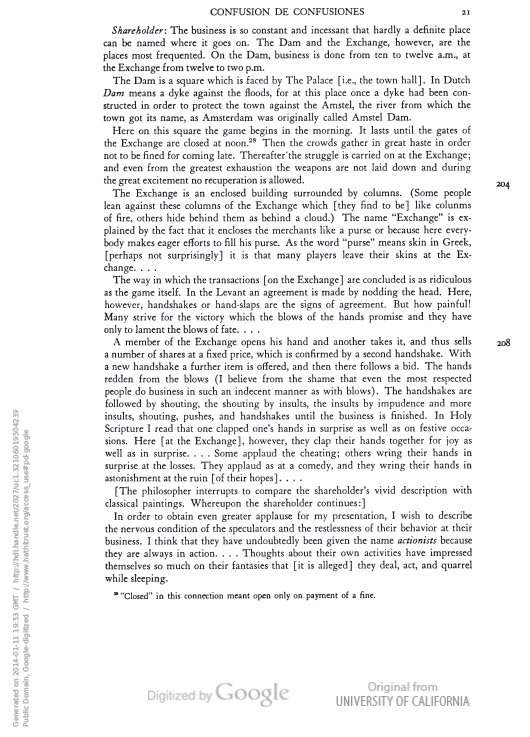
About the place and the way the market operated, he explained (extract from Google digitized English version, public domain, which however omits some paragraphs):

Extract from "Confusión de Confusiones".

Extract from “Confusión de Confusiones”.

To conclude with the comments on the book I will include here some of the advises from the author, first in Spanish so the readers of the blog who understand it can capture the language and then translated:

“Los necios, que de todo se afligen, de todo se lamentan, de todo se desesperan.”

“Los que están con la soga en la garganta no tienen otro cortejo que de verdugos.”

“¿Qué vale no arriesgar la hacienda, si se pierde el Alma?”

“Si el que compra algunas partidas, ve que bajan, rabia de haber comprado, si suben, rabia de que no compró más; si compra, suben, vende, gana, y vuelan aun a más alto precio del que ha vendido, rabia de que vendió por menor precio; si no compra ni vende, y van subiendo, rabia de que habiendo tenido impulsos de comprar, no llegó a lograr los impulsos.”

“En acciones no se debe dar consejo a nadie, porque donde está encantado el acierto, mal puede lucir airoso el consejo.”

“La máxima de los accionistas veteranos, es No casarse con las Acciones.”

“En perdiendo esperar, en ganando recoger.”

“Es ignorancia haberos dejado engañar, porque precediendo para la constancia tantos avisos, no pueden tener descargo los errores.”

“No quieren apercibir esta filosofía los inquietos, y como son aire, y es aire lo que tratan, para fabricar torres en el aire, juzgan que cuanto más se mueven más se exaltan, cuanto más se agitan más se calientan, y cuanto más se calientan más crecen.”

“Quien tal hace, que tal pague.”

“El punto no estaba en ver cómo se había de entrar, sino en considerar cómo se había de salir.”

… (see translations below (2))

Each of those sentences would suggest a topic for a whole post in itself; advisors, frequent trading, bubbles, short-term view, banks bail outs, etc…

The book is great, however it is quite difficult to read. Jose de la Vega lived in 1688 and was a philosopher; be prepared for the language he uses and the use of ancient History episodes to illustrate his explanations.

Finally, researching for this post I learned in the Wikipedia that the Federation of European Securities Exchanges (FESE) awards each year a prize honouring De la Vega to authors of outstanding research related to the securities markets in Europe. You can see here the list of winners of the prize.

Curiously enough, the 2013 prize went to Sophie Moinas from Toulouse School of Economics, for her paper “Liquidity Supply across Multiple Trading Venues” (jointly with Laurence Lescourret).

—

(1) Translations are mine, as I noted the book I have is a Spanish version of it.

(2) Translations of the advises:

“Fools, they grieve about everything, lament everything, despair with everything.”

“The ones with the rope in the throat are not courted by anyone but executioners.”

“What is it worth not to bet the house, if the soul is lost?”

“The one who buy some shares, if they, is angry at having bought, if they go up , is angry because he did not buy more; if he buys, they go up, sells, wins, and the share fly even higher than the price at which he sold, he is angry for having sold at a lower price; if he neither bought nor sold, and he sees the shares going up, he is angry because having had buying impulses, he failed to buy.”

“Regarding shares one should not give advice to anyone, because where success is haunted, it is difficult that the advice looks graceful.”

“The mantra of veteran shareholders, is Not marry the Shares.”

“When losing wait, when winning collect.”

“You have been an ignorant for having let yourself fooled, because preceding such a record of warnings, there can not be excuse for errors. “

“The restless do not want to embrace this philosophy, and like the air they are, and air is what they trade, to build castles in the air, they judge that the more they move the more exalted they are, the more agitated they are more over heated they become, and the more hotter they become they grow more.”

“He who does that, he who shall pay that.”

“The point was not in seeing how to enter in it, but in considering how to exit.”

1 Comment

Filed under Books, Investing

Book review: Pirate Latitudes

I bought this book together with some others in the Books & News shop of Schiphol airport in Amsterdam in a recent trip to NL. I have read about this book sometime ago as it had been discovered in the computer files of Michael Crichton after his death.

I had read most of his last books so I was determined to buy this last one as soon as I would find it and so did I.

I found this book quite different from his last novels (Next, State of Fear, Prey…), but still, it was a quite entertaining reading about pirates in the Caribbean hunting treasures, fighting warships, storms, hurricanes, aborigines…

I would remark its very vivid descriptions everything related to sailing, firing cannons, the Caribbean, etc. One more thing I liked it about it is that it leaves the reader rested with all vengeances possible, well taken. I do recommend the book (387 pgs.).

Lastly, I found out in the Wikipedia that there will probably be a movie about this book by Steven Spielberg and even most intriguing: there is yet another novel by Crichton coming posthumously in 2012!

3 Comments

Filed under Books