Tag Archives: Berkshire Hathaway

Why do I prefer Coke

Some weeks ago I read an article about why do we prefer Coke over Pepsi by the blogger Farnamstreet (1). It mentioned a marketing initiative by Pepsi some years ago, “The Pepsi Challenge”, in which blind test were organized to see whether consumers preferred one or the other. Pepsi consistently advantaged Coke in the tests.

The article mentions other studies in which it is explained why nevertheless Coke still outsells Pepsi. In the end it seems to be due to the powerful brand Coca Cola has created along history and its association with happiness and satisfaction. This is an extreme case of what Warren Buffett describes as moat:

Definition of ‘Economic Moat’

The competitive advantage that one company has over other companies in the same industry. This term was coined by renowned investor Warren Buffett.

Investopedia explains ‘Economic Moat’

The wider the moat, the larger and more sustainable the competitive advantage. By having a well-known brand name, pricing power and a large portion of market demand, a company with a wide moat possesses characteristics that act as barriers against other companies wanting to enter into the industry.

My preference for Coke

Luca and I did this kind of blind test about 4 years ago when we lived in Madrid. We had heard of these tests and I was sure I could distinguish one from the other.

Normally, I never buy Pepsi (except when you order a “cola” at some place where there is no Coke). For the test we purchased both Pepsi and Coke, and placed them in the fridge for a while. Then I got blinded. Luca took them out of the fridge and poured each in a different glass (same kind of glass) with ice cubes. Then she offered me one glass. I tasted it.

“Ok, I don’t even need to test the other one, this is Pepsi”, I said. Then, I thought “well let’s try the other to confirm my choice”. I tasted the other glass… then I tasted again the first one. I ended up completely lost. I couldn’t tell one from the other. I finally changed my initial decision.

I was wrong in the test. Since then, I have told some friends about the experiment. Most of these friends claim they would indeed distinguish one from the other. They would probably even state that they prefer Coke due to its flavour (of course, I have no friend who prefers Pepsi! Who does?)…

After having done the test, no doubt I continue to buy Coke, but now I am aware that it is partly due to some behavioural trick being played within my mind, the kind of trick explained in the article.

(1) Farnam Street being the street in Omaha where Berkshire Hathaway HQ are located.

NOTE: You may want to read this case by Charlie T. Munger, Berkshire Hathaway vice chairman, about the compounding effects that led to the tremendous success of this carbonated water drink. The essay was part of a lesson he gave at USC Business School in 1994 and appears in his book “Poor Charlie’s Almanack”.

3 Comments

Filed under Economy, Marketing, Miscellanea

Inflation and assets

During the last weekend, I spent some hours watching the webcast of the annual investors’ conference of Bestinver, a Spanish investment fund.

I find the conference itself not only entertaining and informative but quite funny due to the way the fund managers show their value investing principles and how stubborn they’re with them (luckily for investors). The experience is comparable to that of Berkshire Hathaway annual general meeting.

As in previous years the managers defended how not only to have profits but to defend your savings during recessions it is much better to be invested in real assets than to have your money in cash, state bonds, etc.

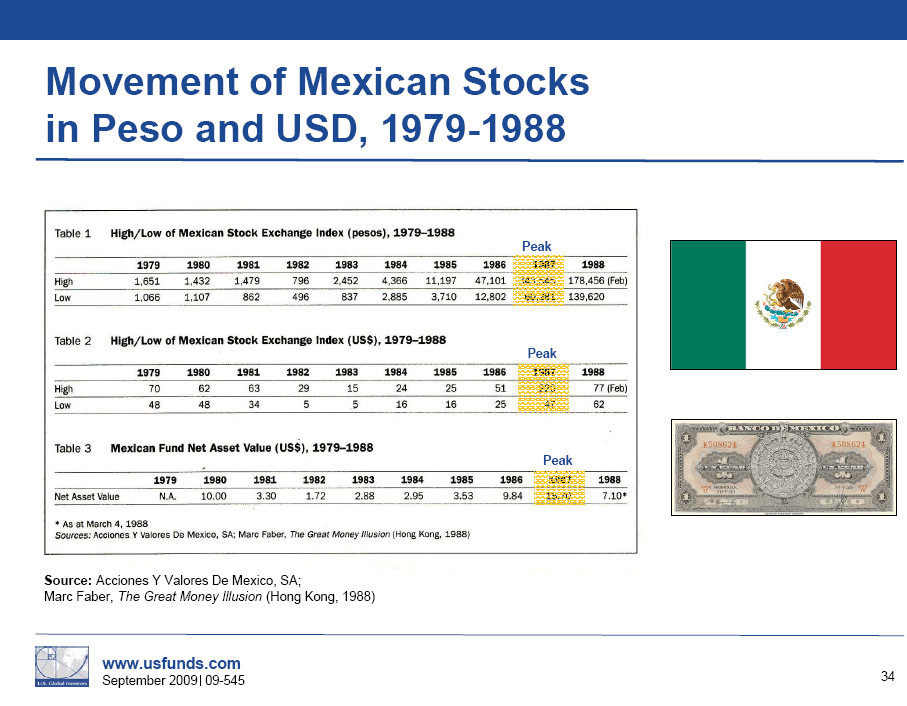
This time they raised the case of Mexico during 1979-1988 (in previous cases they had referred to the Weimar Republic or Argentina), based on an analysis by Marc Faber (a presentation containing the same info can be retrieved here, PDF 4.8MB). During those years the Mexican peso suffered an extreme hyperinflation explained in the Wikipedia as follows:

In spite of the Oil Crisis of the late 1970s (Mexico is a producer and exporter), and due to excessive social spending, Mexico defaulted on its external debt in 1982. As a result, the country suffered a severe case of capital flight and several years of hyperinflation and peso devaluation. On 1 January 1993, Mexico created a new currency, the nuevo peso (“new peso”, or MXN), which chopped 3 zeros off the old peso, an inflation rate of 10,000% over the several years of the crisis. (One new peso was equal to 1000 of the obsolete MXP pesos).

Mexican peso evolution vs USD. Source: Ron Griess

Obviously, anyyone who either held savings in cash in pesos or Mexican bonds at that time virtually lost all his money.

However, the same author made the analysis of what would have happened during those years to an individual holding Mexican stock, for which he used the Mexican Stock Exchange Index. The result is that at the end of the decade that person would have kept his wealth in US dollar terms, as the nominal value of the Mexican stocks raised at par with the hyperinflation and peso devaluation going on in the country.

Evolution of Mexican Stock. Source: Marc Faber

Conclusion: better be invested in assets if only to keep your savings safe in the long run.

Leave a comment

Filed under Economy, Investing

My experience at BRK2011

Berkshire Hathaway was a small textile company in Rhode Island. As many other textile companies it was struggling due to cheap labour competition elsewhere. Warren Buffett had already invested in the company before realising that it was headed for the worst. He was about to sell his stake when he felt irritated by an underbid from the managing director, then he decided not only not to sell his shares but to invest until gaining control, sacking the CEO and completing what he later referred to as his worst investment mistake he ever made…

Today Berkshire is a very different outfit: a big conglomerate, with over 130 billion USD in revenues, with a big insurance arm, dozens of operating companies and large investments in securities. Warren Buffett, his current CEO, regarded as the best investor ever.

Berkshire Hathaway annual shareholder meeting (BRK 2011, for this year’s event) is an extraordinary event, widely covered by press and attended by over 30.000 investors and relatives.

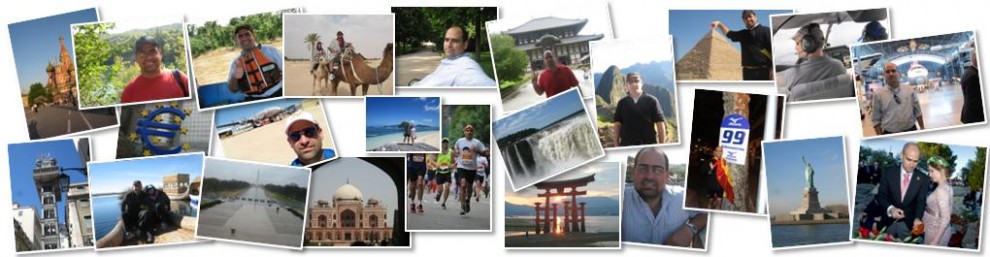
I explained in a previous post how I became interested in investing and when and why Luca and I became shareholders of Berkshire, now I want to give a small account of my experience in my baptism in the Woodstock for Capitalists (pictures below)…

… on Thursday 28th April Luca and I picked a rental car in Chicago, from where we would drive 800km to Omaha, Nebraska, with a stop over in Des Moines. Early in the afternoon Friday 29th we arrived at our hotel in Omaha, where the receptionist informed that there was a package waiting for us: our credentials for the weekend (thanks Debra!).

The event is not restricted to just the shareholders meeting, it is composed of a series of events covering the whole weekend. Let me describe them.

Cocktail at Borsheims. On Friday evening several buses would pick shareholders up from an infamous mall to bring us to Borsheims, the group’s jewellery shop. In front of the shop there was a big tent with live music, drinks and food. The shop was open, with re-doubled staffing to attend shareholders in eventual sales (as Buffett says “what better occasion to propose to your girlfriend than at BRK shareholders meeting?”).

Shareholder meeting on Saturday morning. The meeting started at 8:30am, doors opened at 7:00am and Luca and I arrived at 6:45am when there was already a huge queue. The meeting is held at the Qwest Center, a big convention center, which has room for exhibition and a sports indoor arena where the meeting is held. The exhibition area is packed by stands selling all kinds of goods from the group subsidiaries: boots, construction tools, books, sports wear, insurance… anything at a nice discount for shareholders. What better place to go shopping than to your own shop at a discount? To open the day some very funny videos and commercials were displayed. One featuring cartoons of Buffett, Munger and Schwarzenegger as Governator was especially welcomed.

Q&A session. Most of the meeting, until about 15:30 in the afternoon is a questions and answers session. This is when everybody wants to test and listen to the insights from the “Oracle of Omaha”. They made room for approximately 60 questions. Half were selected by 3 journalists from the thousands sent in by shareholders and the other half were drawn just before the meeting from volunteering shareholders in the floor.

This Q&A session is the most widely event reported by media. If you have read anything about the meeting, it was most probably said there. Instead of me telling here again what’s that was said, let me just refer to my first and second favourite accounts from other sources.

Charlie T. Munger. He is the vice chairman of the company and doesn’t get nearly as much coverage in the media as Buffett, however Warren has for him the highest regard. Munger has written a book, “Poor Charlie’s Almanack”, which is a treasure of wit and wisdom (and heavy as a brick).

At the meeting he is sitting side by side Warren all day during the meeting, looking half asleep and eating candies. Every now and then he replies with a “I have nothing to add” whenever Warren asks him for comment, except for a few times when he gets to give his point. That point goes without cosmetics straight to the issue at hand: “Much of the present crisis was caused not so much by evil but by stupidity”, [on financial projections] “seeing them in paper or in a screen makes some people believe they’re something serious”, “It seems both parties are competing to see which can be the most stupid. What it’s worse, they’re topping each other”, “Insurance is a difficult business: there are many temptations to be stupid… like in banking”…. after hours of this is when Warren came with his “If there’s anybody we’ve forgotten to insult, pass a note up and we’ll get to you.”

Business meeting. Just as a reminder I will say that this was a shareholders meeting. I hadn’t been in any other before though I had seen some either by streaming or podcast. Luca had attended one of EADS. At BRK the shareholders meeting itself lasted… 20 minutes? Reports, directors for the next year, etc., were voted in a matter of seconds. The only issue which took longer was a proposal to get all subsidiaries to report their carbon impact anticipating eventual legislation. Several shareholders took the word for and against and it was finally turned down… this is America.

Picnic at the Nebraska Furniture Mart. Once the shareholders meeting was finished, we all headed for NFM to enjoy a very professionally organized picnic as well as to visit the furniture shop (largest one in North America). This is another BRK subsidiary founded by Mrs. Rose Blumkin, a strong woman who emigrated from Russia at the beginning of the XX century and started the business at her place,  and after a disagreement with Warren went on to open a new business well into her ‘90s, being involved in the operations until shortly before her death at 104.

Brunch at Borsheims. On Sunday morning shareholders could go back to the jewellery shop to have a brunch while shopping, playing bridge or chess, seeing the performance of a magician, etc… It sounds all fine for a Sunday morning plan, the singularity comes from that jewels were sold by Warren Buffett himself, you could play bridge with or against Bill Gates, the chess game was against US champion, etc.

Lunch at Gorat’s. On Sunday two steak houses in Omaha closed doors for shareholders of BRK. Luca and I booked a place in both; one for lunch, the other for supper. Both are Buffett’s favourite places and this is why he recommends them (not being part of the group). Food was wonderful, just too much for us to finish everything.

Dinner at Piccolo’s. This would be our last event in the weekend. We had finished lunch just 5 hours before and were not really hungry. In fact, we were not hungry at all, but we went on with the plan. While we were having our burgers, Warren and Bill came in with their entourage to have dinner at a table 2 tables away from ours. It felt awkward to say the least but this how we closed our BRK2011, our first.

This slideshow requires JavaScript.
8 Comments

Filed under Investing, Travelling

Woodstock for Capitalists

Right now, while this is being published and if everything is going as planned, Luca and I are in Omaha, Nebraska. By now we should be already registered to attend tomorrow the annual shareholders meeting of Berkshire Hathaway, company famous for its CEO and Chairman, Warren Buffett.

While studying an MBA at EOI business school in Seville some 5 years ago, I developed a special interest in investing. I started reading some books and this led me to the bible of them all, Benjamin Graham’s “Intelligent Investor”, which I have referred to in this blog a number of times.

Warren Buffett, of World fame, was one of Graham’s disciples. He started very early setting up small businesses and investing in stocks. Decades later, he is known as the “oracle of Omaha” and considered to be on of the best investors ever.

About 2 years ago, Luca and I decided to invest in Berkshire Hathaway, mainly to acquire the right to attend this weekend’s party (you may call us freaks, right). Sure, we have arranged a nice holiday trip around it passing by Montreal, DC, Chicago and even Des Moines (!). But the end of this trip, was attending the shareholders’ meeting (others travel to attend a concert of U2!).

If you want to grasp what the experience may feel like, start by reading one of his letters to the shareholders of BRK, e.g. this year’s letter [PDF]. It’s 26 pages, ok, but it won’t take you more than 1 or 2 hours, and who knows, it may change your view of saving, investing, managing businesses, doing you a great favour. Apart from that, you’ll have a great fun reading it, as it is a very entertaining and humorous piece.

Finally, a positive note from an extract of the letter to reflect on, in today’s times:

“Don’t let that reality spook you. Throughout my lifetime, politicians and pundits have constantly moaned about terrifying problems facing America. Yet our citizens now live an astonishing six times better than when I was born. The prophets of doom have overlooked the all-important factor that is certain: Human potential is far from exhausted, and the American system for unleashing that potential – a system that has worked wonders for over two centuries despite frequent interruptions for recessions and even a Civil War – remains alive and effective.”

2 Comments

Filed under Investing

Resist the bias to act

Some days ago I tweeted about the swings of Mr. Market lately. The consideration of the stock market as Mr. Market is a metaphor that we owe it to Benjamin Graham.

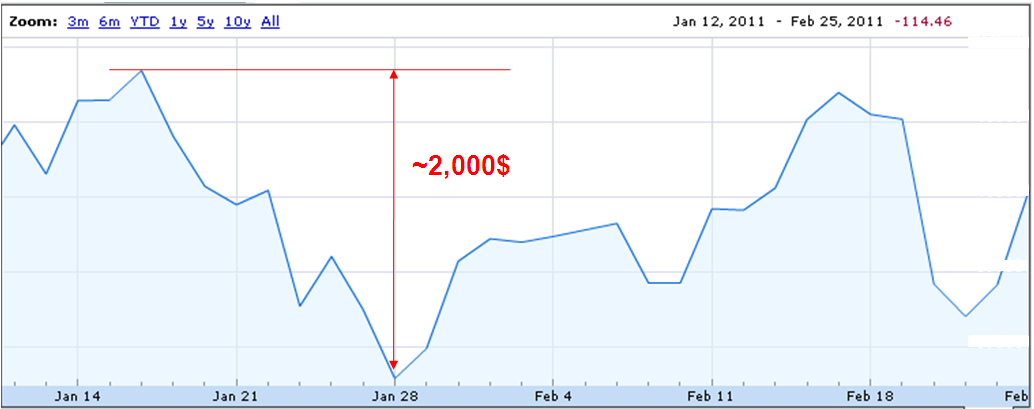
Since a picture is worth a thousand words, I wanted to share a snapshot of the swings of our “J&L” ( 😉 ) portfolio in the past few weeks. One could read the picture as “you have lost 114$ in the past weeks”. That same person on January 28th would have said “you’ve lost 2,000$ in the last 10 days”.

"Resist the human bias to act", Charlie T. Munger

In fact we have not lost a nickel in these weeks, since we haven’t sold any stock. I love a quote from Charlie T. Munger, Berkshire Hathaway vice chairman, which goes: “Resist the natural human bias to act”.

You actually don’t need to buy or sell stock when the market is in the mood. It is as easy as not doing it. You may buy only when you see a margin of safety and sell only when the stock has reached what you considered it to be at its intrinsic value.

You can see that in these 5 weeks we could have lost up to 2,000$ twice; we didn’t. The only tools we counted with: patience and not “listening to Mr. Market”.

Precisely today, it is published the letter of Warren Buffett to Berkshire shareholders. Whether you are planning to invest in stocks or only want to have a fun read, take a look at it.

2 Comments

Filed under Investing

The Snowball, Warren Buffett bio (book review)

Last Christmas, my brother gave me “The Snowball: Warren Buffett and the Business of Life“, by Alice Schroeder. He completely hit on the spot, though I only started reading it during last August holidays (Luca also started reading it to the point that she ended up buying her own Kindle version of it!).

The book is a thorough review of Buffett’s life, including relationships with family & friends and investment decisions. I had previously read other books about Buffett, but they were merely about his investment “strategy” so to say, nothing compared to this one. To complete the book, the author made over 250 interviews, so you can imagine the many insights contained in it.

There are many lessons or just ideas that can be taken from this book. Let me just point the few I can recall at the moment of writing this post:

  • The Inner Scorecard: the idea of acting and valuing yourself according to what you care about and not according to what others’ deem important.
  • The concept of margin of safety: from Benjamin Graham (recommended reading “The Intelligent Investor“).
  • Circle of competence: the idea of looking for simple business that have an enduring competitive advantage (technology companies are not that simple).
  • Cigar butts: companies which are worth more “death than alive” (looking for cheap price to book).
  • Snowball: the idea that compounding interest acts as a snowball falling down the hill, the sooner you start the larger the ball will be down the road (thinking about retirement here).
  • The story of the genie: or that you should invest in your own health as your body is the only one you are going to be given in this life.
  • The Ovarian lottery and the idea that philanthropy achieves more if exercised now and trying to maximize its impact.

Throughout the book you get to learn about many great entrepreneurial characters (e.g. Rose Blumkin, Bill Gates); about the workings of the board of directors of some companies (e.g. Coca Cola, Berkshire Hathaway); about some of the most impressive falls in corporate history (e.g. Solomon Brothers, Long Term Capital Management); about several depressions, recessions and crisis; and above all you learn about what were the thoughts and calculations behind some of Buffett’s investments decisions since the early 1940’s to date.

I definitely recommend this book (700+ pgs.).

5 Comments

Filed under Books, Investing

Ethical Banking

I attended yesterday a conference by Joan Melé at EOI Business School. It caught my interest by its title Dinero y conciencia: ¿A quién sirve mi dinero? (Money and conscience, who benefits from my money?), even though I didn’t know the presenter nor the bank he works for.

I want to make some reflections of yesterday’s experience:

  • The first one as a Toastmasters member: I applaud the decision of the speaker to stand up, not using notes or a power point presentation and managing to get the focus of the audience on him and his message for over an hour and half… we witness many conferences in which the experience is not so enjoyable.
  • The next reflection is to praise the move by EOI Business School towards web 2.0 made some months ago. As an alumnus of the school I must say that it’s very motivating to see the number of activities organized, the topics covered and it’s very convenient the way they are publicized in the different channels: EOI web and blogs, Facebook, streaming TV channel, Twitter… and because of that, because you can actually watch the whole of the conference or catch a glimpse of the main messages, I will just add very few ideas that I took for reflection and some sources the presenter cited.

Regarding money itself, the speaker structured his speech in the three main uses of money: to buy, to save and to donate.

  • When buying: he proposed the exercise of thinking “what”, “why” and “where” to see how our purchasing decisions affect others (low wages, pollution, exploitation…). He made the case for an economy based not so much in consumption of material things but cultural and intellectual ones: e.g. we happily pay 30 euro for a dinner, would be pay the same to be read poetry?
  • Regarding saving he noted the positive side of it: planning for future expenses. The other side of the coin being “fear of the day of tomorrow”: what will happen that we won’t be able to face? Nothing: Whatever comes, we will be able to face it. This reminds me to Charlie Munger comment on Berkshire Hathaway shareholders meeting when he said that he became comfortable […] after he realized he could survive hardship, “Maybe you should get your feet wet with a little more failure”. We lack some entrepreneurship…
  • The speaker did not want to go in deep about donating, except pointing that handing large inheritances to offspring can be more harmful than positive to them and society.

Some ideas to take away:

  • There are no leaders to solve our problems; it’s the turn of civil society to take action. It’s the time for the Globalisation of conscience.
  • The responsibility for what happens around us is ours, we need to first change ourselves.
  • We are the crisis of 3 billion people since dozens of years ago.
  • Need to bring back the role of banks as agents that relate people: savers with entrepreneurs in order to create wealth with profits as a by-product not as the one and only end.
  • Need to start and epidemic of courage and enthusiasm.

Finally, some reports, articles and documentaries he cited:

One final quote from Charlie Munger to end this post: “The secret to happiness is to lower your expectations.”

4 Comments

Filed under Books, Helping others, Investing, Movies, Toastmasters, Twitter & Media

Not just another letter

Last Saturday Warren Buffet’s letter to the shareholders of Berkshire Hathaway was released.

I encourage you to read it. In the best case it will raise some interest for this guy within you, and that may be translated in further readings and wiser investments decisions. If it doesn’t go that far, it’ll provide some fun reading. Let me give you some hints of this year’s letter:

“An old Wall Street joke gets close to our experience:

  • Customer: Thanks for putting me in XYZ stock at 5. I hear it’s up to 18.
  • Broker: Yes, and that’s just the beginning. In fact, the company is doing so well now, that it’s an even better buy at 18 than it was when you made your purchase.
  • Customer: Damn, I knew I should have waited.”

“If Charlie, I and Ajit are ever in a sinking boat – and you can only save one of us – swim to Ajit.”

“GEICO’s managers, it should be emphasized, were never enthusiastic about my idea. They warned me that instead of getting the cream of GEICO’s customers we would get the – – – – – well, let’s call it the non-cream. I subtly indicated that I was older and wiser.

I was just older.”

“It’s clear that I failed you in letting NetJets descend into this condition. But, luckily, I have been bailed out.”

“Big opportunities come infrequently. When it’s raining gold, reach for a bucket, not a thimble.”

“Charlie and I enjoy issuing Berkshire stock about as much as we relish prepping for a colonoscopy.”

“If you decide to leave during the day’s question periods, please do so while Charlie is talking. (Act fast; he can be terse.)”

“If pushed, we would gladly pay substantial sums to have our jobs (but don’t tell the Comp Committee).”

It’s only 19 pages…

4 Comments

Filed under Investing