Tag Archives: running

Musings on objectives setting

A few days ago, I had a short Twitter exchange with a couple of friends on  objectives. Sara mentioned that she was not setting objectives for the New Year. Nacho made a point of my objective tracking approach, which I detailed in a post in the blog back in 2011 (Personal mid-year review). Unfortunately (or fortunately) I do not follow such a thorough approach anymore (1), though I do set myself some personal yearly objectives, have them noted down, track them, etc.

In that post from 2011, I made reference to a previous post in which I commented on a HBR study and a post post by Sid Savara. The main takeaways from those readings were: have the goals in written, have plans towards achieving them and share the objectives with someone (at least with someone you have confidence with, not necessarily with everyone!).

In this post I quickly wanted to share some examples of the objectives I set to myself (2):

  • Reading: as I mentioned in a previous post in which I shared a summary of (my) 2015, I set myself a minimum objective of reading 10 books a year. I do not read any book for the sake of meeting the objective. It is rather that I have dozens of very much dear books in the shelves waiting to be read and I keep buying (and grabbing from my parents’ home) books that I think would teach me something or add some value. Ideally, I would like to read about 2 books a month. That would make over 20 books in a year, however, during some periods along a year I read less often, I found that I am not that fast reader (in English and French and neither in Spanish!) nor all the books that I pick are that easy or short, so I linger every year around the 10 books. Do I share the objective? Up to now, not explicitly, though I force myself to write at least a yearly post commenting the books I have read… thus, I do have to read them! Follow up: it is not very structured, though I know at any moment the books I have read along the year (I keep a record) and every now and then make some numbers of pages to be read per day, per week, in order to complete this or that book at a given point in time.
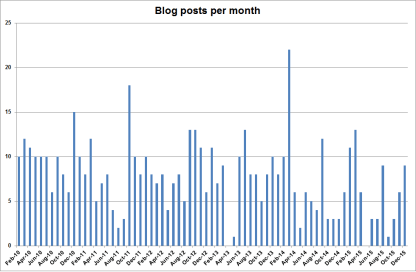
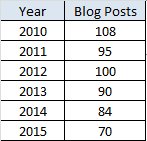
  • Writing: here I always remember a tip from Conor Neill, a professor at IESE, who says that we should strive to write something everyday, at least 500 words (see the blog post where he explains the benefits of doing so, Writing to reflect. Mindful leadership). In my case, apart from job emails, files, presentations…, I do not write (and reflect on) for this blog (or any other format) on personal interests everyday. Ever since I started the blog, back in February 2010, I intended to write regularly. What does that mean? Initially I aimed at publishing 8 posts per month, I lowered this target lately to about 6 posts per month. That would make about 70 a year. In 2015 I just met that target. Previously I had always been above 80 posts. See below the monthly production.

Blog post per month

Blog post per year

  • Speaking: on this front I was very consistent when I joined Toastmasters in December 2007, trying to give a public speech every two months. I kept being quite engaged until more or less mid 2012. I then dropped Toastmasters until I re-engaged myself in mid 2014 at the corporate club of Airbus in Toulouse. I am now trying to figure out the pace at which the club attendance allows and I am able to prepare myself to speak often (by speaking I refer to giving prepared speeches, as every two weeks in the club almost everyone gets to speak either with a role of evaluator, in table topics, etc). Thus, a vague objective (speaking regularly), not quantified, not yet in written, though shared.
  • Flying: for this objective scheduling is key. As I mentioned in the post where I shared my path to the private pilot license (PPL), it took me 4 years to obtain it mainly due to the difficulty in finding slots. From March 2015 (once I had passed the theoretical exam) I was more rigorous, always trying to have at least two slots scheduled with the instructor and airplanes booked at any point in time. This enabled that, even if many slots had to be cancelled due to weather conditions (or any other issue), I was more regular with the flying, I managed to obtain the license and fly over 19 hours. For the 2016, the goal is clear: to fulfil the requirements to maintain the license, that is 12 flight hours with 6 take offs and landings in the last 6 months prior to the license expiry date. On top of that, in order to carry passengers it is required to have completed 3 take offs and landings in the previous 90 days. Thus, the requirements by law help you in aiming at flying often. On the other hand, I was trained to fly on Robin DR 400 airplanes and another objective I have is to learn to fly another model, Diamond DA20 in order to have more flexibility with the scheduling of airplanes and be able to fly oftenhow often is often? At least a flight per month (ideally 2), about 2 flight hours a month… this objective, then, is well followed up with the aeroclub scheduling tools, navigation logs, etc.
  • Running: with the running I have many and varied objectives. From running (e.g.) 2,000 km in a year, to completing at least 2 marathons a year, to beating personal best times (PBs) in different distances (10k, half marathon and marathon), to other miscellanea objectives (e.g. running x days in a given week, y kilometres in a given week or month, running some special race, running a number of days while on holidays…). For the completion of marathons and aiming at PBs I do schedule training plans at the online tool provided by Garmin (the provider of the GPS watch I use). Thus, the objectives are clearly defined, shared (with Luca, colleagues, in social media) and well followed up.

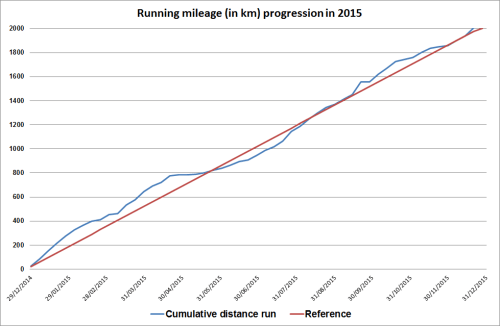
And it is here that I wanted to stress on the definition of the goal, its writing and its sharing. I will take the objective “running 2,000 km”. In 2014 I started to publish online in Twitter regularly both the goal and how I was progressing.

With the online tool I have the objective clearly written down and tracked, I know whether I am ahead or behind, the weekly or monthly mileage needed to attain the goal, etc. The sharing of the goal in my inner circles helps with the finding slots to run. The sharing of the goal more widely encourages and pushes oneself. See below how I reached the objective in 2015. You can see that while the training towards Seville (February) and Madrid (April) marathons lasted I was well ahead the reference. After those marathons took place I fell behind, even if I only fully stopped for a week after Madrid marathon. I kept running below the reference weekly mileage until the end of June, when I was 70km behind… I then subscribed for Millau (September) and started building up mileage for it, then extended the training up to Toulouse marathon (October), stopped only 3 days after it and, since then, I always was around or over the reference to attain the goal (even if I had to stop for over a week at the end of November due to a cold that got me down with severe throat ache).

Running mileage 2015 progression

***

It is clear that each one has a different approach and there is not a single one that fits us all. Many will not want to be constrained by fixed goals, nor be reminded of them by having them written, even less sharing some goal they are unsure to meet, not to talk about publishing it on social media! This is just how I go about trying to meet some personal objectives.

(1) At least not for every objective and plotting a global indicator.

(2) These goals are easy to share others are kept in the inner circles.

1 Comment

Filed under Personal development & HR

San Silvestre 2015

Fifteenth participation (1) in the popular San Silvestre Vallecana on New Year’s Eve.

The team this time was composed by some 8 friends (Nacho, me, Pablo, Maicol, Carlos, Sara, Jaime and Alicia):

https://twitter.com/soler_bravo/status/682661492689342464

This year, we finished the race with a sprint over the last 200 meters, after having been joking about it all along the race. Even with that last rush, we added some more seconds to our record: this year it took us 1h12’17” to complete the 10km.

The time in this race is the less important aspect of it. As always, it is a pleasure to share a run through the centre of our home town with friends to give a healthy, funny and colorful farewell to the year. Be sure that next year we’ll be there to laugh, jog and beat our time!

(1) I took part in it for the first time in 1998, when less than 5,000 raced in it, and have always participated (not always inscribed though) except for 3 years (twice I spent New Year’s Eve in the Netherlands and other time I was injured).

Leave a comment

Filed under Sports

Toulouse marathon (2015)

Last October 25th, I ran the Toulouse marathon. It was the second time I completed this race; the first one being in 2011, then the first marathon I had run since 2001.

This year, like in 2011, I ran the Toulouse marathon after having run the 100 km of Millau one month before. In fact, I only decided to take part in it 2 months before the race. The main driver: within the programme I am working on in Airbus since July (A330neo), the marathon of Toulouse had been taken as a big collective well-being activity. Over 80 people from different teams ran the race; which can be completed in relays (teams of 4 runners where each one runs about 10km) (1) and individually.

At the end of August, running about 50 kilometres per week as training for Millau, even if not doing tempo and series training sessions, I decided that I could fairly run the Toulouse marathon after Millau, if I sustained no major injuries and did not care much about the time. So I subscribed.

The day before the marathon we had a photo session, distribution of A330neo t-shirts especially made for the occasion and the traditional pasta party on the eve of marathons. This one was a somewhat elegant dinner, consisting of buffet with different salad, pasta and desert options, organized at the top floor of the Mediatheque in Toulouse, with live performance of a flamenco group.

The race itself went rather well. In the weeks beforehand, I had been considering the starting pace: whether to go for a 5’20” per km or faster. The first pace leads to a marathon of about 3h45′ (a time around which I had already completed some and was comfortable with). After some testing training sessions I decided to be conservative and go with the 3h45′ pacers as long as I could keep up with them.

… and so I did until the kilometre 35. It was therefore a rather pleasant race. Always keeping myself to the rhythm set by the pacers, enjoying the route along the far North neighbourhoods of Toulouse, the music bands, etc. Entering back to the centre of the city, at about the km 33 I started to feel that the pace took more effort to keep and at the km 35 I decided to let go, and run the last 7 km, through the centre (the boulevards, the Jardin de plants, Alsace – Lorraine…) at a more comfortable pace. I estimated that in those last 7 kilometres I would not lose much more than a couple of minutes, that would not make any difference (it wouldn’t anyway be my best time nor the second in the distance).

Pace followed during the race.

Pace followed during the race.

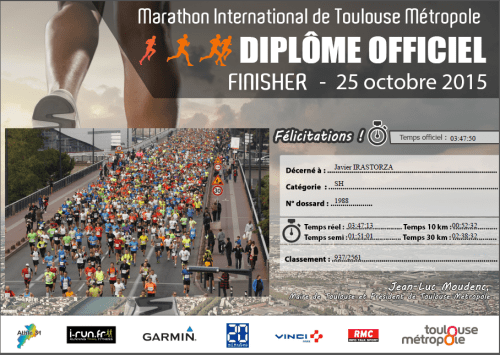
In the end I completed the marathon in 3h47’13”, my fifth best time, the 4th time I finished in the time bracket between 3h44’30” and 3h47’13”. Thirteenth marathon completed (2).

Finisher diplome.

Finisher diploma.

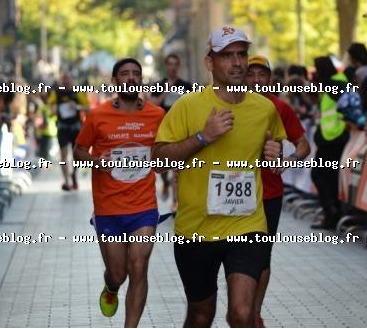
Find below pictures of myself and of the A330neo team:
TLS

EVE-957-03-20151025-AT-MARATHON DE TOULOUSE-158

(1) I took that option of running the marathon in relay in the year 2013 as a preparation towards Athens marathon.

(2) See all the others in the section Races from the blog.

2 Comments

Filed under Sports

Running a 10k a week before a marathon

A couple of months ago I discovered that there was a short race, 10km du Stade Toulousain, that was going to take place close to home. I decided to take part in it. Normally I have to travel or wake up early to arrive at the place where a race starts. This time I could stay longer in bed and I would go jogging from home. I could not skip this chance.

However, the date of the race was not the most suitable. It was just a week before Toulouse marathon. On top of it, I had run the 100km de Millau 3 weeks before, and in the following 4 weeks I was trying to train for the marathon and get an idea of how fit I was in order to see at what pace should I run it.

In races of 10km I normally try to run all out to see what is the best time I can achieve. In 2014 I collected some personal bests in the distance and several times under 45′. However, I knew I was slower from mid 2015, as the couple of 10k I run in June and July were in the range of 46 to 48 minutes.

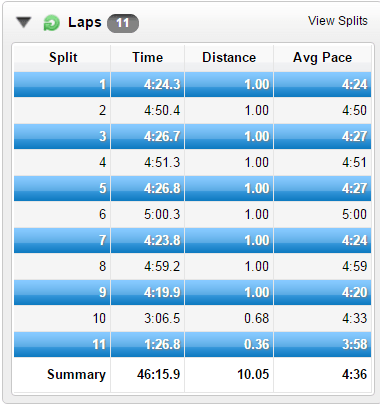
Reading online in some forums I found people both in favor and against running a 10k all out just a week before a marathon. I found also an interesting idea: take it as a series training. The poster suggested to run it alternating 1 mile at marathon pace with 1 mile all out, 3 times. I found this idea interesting and decided to do something like that. I would run the 10k alternating kilometers running at all out and marathon pace (however, the latter ones I ran them faster than my best time in marathon… and faster than the intended pace for Toulouse marathon).

It was a good experience. I thought that it would take me more effort to go each time all out and also to not relax completely but to keep a good pace in between those all out kilometres.

I did the fast kilometres at in between 4’20” and 4’27”. The last half kilometre at below 4′ pace.

I did the slow kilometres at in between 4’50” and 5’00”. The previous to the last half kilometre at 4’33” pace.

[My best time in a 10k was at a pace of 4’24”]

[My best time in a marathon was at a pace of 5’04”]

Splits during the race.

Splits during the race.

Apart from the running experience, it was strange to overtake and be overtaken by the same runners once and again. I would pass them along the third kilometre, they would overtake me along the fourth, and so on… as the race advanced some of the runners I exchanged positions with during the race were not overtaking me anymore, until the last two kilometre, when I finished at a faster pace than the groups I had been running with.

Finally, we got a nice t-shirt with the logo the rugby club.

Leave a comment

Filed under Sports

100km of Millau (2015)

I had doubts I would ever put myself to the test of an ultra marathon or a 100km race again after having completed the “100km de Millau” in 2011.

Jose, whom I ran with that time, suggested at times to do another one. Manuel, with whom  I have trained often and now regularly runs ultra marathons, had often suggested to join him in one. My brother Jaime had also indicated that he would like to try once. I never go tempted by those calls…

… a couple of months ago, Manuel mentioned that he would run Millau and asked whether I was interested. I passed on the baton to Jaime, who almost immediately said yes. And thus, we subscribed ourselves to the race.
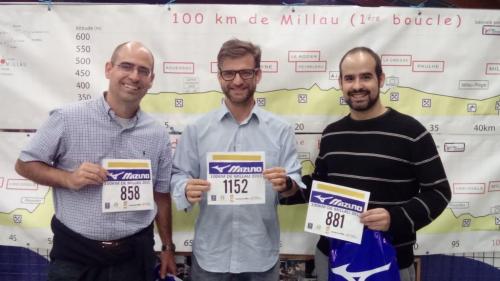
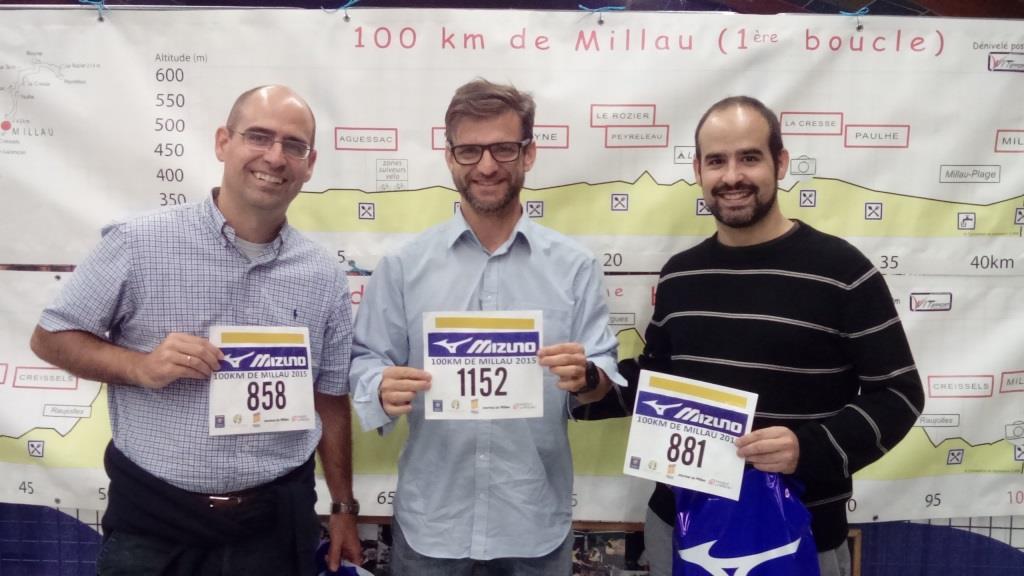
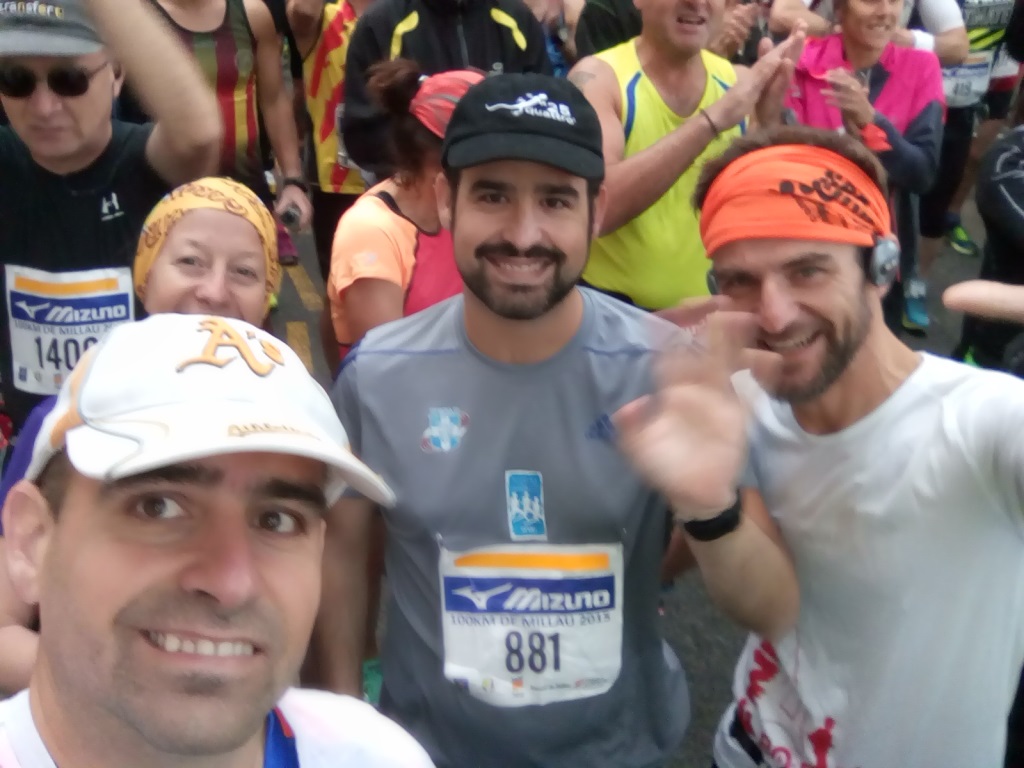
Running bibs the night before the race.
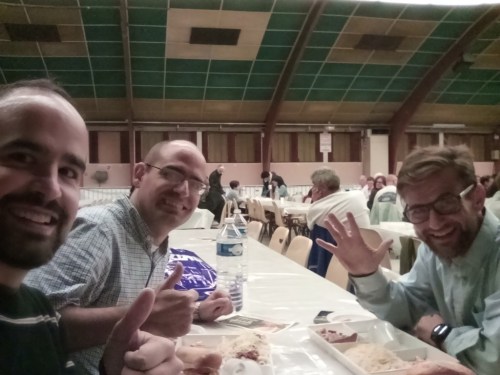
Running bibs the night before the race.

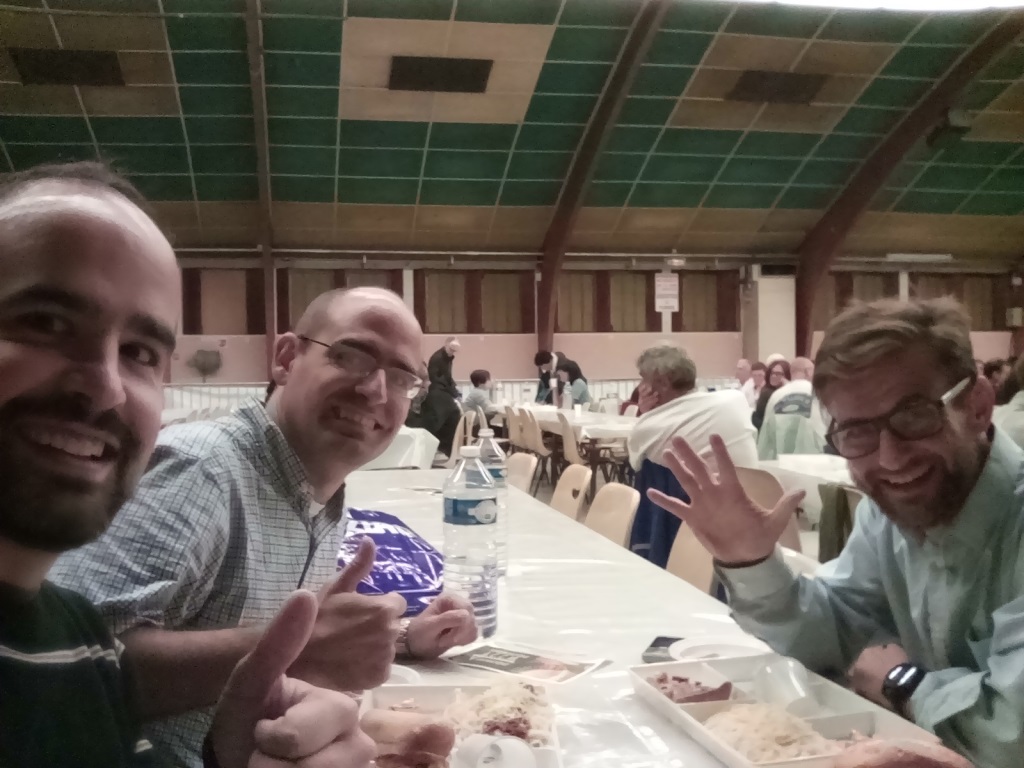
Pasta dinner the night before the race.

Pasta dinner the night before the race.

We didn’t specifically train for this race. Jaime didn’t almost find the time to train, except for the weekends. I took a look at some training plans and the amount of dedication required put me off. Thus, I decided to simply keep running a moderate mileage of between 40-60km per week on average and knowing that this would suffice to complete the marathon satisfactorily, go with that as training and rely on the mental side and experience for the rest.

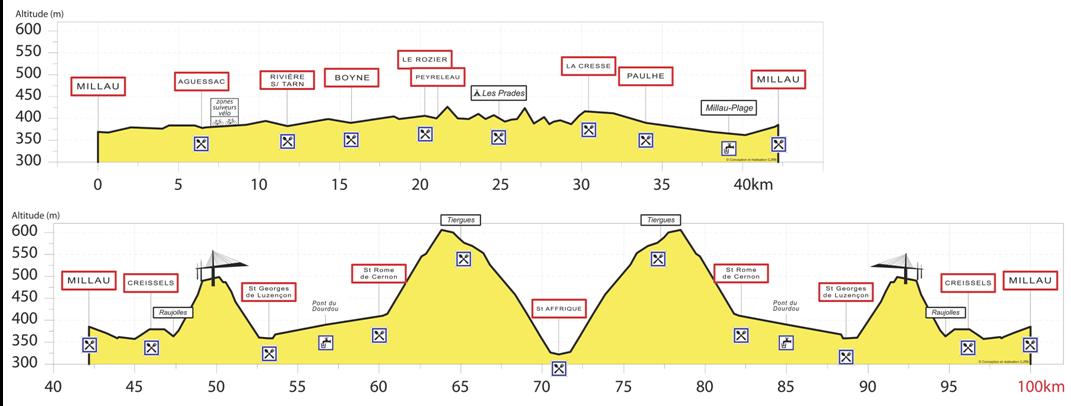
The circuit of the race and the profile remained unchanged from 2011. This helped a lot, as I remembered several parts of the race, profiles, etc. (1)
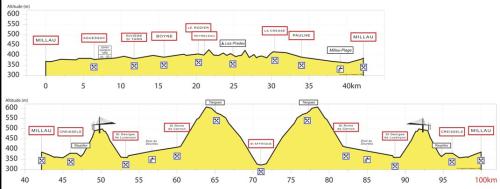
Perfil de la carrera.

Profile of the course.

Our race strategy was rather simple this time: run a marathon in a ~6:20 pace, aiming at about 4h30′, stopping briefly in the supply posts, reduce at least in half the time spent changing clothes and shoes in Millau (km 42) and Sainte Affrique (km 71)… and so we did. We basically followed it to the point.
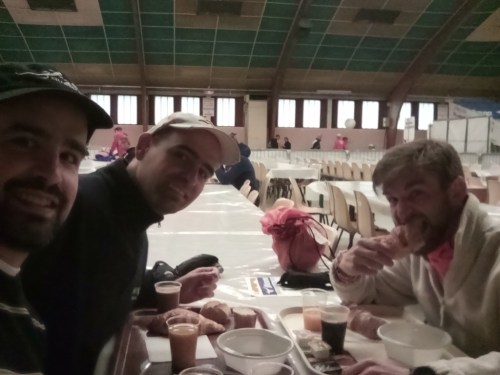
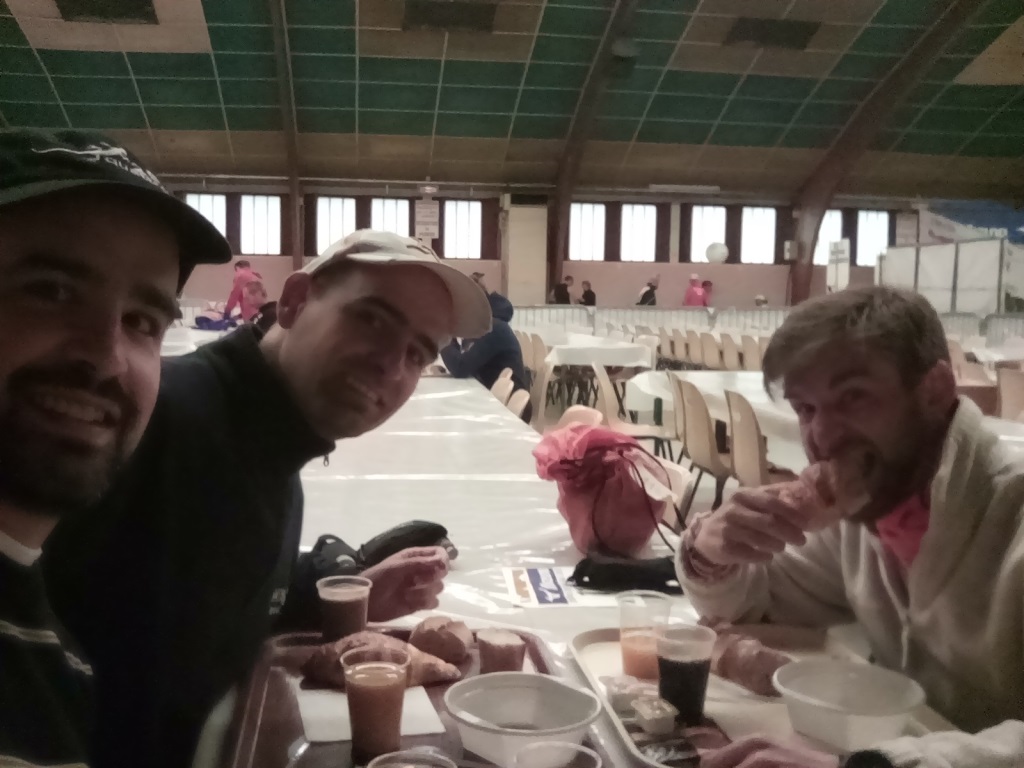
Breakfast the day of te race.
Breakfast the day of te race.

Leaving the hall towards the starting point.
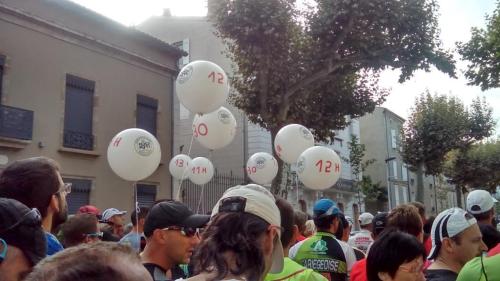
Leaving the hall towards the starting point.

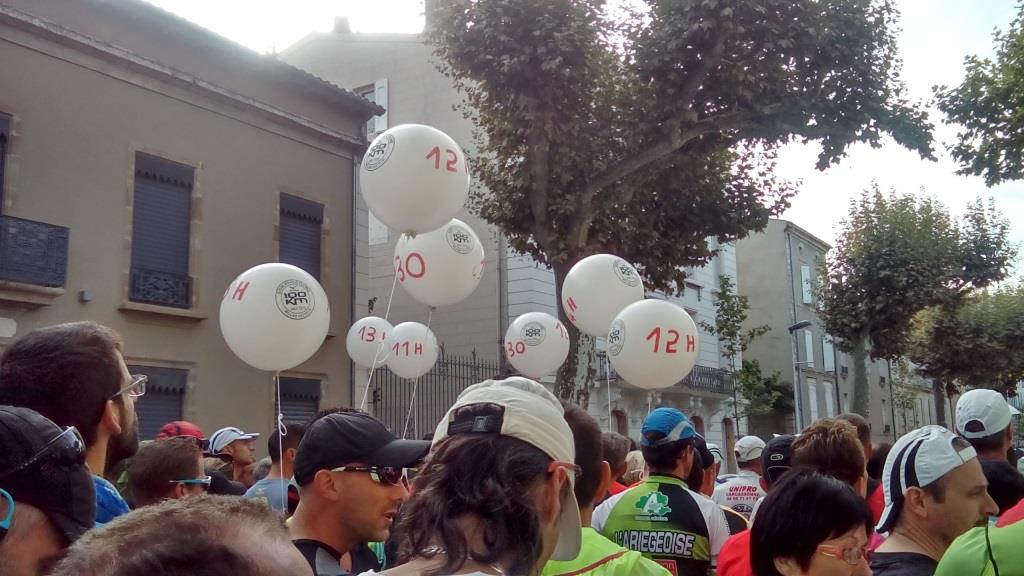
Which pacer do we follow?
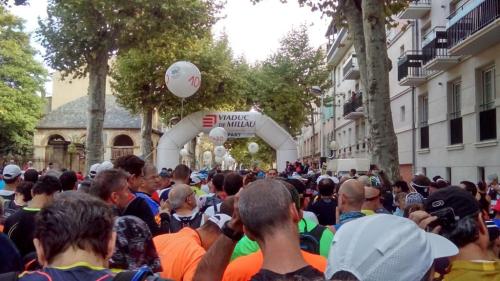
Which pacer do we follow?

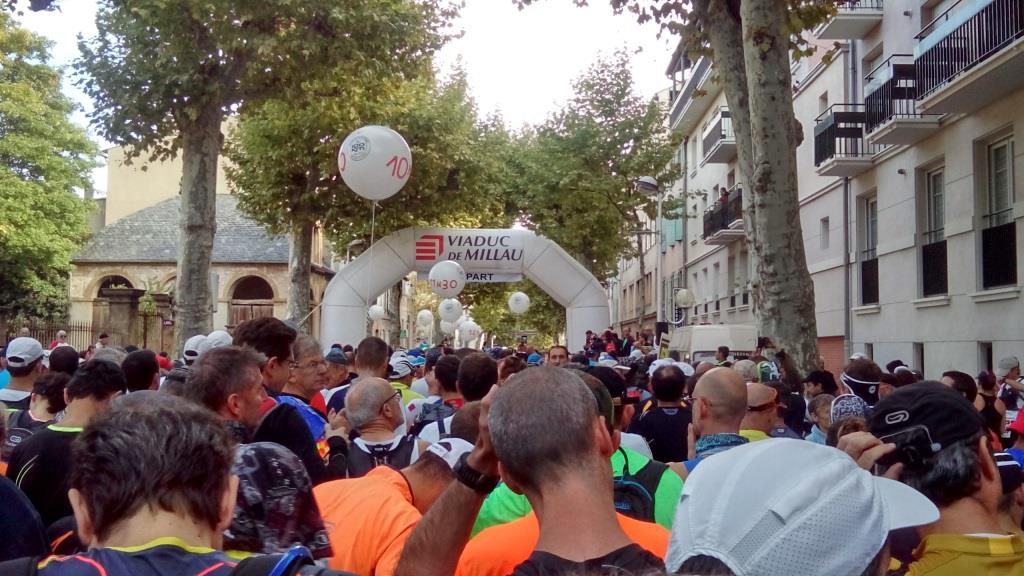
Departure line.
Departure line.

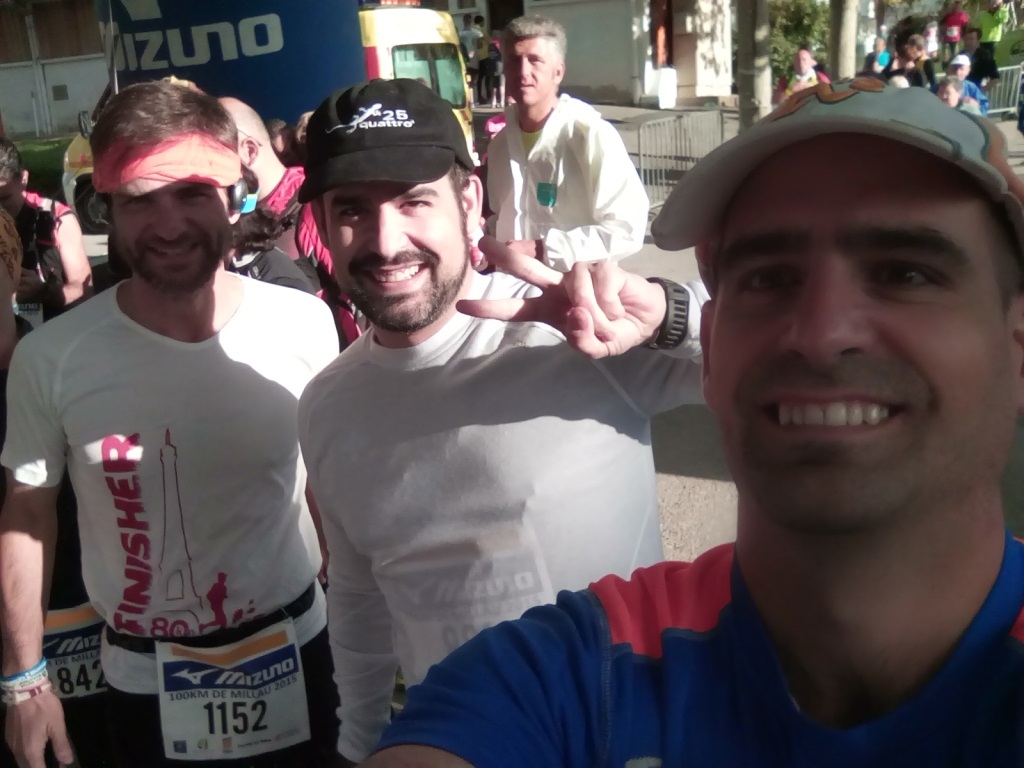
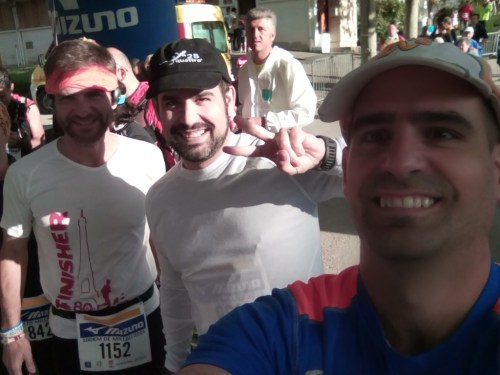
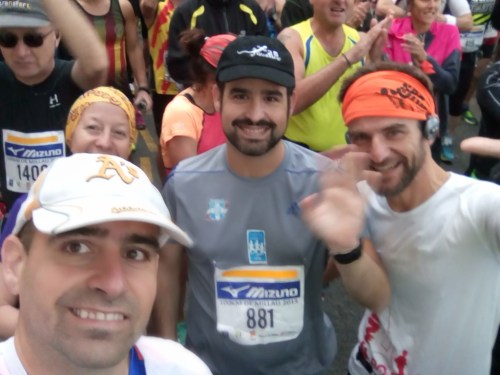
One last picture before we start running.

One last picture before we start running.

We started running at the intended pace. We first catched the 13h pacer, the 12h pacer, the 11h30 pacer… we knew we wouldn’t arrive with them but wondered why we were overtaking them. We asked their estimated arrival time at the marathon and it was slower than ours (though they wouldn’t stop then and would keep a faster pace in the second 58km than what we intended). So, after about 10km we went forward with our 6’20″/km rhythm.

When you see the profile of the complete race you may get the impression that the marathon runs along a flat profile. It certainly does  not. There are some spots, especially right after the half marathon, which are very demanding. We took them easily even if kept running in them. At about the km 28, we softened the pace to avoid meeting the Wall. And so we did. Again, running this marathon at a leisure pace was a great experience. In the end we spent some 14 minutes longer than planned (~4h42′), but the timing was good enough.

At Millau (km 42.195) we changed clothes, but kept the pause shorter than we did in 2011 (just less than 20′). Departing from Millau was difficult again: getting the muscles to work again after a little resting time. We needed to keep running for just about 5km until the first hard climb to pass under the viaduct. We did so. Even if I had some pain in the Achilles tendon when running uphill.
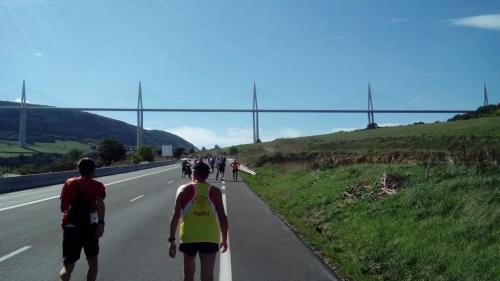
Km. 47, it is tough...

Km. 47, it is tough…

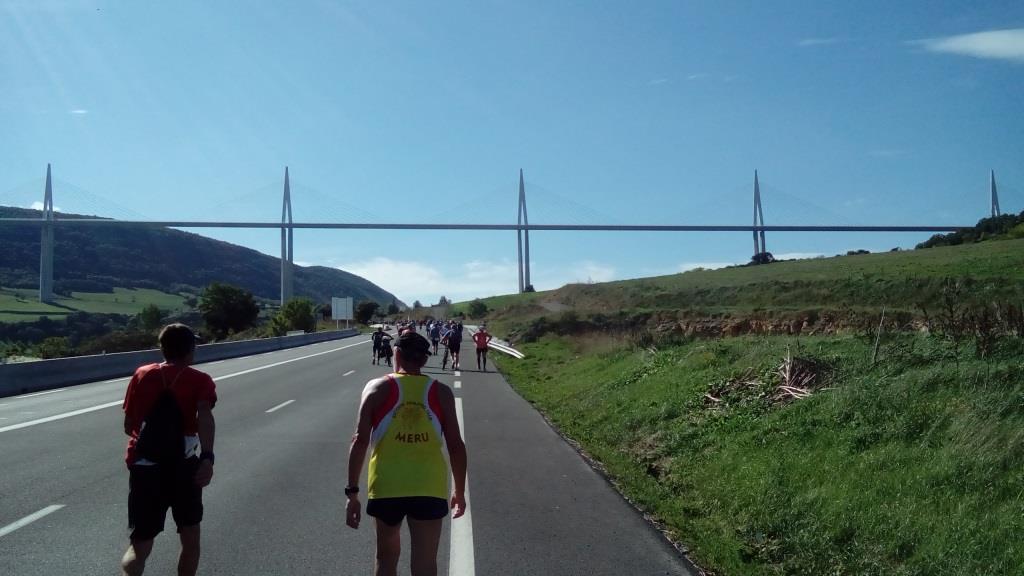
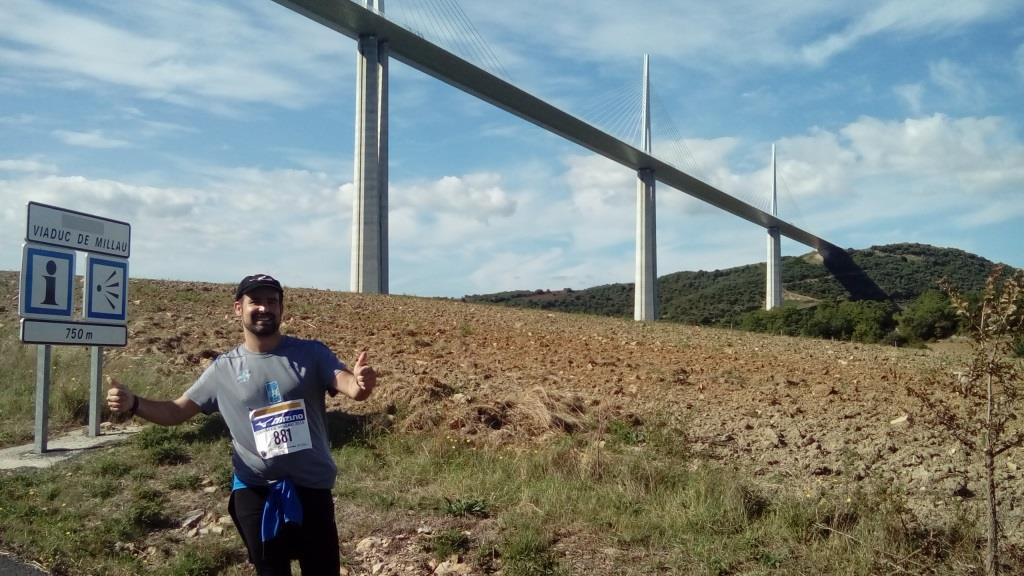
At the viaduct we took again some pictures, plus another at the 50km mark, even if changed to a smaller one (in comparison to 4 years ago). Descending towards St. Georges Luzencon we took a conservative pace as we did at the beginning of the false flat course towards St. Rome de Cernon. However, after some minutes of soft climb I felt again pain in the Achilles tendon and I had to walk at some stretches combining it with running.
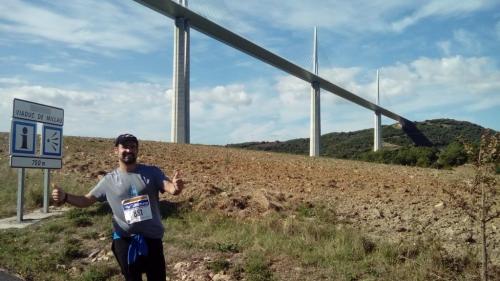
Highest viaduct in the World, definitely worth a picture.

Highest viaduct in the World, definitely worth a picture.

At St. Rome, we took a quick preventive massage. Followed by a good supplies ingestion. Funny enough, just leaving the village, I was still eating some bread with foie gras and drinking (both hands occupied) when some spectators cross checked my bib number with the local newspaper, found my name and started cheering me! I found it funny: being cheered for eating and drinking :-).

After St. Rome, it came the climb to Tiergues, which we walked up. In the descent from the top of the hill towards Tiergues itself (at km 65) we met Manuel who had some muscular troubles himself (but he nevertheless would finished in a very respectable time of 11h22′). After the supply post at Tiergues we continued running down to St. Affrique.

We arrived there with some 40-50′ in advance in relation to the timing we did in 2011. And again, we kept the stop in St. Affrique to the minimum time needed for changing clothes, eating and drinking. Another 20′ and we went. Started running just to the outskirts of the village before starting the long(est) climb back to Tiergues, about 7km. At the top we were about 1h10′ ahead of the time we did in 2011.

I remember one of the volunteers at Tiergues (ex km. 65, now km. 77) who was continuously making jokes to runners, very loudly, all other volunteers laughing with him. I told my brother that I wouldn’t have minded to stay there partying with them. However, after a few minutes of eating (some hot soup) and drinking (some beer) we re-started running to complete the uphill climb and the downhill descent back to St. Rome.

Once you start the descent to St. Rome you know you have made it. You’re about a half marathon from it. 22km. In the (almost) worst of the cases you can slowly walk them to the end and it would take you a mere 5 extra hours… so what? But then you run and it takes half of it.

At St. Rome I needed some attention from the podiatrist to heal a blister. It did more bad than good, as instead of just removing the liquid and drying it out, she introduced some other disinfectant liquid which kept the pressure and left me in pain for a couple of days.

From St. Rome we had another gentle descent down to St. Georges. At mid-way point (Pont du Dourdou) there was the supply post in which the play rather loud and very animated music, a kind of discotheque. I would not have minded to stay there either for the remainder of the night. But we still had 15km to go. At the time I was already making numbers knowing that we wouldn’t finish under 14h but confident that we would under 15h.

We kept running down to St. Georges where we stopped to take some more soup, coke… one more kilometer and up again to the viaduct, walking again. Once you run under the viaduct on the way back you’re less than 8km to go. It – is – done. At the descent down to Raujolles we noticed the sign post with the 8% descent (meaning that from km. 47 you had a nice 2km-long 8% climb!).

By then we had been over taking runners and walkers for some time. Some of whom were not stopping at supply posts and would overtake us during those pauses. At Creissels we took the last bit of soup, chocolate and water. And there we went down to Millau. Again, to Millau. Millau.

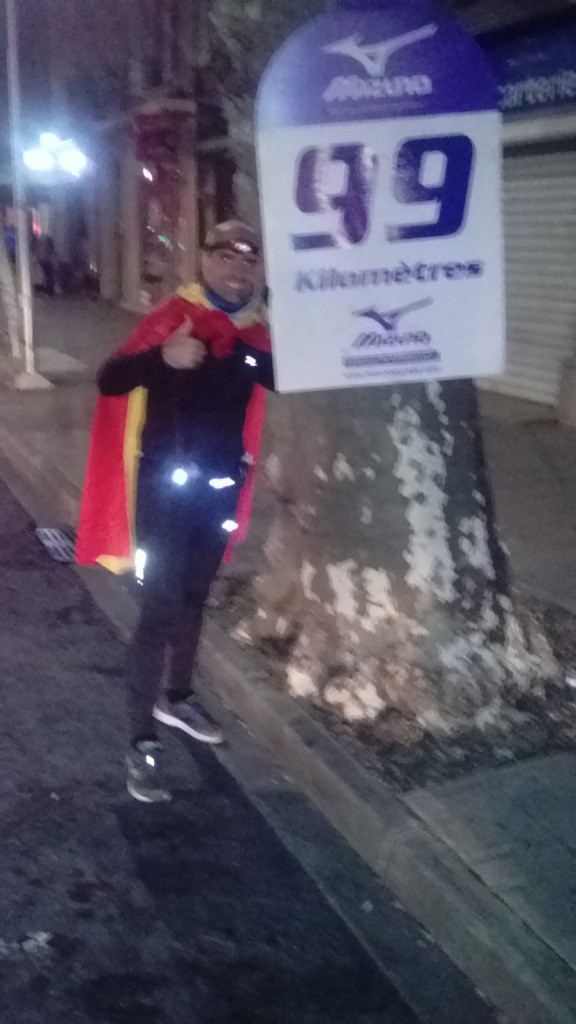
The bridge crossing the river Tarn in the entrance of the city is at about the 98th kilometer. This time again, I put then on the Spanish flag to complete the last two kilometers with it. We again took some pictures at the emblematic sign post at the km. 99 in the streets of Millau.
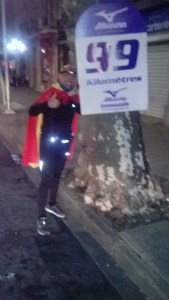
DSC_0177

Posing by the km. 99 sign post.

We kept running in the Avenue de la Republique afterwards called Charles de Gaulle, we then entered the Parc de la Victoire and again we sprinted to climb the metallic structure allowing us to enter into the Salle de fetes de Millau, crossing the finish line in 14h39’21”.

Four years later, again, objective accomplished. The 100km of Millau completed. Another ultra marathon finished.
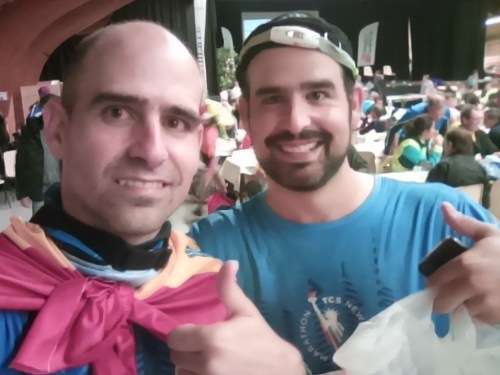
Mission accomplished!

Mission accomplished!

This time we employed some 35′ less than the previous time. We basically reduced the time spent in long pauses, we ran a faster marathon and needed less medical assistance. However, we ran slower the last 22km (we consumed there some 35′ more, or half of the time-cushion we had at Tiergues).

This time, for me it was very much less mentally demanding. I remember that in 2011 I had many doubts at some points. If Jose had not been there, I may had dropped it between km 60 and 71. This time I didn’t have any doubt. I was cheering my brother and myself from km. 25 every now and then. Knowing that we would make it. Again, no matter the time.

The following days, again, I had a terrible pain in the legs, similar to those you may have after the first marathon you run (especially if not well trained, as it was my case back in 2000). However, after a week I could start running and training again. A much better recovery than 4 years ago, when I suffered from a serious tendonitis.

I don’t know if I will run another time in Millau, or even another ultra, but this time, yes, I felt comfortable with knowing that it was manageable and that if needed, it can be done yet another time.

(1) It also helped that I had written a detailed post about it in this blog, to which I came back for references.
5 Comments

Filed under France, Sports

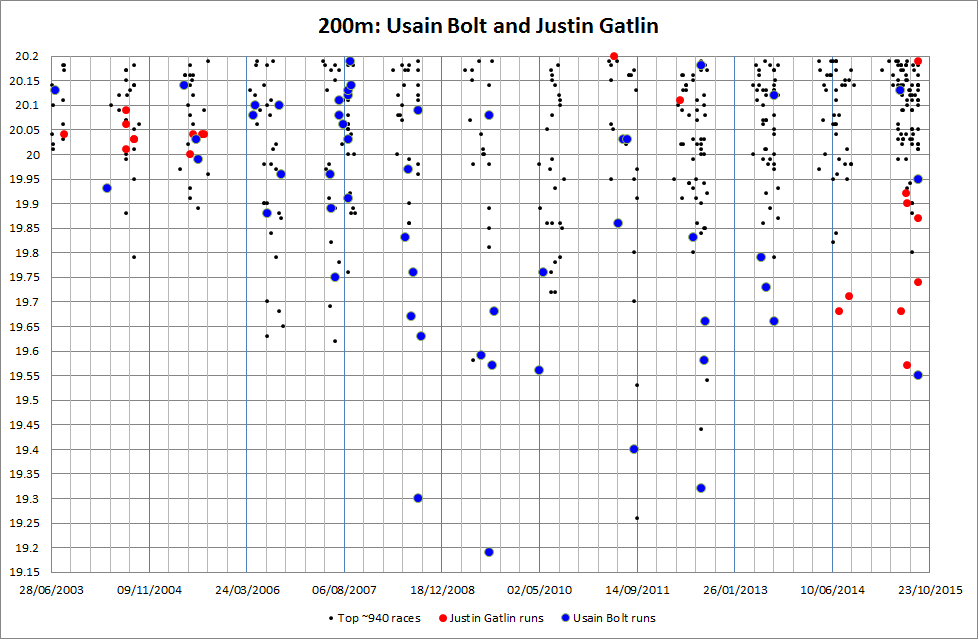
Usain Bolt and Justin Gatlin; 100m and 200m

In the previous two posts I compared Usain Bolt and Carl Lewis as 100m and 200m sprinters. For that comparison I used as a source a website with all time best performances in track and field (maintained by Peter Larsson). I will use the same source to make a more relevant comparison nowadays: Usain Bolt and Justlin Gatlin, both in 100m and 200m.

Best ever ~800 100m times, focus on Usain Bolt and Justin Gatlin.

Best ever ~800 100m times, focus on Usain Bolt and Justin Gatlin.

Best ever ~950 200m times, focus on Usain Bolt and Justin Gatlin.

Best ever ~950 200m times, focus on Usain Bolt and Justin Gatlin.

You can see in both graphics why there was so much attention in the races of this summer Beijing World Championship and expectation with the possibility of Bolt being defeated by Gatlin. 2014 wasn’t a good year for Bolt due to injuries. Gatlin ran more often and faster that year. The year of 2015 had started in the same way, with Gatlin running more often and faster, to the point of beating his personal bests in both 100m and 200m (twice).

  • The best 5 times in 100m of the year belong to Gatlin, yet the 6th best time made Bolt the World Champion.
  • Of the best 4 times in 200m of the year, 3 belong to Gatlin, yet the Bolt managed the best time (better than Gatlin’s personal best) on the final and that made Bolt the World Champion.

Note: the times included here exclude wind-aided races and times excluded due to doping.

Leave a comment

Filed under Sports

200m: Usain Bolt and Carl Lewis

Usain Bolt has recently won the gold medal in the 200m of Beijing Athletics World Championships, with a time of 19.55″, that is the 10th best ever time.

In the previous two posts, I wanted to highlight the size of the figure of Carl Lewis as a long jump athlete (here) and to compare both Usain Bolt and Carl Lewis as 100m sprinters (here). I want to recap here the following two graphics:

Best ever ~180 long jumps, focus on Carl Lewis.

Best ever ~180 long jumps, focus on Carl Lewis.

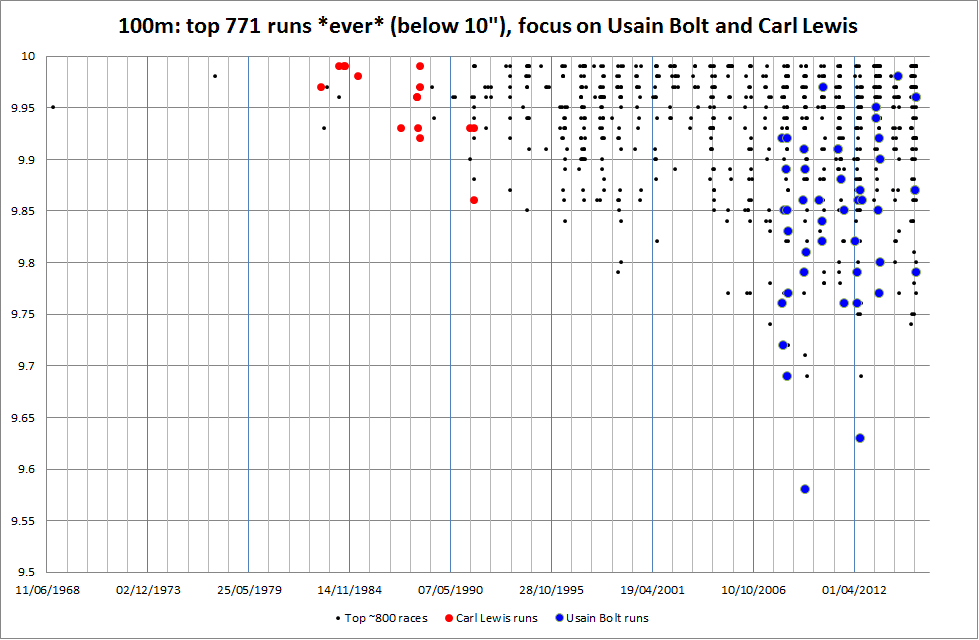
Best ever ~800 100m times, focus on Carl Lewis and Usain Bolt.

Best ever ~800 100m times, focus on Carl Lewis and Usain Bolt.

Recall the following lines from those two posts, on the long jump:

Now, in 2015, 18 years later, of the best 184 long jumps ever (all those at or above 8.50m), 55 of those jumps (a 30%) correspond to Carl Lewis. I let you to qualify the feat.

The runs (100m and 200m) Carl Lewis did in the 80s would probably not win him any gold medal today; his jumps would still win him almost everygold medal today.

On the dash 100m:

[…] on all the times a runner has *ever* finished the 100m below 9″90, 187 times. Of those,

  • 32 times correspond to Usain Bolt (17%), and
  • just 1 to Carl Lewis.

In this post, I want to compare Usain Bolt and Carl Lewis as 200m sprinters. I will use as a source again the website with all time best performances in track and field (maintained by Peter Larsson).

Best ever ~950 200m times, focus on Carl Lewis and Usain Bolt.

Best ever ~950 200m times, focus on Carl Lewis and Usain Bolt.

In the previous graph you can notice that times in the 200m have significantly improved since the 80s and 90s. Usain Bolt is today way faster than Carl Lewis was in the 80s.

If we want to focus not on the best ~950 times, but in a similar amount of marks as in the long jump and the 100m above, we can just focus on all the times a runner has *ever* finished the 200m below 19.95, 190 times. Of those,

  • 26 times correspond to Usain Bolt (14%), and
  • just 7 to Carl Lewis (4%).

Compare that 14% of best times of Usain Bolt in the 200m with the 17% in the 100m. Despite his telling that the 200m is his preferred distance, his dominance of the 100m has been even greater. Anyway, compare that to the 30% of long jumps today (while he retired 18 years ago) of best long jumps of Carl Lewis.

In relation to Lewis, he retains 7 of the best 190 200m times (4%) while only 1 of the best 184 100m times… who would have suspected that? We tend to remember Lewis as more of a 100m sprinter and Bolt more of a 200m…

… and it seems that Lewis was first a jumper, then a 200m sprinter (despite of never holding the world record of any of those) and then a 100m sprinter. Whereas it seems that Bolt is a more distinguished 100m sprinter despite of what he likes best.

2 Comments

Filed under Sports

100m: Usain Bolt and Carl Lewis

Usain Bolt has recently won the gold medal in the 100m of Beijing Athletics World Championships, with a time of 9″79, that is the 34th best ever time.

In the previous post, I wanted to highlight the size of the figure of Carl Lewis as an athlete, but a long jump athlete. I want to recap here the following graphic:

Best ever ~180 long jumps, focus on Carl Lewis.

Best ever ~180 long jumps, focus on Carl Lewis.

Recall the following lines from that post:

Now, in 2015, 18 years later, of the best 184 long jumps ever (all those at or above 8.50m), 55 of those jumps (a 30%) correspond to Carl Lewis. I let you to qualify the feat.

The runs (100m and 200m) Carl Lewis did in the 80s would probably not win him any gold medal today; his jumps would still win him almost every gold medal today.

In this post, I want to compare Usain Bolt and Carl Lewis as 100m sprinters. I will use as a source again the website with all time best performances in track and field (maintained by Peter Larsson).

Best ever ~800 100m times, focus on Carl Lewis and Usain Bolt.

Best ever ~800 100m times, focus on Carl Lewis and Usain Bolt.

In the previous graph you can notice that times in the 100m have significantly improved since the 80s. Usain Bolt is today way faster than Carl Lewis was in the 80s.

If we want to focus not on the best ~800 times, but in a similar amount of marks as in the long jump above, we can just focus on all the times a runner has *ever* finished the 100m below 9″90, 187 times. Of those,

  • 32 times correspond to Usain Bolt (17%), and
  • just 1 to Carl Lewis.

Compare that 17% of best times of Usain Bolt today (while he is running) with the 30% today (while he retired 18 years ago) of best long jumps of Carl Lewis. That speaks about the size of the figure of Bolt as a sprinter but, again, speaks a great deal about the figure of Lewis as a jumper and also about the different evolution of both events.

3 Comments

Filed under Sports

Carl Lewis, the jumper

I read earlier today an article claiming that Usain Bolt might be the best athlete ever (here, in Spanish). I do not want to dispute that with this post; by the number of olympic and world championship medals he has won and the records he has set, he might be so. However, in that article the author compared Usain Bolt (the runner) with Carl Lewis the runner. However, it happens that Carl Lewis was much more than a runner, he was a long jumper. In this blog post I just want to put into perspective the size of Carl Lewis as a jumper.

I will again base the analysis on the following terrific website with all time best performances in track and field (maintained by Peter Larsson (1)). In the following two graphics you can see the best ~2200 and the best ~180 long jumps *ever*. The red dots correspond to Carl Lewis’ jumps.

Best ever ~2200 long jumps, focus on Carl Lewis.

Best ever ~2200 long jumps, focus on Carl Lewis.

Best ever ~180 long jumps, focus on Carl Lewis.

Best ever ~180 long jumps, focus on Carl Lewis.

Carl Lewis retired in 1997. His last great competition was the Olympic Games of Atlanta in 1996 (where, by the way, he collected a gold medal with a 8.50m jump at age 35).

Now, in 2015, 18 years later, of the best 184 long jumps ever (all those at or above 8.50m), 55 of those jumps (a 30%) correspond to Carl Lewis. I let you to qualify the feat.

The runs (100m and 200m) Carl Lewis did in the 80s would probably not win him any gold medal today; his jumps would still win him almost every gold medal today.

That was Carl Lewis the jumper.

Finally, after having highlighted the talent of Carl Lewis as a jumper, I wanted to recall that several times along the past years we have read news indicating that Usain Bolt was going to venture into either long jump (here) or 400m (here), he hasn’t done so far (not in big events, at least). This is not a criticism. Without a doubt, he is the best sprinter ever. However, athletics is much more than sprinting… (2)

(1) I already used this magnificent source when I analyzed Rotterdam marathon times, here.

(2) Personally, I would always pick a marathoner ;-).

Edit [28/08/2015]

(3) I believe it would be interesting to share the World Championship long jump competition of 1991, when Mike Powell managed to set a new long jump world record (8.95m), 22 years after Bob Beamon had set the previous one in Mexico DF (8.90). Find the explanation from the Wikipedia here. Despite of losing it, Carl Lewis managed the following four jumps in that competition: 8.91 (wind aided, therefore it doesn’t count for world record and best ever jumps), 8.87, 8.84, 8.68 and 8.56. The first 3 jumps would have won *any* competition in history except 3, including the two world records referred. Unluckily for Lewis, these jumps got him only a silver medal.

(4) Better still, see it here:


2 Comments

Filed under Sports

La corrida pedestre de Toulouse (2015)

About a month ago, on the evening of July 3rd, it took place the XVI edition of the “Corrida Pedestre de Toulouse“, arguably the most popular race in the region with a participation of about 5,000 runners among the two distances, 3 and 10km (4,089 finishers in the 10km).

In the previous post I stressed how satisfying the experience is of running a race end to end in the company of friends. In the case of this race, I was lucky enough to have my friend Jose visiting us in Toulouse (being an aerospace professor, he made a study trip to Airbus during those days). Thus, we subscribed together to the race and we ran it again end to end together (1).

The Corrida is always a nice run as it goes through all the main streets of Toulouse. This year the organization had announced a revised circuit which had been measured again (2). Strangely enough during the race itself the circuit was also different to what had been announced! [PDF, 782KB] See it below:


But the essence of the race is kept: very good atmosphere in Capitole square both before and after the race, the chance of running through the main streets of downtown Toulouse (Alsace Lorrain, Saint-Rome, Metz, Quai de Tunis, Pont Neuf, Pont Saint Pierre…) emptied of cars for the occasion.

My friend Jose and I finished in the 534th and 535th positions in ~46’19” (that is among the first 13% runners; though that is aided by the amount of casual runners who take to the streets on this day). That is about 3 minutes slower than it took me last year.

Jose and I running the last metres (right side of the photo).

Jose and I running the last metres (right side of the photo).

Within Airbus, we also arranged a team of above 30 runners to take part in the race, with the result of winning the companies challenge with accumulated time among our first 5 runners of 3h20’27”!

(1) To be honest, I lost him at the km 7 when he took some 10 metres of advantage that extended to some 50m  by the 9th kilometre, but he then waited for me so we effectively completed the last stretch together again.

(2) In the previous years there had been complaints that the circuit was shorter than 10km. That had also been my experience (9.63km).

Leave a comment

Filed under France, Sports