Category Archives: Aerospace & Defence

Buffett and Branson on airline business

While reading a few days ago Warren Buffett’s Letter to the Shareholders of Berkshire Hathaway, I was reminded of NetJets, the fractionary ownership of planes business which has as parent company. The fact that BRK owns such a company is quite ironic bearing in mind the following quote from Buffett:

“The worst sort of business is one that grows rapidly, requires significant capital to engender the growth, and then earns little or no money. Think airlines. Here a durable competitive advantage has proven elusive ever since the days of the Wright Brothers. Indeed, if a farsighted capitalist had been present at Kitty Hawk, he would have done his successors a huge favor by shooting Orville down.”

But then again, Richard Branson, another prominent businessman, founded Virgin Atlantic, which is now part of the Virgin Group, chaired by Branson, who is quoted saying:

“The quickest way to become a millionaire in the airline business is to start out as a billionaire.”

Are these cases of “do as I say, not as I do”?

Leave a comment

Filed under Aerospace & Defence, Investing

My first landing in Blagnac (LFBO)

I think this post is better understood just by watching the video (find referenced charts below):

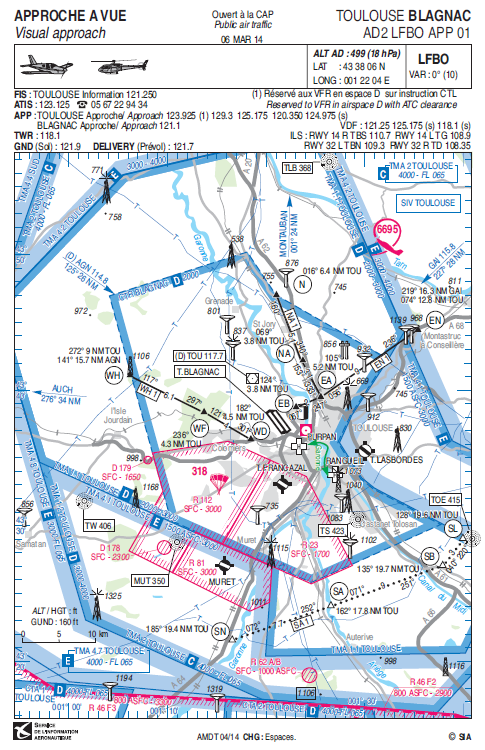
Find the Visual Approach Chart of Toulouse Blagnac (LFBO) [PDF, 846KB] from the Service de l’Information Aeronautique (SIA). Main pages to follow the video are shown below:

Visual Approach to Blagnac. Special attention to route followed from Lasbordes, EN - EA - EB.

Visual Approach to Blagnac. Special attention to route followed from Lasbordes, EN – EA – EB.

Visual Landing in Blagnac. Special attention to waypoint EB (water tower) and clockwise aerodrome circuit to land on 32L.

Visual Landing in Blagnac. Special attention to waypoint EB (water tower) and clockwise aerodrome circuit to land on 32L.

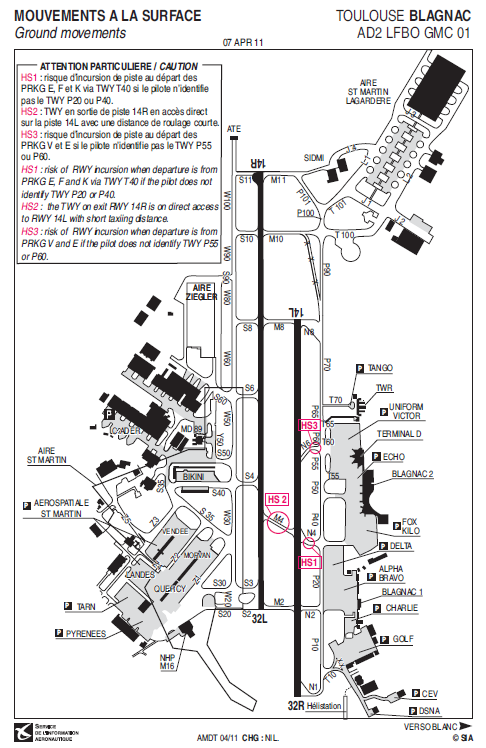
Taxiing in Blagnac. Special attention to the crossing of 32R by way of M4 and N4. Note parking Golf. Departure from 32R by way of N1.

Taxiing in Blagnac. Special attention to the crossing of 32R by way of M4 and N4. Note parking Golf. Departure from 32R by way of N1.

Leave a comment

Filed under Aerospace & Defence

Aerospace & Defence assets employed in the search of Malaysian Airlines Boeing 777 flight MH370

Few months ago I wrote a post about Europe’s Common Security and Defence Policy (CSDP) and the need that EU countries have clearer policies, commitments, roadmaps, resources… I started that post with the following reflection:

Security and Defence is a topic which only makes it to the front pages of the media when there are actual war operations. Rarely a debate is centered on whether the country needs to foster its capabilities, invest in new defence technologies, or protect a certain industry base. I cannot recall a single electoral programme calling for such initiatives. The defence is not popular in today’s (European) society.

These days, we are witnessing a 24/7 coverage of the search operation of the missing Malaysian Airlines Boeing 777 flight MH370. In this post I just wanted to highlight the aerospace and defence assets involved in that operation, as reported by one of The Wall Street Journal’s blogs, “How India’s Effort in Search for MH370 Matches Up Globally“. See the graphic below:

Aerospace and defence assets employed in MH370 B777 airplane search operation.

Aerospace and defence assets employed in MH370 B777 airplane search operation.

According to the article, among those 12 countries, they are employing about 32 aircraft (fixed wing), 14 helicopters, 63 boats (ships, destroyer, patrol boats…) and 10 satellites. It goes without saying that before such an operation can be put in place, the assets shall be owned (acquired) by those states, they need to have been maintained, the crews need to have been trained, etc. All those activities and assets, need to have been performed and funded (ideally) in times of peace, when the public opinion is less prone to think that those assets and activities (and the budget directed to provide them) are needed.

A second after thought I had reading the article is the continuous need to educate about aerospace.

I see (and have circled in red) in the graphic a distinction between “aircraft” and “fixed-wing aircraft“, or “helicopter” and “search and rescue aircraft“. I am aware that the distinction comes not from The Wall Street Journal but from the information source, Jane’s. Jane’s is a well-known publishing group which offers information of aircraft and other warfare, and inventories of those assets owned and operated by different government services around the world (e.g. Malaysian Air Force, Navy, etc.).

  • When Jane’s differentiates aircraft as fixed-wing is to differentiate them from rotary-wing (i.e. helicopters) and not from “aircraft” such as the P-3 Orion or the P-8 Poseidon cited in the graphic, all those are fixed-wing aircraft. Thus, the split between  “aircraft” and “fixed-wing aircraft” was unnecessary.
  • When Jane’s differentiates helicopters (or rotary-wing aircraft) as “search and rescue aircraft” is to differentiate them from others but from the operation point of view, thus, “search and rescue” versus “transport”, “attack”, “gunship”… thus, here, again, the split between “helicopter” and “search and rescue aircraft” (SAR) was unnecessary, as the only SAR included in the graphic is another helicopter.

I am afraid that a similar confusion has been created when using the terms ship/destroyer and maritime vessel/patrol boat, but since I am not an expert in the field I will not comment.

Finally, I wonder where The Wall Street Journal has taken the pictures to symbolize aircraft and helicopters. The icon used to represent the fixed-wing aircraft is a Fairchild Republic A-10 Thunderbolt II, which is indeed a fixed-wing aircraft, but it is a ground attack aircraft (rather than maritime patrol or search and rescue aircraft) only operated by the United States Air Force, not by the Malaysian Maritime Enforcement Agency, Vietnam or Singapore, as the graphic may lead to think.

Leave a comment

Filed under Aerospace & Defence

Turboprop market vs. oil price (ATR figures 2013 update)

Few weeks ago, the Toulouse-based aircraft manufacturer ATR (Avions de Transport Régional) published a press release reporting some of its numbers from 2013 exercise (being a private company, owned by Airbus and Alenia, it does not publish full financial annual report). Some of the key figures were:

  • Revenues increased 13% to 1.63bn$.
  • A new record of 74 deliveries (+16%).
  • Sales of a total of 195 aircraft (89 firm orders and 106 options). (1)
  • Backlog at year-end of 221 firm aircraft orders.

About 3 years ago, I wrote a post, “Turboprops market different dynamic“, in which I discussed:

[…] how civil turboprop market is unrelated to the larger and more known turbofan civil aircraft market and how its dynamics are completely unrelated to World GDP growth and thus world air traffic growth. […]

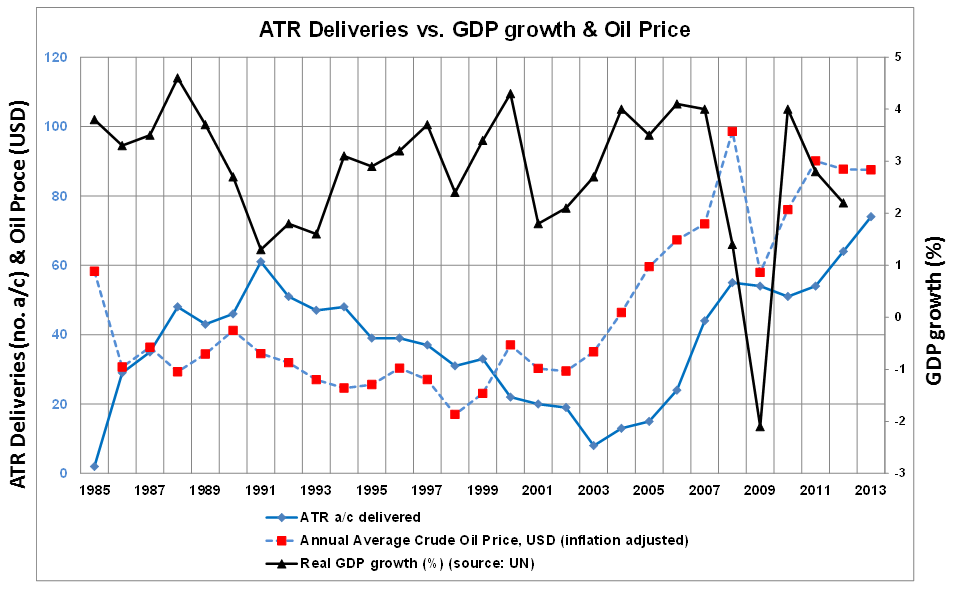
When calculating correlation between the different variables, I discovered that the correlation between GDP and deliveries is rather low, despite of the time lag applied (be it 2, 3, 4 years…). However I found that the oil prices and deliveries did correlate very well with a lag of 5-6 years, yielding coefficients of 0.55-.65, which are rather high.

I wanted to update the calculations I made then with the information of the last years.

ATR deliveries vs. GDP growth and oil price (2013 update).

ATR deliveries vs. GDP growth and oil price (2013 update).

With the last years’ data, correlations are similar:

  • Between oil prices and deliveries: high, above 0.54 from 1 year time lag, increasing through 6 years time lag (when it reaches a maximum of 0.77).
  • Between GDP growth and deliveries: low, not more than 0.26, and negative correlations up from 1 to 4 years time lag.

If there was causality, we could infer that the from the moment that oil prices are computed, till they are taken into regional airlines’ models, the fleet planners identify the need for new turboprops, the case is approved by airlines’ management, discussions start with ATR, negotiations are closed between the airline and the manufacturer, the aircraft are built and delivered to the airline… it takes about 6 years. (2)

(1) 15 cancellations (4 ATR-42 & 11 ATR-72) that took place in 2013 go untold in the press release, though they are easily deduced comparing orders and backlogs for 2013 and 2012.

(2) About 3 of those 6 years are consumed from placing the firm order to getting the aircraft delivered, as we can see by the current figures of backlog (221 a/c) and yearly deliveries (74 a/c).

1 Comment

Filed under Aerospace & Defence

Boeing real prices (accounting for inflation) after discount

In a previous post I compared for some Boeing airplanes (737-800, 737-900ER, 777-300ER and 787-8) what had been the evolution from 2008 to 2013 of the published list prices against the estimated discounted prices. In that post, I arrived to the following conclusions:

[…] the pricing power of Boeing had remained barely constant during the last 5 years.

  • Through continuous increases, 2013 list prices were between 18% (737 and 777) and 27% (for the 787) higher than in 2008.
  • However, due to increasing discounts from 38% in 2008 to 47% in 2013, the increase in list prices is almost entirely offset.
  • 2013 discounted prices are below 2010 discounted prices for all models.
  • 2013 discounted prices are almost back at 2008 levels for the 737 and 777, only the 787 seems to have stayed at 2010 levels.

I, then, received one interesting comment from a reader, ikkeman, pointing at the fact that if the estimated discounted prices are expressed in then-year dollars (1), if real prices had not increased since 2010, that meant that they had indeed decreased.

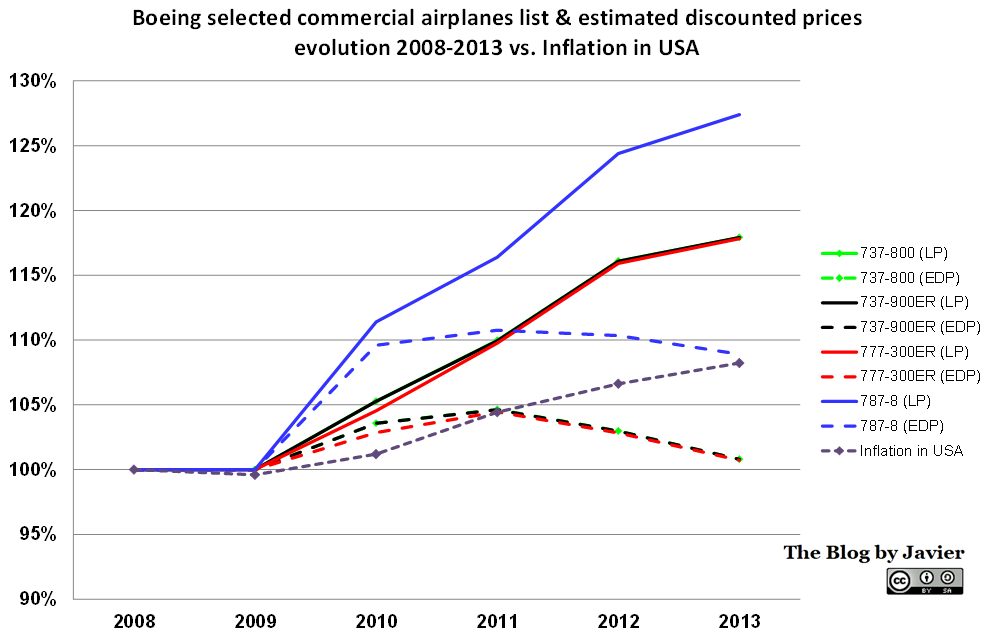
See below the graphic I included in the a previous post updated adding the data of US inflation after 2008. [The series is: -0.4% (2009), 1.6% (2010), 3.2% (2011), 2.1% (2012) and 1.5% (2013)]

Boeing List & discount Prices evolution graphic vs. inflation in USA,

Boeing List & discount Prices evolution graphic vs. inflation in USA.

With the information of the inflation (purple line) the following 2 conclusions apply:

  • 787 real price (accounting for inflation) after discount has simply kept up with inflation rate since 2008.
  • 737 and 777 real prices after discounts, however, have lost ground with respect to inflation since 2008. On average they have lost about 8.5% in total or about 1.6% per year.

(1) That is the case as estimated discounted prices have been estimated year by year from the financial reports and list prices of the year, thus, using then-year US dollars.

Leave a comment

Filed under Aerospace & Defence

Boeing discounts detailed calculation, 2013 vs. 2012

Last years I have published in the blog  some posts (1) dedicated to show what was my estimate of the average discount Boeing applies to its commercial airplanes. I included in those posts the rationale used for the calculation. Find here the post related to the calculation of the discount based on 2013 data of Boeing Commercial Airplanes revenues, deliveries and list prices.

In this post, I wanted to show in detail a simplified table (2) with the calculation comparing 2013 simplified result versus 2012:

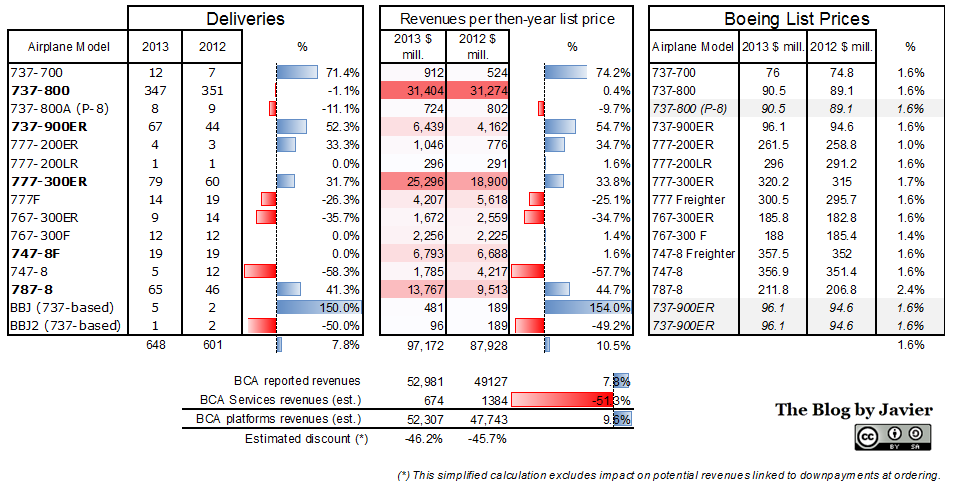
Boeing discount detailed simplified calculation: 2013 vs. 2012.

Boeing discount detailed simplified calculation: 2013 vs. 2012.

In the table above, you may find for both 2013 and 2012 Boeing reported deliveries per model and Boeing published list prices per model (3) and Boeing Commercial Airplanes reported revenues.

What is then estimated? Boeing Commercial Airplanes services revenues (deduced from financial reports reported information), Boeing Commercial Airplanes platforms revenues (derived from the previous figure) and the average discount; this is calculated from the difference between estimated BCA platforms revenues and what should have been that figure had the airplanes been sold at list prices.

Results: average discounts of above 46% in 2013 and above 45% in 2012.

(1) Find here what is becoming a “body of knowledge” on Boeing discounts: estimates calculated for 2013201220112010 and 2009; a review of the French portal Challenges.fr of aircraft discounts prior to Le Bourget airshow of 2013; aBombardier’s CEO statement on what is known in the market as the Boeing discount; Boeing Commercial Airplanes president Ray Conner speaking about the more aggressive pricing they are being forced to offer.

(2) I refer to this table as “simplified” as it excludes from the calculation the potential influence on yearly revenues (note, not cash flow) of down payments linked to orders received in then-year versus orders received in previous years for aircraft delivered in then-year.

(3) Two assumptions are needed: 737-800A transfer prices from BCA to Boeing Defense Space & Security for the P-8 (for simplicity assumed to be the same as the 737-800 price) and for the 737-based business jets (for simplicity assumed to be the same as the 737-900ER).

1 Comment

Filed under Aerospace & Defence

Augustine’s Laws and the future long-range bomber

The US Air Force is moving ahead with its plan to develop a new long-range bomber aircraft to be operational by the mid of next decade. The program is not yet launched, but within this year it is expected that we will see the launch of a request for proposals (RFP).

I read about the latest moves about this program-to-be in an article from DefenseNews, “USAF To Shed Light on ‘Mystery’ Plane“. Apart from different declarations from officials and industry, the article provided some main general clues:

The Air Force intends to begin fielding the bomber in the mid 2020s, with penetrating capability in mind. The service will procure 80 to 100 planes, which will mostly be made with existing technologies. Those machines will also have both standoff and direct-attack munitions and room for a large payload.

The service also is exploring the idea of the aircraft being optionally manned.

Service officials have cited a cost of $550 million per plane as the ceiling for the program, but even that figure has some mystery to it. Observers have noted that the figure does not include research and development (R&D) costs, which could drive that amount up.

My first reaction on that figure of $550 million per aircraft was:

For those not acquainted with him, Norman Augustine served in many positions both in the Administration (Under Secretary of the Army) and in the Aerospace & Defense industry (CEO of Lockheed Martin). Lately he lead the Committee that was reviewing the US Human Space Flight Plans. He wrote a fantastic book, “Augustine’s Laws”, about the aerospace and defense industry, the problems that plague their programs, etc. I reviewed that book in this post.

However, after writing that tweet I decided to check it myself…

See below the original graphic from the book depicting the trend of increasing costs of bomber aircraft:

Trend of Increasing Cost of Bomber Aircraft (source: Augustine's Laws).

Trend of Increasing Cost of Bomber Aircraft (source: Augustine’s Laws).

I extrapolated the trend with the information provided in the article, that is, a $550 million unit cost with an entry into service by the mid 2020s, see below where that spot is in the enlarged graphic:

Updated Trend of Increasing Cost of Bomber Aircraft (source: Augustine's Laws + future long-range bomber information).

Updated Trend of Increasing Cost of Bomber Aircraft (source: Augustine’s Laws + future long-range bomber information).

You will see that I marked 2 different spots in red and blue. The blue one corresponds to the unit cost ceiling of 550M$ reported in the article. You will see that the spot is way off the 70-year old trend (from the end 1920s-1990s). Therefore, I decided to continue the trend line and see at what unit cost would a bomber aircraft with entry into service in the mid 2020s still follow the trend, and I marked that unit cost in red. The result is that the future bomber would have to cost about $500 billion apiece, or a cost roughly equal to the entire Department of Defense yearly budget.

That may seem impossible today, completely off reality. How could that happen? Start by imagining that the budget which will be earmarked for 80-100 airplanes along several years, in the end serves to procure many less units (40?, 10?… 1?). Then, add to that the information appearing in the article accompanying the 550M$ figure, “the figure does not include research and development (R&D) costs, which could drive that amount up”. Put all that together and we might end up seeing, 10 years from now, that Augustine’s was right on the spot.

In fact, the assertion that one single airplane would cost the US Air Force the entire DoD yearly budget was exactly predicted by Augustine in his Law number IX, though he applied it for tactical fighter aircraft, and the date in that case would be a bit later, 2054:

In the year 2054, the entire defense budget will purchase just one tactical aircraft. This aircraft will have to be shared by the Air Force and Navy 3 1/2 days each per week except for leap year, when it will be made available to the Marines for the extra day. (LAW NUMBER IX)

Update (2014-03-08): See in the article from Bloomberg, “Long-Range Bomber’s Development Would Get $12 Billion“, a declaration from Lt. General Charles Davis: “Is it going to be $550 million a copy? No, of course it’s not going to be $550 million a copy once you add in everything.“. The article includes further figures providing a new estimate of 810M$ apiece… The closing of the gap between 550M$ and ~ 500bn$ has started.

1 Comment

Filed under Aerospace & Defence

Learning Curves: Boeing 787 case in 2013

In the previous two posts I introduced the concept of learning curve and provided a case in point (based on figures attributed to A350 FAL by Leeham News). In the first of those posts, I discussed that:

Boeing does not disclose outright what is the actual learning curve it is achieving in its program. Nevertheless, in its investor relations conferences it provides information here and there of cost savings achieved, etc. This can be interpreted as derived from learning curve effects, and would permit to build a model, even if based on scarce information.

Let me quote again one of those excerpts from Boeing executives:

“We continue to see progress in key operational performance indicators and unit costs, as we further implement production efficiencies and stabilize the overall production system on the 787 program. Unit cost has improved approximately 20% over the past year on the 787-8 […]“Greg Smith, Boeing EVP – CFO at Q4 2013 Earnings Conference.

To the avid reader, and knowledgeable and savvy analyst, this paragraph is enough to deduce the actual learning curve achieved by the 787 during 2013, provided that information reported by Boeing CFO, Greg Smith, was accurate.

During 2013 Boeing delivered 65  787s, from the 50th to the 114th units (in previous years it had delivered already 3 in 2011 and 46 in 2012).

Thus, the exercise to find out what learning curve Boeing achieved in 2013 is as simple as to see what learning curve yields an “approximately 20% unit cost improvement” from the unit 50th to the unit 114th. The beauty is that we do not even need to know the initial unit cost to perform the calculation, as the relative improvements in terms of percentages are independent of the starting point. All the information has indeed been provided by Boeing.

In the first graph below I just plotted some generic learning curves, from 95% to 75%. This form of representation provides a good view of how learning is intense at the beginning of the production process and it stabilizes later on. It also shows well how learning is more intense and cost reductions are bigger for a 75% curve than for a 95% curve.

Generic learning curves.

Generic learning curves.

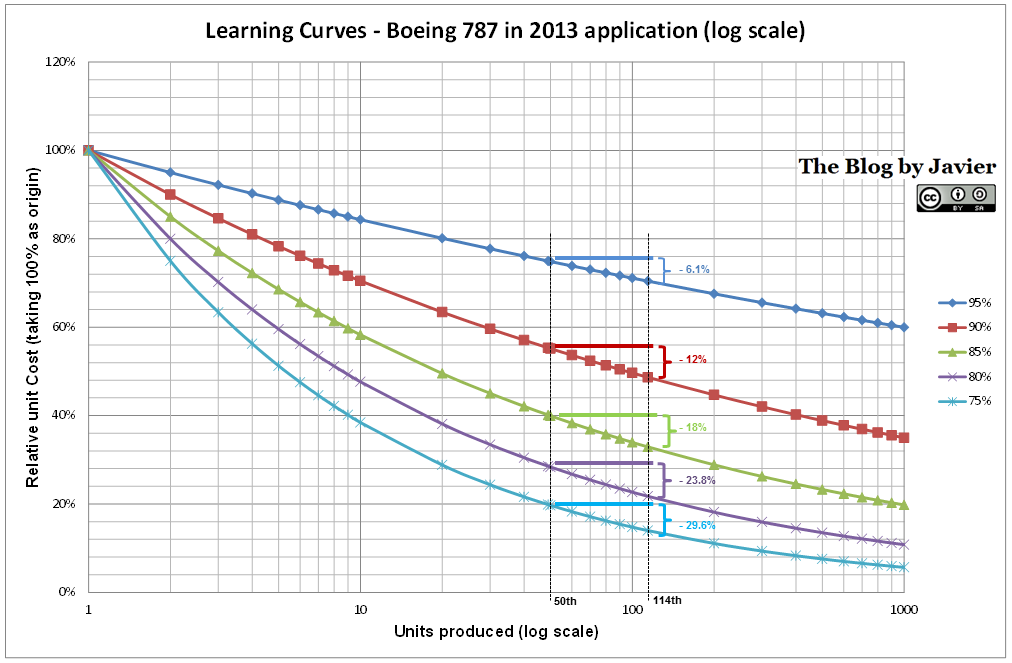
However, in the previous curve it is difficult to distinguish the 50th and the 114th units which are needed for the calculation. Thus, I plotted the same curves in with a log scale for the numbers of units produced in the graphic below:

Boeing 787 learning curve in 2013 calculation, delta unit cost between 50th & 114th units.

Boeing 787 learning curve in 2013 calculation, delta unit cost between 50th & 114th units.

In this second graphic I added the information of what relative cost reduction is achieved between the 50th and the 114th units for each of the curves (1).

To make sure that readers are not lost, let’s take the 85% curve. Following that curve, the unit cost of the 50th unit produced is a 40.2% of the 1st unit cost, whereas the unit cost for the 114th unit produced is a 32.9% of the 1st unit cost. The difference is then 40.2% – 32.9% = 7.2%, which represents a 18.0% cost reduction from the 50th unit cost. If you follow the same calculation for each of the curves, you will obtain the following unit cost improvements between 50th and 114th units:

  • 95% curve: -6.1% unit cost improvement
  • 90% curve: -12.0% unit cost improvement
  • 85% curve: -18.0% unit cost improvement
  • 80% curve: -23.8% unit cost improvement
  • 75% curve: -29.6% unit cost improvement

Thus, from the information provided by Boeing of units delivered and unit cost improvement (“approximately 20”, Greg Smith) we can deduce that during 2013 the learning curve that the 787 program has achieved is between 85% and 80%. Thus, in line with aerospace average indicated by NASA (85%), or in line with the reported 84% achieved in the 777.

If we wanted to know what learning curve yields exactly that 20% unit cost improvement, it is now trivial to calculate it: the 83.3% learning curve.

Having made these numbers, and taking into account the words used by Boeing CFO, “unit cost has improved approximately 20% over the past year on the 787-8″, I take it as that the improvement has been close to 20% though probably not reaching it; thus, I understand that the learning curve was rather between 83.3-85% instead of down to 83.3%.

(1) Bear in mind what a relative cost reduction is in contrast to the fact of relative costs represented in the vertical axis as percentages of the initial cost (100%).

2 Comments

Filed under Aerospace & Defence

Learning Curves (case in point)

In a previous post I made an introduction of the concept of learning curve and the gains that can be achieved through experience, with the focus on aerospace industry.

Case in point 1

Few days ago I found an interesting blog post at Leeham News, “Lessons learned from A380, 787 benefit A350“, which discusses lessons learned reportedly being applied into the A350 programme and includes two interesting tables. I will use one of those tables in order to show an exercise of learning curve calculation, without caring of whether the information included in the table is accurate or reflects actual lead times of A350 at Final Assembly Line (FAL). [I do not validate the information of the table despite of using it for an intellectual exercise.]

A350 days in FAL as reported by Leeham News (Reprinted with permission by Leeham Co).

If we take the lead times reported by Leeham News in the table above, we can calculate to what learning curve profile would those lead times correspond. See the result in the graphic below:

Learning Curves.

Learning Curves.

The information reported by Leeham News corresponds to a learning curve between 85% and 90%, about 88%. If figures resemble the reality, between the first and second units, the learning was closer to 95%, however, between the 2nd and 3rd it improved greatly. Since the 3rd unit, the learning is more stabilized at about 88%. [Again, having made this calculation as an exercise does not validate the information taken as an input]

It is important to bear in mind the units used in this calculation are days. Days of assembly are linked to unit production costs, but not necessarily in a linear fashion, as it will depend on the labor / automation being employed in the production of each unit, which may change as production evolves. It is also important to note, that the example of learning curve calculated would refer only to assembly at FAL and not to the overall production process, from material costs, production at earlier stages of the manufacturing process, etc. The value added at FAL is but a minor percentage of the value of an airplane.

I leave for a following post a case in point 2, with the learning curve of the 787 during 2013.

1 Comment

Filed under Aerospace & Defence

Introduction to Learning Curves

Let me introduce the learning curve effect by quoting directly from the Wikipedia:

“The rule used for representing the learning curve effect states that the more times a task has been performed, the less time will be required on each subsequent iteration. This relationship was probably first quantified in 1936 at Wright-Patterson Air Force Base in the United States, where it was determined that every time total aircraft production doubled, the required labour time decreased by 10 to 15 percent.” […]

“Learning curve theory states that as the quantity of items produced doubles, costs decrease at a predictable rate.”

I used the concept of learning curve in a blog post in which I discussed whether and when the Boeing 787 would break even. In that post I referred to Boeing’s target of reaching a 75% learning curve on the 787 program, much more difficult to reach than the 84% that Boeing reportedly achieved in the 777 program.

Why is a curve of 75% more difficult to achieve than a 84% curve? The meaning of the figure “84%” attached to the learning curve is that each time that the number of units produced is doubled, the cost is reduced in 16%, or the 2*nth unit cost is 84% of the unit cost of the nth unit. Thus, a 75% curve would imply that the cost is reduced in 25%, which is a higher cost reduction than 16%, and, thus, more difficult to achieve.

On the other hand, NASA, in its Learning Curve Calculator, offers some guidance on learning curves for different industries and mixes of hand labor and machining work:

  1. Aerospace 85%
  2. Shipbuilding 80-85%
  3. Complex machine tools for new models 75-85%
  4. Repetitive electronics manufacturing 90-95%
  5. Repetitive machining or punch-press operations 90-95%
  6. repetitive electrical operations 75-85%
  7. Repetitive welding operations 90%
  8. Raw materials 93-96%
  9. Purchased Parts 85-88%

How is the concept of learning curve calculated? (from Wikipedia: )

Now the equation for the unit curve is given by:

Y_x = K x^{\log_2 (b)}

where

  • K is the number of direct labour hours to produce the first unit
  • Yx is the number of direct labour hours to produce the xth unit
  • x is the unit number
  • b is the learning percentage (expressed as a decimal)

How does a learning curve look like? (from Wikipedia) Actual examples of curves in both linear and logarithmic scales would be:

The concept of learning curve is indeed used in aerospace, however, coming back to the 787 program, Boeing does not disclose outright what is the actual learning curve it is achieving in its program. Nevertheless, in its investor relations conferences it provides information here and there of cost savings achieved, etc. This can be interpreted as derived from learning curve effects, and would permit to build a model, even if based on scarce information.

See some of the hints that Boeing provides:

“We continue to see progress in key operational performance indicators and unit costs, as we further implement production efficiencies and stabilize the overall production system on the 787 program. Unit cost has improved approximately 20% over the past year on the 787-8 […]”, Greg Smith, Boeing EVP – CFO at Q4 2013 Earnings Conference.

“[…] as we continue to make improvements 787 unit cost […]”, Greg Smith, Boeing EVP – CFO at Q4 2013 Earnings Conference.

“when you look at flow-time, you look at unit cost at Charleston whether it’s final, mid, or (aft) it made great progress there. And the team has been very focused on continuing that progress going forward. We have experienced a higher number of jobs behind schedule in the mid-body section, and that’s really due to, if you think about it, you are introducing the Dash-9 at the same time going to 10 a month. […], we’ve applied additional resources. We know how to do this and we’ll get those jobs back to what we view as a more acceptable level. So we got mitigation plans.” Greg Smith, Boeing EVP – CFO at Q4 2013 Earnings Conference.

“This morning we announced plans to increase 787 production beyond the 10 per month we’re on track to achieve this year to 12 per month in 2016 and then 14 per month, before the end of the decade. […], capture productivity and learning improved profitability […]” Jim McNerney, Boeing Chairman, President and CEO at Q3 2013 Earnings Conference.

“We’ve added another line or sorry, a position within the line, where we’re doing the wing, body joint earlier in the process and this is through experience after 134 airplanes, the teams are really coming up with better ideas or improvements on how to increase flow and that’s going to require some upfront investment. But obviously in the units to come after we’ll see that improvement again in flow and productivity.” Greg Smith, Boeing EVP – CFO at Q3 2013 Earnings Conference.

“[…] the flow time reductions, we’ve had in our factories, the hours per unit, the productivity per whatever are increasing significantly on all of our programs.” Jim McNerney, Boeing Chairman, President and CEO at Q3 2013 Earnings Conference.

5 Comments

Filed under Aerospace & Defence