Category Archives: Economy

Long-term commodity prices

On previous posts I have written about the long-term prices of housing and why I didn’t considered a house a sound investment, about why it is better to invest in any asset than having cash, why pencils would be as safe as an asset can be (even if not productive) and why gold is not more worthy than pencils. I, then, included some interesting graphics showing quite long-term views on the issue.

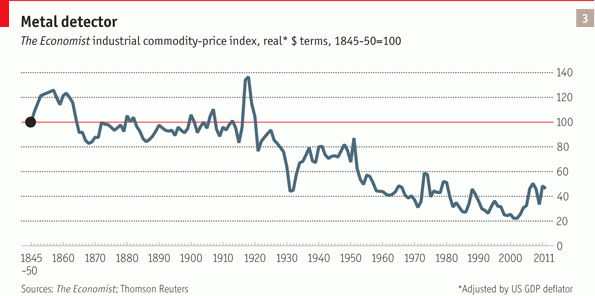
Weeks ago The Economist showed another interesting long-term graphic that I wanted to share and also to leave it here as a note to self as a reminder of the long-term worth of commodities.

Commodity-price index, adjusted by US GDP deflator.

Leave a comment

Filed under Economy

Gold as an invesment?

If in a previous post, pencils were treated as a supposedly safe haven in case of a recession. In this post I just wanted to mention that I don’t see anything more value in gold or silver than I see in pencils.

That may sound shocking, as we are used to have gold items in great praise. Well, as a commodity, as an asset, I don’t see much difference between gold and other materials. What it is valuable is the company that continues to produce goods out of those commodities, with ever greater productivity and value added to its products.

Gold by itself is just like a pencil, assuming that you continue to find someone in the future willing to pay something for both commodities (certainly not more than it is worth at any given moment).

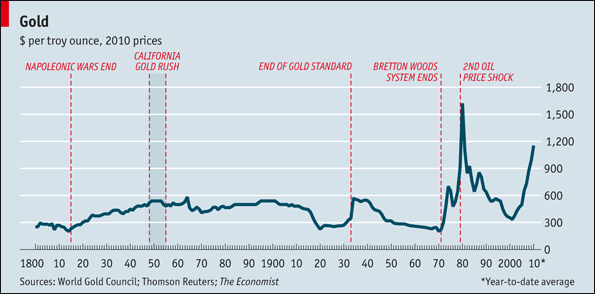
It is easy to say this now that both silver and gold have seen its prices plummet after the summer, but more than using the recent fall as basis for the argument, I have in mind these other long-term (as in centuries’ trend) graphics below:

Gold price fluctuations since 1800. Source: The Economist.

From the previous graphic, gold went up to 1,900 in the summer of 2011 and then fell again to around 1,600$ per ounce, in September. Well, I see no reason why it shouldn’t be around 300-600$ again, as it has always been.

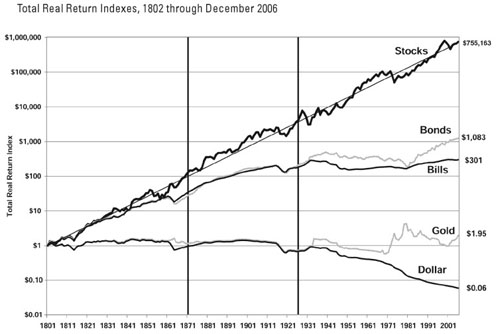
Gold as an "investment"... Source: Jeremy Siegel

In this other graphic you may see how much gold is worth as an investment… well, it is more valuable than cash, but we already discredited cash in a previous post.

And still, you’ll find people running towards gold when there is a crisis… I never understood that. What are the gold price fluctuations based on?

Personally, I prefer to go to the Casino in Torrelodones once a year, lose at most some 50€, if that is the case, and kill altogether the speculative behaviours until the next year.

Leave a comment

Filed under Economy, Investing

Hyperinflation and defaults in Europe

In my previous post, I purposefully selected Germany as the case of country that would need to be kicked out of the Europe due to its fiscal irresponsibility. Surely, most of you think the situation today is just the reverse and thus it was just a bit of irony…

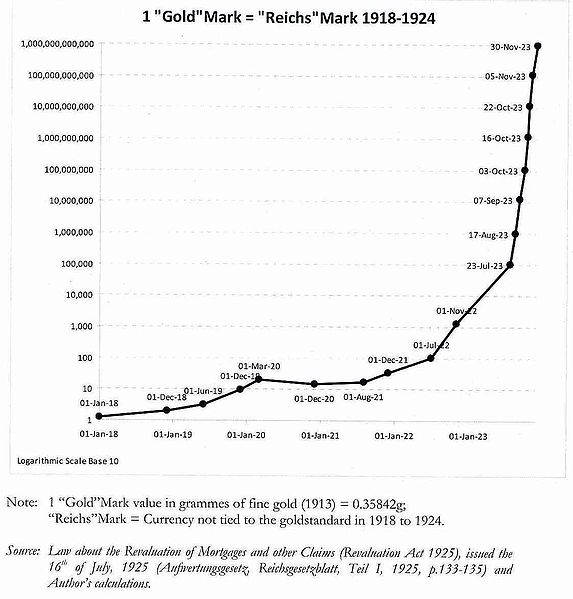
… well, I wanted to come to it at a later point, in this post, to share the following graphic from the Wikipedia in which you can see the hyperinflation lived in Germany’s Weimar Republic between 1921 and 1923:

Weimar Republic hyperinflation. Source: Wolfgang Chr. Fischer

The explanation in the Wikipedia is astonishing, I recommend that reading.

The situation only stabilized when the Retenmark indexed to gold bonds was introduced at the end of 1923, by then there were notes of 1,000,000,000,000 marks (and even so there were two other cases of higher hyperinflations in History, in Hungary and Zimbabwe!).

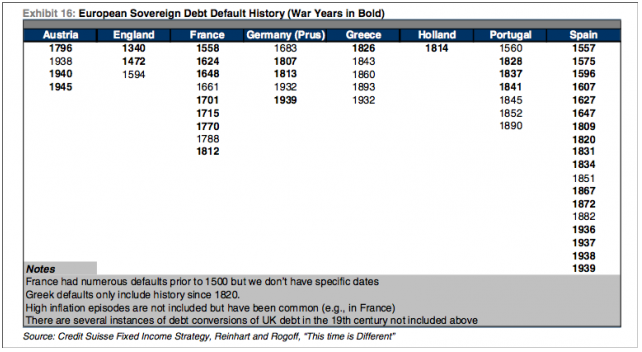
Even though during those hyperinflationary years the Weimar Republic Germany did not default, Germany did so in 1932 and 1939, being those of the latest defaults in Western Europe… later than the latest from Greece or Portugal, as can be seen in the following table.

Sovereign Defaults in Europe. Source: Reinhart and Rogoff, “This time is different”, via Credit Suisse.

Finally, you may also see in the table that now, after 72 years since the end of the Spanish Civil War, we are living the longest period since 1800 (and second longest since 1500) that Spain has not defaulted on its debt! I am not sure whether this should be a source of calmness or worry.

1 Comment

Filed under Economy

Invest in real assets (pencils if need be)

My previous post discussed why it is better to be invested in real assets vs. cash or bonds in order to protect your savings in case of a recession.

Even though all the references were to stocks, I kept the word “assets” instead of “stocks” in the title and conclusion of the previous post in order to come back to it a later time, in this post.

Bestinver fund managers, in their conferences, have often given examples of assets to be invested in to protect your wealth such as pencils, chairs, and, this year, books.

If by the time a recession came and inflation started to build up, you had all your fortune invested in pencils, the same discussion that was made in the previous post with stocks would hold true for pencils.

For example, say that Southern Europe (Greece, Portugal, Italy…) in a near future needs to kick Germany out of the Euro due to its fiscal irresponsibility. Germany would then have to use another currency, e.g. the Deutsche Mark. Say that at day one the mark would be worth 2DM = 1 Euro, as it was more or less 10 years ago.

Due to the inevitable capital runaway from Germany, Germany would most probably undergo a period of hyperinflation and mark devaluation that could very well end with 1 Euro being worth ~ 2.000 DM. Obviously, the prudent Bavarian who had all her savings in cash would have nearly lost all of them.

However, if this Bavarian had instead purchased pencils in order to protect her wealth, she would have seen a different outcome. Say a pencil cost 0.5€ at the beginning, or 1DM. After all the hyperinflationary period, and if German students still needed pencils for their classes a pencil would sell for ~1,000DM. Thus, as the theory goes, the Bavarian investor would have protected her wealth just by being invested in real assets, i.e. pencils.

Of course, if you wanted to see your wealth grow pencils wouldn’t be the best assets to be invested in, as they do not reproduce, or any other assets are taken out of them, but to protect your savings they would work just fine.


Leave a comment

Filed under Economy, Investing

Inflation and assets

During the last weekend, I spent some hours watching the webcast of the annual investors’ conference of Bestinver, a Spanish investment fund.

I find the conference itself not only entertaining and informative but quite funny due to the way the fund managers show their value investing principles and how stubborn they’re with them (luckily for investors). The experience is comparable to that of Berkshire Hathaway annual general meeting.

As in previous years the managers defended how not only to have profits but to defend your savings during recessions it is much better to be invested in real assets than to have your money in cash, state bonds, etc.

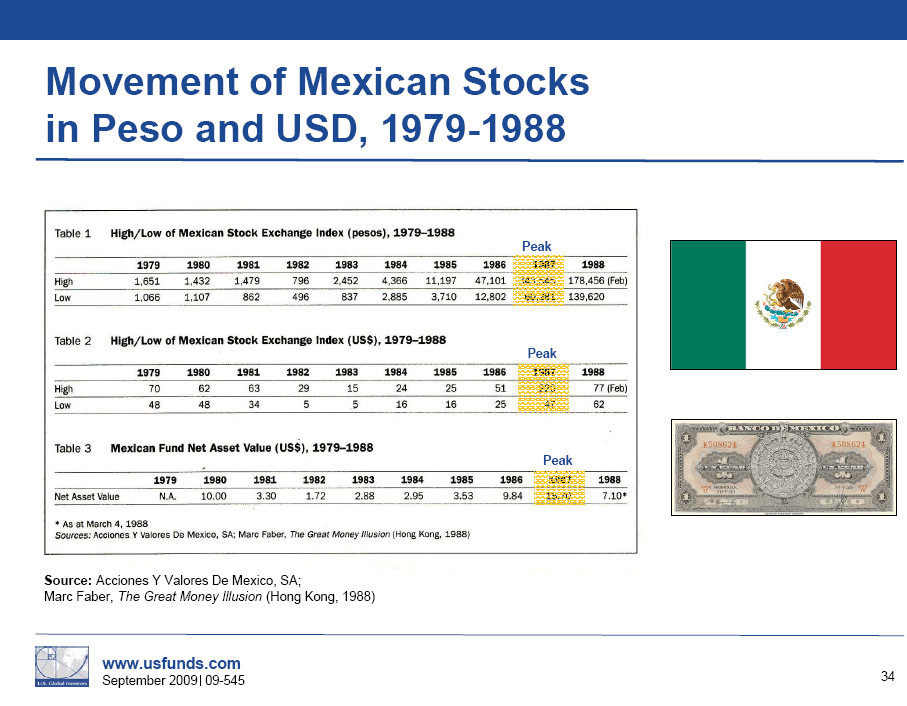
This time they raised the case of Mexico during 1979-1988 (in previous cases they had referred to the Weimar Republic or Argentina), based on an analysis by Marc Faber (a presentation containing the same info can be retrieved here, PDF 4.8MB). During those years the Mexican peso suffered an extreme hyperinflation explained in the Wikipedia as follows:

In spite of the Oil Crisis of the late 1970s (Mexico is a producer and exporter), and due to excessive social spending, Mexico defaulted on its external debt in 1982. As a result, the country suffered a severe case of capital flight and several years of hyperinflation and peso devaluation. On 1 January 1993, Mexico created a new currency, the nuevo peso (“new peso”, or MXN), which chopped 3 zeros off the old peso, an inflation rate of 10,000% over the several years of the crisis. (One new peso was equal to 1000 of the obsolete MXP pesos).

Mexican peso evolution vs USD. Source: Ron Griess

Obviously, anyyone who either held savings in cash in pesos or Mexican bonds at that time virtually lost all his money.

However, the same author made the analysis of what would have happened during those years to an individual holding Mexican stock, for which he used the Mexican Stock Exchange Index. The result is that at the end of the decade that person would have kept his wealth in US dollar terms, as the nominal value of the Mexican stocks raised at par with the hyperinflation and peso devaluation going on in the country.

Evolution of Mexican Stock. Source: Marc Faber

Conclusion: better be invested in assets if only to keep your savings safe in the long run.

Leave a comment

Filed under Economy, Investing

¿Cómo aflorar la economía sumergida?

Por todos es conocido el nivel que la economía sumergida tristemente alcanza en España (“Dinero B”, “¿Con IVA o sin IVA?”, “Ay, si quiere factura le tendré que cobrar el IVA”). En junio la Fundación de Cajas de Ahorro (FUNCAS) estimaba que la economía sumergida podía suponer hasta un 24% del P.I.B.

¿Cómo conseguir aflorar parte de estos movimientos de dinero? ¿Qué incentivo puede haber para el comprador en pagar el IVA? ¿Qué incentivo hay para el vendedor en declarar esos ingresos?

Hace unos meses contraté a una empresa de servicios que envía a una persona un par de veces al mes a limpiar el piso donde vivo. Esta es una de las típicas tareas que en España se mueve en dinero B. “¿Cómo voy a hacer yo un contrato a la señora de la limpieza?” “¿Cómo voy a contratarla a través de una empresa intermediaria si me va a costar más caro?”

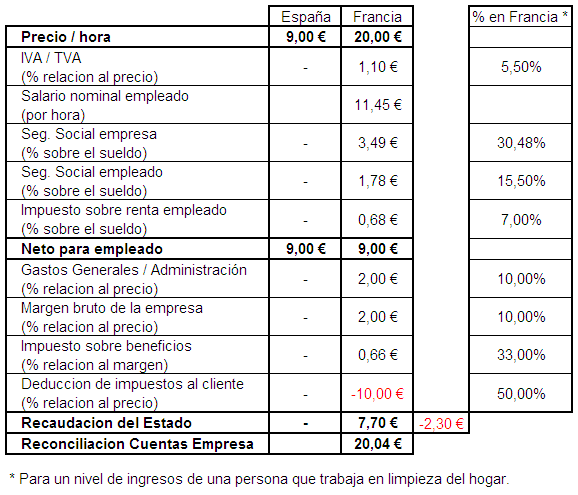
En Francia me he encontrado con una idea muy simple a la vez que brillante: los gastos en estos tipos de servicios (limpieza, plancha, cuidado de niños, jardinería…) permiten una deducción en impuesto de la renta del 50% de lo gastado hasta un límite (muy superior a lo que yo vaya a gastar al año). Es decir, por cada 100€ que yo gaste en limpieza, me podré deducir 50€ de impuestos.

En España estos servicios se pagan entre 8 y 10 euros por hora, en negro. La persona que realiza el servicio no declara el ingreso, no paga impuestos sobre ello, no cotiza a la seguridad y no pagamos IVA por la transacción.

En Francia estos servicios cuestan entre 18 y 20 euros por hora. Pero teniendo en cuenta que me deduciré la mitad, me acaba saliendo por el mismo precio.

  • Se establece un contrato de servicios entre una empresa y yo.
  • La empresa contrata a un limpiador, un contable, unos comerciales.
  • Se contrata un seguro que cubre posibles desperfectos o robos, dando al usuario un valor añadido.
  • La factura que me pasan lleva IVA (“TVA”).
  • La empresa paga impuesto de sociedades si tuviese beneficios, de actividades económicas y seguridad social al trabajador.
  • El trabajador paga su impuesto sobre la renta y cotiza a la seguridad asegurándose su desempleo y jubilación.
  • El hecho de haber una empresa intermediaria crea una serie de puestos de trabajo que en España no existirían, además de compras de materiales y servicios (oficina, líneas de teléfono e internet, material de oficina…)

Y todo por esos 50€ que el estado francés dejará de ingresar a través de mis impuestos directos. ¿Por qué me debe subvencionar Francia ese gasto, qué interés tiene? Vamos a ver los números y veréis como le cuadra al estado.

La limpieza del hogar en Francia en números.

Al hacer las cuentas he impuesto que el trabajador reciba un neto equivalente al que recibiría en negro. De ese modo, su incentivo estaría claro: a igualdad de ingresos, mejor estar cotizando a la seguridad social. El precio hora para el usuario finalmente es 1€ más caro en Francia, lo he dejado así en vez de retocar beneficios de la empresa, etc., para poner en valor el extra que el usuario recibe en forma de seguro contra desperfectos y robos, atención de los comerciales, etc. Todo esto al final del año pueden suponerme unos 40€, entiendo que están bien pagados.

Como se puede ver, al estado francés el aflorar 9€ de esta economía sumergida parece que le cuesta 2,30€. Pero hay que tener en cuenta que los gastos generales también suponen ingresos al estado (impuestos sobre la compra de materiales e impuestos y seguridad social de los otros trabajadores de la empresa).Además hay que tener en cuenta que de esta forma el estado se asegura que la persona que realiza la limpieza está trabajando de forma legal y por tanto no está a la vez registrada como desempleada y cobrando un subsidio de desempleo, caso que sucede en España a menudo.

Teniendo en cuenta estos últimos comentarios, es posible que al estado francés le cuadren del todo las cuentas o incluso acabe ingresando más / gastando menos que si no existiese esta medida.

Me parece brillante.

3 Comments

Filed under Economy, France

3 billion of Takatoris

In this post I just wanted to share a couple of thoughts that I discussed with my father and older brother some months ago on the welfare state that we enjoy in Europe.

Luca and I went on a holiday trip to Japan 3 years ago. There, while in Kyoto and thanks to a cultural association, we enjoyed an activity consisting of spending the afternoon and evening with a Japanese family at their place.

The Takatori family lived in the centre of Kyoto (a wonderful city). He was an engineer who worked for a big electronics company (I forgot the name), thus I imagine that he earned a decent salary. The family lived in a 40-50 sqm flat, without bedrooms for the teenage children as they slept in futons in the living room. The Takatoris had no car and travelled either by bike or public transport every where.

At some point in the conversation we talked about travelling, holidays, etc., and then I asked him how many holidays did he had? “120 days.” I was surprised, “120 days?!?” He explained it better: “There are 120 days a year in which I don’t work, including weekends”… I started making the numbers: since the year has 52 weeks, 104 days are weekends, these left only 16 days off for Mr. Takatori, including bank holidays. This was in Japan and a medium class family.

I take it that in the rest of East Asia the conditions will be lower and work ethics will be at par with Japan (think of Chinese shops opening schedules in Europe).

When I compare that with Europe: 35 hour work-week (in France), a collective bargaining agreement with 211 working days a year (or 154 non-work days as Takatori viewed it – since weekends are the same here and in Japan, that means we enjoy 34 days more of holidays, or 7 more full weeks!), subsidies for a myriad of things, retirement at 60 (in France, with protests when raised to 62)… well, there’s simply no comparison.

Sure, the system we have here is something to be proud of, but then again, will it last? It’s not like the Takatoris of Japan, China, South Korea, etc., will refrain to: work an hour or a day more, lower a dollar in a price, retire a year later, etc., so we can continue to enjoy our welfare state.

Will it last? I have no answer, it escapes my power of analysis, but if I were you, I’d start saving yesterday.


1 Comment

Filed under Economy, France, Travelling

Turboprops market different dynamic

In the last post I discussed about the dynamics of commercial aircraft orders and its correlation with air traffic growth and GDP growth.

In the previous post, I had discussed about turboprops. Today, I want to connect the two dots in a particular way.

I want to show how civil turboprop market is unrelated to the larger and more known turbofan civil aircraft market and how its dynamics are completely unrelated to World GDP growth and thus world air traffic growth.

For this purpose I studied the numbers of ATR (using the info available in its website from yearly news releases discussing results).  I proceeded in the same way as before, analysing the correlation between the different variables.

In order to take a larger time span, I used ATR deliveries instead of orders, as I found a larger data set for deliveries (obviously aircraft delivered were previously ordered, lag in between is not that obvious, today’s backlog is about 3 years production).

In the following graphic I plotted ATR deliveries, GDP growth and oil price:

ATR deliveries vs. GDP growth and oil price.

When calculating correlation between the different variables, I discovered that the correlation between GDP and deliveries is rather low, despite of the time lag applied (be it 2, 3, 4 years…). However I found that the oil prices and deliveries did correlate very well with a lag of 5-6 years, yielding coefficients of 0.55-.65, which are rather high.

This different behaviour of the turboprop market compared to the bigger turbofan market could be explained by the oil price forecasts that airlines shall make each time the oil price goes up.

Again, I can imagine some C-suite executive of a regional airline demanding an oil price forecast/report with which to substantiate his gut-feeling that prices will continue to go up and thus turboprops,  which are more fuel-efficient than turbofans, will be best suited for their short-haul routes.

3 Comments

Filed under Aerospace & Defence, Economy

Air traffic growth vs. aircraft orders

Taking the topic of the headline of this post I want to share some reflections on the commercial aircraft market.

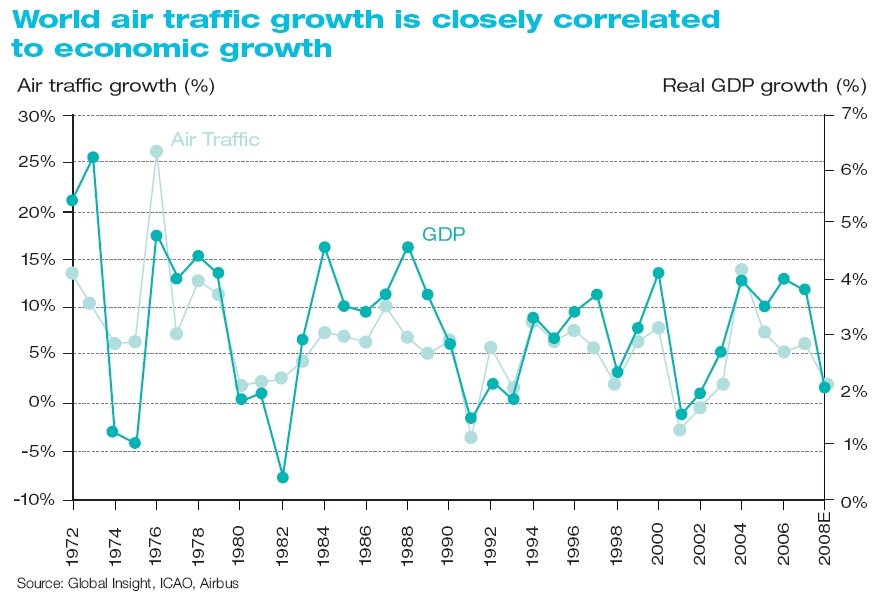
The first is how closely air traffic growth is correlated to world economic growth. This sentence and the following graphic are taken directly from the Global Market Forecast [PDF, 7.9MB] produced by colleagues at Airbus.

Air traffic growth vs GDP growth (source: Airbus).

You may see in the graphic the correlation (correlation coefficient above 0.7) and how the air traffic growth is however much more volatile than the economic growth. This is very intuitive. The better the economic situation the more business trips, family visits and holiday trips will take place. Nevertheless Airbus explains that in some situations and regions this is not enough to forecast traffic and thus they produce hybrid models.

Then, I wondered: how do airlines translate this growth in traffic into airplane orders?

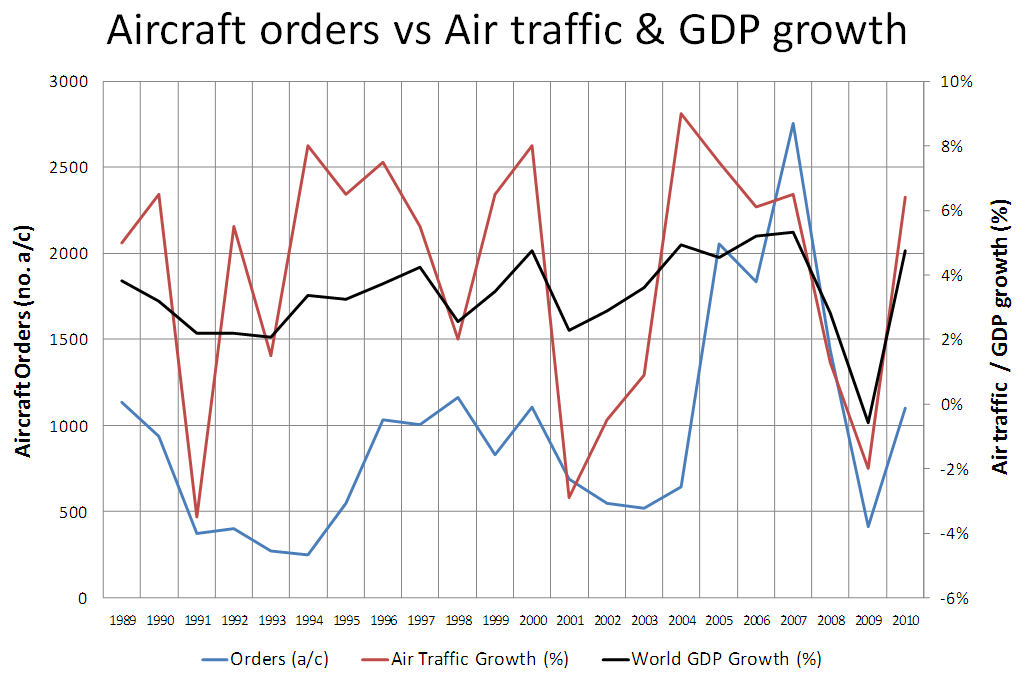
I made some numbers and played with them. I gathered aircraft orders for both Boeing and Airbus in the last ~20 years, plus air traffic and GDP growth over the same period of time. Then, I tried to connect one with another and see how best they would correlate with each other. Even though correlation does not imply causation, it may indicate existence of such causal relations that it’s why I searched for such results.

Here I plotted GDP growth (IMF), traffic growth (ICAO) and aircraft orders:

Aircraft orders vs. air traffic and GDP growth.

One could expect that airlines, after collecting first hand data of traffic growth plus the aggregate demand from industry sources (IATA, ICAO) and after applying their complex planning models would order aircraft from manufacturers. Thus, a correlation might be expected between traffic growth and aircraft orders. What we don’t know is whether airlines would place orders in the same year where the traffic growth actually takes place or there would be a lag (due to the airline analysis process, the negotiation with the manufacturer, arranging the financing, waiting for the next air show…).

The correlation results I got between these 2 variables are satisfactory though not that high. Matching data of the same year yields a 0.35 correlation coefficient. If however, we apply a 1-year lag in between air traffic growth data and orders the correlation is better, 0.44 (a lag of 2 years would worsen it down to 0.27 and so forth).

I found it curious that correlation between orders and GDP growth is much better! Matching data of the same year yielded a 0.61 correlation coefficient (which is rather high). A lag of a year would produce a still high 0.56 (2-year lag, 0.41; 3-year, 2.6…).

This was a striking result for me. After all, even though individual airlines do have complex models and experienced analysts behind them, taking the aggregate of the market, it seems that orders are placed less on data of traffic and more relying on data of economic growth, and rather soon, acting within the same year or a year later!

Who knows how the process within the airlines actually works… I can imagine thoroughly thought and thick studies coming from planning & analysis departments being put aside in the board room where one or two directors (more assertive than the average) convince the rest of the soundness of an operation based half in broad economic prospects (world GDP growth) and half in gut-feeling… wouldn’t surprise me much.

Leave a comment

Filed under Aerospace & Defence, Economy

For Living or Investing

"Pour Vivre ou Investir", seen in Toulouse.

This is an ad I see every day on my way to the office: “For Living or Investing”. They sell villas and apartments up to 4 rooms.

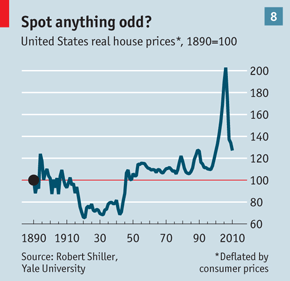
I have often defended the position that a house cannot be considered an investment. Recently I read yet another article at The Economist, in which they showed the latest graphic of the Case-Shiller index (below). I showed this graphic in a post last year. Now the prices have decreased some percentage points more. Most importantly, the curve and the article point that a further decrease will come. Down to the point where the prices stay stable along the last 130 years once inflation is adjusted.

Case-Shiller index.

Taking that into account, when I see that ad in the morning I can only smile and think of that other story which I included in another post about a message from the future describing how the housing craze continues to go on in Spain for decades… (extremely funny – in Spanish).

I have only one complain to the promoter of these houses in the ad: they are using land so close to the city to build houses for investing… if these houses are just meant for investing, and not necessarily for living, they could have built them under the sea and leave the land in Toulouse for living, public parks, roads, etc…

1 Comment

Filed under Economy, Investing