Category Archives: Investing

My risk profile…

Few days ago I received an email from my bank back in Spain, ING, suggesting me to take a small test in their website to see what my risk profile as an investor was. I was curious about what the result could be so I took it.

The test consisted of 7 questions regarding what kind of financial products you have, how much you save, whether you would take or not some products, etc. The result:

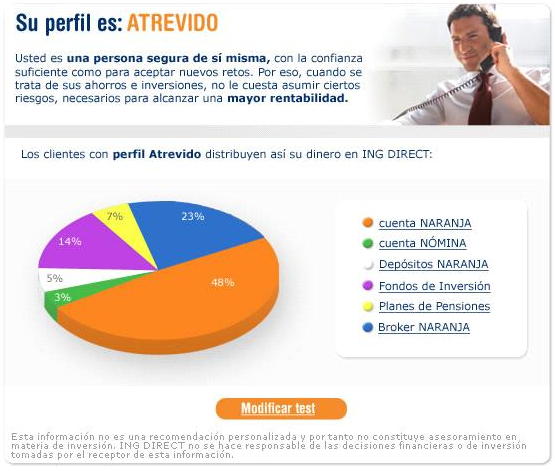
My risk profile: Bold, daring....

Contrary to that statement I consider myself quite conservative in relation with my financial behaviour and that is why I save and invest the way I do. Nevertheless, it seems that the mainstream definition or perception of risk is quite different to the one I have.

Together with the result of the test, ING showed a graphic showing the proportion of different financial products that people with “my” risk profile had… well, at least they got it right regarding the amounts I put in short-term fixed-income deposits, investment mutual funds and current account… the rest of them is quite different.

Bold, daring…

1 Comment

Filed under Investing

Gold as an invesment?

If in a previous post, pencils were treated as a supposedly safe haven in case of a recession. In this post I just wanted to mention that I don’t see anything more value in gold or silver than I see in pencils.

That may sound shocking, as we are used to have gold items in great praise. Well, as a commodity, as an asset, I don’t see much difference between gold and other materials. What it is valuable is the company that continues to produce goods out of those commodities, with ever greater productivity and value added to its products.

Gold by itself is just like a pencil, assuming that you continue to find someone in the future willing to pay something for both commodities (certainly not more than it is worth at any given moment).

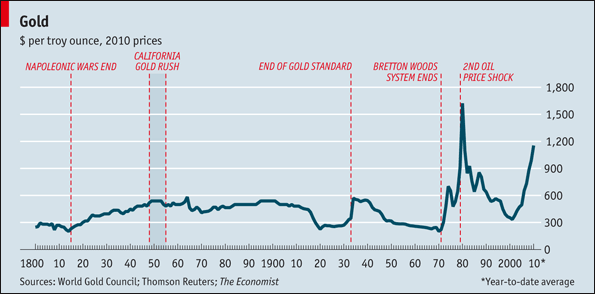
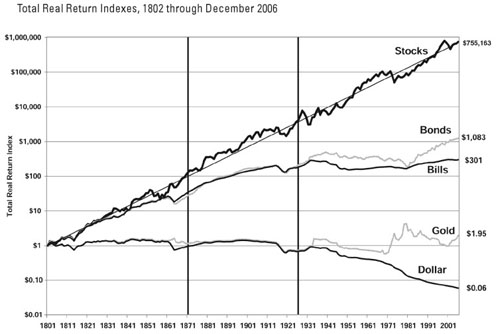
It is easy to say this now that both silver and gold have seen its prices plummet after the summer, but more than using the recent fall as basis for the argument, I have in mind these other long-term (as in centuries’ trend) graphics below:

Gold price fluctuations since 1800. Source: The Economist.

From the previous graphic, gold went up to 1,900 in the summer of 2011 and then fell again to around 1,600$ per ounce, in September. Well, I see no reason why it shouldn’t be around 300-600$ again, as it has always been.

Gold as an "investment"... Source: Jeremy Siegel

In this other graphic you may see how much gold is worth as an investment… well, it is more valuable than cash, but we already discredited cash in a previous post.

And still, you’ll find people running towards gold when there is a crisis… I never understood that. What are the gold price fluctuations based on?

Personally, I prefer to go to the Casino in Torrelodones once a year, lose at most some 50€, if that is the case, and kill altogether the speculative behaviours until the next year.

Leave a comment

Filed under Economy, Investing

Invest in real assets (pencils if need be)

My previous post discussed why it is better to be invested in real assets vs. cash or bonds in order to protect your savings in case of a recession.

Even though all the references were to stocks, I kept the word “assets” instead of “stocks” in the title and conclusion of the previous post in order to come back to it a later time, in this post.

Bestinver fund managers, in their conferences, have often given examples of assets to be invested in to protect your wealth such as pencils, chairs, and, this year, books.

If by the time a recession came and inflation started to build up, you had all your fortune invested in pencils, the same discussion that was made in the previous post with stocks would hold true for pencils.

For example, say that Southern Europe (Greece, Portugal, Italy…) in a near future needs to kick Germany out of the Euro due to its fiscal irresponsibility. Germany would then have to use another currency, e.g. the Deutsche Mark. Say that at day one the mark would be worth 2DM = 1 Euro, as it was more or less 10 years ago.

Due to the inevitable capital runaway from Germany, Germany would most probably undergo a period of hyperinflation and mark devaluation that could very well end with 1 Euro being worth ~ 2.000 DM. Obviously, the prudent Bavarian who had all her savings in cash would have nearly lost all of them.

However, if this Bavarian had instead purchased pencils in order to protect her wealth, she would have seen a different outcome. Say a pencil cost 0.5€ at the beginning, or 1DM. After all the hyperinflationary period, and if German students still needed pencils for their classes a pencil would sell for ~1,000DM. Thus, as the theory goes, the Bavarian investor would have protected her wealth just by being invested in real assets, i.e. pencils.

Of course, if you wanted to see your wealth grow pencils wouldn’t be the best assets to be invested in, as they do not reproduce, or any other assets are taken out of them, but to protect your savings they would work just fine.


Leave a comment

Filed under Economy, Investing

Inflation and assets

During the last weekend, I spent some hours watching the webcast of the annual investors’ conference of Bestinver, a Spanish investment fund.

I find the conference itself not only entertaining and informative but quite funny due to the way the fund managers show their value investing principles and how stubborn they’re with them (luckily for investors). The experience is comparable to that of Berkshire Hathaway annual general meeting.

As in previous years the managers defended how not only to have profits but to defend your savings during recessions it is much better to be invested in real assets than to have your money in cash, state bonds, etc.

This time they raised the case of Mexico during 1979-1988 (in previous cases they had referred to the Weimar Republic or Argentina), based on an analysis by Marc Faber (a presentation containing the same info can be retrieved here, PDF 4.8MB). During those years the Mexican peso suffered an extreme hyperinflation explained in the Wikipedia as follows:

In spite of the Oil Crisis of the late 1970s (Mexico is a producer and exporter), and due to excessive social spending, Mexico defaulted on its external debt in 1982. As a result, the country suffered a severe case of capital flight and several years of hyperinflation and peso devaluation. On 1 January 1993, Mexico created a new currency, the nuevo peso (“new peso”, or MXN), which chopped 3 zeros off the old peso, an inflation rate of 10,000% over the several years of the crisis. (One new peso was equal to 1000 of the obsolete MXP pesos).

Mexican peso evolution vs USD. Source: Ron Griess

Obviously, anyyone who either held savings in cash in pesos or Mexican bonds at that time virtually lost all his money.

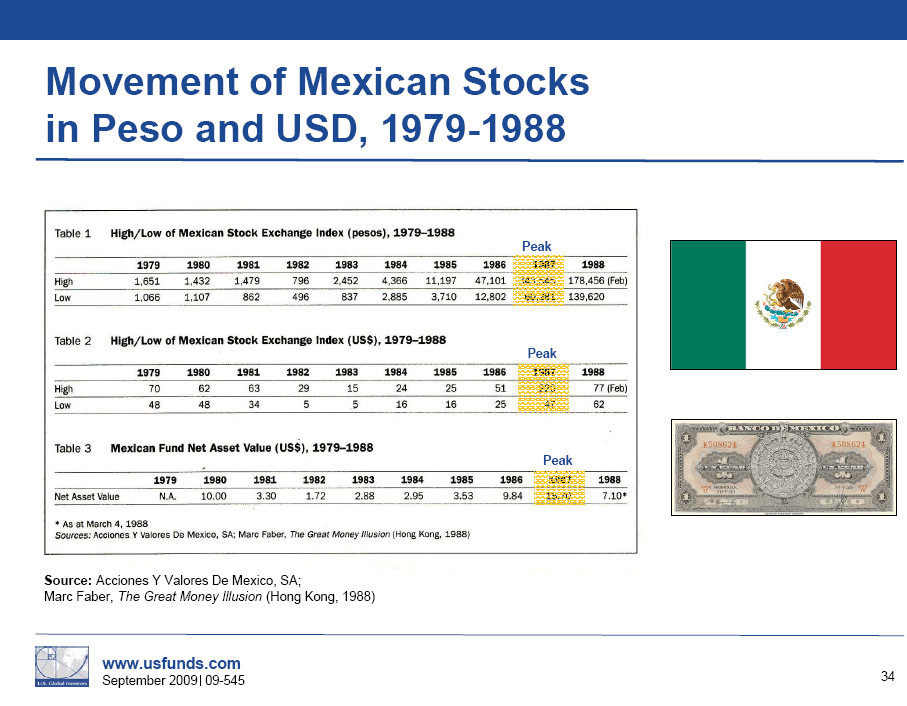
However, the same author made the analysis of what would have happened during those years to an individual holding Mexican stock, for which he used the Mexican Stock Exchange Index. The result is that at the end of the decade that person would have kept his wealth in US dollar terms, as the nominal value of the Mexican stocks raised at par with the hyperinflation and peso devaluation going on in the country.

Evolution of Mexican Stock. Source: Marc Faber

Conclusion: better be invested in assets if only to keep your savings safe in the long run.

Leave a comment

Filed under Economy, Investing

My experience at BRK2011

Berkshire Hathaway was a small textile company in Rhode Island. As many other textile companies it was struggling due to cheap labour competition elsewhere. Warren Buffett had already invested in the company before realising that it was headed for the worst. He was about to sell his stake when he felt irritated by an underbid from the managing director, then he decided not only not to sell his shares but to invest until gaining control, sacking the CEO and completing what he later referred to as his worst investment mistake he ever made…

Today Berkshire is a very different outfit: a big conglomerate, with over 130 billion USD in revenues, with a big insurance arm, dozens of operating companies and large investments in securities. Warren Buffett, his current CEO, regarded as the best investor ever.

Berkshire Hathaway annual shareholder meeting (BRK 2011, for this year’s event) is an extraordinary event, widely covered by press and attended by over 30.000 investors and relatives.

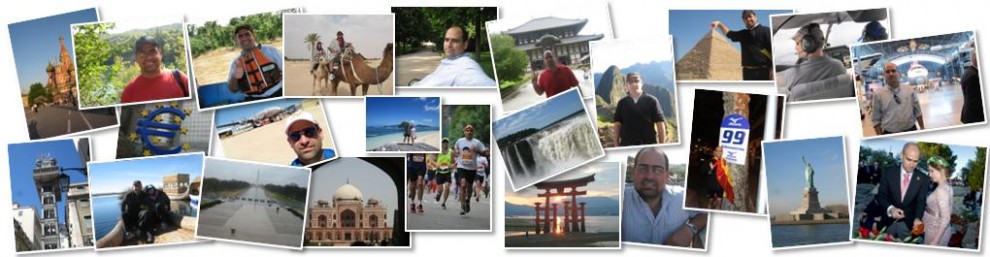
I explained in a previous post how I became interested in investing and when and why Luca and I became shareholders of Berkshire, now I want to give a small account of my experience in my baptism in the Woodstock for Capitalists (pictures below)…

… on Thursday 28th April Luca and I picked a rental car in Chicago, from where we would drive 800km to Omaha, Nebraska, with a stop over in Des Moines. Early in the afternoon Friday 29th we arrived at our hotel in Omaha, where the receptionist informed that there was a package waiting for us: our credentials for the weekend (thanks Debra!).

The event is not restricted to just the shareholders meeting, it is composed of a series of events covering the whole weekend. Let me describe them.

Cocktail at Borsheims. On Friday evening several buses would pick shareholders up from an infamous mall to bring us to Borsheims, the group’s jewellery shop. In front of the shop there was a big tent with live music, drinks and food. The shop was open, with re-doubled staffing to attend shareholders in eventual sales (as Buffett says “what better occasion to propose to your girlfriend than at BRK shareholders meeting?”).

Shareholder meeting on Saturday morning. The meeting started at 8:30am, doors opened at 7:00am and Luca and I arrived at 6:45am when there was already a huge queue. The meeting is held at the Qwest Center, a big convention center, which has room for exhibition and a sports indoor arena where the meeting is held. The exhibition area is packed by stands selling all kinds of goods from the group subsidiaries: boots, construction tools, books, sports wear, insurance… anything at a nice discount for shareholders. What better place to go shopping than to your own shop at a discount? To open the day some very funny videos and commercials were displayed. One featuring cartoons of Buffett, Munger and Schwarzenegger as Governator was especially welcomed.

Q&A session. Most of the meeting, until about 15:30 in the afternoon is a questions and answers session. This is when everybody wants to test and listen to the insights from the “Oracle of Omaha”. They made room for approximately 60 questions. Half were selected by 3 journalists from the thousands sent in by shareholders and the other half were drawn just before the meeting from volunteering shareholders in the floor.

This Q&A session is the most widely event reported by media. If you have read anything about the meeting, it was most probably said there. Instead of me telling here again what’s that was said, let me just refer to my first and second favourite accounts from other sources.

Charlie T. Munger. He is the vice chairman of the company and doesn’t get nearly as much coverage in the media as Buffett, however Warren has for him the highest regard. Munger has written a book, “Poor Charlie’s Almanack”, which is a treasure of wit and wisdom (and heavy as a brick).

At the meeting he is sitting side by side Warren all day during the meeting, looking half asleep and eating candies. Every now and then he replies with a “I have nothing to add” whenever Warren asks him for comment, except for a few times when he gets to give his point. That point goes without cosmetics straight to the issue at hand: “Much of the present crisis was caused not so much by evil but by stupidity”, [on financial projections] “seeing them in paper or in a screen makes some people believe they’re something serious”, “It seems both parties are competing to see which can be the most stupid. What it’s worse, they’re topping each other”, “Insurance is a difficult business: there are many temptations to be stupid… like in banking”…. after hours of this is when Warren came with his “If there’s anybody we’ve forgotten to insult, pass a note up and we’ll get to you.”

Business meeting. Just as a reminder I will say that this was a shareholders meeting. I hadn’t been in any other before though I had seen some either by streaming or podcast. Luca had attended one of EADS. At BRK the shareholders meeting itself lasted… 20 minutes? Reports, directors for the next year, etc., were voted in a matter of seconds. The only issue which took longer was a proposal to get all subsidiaries to report their carbon impact anticipating eventual legislation. Several shareholders took the word for and against and it was finally turned down… this is America.

Picnic at the Nebraska Furniture Mart. Once the shareholders meeting was finished, we all headed for NFM to enjoy a very professionally organized picnic as well as to visit the furniture shop (largest one in North America). This is another BRK subsidiary founded by Mrs. Rose Blumkin, a strong woman who emigrated from Russia at the beginning of the XX century and started the business at her place,  and after a disagreement with Warren went on to open a new business well into her ‘90s, being involved in the operations until shortly before her death at 104.

Brunch at Borsheims. On Sunday morning shareholders could go back to the jewellery shop to have a brunch while shopping, playing bridge or chess, seeing the performance of a magician, etc… It sounds all fine for a Sunday morning plan, the singularity comes from that jewels were sold by Warren Buffett himself, you could play bridge with or against Bill Gates, the chess game was against US champion, etc.

Lunch at Gorat’s. On Sunday two steak houses in Omaha closed doors for shareholders of BRK. Luca and I booked a place in both; one for lunch, the other for supper. Both are Buffett’s favourite places and this is why he recommends them (not being part of the group). Food was wonderful, just too much for us to finish everything.

Dinner at Piccolo’s. This would be our last event in the weekend. We had finished lunch just 5 hours before and were not really hungry. In fact, we were not hungry at all, but we went on with the plan. While we were having our burgers, Warren and Bill came in with their entourage to have dinner at a table 2 tables away from ours. It felt awkward to say the least but this how we closed our BRK2011, our first.

This slideshow requires JavaScript.
8 Comments

Filed under Investing, Travelling

Woodstock for Capitalists

Right now, while this is being published and if everything is going as planned, Luca and I are in Omaha, Nebraska. By now we should be already registered to attend tomorrow the annual shareholders meeting of Berkshire Hathaway, company famous for its CEO and Chairman, Warren Buffett.

While studying an MBA at EOI business school in Seville some 5 years ago, I developed a special interest in investing. I started reading some books and this led me to the bible of them all, Benjamin Graham’s “Intelligent Investor”, which I have referred to in this blog a number of times.

Warren Buffett, of World fame, was one of Graham’s disciples. He started very early setting up small businesses and investing in stocks. Decades later, he is known as the “oracle of Omaha” and considered to be on of the best investors ever.

About 2 years ago, Luca and I decided to invest in Berkshire Hathaway, mainly to acquire the right to attend this weekend’s party (you may call us freaks, right). Sure, we have arranged a nice holiday trip around it passing by Montreal, DC, Chicago and even Des Moines (!). But the end of this trip, was attending the shareholders’ meeting (others travel to attend a concert of U2!).

If you want to grasp what the experience may feel like, start by reading one of his letters to the shareholders of BRK, e.g. this year’s letter [PDF]. It’s 26 pages, ok, but it won’t take you more than 1 or 2 hours, and who knows, it may change your view of saving, investing, managing businesses, doing you a great favour. Apart from that, you’ll have a great fun reading it, as it is a very entertaining and humorous piece.

Finally, a positive note from an extract of the letter to reflect on, in today’s times:

“Don’t let that reality spook you. Throughout my lifetime, politicians and pundits have constantly moaned about terrifying problems facing America. Yet our citizens now live an astonishing six times better than when I was born. The prophets of doom have overlooked the all-important factor that is certain: Human potential is far from exhausted, and the American system for unleashing that potential – a system that has worked wonders for over two centuries despite frequent interruptions for recessions and even a Civil War – remains alive and effective.”

2 Comments

Filed under Investing

For Living or Investing

"Pour Vivre ou Investir", seen in Toulouse.

This is an ad I see every day on my way to the office: “For Living or Investing”. They sell villas and apartments up to 4 rooms.

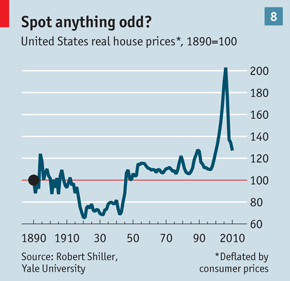
I have often defended the position that a house cannot be considered an investment. Recently I read yet another article at The Economist, in which they showed the latest graphic of the Case-Shiller index (below). I showed this graphic in a post last year. Now the prices have decreased some percentage points more. Most importantly, the curve and the article point that a further decrease will come. Down to the point where the prices stay stable along the last 130 years once inflation is adjusted.

Case-Shiller index.

Taking that into account, when I see that ad in the morning I can only smile and think of that other story which I included in another post about a message from the future describing how the housing craze continues to go on in Spain for decades… (extremely funny – in Spanish).

I have only one complain to the promoter of these houses in the ad: they are using land so close to the city to build houses for investing… if these houses are just meant for investing, and not necessarily for living, they could have built them under the sea and leave the land in Toulouse for living, public parks, roads, etc…

1 Comment

Filed under Economy, Investing

Modelo de servicio al cliente

Hace unos meses escribí un post comentando los pasos que seguí para cerrar una cuenta bancaria en Ibercaja.

Desde hace unos 3 años empecé a usar ING. Al principio solo una cuenta Naranja, luego una cuenta nómina, otra naranja, bróker naranja, depósitos, etc.

Hoy al contrario que en el post sobre Ibercaja quería comentar algunos de los aspectos que me encantan del servicio de ING.

Comisiones: no hay. Por hacer transferencias, ingresos, por la tarjeta, etc. Nada. Los únicos costes que hay son los de operar en bolsa.

A alguna gente le da miedo el no poder ir a una oficina a quejarse, a solucionar un problema. En primer lugar, decir que en determinados sitios sí hay oficinas de ING. En segundo lugar vendría una pregunta ¿acaso en una oficina de un banco uno recibe un buen trato o te solucionan un problema de forma adecuada? Sin embargo, ejemplos de excelente servicio con ING he tenido varios.

Hubo una vez que quise comprar acciones de determinada compañía de la bolsa de Nueva York, y no estaba disponible en el interfaz de la web del banco. Llamé, tomaron nota, se aseguraron de que la compañía cotizaba en el NYSE y en unas horas estaba dada de alta en su sistema. Incluso se disculpan de antemano por si pasa un día hasta que se encuentre disponible en el sistema. Esta operación la he repetido en numerosas ocasiones.

Con ING eso de llegar tarde al trabajo porque “he pasado por el banco”, o salir entre horas, no existe. Para operaciones normales uno puede llamar a cualquier hora. Bueno casi cualquiera. Recuerdo otra ocasión en que llegué a casa sobre las 20h y tenía varias cosas que hacer. Y las fui haciendo una a una y dejé la llamada a ING para el final. Creo que debí llamar sobre las 22:30. Me atendieron y entonces pedí hacer una operación en bolsa, a lo que la comercial me respondió “lo sentimos, desde hace dos semanas los compañeros de bróker naranja dan servicio solo hasta las 22:00”… solo. Ya me había acostumbrado a eso, a que estuviesen 24/7.

Gratuitamente envían un SMS o email con cada operación que hagas, pagos, transferencias, dividendos recibidos, nóminas recibidas, etc. En una ocasión después de recibir tal SMS con un cargo de una operación que yo no había hecho por 60€ en Brasil, semanas después de después de haber vuelto de las vacaciones. Me dio tiempo a rechazar el cargo antes de que me lo pasaran por la cuenta. Cancelé la tarjeta y nunca tuve que pagar ese dinero.

Cuando debo tomar alguna decisión al respecto de si recibir dividendos en cash o en acciones de una compañía me escriben un SMS o me llaman por teléfono… a Francia si es necesario.

A día de hoy la única vez que no quedé muy satisfecho fue cuando intenté comprar acciones de una compañía del NASDAQ y no pude porque no era del NASDAQ 100. Pero aquello era un problema del producto bróker naranja, no del servicio. De hecho estuve hablando un rato con un comercial sobre ello hasta que dejó la sugerencia por escrito (por supuesto, luego me llegó un email diciendo que habían recogido la sugerencia). A día de hoy, creo que todavía no se puede operar en el NASDAQ, solo en NASDAQ 100.

Una pega que se le puede poner es que ofrezcan un teléfono 901… pero bueno, sabiendo que se puede llamar con la tarifa plana a un teléfono fijo de Las Rozas no hay mayor problema (el mismo teléfono que aparece en el dorso de las tarjetas para el caso de que necesites llamar desde el extranjero).

—–

Disclaimer: no soy accionista de ING (todavía 😉 ), solo un cliente satisfecho.

Leave a comment

Filed under Investing, Marketing

Snowball (Compound interest)

I wanted to share with you in this post a speech I gave last Saturday at Rosemasters club contest. I was not contesting but a speech was needed for the evaluation contest, so I volunteered.

Why do I share this speech in particular? Not because it was especially good (nor especially bad), but because it has some insights that could help some of you in case you hadn’t reflected on them or made the numbers yourself.

I titled the speech “Snowball” but a more suitable title would have been “Snowball, or the beauty of compound interest”. Please, note that the metaphor of the snowball it’s not mine, so no need to praise my originality here. I borrowed it from Alison Schroeder’s biography of Warren Buffett “Snowball”, which I reviewed in other post in this blog (I take the opportunity to recommend the book again).

Below you can watch the video uploaded in Youtube (from the second 0:42 some helping hand lifts the camera, please be patient during those first seconds). Below the video I share the script of the speech so you can actually see the formula and the charts I showed. Reflect on it; it may help you a lot a long way down the road.

—–

Script:

“How many of you used to play with snow when you were a child?

Do you remember what the process you followed to build snowballs was? You started by making a small ball with your hands, like this. Then, you left it on the ground and let it roll over itself, so it was gaining more snowflakes and thus getting a bit bigger with every roll… for you it was a small effort, and after some time of rolling and rolling over, you easily could end up with big snowball like this.

Mr Contest chair, fellow members and guests,

Today I haven’t come to talk about snow. I want

  1. to explain the concept of compound interest
  2. to show how important it can be for or future and
  3. maybe to persuade you to take some action.

Let’s start:

This is the formula.

It shows what is the future value (FV) of an investment’s present value (PV) that gains a fixed interest rate (i) for n periods.

To put it simple, it means that the interest that we earn over the investment in the first year, will enter the calculation in the second year. In a very similar way that small snowflakes are making the snowball bigger.

  • The importance of compound interest for our future.

Who is the younger member of the audience today? I will ask you one question, let me see if I get the answer I want.

Are you saving and investing with your retirement in mind? Do you have pension plan or fund?

An extremely important factor in this discussion is that time in the formula appears in the exponent. This means the longer the time period, the better. Or put it in another way, the sooner we start investing or saving, the better.

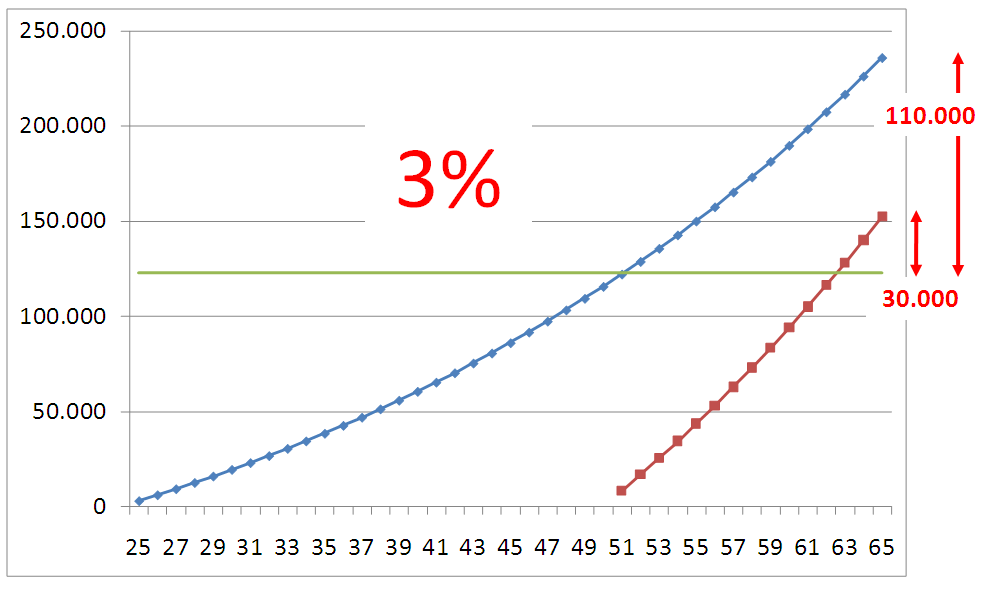
I made two quick calculations to show you. Imagine a 25 year old person who just started working. If he or she is able to save 250 euros per month, that is 3,000 euros per year, and puts it in a conservative fund which earns 3% a year… by the time he is 65 he will have around 230.000€. His yearly contribution would have been 123.000€. So another 110.000€ will have come from the interest. He will practically have doubled his money.

On the other hand, take a 50 year old person who never saved any money beforehand. He will have to save it in only the last 15 years of his working life. To make the comparison, I supposed that he contributed the same 123.000€ in those 15 years, for this he has to save 8.200 per year or 680€ per month… when he is 65 he will have 150.000€, having earned about 30.000€ from the interests, 4 times less!

Effect of a 3% compound interest over 40 years.

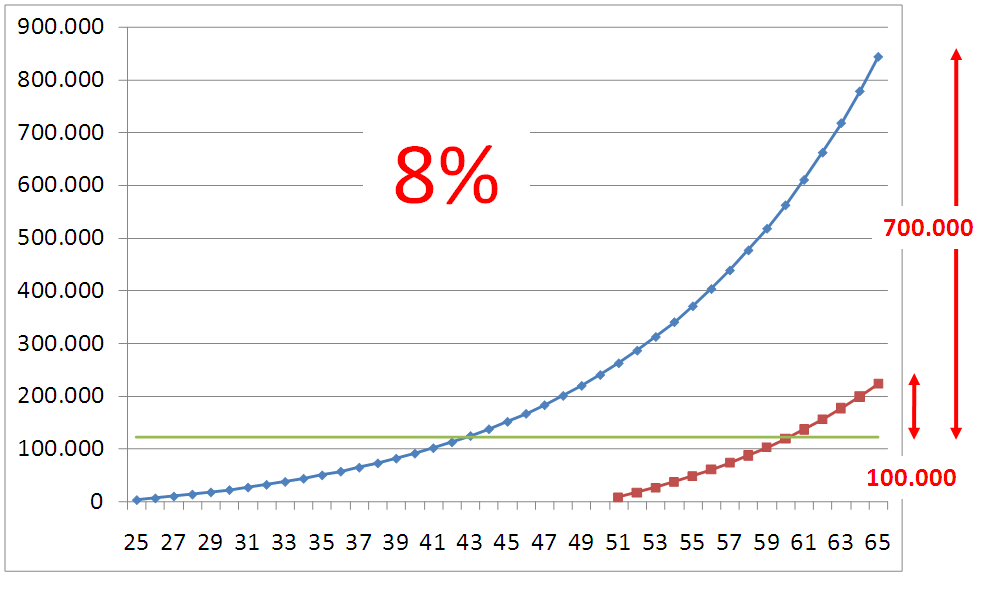
If the young person would invest in more volatile asset, for example the stock market, which historically earns about 8% every year, the new figures would be these ones.

  • 840.000 – earning 720.000 from interests
  • 222.000 – earning 100.000 from interests / 7 times less.

Effect of a 8% compound interest over 40 years.

Finally, with this discussion I wanted to explain little bit the compound interest, how it is making your savings grow, and even though at the beginning the growth seems very slow this is because the growth with time is exponential and we human beings are not very patient, thus it is important to start early saving small amounts, as snowflakes… in the end you will have a big snowball.

Start saving and see you at the retirement age.”

—–

Final comment: as you may have noticed there several passages when what I say differs from the script. I didn’t learn it by heart. During my first speeches in Toastmasters I tried to do so. Now I am departing from that approach. However, I do write the speech to give it a clear structure, to polish some parts, spot words I may have difficulty in pronouncing (so I can replace them for others) and count the amount of words so I am sure it fits in 5 to 7 minutes (often 7’30”… never more or fellow Toastmasters will start clapping).

5 Comments

Filed under Investing, Toastmasters

Resist the bias to act

Some days ago I tweeted about the swings of Mr. Market lately. The consideration of the stock market as Mr. Market is a metaphor that we owe it to Benjamin Graham.

Since a picture is worth a thousand words, I wanted to share a snapshot of the swings of our “J&L” ( 😉 ) portfolio in the past few weeks. One could read the picture as “you have lost 114$ in the past weeks”. That same person on January 28th would have said “you’ve lost 2,000$ in the last 10 days”.

"Resist the human bias to act", Charlie T. Munger

In fact we have not lost a nickel in these weeks, since we haven’t sold any stock. I love a quote from Charlie T. Munger, Berkshire Hathaway vice chairman, which goes: “Resist the natural human bias to act”.

You actually don’t need to buy or sell stock when the market is in the mood. It is as easy as not doing it. You may buy only when you see a margin of safety and sell only when the stock has reached what you considered it to be at its intrinsic value.

You can see that in these 5 weeks we could have lost up to 2,000$ twice; we didn’t. The only tools we counted with: patience and not “listening to Mr. Market”.

Precisely today, it is published the letter of Warren Buffett to Berkshire shareholders. Whether you are planning to invest in stocks or only want to have a fun read, take a look at it.

2 Comments

Filed under Investing