Category Archives: Sports

Elche – Alicante marathon 2025

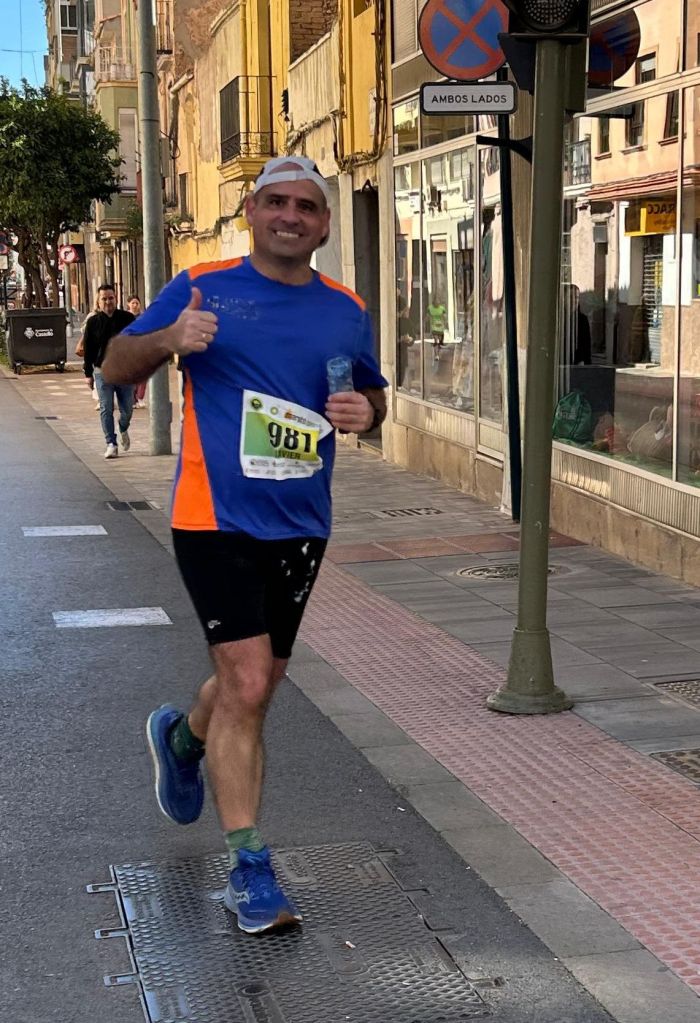
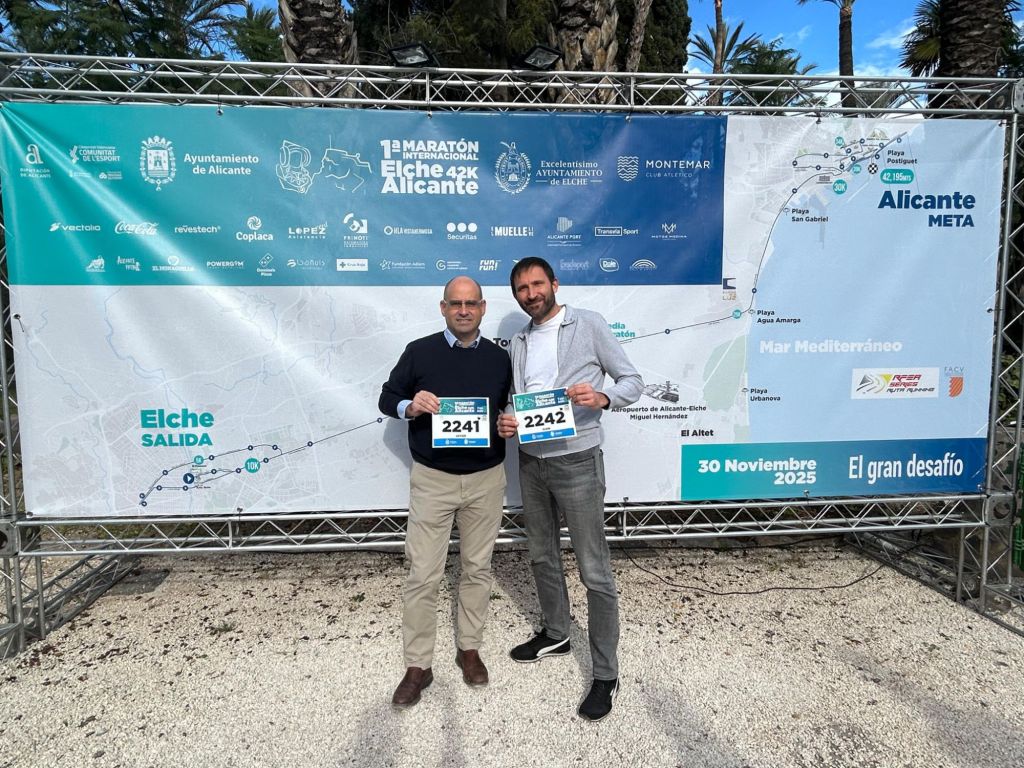
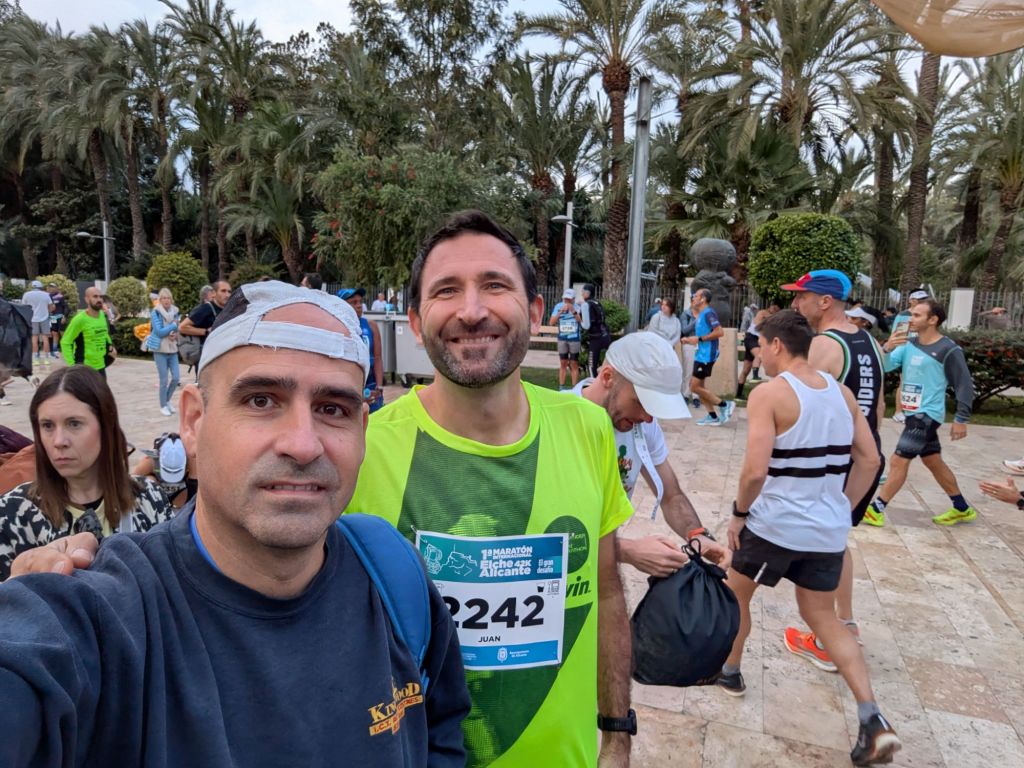
Last Sunday, November 30th, together with my friend Juan we traveled to Alicante to take part in its marathon, with over 3,000 runners registered in the distance.

We picked Elche – Alicante following our series of marathons abroad (to combine tourism with long distance running) that has taken some of us to run together in Paris, Berlin, Roma, Athens, Rotterdam, New York, Sevilla (x3), Madrid, Millau, Dublin (x2), Lisboa, Vienna, Krakow, Porto, Bucharest, Malaga and now Alicante (in bold those run with Juan).

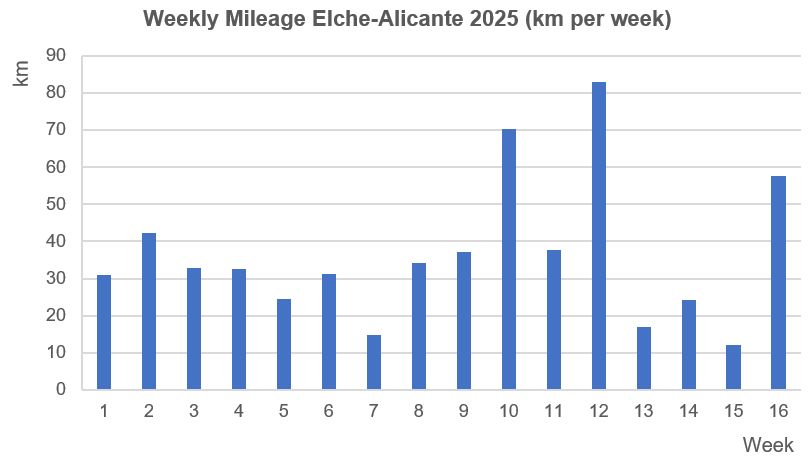
To prepare for this marathon I followed the same 16-week training plan I had used in the past. I started with the plan in mid August during our holidays in Italy. In the end I arrived to Alicante with 540km in the legs in those 16 weeks, a bit less than I would have liked. For some months I felt the Achilles tendon of the left leg a bit sensitive, hence I decided to run a moderate weekly mileage for over a month before starting with the long runs. I also chose to skip the series training, as being overweight (94kg the day after the race), the series would hurt the tendon. By mid October I started to run some long runs. Not many though, just 3 over 20km: 27km, 30km and 30km. I then had some business travel during which I managed to run some days even if on the treadmill. With that training behind and the experience of the last 3 marathons I was somewhat confident in being able to complete the marathon in a time between 4h05′ and 4h15′ even if the final mark was uncertain.

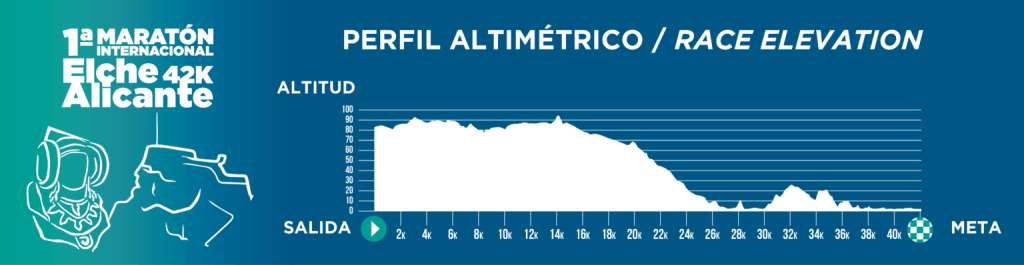
The profile from Elche to Alicante was rather flat on each of the cities and with a 10km descending stretch from one to the other. The race started in Elche by the castle and finished by the port in Alicante. We stayed in Alicante and we counted with another friend, Nacho, to bring us to Elche on the morning of the race.

Race profile

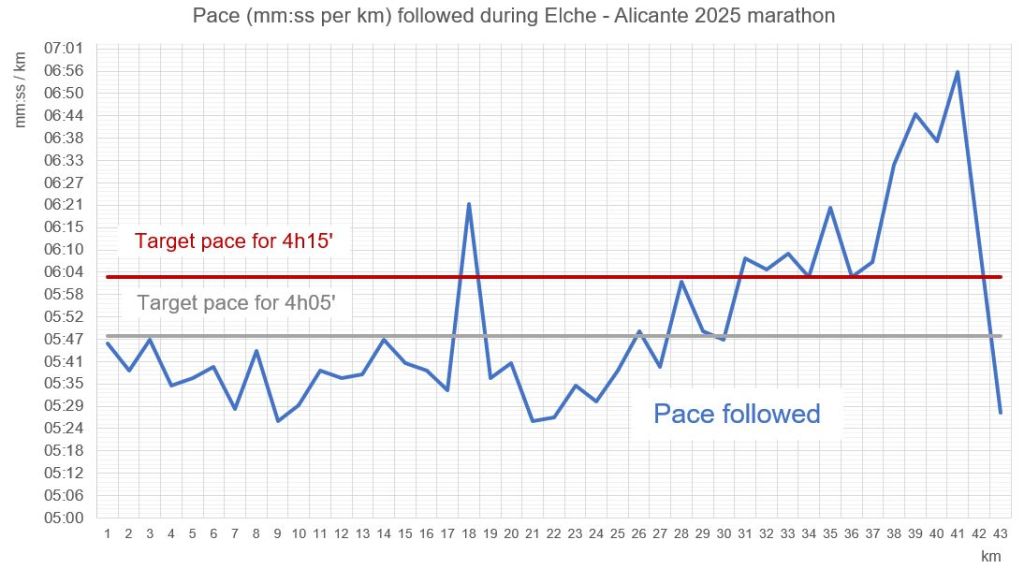
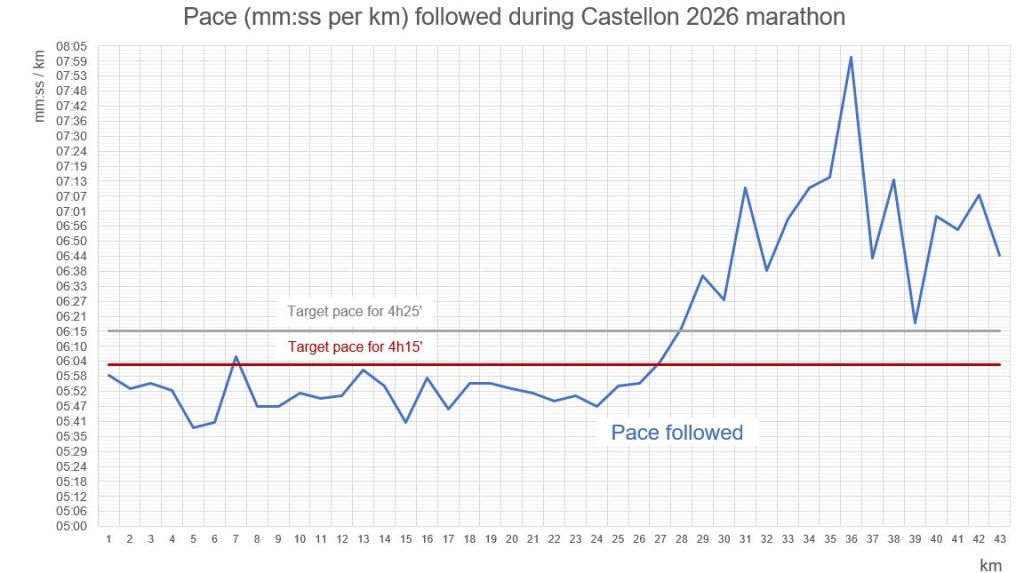
The temperature was a bit fresh in the morning (~8°C), the sky was clear and it would be a bit warmer towards the end of the race, though the temperature did not exceed 19°C. My strategy was to start at a pace just below 6min per km, and then, if I felt well, accelerate a bit after some kilometres to build up some margin during the descent part of the circuit so that I could target a time below 4h15′. There were pacers for times aiming at every 15-minute mark and I started a bit behind the 4-hour pacers, which I kept at a short distance until the km 25.

The race started at 9:00am and Juan departed a bit ahead, hence we wished luck to each other and ran separately. I ran at comfortable and faster paces than I had targeted until the km 25. I didn’t feel any pain in the tendons. Then from the km 30 I started running at paces above 6:00/km, but I still felt good, focused and running one km after another. Until km 37… During the 4 kilometres between 38 and 41 I was unable to keep those paces and I slowed down to ~6:40/km, until I gathered some strength for the last 1.2km.

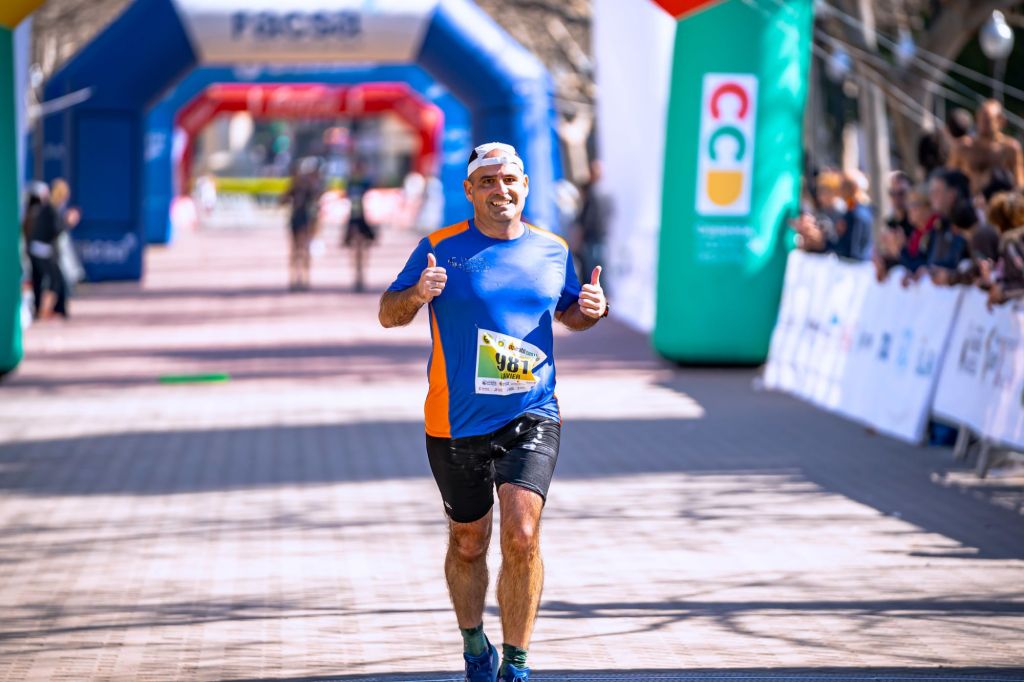
That last kilometre of the race felt great, as always. Seeing the finish line arches from afar and sprinting towards them, feeling proud of having done it again without having gone through much suffering during the race itself.

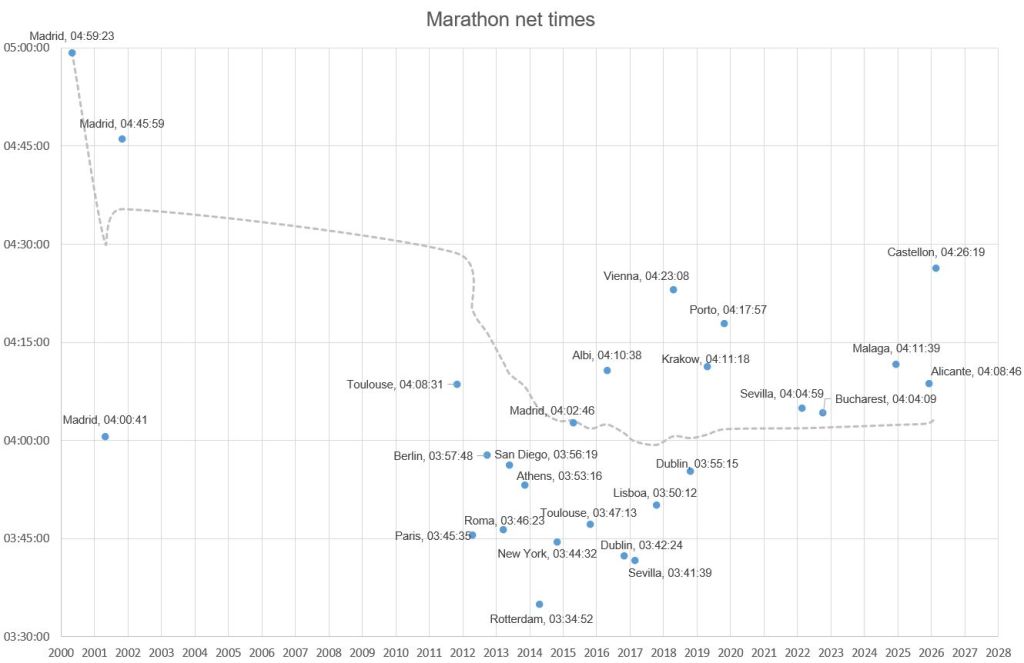
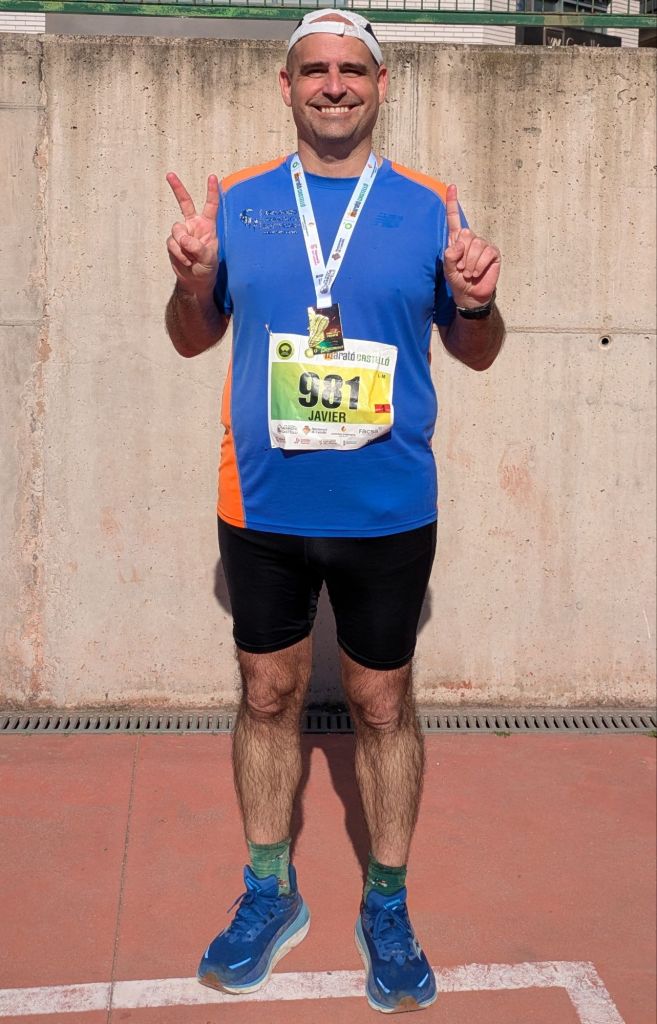
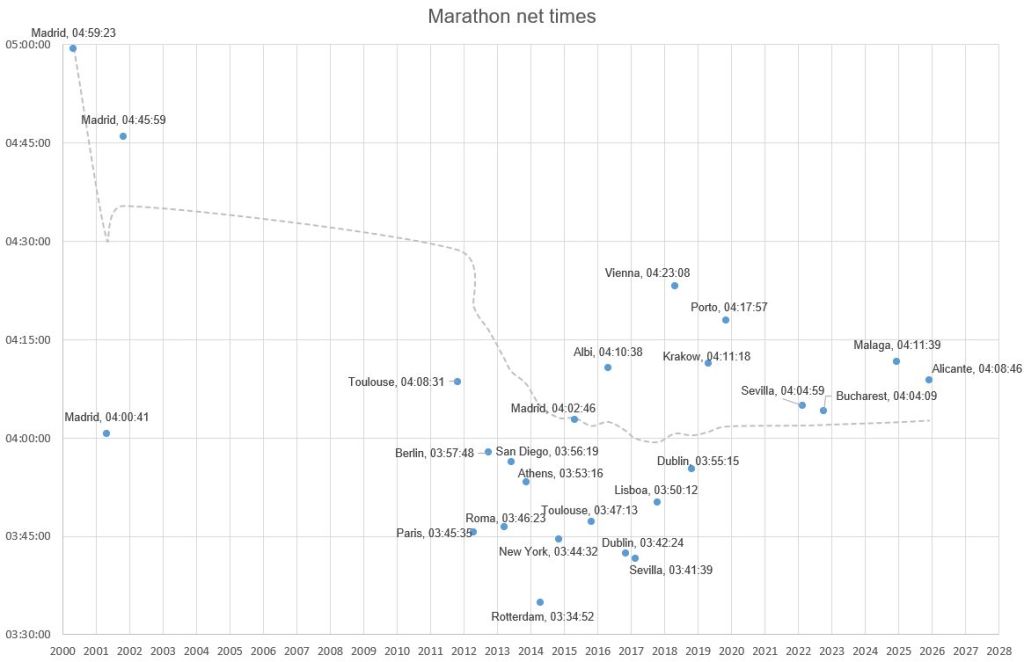
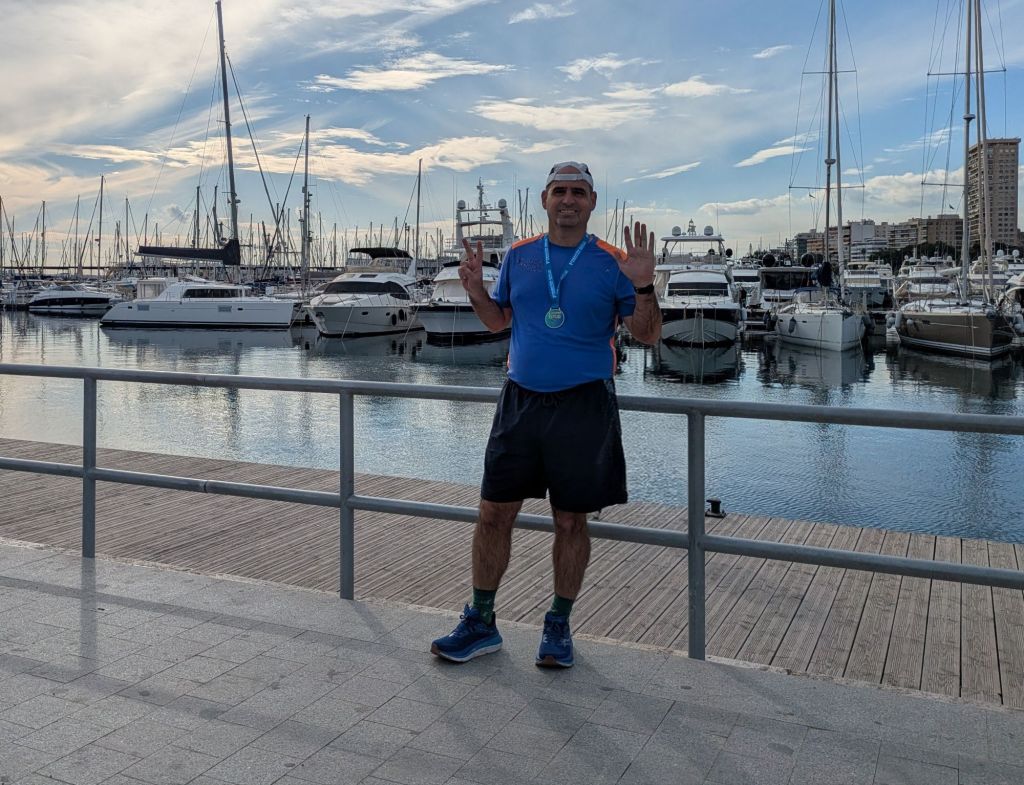
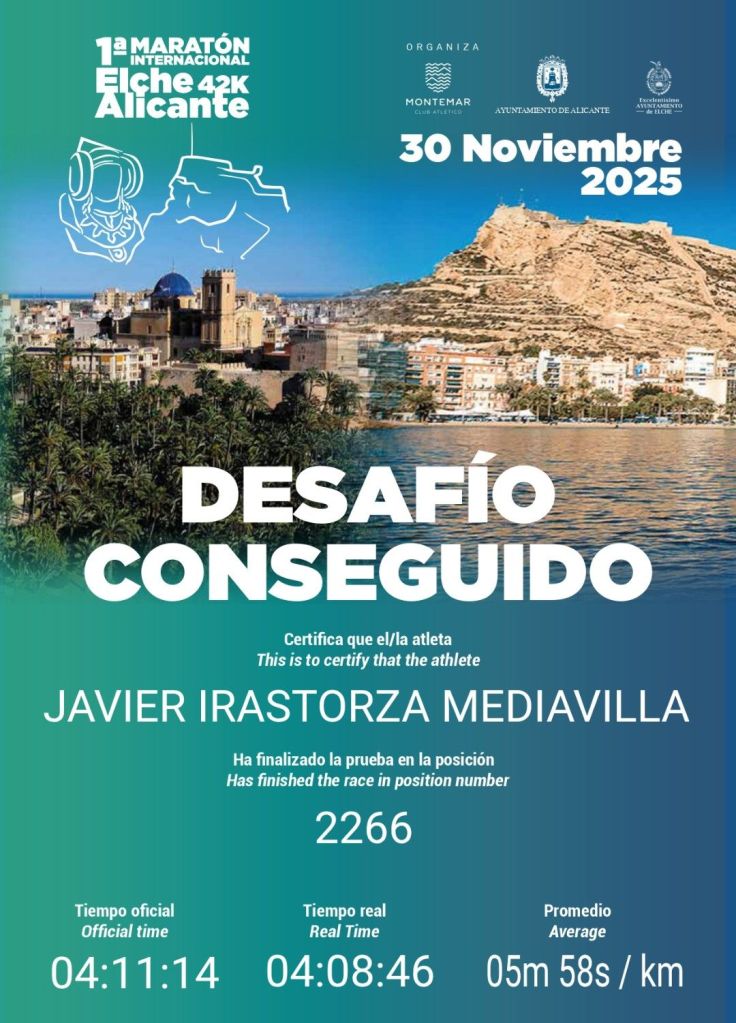
In the end, I clocked a net time of 4h08’46”, a time about what I expected given the weight with which I arrived at the race and the incomplete training that I followed, even nearly 3 minutes faster than the last marathon (Málaga). This has been my 25th marathon completed, easy to say today but not so on April 30th 2000 when I started in the distance in Madrid.
With those 4h08’46”, I was again above the 4-hour mark and finished in the 2,266th place out of 3,161 finishers (28% percentile). That time makes it my 8th worst marathon, though with a positive feeling of having completed another marathon 1 year later and a bit faster than the last. I am now looking forward to the next one.

This was the first marathon organized between Elche and Alicante. The organization of the race was rather good. They only underestimated the amount of trucks needed to provide a smooth wardrobe service for the runners’ bags. The circuit was good. They included plenty of water supply (with bottles) posts, isotonic drinks, some food (bananas and dates; a bit late in the race though) and gels (though I carried myself enough of those). It was a great experience.

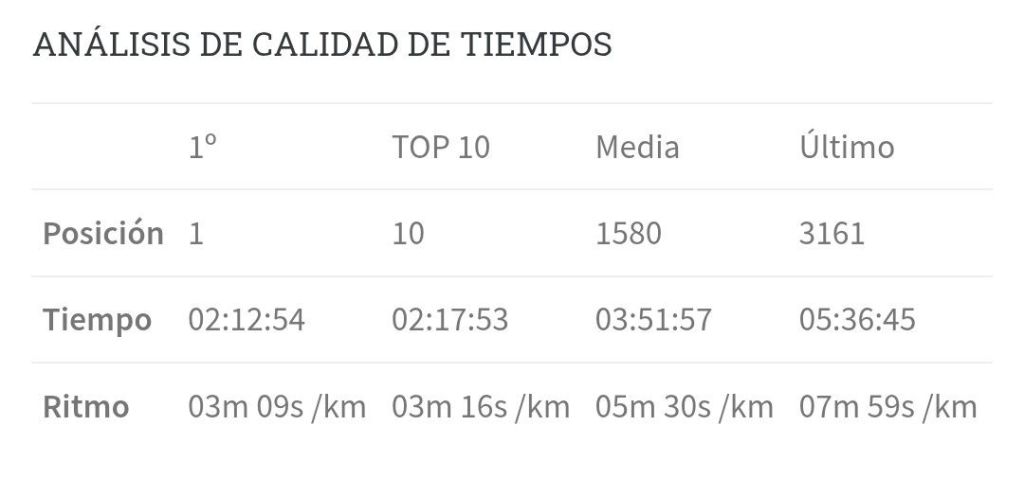
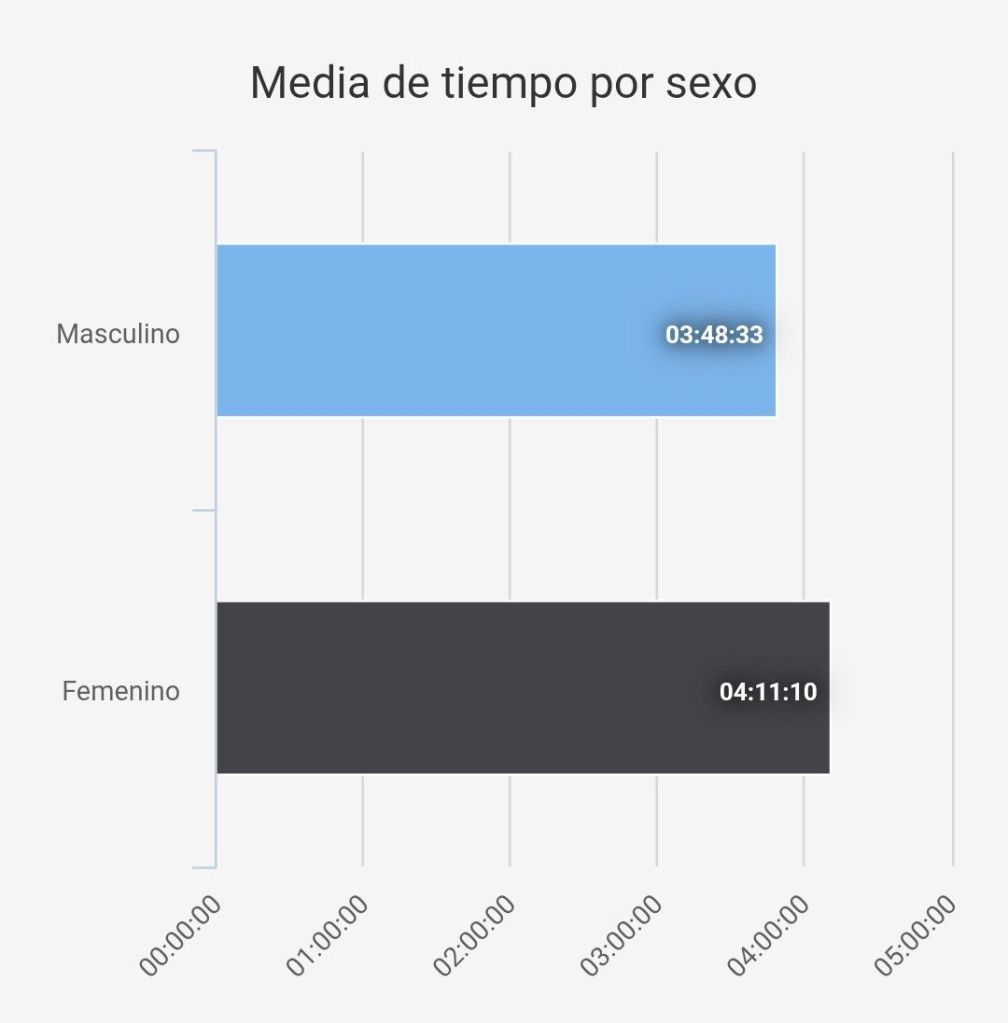
I leave below some charts with statistics of the race:

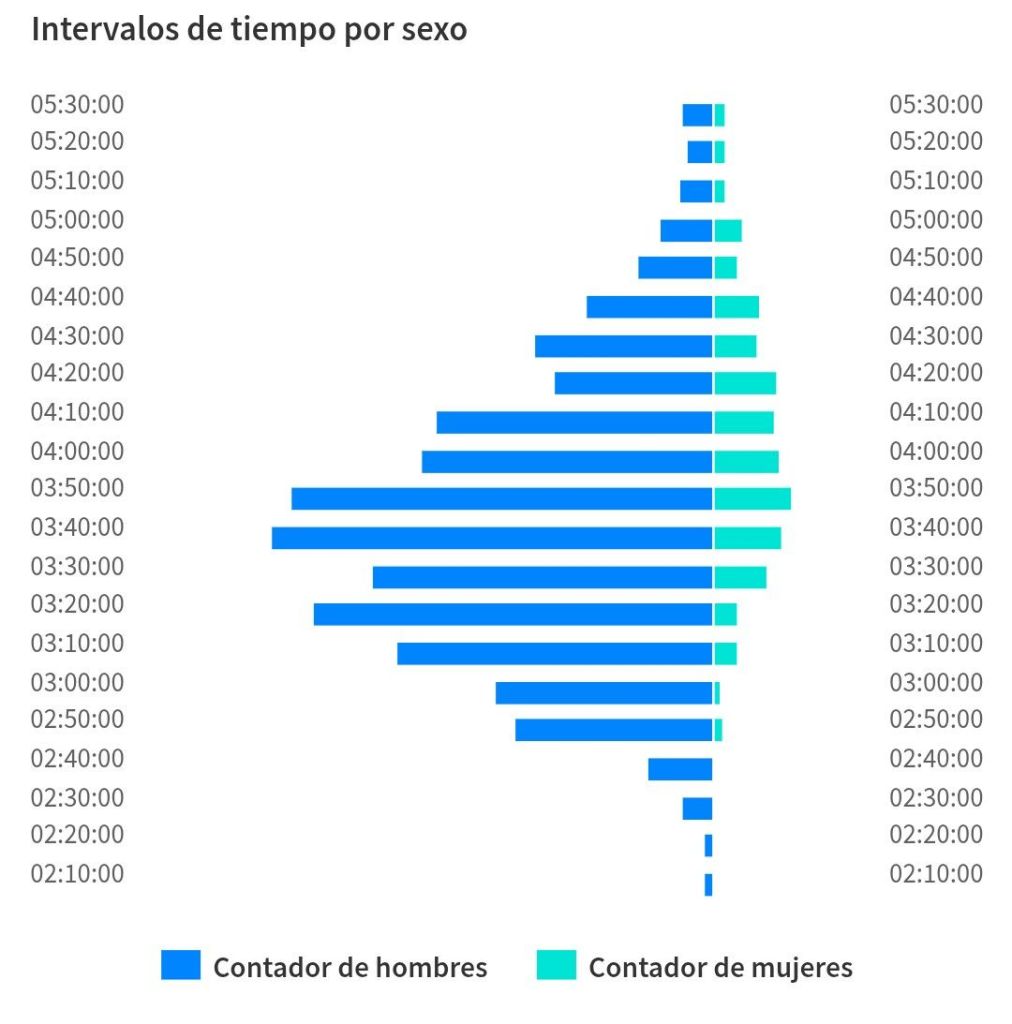
  • The average finish time was just below 3h52′. For the men 3h48′, for the women 4h11′. You can also see the distribution of runners by their times by splits of 10 minutes.
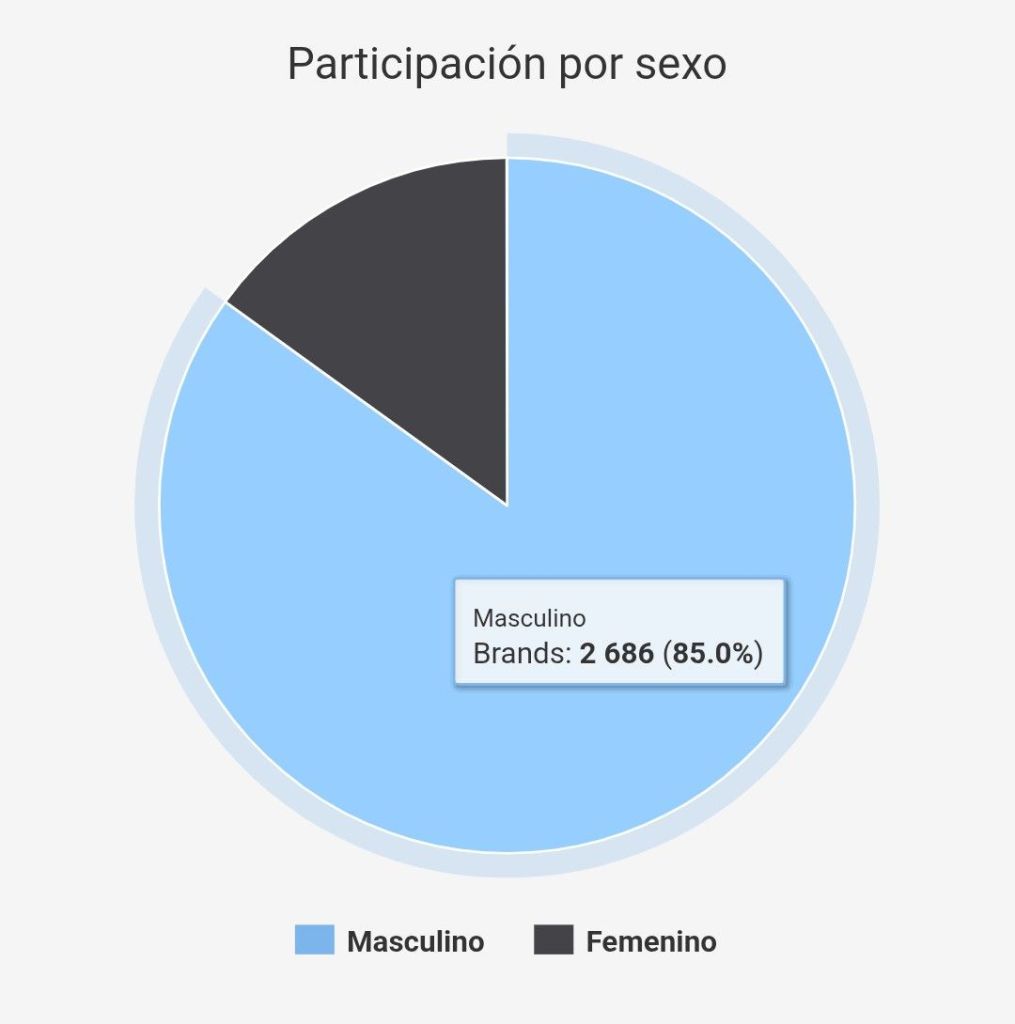
  • 85% of the participants were men.

Leave a comment

Filed under Sports

Marathon world record evolution (2025)

Last time I checked all-time men’s best marathon times and the world record evolution was in 2014 ahead of running Rotterdam marathon (post back then). In this blog post I’m going to make an update, share some charts and review some statistics. For that purpose, I use the website “Track and Field all-time Performances” (maintained since years ago by Peter Larsson).

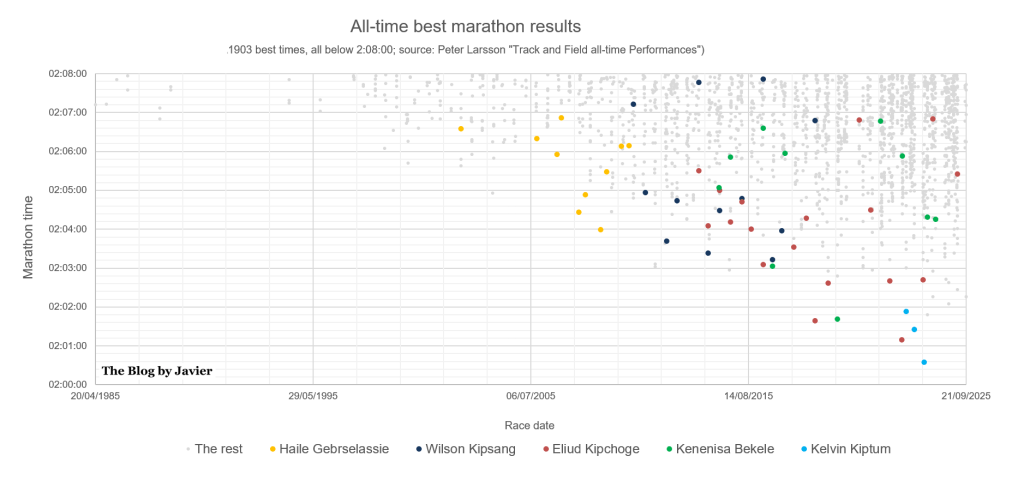
With the data of all-time best men’s marathon I plotted the chart below with the best 1,903 times, i.e., all those below 2h08′ and their dates, highlighting marathon times by Haile Gebrselassie, Wilson Kipsang, Eliud Kipchoge, Kenenisa Bekele and Kelvin Kiptum.

Some stats in relation to those 1,903 times under 2h08′:

  • Countries of which athletes achieved most such times: Kenya 853 times or 44.8%, Ethiopia 570 times or 30.0%, Japan 114 (6.0%), Morocco 44 (2.3%), Eritrea 41 (2.2%), Israel 20 (1.1%), France 20 (1.1%), Uganda 19 (1.0%). Those are the top 9 countries, there are another 34 from which athletes have run below 2h08′ (for a total of 43 countries).
  • There are 742 athletes that have run below 2h08′. The individuals who have done so more often: Eliud Kipchoge 18 times, Sisay Lemma 17, Tsegay Kebede 15, Tamirat Tola 13, Abel Kirui 13, Wilson Kipsang 12, Bernard Kiprop 12, Evans Chebet 12, Benson Kipruto 12, Laban Korir 11, Emmanuel Mutai 11, Amos Kipruto 11, Birhanu Legese 11, Kenenisa Bekele 10, Haile Gebrselassie 10, Leul Gebrselassie 10, Deso Gelmisa 10…

Now, if we raise the bar to see the times at or below 2h05′, we find 231 times:

  • Countries of which athletes achieved most such times: Kenya 108 times or 46.8%, Ethiopia 98 times or 42.4% (both combined 89.2%!), Tanzania 4 (1.7%), Belgium 4 (1.7%), Netherlands 3 (1.3%). Those are the top 5 countries, there are another 11 from which athletes have run at or below 2h05′ (for a total of 16 countries).
  • There are 124 athletes that have run at or below 2h05′. The individuals who have done so more often: Eliud Kipchoge 14 times, Tamirat Tola 8, Wilson Kipsang 8, Sisay Lemma 7, Amos Kipruto 6, Birhanu Legese 6, Leul Gebrselassie 5, three athletes with 4 times including Kenenisa Bekele, 14 athletes with 3 times including Kelvin Kiptum, Dennis Kimetto, Geoffrey Mutai and Haile Gebrselassie, 23 athletes with 2 times including Patrick Makau…
  • Which are the fastest marathons? The cities where most of those 231 times at or below 2h05′ have been achieved are: Berlin and Valencia with 35 each, London and Dubai with 27 each, Rotterdam 18, Amsterdam and Chicago with 15 each, Tokyo 14. Those are the top 8 cities (accounting for 81% of those 231 times), there are other 16 cities where such fast times have been achieved.

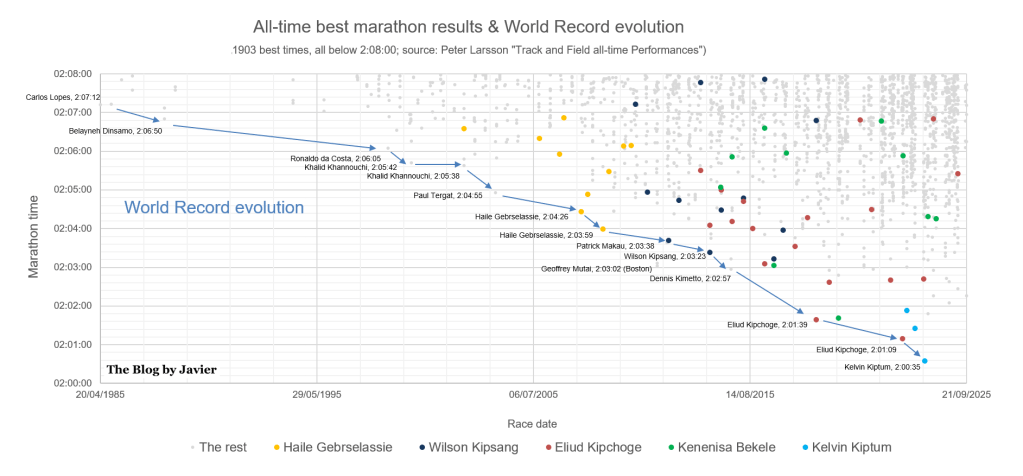
Now let’s look at the evolution of the World Record since 1985 in this other chart:

Some comments to the chart:

  • In the last 40 years, the record has been beaten 13 times.
  • The current world record was set by Kelvin Kiptum in Chicago in 2023 with 2h00’35” at the age of 23.9. He sadly passed away in a car crash a few months later. His career was very promising, having run only 3 marathons, all three in less than 12 months, all 3 below 2h02′. 3 of the best 7 times, 1 of the only 4 men having run below that mark.
  • The record that lasted the most was Dinsamo’s 2:06:50 in 1988, which took just over 10 years to be beaten by Ronaldo da Costa in 1998.
  • 3 athletes have set the world record twice: Khalid Khannouchi, Haile Gebrselassie and Eliud Kipchoge.
  • The biggest improvement of the record was made by Eliud Kipchoge who took 1’18” off Dennis Kimetto’s previous record.
  • Geoffrey Mutai ran in 2h03’02” before 3 world records set the bar below his time, however, as he achieved that in Boston 2011 (downhill and point to point race) it didn’t count for the record.

What is the best age to run marathons?

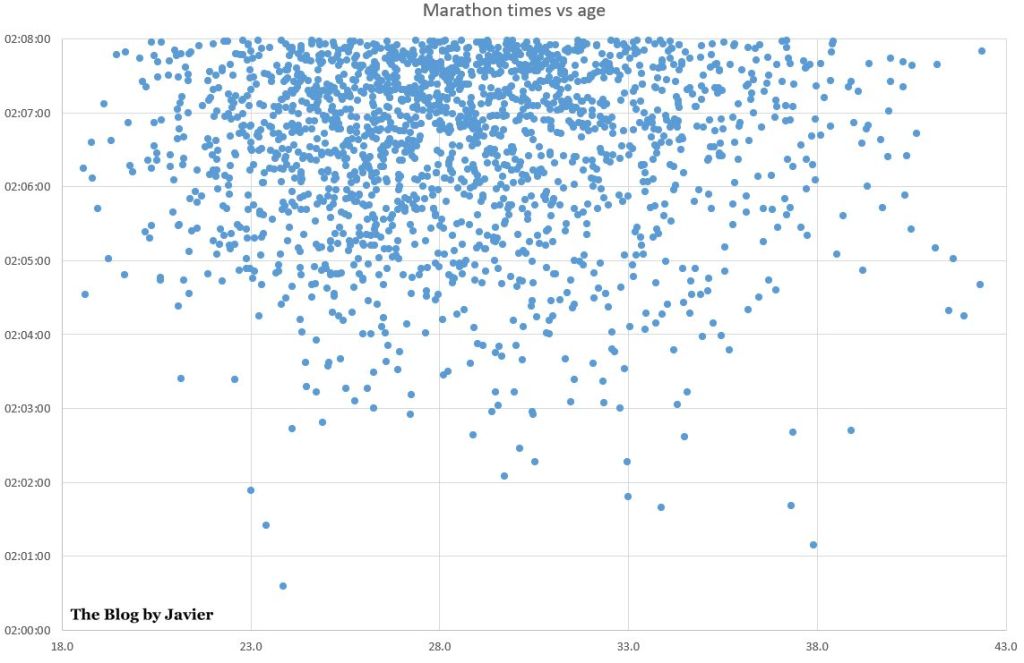
I plotted this other chart looking at the best 1,903 marathon times vs the age the runners had at the time of completing each of those races.

Most of the times below 2h08′ are achieved between 23 and 33 years old, but indeed most of the best ones are achieved between 28 and 39 years old, with the exception of the 3 marathons ran by Kelvin Kiptum, including his current world record.

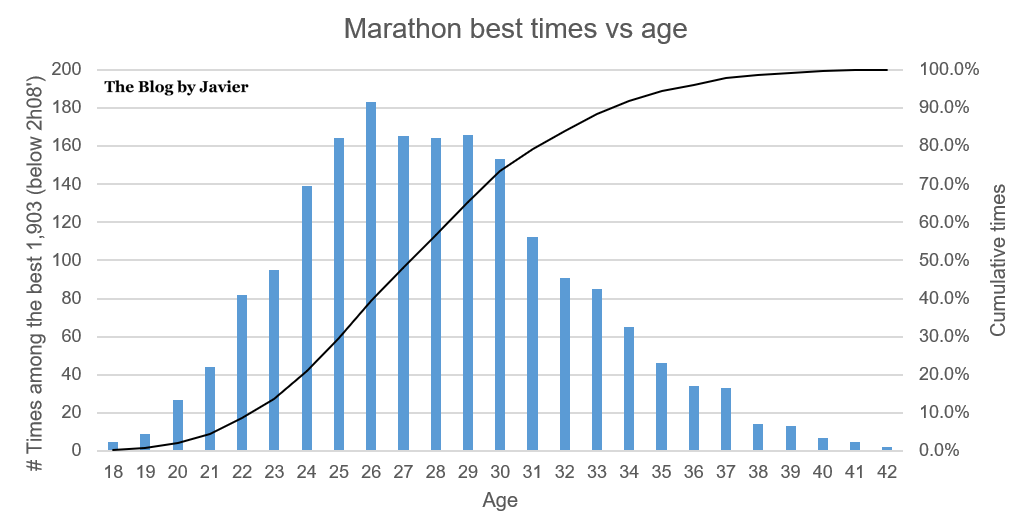
Another interesting chart to relate best times and age is the histogram below. In that one we can see that effectively most of the times below 2h08′ are achieved between 24 and 30 years old, and between 23 and 33 (both included) 80% of those times are achieved.

Leave a comment

Filed under Sports

All-time men’s best pole vault – Tokyo 2025 World Athletics Championships – Armand Duplantis

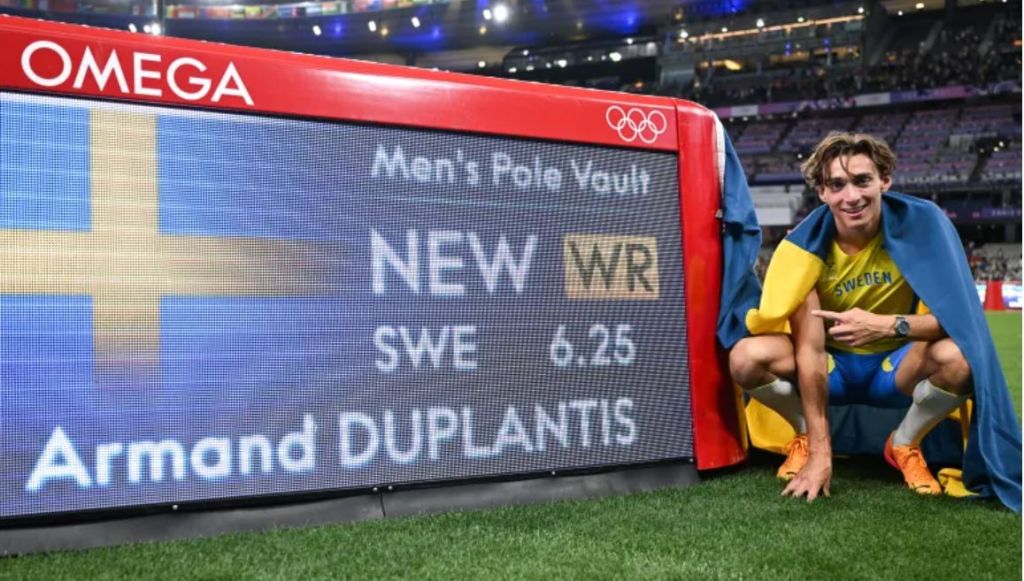
Last summer, after the Olympic Games Paris 2024 I wrote a post to review the best pole vault jumps after the world record set in that competition by Armand Duplantis with 6.25m. That post aged very quickly as just 3 weeks later Duplantis set another World record.

In this 2025 he had set another 3 records before going to the World Championship in Tokyo, where again he sat a new World record with 6.30m. This is a good time to update last year’s chart and recap the best ever performances.

For that purpose I used the website “Track and Field all-time Performances” (maintained since years ago by Peter Larsson).

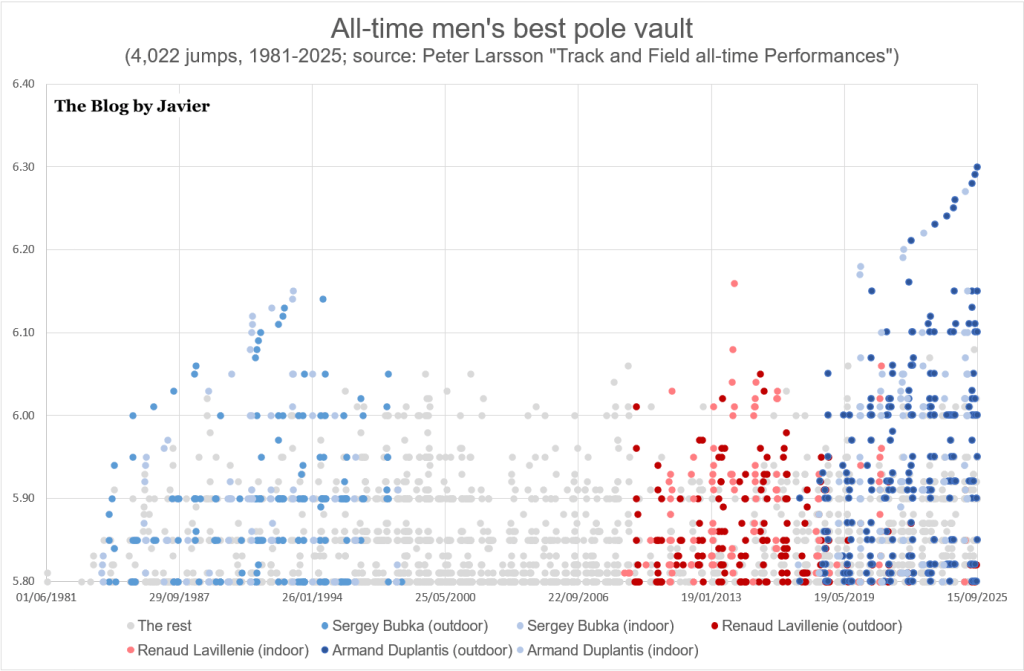
With the data of all-time men’s best pole vault I plotted the chart below with the best 4,022 jumps (jumps from 5.80m and above) and their dates, highlighting the jumps by Sergey Bubka, Renaud Lavillenie and Duplantis (dark colour for outdoor vaulting, light colour for indoor).

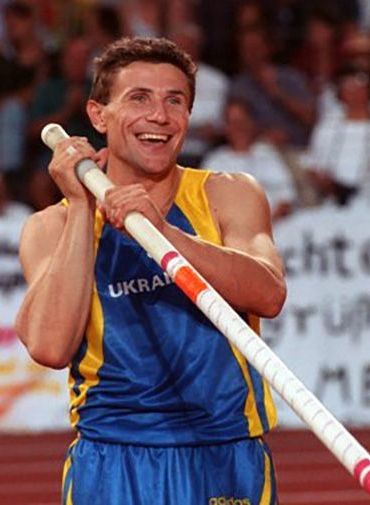
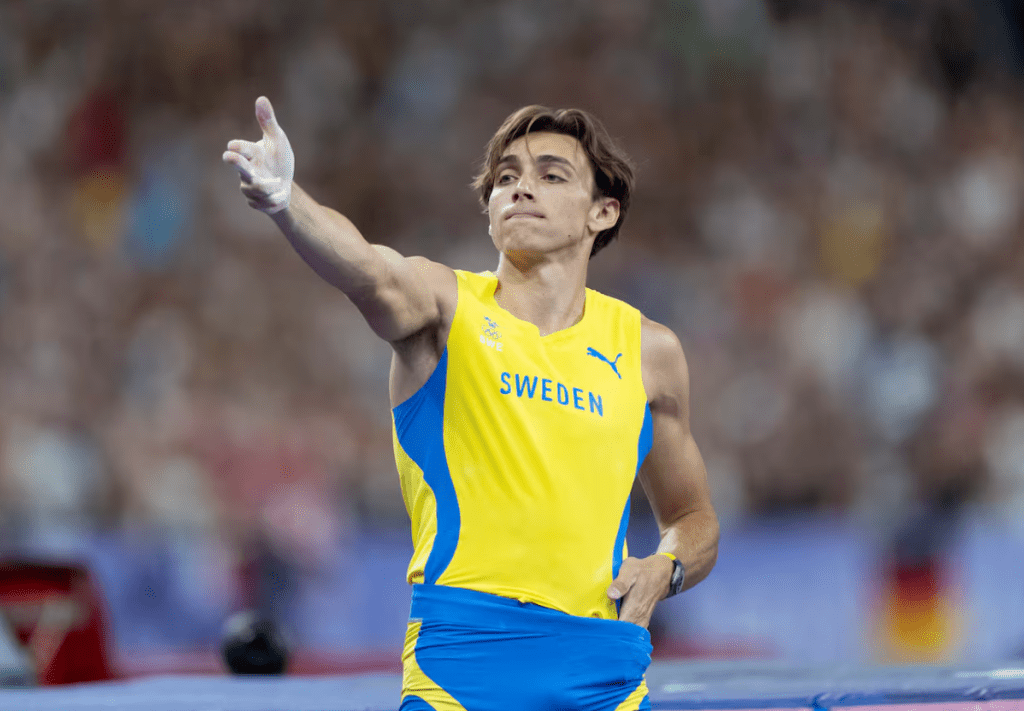
Bubka dominated the sport in the 1980’s and 90’s (first competing for the Soviet Union and later for Ukraine) when he set up to 35 world records (17 outdoor and 18 indoor), won 6 gold medals at the World Championships and 1 at the Olympic Games. Lavillenie also won a gold medal at the Olympics in London and won several World Indoor Championships (among other medals) and set an indoor world record (which was the absolute record for 6 years). Duplantis, competing for Sweden, at the young age of 25 has already won 2 gold medals at the Olympics (Tokyo and Paris) and 3 World Championships outdoors (among other medals) and has already set 14 world records (10 outdoors and 4 indoors).

Some comments after looking at the chart:

  • Bubka holds 249 of the 4,022 jumps (6.2%) at 5.80m and above
  • Lavillenie holds 271 of the 4,022 jumps (6.7%) at 5.80m and above
  • Duplantis holds 323 of the 4,022 jumps (8.0%) at 5.80m and above… he’s already the athlete with the highest proportion in that segment
  • Of those jumps of 6.00m and above (274 jumps… 52 such jumps in just the last year):
    • Bubka holds 46 of the 274 jumps (16.8%) at 6.00m and above
    • Lavillenie holds 21 of the 274 jumps (7.7%) at 6.00m and above
    • Duplantis holds 122 of the 274 jumps (44.5%) at 6.00m and above
  • If we focus at outdoor jumps of 6.00m and above (170 jumps):
    • Bubka holds 28 of the 170 jumps (16.5%) at 6.00m and above
    • Lavillenie holds 4 of the 170 jumps (2.4%) at 6.00m and above
    • Duplantis holds 82 of the 170 jumps (48.2%) at 6.00m and above
    • 25 men have vaulted outdoors at 6.00m or above, only Bubka and Duplantis jumped 6.09m or above: 6 and 28 times, respectively. Duplantis has performed 13 such jumps since the Olympics last year.
  • Until Duplantis came to the scene when the World record was at 6.16m held by Lavillenie, established indoors in 2014 (Donetsk). Since 2020 Duplantis has jumped above that world record 14 times.

Bubka achieved his best jumps when he was between 27 and 30 years old. Duplantis at his 25 years has already more than twice as many high jumps as Bubka in his entire career. If Duplantis continues his progression up to 27-30 years of age we can only imagine what I’d to come, something that might have been deemed unbelievable for those of us who witnessed Bubka in his prime, but we are now going through the same dominance yet with higher heights and more pronounced (Emmanouil Karális, silver at the World Championships in Tokyo, achieved 6.00m… 30cm less than Duplantis!).

Leave a comment

Filed under Sports

How does UEFA weigh club honours? (football clubs’ coefficients, 2024 update)

This is an update of a post I wrote 6 years ago (here, in Spanish) explanining how UEFA weighs club honours and now sharing the current (end of 2023/24 season) ranking.

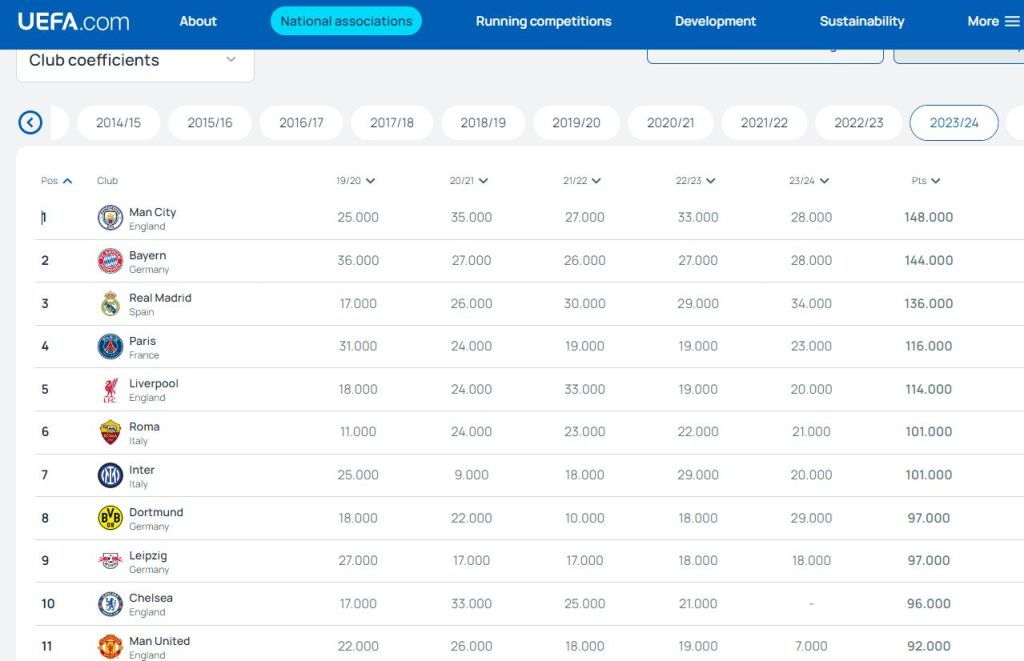
UEFA publishes various rankings of football clubs, football federations and national teams. For that purpose UEFA assigns a series of points according to results achieved in the competitions organized by UEFA itself. From those, one can see at the end of each season the club which reached the highest scoring.

With the scoring of different years, UEFA publishes two different club rankings: the 5-year club ranking and the 10-year club ranking.

The 5-year club ranking is the one that UEFA generally employs to rank the teams (when UEFA publishes the team leading the ranking at any given point, it refers to the team leading that 5-year ranking, not the one with the highest score on that particular year). UEFA also uses the 5-year club ranking at the time of seeding the draw of the different groups of the Champions League.

5-year club coefficients (2023/24)

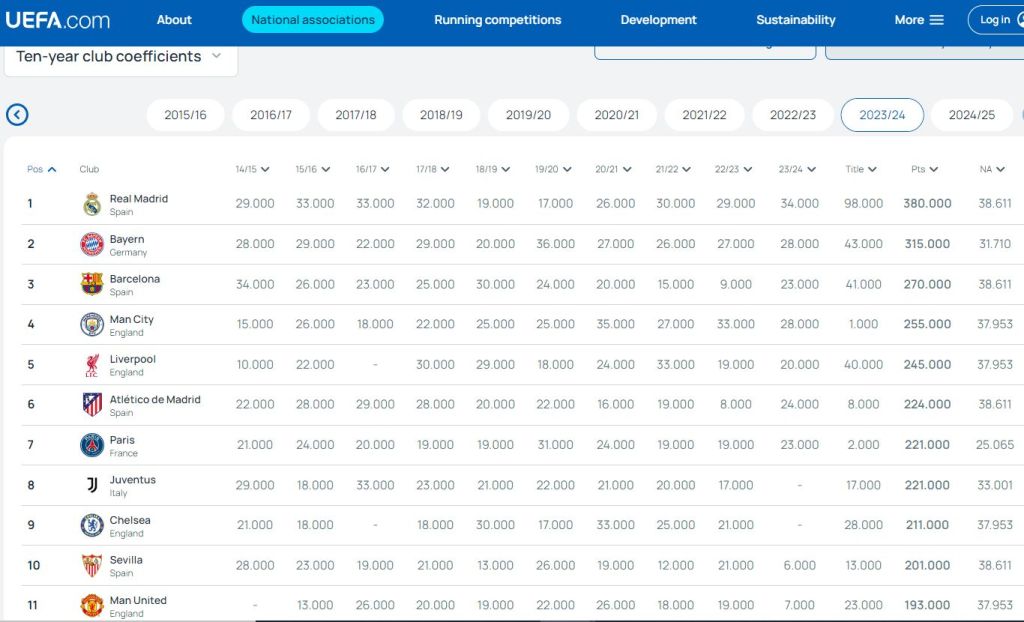
On the other hand, UEFA uses a slightly different 10-year club ranking as one of the criteria in order to distribute the money prizes among the different clubs. To compute that 10-year club ranking UEFA collects the yearly scoring of clubs in the last 10 years, and to that sum it adds another coefficient that UEFA calls “Title“, which is the coefficient I wanted to write about, and that shows the weighing that UEFA does of clubs’ honours.

10-year club coefficients (2023/24*)

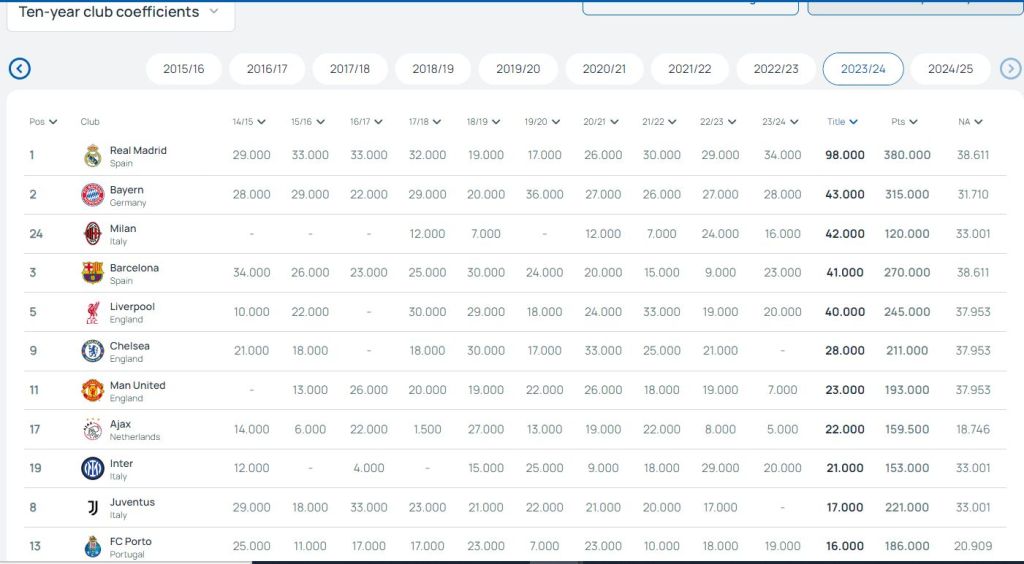
I leave below the the 10-year club ranking sorted by the column “Title:

10-year club coefficients (2023/24*) sorted by the column Title

The table shows that Real Madrid leads the “Title” ranking with 98 points, followed by Bayern Munich with 43, AC Milan with 42 and Barcelona with 41…

How does UEFA compute that “Title” coefficient?

  • UEFA Champions League / European Cup:
    • 12 points for those won in the last 5 seasons, i.e., 2019/20 to 2023/24
    • 8 points for those won since the creation of the Champions League up to 6 seasons ago, i.e., 1992/93 to 2018/19
    • 4 points for the European Cups won from 1955/56 to 1991/92
  • European Cup Winners’ Cup / UEFA Cup / UEFA Europa League:
    • 3 points for those won in the last 5 seasons, i.e., 2019/20 to 2023/24
    • 2 points for those won since the creation of the Champions League up to 6 seasons ago, i.e., 1992/93 to 2018/19
    • 1 point for the Cup Winners’ Cup / UEFA Cup won from 1960/61 or 1971/72 to 1991/92
  • UEFA Super Cup does not compute for UEFA Title coefficient (if it did, Real Madrid leads that ranking as well with 6 titles)
  • Intercontinental Cup / FIFA Club World Cup do not compute for UEFA Title coefficient (if they did, Real Madrid leads that ranking as well in both of them with 3 and 5 titles, respectively)
  • National competitions do not compute for UEFA Title coefficient

After having gone through the explanation, some comments to it:

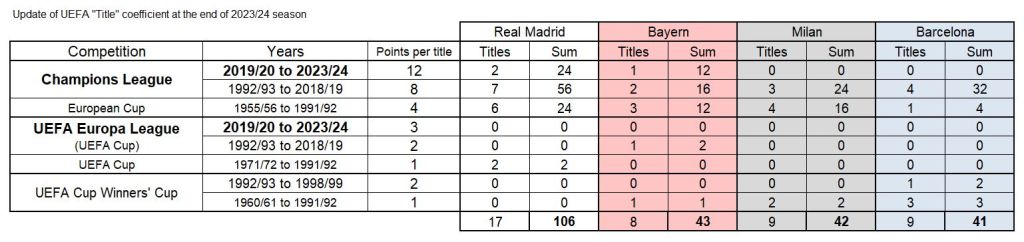
  • UEFA has not updated this Title since the end of 2021/22 season; you can see that Manchester City’s Title coefficient shows 1 point only, which is related to the European Cup Winners’ Cup they won in 1969/70 and does not include the 12 points for the Champions League won in 2022/23. Similarly, Real Madrid updated figure should be 106 points, as you can see in the table below
  • Among the competitions that UEFA organizes it weighs the Champions League as 4 times more important than either the UEFA League, or the extint UEFA Cup and European Cup Winners’ Cup
  • UEFA applies a time weighing as described above: titles in the last 5 seasons get a given amount of points, titles since 1992/93 to 6 years ago get 2/3 of those points and everything older than 1992 get 1/3 of those points
    • That time weighing makes teams having won titles more recently (Chelsea, 6 major titles) be better placed than others with older titles (Juventus, 6 major titles)
  • The extint Inter-Cities Fairs Cup (played between 1955 and 1971) does not compute for UEFA Title coefficient as it was not organized by UEFA and there were not qualifying criteria to take part in it. Interestingly enough, this competition is much talked about in Spain to make up for the lack of sufficient honours on the part of Barcelona when compared to Real Madrid

Which European club has the largest honours sheet?

The answer is clear, Real Madrid. So clear that the Title coefficient it has (either the outdated 98 or the updated 106, see below) is as high as the sum of the coefficients of all the other clubs that played the Champions League finals in the last 4 seasons (2020/21 to 2023/24) combined: Chelsea (27), Manchester City (13), Liverpool (36), Internazionale Milan (21) and Borussia Dortmund (9).

To conclude, I leave below a table where I show the computation to get the coefficients for the top 4 clubs (Real Madrid, Bayern, Milan and Barcelona) with the results up to the end of the 2023/24 season. I invite the reader to compute the updated figures for City, Chelsea or Liverpool that I referred to above.

Title coefficient computation, updated to the end of 2023/24 season for the top 4 clubs

Leave a comment

Filed under Sports

All-time men’s best pole vault – Olympic Games Paris 2024 – Armand Duplantis

Following the closure of the Olympic Games Paris 2024 a few days ago, I wanted to take a look at the track record of Armand “Mondo” Duplantis, one of the dominant athletes of our times that set a new world record in the pole vault competition with 6.25m. For that purpose I used the website “Track and Field all-time Performances” (maintained since years ago by Peter Larsson).

With the data of all-time men’s best pole vault I plotted the chart below with the best 3,754 jumps (jumps from 5.80m and above) and their dates, highlighting the jumps by Sergey Bubka, Renaud Lavillenie and Duplantis (dark colour for outdoor vaulting, light colour for indoor).

Bubka dominated the sport in the 1980’s and 90’s (first competing for the Soviet Union and later for Ukraine) when he set up to 35 world records (17 outdoor and 18 indoor), won 6 gold medals at the World Championships and 1 at the Olympic Games. Lavillenie also won a gold medal at the Olympics in London and won several World Indoor Championships (among other medals) and set an indoor world record (which was the absolute record for 6 years). Duplantis, competing for Sweden, at the young age of 24 has already won 2 gold medals at the Olympics (Tokyo and Paris) and 2 World Championships (among other medals) and has already set 9 world records (6 outdoors and 3 indoors).

Some comments after looking at the chart:

  • Bubka holds 249 of the 3,754 jumps (6.6%) at 5.80m and above
  • Lavillenie holds 271 of the 3,754 jumps (7.2%) at 5.80m and above
  • Duplantis holds 259 of the 3,754 jumps (6.9%) at 5.80m and above
  • Of those jumps of 6.00m and above (222 jumps):
    • Bubka holds 46 of the 222 jumps (20.7%) at 6.00m and above
    • Lavillenie holds 21 of the 222 jumps (9.5%) at 6.00m and above
    • Duplantis holds 86 of the 222 jumps (38.7%) at 6.00m and above
  • If we focus at outdoor jumps of 6.00m and above (134 jumps):
    • Bubka holds 28 of the 134 jumps (20.9%) at 6.00m and above
    • Lavillenie holds 4 of the 134 jumps (3.0%) at 6.00m and above
    • Duplantis holds 57 of the 134 jumps (42.5%) at 6.00m and above
    • 24 men have vaulted outdoors at 6.00m or above, only Bubka and Duplantis jumped 6.08m or above (7 and 14 times, respectively)
Sergey Bubka

Bubka achieved his best jumps when he was between 27 and 30 years old. Duplantis at his 24 years has already twice as many high jumps as Bubka in his entire career. If Duplantis continues his progression up to 27-30 years of age the best is still to come, something that might have been deemed unbelievable for those of us who witnessed Bubka in his prime, but we are now going through the same dominance yet with higher heights and more pronounced (Sam Kendricks, silver at the Olympics in Paris, achieved 5.95m… 30cm less than Duplantis!).

Leave a comment

Filed under Sports

Repaso a la evolución histórica del palmarés de la Copa de Europa (2024)

Esta es una pequeña entrada futbolera para compartir la gráfica de debajo tras la consecución de la decimoquinta Copa de Europa de fútbol por el Real Madrid.

La gráfica presenta la evolución de las Copas de Europa conseguidas por el Real Madrid y todos aquellos clubes que en algún momento de la historia han sido el segundo equipo con más copas. Por orden: Benfica (Lisboa), Internazionale (Milán), Milan AC, Ajax (Ámsterdam), Bayern Munich, Liverpool y de nuevo Milan AC.

Algunas curiosidades que se observan en la gráfica:

  • Es ahora, en 2024, cuando con 8 la distancia, medida en Copas de Europa, entre el Real Madrid y el segundo club con más títulos es más grande.
  • Históricamente la distancia media ha estado en 3,1 copas.
  • La moda, es decir la distancia más veces repetida entre el Madrid y el segundo, ha sido de 3 copas. Esa fue la distancia en 24 años, el 35% de estos 69 años de Copa de Europa (ver histograma debajo).
  • La distancia mínima se dio entre 1994 y 1998, tras ganar el Milan AC su quinta Copa de Europa en Atenas y hasta la consecución de La Séptima por el Real Madrid en 1998 en Ámsterdam.

A partir de esas curiosidades, me surgieron después otras tres ideas muy visuales que incluyo más abajo:

  • Un histograma con el número de años que se ha dado cada distancia en Copas de Europa.
  • Una tabla donde se muestra en cada momento qué clubes eran los segundos en el palmarés.
  • Otra tabla donde se muestra cuántos años ha sido cada uno de esos el segundo en el palmarés.

Leave a comment

Filed under Sports

Summary of (my) 2023

Time to look back and reflect on how the year which is about to end developed. Brief recap of my 2023. (*)

The main experience that has marked our lives in this 2023 has been hosting Lena and Karina in the second half of the year. They had to leave Ukraine following the Russian invasion in February 2022 and had been hosted at different homes in the region for the previous year and a half, the previous months at my friend Alex’s from which they moved to our place in the summer. Even if it is not possible to put ourselves in their shoes, sharing with them the news, the daily routines and trying to make their life a bit easier has been very rewarding.

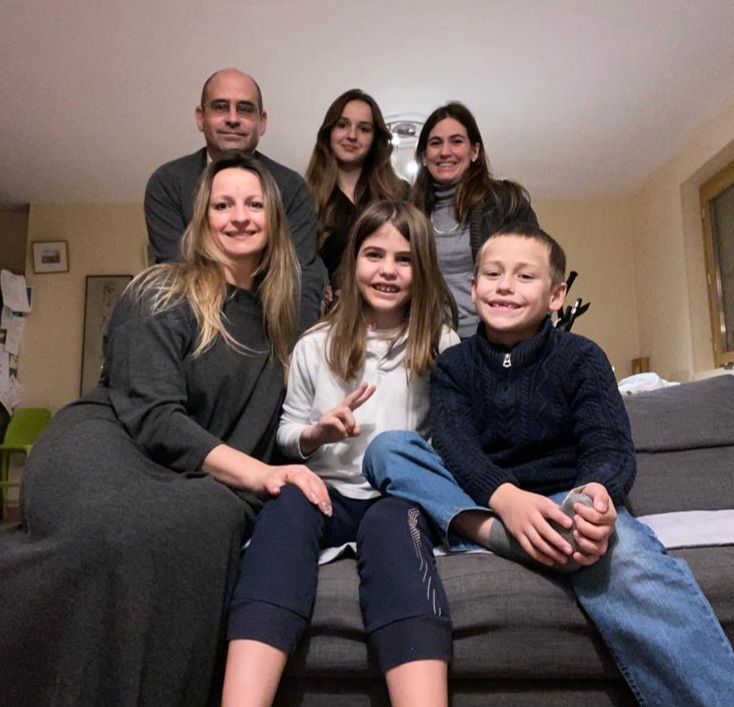
Family. Andrea is now 10 years old and David, 7. Andrea loves drawing, doing manual work and researching for her school homework. She continues to learn piano and this year she volunteered to be junior librarian. She is in her second year of Spanish lessons, on top of the Dutch lessons they both take every second week. David loves building Lego sets, helping with whatever task we have at home and football. He is very fond of reading and maths and this year he also has started taking piano and Spanish lessons.

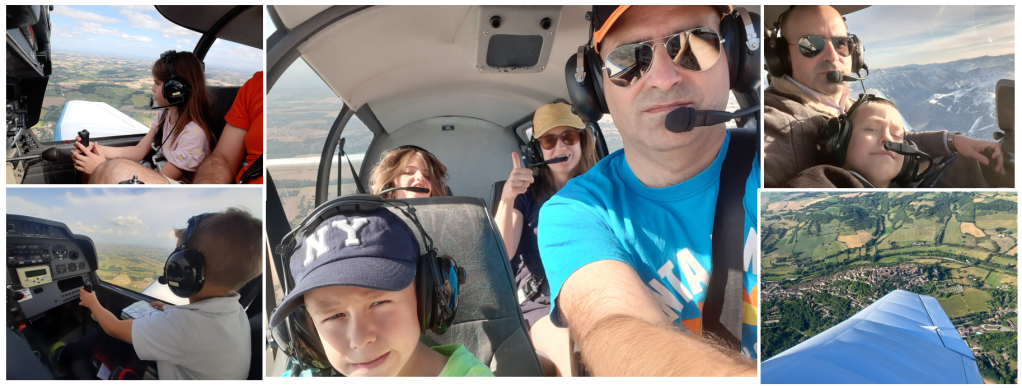
Flying. This year I went flying with kids again! Since a couple of years ago, and following some uneasiness they experienced in some flights, both Andrea and David had refused to fly small aircraft. But since the last spring, first David and then also Andrea, they have been wanting not only to fly but to be in the front seats. Those have been some of the most rewarding experiences of the year. This year I also flew for the first time with Manuel, Alex and Karina. I am sure that in 2024 I will have the chance to fly with more colleagues.
In all, this year I have flown just over 17 flight hours13 flights and 23 landings. This takes my total experience to 210 flight hours and 324 landings I started taking lessons back in 2011. At the end of November I renewed the SEP (single-engine piston) qualification and that allows me to fly for two more years.

Together with our Aviation Society we were planning some excursions for the summer time but for different reasons a couple of them were cancelled (to Morocco and Corsica). However, with the family we quickly organized a weekend excursion to l’île d’Oléron (see related post here), that was another memorable experience of 2023.

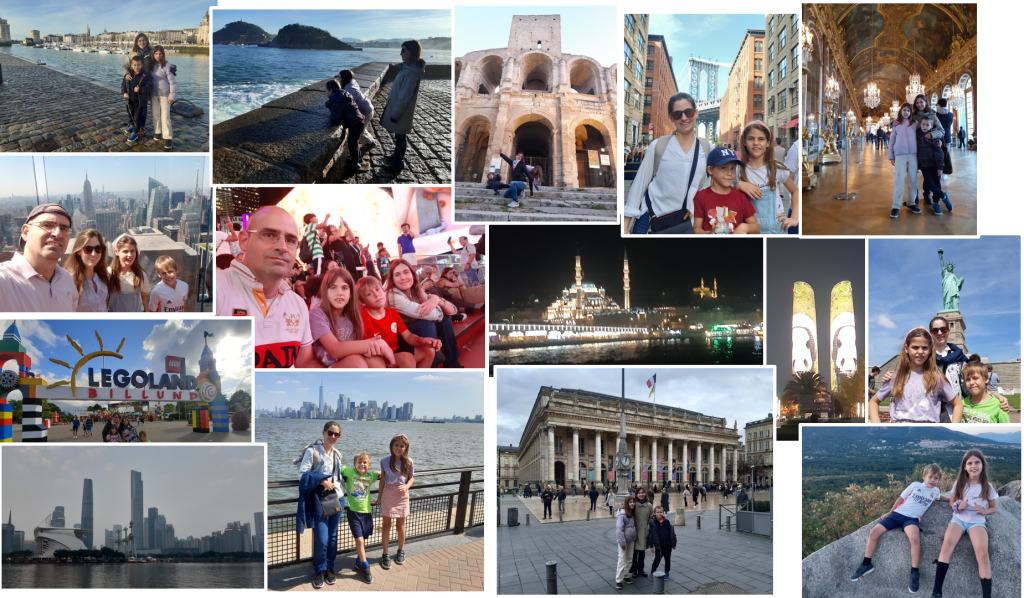
Travelling. Leaving behind the prolonged the travel restrictions during the pandemic, we continued to visit some new and old places: Arles, Aix-en-Provence, Vars, Boulogne-sur-Mer, Beauvais, Vic Fezensac, Helsinki, Paris, Copenhaguen, Odense, Roskilde, Frederica (we spent a great week in Denmark visiting my sister!), Dublin, Madrid, San Sebastián, New York (first time with the kids, they loved it! Especially travelling to a place where everybody speaks English), Beijing, Shanghai, Chengdu, Guangzhou (first time in China for me), Istanbul, l’isle d’Oleron, Versailles, Amiens, Wijchen, Ghent, Rouen, La Rochelle…

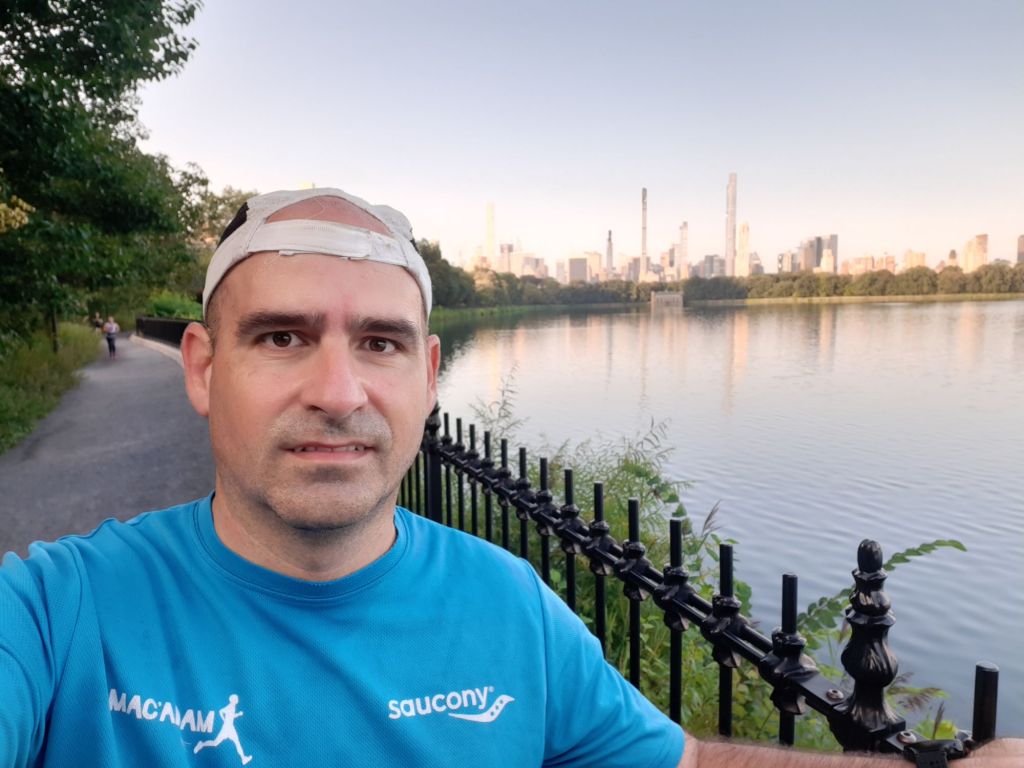
Running: After a good 2022 when I got to run two marathons, this 2023 has been a frustrating year on the running front. In June I got injured in the left Achilles tendon, from which I seemed to be recovering between July and August but I then got injured in the left calf… and I haven’t retaken running in the last 4 months. In all, I ran just over 520km in 2023, the least since 2011… 

Following a mantra I try keep to the letter (when in good health), “the running shoes, always in the suitcase”, the year 2023 caught me running in: Galapagar, Dublin, Helsinki, San Sebastián, Licques (France) and New York, plus the tens of times I trained in my village, Blagnac and Toulouse. I finished 2022 with the hope of increasing mileage from the 1,200km I had run in that year, now I finish 2023 just hoping to leave the injuries behind.

Skiing. In 2023 we went again with the family for a week to our favourite resort at Vars, in the Southern Alps. This year we could enjoy much more time skiing with the kids out of their skiing lessons. And to be honest, being much more daring than we are, it is sometimes difficult to keep pace with them especially when going off track. This year Andrea got her 1ère étoile medal and David his Flocon one (levels from the French ESF).

Real Madrid. We enjoyed watching a few football matches together supporting our favourite team and on top of that we visited the Santiago Bernabéu stadium in summer for the first with the kids. They loved it despite of the construction work going on at the time. Now we are looking forward to attending a first match together. 

Work. Since January 2023 I changed the scope of the job within the same department, now focusing on the A330neo product marketing (back to the A330neo after having spent 4 years (2015-2019) working in its development!). In this role I have been working hand in hand with Anna, Raphael and lately Yohann.

With the oppening up of aviation markets and the picking up of travel, the year 2023 marketing our Airbus widebody aircraft has meant lots of fun and a great learning experience. The everyday work is already quite interesting and exchanging with the team I learnt new things everyday. On top of that we had a very good year in terms of sales which should be confirmed in the coming weeks.

Reading. On this front, 2023 has also been a frustrating year. I started 2023 reading at a good pace until I got stuck with Notre Dame de Paris (Victor Hugo) with which I have been dragging for months. In all I have just read 4 books, the least by far since I started to keep track of it in 2010. For the detailed list of books, see the post I wrote about my 2023 reading list with a brief description of each book.
Other cultural activities:

  • Bullfighting. This year again together with Luismi we went to Vic Fezensac to attend its corrida concurso, which even if it doesn’t provide for the best of the shows it’s a good atmosphere to be part of. I also renewed my membership to the foundation Toro de Lidia to keep supporting the art.
  • Museums. This year again we took benefit of every road trip to visit as many museums and castles as we could, among them: Ellis Island, Liberty Island, American Museum of Natural History (New York), MOMA, Metropolitan Museum of Art (NY), Theodore Roosevelt Birthplace, Château de Fougères-sur-Bièvre, Château de Versailles, Museo Real Madrid, Jules Verne house (Amiens), Roskilde Viking ship museum, Hans C Andersen museum (Odense), Tivoli park, Kronborg castle, Foundation Vincent Van Gogh (Arles), La Coupole d’Helfaut Wizernes…

Blogging. This is the 14th year since I started the blog, but I didn’t manage to write much, only 3 blog posts in 2023. The blog received just above 18,200 visits in 2023 (the least since 2012) and over 491,000 since I started it in 2010.

Not everything was positive in 2023: the mother of one of my best friends passed away, plus the already mentioned ongoing Russian invasion of Ukraine which created havoc in many families, including the many refugees host in the region. Hopefully in 2024 that war comes to an end.

On the positive side, some colleagues and friends had new babies and got married in this 2023!

Now it’s time to rest, celebrate with the family and hope for the best in 2024. For the moment we have just a few days in Madrid to enjoy with family and friends and a planned skiing week in Vars; hopefully that will be just the beginning of another memorable year.
I wish you the best for 2024, enjoy it!


(*) You can see here my 2010, 2011, 2012, 2013, 2014, 2015, 2016, 2017, 2018, 2019, 2020, 2021 and 2022 recaps.
1 Comment

Filed under Personal development & HR, Sports, Travelling

Bucharest marathon 2022

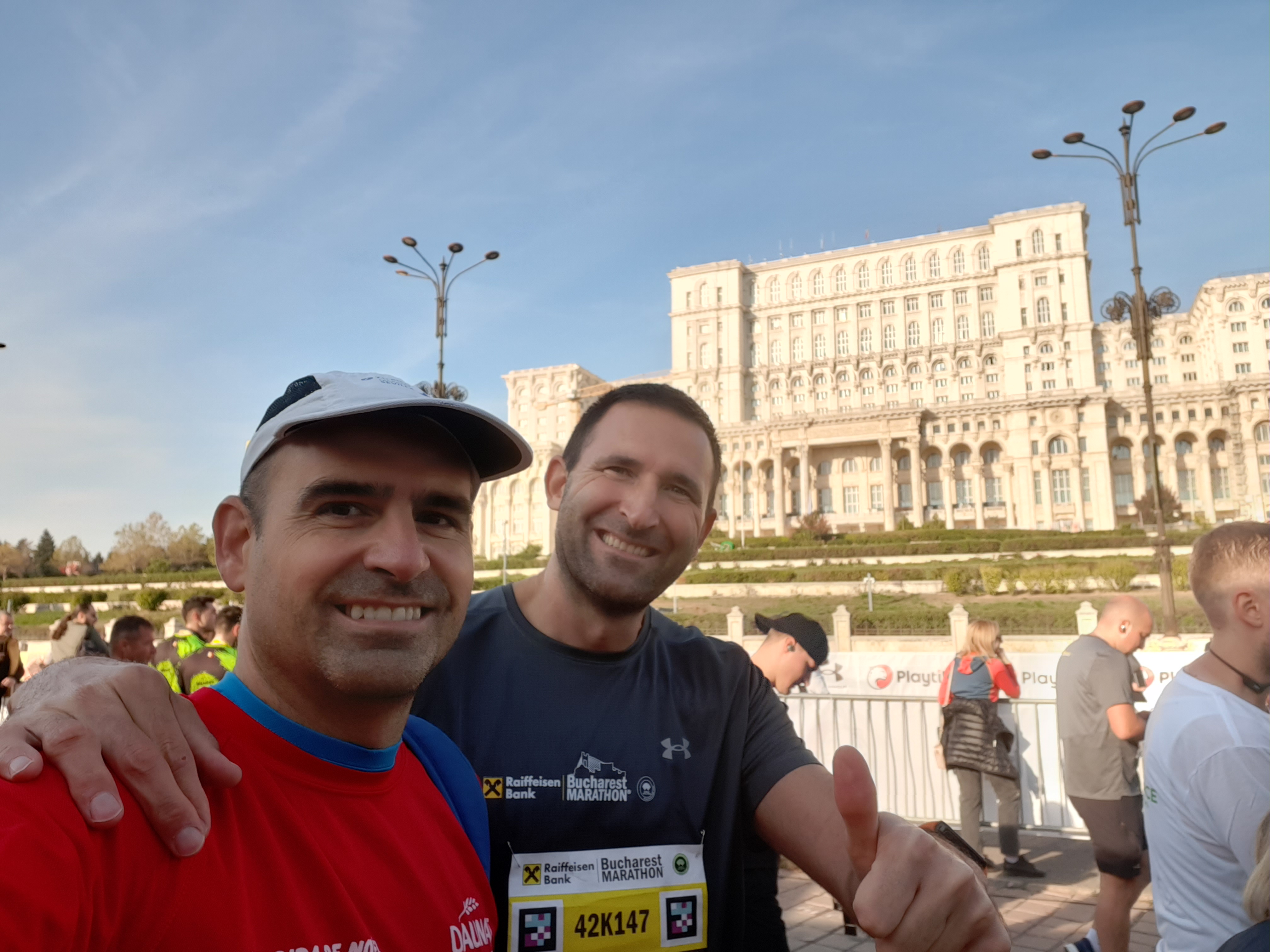
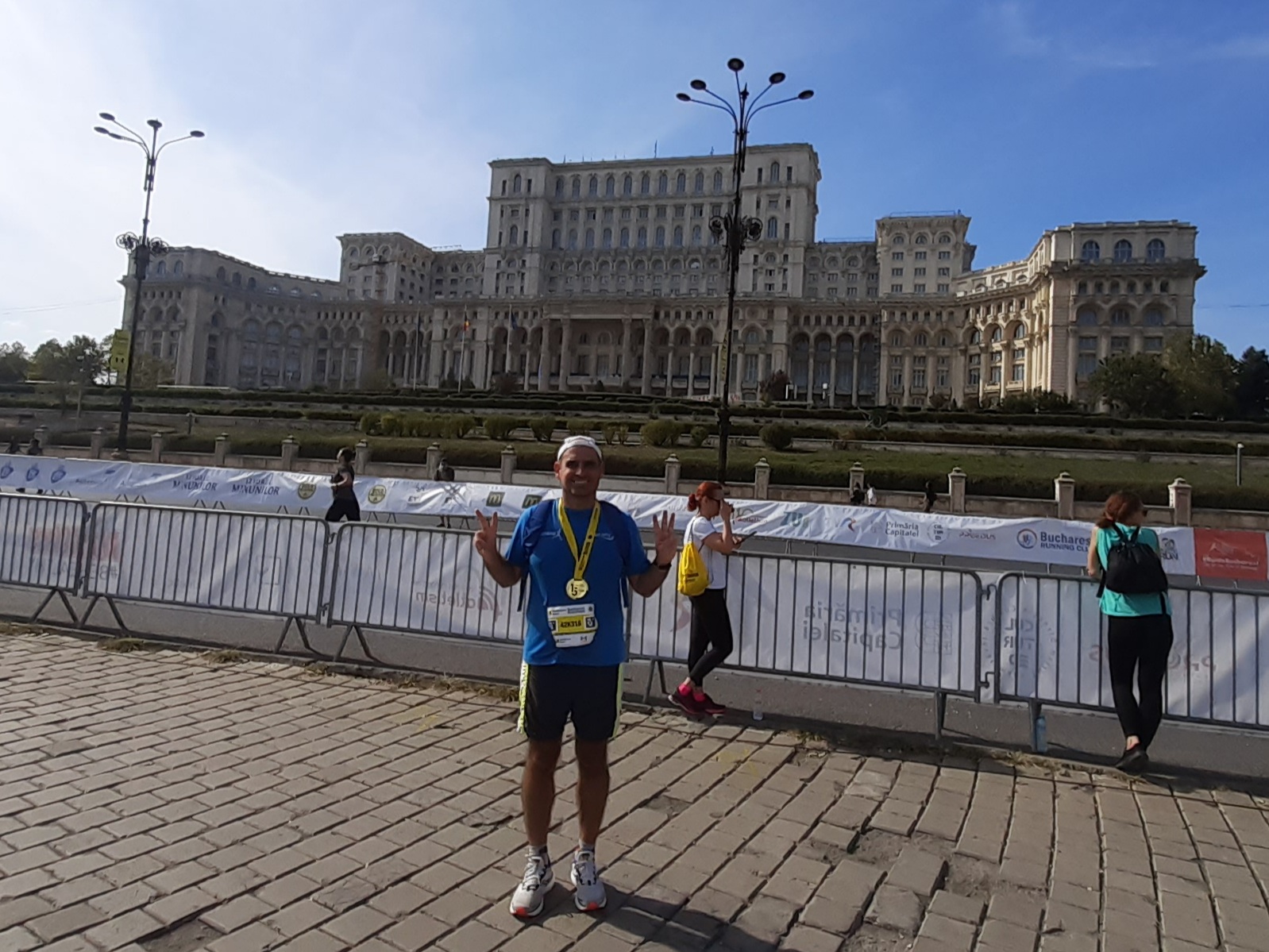
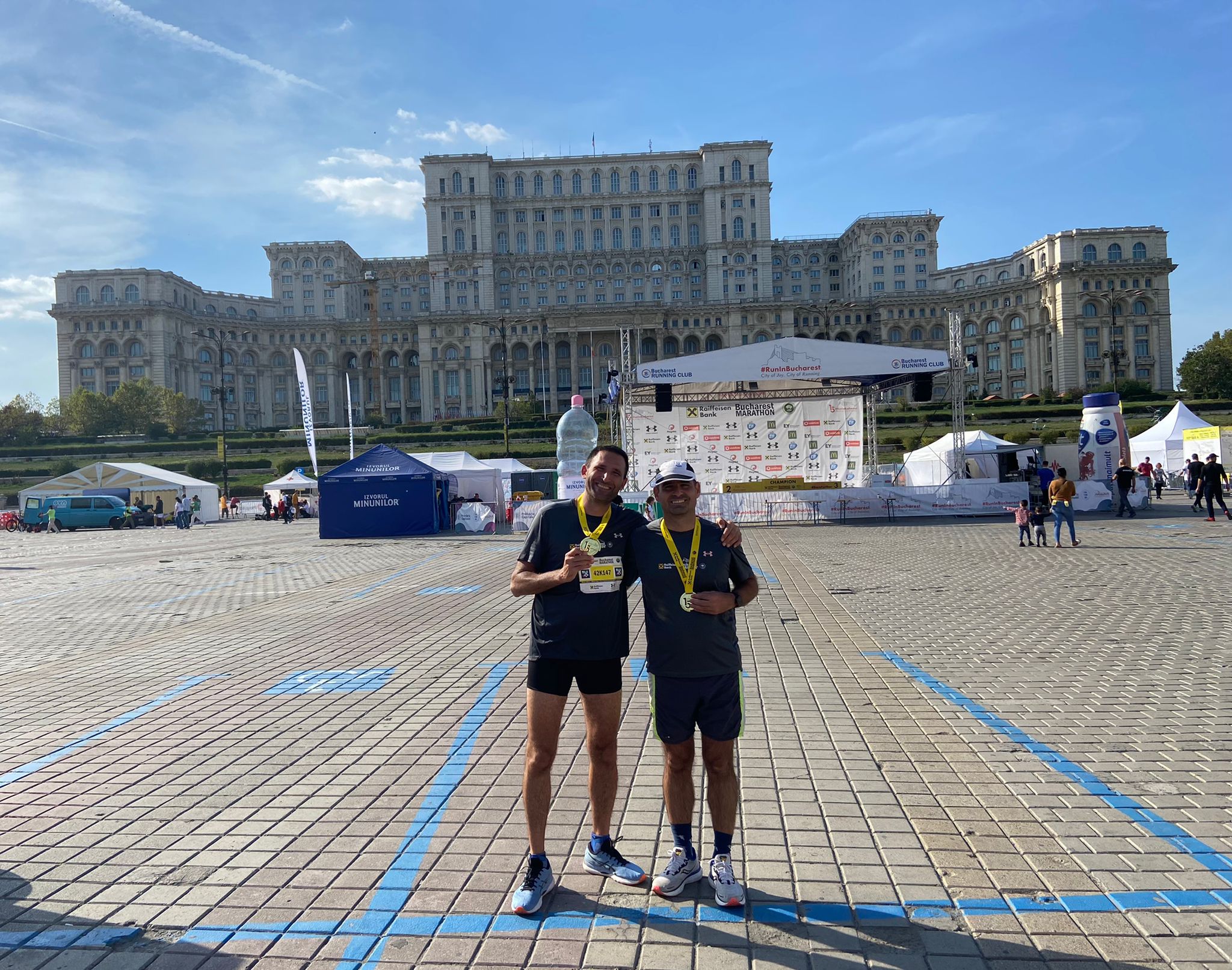
Last Sunday, October 9th, together with my friend Juan and my brother Jaime, we traveled to Bucharest to take part in its marathon, with around 700 runners registered in the distance.

We picked Bucharest following our series of marathons abroad (to combine tourism with long distance running) that has taken some of us to run together in Paris, Berlin, Roma, Athens, Rotterdam, New York, Sevilla (x3), Madrid, Millau, Dublin (x2), Lisboa, Vienna, Krakow, Porto and now Bucharest.

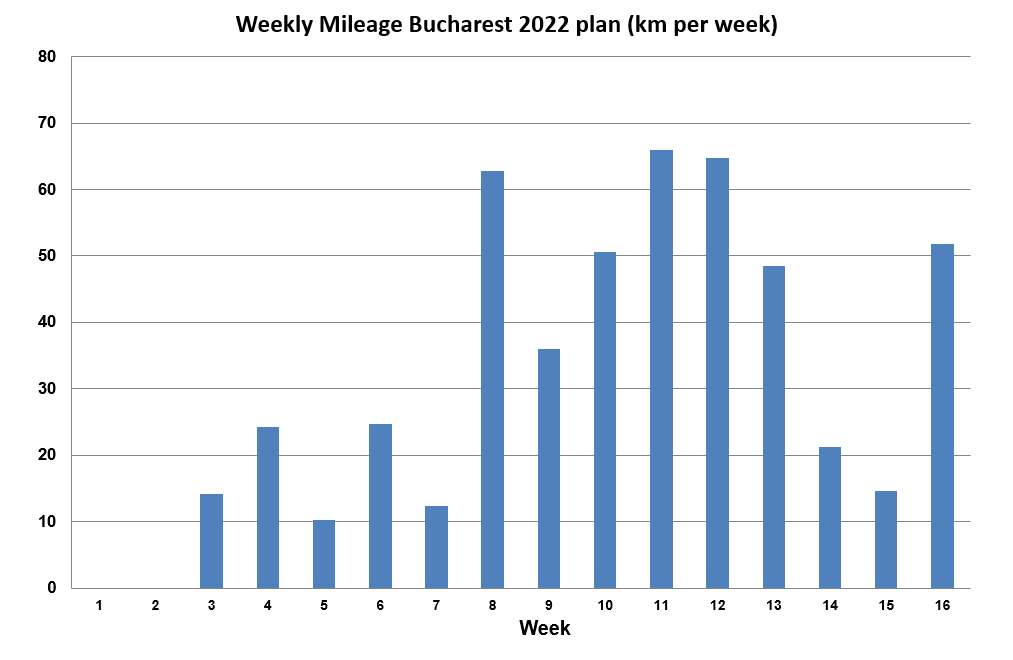
To prepare for this marathon I followed the same 16-week training plan I had used in the past. Just before those 16 weeks of the plan, thanks to a running challenge we followed in the company, I cumulated ~240km in 4 weeks between end May and end June. Then I kicked off slow with the plan as I had some weeks in which I traveled due to family and work. In the end I arrived to Bucharest with less mileage (460km) in the legs in those 16 weeks than I would have liked. I trained quite well between August and especially September. In those 16 weeks I averaged 35km per week, completed 4 long runs (of 22km, 27km, 30km and 21km – with positive feelings especially in this last one) and a few sessions of series, though not enough of them to get a bit faster. I was confident in being able to complete the marathon in a time between 4h05′ and 4h15′ even if the final mark was uncertain.

The profile in Bucharest is rather flat. The organization prepared a circuit mainly composed of long avenues, allowing us to run at constant pace though there were up to eight sharp U-turns. The race started and finished in the Constitution square, in front of the iconic Parliament building. And we stayed the weekend at an apartment at walking distance from the place.

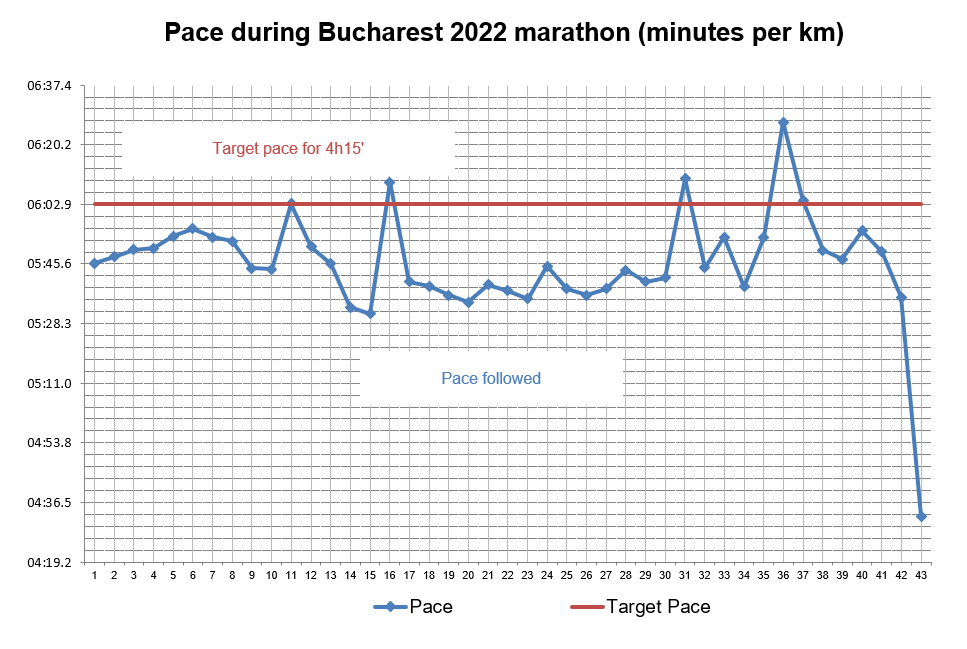
The temperature was mild in the morning, the sky was clear and it would be a bit hot towards the end of the race, though the temperature did not exceed 22°C. My strategy was to start at a pace just below 6min per km, and then, if I felt well, accelerate the pace at mid-race so that I could target a time below 4h15′. There were pacers for times aiming at every 15-minute mark and even though I did not follow any of them they were useful as references at every U-turn (i.e., I could see how far I was from each of the 4h00 and 4h15 pacers as I ran always in between them).

The bad news of the weekend was that my brother Jaime fell sick and by Saturday afternoon the throat ache he developed did not allow him to swallow without strong pain. He stayed in the apartment and finally took the decision not to take part in the race on Sunday, as in a marathon you need to constantly drink and eat.

The race started at 9:30am and we ran together with the participants in the half marathon and the relay race. That made the first half of the race a bit more crowded. For the first 13-14 kilometres Juan and I ran together, all the way up to the Arch of Triumph and down to the Romanian Athenaeum. Up until then we had averaged ~5’50″/km including a technical stop. Then, Juan softened his pace and stayed behind.

I kept my pace for a few kilometres including the stretch in the Cișmigiu Gardens where I found it difficult to run with the narrower paths (compared to the big avenues of the rest of the race) and the irregular ground. From the km 18 I increased the pace and averaged ~5’40″km in the next 13 kilometres until the km 30 mark. In that stretch we ran long kilometres by the Dâmbovița river, we passed the half marathon by the Parliament, we ran by the iconic Bucharest Fountains (by then we were no longer a crowd but a flow of isolated runners and some small groups)…

At the km 31 the race circuit went back to the Bulevardul Unirii, where we first turned to the East all the way to the National Arena (by the km 36) and then took a U-turn to head West back to the Parliament building. The circuit was quite straightforward in that last quarter of the race. There I felt the legs a bit stiffer, but I managed to keep a constant pace which was only slowed down at a supply post and a medical stop that made me lose some 30 seconds. I averaged 5’55″/km from the km 31 to the 41.

In all those kilometres I had seen the pacers of 4h00 not very far away and the 4h15 at increasing distances behind me. I started to make the numbers in my head and realized that I could well be somewhat below 4h05 and set that as an objective for the last kilometres, to try to run a faster marathon than my previous one in Sevilla.

The last 3 km of the race are superb. The race goes back to the Bulevardul Unirii and you have the view of the imposing Parliament building at the end of it, where you know that the Finish line is located. I kept my pace along the 40th and 41st kilometres and only gave it all at the last 1,200 metres.

In the end, I clocked a net time of 4h04’09”, a time better than what I expected and a bit faster (45″) than in Sevilla earlier this year (where I finished stronger but did a slower first half). Bucharest 2022 has been my 23rd marathon completed, easy to say today but not so on April 30th 2000 when I started in the distance in Madrid.

With those 4h04’09”, I was again above the 4-hour mark and finished in the 317th place out of 640 finishers (50% percentile). That time makes it my 9th worst marathon, though with a better time than the last three marathons and with a very positive feeling all along the race (for a second marathon in a row), thus, I am already thinking on getting again more serious with the series training to target a time under 4 hours in the next marathon, possibly next spring.

The organization of the race was great. The circuit showed a magnificient and beautiful city. They could have included some more water supply posts, but at least we could get water bottles to administer the water ingestion in between posts. I also missed some gels provided by the organization or more isotonic drinks; but with what they provided and the three gels I took I could manage the race well. The finish line was great, the wardrobe service was close to the start and finish line, there were even some puffs where to sit and rest by the finish area… It was a great experience.

Looking forward to the next race, that one with Jaime running with us again.

3 Comments

Filed under Sports

Repaso a la evolución histórica del palmarés de la Copa de Europa (2022)

Esta es una pequeña entrada futbolera para compartir la gráfica de debajo tras la consecución de la decimocuarta Copa de Europa de fútbol por el Real Madrid.

La gráfica presenta la evolución de las Copas de Europa conseguidas por el Real Madrid y todos aquellos clubes que en algún momento de la historia han sido el segundo equipo con más copas. Por orden: Benfica (Lisboa), Internazionale (Milan), Milan AC, Ajax Amsterdam, Bayern Munich, Liverpool y de nuevo Milan AC.

Algunas curiosidades que se observan en la gráfica:

  • Es ahora, en 2022, cuando con 7 la distancia, medida en Copas de Europa, entre el Real Madrid y el segundo club con más títulos es más grande.
  • Históricamente la distancia media ha estado en 3,0 copas.
  • La moda, es decir la distancia más veces repetida entre el Madrid y el segundo, ha sido de 3 copas. Esa fue la distancia en 24 años, el 36% de estos 67 años de Copa de Europa (ver histograma debajo).
  • La distancia mínima se dio entre 1994 y 1998, tras ganar el Milan AC su quinta Copa de Europa en Atenas y hasta la consecución de La Séptima por el Real Madrid en 1998 en Ámsterdam.

A partir de esas curiosidades, me surgieron después otras tres ideas muy visuales y rápidas de ejecutar y que incluyo más abajo:

  • Un histograma con el número de años que se ha dado cada distancia en Copas de Europa.
  • Una tabla donde se muestra en cada momento qué clubes eran los segundos en el palmarés.
  • Otra tabla donde se muestra cuántos años ha sido cada uno de esos el segundo en el palmarés.

Leave a comment

Filed under Sports

Maratón de Sevilla 2022

Last Sunday, February 20th, together with my friend Juan and my brother Jaime, I took part in the Sevilla marathon, with over 10,000 runners registered.

Following two years of not having taken part in any marathon due to restrictions imposed by the Covid-19 pandemic, the three of us subscribed to the marathon following our series of marathons abroad (to combine tourism with long distance running) that has taken us to run together in Roma, Athens, Rotterdam, New York, Sevilla, Madrid, Millau, Lisboa, Vienna, Krakow, Porto and now Sevilla, again.

To prepare for this marathon I followed the same 16-week training plan I had used in the past. I arrived to Sevilla with more mileage (629km) in the legs than in the case of the last few marathons. I trained quite well in November, December and the first week of January. Then, I caught Covid-19 and had to stop running for about 10 days. During the last two weeks of the plan, with workload and work-related travel, I found it difficult to train, but most of the training was already done. In those 16 weeks I averaged over 41km per week, completed 5 long runs (of over 21km, twice 23km, 27km and 30km) and a few sessions of series, though not enough of them to get a bit faster. The negative note was that in the last long run over 21km (just two weeks before the race) I finished very weak and with bad feelings for the race in terms of targeting a pace at or below 4 hours, but still with the confidence of being able to finish it even if the final time was uncertain.

The profile in Sevilla is rather flat. The organization changed the circuit in comparison to the previous times we had taken part in the race. It did not start and finish at the athletics stadium in La Cartuja, but close to the Parque Maria Luisa.

The temperature was fresh in the morning, the sky was clear and it would be a bit hot towards the end of the race, though the temperature did not exceed 19°C. My strategy was to start with a pace just below 6min per km, so that I could target a time slightly below or around 4h15′, with no pacers for that time.

Despite the 10,000 runners taking part in the race, we could easily run from the start at the targeted pace. For the first 16-17 kilometres we ran the three of us together, then my brother Jaime went ahead and Juan and I kept running together until about the half marathon, which we crossed in 2h04’59” net time (at a pace of 5’55” per km). Then, Juan softened his pace and stayed behind. I increased my pace in the second half, finding my brother again at around the km 28 and, after exchanging a few words about how we were doing at that moment, I went forward.

In the second half of the race I found myself quite at ease with the pace and averaged 5’41” per km to achieve a negative split; completing the second half of the marathon in just few seconds below 2 hours.

In the end, I clocked a net time of 4h04’56”, a time better than what I expected (~4h15′). Sevilla 2022 was my 22nd marathon completed, easy to say today but not so on April 30th 2000 when I completed my first one in Madrid.

With those 4h04’56”, I was again above the 4-hour mark and finished in the 5664th real place (or 5721st official place, in the bottom half, though the percentile is not yet clear as the results are temporary), while I overtook over 1,200 runners in the second half of the race. That time makes it my 8th worst marathon, though with a better time than the last two marathons and with a very positive finish, thus, I am already thinking on getting again under 4 hours in the next marathon, possibly next autumn.

This marathon left me some memorable moments:

  • seeing my cousin Marileo and her kids while we passed in front of her house,
  • running several kilometres with Juan and Jaime,
  • the good feelings of the second half marathon.

The organization of the race was great. There were supply posts of water and isotonic drinks very often, thus we did not need to carry bottles at any moment. They provided a very handy and light cap to protect us from the sun. And there were plenty of music stations to cheer us up in the second half of the race.

The marathon in itself was also a success as the winner Asrar Abderehman set a new race record with 2:04:43 (making Sevilla the 13th world fastest marathon) and the Spanish Ayad Lamdassem set a new national record with 2:06:25.

1 Comment

Filed under Sports