Tag Archives: Airbus

A380, a game-changer

Probably you remember having seen in some magazines ads paid by airlines showing their luxury A380 cabins. Singapore Airlines was the first one in launching this kind of branding campaigns.

According to the definition by the Business Dictionary: Branding aims to establish a significant and differentiated presence in the market that attracts and retains loyal customers.”

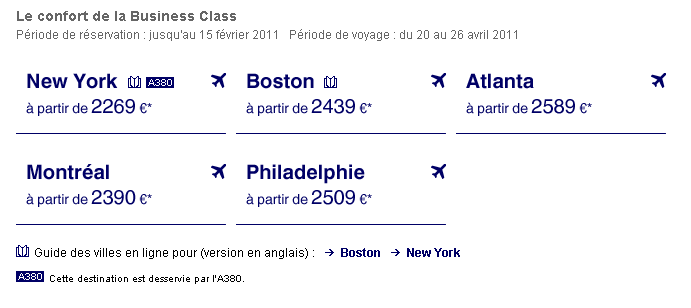
Few days ago, I received an email with publicity from a company that operates the A380. As you can see, they go a step beyond: they now use the A380 not only for branding but for advertising a concrete product, a specific flight. In one of the destinations offered you may see a label indicating that the flight is served by an A380.

Ad: flight served by an A380.

From the Wikipedia: Advertising is a form of communication intended to persuade an audience to purchase or take some action upon products, ideas, or services.”

If they use it there must be a reason behind. I have heard from colleagues that, in fact, the companies already operating it in some of their routes are noticing that repeatedly the connections offered by an A380 show higher passenger load factor or occupancy rates than the same connections when offered by a different aircraft.

I have never seen anything like this before. It could have happened when the B-747 entered into service in the 70’s, but I was not here then; I didn’t witness it. It doesn’t happen now; not with the 747 nor with other aircraft. I certainly do not base my buying decisions, when I have to flight within Europe, on whether the airline operates a B-737 or an A320 (maybe I should!). But exactly this is happening in the case of the A380. And airlines are profiting from it.

In a previous post I wrote about the difference in current forecasts for the A380 that Airbus and Boeing report (Boeing has steeply reduced its reported forecast in the past decade). If the appeal of the aircraft continues to bring customers in, we could have a reason to believe that in end the orders figure of A380 maybe rather high. Only time and the market will let us know.

In its website, Airbus dubs the A380 as game-changer. One could expect this when a company is talking about one of its products, however when others are basing its branding and advertising on it, we seem to be really facing a game-changer.

Leave a comment

Filed under Aerospace & Defence, Marketing

Salesmanship at Airbus

Yesterday I saw John Leahy, Airbus sales chief, in the corridors of the company for the first time since I arrived to Toulouse. At night, I found via Twitter this special report about him by Reuters.

The report is a very interesting piece, and reading in it about Jean Pierson reminded me of a very curious story I heard some years ago and I wanted to recall for you (this is the only reason for this post).

Pierson was the CEO of Airbus from 1985 to 1998. The story I am talking about appears described in the book “Boeing versus Airbus”, by John Newhouse (I haven’t yet read it but is in my wish list). Let me extract the summary that Reuters gave in this other article.

Pierson […] was at US Airways’ headquarters for what he thought would be a short meeting to tie up a 400-plane deal, the anecdote runs.

At the last minute, US Airways’ then-chairman Stephen Wolf started arguing for a 5 percent discount on the selling price.

“Pierson began slowly lowering his trousers and saying ‘I have nothing more to give.’ He then allowed the trousers to fall around his ankles,” says Newhouse in his book.

Wolf replied: “Pull up your pants. I don’t need any more money,” and the deal was signed, according to the book. The author says he got the story from Pierson himself, and it was confirmed by another person present.

Shortly afterward, US Airways announced the purchase of 124 single-aisle Airbus A320 family jets with options for 276 more, a stab into the heart of Boeing’s competing 737 program. It put the European company on track to overtake Boeing in global orders only two years later.

If the situation ever calls for me to drop my trousers I hope there is no one nearby with the intention of reporting it in a book :-).

3 Comments

Filed under Aerospace & Defence, Books

Impact of Airbus in Toulouse employment

Some days ago, I attended for the first time a meeting of Rosemasters club in Toulouse. We were about 20 people attending. During the introduction round we discovered that there were 5 Airbus employees among us, which was 25% of us (plus 2 former employees). This could be expected given the importance of Airbus in the city of Toulouse… but, how important is it really?

I had read in some studies about the impact of air transport and aerospace industries in the economy of a given region; taking into account direct employment, indirect and induced. You may take a look at the report “The National Economic Impact of Civil Aviation” [PDF, 1.5MB] prepared by DRI•WEFA, to see some multipliers (Table 1 in page 8).

In the study, we can see that in the case of the USA, for every aerospace job there are 1.9 indirect jobs created and 1.5 induced jobs; thus one aerospace job creates 3.4 jobs.

If we use the same figures for the case of Toulouse:

  • Airbus and  EADS employ over 21,000 people here;
  • there would be another 41,000 indirect (employment generated in the businesses that supply goods and services to the aerospace sector) and
  • 32,000 induced jobs (employment in other sectors generated thanks to the income spent by direct and indirect aerospace-related employees) thanks to the activity of EADS in the region, in total ~73,000 extra jobs.

These together with the 21,000 jobs from EADS make up for a total of ~94,000 jobs.

Toulouse is a city of ~440,000 inhabitants, with 1.1 million living in the metropolitan area: ~9% of the population of the metropolitan area has a job created directly or indirectly thanks to EADS activity… if we talk about families, between 25-30% of the families depend on a job created directly or indirectly thanks to EADS activity.

No doubt, aerospace is a strategic sector for the region.

4 Comments

Filed under Aerospace & Defence, Economy, France

Women in aerospace

I recently read an article titled “Why don’t women run airlines?” I found the question interesting, because I have had some conversations about the number of women and especially in management positions within my company.

Surely there are a lot of issues and reasons behind (e.g. what is called “the glass ceiling”) that have been well-studied. When encountered with this question, I asked my senior peers within the department how many women were in their class at the university when studying aerospace engineering: the answer was one or none. That is the proportion of women that one could expect should be in the top management of the company now.

Luckily the trend now is changing, but still, in general, the aerospace sector is lacking women. I compiled some statistics:

  • Only 4% of flagship airlines had a woman as CEO (according to the study in the above-mentioned article).
  • 19,627 women worked for EADS (16.5%) at the end of 2009 (17% in the case of Spain; 13.6% in the case of Airbus).
  • 31.9% women out of the 39,469 students of the Universidad Politécnica de Madrid in the year 2004 (I found this information using the Wayback Machine as the university does not publish this anymore in its website).
    • The admissions of that year kept the same proportion, 32% women.
  • 25.8% women out of the 1,983 students of my engineering school that same year (Escuela Técnica Superior de Ingenieros Aeronáuticos, now EIAE).
    • The admissions of that year had a higher proportion, 31.7% women (something is changing).
  • 41 women out of 191 (21.5%) students graduated with me in November 2005.
    • The promotion of 2005, ideally should have started in September 2000. That year, there were admitted 117 women out of 368 students, or 31.8% (the year I started, 1999, the proportion was 25.2% women… though not published, I guess the share was lower in previous years).
    • The fact that women were 21.5% of graduates while being 25.8% of the population of the school may point at some of the other reasons, which I am not qualified to discuss.

Even if there was no discrimination, I believe it will take some years before 32% of EADS workforce and top management are women (~25 years? when the proportion of the students now in the university reaches all stages of the age pyramid of the company). I guess the same will apply for airlines.

I’m afraid it may never happen that 50% of the workforce in the company are women, probably not until 25 years later than we see such a proportion in the aerospace engineering schools… which 5 years ago was still 32%.

Leave a comment

Filed under Aerospace & Defence

New entrants in the commercial aircraft business

In a previous post, I mentioned the new entrants in the large commercial aircraft business (Bombardier CSeries, Embraer, Russian MS-21, Sukhoi SuperJet, Comac C919, Mitsubishi…). Now that the latest market forecasts both from Airbus (Global Market Forecast) and Boeing (Current Market Outlook) are available, I wanted to briefly note how they are treating the segment that most of these entrants would enter: single aisle jet aircraft.

For example, Boeing in this year’s CMO already splits the single aisle between 90-175 passengers (where new entrants would fall into) and over 175 passengers (still the safe harbor?). In previous studies Boeing didn’t offer such sub-segmentation. On the other hand, Airbus hasn’t published yet such differentiation.

It is even more interesting to compare last year’s GMF and CMO with this year’s ones.

  • Airbus saw a demand for 16,977 single aisle aircraft in 2009 while in 2010 sees a demand for 17,870.
  • Boeing saw a demand for 19,460 single aisle aircraft in 2009 while in 2010 sees a demand for 21,150.

In other words Airbus has increased the single aisle market forecast in 893 aircraft, while Boeing has increased it in 1,690 aircraft… Both have made the forecasted pie bigger before it will have to be shared.

On average, they see ~1,300 more single aisle aircraft than what they saw last year… In the case that these extra aircraft was room made for new entrants, that would leave the new entrants a market share of 6.7% of the single aisle market… not much.

However, those entrants are not yet delivering in that segment and most of their deliveries would come at the second half of the 20-year period. By 2029, it could well be possible that their combined market share is around 10%… still not a big share, but already ~7bn$ yearly business (in 2010 dollars); a ~4.4bn$ after discounts, an amount the size of Embraer revenues (the 3rd company in commercial aviation, reason enough for them to enter the segment).

Boeing even concedes that of the 21,150 single aisle aircraft, 86% of them will be between 90-175 passengers, precisely the market sub-segment that will be ferociously fought.

Leave a comment

Filed under Aerospace & Defence

Commercial aircraft market size after discounts (update)

In an older post I already made an analysis of the aircraft discounts related to the published list prices (by the way, Boeing just raised its list prices 5.2% a couple of days ago). In that case, I used the revenues and deliveries of Boeing in the previous 3 years (38% discount was the result!).

Using that information, now that the latest market forecasts both from Airbus (Global Market Forecast) and Boeing (Current Market Outlook) are available, we can say that the real market size in the next 20 years will be in the order of 2,100bn$ (average of both forecasts in 2010 dollars).

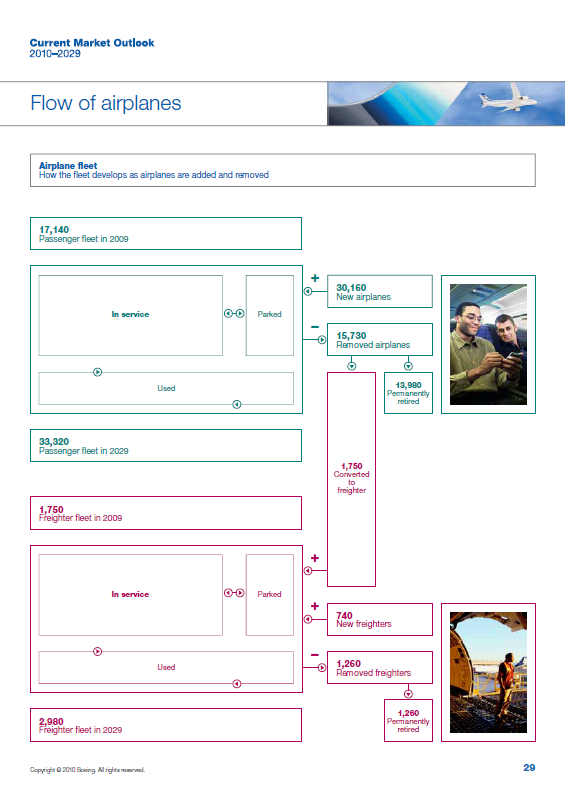
Flow of airplanes

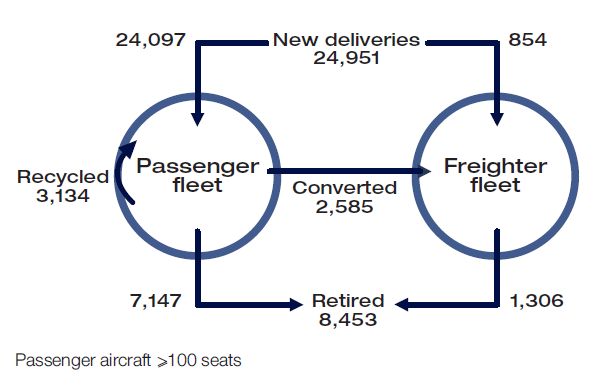
Another very interesting feature that Airbus published in last year’s GMF (it is not yet in this year’s publication) and Boeing used for this year’s CMO is a graphic showing the dynamics of aircraft. In it you may understand how from today’s fleet, adding new deliveries, retiring old aircraft, converting some from passenger to freight transport they arrive to the forecasted fleet in 2029.

I include below both graphics.

Leave a comment

Filed under Aerospace & Defence

Airbus vs. Boeing, comparison of market forecasts

Airbus announced on Monday its latest Global Market Forecast (PDF, 4.6MB) for the 20-year period 2010-2029. Media has already highlighted the main points: ~26,000 new aircraft will be delivered with a market value of ~3,200bn$.

Some months ago, Boeing published its equivalent study, the Current Market Outlook (PDF, 8.2MB) for the same period.

It is interesting to compare the two of them. In that way we can see how each other treat competitors’ products (mainly A380) and how they try to shape the market and send messages to it (point-to-point & hub-spoke).

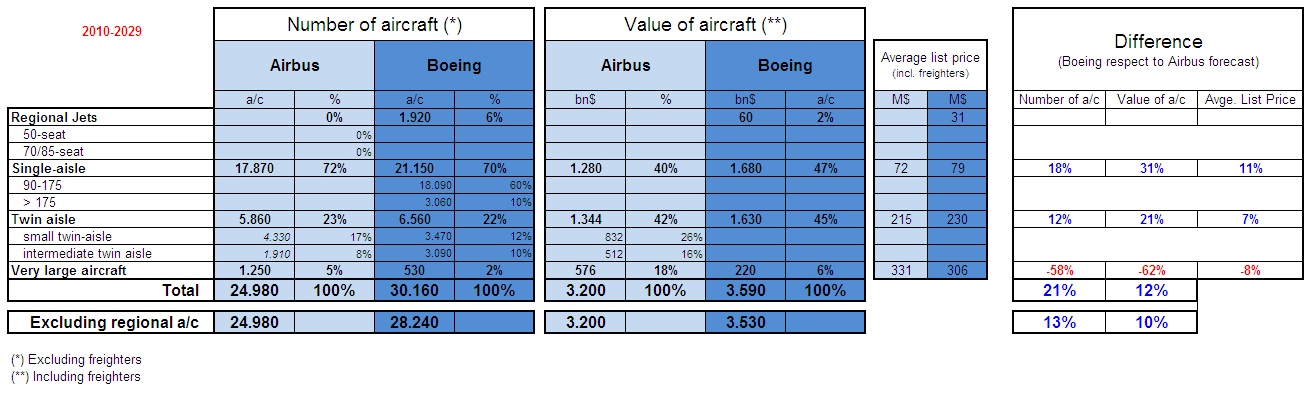
However, it is not easy to compare the studies as they use slightly different segmentations, disclose in different ways the value of aircraft for the segments (list prices) and is not always clear how to discount freighter aircraft from global figures. I dig for some time into those numbers and arrived to the following table:

Comparison of Airbus GMF and Boeing CMO 2010-2029.

Some comments on the comparison:

  • Boeing sees demand for 13% more aircraft with a 10% more value.
  • However, this higher demand is not applicable to all segments: Boeing sees ~60% less A380s or equivalent being delivered over the next 20 years, while 18% more single aisle (A320s) and 12% more twin aisle (A330/A350s).
  • Boeing plays down A380 potential, but sees a very similar number of RPKs (“revenue passenger kilometer”), that is, the number of paying passenger by the distance they are transported. Airbus forecasts for 2029 12.03 RPKs while Boeing forecasts 12.60 (in trillion).
  • The difference of less than 5% in RPKs means that out of the 13% difference in aircraft deliveries over 8% comes from the different business model each company is trying to push.
  • Finally, we can see that Boeing uses again higher average prices for smaller aircraft and a lower reference price for A380s.

Enjoy the two documents, differences apart, they gave a very good piece of information and insight about the market.

7 Comments

Filed under Aerospace & Defence

Home

By now, most of you are aware that I moved recently to Toulouse. Some of you may have read about the process of finding my new flat.

I live in the Rue du Cimetière Saint-Cyprien, close to the city centre. Going back and for to work takes about 20 minutes, there is traffic as they say here, but nothing compared to larger cities.

My street.

The flat is what they call a T3; this is a living room plus 2 bedrooms. The kitchen is way larger than my cooking skills will ever ask for. It has an open-air private parking lot…

… but really, what makes me call it home is this view:

Sweet home.

1 Comment

Filed under Travelling

The cost of flying low

Last 12th October, I came from Amsterdam to Madrid by plane. That day there was an air controllers strike in France. While flying, the pilot commented that the company had tried to re-route the flight in order not to lose the slot it had, this proved almost impossible so what they did was to fly at a lower level. The pilot explained that this was very “costly as the engines consume much more” at that lower level.

How much more? How costly was this measure? I wanted to check it out, and some weeks later I have made the numbers that I show here.

We flew in an Airbus A321. Since it was the early flight in the morning I assume it carried maximum fuel and the weight was limited by Maximum Landing Weight (75.5 tonnes, MLW), so the takeoff weight would be the MLW plus the fuel weight we would consume in the flight, in the order of 5,500 kg (an average of 2,400 kg/hour according to some operators). Thus I used a takeoff weight of ~81,000 kg.

When flying at a lower level, the air density is higher and this increases drag. Normally, planes in this route fly at ~ 33,000 ft or ~ 10,000 m. What flight level did we use? This I don’t know, so I took the worst situation: say we flew at FL210, or 21,000 ft (~ 6,400 m). We can find at the chart the Standard Atmosphere and see the difference in density at both altitudes (~ 0.53ρ0 compared to ~ 0.33ρ0).


Flight levels, image from Wikipedia.


Standard Atmosphere, image from Wikipedia.


Using the Breguet range equation, all other things being equal (same distance, same aircraft, same weight at the departure…), we can relate the weights and densities of the initial flight plan the company had and the one used after trying to re-route.


Breguet range equation.


The result I got is that by flying at FL210 instead of FL330 the aircraft would have consumed over 1,400 kg of fuel more, a whole 26% more.

I checked the prices for fuel at IATA (International Air Transport Association) and at the moment is 746$/mt. The 1,400 kg of extra fuel would cost about 1,050$ (~ 760€), or about 4.2€ more per passenger (assuming we were around 180 passengers).

8 Comments

Filed under Aerospace & Defence

Moving to France


My one-way ticket to France.


By now, most of you (family, friends and colleagues) know about it, this is mainly for those who did not.

I am starting there sometime in December.

You are invited to pay a visit.

10 Comments

Filed under France