

My one-way ticket to France.
By now, most of you (family, friends and colleagues) know about it, this is mainly for those who did not.
I am starting there sometime in December.
You are invited to pay a visit.
My one-way ticket to France.
By now, most of you (family, friends and colleagues) know about it, this is mainly for those who did not.
I am starting there sometime in December.
You are invited to pay a visit.
Filed under France
The last two issues of Boeing’s Current Market Outlook, included a slide in which Boeing wanted to prove that their forecasts have been more accurate in the last 10 years. They compare actual aircraft demand versus both Airbus and Boeing forecasts in the year 2000.

Boeing Current Market Outlook, different views.
I find it interesting that all segments are described as such, segments: “Single-aisle”, “Twin-aisle”, “Large”… except for Airbus forecast in which Boeing introduces the model “A380”. As if wanting to point that Airbus was wrong in its A380 forecast… as if wanting to steer demand.
Let’s see the numbers:
As of today, Airbus has sold 234 A380s, including the latest 32 from Emirates. The prospects for the aircraft seem brighter as operators started operating it, on the other hand Boeing 747-8 orders have stalled since 2007.
A bit of history.
Yesterday, I was digging into back materials and I found two interesting pieces. Both from Boeing’s website in the year 1996 (using the way back machine). The first one is from a webpage about delivering value it could be read:
“In an industry defined by continual change, customers expect Boeing to help them prepare for the challenges ahead. That’s why we work closely with customers to understand their long-term requirements.
Customers have expressed interest in many potential airplanes, including:
Of those potential airplanes: we have seen the Embraer 190, the Airbus A380, derivatives and the only one that never came true was the supersonic jetliner…

Artist image of Boeing Sonic Cruiser.
The other piece is from a news release on the occasion of the Farnborough air show of 1996 (2010 edition is taking place right now). There, Boeing stated:
“Most major aerospace companies agree that airlines will require 500 to 700 airplanes capable of carrying more than 500 passengers. Boeing forecasts 500 airplanes will be needed by the year 2015.
Much of the demand for these very large airplanes will be generated by steady growth in air travel to and from Asia, and by capacity constraints at some of the world’s largest airports.
The 747-600X, with its ability to carry 548 passengers on routes up to 7,750 nautical miles (8,900 statute miles or 14,350 km), is designed to fill this market need. It will allow airlines to accommodate traffic growth without increasing the number of departures scheduled for busy airports.
During the next 20 years, airlines also will need approximately 600 airplanes capable of carrying between 400 and 500 passengers.
The Boeing 747-400 and 747-500X are designed to fill this market need.”
At this point it is useful to remember that in 1993 Boeing together with Airbus consortium companies started the feasibility study for the Very Large Commercial Transport (VLCT). Boeing left the joint study two years later. Nevertheless, still in 1996 it stated in its website that demand of aircraft carrying above 400 seats (747 and A380 of today) in the following 20 years would be between 1,100-1,300 planes, very close to Airbus forecast of the year 2000. The reasons behind that demand were the same Airbus argues nowadays: growth in Asia, constrains in largest hubs…
Later on, Boeing changed its forecast down to 700 aircraft.
Filed under Aerospace & Defence
Boeing has recently unveiled its latest Current Market Outlook (CMO): a commercial aviation market forecast for the next 20 years. It calls for 30,900 new aircraft deliveries worth 3.6 trillion dollars. Today, I wanted to write about aircraft discounts and the possibility of having new entrants.

Boeing Current Market Outlook.
Both Boeing and Airbus give their market forecast and backlog figures in what they call as list prices. If you take figures from CMO, you will reach average list prices for regional jets (31M$), single-aisle (79M$), twin-aisle (230M$) and large aircraft (306M$). These figures are in accordance to the prices published in their website (dating from 2008).
However, if you take their published numbers of deliveries each year and use the same prices, you would come to much higher revenues figures than the ones they publish in the year-end results: this is because aircraft makers actually sell the planes at a much lower price. How much lower?
Discounts
I took the figures of revenues, orders and deliveries of the last three years and tried to reach what would be the corresponding discount Boeing’s customers manage to get on average.
I assumed that new orders come with a 3% down payment in the year of the booking, while the remaining cost I assumed that was paid on the year of delivery (for simplicity I didn’t consider more intermediate payments, the 3% figure was taken from the AIAA paper “A Hierarchical Aircraft Life Cycle Cost Analysis Model” by William J. Marx et al.). I also used estimated figures for Boeing Commercial Aviation Services ranging from 2.2bn$ to 3.3bn$.
With these assumptions, I concluded that the average discount that would best replicate revenues figures for Boeing Commercial Airplanes with a minimum error was: 38%! (being the errors in revenues of: 0.05% for 2009, 3.2% for 2008 and 0.5% for 2007).
Thus, when figuring out the value of those 30,900 aircraft we could rather estimate it at 2.2 trillion dollars (instead of 3.6 trn$).
New entrants?
Randy Tinseth, BCA’s VP Marketing, was quoted in Flight Global saying that he expected at least one more competitor in the single-aisle segment. If there are more competitors, competition is going to be tight.
Today Boeing Commercial Airplanes and Airbus Commercial yearly revenues together approximately account for 70bn$. If their revenues are to grow with Boeing’s forecasted world airplane fleet growth of 3.3%, along the next 20 years the revenues of both companies combined would amount to 1.94 trillion dollars.
Considering that the whole market, factoring in discounted prices, was going to be 2.2 trn$, this leaves the rest of competitors a share of the pie of about 250bn$ for the next 20 years (excluding regional jets), this is just 11.4% of the market.
If we look at it on a per year basis: 12.5bn$ a year for all new entrants (CSeries, Embraer, MS-21, SSJ, C919, Koreans, Japanese…) would mean about 250 aircraft a year (compared to the ~380-400 single-aisle that each Boeing and Airbus are delivering per year).
There is room for one commercial success comparable to the 737 or A320 family, but there is not room for two… maybe this is why Randy says “one or two of those guys into the mix” (despite of the many more new possible players).
Filed under Aerospace & Defence
Today I was attending a project management course at Airbus. After some introductions, the teacher came to the always controversial (within such a technological company) comment that “the project leader needs to have experience in project management not in the technical issues related to the project”… she then cited aircraft as an example: “nobody within Airbus may know every technical detail of an aircraft which counts with hundreds of thousands parts, yet there is someone managing its development…”
That example seems very clear. Tonight, while listening to a TED Talk on the exchange of ideas, by Matt Ridley, I got the thread to a way better example: that is the essay “I, Pencil: My Family Tree as told to Leonard E. Read” by Leonard E. Read, which can be found at the Library of Economics and Liberty.
I believe this a much better example because of exactly the same reasons Mr. Pencil gives:
“[…] I have a profound lesson to teach. And I can teach this lesson better than can an automobile or an airplane or a mechanical dishwasher because—well, because I am seemingly so simple.
[…] Simple? Yet, not a single person on the face of this earth knows how to make me.”
Then, the pencil goes explaining where all its components are coming from…
“[…] My family tree begins with what in fact is a tree, a cedar of straight grain that grows in Northern California and Oregon. Now contemplate all the saws and trucks and rope and the countless other gear used in harvesting and carting the cedar logs to the railroad siding. Think of all the persons and the numberless skills that went into their fabrication: the mining of ore, the making of steel and its refinement into saws, axes, motors…”
If it’s clear that nobody knows how to make simple pencil, clearer will be for any other case of a more complex product.
There is indeed a Mr. President of the pencil company, there may even be a Pencil Programme Manager, but as Pencil says: “There is a fact still more astounding: the absence of a master mind, of anyone dictating or forcibly directing these countless actions which bring me into being.”
Filed under Aerospace & Defence, Economy
Some days ago I came across a post in the blog of Randy Tinseth, VP Marketing for Boeing Commercial Airplanes, where he explains the concept of StartupBoeing and invites entrepreneurs to take up the opportunity. StartupBoeing is a website which offers information to entrepreneurs in order to help them build their business plan or run their operations. As it is stated in the web itself:
“The StartupBoeing team assists entrepreneurs in launching new airlines. From concept through launch, StartupBoeing offers guidance, review, analysis, data, resources, contacts, and referrals to qualified startup airlines.”
The first thing I thought was “yes, there is the opportunity to lose your investment”. To be fair, Tinseth points at different moments the difficulty of the business and that it is tough to start-up an airline. Airbus does also have the same concept available to entrepreneurs, in this case is called: Start Me Up.
I looked for the last industry outlook from the International Air Transport Association (IATA), the industry association. The figures are appalling (see the table below):

IATA Financial results of the last decade.
Airlines around the world have lost during the last decade 50 billion dollars, with only 2 out of ten years with profits. On average the net profit, loss in this case, was -1.4% of the revenues (over 4 trillion dollars in the decade). Of course, there are airlines making profits, but the industry is not doing well (just remember the last achievements of G. Díaz Ferrán).
I then remembered this other comment from Warren Buffet about the airline industry since its inception:
“I made the comment that if a capitalist had been present at Kittyhawk back in the early 1900s, he should have shot Orville Wright. He would have saved his progeny money.
But seriously, the airline business has been extraordinary. It has eaten up capital over the past century like almost no other business because people seem to keep coming back to it and putting fresh money in.
You’ve got huge fixed costs, you’ve got strong labour unions and you’ve got commodity pricing. That is not a great recipe for success.
I have an 800 (free call) number now that I call if I get the urge to buy an airline stock. I call at two in the morning and I say: “My name is Warren and I’m an aeroholic.” And then they talk me down.”
So, yes, if you are considering whether to start-up an airline, do yourself a favour: call that 800 number, and put your cash somewhere else where it returns more than -1.4%…
The one thing we should definitely praise from these initiatives is the information resources available to the general public, something commented by readers of Randy’s blog and a purpose expressed in the Startup website as well:
“StartupBoeing.com also has a wider purpose as a resource to pass on information to our customers – and also as a resource for existing airlines, financial institutions, consultants and the leasing community. It’s a place for neutral industry data. We want to help make the industry healthy and make airlines safe, reliable and profitable.”
Filed under Aerospace & Defence, Investing, Marketing
Airbus announced last January that it had raised the list prices of its commercial aircraft by an average of 5.8%. It had not updated its prices since 2008. You may see the current prices here: Airbus list prices.
Boeing also discloses in its website the range of list prices of its aircraft. Those prices haven’t been increased in the last two years.
Few years ago, I saw for the first time a comparison of prices of aircraft per kilogram. It was prepared by a teacher I had at EOI Business School in Seville, Felipe Moran, who later has become a co-worker. With this post I will start a series of comparisons, the first one being precisely that one: an update on price per kilogram of aircraft.
We already saw where to get the prices from. The other input we are going to use is the weight of the aircraft, what is called: Operating Empty Weight (OEW). You may find this information in various places, I recommend you to pay a visit to Boeing’s “Airplane Characteristics for Airport Planning”, where you will find very detailed data of all its commercial aircraft. (While gathering this info I also came across the following section dedicated to fun facts of the legendary Jumbo 747).
Combining these inputs we can build the following table.
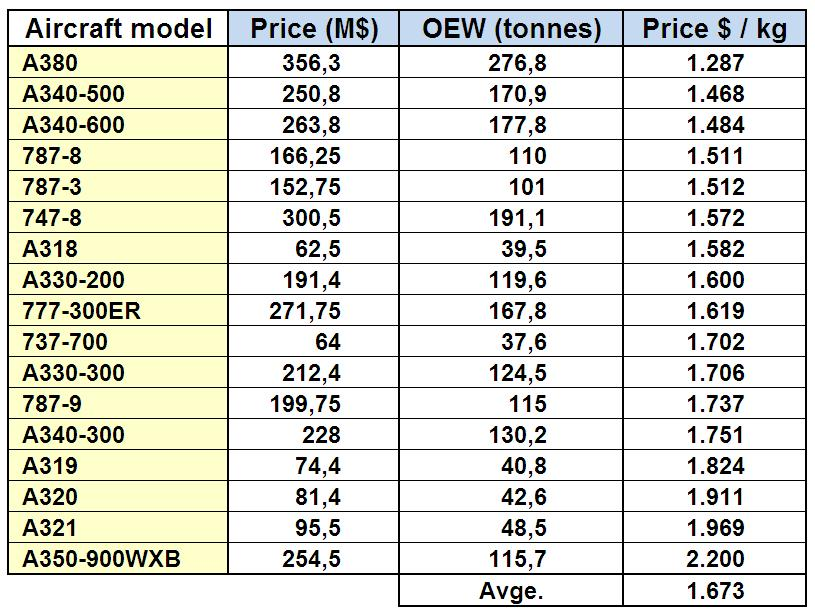
Price per kg of commercial aircraft.
Some facts may counter intuition:
With the exceptions of A350-900 and 787-9 there seems to be a very slight trend in bigger aircraft being cheaper in this per kg basis. One may argue that once the frame of a certain size is built, building a bigger one might not cost that much.
Now, let’s talk about the Military Transport business. Do we think those aircraft are more or less expensive? On one hand, those aircraft are not carrying systems such as the in-flight entertainment and, on the other, the scale of the market is smaller (with few exceptions such as the C-130) and they do carry diverse military systems, protections, etc. What is the trend weighting more in the balance?
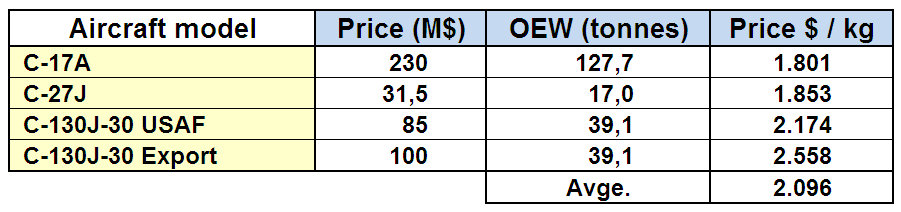
Military transport aircraft price per kg.
As you can see, military transport aircraft are on average 25% more expensive on a per kg basis. There is much more technology in them than people tends to think… they are clearly not just flying trucks.
As you may have noted I have not included any sources for the prices of these aircraft, since they are rarely disclosed. I have used prices reported by the press and US budgets.
Let’s stretch the argument a bit more… What is the trend for fighter aircraft? This time scales are bigger than in military transport. Does this make them cheaper? See the table.
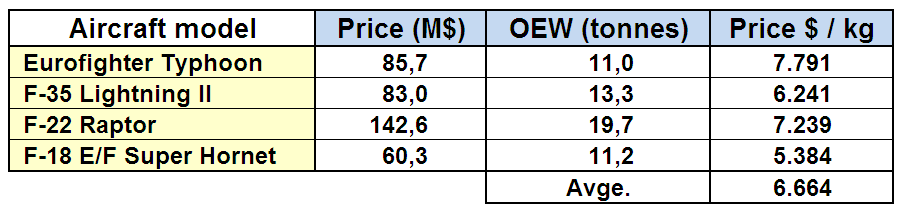
Fighter aircraft price per kg.
Not even close. Fighters are around 3.2 and 4 times more expensive than military transport and commercial aircraft, respectively, on a per kg basis.
We can see in the following graphic all these aircraft together and maybe spot those trends.
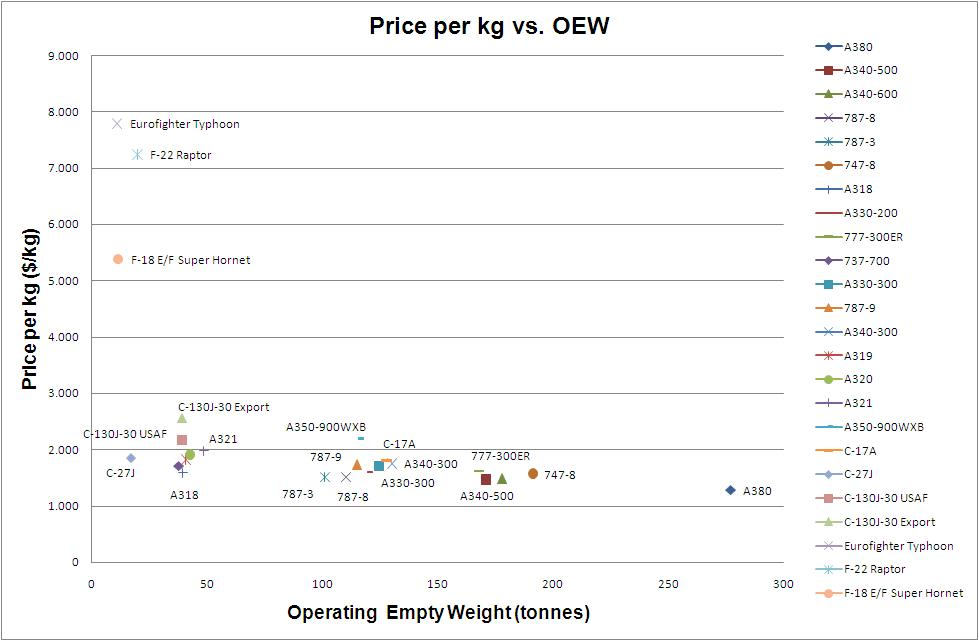
Aircraft prices per kg.
Now that we have an idea of how much aircraft cost per kg (1,700$ commercial aircraft, 2,100$ military transport aircraft and 6,700$ fighter aircraft)… is this expensive? Expensive compare to what?
Let’s relate these prices to something closer to us.
Cars:
It may be worthy to note that in the cars we see the completely opposite trend than that we saw in airplanes: the bigger the car the more expensive on a per kg basis.
Let’s compare this yet again with some other unrelated luxury item: Jamón Ibérico Puro de Bellota de Jabugo 5J. Today it was on offer in El Corte Ingles website for only 449€, a piece of about 7 kg, yielding: 87 $/kg. This is twice more expensive than buying a Mercedes (this may be the reason why it was an offer from Sanchez Romero supermarkets) but still 20 times cheaper than a commercial airliner.
To end this post, let’s answer the question posed in the title of the post:
The kilogram of gold is in the order of 35,400$, clearly more expensive than any aircraft.
After all, nowadays, we may find no aircraft worth its weight in gold.
Filed under Aerospace & Defence
Today Spanish financial press gave some coverage to a study performed by Randstad, “Employer Branding: cuando la percepción puede convertirse en realidad”. To compile this study Randstad interviewed 10.000 workers between 18 and 65 years old in Spain.
Workers were asked what issues they considered most important at the time of choosing a company to work for, the highest rated ones were:
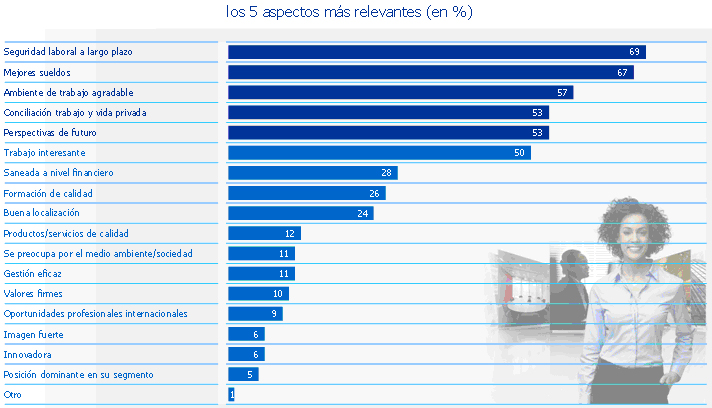
Most important factors when selecting a company to work for
Randstad found a high variability between men and women respondents and between different age groups.
…
After this introduction… what I wanted to say: EADS CASA (Airbus Military) was rated by respondents as the most desirable company to work for. (period)
Other remarkable companies: GlaxoSmithKline, Nokia Spain, Pfizer, Correos, Coca-Cola and Iberdrola.
Filed under Aerospace & Defence

 The Blog by Javier