Tag Archives: Boeing

Ray Conner on pricing and Boeing discounts

Reading in Leeham News and Comment aerospace blog about the appearance of Ray Conner, CEO of Boeing Commercial Airplanes, at JP Morgan aerospace conference I picked the following lines:

Joe Nadol (JN) of JP Morgan: Is there pricing pressure?

Ray Conner (RC): I think margin will be OK [for 737NG]. Some initial launch deals for MAX can be a little more aggressive, but we’re seeing that become more stable.

JN: MAX–I thought pressure would be more on late NGs than on the MAX.

RC: We were a little late getting into the marketplace with MAX and there was pricing pressure on NGs. We were about a year late so we were more aggressive than we would have been had we not been late.

For the last years I have been trying to estimate averages for the discounts Boeing applies to its commercial aircraft using as departing information Boeing year-end financial results, list prices, net orders, deliveries and services revenues. You can see the results for 2012, 2011, 2010 and 2009. In each of the posts you can see a detailed explanation of the methodology I followed.

Why do I comment this? Since 2009 I have noticed that the average discount has gone from ~38% (2009), 39% (2010), 41% (2011) to 45% (2012)!!

Find below the explanation I could find for that hike in the discount:

The explanation I can find for that increase shall be linked the built-in penalties for 787 (net orders for 2012 being -12 a/c) and 747 delays (1 single net order) into revenues plus the launch of a new aircraft, 737 MAX (forced by A320neo sales success in 2011).

How does it compare to Conner’s words?

6 Comments

Filed under Aerospace & Defence

KC-46 EMD contract 101

The US Government Accountability Office (GAO) has recently published a report about the KC-46 Tanker Aircraft [PDF, 1.2 MB]. In it the GAO reviews the situation of the program, measures introduced, costs, technology development, etc. In the first page it summarizes:

“The KC-46 program 2012 estimates for cost, schedule, and performance are virtually the same as last year’s, with the contractor running very close to the planned budget and schedule”.

On the technical side it points to several challenges: flight test plan, completion of engineering drawings, relocation of personnel and facilities related to defense equipment, etc.

However, in this post I wanted to focus only on the costs and contractual sides of the program, given the amount of articles that we could read about it during the past year. Several news have reported about the cost overruns in the program and about how these were to be born by Boeing.

The last time I read about the topic, the reported overrun was of about 1.2bn$ on a 4.4bn$ contract, out of which ~500M$ would be born by USAF and the remaining 700 M$ by Boeing (see articles from Bloomberg, Aviation Week, The Seattle Times…).

But, where do these figures come from?

One of the many things I like of the USA is the transparency in making lots of information and data available to the public, for example, budgeting information of the Air Force, GAO’s assessments, hearings at the Senate and House of Representatives Committees, etc. Thus, you can find:

Contractual framework

From the USAF budgeting material, page 675, under the paragraph “E. Acquisition Strategy“, the explanation of the different contracts structure for the KC-X program (the name of the program prior to the contract award) can be found:

“The KC-46 program released a final Request for Proposal (RFP) on 24 Feb 2010, and entered source selection on 9 Jul 2010. The KC-46 program held a Milestone B Defense Acquisition Board (DAB) on 23 Feb 2011, received approval to enter EMD from OSD AT&L on 24 Feb 2011, and awarded the KC-46 contract to Boeing on 24 Feb 2011 to develop and procure 179 KC-46 aircraft. The KC-46 contract procurement was conducted via a full and open competition per Federal Acquisition Regulation (FAR) Part 15, and resulted in a FY 2011 EMD Fixed Price Incentive Firm (FPIF) contract. The EMD phase will develop, build, and test four KC-46 aircraft, and will qualify receiver aircraft.

Production will begin in FY 2015 with two Low-Rate Initial Production (LRIP) lots (Firm Fixed Priced (FFP)) and then Full-Rate Production (FRP) options (FFP with Not to Exceed (NTE) + Economic Price Adjustment (EPA)). The LRIP and FRP options will be exercised following successful completion of Operational Assessments (OAs) for the LRIP decisions, and a successful completion of Initial Operational Test and Evaluation (IOT&E) for the FRP decision.”

Thus, so far only the Engineering Manufacturing and Development (EMD) contract  phase has been contracted, on February 24th Feb 2011 (you can see Boeing and DoD press releases).

Cost Assessment by GAO:

From the Government Accountability Office (GAO) assessment of the program, referred above:

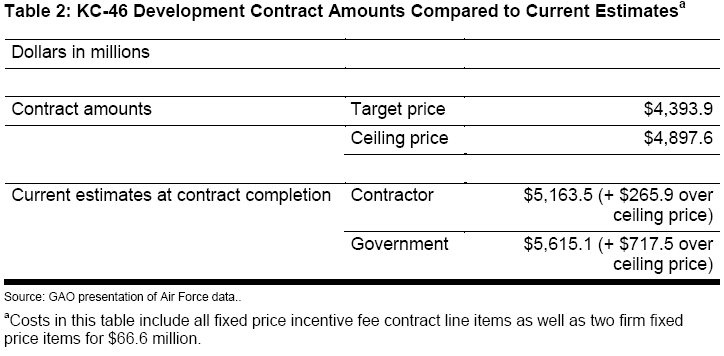
“The current development cost estimate of $7.2 billion as reported in October 2012 includes $4.9 billion for the aircraft development contract and 4 test aircraft, $0.3 billion for the aircrew and maintenance training systems, and $2 billion for other government costs to include program office support, government test and evaluation support, contract performance risk, and other development risks associated with the aircraft and training systems. […]

Through December 2012, Boeing has accomplished approximately $1.4 billion (28 percent) in development work and has more than $3.5 billion (72 percent) in estimated work to go over the next 5 years. […]

Barring any changes to KC-46 requirements by the Air Force, the contract specifies a target price of $4.4 billion and a ceiling price of $4.9 billion at which point Boeing must assume responsibility for all additional costs. […]”

See the table below showing Air Force and Boeing contract amounts and estimates:
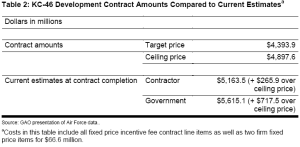
KC-46 EMD Contract & Estimates.

KC-46 EMD Contract & Estimates (Source: GAO).

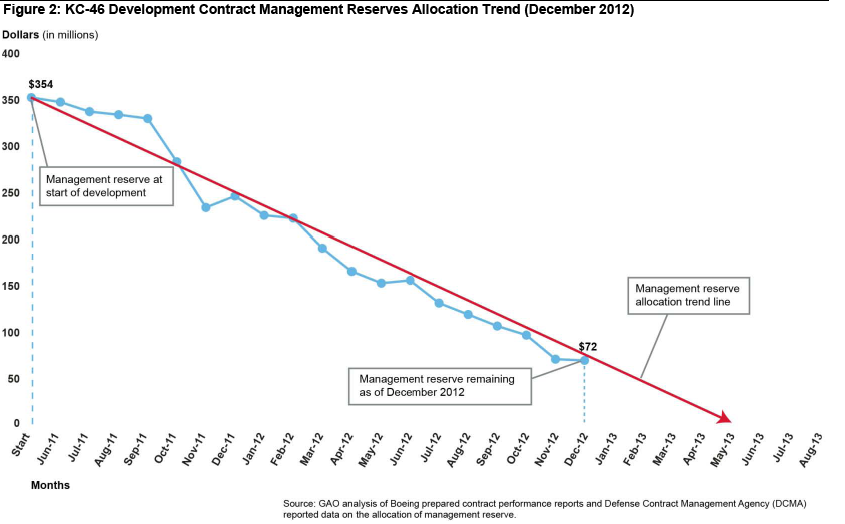
The report from GAO offers the following graphic referring to what they call “management reserves“:
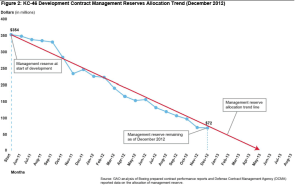
KC-46 EMD Management Reserves (Source: GAO)

KC-46 EMD Management Reserves (Source: GAO)

This graphic shows well the rate at which Boeing has been supposedly burning its margins. However, it does not reflect at all the nature of the issue, related to the type of contract this “Engineering Manufacturing and Development” (EMD) contract: a Fixed Price plus Incentive Firm type of contract (FPIF).

Fixed Price Incentive Firm contracts

It is not easy to find good literature online about these types of contracts. The Wikipedia for instance does not have yet an article on FPIF contracts, but only on the calculation of the Point of Total Assumption. However, you can find a couple of good sites with explanations and examples of FPIF contracts here and here [PDF from the US Army].

Some concepts that we need to bear in mind are (definitions from the link above):

Target Cost (TC): The initially negotiated figure for estimated contract costs and the point at which profit pivots.
Target Profit (TP): The initially negotiated profit at the target cos
Target Price: Target cost-plus the target profit.
Ceiling Price (CP): Stated as a percent of the target cost, this is the maximum price the government expects to pay. Once this amount is reached, the contractor pays all remaining costs for the original work.
Share Ratio (SR): The government/contractor sharing ratio for cost savings or cost overruns that will increase or decrease the actual profit. The government percentage is listed first and the terms used are “government share” and “contractor share.” For example, on an 80/20 share ratio, the government’s share is 80 percent and the contractor’s share is 20 percent.
Point of Total Assumption (PTA): The point where cost increases that exceed the target cost are no longer shared by the government according to the share ratio. At this point, the contractor’s profit is reduced one dollar for every additional dollar of cost. The PTA is calculated with the following formula. [thus, PTA = (Ceiling Price – Target Price)/Government Share + Target Cost]

Where can we get these figures for the KC-46 EMD contract? Some of them are referred to in the different reports and budgeting materials (explicitly or implicitly) and others can be found in the following letter from US Senator John McCain to the DoD from July, 15 2011 [PDF, 400 KB].

Thus for the KC-46 EMD contract we have:

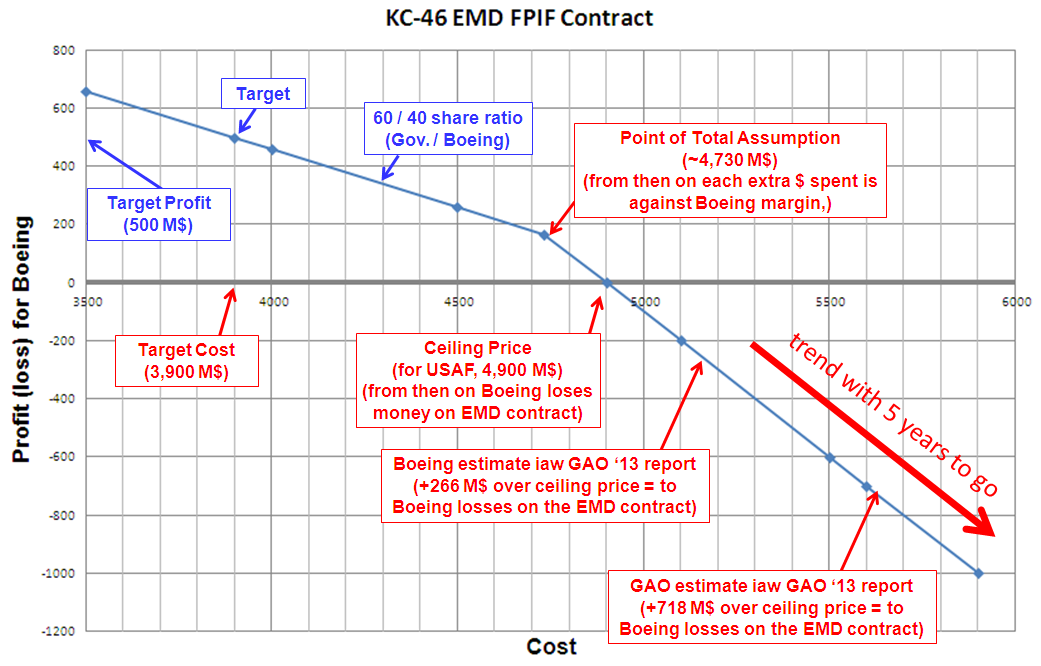
  • Target Cost: 3.9 bn$.
  • Target Profit: 500 M$.
  • Target Price: 4.4 bn$
  • Ceiling Price: 4.9 bn$
  • Share Ratio: 60% / 40% (Government / Boeing).
  • Point of Total Assumption (calculated): ~4.73 bn$.

With this information we can produce the typical FPIF contract curve, which is the only thing which is missing in ALL the news, budgeting materials, GAO reports, etc., that I have read and is the most illustrative graphic to understand what is going to happen if the cost overruns keep piling and who is going to bear which amount of the cost from which point:
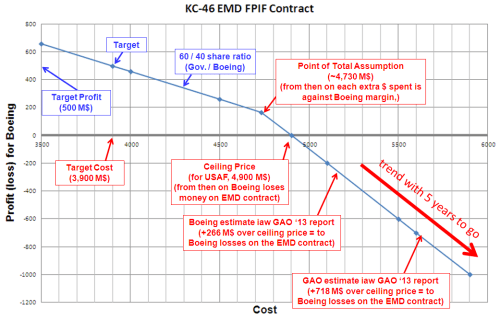
KC-46 EMD FPIF Contract.

KC-46 EMD FPIF Contract.

3 Comments

Filed under Aerospace & Defence

Boeing 787 orders vs. cancellations

I read yesterday the first article about delays in 787 deliveries in 2013 due to the grounding of the fleet. With the investigation of the batteries issue taking already a month, it was evident that these delays were going to happen.

I have not yet read anything in the specialized or business press about cancellations. However, taking into account that when the 787 program started announcing 3-month delays from Q3 2007, cancellations started to pile, I guess that this time it will not be very different.

I checked the information of orders and cancellations from Boeing website.

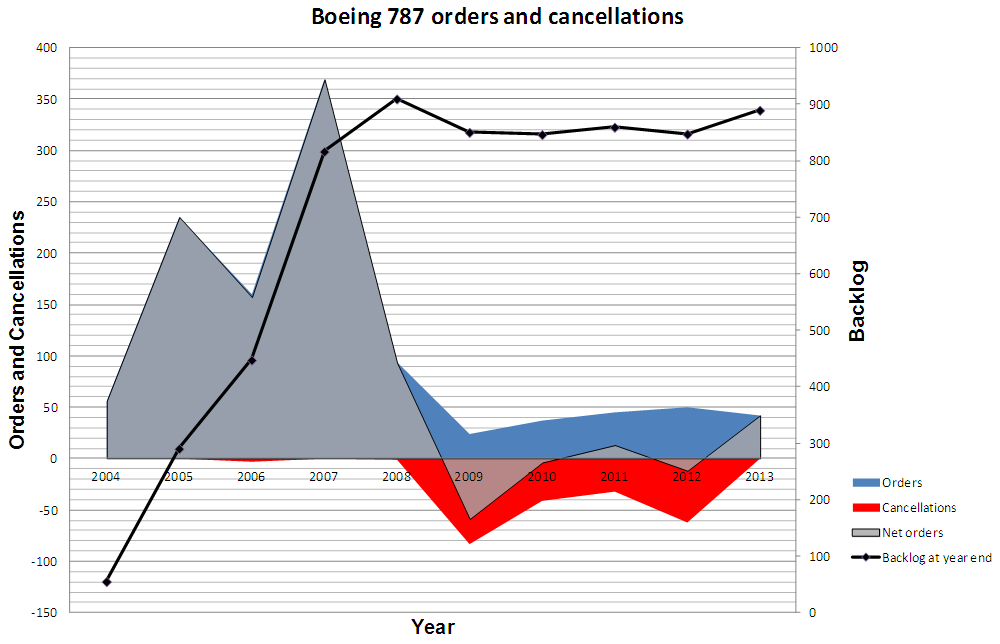
Since 2004, Boeing has received a total of 1,112 787 orders. Out of these, 222 orders were later on cancelled; mostly between 2008 and 2012. Now there are still 890 firm orders (with about 50 of those aircraft already delivered). As a summary, find the graphic below:

Boeing 787 orders and cancellations

Boeing 787 orders and cancellations

1 Comment

Filed under Aerospace & Defence

Boeing commercial aircraft discounts (update for 2012)

A week ago, Boeing released 2012 results [PDF, 223KB]. The company reported revenues of almost 81.7bn$601 commercial deliveries and 1,203 net orders for its commercial aircraft. All these were widely reported by the media and mean a great year 2012 for Boeing (with increases in these metrics from 20 to 30%).

Last years, I wrote in some posts what was my estimate of Boeing discounts: the relation between what is announced by the press, what appears in its list prices and sometimes as backlogs and what it is indeed computed into the profit and loss account. In this post I wanted to update, if necessary, the figure I calculated for the average discount of Boeing.

Most of the necessary information can be found in its website. Boeing list prices can be found here.

The number of gross and net orders (after cancellations) year by year can be found here.

Last year deliveries can be found in the report of financial results (or here). From there we can also deduct the figure of Boeing Commercial’s sales of services. That is not directly reported but can be deducted (all Boeing services-related sales are reported as well as Boeing Capital Corporation division and Boeing Defense’s “Global Services & Support” unit)

As in the post of last year:

  • I needed to make one assumption: new orders come with a 3% down payment in the year of the booking, while the remaining cost I assumed that was paid on the year of delivery (for simplicity I didn’t consider more intermediate revenue recognition milestones linked to payments, the 3% figure was taken from the AIAA paper “A Hierarchical Aircraft Life Cycle Cost Analysis Model” by William J. Marx et al.). [1]

Having put all the figures together, the calculation is immediate. Boeing Commercial Aircraft revenues in 2012 (49,1bn$) are the sum of:

  • the discounted prices times the delivered aircraft in the year (including possible penalties from delays),
  • less the down payment of the current year delivered aircraft, as the down payment was included in previous years results,
  • plus the down payment of current year net orders (this year’s calculation has been again a bit tricky as it included 737NG deliveries and 737 MAX orders),
  • plus services revenues (about 1.4bn$ from the commercial aircraft unit – calculated, not reported).

The discount figure that minimized errors last year was 41%. Using this figure, the error obtained this year in relation to Boeing Commercial Aircraft reported revenues is 7.5%, much too high. The best estimate for last years average discounts were: 41% for 2011, 39% for 2010 and 38% for 2009.

The updated figure (which minimize errors for 2012 down to 0.4%) for the discount for Boeing commercial aircraft is 45% [2].

The explanation I can find for that increase shall be linked the built-in penalties for 787 (net orders for 2012 being -12 a/c) and 747 delays (1 single net order) into revenues plus the launch of a new aircraft, 737 MAX (forced by A320neo sales success in 2011).

[1] Two years ago, I received a comment from the analyst Scott Hamilton on the level of downpayments. He mentioned they could reach up to 30%. I tried this time to compute the calculation using that input, though the figures of discounts to be applied each year to minimize errors would have to be even higher, over 50% (!), thus I stayed with the 3% used in the above-mentioned published paper to stay on the conservative side.

7 Comments

Filed under Aerospace & Defence

Daily cost of Boeing 787 fleet grounding? (number play)

I am following relatively closely the news related to the grounding of Boeing 787 world fleet due to the recent issues that 2 of the operating aircraft had in service. I was wondering how much could Boeing be penalised by this situation.

Then, a couple of days ago I started seeing estimates (up to 5bn$?!), so enjoying playing with numbers as I do, I wanted to make up my figures before reading the explanation I am looking for somewhere else. Let me share the number play with you.

I have read news pointing at a solution based on new batteries, which certification could extend until 2014! Well, hopefully it doesn’t take that long, but since we don’t know for how long the fleet is going to be grounded and we also don’t know what the final fix is going to be, what I am interested at this moment is in trying to guess the cost per day of the grounding of the fleet.

Let me explain the assumptions I am going to take and where do they come from:

  • aircraft grounded: 50 (Boeing deliveries).
  • average seating: 210-250 seats for -8 (a/c delivered) and 250-290 for -9 (seating numbers from Boeing; deliveries from Wikipedia).
  • revenue per passenger: here, instead of doing an extensive research, I based the calculation on a previous research made by Air Insight for a report about Air India potential claim for 787 delays (the article is from one year ago).
    • $234 per flight hour for first class (using a 75% load factor),
    • $136 per flight hour for business class (80%),
    • $67 per flight hour for economy class (85%).
  • seating per class: using the information from United as reported by SeatGuru for the
  • 787-8: 36 + 72 + 111 (1) (for a total of 219 pax).
  • flight hours per day: Air India was flying between 11 and 11.78 FH/day according to Air Insight. Ethiopian was said to be flying about 14 FH/day. I’ll take an average of 12 flight hours per day.

With all these assumptions, the daily cost of B787 grounded fleet is: ~12.3 millon dollars / day.

Partial results of the calculation are:

  • average revenue per flight hour, ~20,500$;
  • average daily revenue of a 787, ~245k$.

Taking into account that the fleet has been grounded for already 2 weeks, the cost so far is in excess of 170m$, not much compared to Boeing earnings (to be released today). But if the solution and certification process takes really until 2014, this cost would be in the order of 4.5bn$ (close to the 5bn$ figure pointed by Jefferies & Co. analyst).

Final remarks. Remember that this number play just tries to guess what is the revenue loss from not flying 787s. It doesn’t take into account the cost of fixing the problem, or whether the same routes are flown by other aircraft models and to what extent Boeing might or might not be penalised (in relation to revenue loss? profit loss?). This number play also does not take into account potential financial impact on further deliveries being postponed.

***

(1) Taking estimate of revenues and load factors from Air India and seating numbers from United already introduces some error.

Note: After completing this post, I saw the following similar estimate in Reuters published 2 weeks ago: 1.1m$ per day for a fleet of 17 a/c, the case of ANA.

4 Comments

Filed under Aerospace & Defence

World commercial aircraft fleet: forecast vs. actual

Some weeks ago I made a comparison about Airbus and Boeing aircraft market forecasts. Last week I published a couple of posts about the evolution in the forecasted aircraft average size and on the accuracy of these market forecasts. For this, I looked for old issues of Boeing Current Market Outlook from as back as 1990.

The next step then it was obvious, I compiled the following graphic showing with the data available information over a 40-year span on:

  • The evolution of world commercial aircraft fleet year by year (blue line) from 1995 to 2011,
  • The forecasted world aircraft fleets by Boeing CMO (red line) from 2000 to 2031 (with some gap years). For 2015 to 2031 the forecast was made 20 years ahead; for 2010-13 it was made 15 years ahead; for 2005-2008, 10 years ahead and for 2000-2003, 5 years ahead.
  • The published 20-year aircraft market forecast year by year.

World commercial aircraft fleet: forecast vs. actual (data source: Boeing CMO).

As you can fleets, forecasted fleets and market fleets have all been increasing year by year. The compounded annual growth rate (CAGR) for each one has been:

  • Actual fleet growth: 3.73% from 1995 to 2011 (2.88% from 2000 to 2011).
  • Forecasted fleet growth: 3.55% from 2000 to 2031 (3.69% from 2000 to 2011).
  • 20-year market forecast: 5.07% from 1992 to 2012 (3.43% from 2001 to 2012).

It is interesting to see that in those years when there is both figures for actuals and forecasted fleets the figures are close (-3.3% average deviation) and so is the trend, though forecasted fleet was lower at the beginning of that period (-7.2% in 2000) and grew at a higher rate until almost matching the numbers in 2011 (+1.2%).

Even though, the 20-year market forecasts have grown at a higher rate than fleets, it is mainly because the first data that I could retrieve come from the economic crisis of the beginning of the 1990’s, when Boeing trimmed down its forecasts. From the 2000’s the figures for market forecast have grown at a similar rate than those of fleets. And so will be the growth of forecasted fleet from 2011 to 2031: 3.5%.

****

Notes:

  • 1990 CMO long-term market forecast is made for 15 years, not 20.
  • Forecast of fleet for the periods 2000-2003, 2005-2008 and 2010-2013 does not come from CMOs published 20 years before, but from 5, 10 and 15-year fleet forecasts included in the CMOs of 1996, 1997, 1998 and 1999.
  • Boeing does not publish 5, 10 and 15-year fleet forecasts anymore.
  • It would be interesting to have a per-segment graphic, however there is not consistent data to produce it for the same time span. Boeing changed singe-aisle cut-off seat size from 1999-2000, in 1996-1997 and 2008 didn’t report the split within twin-aisle, in 2008 it also didn’t report the split within single-aisle.

2 Comments

Filed under Aerospace & Defence

Aircraft market forecasts accuracy

In a previous post I wrote about how the predicted average aircraft size by Boeing in 1990 did not match the actual evolution of that average size since then. In a more general context, how accurate are these aircraft market forecasts? Especially taking into account that they forecast along a 20-year period.

I dug in the archives and found an article in Flight International‘s issue of 10-16 March 1993 which compared Airbus’ GMF and Boeing’s CMO (you can find 2012 comparison here). Some excerpts from that article:

  • “Boeing is projecting deliveries of 12,005 aircraft, worth $815 billion at current values, from 1993 to 2010.”
  • (Boeing) “The trend towards larger aircraft will accelerate so that, although single-aisle types will account for about two-thirds of all deliveries, they will comprise 74% of those up to 2000 and only 60% beyond.”
  • “Airbus Industrie has released an upbeat forecast, predicting market demand for 11,653 new jet airliners to be delivered during 1992-2011, up from the 11,500 deliveries predicted in 1991.”
  • (Airbus) “The manufacturer foresees an accelerating demand for widebodied aircraft, driving average airliner size from today’s 176 seats to 255 seats in 20 years.”
  • (Airbus) “The global jet-airliner fleet will grow to 10,000 by 1998 and to almost 15,000 by 2011.

Now, let’s see what was the fleet at the end of 2011. Seeing Airbus’ Global Market Forecast from 2012, the departing numbers are those of 2011 fleet.

  • Passenger aircraft: 15,556 a/c.
  • Freighter aircraft: 1,615 a/c.

Thus, 17,171 a/c at the end 0f 2011. The GMF from 1992 underestimated the 20-year market by slightly above 2,100 or nearly 15% error. Not a bad shot taking into account the time span used.

Let’s take a more recent example, this time from Boeing. In the CMO from 1997, we find the following chart showing Boeing’s forecasted fleet size and distribution for 2001, 2006, 2011 and 2016 year-ends.

1997 Boeing CMO year-end fleet forecasts for 2001, 2006, 2011 & 2016.

In 2012 CMO, Boeing offered figures of 2011 year-end fleet.

Fleet at year end 2011 according to Boeing 2012 CMO.

We can make a quick comparison:

Comparison of aircraft fleet at year-end 2011: 1997 forecast vs. actual (sources: Boeing CMO 1997 and 2012).

Some reflections:

  • The total fleet figure was missed only by 1%.
  • The single-aisle figure was missed only by 2%, though less larger single-aisle were acquired than expected.
  • Where the forecast is off mark is in both regional jets (underestimated) and twin-aisle, where there are almost 1,800 less aircraft in the current fleet than forecasted… another reason for Boeing to play down on A380 segment.

***

NOTE: Figures of current fleet from Boeing and Airbus differ. Some causes: Airbus does not include figures for regional jets, and definitions between large aircraft and twin-aisle vary from one company to the other. Other than that, figures for freighters are similar, 1,615 (A) vs. 1,740 (B), as they are for passenger single-aisles, 12,161 (A) vs 12,030 (B).

3 Comments

Filed under Aerospace & Defence

Aircraft average size: Boeing’s forecast in 1990 and following evolution

Boeing, in its Commercial Market Outlook forecast, currently downplays the potential of the A380. Two years ago, I wrote a post in which I collected some views from Boeing in 1996:

Most major aerospace companies agree that airlines will require 500 to 700 airplanes capable of carrying more than 500 passengers. Boeing forecasts 500 airplanes will be needed by the year 2015. […]”

Boeing later left a joint study with Airbus for the Very Large Commercial Transport (VLCT).

Going backwards further than 1996, I found in Flight International issue of 5-11 September 1990 the following chart showing Boeing’s estimate for the average size of airplanes up to 2005. It showed an ever increased average size:

Average aircraft size forecast made in 1990.

Seven years later, in the 1997 CMO Boeing forecasted as well an ever-increasing average aircraft size (though trimmed from 1990 forecast):

Average size evolution forecast (source: Boeing CMO 1997).

However, you may see the evolution since then in this other chart from Boeing’s CMO below:

Average aircraft size evolution 1991-2011.

In a following post I will compare how accurate these market forecasts are in general and by segment. As we will see, the general figures for fleet and for some segments were well predicted, not so for other segments.

3 Comments

Filed under Aerospace & Defence

Airbus vs. Boeing, comparison of market forecasts (2012)

Yesterday, John Leahy, Airbus COO Customers, unveiled at a press conference in London the new figures of the 2012-31 Airbus’ Global Market Forecast (GMF, PDF 5.6MB).

The last two years, I already published comparisons of both Airbus’ and Boeing’s forecasts (Current Market Outlook, CMO, PDF 3.0MB). You can find below the update of such comparison with the latest released figures from both companies.

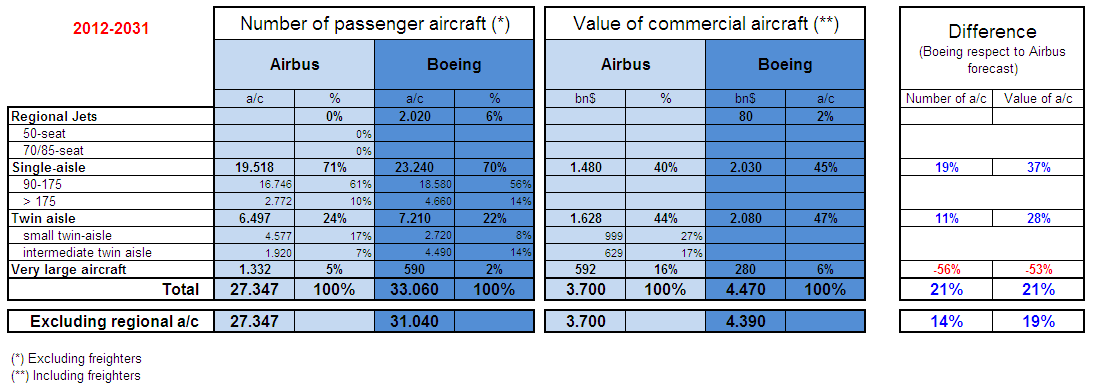
Comparison of Airbus GMF and Boeing CMO 2012-2031.

Some comments about the comparison:

  • Boeing sees demand for 14% more passenger aircraft (excluding regional a/c) with a 19% more value (including freighters).
  • Boeing continues to play down A380 niche potential (56% less a/c than Airbus’ GMF), though for second year in a row it has slightly increased its Very Large market forecast, this time by 20 a/c, or 3.5%.
  • On the other hand, Boeing forecasts about 200 twin-aisle and 4,200 single-aisle more than Airbus, clearly pointing to its point-to-point strategy versus the connecting mega-cities rationale presented by Airbus.
  • In terms of RPKs (“revenue passenger kilometer”), that is, the number of paying passenger by the distance they are transported, they see a similar future: Airbus forecasts for 2031 ~12.8 RPKs (in trillion) (a ~4% increase vs last year GMF) while Boeing forecasts 13.8 (also increased about 3%).

The main changes from last year’s forecasts are:

  • Both manufacturers have increased their passenger aircraft forecast in about 500 a/c, less dramatically than last year’s change.
    • In the case of Airbus it has increased the single aisle segment, probably reflecting the success of the A320neo launch.
    • In the case of Boeing, they decreased both single aisle (130 a/c) and small twin aisle (300 a/c), but increased the intermediate twin-aisle in 900 a/c… selling internally a new version of the 777?
  • Both manufacturers have increased the value of RPKs in 2031.
  • Both manufacturers have increased the volume (trn$) of the market in this 20 years, 12% Airbus (to 3.7trn$) and 10% Boeing (to 4.4trn$).

Some catchy lines for those who have never seen these type of forecasts:

  • Passenger world traffic (RPK) will continue to grow about 4.7% per year (5.0% according to Boeing). This is, doubling every ~15-20 years.
  • Today there are about 15,500 passenger aircraft around the world, this number will more than double in the next 20 years to above 32,500 a/c in 2031.
  • The A380 market equation: Urbanisation + Mega-cities + Wealth = VLAs (Very Large Aircraft, i.e. A380 and B747).
  • Emissions of aviation industry amount to 2% of man-made CO2 emissions.
  • Centre of gravity of world travel will have moved from the Atlantic Ocean (in 1971) to the Middle East (2031).
  • A key driver here is the propensity to fly of the people as the economies of their countries grow. This is captured well by the graphic below, a classic in the industry. This time, Airbus mentioned in the GMF that it has carried out a survey during summer asking 10,000 people around the world whether they expected to fly more in the future. This was true especially in China and India.

Trips per capita vs. GDP per capita (source: Airbus GMF).

Again, I strongly recommend both documents (GMF and CMO) which, differences apart, provide a wealth of information of market dynamics. The complete book from Airbus will be published online next week according to Chris Emerson (SVP for Future Programmes & Market Strategy).

In case you find it tough, to read those kind of booklets, you may take a look at the video of the press conference, a great class on global economy, world aviation, forecasting, trend spotting…

11 Comments

Filed under Aerospace & Defence

Boeing commercial aircraft discounts (update for 2011)

Some weeks ago, Boeing released 2011 results [PDF, 252KB]. The company reported revenues of almost 69bn$477 commercial deliveries and 805 net orders for its commercial aircraft. All these were widely reported by the media and mean a good year for Boeing.

Last years I wrote in some posts what was my estimate of Boeing discounts: the relation between what is announced by the press, what appears in its list prices and sometimes as backlogs and what it is indeed computed into the profit and loss account. In this post I wanted to update, if necessary, the figure I calculated for the average discount of Boeing.

Most of the necessary information can be found in its website. Boeing list prices can be found here.

The number of gross and net orders (after cancellations) year by year can be found here.

Last year deliveries can be found in the report of financial results. From there we can also deduct the figure of Boeing Commercial’s sales of services. That is not directly reported but can be deducted (all Boeing services-related sales are reported as well as Boeing Capital Corporation division and Boeing Defense’s “Global Services & Support” unit)

As in the post of last year:

  • I needed to make one assumption: new orders come with a 3% down payment in the year of the booking, while the remaining cost I assumed that was paid on the year of delivery (for simplicity I didn’t consider more intermediate revenue recognition milestones linked to payments, the 3% figure was taken from the AIAA paper “A Hierarchical Aircraft Life Cycle Cost Analysis Model” by William J. Marx et al.). [1]

Having put all the figures together, the calculation is immediate. Boeing Commercial Aircraft revenues in 2011 (36,2bn$) are the sum of:

  • the discounted prices times the delivered aircraft in the year (including possible penalties from delays),
  • less the down payment of the current year delivered aircraft, as the down payment was included in previous years results,
  • plus the down payment of current year net orders (this year’s this calculation was a bit trickier as it included 737NG deliveries BUT 737 MAX orders),
  • plus services revenues.

The discount figure that minimized errors last year was 41%. Using this figure, the error obtained this year in relation to Boeing Commercial Aircraft reported revenues is 0.1%. That is a little higher discount than previous years (39% for 2010 and 38% for 2009). The only explanation for that would be the built-in penalties for 787 and 747 delays into revenues plus the launch of a new aircraft, 737 MAX.

Thus, the updated discount for Boeing commercial aircraft is 41% (!).

[1] Last year, I received a comment from the analyst Scott Hamilton on the level of downpayments. He mentioned they could reach up to 30%. I tried this time to compute the calculation using that input, but the figures of discounts to be applied each year to minimize errors are not consistent, thus I stayed with the 3% used in the above-mentioned published paper.

6 Comments

Filed under Aerospace & Defence