Tag Archives: deliveries

Boeing 787 orders vs. cancellations

I read yesterday the first article about delays in 787 deliveries in 2013 due to the grounding of the fleet. With the investigation of the batteries issue taking already a month, it was evident that these delays were going to happen.

I have not yet read anything in the specialized or business press about cancellations. However, taking into account that when the 787 program started announcing 3-month delays from Q3 2007, cancellations started to pile, I guess that this time it will not be very different.

I checked the information of orders and cancellations from Boeing website.

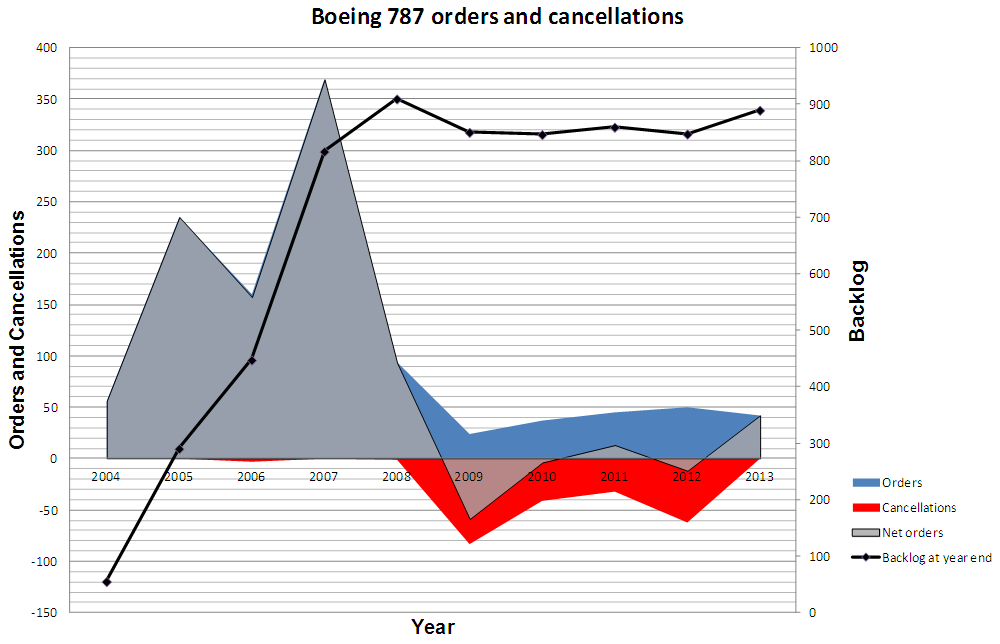
Since 2004, Boeing has received a total of 1,112 787 orders. Out of these, 222 orders were later on cancelled; mostly between 2008 and 2012. Now there are still 890 firm orders (with about 50 of those aircraft already delivered). As a summary, find the graphic below:

Boeing 787 orders and cancellations

Boeing 787 orders and cancellations

1 Comment

Filed under Aerospace & Defence

Boeing commercial aircraft discounts (update for 2010)

Boeing released 2010 results last Wednesday. The company reported revenues in excess of 64bn$, 462 commercial deliveries and 530 net orders for its commercial aircraft. All these were widely reported by the media.

Last year I wrote in one post what was my estimation of Boeing discounts. In this post I wanted to update, if necessary, the figure I calculated for the average discount Boeing applies in its commercial aircraft in relation to the published list prices.

Most of the necessary information can be found in its website. Boeing list prices can be found here. With these list prices, the updated average list price per kg is now ~1,750$ (find the post I wrote last year about this).

The number of gross and net orders (after cancellations) year by year can be found here. Last year deliveries can be found here.

As in the post of last year:

  • I needed to make one assumption: new orders come with a 3% down payment in the year of the booking, while the remaining cost I assumed that was paid on the year of delivery (for simplicity I didn’t consider more intermediate revenue recognition milestones linked to payments, the 3% figure was taken from the AIAA paper “A Hierarchical Aircraft Life Cycle Cost Analysis Model” by William J. Marx et al.).
  • I also needed to estimate the figure Boeing Commercial Aviation Services revenues: the figure I have used is 2.5bn$ [1].

Having put all the figures together, the calculation is immediate. Boeing Commercial Aircraft revenues are the sum of:

  • the discounted prices times the delivered aircraft in the year,
  • less the down payment of the current year delivered aircraft, as the down payment was included in previous years results,
  • plus the down payment of current year net orders,
  • plus services revenues.

The discount figure that minimized errors last year was 38%. Using this figure, the error obtained this year in relation to Boeing Commercial Aircraft reported revenues is 2.8%. A little higher discount would reduce the error; the best estimate is now 39% (being the errors in revenues of: 1.3% for 2010, 1.45% for 2009, 1.7% for 2008 and 1.02% for 2007).

Thus, the updated discount for Boeing commercial aircraft is 39% (!). The price of Boeing aircraft per kg after the discount is then ~1,070$.

***

[1] The error in the estimate of the services revenues is negligible when calculating the magnitude of the discounts: an error of 1bn$ up or down in the figure used affects the error in the estimate of the discount in only 3%; or another way to see it: an error of 1bn$ up or down in the figure used for services would impact the discount value in just 2% to obtain the same error, e.g. 36% instead of 38%.

11 Comments

Filed under Aerospace & Defence

Aircraft discounts and new entrants

Boeing has recently unveiled its latest Current Market Outlook (CMO): a commercial aviation market forecast for the next 20 years. It calls for 30,900 new aircraft deliveries worth 3.6 trillion dollars. Today, I wanted to write about aircraft discounts and the possibility of having new entrants.

Boeing Current Market Outlook.

Both Boeing and Airbus give their market forecast and backlog figures in what they call as list prices. If you take figures from CMO, you will reach average list prices for regional jets (31M$), single-aisle (79M$), twin-aisle (230M$) and large aircraft (306M$). These figures are in accordance to the prices published in their website (dating from 2008).

However, if you take their published numbers of deliveries each year and use the same prices, you would come to much higher revenues figures than the ones they publish in the year-end results: this is because aircraft makers actually sell the planes at a much lower price. How much lower?

Discounts

I took the figures of revenues, orders and deliveries of the last three years and tried to reach what would be the corresponding discount Boeing’s customers manage to get on average.

I assumed that new orders come with a 3% down payment in the year of the booking, while the remaining cost I assumed that was paid on the year of delivery (for simplicity I didn’t consider more intermediate payments, the 3% figure was taken from the AIAA paper “A Hierarchical Aircraft Life Cycle Cost Analysis Model” by William J. Marx et al.). I also used estimated figures for Boeing Commercial Aviation Services ranging from 2.2bn$ to 3.3bn$.

With these assumptions, I concluded that the average discount that would best replicate revenues figures for Boeing Commercial Airplanes with a minimum error was: 38%! (being the errors in revenues of: 0.05% for 2009, 3.2% for 2008 and 0.5% for 2007).

Thus, when figuring out the value of those 30,900 aircraft we could rather estimate it at 2.2 trillion dollars (instead of 3.6 trn$).

New entrants?

Randy Tinseth, BCA’s VP Marketing, was quoted in Flight Global saying that he expected at least one more competitor in the single-aisle segment. If there are more competitors, competition is going to be tight.

Today Boeing Commercial Airplanes and Airbus Commercial yearly revenues together approximately account for 70bn$. If their revenues are to grow with Boeing’s forecasted world airplane fleet growth of 3.3%, along the next 20 years the revenues of both companies combined would amount to 1.94 trillion dollars.

Considering that the whole market, factoring in discounted prices, was going to be 2.2 trn$, this leaves the rest of competitors a share of the pie of about 250bn$ for the next 20 years (excluding regional jets), this is just 11.4% of the market.

If we look at it on a per year basis: 12.5bn$ a year for all new entrants (CSeries, Embraer, MS-21, SSJ, C919, Koreans, Japanese…) would mean about 250 aircraft a year (compared to the ~380-400 single-aisle that each Boeing and Airbus are delivering per year).

There is room for one commercial success comparable to the 737 or A320 family, but there is not room for two… maybe this is why Randy says “one or two of those guys into the mix” (despite of the many more new possible players).

9 Comments

Filed under Aerospace & Defence